section 7 Hyundai Genesis Coupe 2016 s Owner's Guide
[x] Cancel search | Manufacturer: HYUNDAI, Model Year: 2016, Model line: Genesis Coupe, Model: Hyundai Genesis Coupe 2016Pages: 475, PDF Size: 15.71 MB
Page 350 of 475
65
What to do in an emergency
Jump starting procedure
1. Make sure the booster battery is12-volt and that its negative termi-
nal is grounded.
2. If the booster battery is in another vehicle, do not allow the vehicles
to touch.
3. Turn off all unnecessary electrical loads.
4. Connect the jumper cables in the exact sequence shown in the illus-
tration. First connect one end of a
jumper cable to the positive termi-
nal of the discharged battery (1),
then connect the other end to the
positive terminal on the booster
battery (2).
Proceed to connect one end of the
other jumper cable to the negative
terminal of the booster battery (3),
then the other end to a solid, sta-
tionary, metallic point (for example,
the engine lifting bracket) away
from the battery (4). Do not con-
nect it to or near any part that
moves when the engine is cranked.
Do not allow the jumper cables to
contact anything except the correct
battery terminals or the correct
ground. Do not lean over the bat-
tery when making connections. 5. Start the engine of the vehicle with
the booster battery and let it run at
2,000 rpm, then start the engine of
the vehicle with the discharged
battery.
6. After jump start of your vehicle run the vehicle for at least 15 minutes
either at idle or driving the vehicle
before turning off the engine. This
will assure the vehicle can be
started next time after the engine
is shut off.
If the cause of your battery discharg-
ing is not apparent, you should have
your vehicle checked by an author-
ized HYUNDAI dealer.
Push-starting
Your manual transmission-equipped
vehicle should not be push-started
because it might damage the emis-
sion control system.
Vehicles equipped with automatic
transmission cannot be push-started.
Follow the directions in this section
for jump-starting.
WARNING
Never tow a vehicle to start it
because the sudden surge for-
ward when the engine starts
could cause a collision with the
tow vehicle.
CAUTION - Battery cables
Do not connect the jumper cable from the negative terminalof the booster battery to thenegative terminal of the dis-charged battery. This can causethe discharged battery to over-heat and crack, releasing bat-tery acid.
Page 362 of 475
617
What to do in an emergency
If you have a tire gauge, remove the
valve cap and check the air pressure.
If the pressure is lower than recom-
mended, drive slowly to the nearest
service station and inflate to the cor-
rect pressure. If it is too high, adjust
it until it is correct. Always reinstall
the valve cap after checking or
adjusting tire pressure. If the cap is
not replaced, air may leak from the
tire. If you lose a valve cap, buy
another and install it as soon as pos-
sible.
After you have changed wheels,
always secure the flat tire in its place
and return the jack and tools to their
proper storage locations.To prevent the jack, jack handle,
wheel lug nut wrench and spare tire
from rattling while the vehicle is in
motion, store them properly.CAUTION
Your vehicle has metric threads
on the wheel studs and nuts.Make certain during wheelremoval that the same nuts thatwere removed are reinstalled -or, if replaced, that nuts withmetric threads and the samechamfer configuration are used.Installation of a non-metricthread nut on a metric stud orvice-versa will not secure thewheel to the hub properly andwill damage the stud so that itmust be replaced.
Note that most lug nuts do nothave metric threads. Be sure touse extreme care in checkingfor thread style before installingaftermarket lug nuts or wheels.If in doubt, consult an author-ized HYUNDAI dealer.
WARNING- Wheel studs
If the studs are damaged, they
may lose their ability to retain
the wheel. This could lead to the
loss of the wheel and a collision
resulting in serious injuries.
WARNING - Inadequate
spare tire pressure
Check the inflation pressures
as soon as possible after
installing the spare tire. Adjust
it to the specified pressure, if
necessary. Refer to “Tires and
wheels” section 8.
Page 373 of 475
Maintenance
47
MAINTENANCE SERVICES
You should exercise the utmost care
to prevent damage to your vehicle
and injury to yourself whenever per-
forming any maintenance or inspec-
tion procedures.
Should you have any doubts con-
cerning the inspection or servicing of
your vehicle, we strongly recom-
mend that you have an authorized
HYUNDAI dealer perform this work.
An authorized HYUNDAI dealer has
factory-trained technicians and gen-
uine HYUNDAI parts to service your
vehicle properly. For expert advice
and quality service, see an author-
ized HYUNDAI dealer.
Inadequate, incomplete or insuffi-
cient servicing may result in opera-
tional problems with your vehicle that
could lead to vehicle damage, an
accident, or personal injury.Owner’s responsibility
✽ ✽NOTICE
Maintenance Service and Record
Retention are the owner's responsi-
bility.
You should retain documents that
show proper maintenance has been
performed on your vehicle in accor-
dance with the scheduled mainte-
nance service charts shown on the
following pages. You need this infor-
mation to establish your compliance
with the servicing and maintenance
requirements of your vehicle war-
ranties.
Detailed warranty information is pro-
vided in your Owner’s Handbook &
Warranty Information booklet.
Repairs and adjustments required as
a result of improper maintenance or
a lack of required maintenance are
not covered.
We recommend you have your vehi-
cle maintained and repaired by an
authorized HYUNDAI dealer. An
authorized HYUNDAI dealer meets HYUNDAI’s high service quality
standards and receives technical
support from HYUNDAI in order to
provide you with a high level of serv-
ice satisfaction.
Owner maintenance precau-
tions
Improper or incomplete service may
result in problems. This section gives
instructions only for the maintenance
items that are easy to perform.
As explained earlier in this section,
several procedures can be done only
by an authorized HYUNDAI dealer
with special tools.
✽ ✽
NOTICE
Improper owner maintenance dur-
ing the warranty period may affect
warranty coverage. For details, read
the separate Owner’s Handbook &
Warranty Information booklet pro-
vided with the vehicle. If you're
unsure about any servicing or main-
tenance procedure, have it done by
an authorized HYUNDAI dealer.
Page 390 of 475
721
Maintenance
Air cleaner filter
A Genuine HYUNDAI air cleaner fil-
ter is recommended when the filter is
replaced.
Spark plugs
Make sure to install new spark plugs
of the correct heat range.
Valve clearance
Inspect excessive valve noise and/or
engine vibration and adjust if neces-
sary. An authorized HYUNDAI dealer
should perform the operation.
Cooling system
Check cooling system components,
such as radiator, coolant reservoir,
hoses and connections for leakage
and damage. Replace any damaged
parts.
Coolant
The coolant should be changed at
the intervals specified in the mainte-
nance schedule.
Manual transmission fluid
(if equipped)
Inspect the manual transmission
fluid according to the maintenance
schedule.
Automatic transmission fluid
Automatic transmission fluid should
not be checked under normal usage
conditions.
But in severe conditions, the fluid
should be changed at an authorized
HYUNDAI dealer in accordance to
the scheduled maintenance at the
beginning of this chapter.
Brake hoses and lines
Visually check for proper installation,
chafing, cracks, deterioration and
any leakage. Replace any deteriorat-
ed or damaged parts immediately.
CAUTION
The use of a non-specified fluidcould result in transmissionmalfunction and failure.
Use only specified automatictransmission fluid. (Refer to“Recommended lubricants andcapacities” in section 8.)
Page 392 of 475
723
Maintenance
ENGINE OIL
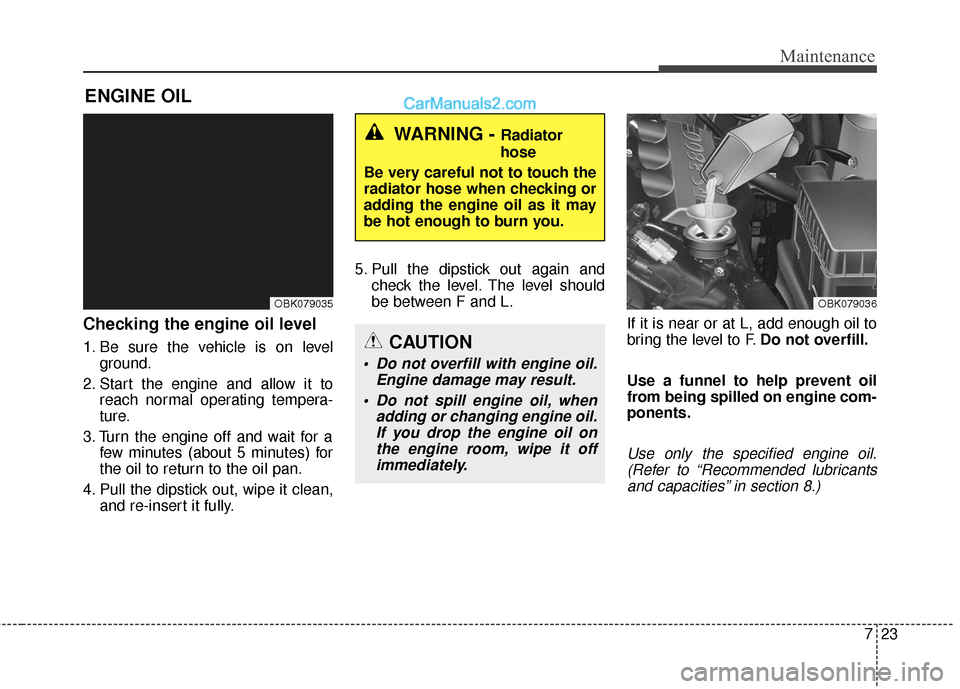
Checking the engine oil level
1. Be sure the vehicle is on levelground.
2. Start the engine and allow it to reach normal operating tempera-
ture.
3. Turn the engine off and wait for a few minutes (about 5 minutes) for
the oil to return to the oil pan.
4. Pull the dipstick out, wipe it clean, and re-insert it fully. 5. Pull the dipstick out again and
check the level. The level should
be between F and L.
If it is near or at L, add enough oil to
bring the level to F.Do not overfill.
Use a funnel to help prevent oil
from being spilled on engine com-
ponents.
Use only the specified engine oil. (Refer to “Recommended lubricantsand capacities” in section 8.)
WARNING - Radiator
hose
Be very careful not to touch the
radiator hose when checking or
adding the engine oil as it may
be hot enough to burn you.
CAUTION
Do not overfill with engine oil. Engine damage may result.
Do not spill engine oil, when adding or changing engine oil.If you drop the engine oil onthe engine room, wipe it offimmediately.
OBK079035OBK079036
Page 393 of 475
Maintenance
24
7
Changing the engine oil and
filter
Have engine oil and filter changed by
an authorized HYUNDAI dealer
according to the Maintenance
Schedule at the beginning of this
section.
CALIFORNIA PROPO-
SITION 65 WARNING
Engine oil contains chemicals
known to the State of California
to cause cancer, birth defects
and reproductive harm. Used
engine oil may cause irritation
or cancer of the skin if left in
contact with the skin for pro-
longed periods of time. Always
protect your skin by washing
your hands thoroughly with
soap and warm water as soon
as possible after handling used
oil.
Page 396 of 475
727
Maintenance
For mixture percentage, refer to the
following table.Changing the coolant
Have coolant changed by an author-
ized HYUNDAI dealer according to
the Maintenance Schedule at the
beginning of this section.
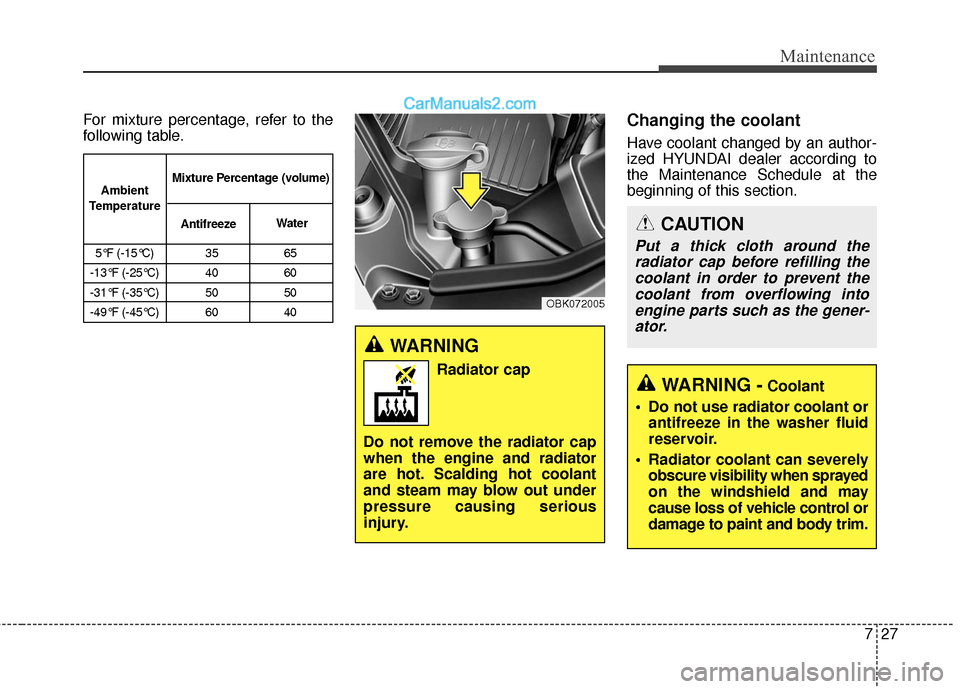
WARNING
Radiator cap
Do not remove the radiator cap
when the engine and radiator
are hot. Scalding hot coolant
and steam may blow out under
pressure causing serious
injury.
CAUTION
Put a thick cloth around the radiator cap before refilling thecoolant in order to prevent thecoolant from overflowing intoengine parts such as the gener-ator.
WARNING -Coolant
Do not use radiator coolant or antifreeze in the washer fluid
reservoir.
Radiator coolant can severely obscure visibility when sprayed
on the windshield and may
cause loss of vehicle control or
damage to paint and body trim.
5°F (-15°C) 35 65
-13°F (-25°C) 40 60
-31°F (-35°C) 50 50
-49°F (-45°C) 60 40
Ambient
Temperature Mixture Percentage (volume)
Antifreeze Water
OBK072005
Page 397 of 475
Maintenance
28
7
BRAKE AND CLUTCH (IF EQUIPPED) FLUID
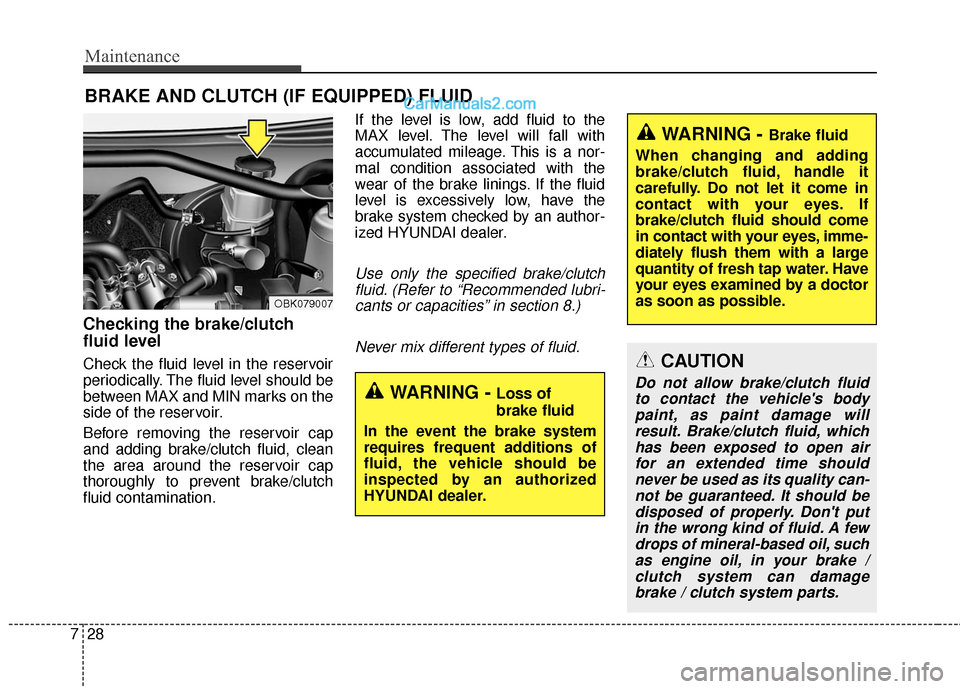
Checking the brake/clutch
fluid level
Check the fluid level in the reservoir
periodically. The fluid level should be
between MAX and MIN marks on the
side of the reservoir.
Before removing the reservoir cap
and adding brake/clutch fluid, clean
the area around the reservoir cap
thoroughly to prevent brake/clutch
fluid contamination. If the level is low, add fluid to the
MAX level. The level will fall with
accumulated mileage. This is a nor-
mal condition associated with the
wear of the brake linings. If the fluid
level is excessively low, have the
brake system checked by an author-
ized HYUNDAI dealer.
Use only the specified brake/clutch
fluid. (Refer to “Recommended lubri-cants or capacities” in section 8.)
Never mix different types of fluid.
WARNING - Brake fluid
When changing and adding
brake/clutch fluid, handle it
carefully. Do not let it come in
contact with your eyes. If
brake/clutch fluid should come
in contact with your eyes, imme-
diately flush them with a large
quantity of fresh tap water. Have
your eyes examined by a doctor
as soon as possible.
WARNING - Loss of
brake fluid
In the event the brake system
requires frequent additions of
fluid, the vehicle should be
inspected by an authorized
HYUNDAI dealer.
OBK079007
CAUTION
Do not allow brake/clutch fluid to contact the vehicle's bodypaint, as paint damage willresult. Brake/clutch fluid, whichhas been exposed to open airfor an extended time shouldnever be used as its quality can-not be guaranteed. It should bedisposed of properly. Don't putin the wrong kind of fluid. A fewdrops of mineral-based oil, suchas engine oil, in your brake /clutch system can damagebrake / clutch system parts.
Page 398 of 475
729
Maintenance
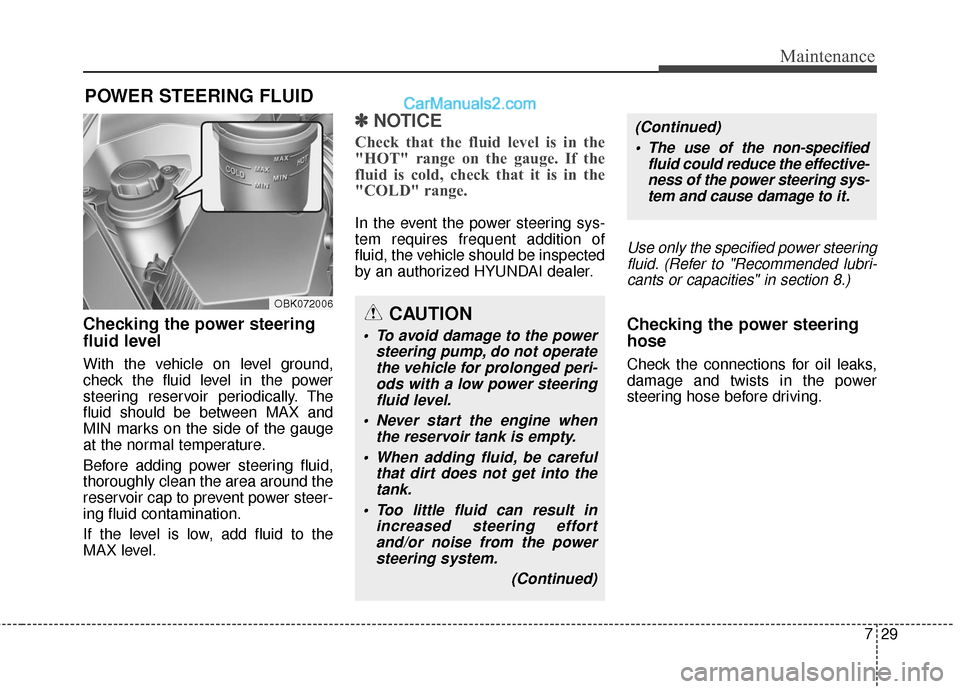
POWER STEERING FLUID
Checking the power steering
fluid level
With the vehicle on level ground,
check the fluid level in the power
steering reservoir periodically. The
fluid should be between MAX and
MIN marks on the side of the gauge
at the normal temperature.
Before adding power steering fluid,
thoroughly clean the area around the
reservoir cap to prevent power steer-
ing fluid contamination.
If the level is low, add fluid to the
MAX level.
✽ ✽NOTICE
Check that the fluid level is in the
"HOT" range on the gauge. If the
fluid is cold, check that it is in the
"COLD" range.
In the event the power steering sys-
tem requires frequent addition of
fluid, the vehicle should be inspected
by an authorized HYUNDAI dealer.
Use only the specified power steering
fluid. (Refer to "Recommended lubri-cants or capacities" in section 8.)
Checking the power steering
hose
Check the connections for oil leaks,
damage and twists in the power
steering hose before driving.
CAUTION
To avoid damage to the power steering pump, do not operatethe vehicle for prolonged peri-ods with a low power steeringfluid level.
Never start the engine when the reservoir tank is empty.
When adding fluid, be careful that dirt does not get into thetank.
Too little fluid can result in increased steering effortand/or noise from the powersteering system.
(Continued)
(Continued) The use of the non-specified fluid could reduce the effective-ness of the power steering sys-tem and cause damage to it.
OBK072006
Page 399 of 475
Maintenance
30
7
It is recommended that the automat-
ic transmission fluid should be
checked or changed at an authorized
HYUNDAI dealer in accordance to
the scheduled maintenance. It is recommended that the manual
transmission fluid should be checked
or changed at an authorized
HYUNDAI dealer in accordance to
the scheduled maintenance.
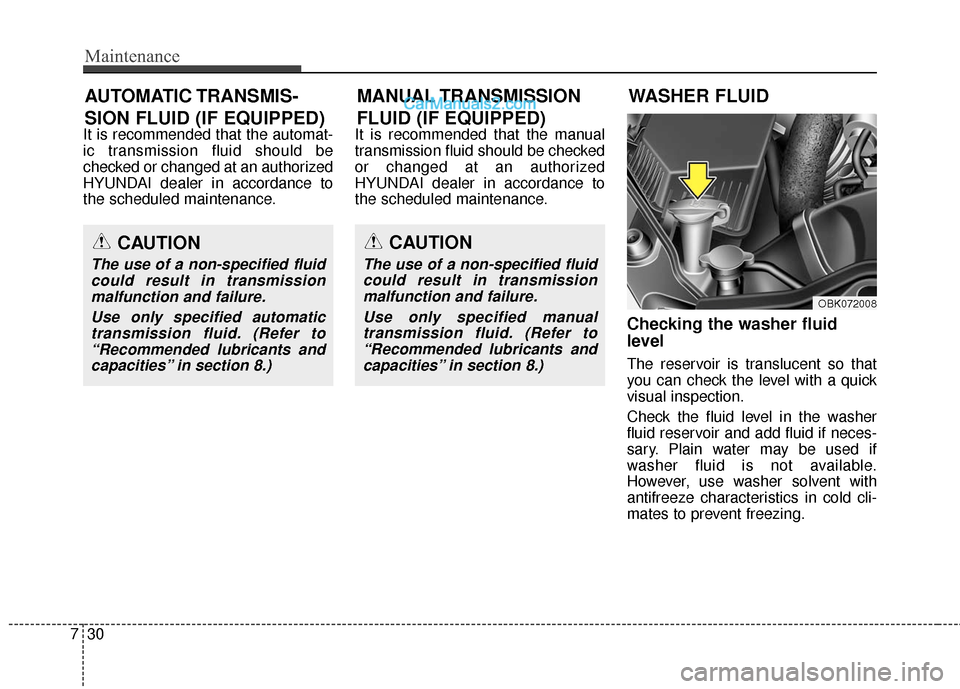
Checking the washer fluid
level
The reservoir is translucent so that
you can check the level with a quick
visual inspection.
Check the fluid level in the washer
fluid reservoir and add fluid if neces-
sary. Plain water may be used if
washer fluid is not available.
However, use washer solvent with
antifreeze characteristics in cold cli-
mates to prevent freezing.
AUTOMATIC TRANSMIS-
SION FLUID (IF EQUIPPED)
MANUAL TRANSMISSION
FLUID (IF EQUIPPED) WASHER FLUID
CAUTION
The use of a non-specified fluid
could result in transmissionmalfunction and failure.
Use only specified automatictransmission fluid. (Refer to“Recommended lubricants andcapacities” in section 8.)
CAUTION
The use of a non-specified fluidcould result in transmissionmalfunction and failure.
Use only specified manualtransmission fluid. (Refer to“Recommended lubricants andcapacities” in section 8.)
OBK072008