child seat HYUNDAI GENESIS G90 2018 User Guide
[x] Cancel search | Manufacturer: HYUNDAI, Model Year: 2018, Model line: GENESIS G90, Model: HYUNDAI GENESIS G90 2018Pages: 538, PDF Size: 13.02 MB
Page 63 of 538
2-43
02
Seat belt use and children
Infant and small children
All 50 states have child restraint laws
which require children to travel in
approved child restraint devices,
including booster seats. The age at
which seat belts can be used instead
of child restraints differs among
states, so you should be aware of the
specific requirements in your state,
and where you are travelling. Infant
and child restraints must be properly
placed and installed in a rear seat.
For more information refer to the
"Child Restraint Systems" section in
this chapter.Small children are best protected
from injury in an accident when prop-
erly restrained in the rear seat by a
child restraint system that meets the
requirements of the Federal Motor
Vehicle Safety Standards. Before
buying any child restraint system,
make sure that it has a label certify-
ing that it meets Federal Motor
Vehicle Safety Standard FMVSS
213. The restraint must be appropri-
ate for your child’s height and weight.
Check the label on the child restraint
for this information. Refer to the
"Child Restraint Systems" section in
this chapter.
ALWAYS properly restrain
infants and small children in a
child restraint appropriate for
the child's height and weight.
To reduce the risk of serious
injury or death to a child and
other passengers, NEVER hold
a child in your lap or arms when
the vehicle is moving. The vio-
lent forces created during an
accident will tear the child from
your arms and throw the child
against the interior of the vehi-
cle.
WARNING
Page 64 of 538
2-44
Safety system of your vehicle
Larger children
Children under age 13 and who are
too large for a booster seat must
always occupy the rear seat and use
the available lap/shoulder belts. A
seat belt should lie across the upper
thighs and be snug across the shoul-
der and chest to restrain the child
safely. Check belt fit periodically.
Children are afforded the most safe-
ty in the event of an accident when
they are restrained by a proper
restraint system and/or seat belts in
the rear seat. Always have the
LATCH system inspected by your
authorized retailer of Genesis
Branded products after an accident.
An accident can damage the LATCH
system and may not properly secure
the child restraint.
If a larger child over age 13 must be
seated in the front seat, the child
must be securely restrained by the
available lap/shoulder belt and the
seat should be placed in the rear-
most position.
If the shoulder belt portion slightly
touches the child's neck or face, try
placing the child closer to the center
of the vehicle. If the shoulder belt still
touches their face or neck they need
to be returned to an appropriate
booster seat in the rear seat.
Transporting an injured person
A seat belt should be used when an
injured person is being transported.
Consult a physician for specific rec-
ommendations.
One person per belt
Two people (including children) should
never attempt to use a single seat belt.
This could increase the severity of
injuries in case of an accident.
Do not lie down
Sitting in a reclined position when the
vehicle is in motion can be dangerous.
Even when buckled up, the protec-
tions of your restraint system (seat
belts and air bags) is greatly reduced
by reclining your seatback.
To reduce the chance of injuries in the
event of an accident and to achieve
the maximum effectiveness of the
restraint system, all passengers
should be sitting up and the front and
rear seats should be in an upright
position when the car is moving.
A seat belt cannot provide proper
protection if the person is lying down
in the rear seat or if the front or rear
seats are in a reclined position.
• Always make sure children
are wearing their seat belts
and that they are properly
adjusted before driving.
• NEVER allow the shoulder
belt to contact the child’s
neck or face.
• Do not allow more than one
child to use a single seat belt.
WARNING
Page 66 of 538
2-46
Safety system of your vehicle
Children Always in the Rear
Children under age 13 must always
ride in the rear seats and must
always be properly restrained to min-
imize the risk of injury in an accident,
sudden stop or sudden maneuver.
According to accident statistics, chil-
dren are safer when properly
restrained in the rear seats than in
the front seat.Even with air bags,
children can be seriously injured
or killed.Children too large for a
child restraint must use the seat belts
provided.
All 50 states have child restraint laws
which require children to travel in
approved child restraint devices. The
laws governing the age or height/
weight restrictions at which seat
belts can be used instead of child
restraints differs among states, so
you should be aware of the specific
requirements in your state, and
where you are travelling.Child restraint systems must be
properly placed and installed in the
rear seat. You must use a commer-
cially available child restraint system
that meets the requirements of the
Federal Motor Vehicle Safety
Standards (FMVSS 213).
Child restraint systems are generally
designed to be secured in a vehicle
seat by lap belt portion of a lap/
shoulder belt, or by a LATCH system
in the rear seats of the vehicle.
Child restraint system (CRS)
Infants and younger children must be
restrained in an appropriate rear-fac-
ing or forward-facing CRS that has
first been properly secured to the
rear seat of the vehicle. Read and
comply with the instructions for
installation and use provided by the
manufacturer of the child restraint.
CHILD RESTRAINT SYSTEM
Always properly restrain chil-
dren in the rear seats of the
vehicle.
Children of all ages are safer
when restrained in the rear seat.
A child riding in the front pas-
senger seat can be forcefully
struck by an inflating air bag
resulting in SERIOUS INJURY
or DEATH.
WARNING
Page 67 of 538
2-47
02
Selecting a Child Restraint
System (CRS)
When selecting a CRS for your child,
always:
• Make sure the CRS has a label
certifying that it meets applicable
Federal Motor Vehicle Safety
Standards (FMVSS 213).
• Select a child restraint based on
your child's height and weight. The
required label or the instructions
for use typically provide this infor-
mation.
• Select a child restraint that fits the
vehicle seating position where it
will be used.
• Read and comply with the warn-
ings and instructions for installation
and use provided with the child
restraint system.
Child restraint system types
There are three main types of child
restraint systems: rearward-facing
seats, forward-facing seats, and
booster seats. They are classified
according to the child’s age, height
and weight.
Rearward-facing child restraints
An improperly secured child
restraint can increase the risk
of SERIOUS INJURY or DEATH
in an accident. Always take the
following precautions when
using a child restraint system:
• NEVER install a child or infant
restraint in the front passen-
ger's seat.
• Always properly secure the
child restraint to a rear seat of
the vehicle.
• Always follow the child
restraint system manufactur-
er's instructions for installa-
tion and use.
• Always properly restrain your
child in the child restraint.
• If the vehicle head restraint
prevents proper installation of
a child seat (as described in
the child restraint system
manual), the head restraint of
the respective seating posi-
tion shall be readjusted or
entirely removed.
• Do not use an infant carrier or
a child safety seat that
"hooks" over a seatback, it
may not provide adequate
protection in an accident.
• After an accident, have retail-
er of Genesis Branded prod-
ucts check the child restraint
system, seat belts, tether
anchors and lower anchors.
WARNING
NEVER install a child or infant
restraint in the front passen-
ger's seat.
Placing a rearward-facing child
restraint in the front seat can
result in SERIOUS INJURY or
DEATH if the child restraint is
struck by an inflating air bag.
WARNING
Page 68 of 538
2-48
Safety system of your vehicle
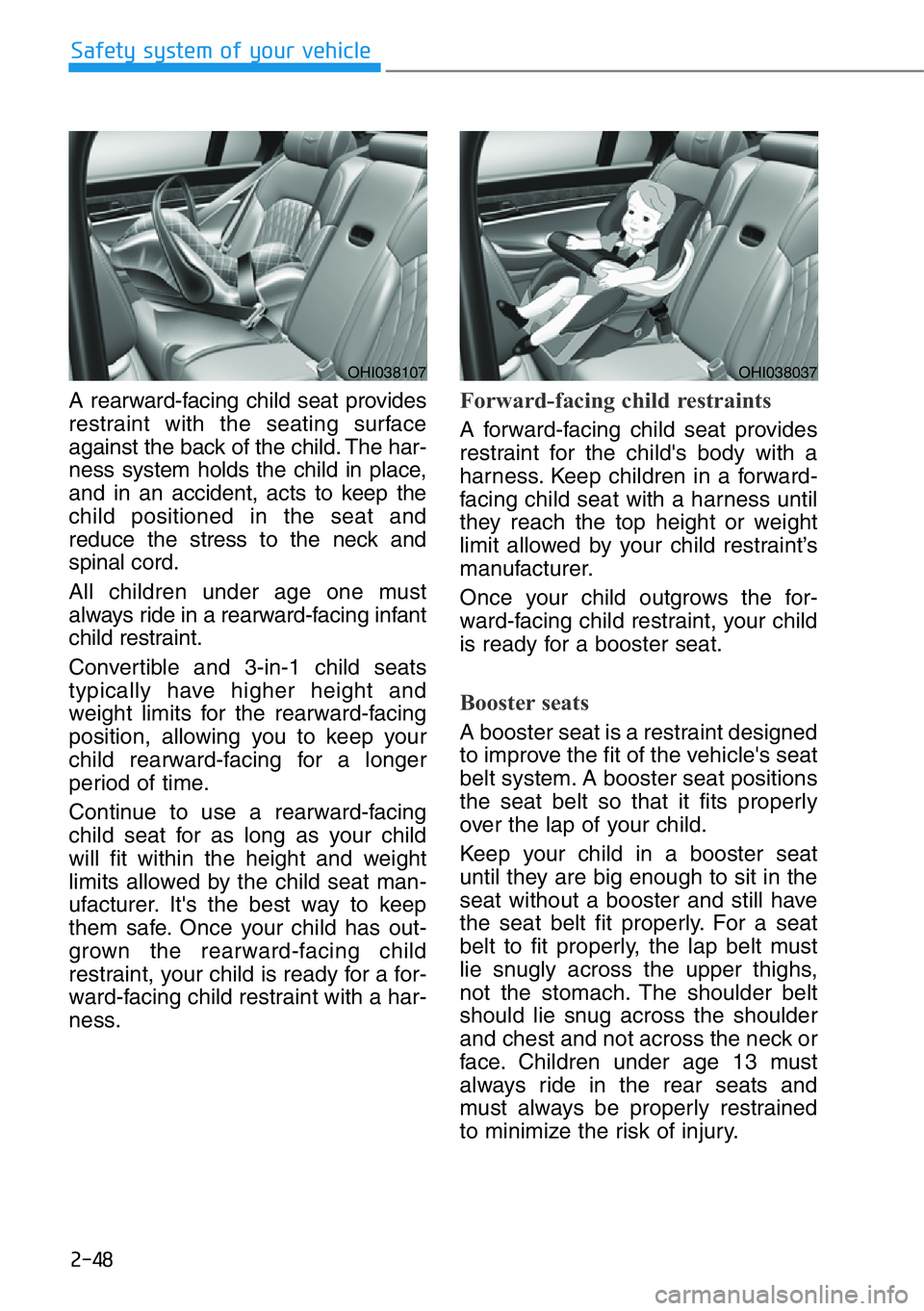
A rearward-facing child seat provides
restraint with the seating surface
against the back of the child. The har-
ness system holds the child in place,
and in an accident, acts to keep the
child positioned in the seat and
reduce the stress to the neck and
spinal cord.
All children under age one must
always ride in a rearward-facing infant
child restraint.
Convertible and 3-in-1 child seats
typically have higher height and
weight limits for the rearward-facing
position, allowing you to keep your
child rearward-facing for a longer
period of time.
Continue to use a rearward-facing
child seat for as long as your child
will fit within the height and weight
limits allowed by the child seat man-
ufacturer. It's the best way to keep
them safe. Once your child has out-
grown the rearward-facing child
restraint, your child is ready for a for-
ward-facing child restraint with a har-
ness.
Forward-facing child restraints
A forward-facing child seat provides
restraint for the child's body with a
harness. Keep children in a forward-
facing child seat with a harness until
they reach the top height or weight
limit allowed by your child restraint’s
manufacturer.
Once your child outgrows the for-
ward-facing child restraint, your child
is ready for a booster seat.
Booster seats
A booster seat is a restraint designed
to improve the fit of the vehicle's seat
belt system. A booster seat positions
the seat belt so that it fits properly
over the lap of your child.
Keep your child in a booster seat
until they are big enough to sit in the
seat without a booster and still have
the seat belt fit properly. For a seat
belt to fit properly, the lap belt must
lie snugly across the upper thighs,
not the stomach. The shoulder belt
should lie snug across the shoulder
and chest and not across the neck or
face. Children under age 13 must
always ride in the rear seats and
must always be properly restrained
to minimize the risk of injury.
OHI038107OHI038037
Page 69 of 538
2-49
02
Installing a Child Restraint
System (CRS)
After selecting a proper child seat for
your child, check to make sure it fits
properly in your vehicle. Follow the
instructions provided by the manu-
facturer when installing the child
seat. Note these general steps when
installing the seat to your vehicle:
•
Properly secure the child restraint
to the vehicle.
All child restraints
must be secured to the vehicle with
the lap part of a lap/shoulder belt or
with the LATCH system.•Make sure the child restraint is
firmly secured.After installing a
child restraint to the vehicle, push
and pull the seat forward-and-back
and side-to-side to verify that it is
securely attached to the seat. A
child restraint secured with a seat
belt should be installed as firmly as
possible. However, some side-to-
side movement can be expected.
•Secure the child in the child
restraint.Make sure the child is
properly strapped in the child
restraint according to the manufac-
turer instructions. Before installing your child
restraint system always:
• Read and follow the instruc-
tions provided by the manu-
facturer of the child restraint.
• Read and follow the instruc-
tions regarding child restraint
systems in this manual.
Failure to follow all warnings
and instructions could increase
the risk of the SERIOUS INJURY
or DEATH if an accident occurs.
WARNING
If the vehicle head restraints
prevents proper installation of a
child seat (as described in the
child seat system manual, the
head restraints of the respec-
tive seating position shall be
readjusted or entirely removed.
WARNING
A child restraint in a closed
vehicle can become very hot. To
prevent burns, check the seat-
ing surface and buckles before
placing your child in the child
restraint.
WARNING
Deactivate the rear switch oper-
ation (RSE LOCKED indicator is
on) when a child occupies a
rear seat.
CAUTION
Page 70 of 538
2-50
Safety system of your vehicle
Do not adjust the seat position
after installing the Child Restraint
System. When the Child Restraint
System is installed, any attempt to
adjust the seat position may dam-
age either the seat belt system or
the Child Restraint System.
Information
When installing the Child Restraint
System, the rear power adjustment
seat must be adjusted to the rearmost
position.
Lower Anchors and Tether for
Children (LATCH System)
The LATCH system holds a child
restraint during driving and in an
accident. This system is designed to
make installation of the child restraint
easier and reduce the possibility of
improperly installing your child
restraint. The LATCH system uses
anchors in the vehicle and attach-
ments on the child restraint. The
LATCH system eliminates the need
to use seat belts to secure the child
restraint to the rear seats.
Lower anchors are metal bars built
into the vehicle. There are two lower
anchors for each LATCH seating
position that will accommodate a
child restraint with lower attach-
ments.
To use the LATCH system in your
vehicle, you must have a child
restraint with LATCH attachments.
The child seat manufacturer will pro-
vide you with instructions on how to
use the child seat with its attachments
for the LATCH lower anchors.
i
NOTICE
Page 71 of 538
2-51
02
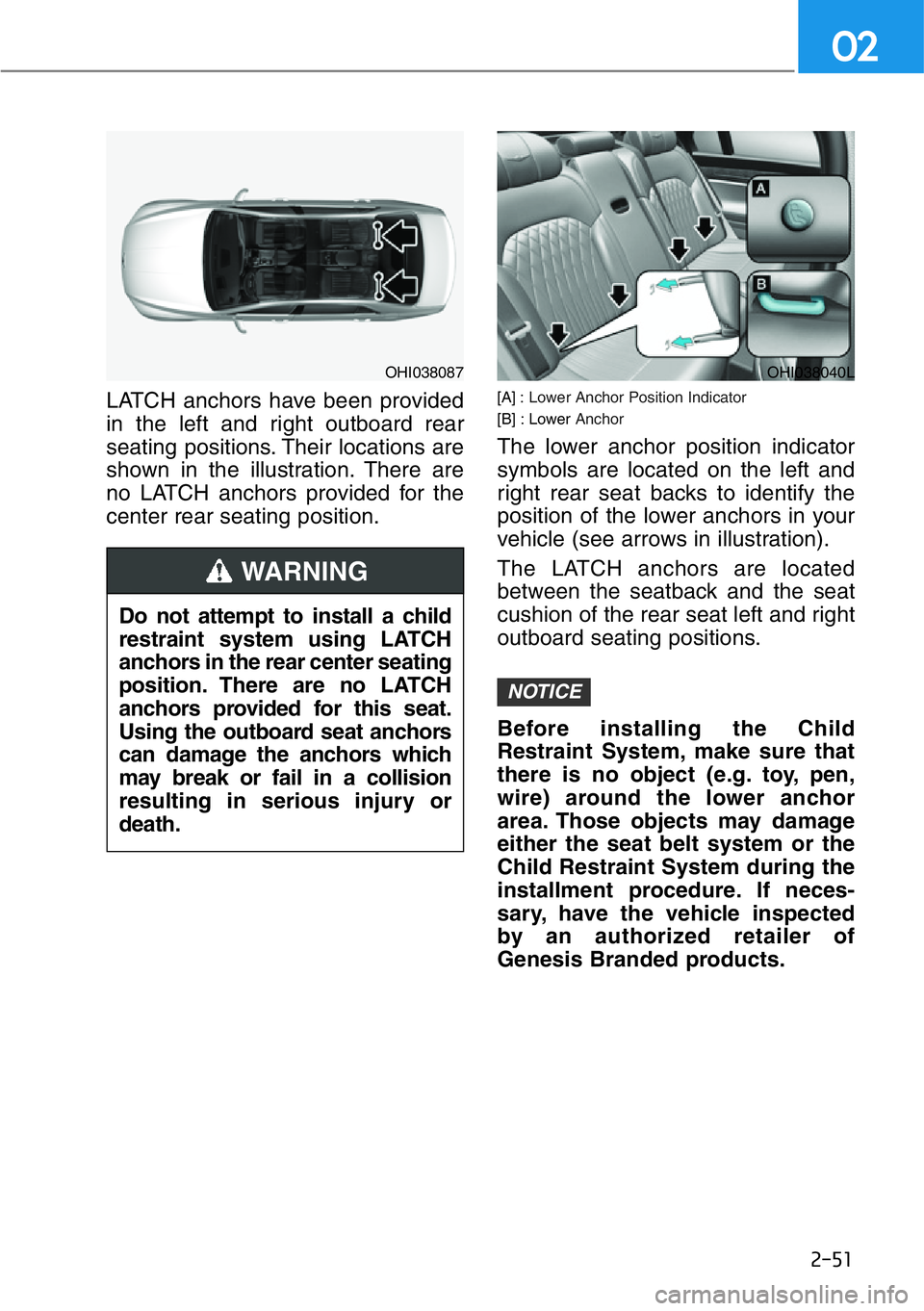
LATCH anchors have been provided
in the left and right outboard rear
seating positions. Their locations are
shown in the illustration. There are
no LATCH anchors provided for the
center rear seating position.[A] : Lower Anchor Position Indicator
[B] : Lower Anchor
The lower anchor position indicator
symbols are located on the left and
right rear seat backs to identify the
position of the lower anchors in your
vehicle (see arrows in illustration).
The LATCH anchors are located
between the seatback and the seat
cushion of the rear seat left and right
outboard seating positions.
Before installing the Child
Restraint System, make sure that
there is no object (e.g. toy, pen,
wire) around the lower anchor
area. Those objects may damage
either the seat belt system or the
Child Restraint System during the
installment procedure. If neces-
sary, have the vehicle inspected
by an authorized retailer of
Genesis Branded products.
NOTICE
OHI038087
Do not attempt to install a child
restraint system using LATCH
anchors in the rear center seating
position. There are no LATCH
anchors provided for this seat.
Using the outboard seat anchors
can damage the anchors which
may break or fail in a collision
resulting in serious injury or
death.
WARNING
OHI038040L
Page 72 of 538
2-52
Safety system of your vehicle
Securing a child restraint with
the LATCH anchors system
To install a LATCH-compatible child
restraint in either of the rear outboard
seating positions:
1. Move the seat belt buckle away
from the lower anchors.
2. Move any other objects away from
the anchors that could prevent a
secure connection between the
child restraint and the lower
anchors.
3. Place the child restraint on the
vehicle seat, then attach the seat
to the lower anchors according to
the instructions provided by the
child restraint manufacturer.
4. Follow the child restraint instruc-
tions for properly adjusting and
tightening the lower attachments
on the child restraint to the lower
anchors.
The recommended weight for the
LATCH system is under 65 lb (30
kg).
How to determine an appropriate
child restraint weight:
Child weight + Child restraint
weight < 65 lb (30kg)
NOTICE
Take the following precautions
when using the LATCH system:
• Read and follow all installa-
tion instructions provided
with your child restraint sys-
tem.
• To prevent the child from
reaching and taking hold of
unretracted seat belts, buckle
all unused rear seat belts and
retract the seat belt webbing
behind the child. Children can
be strangled if a shoulder belt
becomes wrapped around
their neck and the seat belt
tightens.
• NEVER attach more than one
child restraint to a single
anchor. This could cause the
anchor or attachment to come
loose or break.
• Always have the LATCH sys-
tem inspected by your author-
ized retailer of Genesis
Branded products after an
accident. An accident can
damage the LATCH system
and may not properly secure
the child restraint.
WARNING
Page 73 of 538
2-53
02
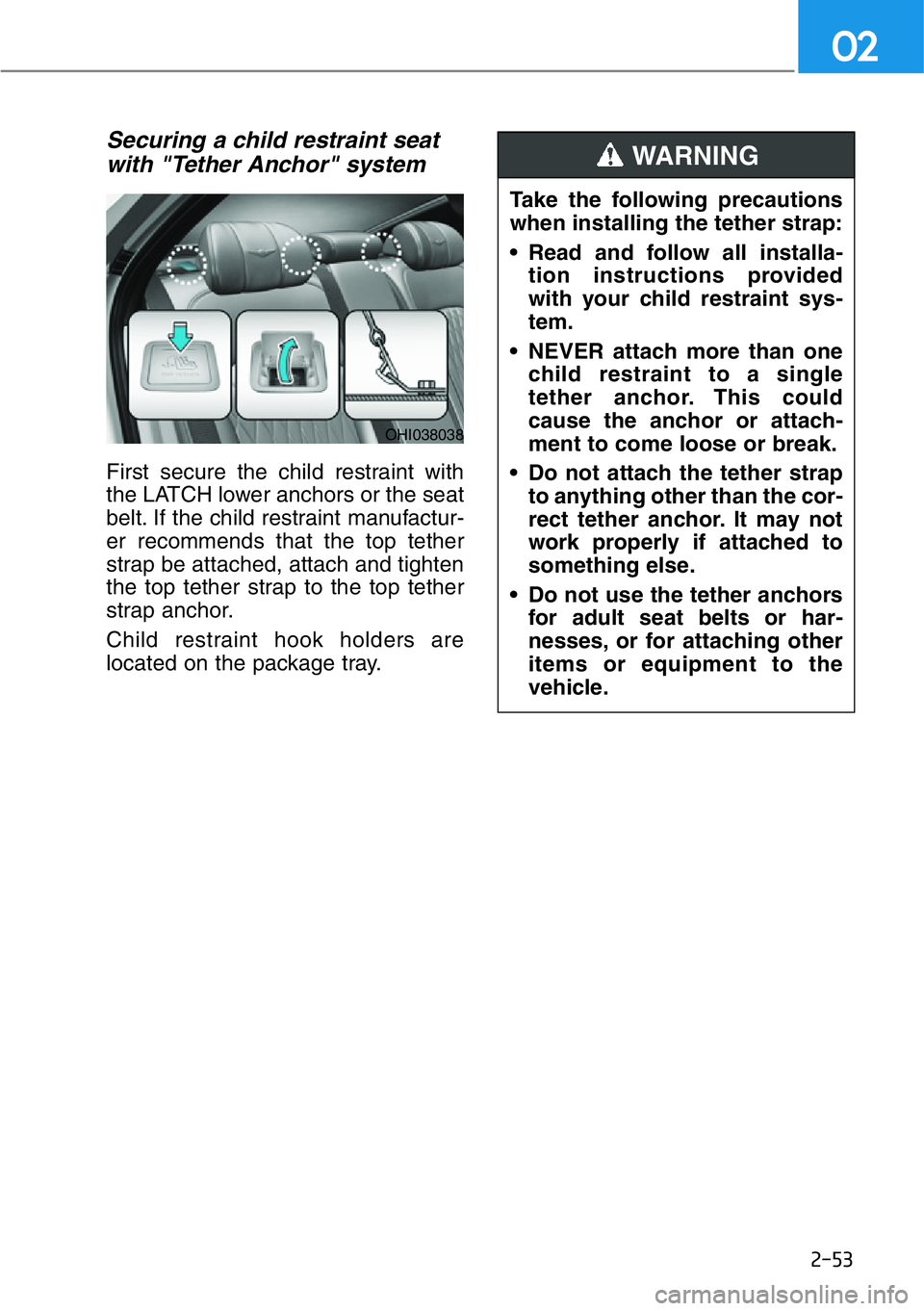
Securing a child restraint seat
with "Tether Anchor" system
First secure the child restraint with
the LATCH lower anchors or the seat
belt. If the child restraint manufactur-
er recommends that the top tether
strap be attached, attach and tighten
the top tether strap to the top tether
strap anchor.
Child restraint hook holders are
located on the package tray.
OHI038038
Take the following precautions
when installing the tether strap:
• Read and follow all installa-
tion instructions provided
with your child restraint sys-
tem.
• NEVER attach more than one
child restraint to a single
tether anchor. This could
cause the anchor or attach-
ment to come loose or break.
• Do not attach the tether strap
to anything other than the cor-
rect tether anchor. It may not
work properly if attached to
something else.
• Do not use the tether anchors
for adult seat belts or har-
nesses, or for attaching other
items or equipment to the
vehicle.
WARNING