transmission HYUNDAI GENESIS G90 2019 Owner's Manual
[x] Cancel search | Manufacturer: HYUNDAI, Model Year: 2019, Model line: GENESIS G90, Model: HYUNDAI GENESIS G90 2019Pages: 538, PDF Size: 13.02 MB
Page 435 of 538
6-21
06
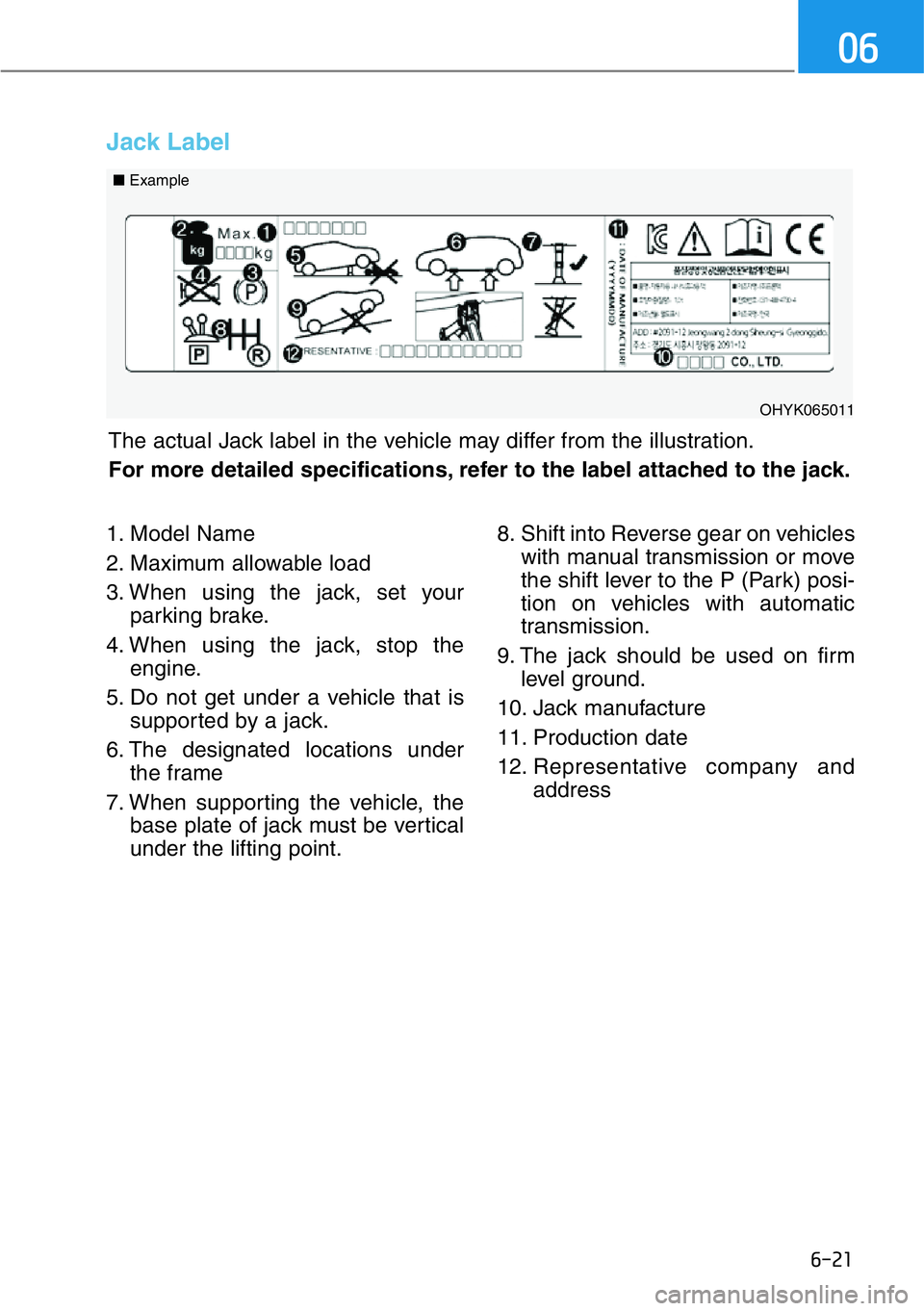
1. Model Name
2. Maximum allowable load
3. When using the jack, set your
parking brake.
4. When using the jack, stop the
engine.
5. Do not get under a vehicle that is
supported by a jack.
6. The designated locations under
the frame
7. When supporting the vehicle, the
base plate of jack must be vertical
under the lifting point.8. Shift into Reverse gear on vehicles
with manual transmission or move
the shift lever to the P (Park) posi-
tion on vehicles with automatic
transmission.
9. The jack should be used on firm
level ground.
10. Jack manufacture
11. Production date
12. Representative company and
address The actual Jack label in the vehicle may differ from the illustration.
For more detailed specifications, refer to the label attached to the jack.
Jack Label
OHYK065011 ■Example
Page 436 of 538
6-22
What to do in an emergency
Towing Service
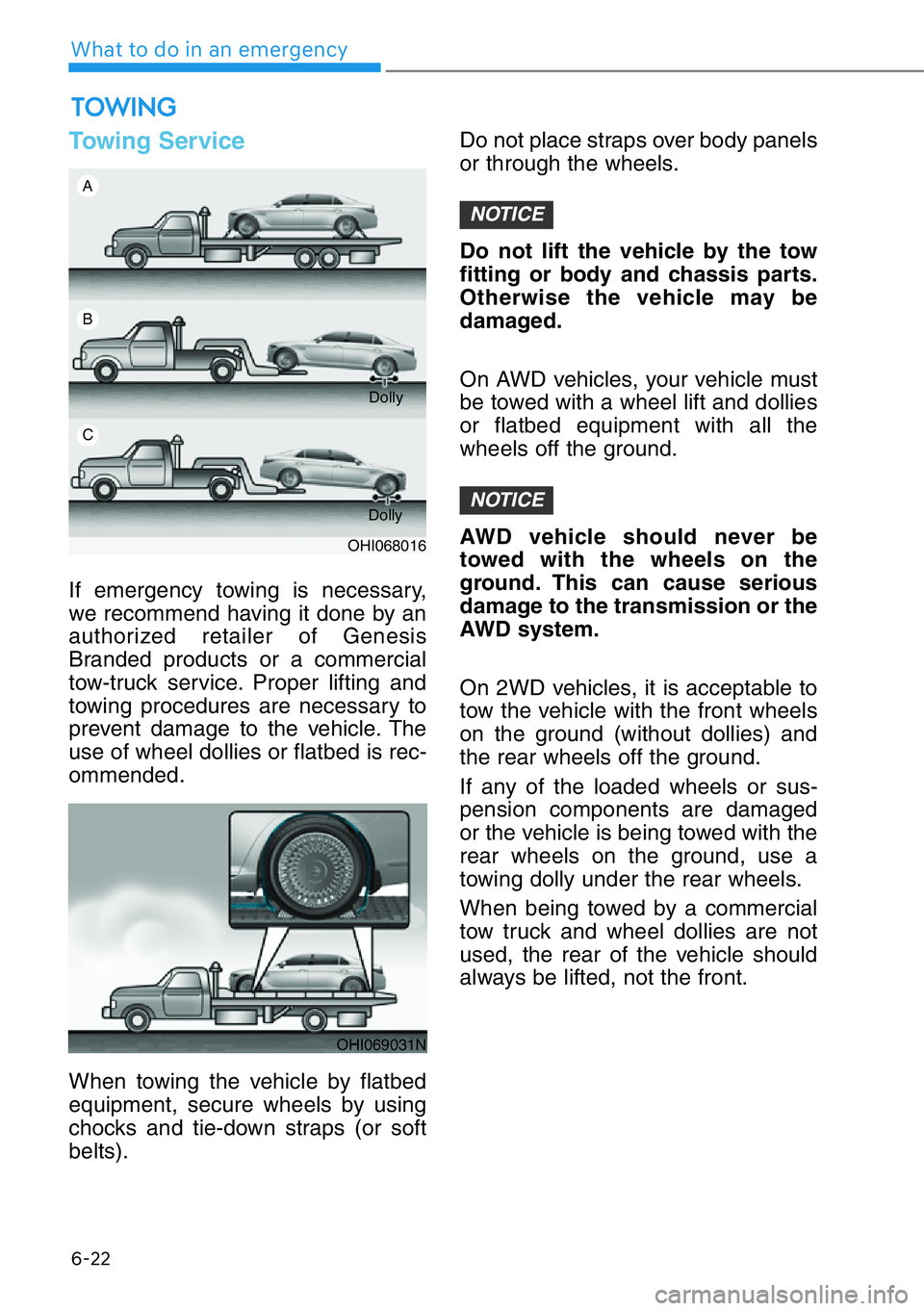
If emergency towing is necessary,
we recommend having it done by an
authorized retailer of Genesis
Branded products or a commercial
tow-truck service. Proper lifting and
towing procedures are necessary to
prevent damage to the vehicle. The
use of wheel dollies or flatbed is rec-
ommended.
When towing the vehicle by flatbed
equipment, secure wheels by using
chocks and tie-down straps (or soft
belts).Do not place straps over body panels
or through the wheels.
Do not lift the vehicle by the tow
fitting or body and chassis parts.
Otherwise the vehicle may be
damaged.
On AWD vehicles, your vehicle must
be towed with a wheel lift and dollies
or flatbed equipment with all the
wheels off the ground.
AWD vehicle should never be
towed with the wheels on the
ground. This can cause serious
damage to the transmission or the
AWD system.
On 2WD vehicles, it is acceptable to
tow the vehicle with the front wheels
on the ground (without dollies) and
the rear wheels off the ground.
If any of the loaded wheels or sus-
pension components are damaged
or the vehicle is being towed with the
rear wheels on the ground, use a
towing dolly under the rear wheels.
When being towed by a commercial
tow truck and wheel dollies are not
used, the rear of the vehicle should
always be lifted, not the front.
NOTICE
NOTICE
TOWING
OHI068016Dolly
Dolly
A
B
C
OHI069031N
Page 437 of 538
6-23
06
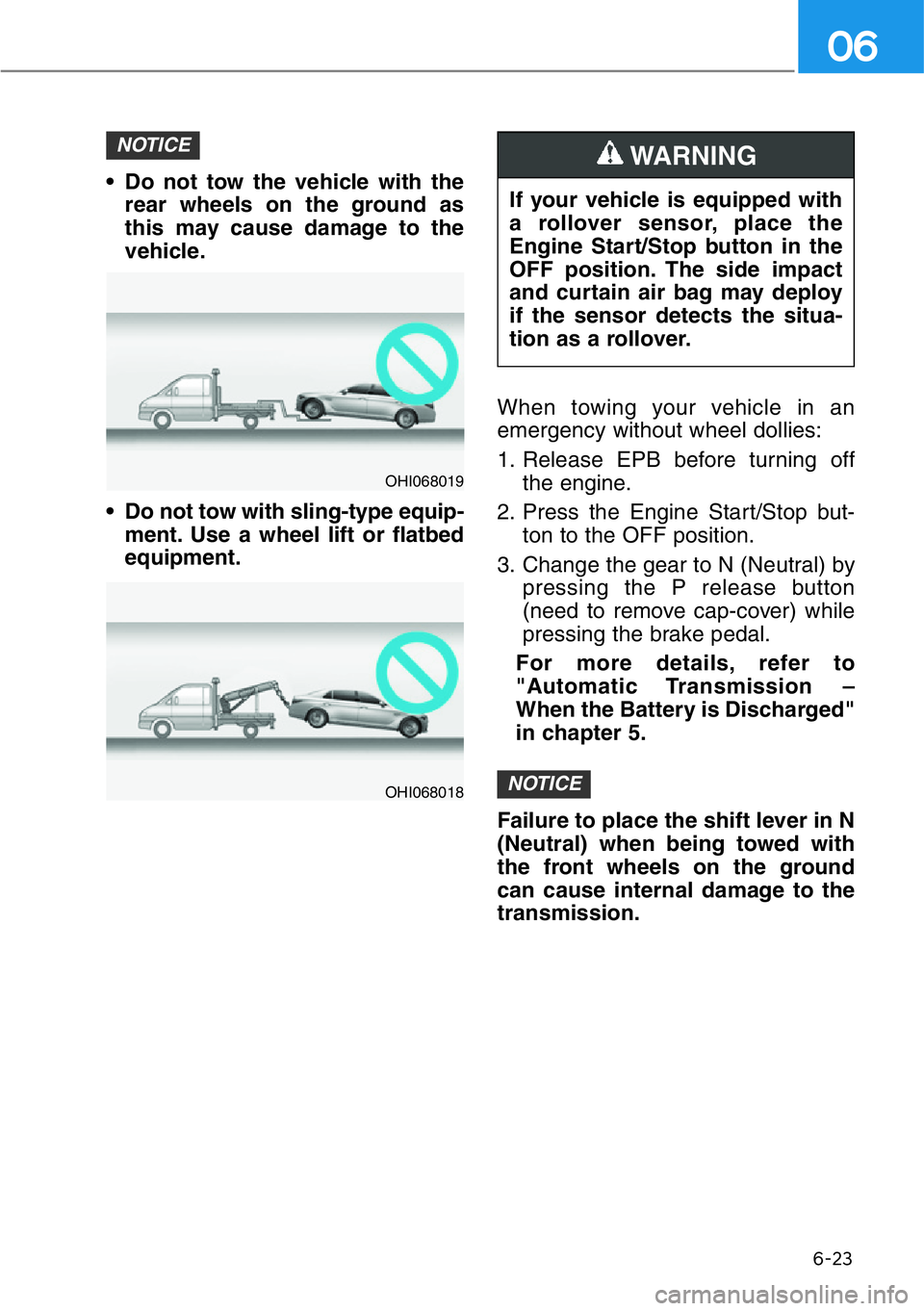
• Do not tow the vehicle with the
rear wheels on the ground as
this may cause damage to the
vehicle.
• Do not tow with sling-type equip-
ment. Use a wheel lift or flatbed
equipment.When towing your vehicle in an
emergency without wheel dollies:
1. Release EPB before turning off
the engine.
2. Press the Engine Start/Stop but-
ton to the OFF position.
3. Change the gear to N (Neutral) by
pressing the P release button
(need to remove cap-cover) while
pressing the brake pedal.
For more details, refer to
"Automatic Transmission –
When the Battery is Discharged"
in chapter 5.
Failure to place the shift lever in N
(Neutral) when being towed with
the front wheels on the ground
can cause internal damage to the
transmission.
NOTICE
NOTICE
If your vehicle is equipped with
a rollover sensor, place the
Engine Start/Stop button in the
OFF position. The side impact
and curtain air bag may deploy
if the sensor detects the situa-
tion as a rollover.
WARNING
OHI068019
OHI068018
Page 439 of 538
6-25
06
Always follow these emergency tow-
ing precautions:
• Place the shift lever in N (Neutral).
• Release the parking brake.
• Depress the brake pedal with more
force than normal as you will have
reduced braking performance.
• More steering effort will be
required because the power steer-
ing system will be disabled.
• Use a vehicle heavier than your
own to tow your vehicle.
• The drivers of both vehicles should
communicate with each other fre-
quently.
• Before emergency towing, check
that the hook is not broken or dam-
aged.
• Fasten the towing cable or chain
securely to the hook.
• Do not jerk the hook. Apply steady
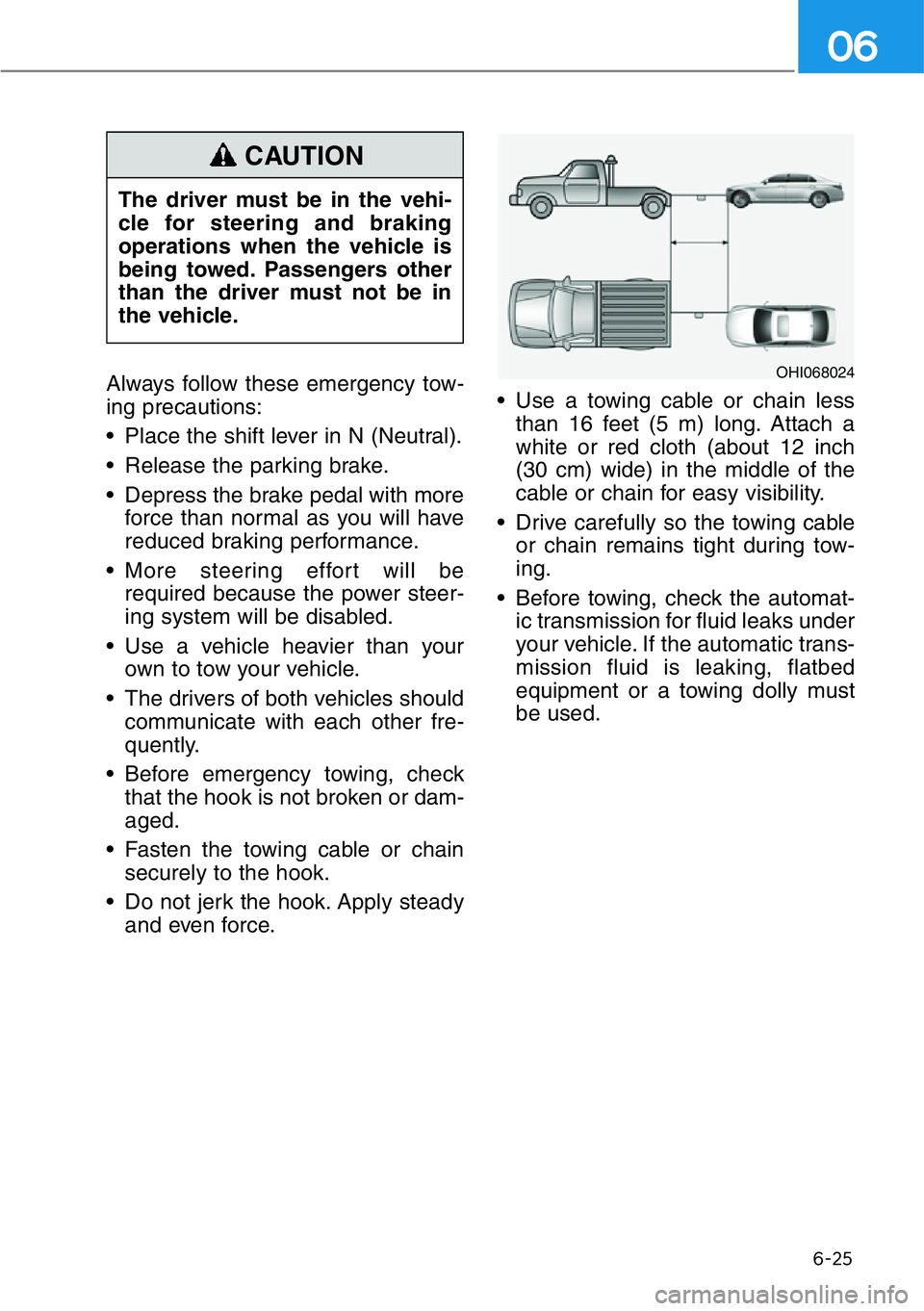
and even force.• Use a towing cable or chain less
than 16 feet (5 m) long. Attach a
white or red cloth (about 12 inch
(30 cm) wide) in the middle of the
cable or chain for easy visibility.
• Drive carefully so the towing cable
or chain remains tight during tow-
ing.
• Before towing, check the automat-
ic transmission for fluid leaks under
your vehicle. If the automatic trans-
mission fluid is leaking, flatbed
equipment or a towing dolly must
be used.OHI068024
The driver must be in the vehi-
cle for steering and braking
operations when the vehicle is
being towed. Passengers other
than the driver must not be in
the vehicle.
CAUTION
Page 440 of 538
6-26
What to do in an emergency
Accelerate or decelerate the vehi-
cle in a slow and gradual manner
while maintaining tension on the
tow rope or chain to start or drive
the vehicle, otherwise tow hooks
and the vehicle may be damaged.
To avoid damage to your vehicle
and vehicle components when
towing:
• Always pull straight ahead when
using the towing hooks. Do not
pull from the side or at a vertical
angle.
• Do not use the towing hooks to
pull a vehicle out of mud, sand
or other conditions from which
the vehicle cannot be driven out
under its own power.
• Limit the vehicle speed to
10 mph (15 km/h) and drive less
than 1 mile (1.5 km) when towing
to avoid serious damage to the
automatic transmission.
NOTICE
NOTICE
Page 447 of 538
7-7
07
Owner Maintenance Schedule
When you stop for fuel:
• Check the engine oil level.
• Check the coolant level in the
engine coolant reservoir.
• Check the windshield washer fluid
level.
• Check the tire for low or under-
inflated tires.
While operating your vehicle:
• Note any changes in the sound of
the exhaust or any smell of exhaust
fumes in the vehicle.
• Check for vibrations in the steering
wheel. Notice if there is any
increased steering effort or loose-
ness in the steering wheel, or
change in its straight-ahead posi-
tion.
• Notice if your vehicle constantly
turns slightly or "pulls" to one side
when traveling on smooth, level
road.
• When stopping, listen and check
for unusual sounds, pulling to one
side, increased brake pedal travel
or "hard-to-push" brake pedal.
• If any slipping or changes in the
operation of your transmission
occurs, check the transmission
fluid level.
• Check the automatic transmission
P (Park) function.
• Check the parking brake.
• Check for fluid leaks under your
vehicle (water dripping from the air
conditioning system during or after
use is normal).
At least monthly:
• Check coolant level in the engine
coolant reservoir.
• Check the operation of all exterior
lights, including the brake lights,
turn signals and hazard warning
flashers.
• Check the inflation pressures of all
tires including the spare for tires
that are worn, show uneven wear,
or are damaged.
• Check for loose wheel lug nuts. Be careful when checking your
engine coolant level when the
engine is hot. This may result in
coolant being blown out of the
opening and cause serious
burns and other injuries.
WARNING
Page 448 of 538
7-8
Maintenance
At least twice a year:
(i.e., every Spring and Autumn)
• Check radiator, heater and air con-
ditioning hoses for leaks or dam-
age.
• Check windshield washer spray
and wiper operation. Clean wiper
blades with a clean cloth damp-
ened with washer fluid.
• Check headlamp alignment.
• Check muffler, exhaust pipes,
shields and clamps.
• Check the seat belts for wear and
function.
At least once a year:
• Clean body and door drain holes.
• Lubricate door hinges and hood
hinges.
• Lubricate door and hood locks and
latches.
• Lubricate door rubber weather
strips.
• Lubricate door checker.
• Check the air conditioning system.
• Inspect and lubricate automatic
transmission linkage and controls.
• Clean the battery and terminals.
• Check the brake fluid level.Follow Normal Maintenance Schedule
if the vehicle is usually operated where
none of the following conditions apply.
If any of the following conditions apply,
you must follow the Maintenance
Under Severe Usage Conditions.
• Repeated driving short distance of
less than 5 miles (8 km) in normal
temperature or less than 10miles
(16 km) in freezing temperature
• Extensive engine idling or low
speed driving for long distances
• Driving on rough, dusty, muddy,
unpaved, graveled or salt-spread
roads
• Driving in areas using salt or other
corrosive materials or in very cold
weather
• Driving in heavy dust conditions
• Driving in heavy traffic area
• Driving on uphill, downhill, or
mountain road repeatedly
• Towing a trailer or using a camper,
or roof rack
• Driving as a patrol car, taxi, other
commercial use of vehicle towing
• Frequently driving in stop-and-go
condition
For additional information or assis-
tance see an authorized retailer of
Genesis Branded products.
SCHEDULED MAINTENANCE
SERVICE
Page 451 of 538
7-11
07
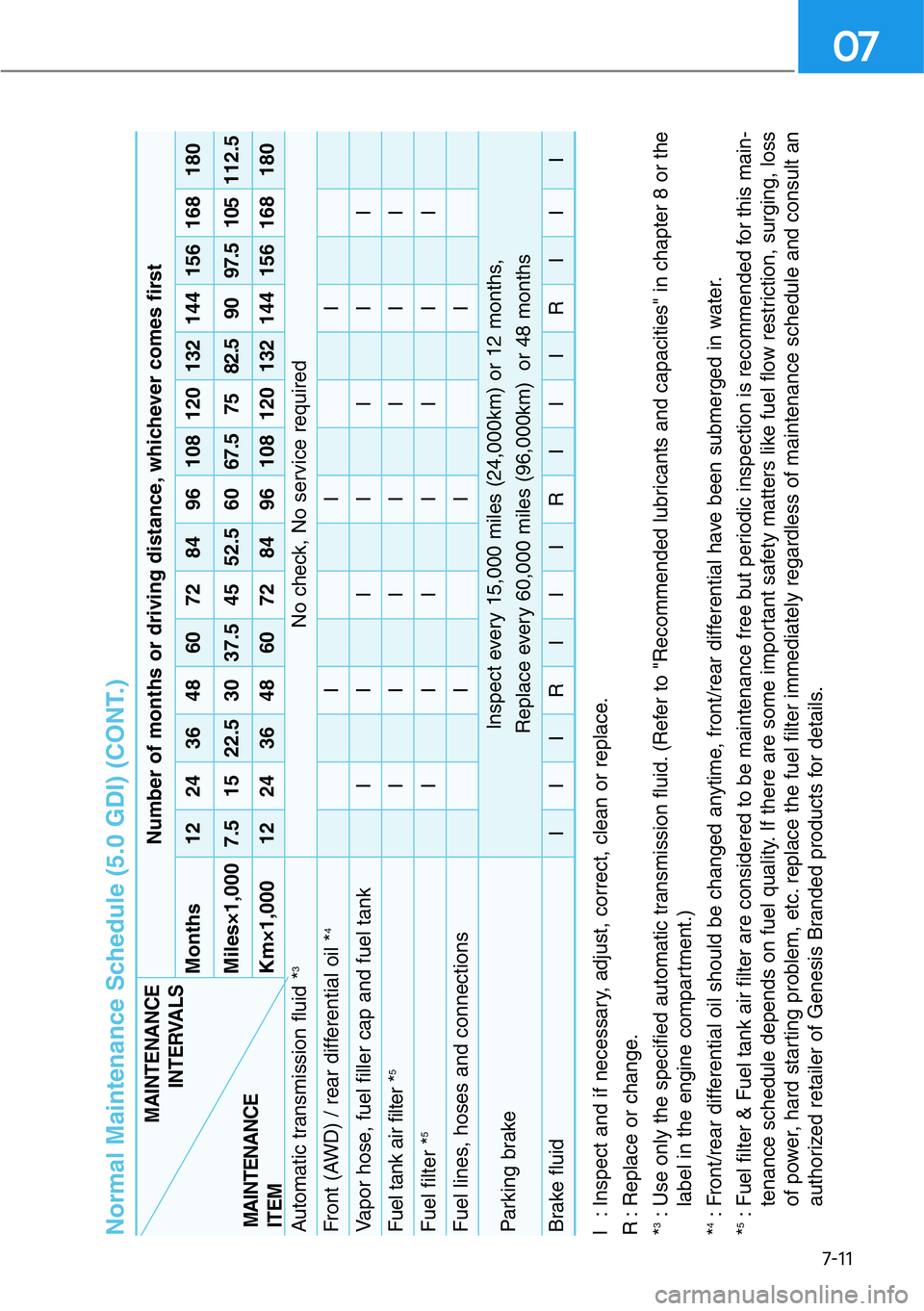
Normal Maintenance Schedule (5.0 GDI) (CONT.)I : Inspect and if necessary, adjust, correct, clean or replace.
R : Replace or change.
*3: Use only the specified automatic transmission fluid. (Refer to "Recommended lubricants and capacities" in chapter 8 or the
label in the engine compartment.)
*4: Front/rear differential oil should be changed anytime, front/rear differential have been submerged in water.
*5: Fuel filter & Fuel tank air filter are considered to be maintenance free but periodic inspection is recommended for this main-
tenance schedule depends on fuel quality. If there are some important safety matters like fuel flow restriction, surging, loss
of power, hard starting problem, etc. replace the fuel filter immediately regardless of maintenance schedule and consult an
authorized retailer of Genesis Branded products for details.
Number of months or driving distance, whichever comes first
180112.5180
No check, No service required
lnspect every 15,000 miles (24,000km) or 12 months,
Replace every 60,000 miles (96,000km) or 48 months
I
168105168IIII
15697.5156I
14490144IIIIIR
13282.5132I
12075120IIII
10867.5108I
966096IIIIIR
8452.584I
724572IIII
6037.560I
483048IIIIIR
3622.536I
241524IIII
127.512I
MonthsMiles×1,000Km×1,000
Automatic transmission fluid *
3
Front (AWD) / rear differential oil *
4
Vapor hose, fuel filler cap and fuel tankFuel tank air filter *
5
Fuel filter *
5
Fuel lines, hoses and connectionsParking brakeBrake fluid
MAINTENANCE
INTERVALS
MAINTENANCE
ITEM
Page 452 of 538
7-12
Maintenance
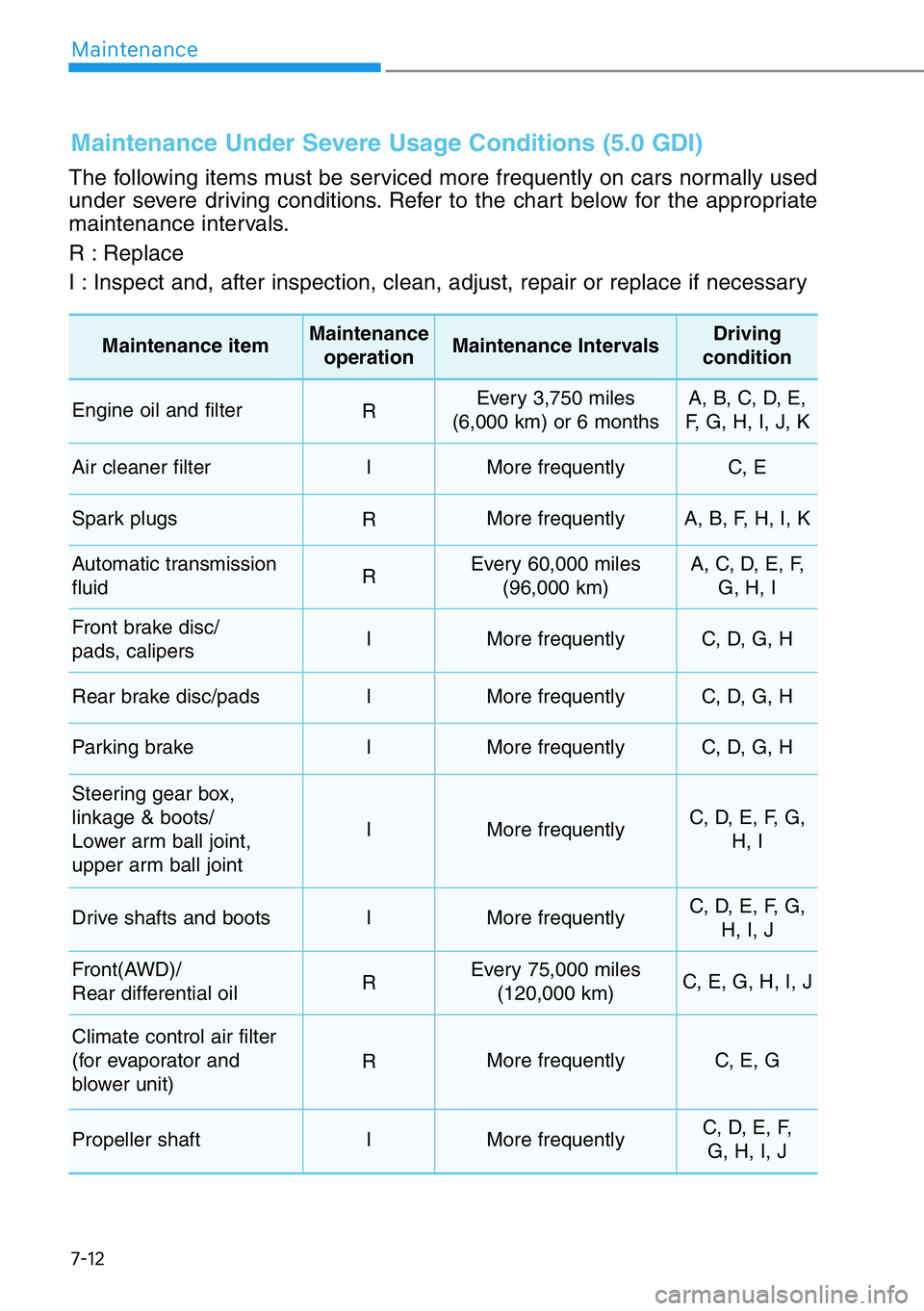
The following items must be serviced more frequently on cars normally used
under severe driving conditions. Refer to the chart below for the appropriate
maintenance intervals.
R : Replace
I : Inspect and, after inspection, clean, adjust, repair or replace if necessary
Maintenance Under Severe Usage Conditions (5.0 GDI)
Maintenance itemMaintenance
operationMaintenance IntervalsDriving
condition
Engine oil and filterREvery 3,750 miles
(6,000 km) or 6 monthsA, B, C, D, E,
F, G, H, I, J, K
Air cleaner filterIMore frequentlyC, E
Spark plugs RMore frequentlyA, B, F, H, I, K
Automatic transmission
fluidREvery 60,000 miles
(96,000 km) A, C, D, E, F,
G, H, I
Front brake disc/
pads, calipersIMore frequentlyC, D, G, H
Rear brake disc/padsIMore frequentlyC, D, G, H
Parking brakeIMore frequentlyC, D, G, H
Steering gear box,
linkage & boots/
Lower arm ball joint,
upper arm ball joint
IMore frequentlyC, D, E, F, G,
H, I
Drive shafts and bootsIMore frequentlyC, D, E, F, G,
H, I, J
Front(AWD)/
Rear differential oilREvery 75,000 miles
(120,000 km)C, E, G, H, I, J
Climate control air filter
(for evaporator and
blower unit)
RMore frequentlyC, E, G
Propeller shaftIMore frequentlyC, D, E, F,
G, H, I, J
Page 456 of 538
7-16
Maintenance
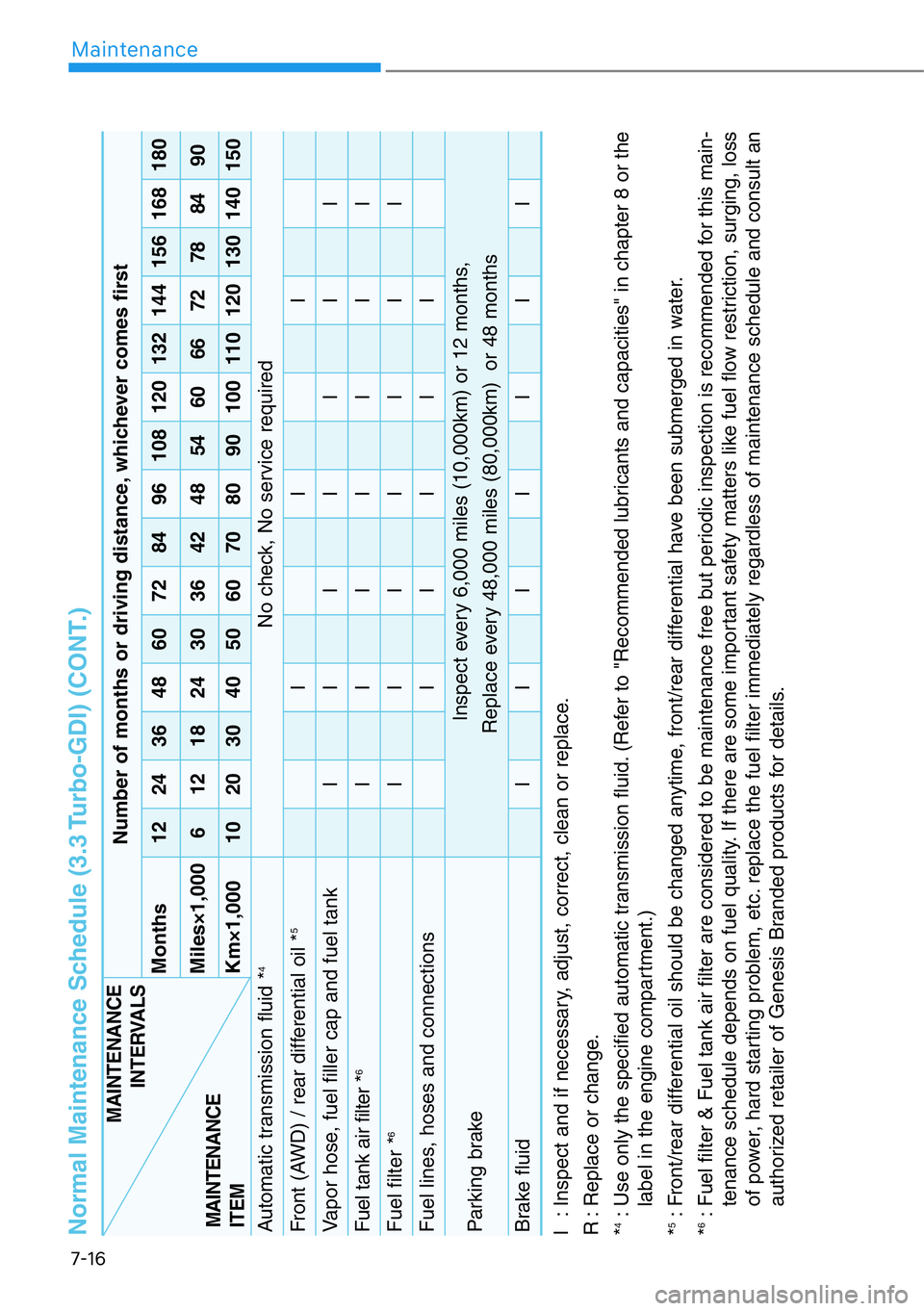
Normal Maintenance Schedule (3.3 Turbo-GDI) (CONT.)I : Inspect and if necessary, adjust, correct, clean or replace.
R : Replace or change.
*4: Use only the specified automatic transmission fluid. (Refer to "Recommended lubricants and capacities" in chapter 8 or the
label in the engine compartment.)
*5: Front/rear differential oil should be changed anytime, front/rear differential have been submerged in water.
*6: Fuel filter & Fuel tank air filter are considered to be maintenance free but periodic inspection is recommended for this main-
tenance schedule depends on fuel quality. If there are some important safety matters like fuel flow restriction, surging, loss
of power, hard starting problem, etc. replace the fuel filter immediately regardless of maintenance schedule and consult an
authorized retailer of Genesis Branded products for details.
Number of months or driving distance, whichever comes first
18090150
No check, No service required
lnspect every 6,000 miles (10,000km) or 12 months,
Replace every 48,000 miles (80,000km) or 48 months
16884140IIII
15678130
14472120IIIIII
13266110
12060100IIIII
1085490
964880IIIIII
844270
723660IIIII
603050
482440IIIIII
361830
241220IIII
12610
MonthsMiles×1,000Km×1,000
Automatic transmission fluid *
4
Front (AWD) / rear differential oil *
5
Vapor hose, fuel filler cap and fuel tankFuel tank air filter *
6
Fuel filter *
6
Fuel lines, hoses and connectionsParking brakeBrake fluid
MAINTENANCE
INTERVALS
MAINTENANCE
ITEM