clutch Hyundai Getz 2002 User Guide
[x] Cancel search | Manufacturer: HYUNDAI, Model Year: 2002, Model line: Getz, Model: Hyundai Getz 2002Pages: 428, PDF Size: 6.13 MB
Page 179 of 428
6- 6 DO-IT-YOURSELF MAINTENANCE
G020A01A-AAT GENERAL CHECKS Engine Compartment The following should be checked regu-larly:
o Engine oil level and condition
o Transaxle fluid level and condition
o Brake fluid level
o Clutch fluid level
o Engine coolant level
o Windshield washer fluid level
o Accessory drive belt condition
o Engine coolant hose condition
o Fluid leaks (on or below compo-
nents)
o Power steering fluid level
o Battery condition G020C01A-AAT Vehicle Interior The following should be checked each time when the vehicle is driven:
o Lights operation
o Windshield wiper operation
o Horn operation
o Defroster, heater system operation
(and air conditioning, if installed)
o Steering operation and condition
o Mirror condition and operation
o Turn signal operation
o Accelerator pedal operation
o Brake operation, including parking brake
o Manual transaxle operation, includ- ing clutch operation
o Automatic transaxle operation, in- cluding "Park" mechanism opera-tion
o Seat control condition and opera- tion
o Seat belt condition and operation
o Sunvisor operation If you notice anything that does not operate correctly or appears to befunctioning incorrectly, inspect it care- fully and seek assistance from your Hyundai dealer if service is needed.
G020B01A-AAT Vehicle Exterior The following should be checked monthly:
o Overall appearance and condition
o Wheel condition and wheel nut
torgue
o Air filter condition
o Exhaust system condition
o Light condition and operation
o Windshield glass condition
o Wiper blade condition
o Paint condition and body corrosion
o Fluid leaks
o Door and hood lock condition
o Tire pressure and condition (including spare tire)
Page 197 of 428

6- 24 DO-IT-YOURSELF MAINTENANCE
HTB293
4. Replace the two filters.
CAUTION:
Be sure to install the air filter in the direction of the arrow sign. Unless, it may cause noise or deterioration.
5. Installation is the reverse order of disassembly.
G150A01A-GAT CHECKING STEERING WHEEL FREEPLAY To check the steering wheel freeplay, stop the car with the wheels pointed straight ahead and gently move thesteering wheel back and forth. Use very light finger pressure and be sen- sitive to changes in resistance thatmark the limits of the freeplay. If the freeplay is greater than specified, have it inspected by your Hyundai dealerand adjusted or repaired if necessary. HTB161
30 mm (1.18 in.)G160A01A-GAT CHECKING CLUTCH PEDAL FREEPLAY
G160A01E
6 ~ 13 mm (0.24 ~ 0.51 in.)
With the engine off, press lightly on the clutch pedal until you feel a change in resistance. This is the clutch pedalfreeplay. The freeplay should be within the limits specified in the illustration. If it is not, have it inspected by yourHyundai dealer and adjusted or re- paired if necessary.
!
Page 229 of 428

10- 2 INDEX
A Air Bag ...................................................................... 1-34
Air Cleaner Filter ....................................................... 6-17
Air Conditioning
Care ....................................................................... 6-22
Operation ............................................................... 1-82
Switch ..................................................................... 1-81
Air filter ............................................................ 1-83, 6-23
Antenna ................................................................... 1-107
Ashtray ...................................................................... 1-58
Auto Fuel cut Switch................................................ 1-73
B
Battery ............................................................. 2-16, 6-28 Brake Anti-lock system ..................................................... 2-13
Checking the brakes .............................................. 6-21
Fluid ....................................................................... 6-21
Pedal clearance ..................................................... 6-25
Pedal freepl ay ........................................................ 6-25
Practices ................................................................ 2-12
Breaking-In your New Hyundai ................................... 1-3
Bulbs Repl acement ................................................... 6-32
Bulbs wattage ........................................................... 6-37C
Care of Cassette Tapes ....................
..................... 1-106
Cargo area cover ...................................................... 1-70
Cassette Tape Player Operation (K220, K240, H280)
............................................................ 1-89, 1-94, 1-99
Catalytic Converter ..................................................... 7-3
Child-Protector Rear Door Lock ................................. 1-8
Child Restraint System............................................. 1-26
Cigarette Lighter ....................................................... 1-58
Clock ......................................................................... 1-58
Clutch Pedal freepl ay ........................................................ 6-24
Combination Ligh Headlight flasher .................................................... 1-54
Headlight swi tch ..................................................... 1-53
High-beam swi tch .................................................. 1-54
Lane change si gnal ................................................ 1-53
Turn signal oper ation............................................. 1-53
Compact Disc Player Operation (H 280) .................1-101
Console tray .............................................................. 1-59
Cooling Fans ............................................................. 6-29
Corrosion protection
Cleaning the interior ................................................. 4-5
Protecting your Hyundai from corrosion .................. 4-2
Washing and waxing ................................................ 4-3
Page 329 of 428

DRIVING YOUR HYUNDAI 2- 3
C020A01O-EAT BEFORE STARTING THE EN- GINE Before you start the engine, you should always:
1. Look around the vehicle to be sure
there are no flat tyres, puddles of oil or water or other indications of pos-sible trouble.
2. After entering the car, check to be
sure the parking brake is engaged.
3. Check that all windows, and lights are clean.
4. Check that the interior and exterior mirrors are clean and in position.
5. Check your seat, seatback and
headrestraint to be sure they are intheir proper positions.
6. Lock all the doors.
7. Fasten your seat belt and be sure
that all other occupants have fas- tened theirs.
8. Turn off all lights and accessories that are not needed.
9. When you turn the ignition switch to
"ON" check that all appropriate warn- ing lights are operating and that you have sufficient fuel. 10.Check the operation of warning
lights and all bulbs when key is in the "ON" position.
!WARNING: (DIESEL ENGINE)
To ensure that sufficient vacuum exists within the brake system dur-ing cold weather start-up condi- tions, it is necessary to run the engine at idle for several secondsafter starting the engine. SC040A1-F COMBINATION IGNITION SWITCH AND STEERING LOCKTo Start the Engine
o If your Hyundai is equipped with a
manual transaxle, place the shift lever in neutral and depress theclutch pedal fully.
o If your Hyundai has an automatic
transaxle, place the shift lever in "P"(park).
o To start the engine, insert the igni-
tion key and turn it to the "START"position. Release it as soon as the engine starts. Do not hold the key in the "START" position for more that15 seconds.
NOTE: For safety, the engine will not start if the shift lever is not in "P" or "N"Position (automatic transaxle).
Page 331 of 428
DRIVING YOUR HYUNDAI 2- 5
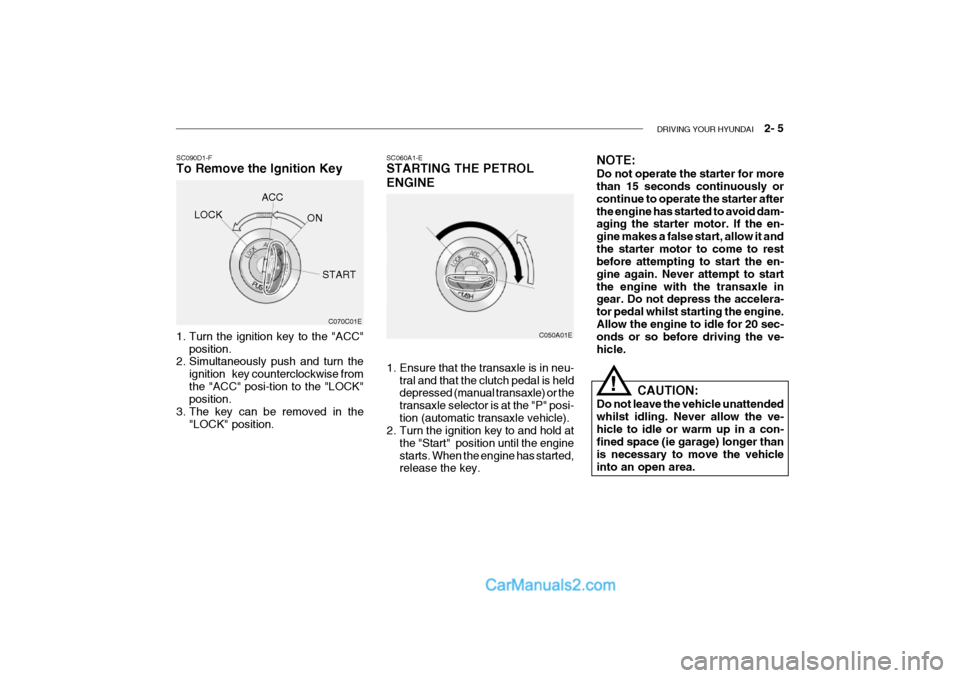
SC060A1-E STARTING THE PETROL ENGINE
C050A01E
1. Ensure that the transaxle is in neu- tral and that the clutch pedal is held depressed (manual transaxle) or the transaxle selector is at the "P" posi-tion (automatic transaxle vehicle).
2. Turn the ignition key to and hold at
the "Start" position until the enginestarts. When the engine has started, release the key.
C070C01E
SC090D1-F To Remove the Ignition Key
1. Turn the ignition key to the "ACC"
position.
2. Simultaneously push and turn the
ignition key counterclockwise from the "ACC" posi-tion to the "LOCK" position.
3. The key can be removed in the "LOCK" position.LOCK
ACC
ON
START NOTE: Do not operate the starter for more than 15 seconds continuously or continue to operate the starter afterthe engine has started to avoid dam- aging the starter motor. If the en- gine makes a false start, allow it andthe starter motor to come to rest before attempting to start the en- gine again. Never attempt to startthe engine with the transaxle in gear. Do not depress the accelera- tor pedal whilst starting the engine.Allow the engine to idle for 20 sec- onds or so before driving the ve- hicle.
CAUTION:
Do not leave the vehicle unattendedwhilst idling. Never allow the ve-hicle to idle or warm up in a con- fined space (ie garage) longer than is necessary to move the vehicleinto an open area.
!
Page 332 of 428
2- 6 DRIVING YOUR HYUNDAI
C050B01HP
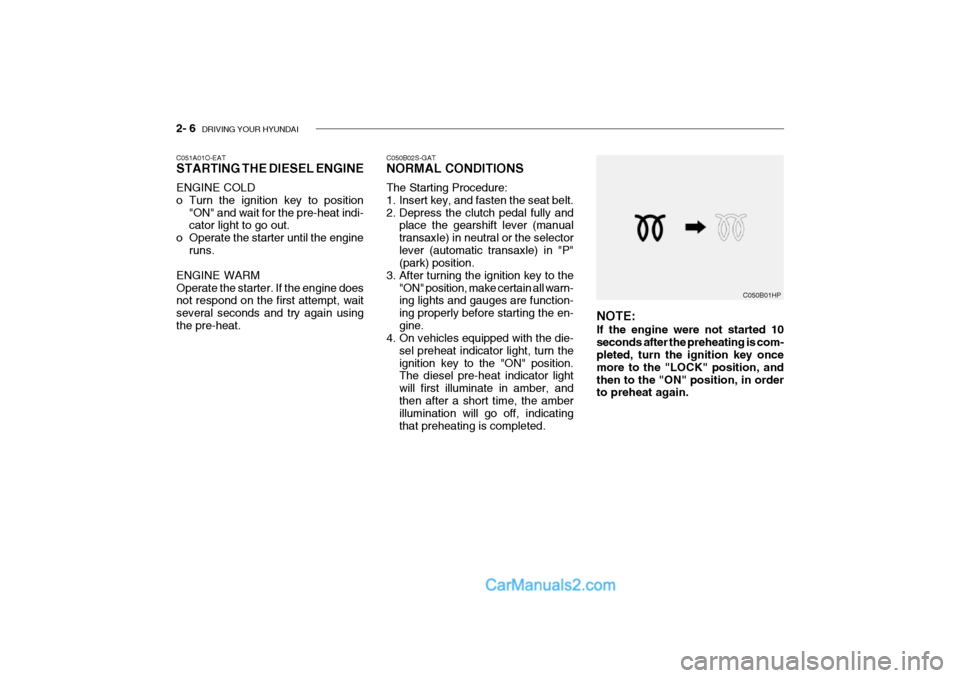
NOTE: If the engine were not started 10 seconds after the preheating is com- pleted, turn the ignition key once more to the "LOCK" position, andthen to the "ON" position, in order to preheat again.
C051A01O-EAT STARTING THE DIESEL ENGINE ENGINE COLD
o Turn the ignition key to position
"ON" and wait for the pre-heat indi- cator light to go out.
o Operate the starter until the engine
runs.
ENGINE WARM Operate the starter. If the engine does not respond on the first attempt, wait several seconds and try again usingthe pre-heat. C050B02S-GAT NORMAL CONDITIONS The Starting Procedure:
1. Insert key, and fasten the seat belt.
2. Depress the clutch pedal fully and
place the gearshift lever (manualtransaxle) in neutral or the selectorlever (automatic transaxle) in "P" (park) position.
3. After turning the ignition key to the "ON" position, make certain all warn-ing lights and gauges are function- ing properly before starting the en-gine.
4. On vehicles equipped with the die-
sel preheat indicator light, turn theignition key to the "ON" position. The diesel pre-heat indicator light will first illuminate in amber, andthen after a short time, the amber illumination will go off, indicating that preheating is completed.
Page 333 of 428

DRIVING YOUR HYUNDAI 2- 7
C055B01B-GAT STARTING AND STOPPING THE ENGINE FOR TURBO CHARGERINTERCOOLER (DIESEL EN-GINE)
(1) Do not race the engine or sudden
accelerate the engine immediately after start it. If the engine is cold, allow the engine to idle for severalseconds before it is driven to en- sure sufficient lubrication of the turbo charger unit.
(2) After high speed or extended driv- ing, requiring a heavy engine load,the engine should be allowed to idleabout 1 minute before turning it off. This idle time will allow the turbo charger to cool prior to shutting theengine off.
!WARNING:
Do not turn the engine off immedi- ately after it has been subjected toa heavy load. Doing so may cause severe damage to the engine or turbo charger unit.
WARNING:
Be sure that the clutch is fully de-pressed when starting a manual transaxle vehicle. Otherwise there is the potential to cause damage tothe vehicle or injury to someone inside or outside the vehicle as a result of the forward or backwardmovement of the vehicle that will occur if the clutch is not depressed when the vehicle is started.
5. Turn the ignition key to the "Start" position and release it when the engine starts.
!
SC060B1-E FUEL ECONOMY The following suggestions are made to assist in achieving the greatest degreeof fuel economy.
o Maintaining a constant check on
fuel consumption will enable the most economical use pattern and driving style to be adopted.
o Avoid using the vehicle for very short journeys if possible, particu-larly when a cold start is involved.
o Ensure that tyre pressures are main- tained at the correct level.
o Use only the recommended grade of fuel.
o Avoid carrying unnecessary weight,
and if a roof rack is in use, removeit as soon as possible after use.
o Anticipate the road and conditions
ahead to enable adjustments inspeed to be made smoothly. Avoid heavy acceleration and sharp brak- ing.
o Avoid cruising at unnecessary high speeds.
Page 334 of 428
2- 8 DRIVING YOUR HYUNDAI
HTB206 CAUTION:
o Do not attempt to engage reverse gear when the car is in motion.
o To avoid damaging the selector mechanism, do not use the gear shift lever as a hand rest. Releasethe lever immediately the shift is completed.
o To avoid premature clutch wear, do not use the clutch pedal as afoot rest, and do not hold the vehicle on a gradient using theclutch.
o Ensure that the engine is not
over-revved by upshifting beforethe tachometer needle enters the red zone.
o Do not coast with the shift lever at the neutral position.
o When descending long gradi-
ents, make use of the engine brak- ing to assist the footbrake to avoid brake fade or over-heating.
o When slippery conditions are en- countered, increased cautionshould be exercised when gear changing, braking or accelerat-
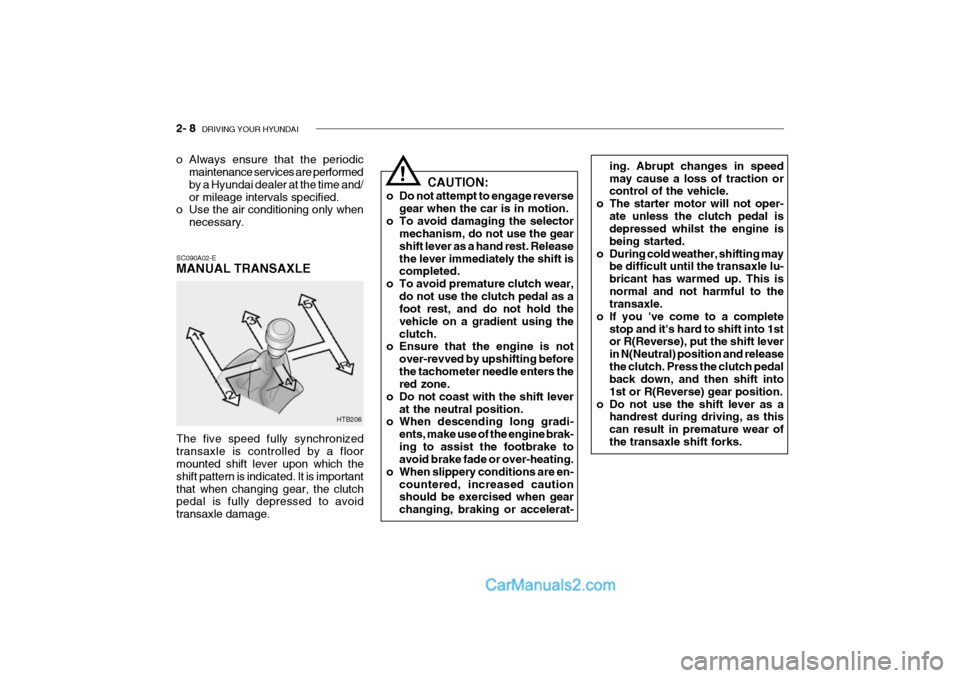
SC090A02-E MANUAL TRANSAXLE The five speed fully synchronized transaxle is controlled by a floor mounted shift lever upon which the shift pattern is indicated. It is importantthat when changing gear, the clutch pedal is fully depressed to avoid transaxle damage. ing. Abrupt changes in speedmay cause a loss of traction or control of the vehicle.
o The starter motor will not oper-
ate unless the clutch pedal isdepressed whilst the engine is being started.
o During cold weather, shifting may be difficult until the transaxle lu-bricant has warmed up. This isnormal and not harmful to the transaxle.
o If you 've come to a complete stop and it's hard to shift into 1stor R(Reverse), put the shift lever in N(Neutral) position and releasethe clutch. Press the clutch pedal back down, and then shift into 1st or R(Reverse) gear position.
o Do not use the shift lever as a handrest during driving, as thiscan result in premature wear ofthe transaxle shift forks.
o Always ensure that the periodic
maintenance services are performedby a Hyundai dealer at the time and/or mileage intervals specified.
o Use the air conditioning only when
necessary.
!
Page 335 of 428
DRIVING YOUR HYUNDAI 2- 9
C070E03A-EAT RECOMMENDED SHIFT POINTS
1-2 2-3 3-44-5
Shift
from-to Recommended
15 mph (20 km/h)25 mph (40 km/h)35 mph (55 km/h) 45 mph (75 km/h)
The shift points as shown above are recommended for optimum fuel economy and performance. SC090B1-F Using the Clutch The clutch should be pressed all the way to the floor before shifting, thenreleased slowly. Do not rest your foot on the clutch pedal while driving. This can cause unnecessary wear.Do not partially engage the clutch to hold the car on an incline. This causes unnecessary wear.Use the parking brake to hold the car on an incline. Do not operate the clutch pedal rapidly and repeatedly.
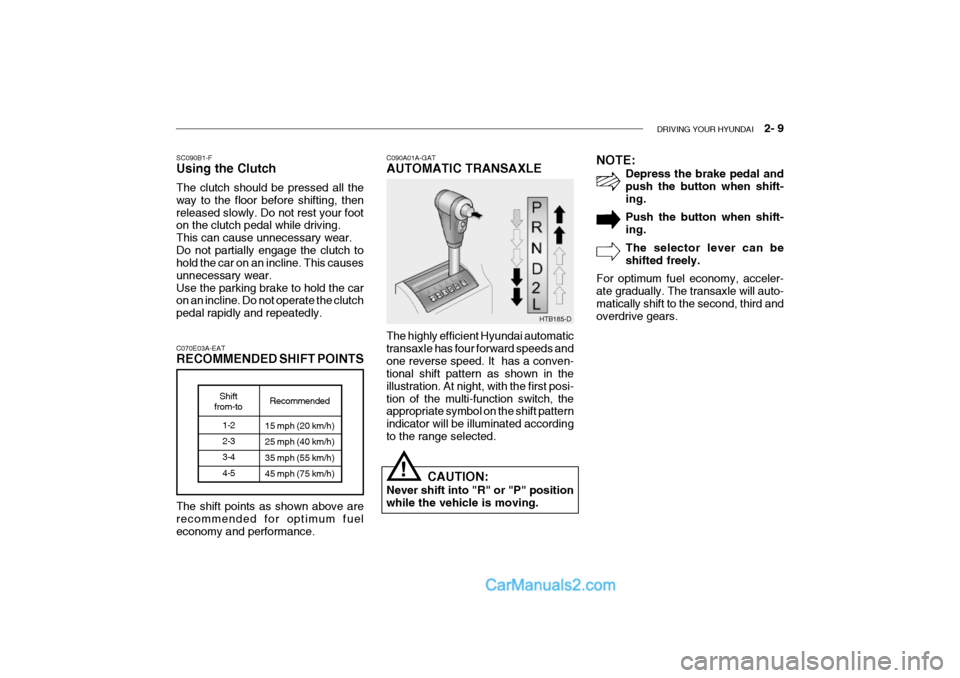
HTB185-D
C090A01A-GAT AUTOMATIC TRANSAXLE The highly efficient Hyundai automatic transaxle has four forward speeds andone reverse speed. It has a conven- tional shift pattern as shown in the illustration. At night, with the first posi-tion of the multi-function switch, the appropriate symbol on the shift pattern indicator will be illuminated accordingto the range selected.
CAUTION:
Never shift into "R" or "P" positionwhile the vehicle is moving. NOTE:
Depress the brake pedal and push the button when shift- ing. Push the button when shift- ing. The selector lever can be shifted freely.
For optimum fuel economy, acceler-ate gradually. The transaxle will auto-matically shift to the second, third and overdrive gears.
!
Page 340 of 428

2- 14 DRIVING YOUR HYUNDAI
!WARNING:
ABS will not prevent accidents due to improper or dangerous driving maneuvers. Even though vehicle control is improved during emer-gency braking, always maintain a safe distance between you and ob- jects ahead. Vehicle speeds shouldalways be reduced during extreme road conditions. The braking distance for carsequipped with an anti-lock braking system may be longer than for those without it in the following road con- ditions.
o Driving on rough, gravel or snow- covered roads.
o Driving with tyre chains installed.
o Driving on roads where the road surface is pitted or has differentsurface height. These roads should be driven atreduced speeds. The safety featuresof an ABS equipped vehicle should not be tested by high speed driving or cornering. This could endangerthe safety of yourself or others. SC150A1-F DRIVING FOR ECONOMY You can save fuel and get more miles from your car if you follow these sug- gestions:
o Drive smoothly. Accelerate at a
moderate rate. Don't make "jack- rabbit" starts or full-throttle shifts and maintain a steady cruisingspeed. Don't race between stop- lights. Try to adjust your speed to that of the other traffic so you don'thave to change speeds unneces- sarily. Avoid heavy traffic whenever pos-sible. Al-ways maintain a safe dis- tance from other vehicles so you can avoid unnecessary braking. Thisalso reduces brake wear. o Drive at a moderate speed. The
faster you drive, the more fuel yourcar uses. Driving at a moderatespeed, especially on the highway, is one of the most effective ways to reduce fuel consumption.
o Don't "ride" the brake or clutch pedal. This can increase fuel consumptionand also increase wear on thesecomponents. In addition, driving with your foot resting on the brake pedal may cause the brakes to overheat,which reduces their effectiveness and may lead to more serious con- sequences.
o Take care of your tyres. Keep them inflated to the recommended pres-sure. Incorrect infla-tion, either toomuch or too little, results in unnec- essary tyre wear. Check the tyre pres-sures at least once a month.
o Be sure that the wheels are aligned correctly. Improper alignment canresult from hitting curbs or drivingtoo fast over irregular surfaces. Poor alignment causes faster tyre wear and may also result in other prob-lems as well as greater fuel con- sumption.