fuel Hyundai Getz 2002 User Guide
[x] Cancel search | Manufacturer: HYUNDAI, Model Year: 2002, Model line: Getz, Model: Hyundai Getz 2002Pages: 428, PDF Size: 6.13 MB
Page 61 of 428
1- 48 FEATURES OF YOUR HYUNDAI
B270A01A-AAT BRAKE PAD WEAR WARNING SOUND The front disc brake pads have wear indicators that should make a high-pitched squealing or scraping noisewhen new pads are needed. The soundmay come and go or be heard all the time when the vehicle is moving. It may also be heard when the brakepedal is pushed down firmly. Exces-sive rotor damage will result if the wornpads are not replaced. See yourHyundai dealer immediately.
B900A01A-GAT ACOUSTIC WARNING SOUND (If Installed) The acoustic warning chime sounds when the tail lights are on and the doorin driver side is open. This prevents thebattery from discharging when the caris left with the tail lights on. The chime sounds until the tail lights are turned off. HTB006
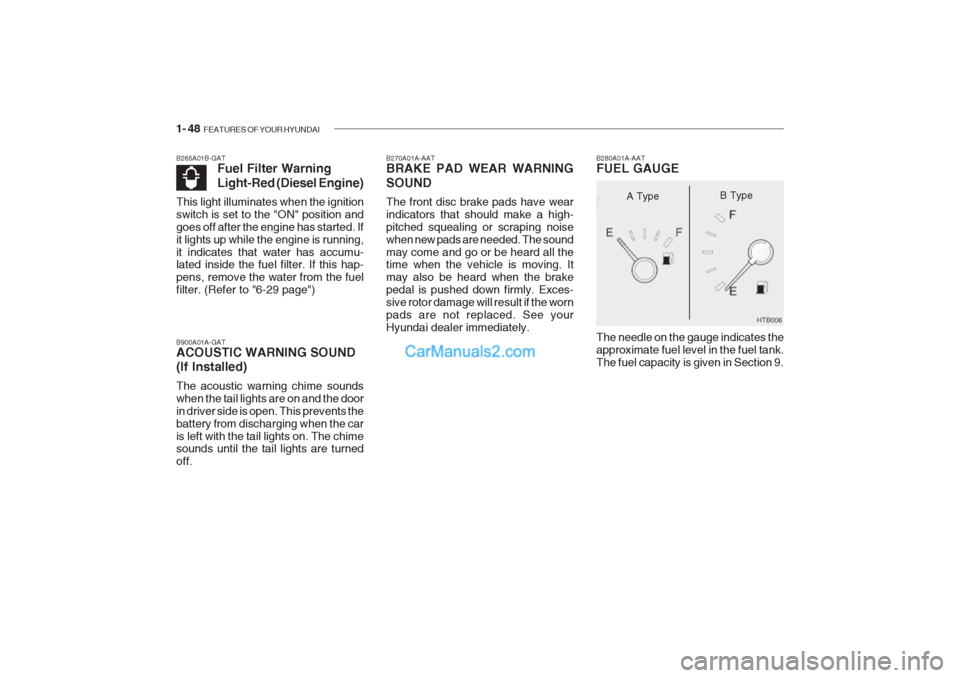
The needle on the gauge indicates theapproximate fuel level in the fuel tank.The fuel capacity is given in Section 9.
B280A01A-AAT FUEL GAUGE
A Type
B Type
B265A01B-GAT
Fuel Filter Warning Light-Red (Diesel Engine)
This light illuminates when the ignition switch is set to the "ON" position andgoes off after the engine has started. Ifit lights up while the engine is running,it indicates that water has accumu- lated inside the fuel filter. If this hap- pens, remove the water from the fuelfilter. (Refer to "6-29 page")
Page 65 of 428

1- 52 FEATURES OF YOUR HYUNDAI
Total Fuel Consumption(L) x 100 Total Cruise Distance (km)
3. Drive Distance
HTB013A HTB014A
MPG =
L/100km = Total Cruise Distance(Miles) Total Fuel Consumption (G)o This mode indicates the estimated
distance to empty from the current fuel in the fuel tank and distance toempty symbol.
o When refueling with more than 6 liters, the trip computer will recog-nize refueling.
o When the battery has been rein-
stalled after being discharged ordisconnected, drive more than 32kmfor an accurate distance to empty.
NOTE:
o If the distance to empty is indi- cated "---", have the trip com- puter system checked by yourauthorized Hyundai dealer.
o The distance to empty can differ
from the actual tripmeter accord- ing to driving conditions.
o The distance to empty can vary according to the driving condi- tions, driving pattern or vehiclespeed. o This mode indicates the drive dis-
tance travelled since the last drivetime reset.
o Pressing the reset switch built in left side of speedmeter for more than 1 second, when the drive distance is being displayed, clears the drivedistance to zero. 4. Average Consumption
o This mode indicates the average
consumption since the data reset.
o It displays per 10 seconds after you drive over 50m and 10 seconds.
o Calculation Method
Page 81 of 428

1- 68 FEATURES OF YOUR HYUNDAI
B560A01HP-AAT REMOTE FUEL-FILLER LID RE- LEASE
The fuel-filler lid may be opened from inside the vehicle by pulling up on thefuel-filler lid opener located on the front floor area on the left side of the car. NOTE: If the fuel-filler lid will not open because ice has formed around it,tap lightly or push on the lid to
WARNING:
o Always double check to be sure that the hood is firmly latched before driving away. If it is notlatched, the hood could fly openwhile the vehicle is being driven, causing a total loss of visibility, which might result in an acci-dent.
o The support rod must be inserted completely into the hole providedin the hood whenever you in- spect the engine compartment. This will prevent the hood fromfalling and possibly injuring you.
Before closing the hood, return thesupport rod to its clip to prevent it fromrattling. Lower the hood until it is about30 cm (1 ft.) above the closed positionand let it drop. Make sure that it locks into place.
HTB288
!
!
3. Pull the support rod from the hood. HTB308
4. Hold the hood open with the support rod. CAUTION:
Make sure that the support rod has been released prior to closing thehood. o Do not move the vehicle with the
hood in the raised position, asvision is obstructed and the hood could fall or be damaged.
HTB115
Page 82 of 428
FEATURES OF YOUR HYUNDAI 1- 69
break the ice and release the lid. Do not pry on the lid. If necessary,spray around the lid with an ap-proved de-icer fluid (do not useradiator anti-freeze) or move the vehicle to a warm place and allow the ice to melt.
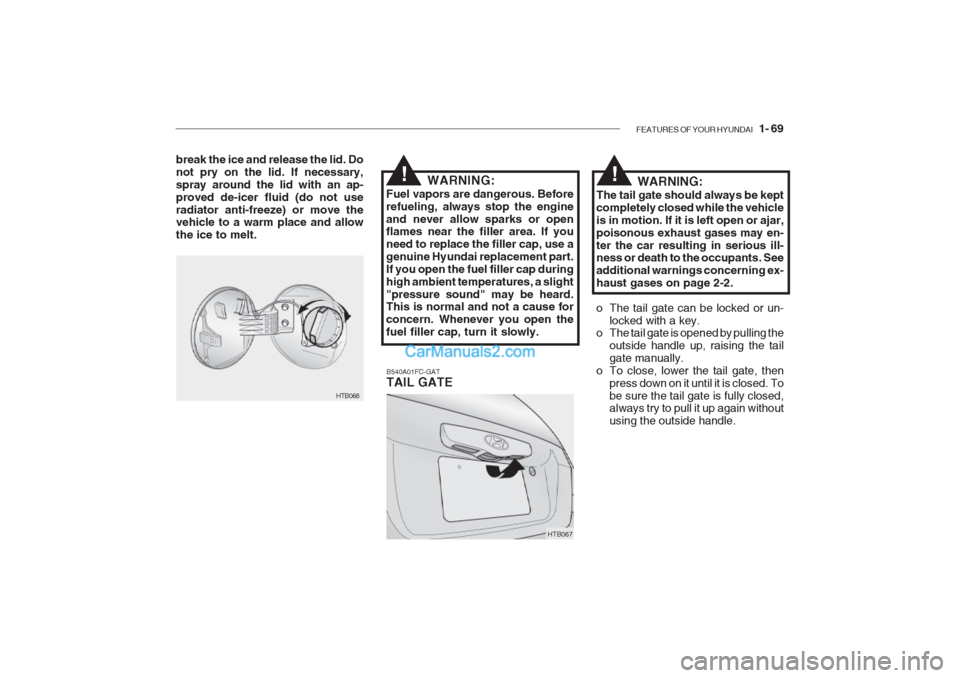
B540A01FC-GAT TAIL GATE
HTB067WARNING:
The tail gate should always be kept completely closed while the vehicleis in motion. If it is left open or ajar,poisonous exhaust gases may en-ter the car resulting in serious ill- ness or death to the occupants. See additional warnings concerning ex-haust gases on page 2-2.
o The tail gate can be locked or un- locked with a key.
o The tail gate is opened by pulling the
outside handle up, raising the tail gate manually.
o To close, lower the tail gate, then press down on it until it is closed. Tobe sure the tail gate is fully closed, always try to pull it up again without using the outside handle.
HTB068
!!WARNING:
Fuel vapors are dangerous. Before refueling, always stop the engineand never allow sparks or open flames near the filler area. If you need to replace the filler cap, use agenuine Hyundai replacement part.If you open the fuel filler cap duringhigh ambient temperatures, a slight"pressure sound" may be heard. This is normal and not a cause for concern. Whenever you open the
fuel filler cap, turn it slowly.
Page 86 of 428

FEATURES OF YOUR HYUNDAI 1- 73
B560B01O-GAT AUTO FUEL CUT SWITCH (Gasoline Engine) (If installed) The auto fuel cut switch is located on the driver's side of the engine compart-ment. In the event of a collision or sudden impact, the auto fuel cut device cuts offthe fuel supply. If this device is acti-vated, it must be reset by pressing inon the top of the switch before theengine can be restarted. HTB304
!WARNING:
Before resetting the auto fuel cut switch, the fuel line should bechecked for fuel leaks.
HTB098
B580A01TB-GAT SUN VISOR
HTB148
A Type
B Type
o To use the luggage board with
unfolding, fix it in the luggage board supporter. There will be an audible "Click" when the luggageboard fixes in the supporter.
o The luggage board can be thrown out in the event of a sudden stopor an accident. Unfold the lug- gage board stablely to prevent cargo damage.
HTB302
Page 124 of 428

DRIVING YOUR HYUNDAI 2- 3
C020A01O-GAT BEFORE STARTING THE EN- GINE Before you start the engine, you should always:
1. Look around the vehicle to be sure
there are no flat tires, puddles of oil, water or other indications of pos-sible trouble.
2. After entering the car, check to be
sure the parking brake is engaged.
3. Check that all windows, and lights are clean.
4. Check that the interior and exterior mirrors are clean and in position.
5. Check your seat, seatback and
headrest to be sure they are in theirproper positions.
6. Lock all the doors.
7. Fasten your seat belt and be sure
that all other occupants have fas- tened theirs.
8. Turn off all lights and accessories that are not needed.
9. When you turn the ignition switch to
"ON", check that all appropriate warning lights are operating and that you have sufficient fuel. 10.Check the operation of warning
lights and all bulbs when key is in the "ON" position.
!WARNING: (DIESEL ENGINE)
To ensure that sufficient vacuum exists within the brake system dur-ing cold weather start-up condi- tions, it is necessary to run the engine at idle for several secondsafter starting the engine. C030A01A-GAT COMBINATION IGNITION SWITCHTo Start the Engine
o If your Hyundai is equipped with a
manual transaxle, place the shift lever in neutral and depress theclutch pedal fully.
o If your Hyundai has an automatic
transaxle, place the shift lever in "P"(park).
o To start the engine, insert the igni-
tion key and turn it to the "START"position. Release it as soon as the engine starts. Do not hold the key in the "START" position for more than15 seconds.
NOTE: For safety, the engine will not start if the shift lever is not in "P" or "N"Position (Automatic transaxle).
Page 129 of 428

2- 8 DRIVING YOUR HYUNDAI
o Exercise extreme caution when driv-
ing on a slippery surface. Be espe- cially careful when braking, acceler-ating or shifting gears. On a slippery surface, an abrupt change in ve- hicle speed can cause the drivewheels to lose traction and the ve- hicle to go out of control.
WARNING:
o The risk of rollover is greatly in- creased if you lose control of your vehicle at highway speeds.
o Loss of control often occurs if
two or more wheels drop off theroadway and the driver oversteers to reenter the roadway.
o In the event your vehicle leaves the roadway, do not steer sharply.Instead, slow down before pull- ing back into the travel lanes.
o In a collision crash, an unbelted person is significantly more likelyto die than a person wearing aseatbelt.
!
C070D02A-AAT Good Driving Practices
o Never take the car out of gear and
coast down a hill. This is extremely hazardous. Always leave the car in gear.
o Don't "ride" the brakes. This can
cause them to overheat and mal-function. Instead, when you are driv- ing down a long hill, slow down andshift to a lower gear. When you do this, engine braking will help slow the car.
o Slow down before shifting to a lower gear. This will help avoid over-rev-ving the engine, which can causedamage.
o Slow down when you encounter
cross winds. This gives you muchbetter control of your car.
o Be sure the car is completely stopped
before you attempt to shift into re-verse. The transaxle can be dam- aged if you do not. To shift into reverse, depress the clutch, movethe shift lever to neutral, wait three seconds, then shift to the reverse position.
C070E03A-GAT RECOMMENDED SHIFT POINTS
1-2 2-33-4 4-5
Shift
from-to Recommended
20 km/h (15 mph) 40 km/h (25 mph) 55 km/h (35 mph) 75 km/h (45 mph)
The shift points as shown above are recommended for optimum fueleconomy and performance.
Page 130 of 428

DRIVING YOUR HYUNDAI 2- 9
HTB185
C090A01A-GAT AUTOMATIC TRANSAXLE
The highly efficient Hyundai automatic transaxle has four forward speeds andone reverse speed. It has a conven- tional shift pattern as shown in the illustration. At night, with the first posi-tion of the multi-function switch, the appropriate symbol on the shift pattern indicator will be illuminated accordingto the range selected. CAUTION:
Never shift into "R" or "P" positionwhile the vehicle is moving. NOTE:
Depress the brake pedal and push the button when shift- ing. Push the button when shift- ing. The selector lever can be shifted freely.
For optimum fuel economy, acceler-ate gradually. The transaxle will auto-matically shift to the second, third and overdrive gears. C090B01A-AAT The Function of Each Position Is As Follows: o P (Park): Use to hold the vehicle in place when parking or while starting the engine; shift the selector lever to the "P" (Park) position. Whenever parking the car,apply the parking brake and shift the selector lever to the "P" (Park) posi- tion.
CAUTION:
Never place the selector lever in the"P" (Park) position unless the ve-hicle is fully stopped. Failure to observe this caution will cause se- vere damage to the transaxle.
!
!
Page 132 of 428

DRIVING YOUR HYUNDAI 2- 11
C090I02A-AAT
CAUTION:
o Shift into "R" and "P" position only when the vehicle has com- pletely stopped.
o Do not accelerate the engine in reverse or any of the forwardpositions with the brakes applied.
o Always apply the footbrake when shifting from "P" or "N", to "R",
"D", "2" or "L" position.
o Do not use the "P" (Park) posi- tion in place of the parking brake.Always set the parking brake, shift the transaxle into "P" (Park)position and turn off the ignition when you leave the vehicle, even momentarily. Never leave the ve-hicle unattended while the en- gine is running.
o Check the automatic transaxle fluid level regularly, and add fluidas necessary. See the maintenance schedulefor the proper fluid recommen- dation. C090N02A-AAT Good Driving Practices
o Never move the gear selector lever
from "P" or "N" to any other position with the accelerator pedal de- pressed.
o Never move the gear selector lever
into "P" when the vehicle is in mo-tion.
o Be sure the car is completely stopped before you attempt to shift into "R".
o Never take the car out of gear and
coast down a hill. This may be ex- tremely hazardous. Always leave the car in gear when moving.
o Do not "ride" the brakes. This can cause them to overheat and mal-function. Instead, when you are driv- ing down a long hill, slow down andshift to a lower gear. When you do this, engine braking will help slow the car.
o Slow down before shifting to a lower gear. Otherwise, the lower gear maynot be engaged.
o Always use the parking brake. Do not depend on placing the transaxlein "P" to keep the car from moving.
! o Exercise extreme caution when driv-
ing on a slippery surface. Be espe- cially careful when braking, acceler-ating or shifting gears. On a slippery surface, an abrupt change in ve- hicle speed can cause the drivewheels to lose traction and the ve- hicle to go out of control.
o Turn the overdrive switch on for good fuel economy and smooth driv-ing. If engine braking is needed in the "D" range or if repeated upshift-ing and downshifting between 3rd and 4th gear is needed when climb- ing a gentle slope, it is recommendedthat the overdrive switch be turned off. Turn the overdrive switch back on immediately afterward.
Page 135 of 428

2- 14 DRIVING YOUR HYUNDAI
o Drive at a moderate speed. The
faster you drive, the more fuel your car uses. Driving at a moderatespeed, especially on the highway, is one of the most effective ways to reduce fuel consumption.
o Don't "ride" the brake or clutch pedal. This can increase fuel consumptionand also increase wear on thesecomponents. In addition, driving with your foot resting on the brake pedal may cause the brakes to overheat,which reduces their effectiveness and may lead to more serious con- sequences.
o Take care of your tires. Keep them inflated to the recommended pres-sure. Incorrect inflation, either toomuch or too little, results in unnec- essary tire wear. Check the tire pres- sures at least once a month.
o Be sure that the wheels are aligned correctly. Improper alignment canresult from hitting curbs or drivingtoo fast over irregular surfaces. Poor alignment causes faster tire wear and may also result in other prob-lems as well as greater fuel con- sumption.
WARNING:
ABS will not prevent accidents due to improper or dangerous driving maneuvers. Even though vehicle control is improved during emer-gency braking, always maintain a safe distance between you and ob- jects ahead. Vehicle speeds shouldalways be reduced during extreme road conditions. The braking distance for cars equipped with an anti-lock braking system may be longer than for those without it in the following road con-ditions.
o Driving on rough, gravel or snow- covered roads.
o Driving with tire chains installed.
o Driving on roads where the road
surface is pitted or has different surface height.
!During these conditions, the ve- hicle should be driven at reduced speeds. The safety features of anABS equipped vehicle should not be tested by high speed driving or cornering. This could endanger thesafety of yourself or others.
C140A01A-GAT DRIVING FOR ECONOMY You can save fuel and get more kilo- meters from your car if you follow these suggestions:
o Drive smoothly. Accelerate at amoderate rate. Don't make "jack- rabbit" starts or full-throttle shifts and maintain a steady cruisingspeed. Don't race between stop- lights. Try to adjust your speed to that of the other traffic so you don'thave to change speeds unneces- sarily. Avoid heavy traffic whenever possible.Always maintain a safe distance from other vehicles so you can avoid unnecessary braking. This also re-duces brake wear.