fuel Hyundai Getz 2002 Workshop Manual
[x] Cancel search | Manufacturer: HYUNDAI, Model Year: 2002, Model line: Getz, Model: Hyundai Getz 2002Pages: 428, PDF Size: 6.13 MB
Page 280 of 428
1- 36 FEATURES OF YOUR HYUNDAI
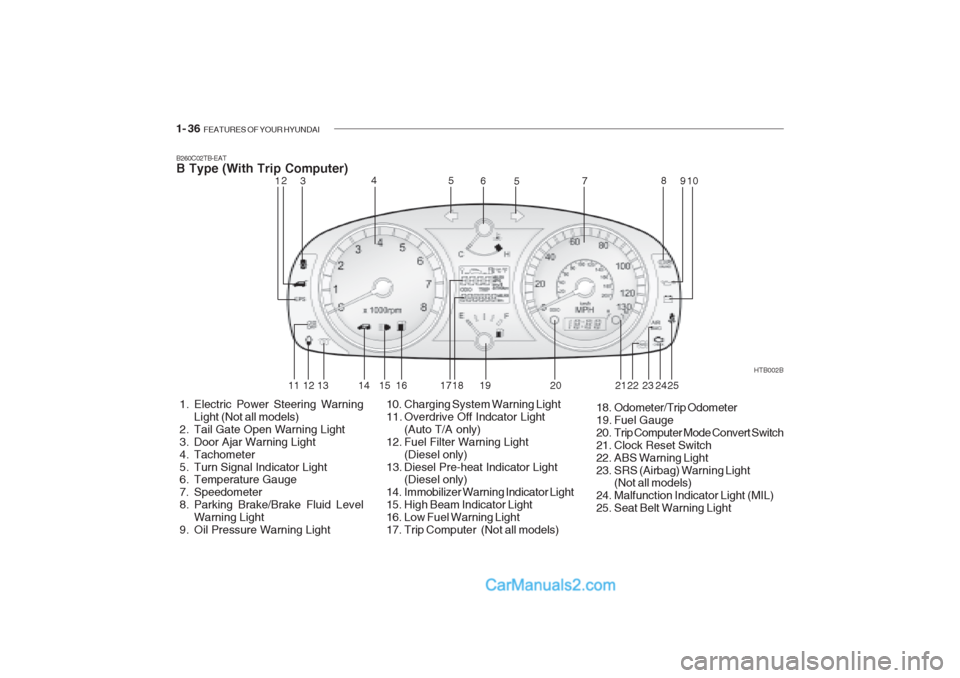
B260C02TB-EAT B Type (With Trip Computer)
1. Electric Power Steering Warning
Light (Not all models)
2. Tail Gate Open Warning Light
3. Door Ajar Warning Light
4. Tachometer
5. Turn Signal Indicator Light
6. Temperature Gauge
7. Speedometer
8. Parking Brake/Brake Fluid Level Warning Light
9. Oil Pressure Warning Light HTB002B
10. Charging System Warning Light
11. Overdrive Off Indcator Light (Auto T/A only)
12. Fuel Filter Warning Light (Diesel only)
13. Diesel Pre-heat Indicator Light (Diesel only)
14. Immobilizer Warning Indicator Light
15. High Beam Indicator Light
16. Low Fuel Warning Light
17. Trip Computer (Not all models) 18. Odometer/Trip Odometer
19. Fuel Gauge
20. Trip Computer Mode Convert Switch
21. Clock Reset Switch
22. ABS Warning Light
23. SRS (Airbag) Warning Light
(Not all models)
24. Malfunction Indicator Light (MIL)
25. Seat Belt Warning Light
12 3 4
5
5
67 8
910
11 12 13 14 15 16 1718 19 20 22 23
242521
Page 283 of 428

FEATURES OF YOUR HYUNDAI 1- 39
SB210M1-E
CHARGING SYSTEM WARNING LIGHT
The charging system warning light should illuminate when the ignition switch is turned to the "ON" position and should be extinguished when theengine is started. If the light fails toilluminate when the ignition is turned"ON" or fails to extinguish after startingthe engine, the nearest Hyundai dealer should be contacted. If the light illumi- nates whilst the vehicle is being driven,stop the vehicle as soon as it is safe todo so and check the condition of thegenerator drive belt. If the belt is in SB2100I-E
DOOR AJAR WARNING LIGHT
The door ajar warning light indicates that a door is not correctly closed.Ensure that the light is extinguishedprior to driving the vehicle.
B260B01FC-EAT
TAIL GATE OPEN WARNING LIGHT
The tail gate warning light indicates when the tail gate is open or is not fully closed. Ensure that the light has extin-guished prior to driving the vehicle. SB210P1-E
LOW FUEL LEVEL WARNING LIGHT
The low fuel warning light serves to warn the driver that the remaining fuelquantity is approximately 9 litres andthat the vehicle should be refuelled. Ifthe vehicle is driven for an extendedperiod with the low fuel warning light illuminated there exists a possibility that misfiring due to fuel shortage mayoccur. This situation must be avoidedto prevent damage to the catalyst oc-curring.
recommended to assist in bringing thevehicle to rest. The vehicle must not bedriven once brake failure has occurreduntil the system has been repaired andis functioning normally. The braking system employs a vacuum servo in order that the pedal efforts arereduced. Power for the servo is derivedfrom the engine and therefore, in theevent of the engine stopping or thevehicle being towed, pedal efforts will be substantially increased.
place and the tension is satisfactory, the advice of a Hyundai dealer shouldbe sought.
CAUTION:
If the drive belt (generator belt) isloosen, broken, or missing while thevehicle is driving, there may be aserious malfunction, engine couldoverheat because this belt also drivesthe water pump.
!
B260N02FC-EAT MALFUNCTION INDICA- TOR LIGHT
This light illuminates when there is a malfunction of an exhaust gas relatedcomponent, and the system is not func- tioning properly so that the exhaust gas regulation values are not satisfied. Thislight will illuminate when the ignition keyis tuned to the "ON" position, and will goout after the engine start. If it illumi-nates while driving, or does not illumi- nate when the ignition key is turned to the "ON" position, take your car to your
Page 285 of 428

FEATURES OF YOUR HYUNDAI 1- 41
SB210S1-E BRAKE PAD WEAR INDICATOR The front brake disc pads are fitted with an audible wear indicator which willcause a high pitched noise to be emit-ted when the remaining amount of fric-tion lining is below the specified value. When the wear indicator is heard, the brake pads should be replaced withoutdelay to avoid damage occurring to thebrake discs and a severe reduction inbraking efficiency.
B900A01A-EAT ACOUSTIC WARNING SOUND (Not all models) The acoustic warning chime sounds when the tail lights are on and the doorin driver side is open. This prevents the battery from discharging when the car is left with the tail lights on. The chimesounds until the tail lights are turned off. HTB006A
The fuel gauge indicates the quantity offuel remaining in the fuel tank. NOTE: The fuel gauge is not intended to give other than an approximate indi-cation of the fuel level and is unsuit-able for the purposes of calculatingfuel consumption figures.
SB215A1-E FUEL GAUGE
B265A01B-GAT
FUEL FILTER WARNING LIGHT-RED (Diesel Engine)
This light illuminates when the ignition switch is set to the "ON" position andgoes off after the engine has started. Ifit lights up while the engine is running,it indicates that water has accumu-lated inside the fuel filter. If this hap- pens, remove the water from the fuel filter. (Refer to "6-26 page")
Page 289 of 428
FEATURES OF YOUR HYUNDAI 1- 45
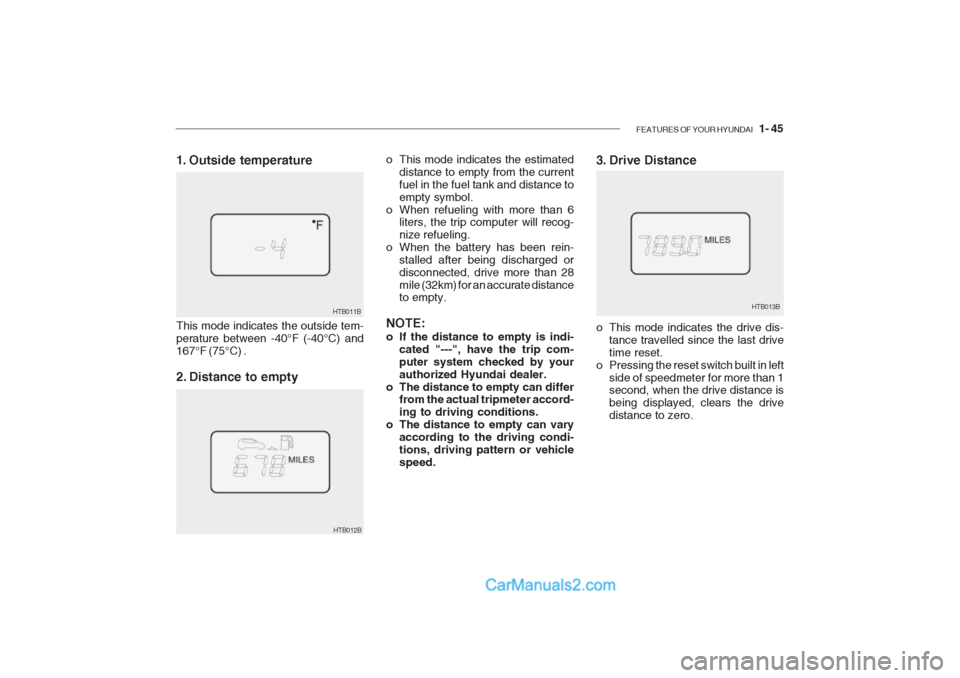
3. Drive Distance
HTB013B
o This mode indicates the estimated
distance to empty from the current fuel in the fuel tank and distance toempty symbol.
o When refueling with more than 6 liters, the trip computer will recog-nize refueling.
o When the battery has been rein-
stalled after being discharged ordisconnected, drive more than 28mile (32km) for an accurate distance to empty.
NOTE:
o If the distance to empty is indi- cated "---", have the trip com- puter system checked by yourauthorized Hyundai dealer.
o The distance to empty can differ from the actual tripmeter accord-ing to driving conditions.
o The distance to empty can vary
according to the driving condi-tions, driving pattern or vehiclespeed. o This mode indicates the drive dis-
tance travelled since the last drivetime reset.
o Pressing the reset switch built in left side of speedmeter for more than 1 second, when the drive distance is being displayed, clears the drivedistance to zero.
HTB012B
1. Outside temperature This mode indicates the outside tem- perature between -40°F (-40°C) and167°F (75°C) .
2. Distance to empty
HTB011B
Page 290 of 428
1- 46 FEATURES OF YOUR HYUNDAI
HTB014B
MPG = Total Cruise Distance(Miles) Total Fuel Consumption (G)
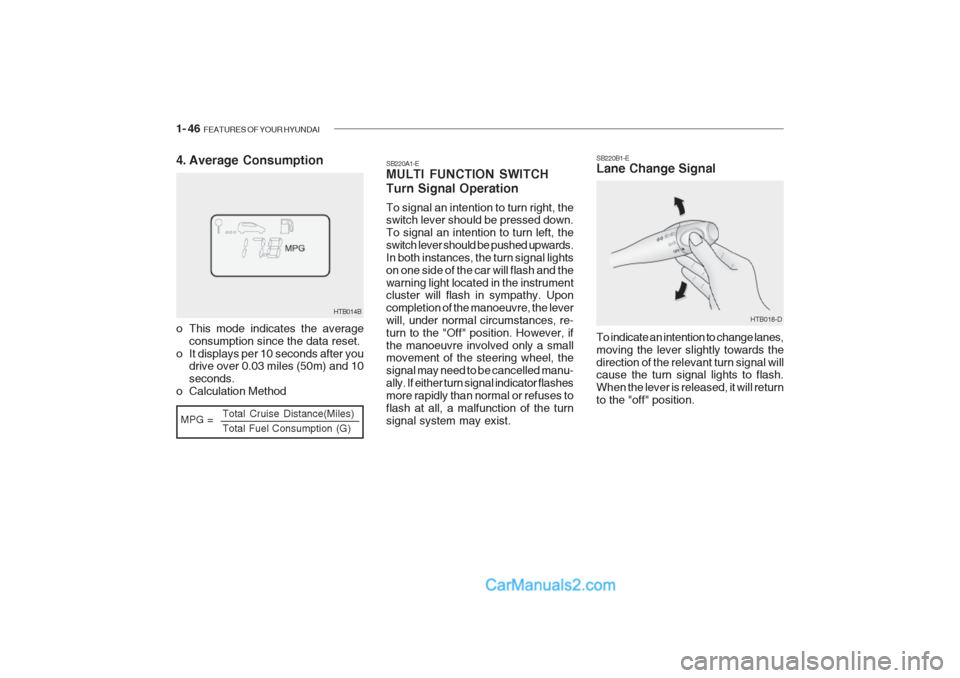
4. Average Consumption
o This mode indicates the average
consumption since the data reset.
o It displays per 10 seconds after you drive over 0.03 miles (50m) and 10 seconds.
o Calculation Method SB220A1-E MULTI FUNCTION SWITCH Turn Signal Operation To signal an intention to turn right, the switch lever should be pressed down. To signal an intention to turn left, theswitch lever should be pushed upwards.In both instances, the turn signal lightson one side of the car will flash and thewarning light located in the instrument cluster will flash in sympathy. Upon completion of the manoeuvre, the leverwill, under normal circumstances, re-turn to the "Off" position. However, ifthe manoeuvre involved only a small movement of the steering wheel, the signal may need to be cancelled manu-ally. If either turn signal indicator flashesmore rapidly than normal or refuses toflash at all, a malfunction of the turnsignal system may exist. SB220B1-E Lane Change Signal To indicate an intention to change lanes, moving the lever slightly towards thedirection of the relevant turn signal will cause the turn signal lights to flash. When the lever is released, it will returnto the "off" position.
HTB018-D
Page 305 of 428

FEATURES OF YOUR HYUNDAI 1- 61
SB440A1-E REMOTE FUEL FILLER LID RELEASE (Not all models) The fuel filler lid may be opened from inside the vehicle by pulling up on thefuel filler lid release.
!
HTB115-D
Before closing the bonnet, return the support rod to its clip to prevent it fromrattling. Lower the bonnet until it isabout 30 cm (1 ft.) above the closedposition and let it drop. Make sure that it locks into place.
HTB288
3. Pull the support rod from the bonnet.
HTB308
CAUTION:
Make sure that the support rod has been released prior to closing thebonnet.
4. Hold the bonnet open with the sup- port rod. WARNING:
o Always double check to be sure that the bonnet is firmly latchedbefore driving away. If it is notlatched, the bonnet could fly open while the vehicle is being driven, causing a total loss of visibility,which might result in an accident.
o The support rod must be inserted
completely into the hole providedin the bonnet whenever you in- spect the engine compartment. This will prevent the bonnet fromfalling and possibly injuring you. o Do not move the vehicle with the
bonnet in the raised position, asvision is obstructed and the bon-net could fall or be damaged.
!
Page 306 of 428
1- 62 FEATURES OF YOUR HYUNDAI
NOTE: If the fuel filler lid will not open because ice has formed around it,tap lightly or push on the lid to breakthe ice and release the lid. Do not pryon the lid. If necessary, spray aroundthe lid with an approved deicer fluid (do not use radiator anti-freeze) or move the vehicle to a warm placeand allow the ice to melt.
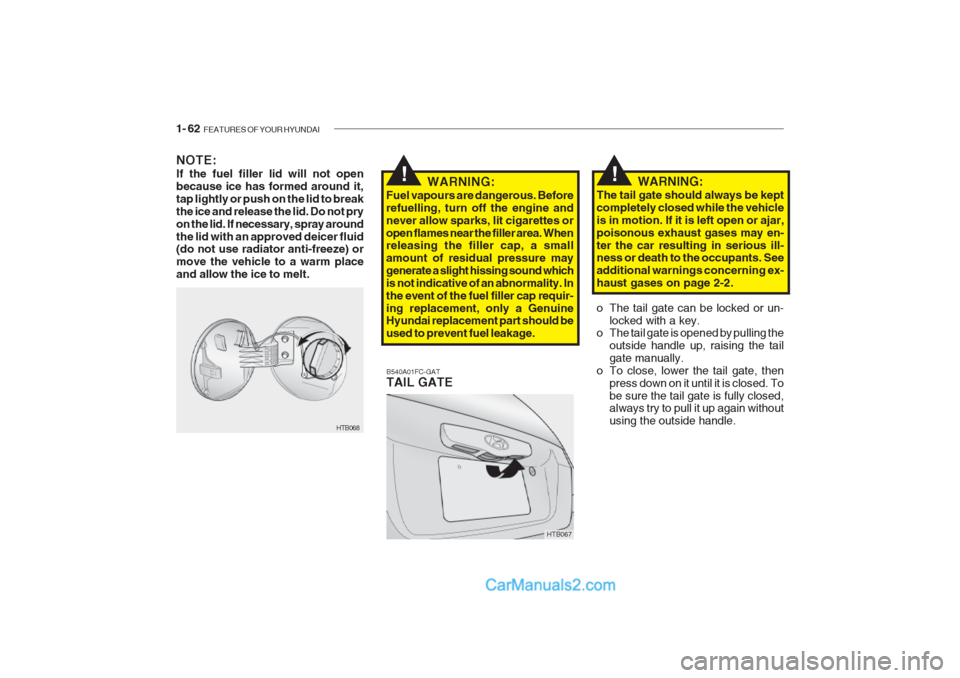
B540A01FC-GAT TAIL GATE
HTB067WARNING:
The tail gate should always be kept completely closed while the vehicleis in motion. If it is left open or ajar,poisonous exhaust gases may en-ter the car resulting in serious ill- ness or death to the occupants. See additional warnings concerning ex-haust gases on page 2-2.
o The tail gate can be locked or un- locked with a key.
o The tail gate is opened by pulling the
outside handle up, raising the tail gate manually.
o To close, lower the tail gate, then press down on it until it is closed. Tobe sure the tail gate is fully closed, always try to pull it up again without using the outside handle.
HTB068
!!WARNING:
Fuel vapours are dangerous. Before refuelling, turn off the engine andnever allow sparks, lit cigarettes oropen flames near the filler area. When releasing the filler cap, a small amount of residual pressure maygenerate a slight hissing sound which
is not indicative of an abnormality. Inthe event of the fuel filler cap requir-ing replacement, only a Genuine Hyundai replacement part should be used to prevent fuel leakage.
Page 310 of 428

1- 66 FEATURES OF YOUR HYUNDAI
B560B01O-EAT AUTO FUEL CUT SWITCH (Petrol Engine)
The auto fuel cut switch is located on the driver's side of the engine compartment.In the event of a collision or sudden impact, the auto fuel cut device cuts off the fuel supply. If this device is acti-vated, it must be reset by pressing inon the top of the switch before theengine can be restarted. HTB304
!WARNING:
Before resetting the auto fuel cut switch, the fuel line should be checked for fuel leaks.
HTB098-D
B580A01TB-GAT SUN VISOR
HTB148-D
A Type
B Type
o To use the luggage board with
unfolding, fix it in the luggage board supporter. There will be an audible "Click" when the luggageboard fixes in the supporter.
o The luggage board can be thrown out in the event of a sudden stopor an accident. Unfold the lug- gage board stablely to prevent cargo damage.
HTB302
Page 329 of 428

DRIVING YOUR HYUNDAI 2- 3
C020A01O-EAT BEFORE STARTING THE EN- GINE Before you start the engine, you should always:
1. Look around the vehicle to be sure
there are no flat tyres, puddles of oil or water or other indications of pos-sible trouble.
2. After entering the car, check to be
sure the parking brake is engaged.
3. Check that all windows, and lights are clean.
4. Check that the interior and exterior mirrors are clean and in position.
5. Check your seat, seatback and
headrestraint to be sure they are intheir proper positions.
6. Lock all the doors.
7. Fasten your seat belt and be sure
that all other occupants have fas- tened theirs.
8. Turn off all lights and accessories that are not needed.
9. When you turn the ignition switch to
"ON" check that all appropriate warn- ing lights are operating and that you have sufficient fuel. 10.Check the operation of warning
lights and all bulbs when key is in the "ON" position.
!WARNING: (DIESEL ENGINE)
To ensure that sufficient vacuum exists within the brake system dur-ing cold weather start-up condi- tions, it is necessary to run the engine at idle for several secondsafter starting the engine. SC040A1-F COMBINATION IGNITION SWITCH AND STEERING LOCKTo Start the Engine
o If your Hyundai is equipped with a
manual transaxle, place the shift lever in neutral and depress theclutch pedal fully.
o If your Hyundai has an automatic
transaxle, place the shift lever in "P"(park).
o To start the engine, insert the igni-
tion key and turn it to the "START"position. Release it as soon as the engine starts. Do not hold the key in the "START" position for more that15 seconds.
NOTE: For safety, the engine will not start if the shift lever is not in "P" or "N"Position (automatic transaxle).
Page 333 of 428

DRIVING YOUR HYUNDAI 2- 7
C055B01B-GAT STARTING AND STOPPING THE ENGINE FOR TURBO CHARGERINTERCOOLER (DIESEL EN-GINE)
(1) Do not race the engine or sudden
accelerate the engine immediately after start it. If the engine is cold, allow the engine to idle for severalseconds before it is driven to en- sure sufficient lubrication of the turbo charger unit.
(2) After high speed or extended driv- ing, requiring a heavy engine load,the engine should be allowed to idleabout 1 minute before turning it off. This idle time will allow the turbo charger to cool prior to shutting theengine off.
!WARNING:
Do not turn the engine off immedi- ately after it has been subjected toa heavy load. Doing so may cause severe damage to the engine or turbo charger unit.
WARNING:
Be sure that the clutch is fully de-pressed when starting a manual transaxle vehicle. Otherwise there is the potential to cause damage tothe vehicle or injury to someone inside or outside the vehicle as a result of the forward or backwardmovement of the vehicle that will occur if the clutch is not depressed when the vehicle is started.
5. Turn the ignition key to the "Start" position and release it when the engine starts.
!
SC060B1-E FUEL ECONOMY The following suggestions are made to assist in achieving the greatest degreeof fuel economy.
o Maintaining a constant check on
fuel consumption will enable the most economical use pattern and driving style to be adopted.
o Avoid using the vehicle for very short journeys if possible, particu-larly when a cold start is involved.
o Ensure that tyre pressures are main- tained at the correct level.
o Use only the recommended grade of fuel.
o Avoid carrying unnecessary weight,
and if a roof rack is in use, removeit as soon as possible after use.
o Anticipate the road and conditions
ahead to enable adjustments inspeed to be made smoothly. Avoid heavy acceleration and sharp brak- ing.
o Avoid cruising at unnecessary high speeds.