battery Hyundai Getz 2002 Owner's Guide
[x] Cancel search | Manufacturer: HYUNDAI, Model Year: 2002, Model line: Getz, Model: Hyundai Getz 2002Pages: 428, PDF Size: 6.13 MB
Page 341 of 428

DRIVING YOUR HYUNDAI 2- 15
o Keep your car in good condition. For
better fuel economy and reduced maintenance costs, maintain yourcar in accordance with the mainte- nance schedule in Section 5. If you drive your car in severe conditions,more frequent maintenance is re- quired (see Section 5 for details).
o Keep your car clean. For maximum service, your car should be keptclean and free of corrosive materi- als. It is especially important thatmud, dirt, ice, etc. not be allowed to accumulate on the underside of the car. This extra weight can result inincreased fuel consumption and also contribute to corrosion.
o Travel lightly. Don't carry unneces- sary weight in your car. Weight is anenemy of good fuel economy.
o Don't let the engine idle longer than necessary. If you are waiting (andnot in traffic), turn off your engine and restart only when you're readyto go.
o Remember, your car does not re-
quire extended warm-up. As soonas the engine is running smoothly, you can drive away. In very cold weather, however, give your enginea slightly longer warm-up period. o Don't "lug" or "over-rev" the engine.
Lugging is driving too slowly in toohigh a gear resulting in the enginebucking. If this happens to you, shift to a lower gear. Over-revving is racing the enginebeyond its safe limit. This can be avoided by shifting at the recom- mended speeds.
o Use your air conditioning sparingly. The air conditioning system is oper-ated by the engine power so yourfuel economy is reduced when you use it.
SC160A1-F SMOOTH CORNERING Avoid braking or gear changing in cor- ners, especially when roads are wet. Ideally, corners should always be takenunder gentle acceleration. If you follow these suggestions, tyre wear will be held to a minimum. SC170A1-E WINTER MOTORING The onset of winter conditions subject motor vehicles to greater operatingdemands. Therefore, the following suggestions will assist in maintaining peak performance and reliability dur-ing these periods: ZC170B1-E Electrical System Winter conditions impose severe de- mands upon vehicle electrical systems, particularly the charging circuit. The battery condition and performance along with the alternator performanceand drive belt condition should be checked prior to the onset of winter.
Page 348 of 428

3- 2 WHAT TO DO IN AN EMERGENCY
HTB165
SD020B1-E IF THE ENGINE CANNOT BE CRANKED
1. If the vehicle is fitted with manual
transaxle, ensure that the clutch pedal is depressed whilst cranking the engine. If the vehicle is fitted with automatic transaxle, ensurethat the transaxle selector is at the "P" or"N" position.
2. Check the battery terminals and
connections to ensure that theseare clean and also tight.
3. If the ignition warning lights dim
when the engine is cranked and thebattery terminals have been checked, a discharged battery isindicated. SD020C1-F If Engine Turns Over Normally but Does Not Start
SD020A1-E IF THE ENGINE WILL NOT START Seek assistance from the nearest Hyundai dealer with regard to the method of ignition and fuel systemdiagnosis.
!
HTB221
CAUTION:
If the engine refuses to start, no attempt should be made to push or tow start the vehicle. Vehicles withautomatic transaxle or fuel injec- tion will not be able to be started in this manner since no drive is trans-mitted through the automatic transaxle whilst the engine is not running, and in the case of fuelinjected derivatives, the fuel pump will not operate under tow start conditions. In addition, if the ve-hicle is equipped with an exhaust catalyst, damage to the catalyst may result if the vehicle is tow started. 4. Do not attempt to push or tow start
the vehicle, refer to "Jump Starting"for information regarding enginestarting when the battery is dis- charged.
1. Check fuel Level
2. Check all connectors at ignition coil and spark plugs. Replace any that may be discon- nected or loose.
3. Check fuel line in the engine room.
4. If engine still refuses to start, call a Hyundai dealer or seek other quali-fied assistance.
Page 349 of 428
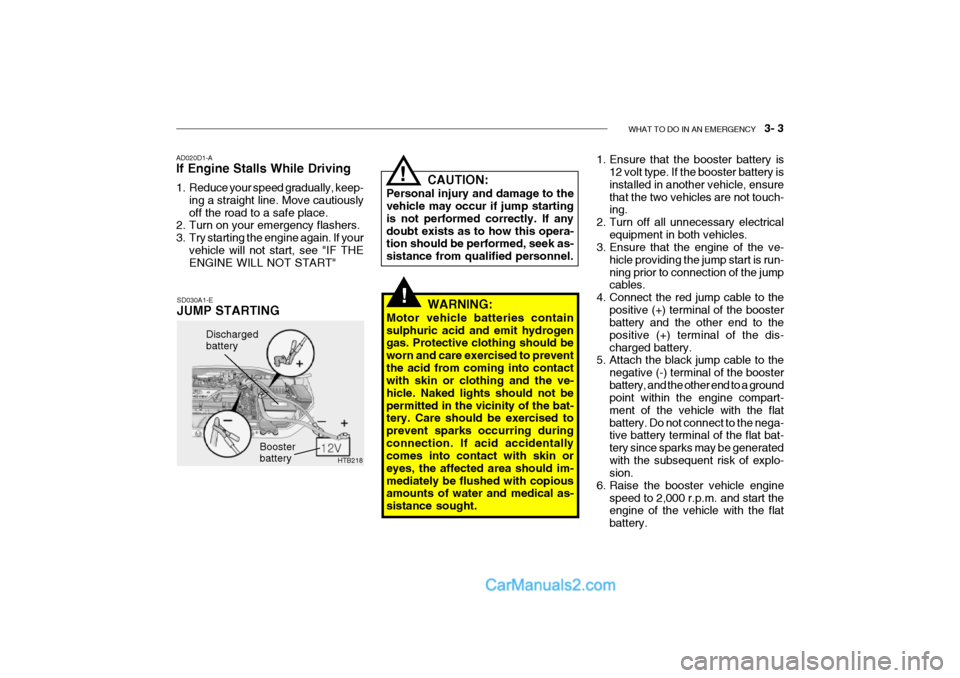
WHAT TO DO IN AN EMERGENCY 3- 3
HTB218
Discharged battery
Booster battery
CAUTION:
Personal injury and damage to the vehicle may occur if jump starting is not performed correctly. If anydoubt exists as to how this opera- tion should be performed, seek as- sistance from qualified personnel.
SD030A1-E JUMP STARTING
AD020D1-AIf Engine Stalls While Driving
1. Reduce your speed gradually, keep-
ing a straight line. Move cautiously off the road to a safe place.
2. Turn on your emergency flashers.
3. Try starting the engine again. If your
vehicle will not start, see "IF THE ENGINE WILL NOT START"!
WARNING:
Motor vehicle batteries contain sulphuric acid and emit hydrogen gas. Protective clothing should be worn and care exercised to preventthe acid from coming into contact with skin or clothing and the ve- hicle. Naked lights should not bepermitted in the vicinity of the bat- tery. Care should be exercised to prevent sparks occurring duringconnection. If acid accidentally comes into contact with skin or eyes, the affected area should im-mediately be flushed with copious amounts of water and medical as- sistance sought. 1. Ensure that the booster battery is
12 volt type. If the booster battery isinstalled in another vehicle, ensurethat the two vehicles are not touch- ing.
2. Turn off all unnecessary electrical equipment in both vehicles.
3. Ensure that the engine of the ve-
hicle providing the jump start is run- ning prior to connection of the jump cables.
4. Connect the red jump cable to the positive (+) terminal of the boosterbattery and the other end to the positive (+) terminal of the dis-charged battery.
5. Attach the black jump cable to the
negative (-) terminal of the boosterbattery, and the other end to a ground point within the engine compart- ment of the vehicle with the flatbattery. Do not connect to the nega- tive battery terminal of the flat bat- tery since sparks may be generatedwith the subsequent risk of explo- sion.
6. Raise the booster vehicle engine speed to 2,000 r.p.m. and start theengine of the vehicle with the flat battery.
!
Page 350 of 428

3- 4 WHAT TO DO IN AN EMERGENCY
D030A01TB-EAT IF THE ENGINE OVERHEATS If the temperature gauge indicates overheating:
1. Pull off the road and stop as soon as
it is safe to do so.
2. Place the gear selector lever in "P" (automatic), or neutral (manual transaxle) and set the parking brake. If the air conditioning is on, turn it off. 3. If coolant is running out under the
car or steam is coming out fromunder the bonnet stop the engine.Do not open the bonnet until the coolant has stopped running or the steaming has stopped. If there is novisible loss of coolant and no steam, leave the engine running and check to be sure the engine cooling fan isoperating. If the fan is not running, turn the engine off.
4. Check to see if the water pump drive belt is missing. If it is not missing,check to see that it is tight. If thedrive belt seems to be satisfactory, check for coolant leaking from the radiator, hoses or under the car. (Ifthe air conditioning had been in use, it is normal for cold water to be draining from it).
WARNING:
Whilst the engine is running, keephands and clothing away from mov-ing parts such as the fan and drive belts to prevent injury.
!
7. Remove jump cables in the reverse order of installation (black cable first).
CAUTION:
If the jump cable is incorrectly in- stalled, damage to the vehicle elec-trical system may occur, in particu- lar the electronic components such as the Fuel Injection system com-puter and the Automatic transaxle computer. The battery must never be disconnected whilst the engineis running.
!
!WARNING (Diesel only):
Never work on injection system with engine running or within 30 sec- onds after shutting off engine. Highpressure pump, rail, injectors and high pressure pipes are subject to high pressure even after the enginestopped. The fuel jet produced by fuel leaks may cause serious in- jury, if it touch the body. Peopleusing pacemakers should not move than 30cm closer to the ECU or wiring harness within the engineroom while engine is running, since the high currents in the Common Rail system produce considerablemagnetic fields.
5. If the water pump drive belt is bro- ken or coolant is leaking out, stop the engine immediately and call thenearest Hyundai dealer for assis- tance.
Page 363 of 428
4- 4 CORROSION PREVENTION AND APPEARANCE CARE
SE040E1-E BUMPER MAINTENANCE The special material from which the bumpers are manufactured warrantsspecial attention to preserve the ap- pearance of the bumpers. Avoid con- tact with battery electrolyte or brakefluid and ensure that accidental spill- ages are immediately flushed with water.Do not use abrasive cleaning materi- als which may damage the bumpers. Avoid subjecting the bumpers to hightemperatures such as may be encoun- tered in high bake paint ovens.
SE040F1-E ACCIDENT REPAIRS In the event of the body work sustain- ing damage, the following points should be noted prior to repairs being under- taken.If body panels are replaced or re- paired, anti corrosion treatment must be applied to the repair area. Theproduct used must be compatible with those used in manufacture. It is rec- ommended that repairs are entrustedto a Hyundai dealer to ensure that replacement parts used are of the same high quality as those used in manufac- ture of the vehicle and that the correctrepair methods and materials will en- sure adequate levels of corrosion pro- tection and the continued validity of theAnti Perforation Warranty. SE050A1-E INTERIOR During the winter period, it is possible that the passenger compartment floor- ing may become wet from damp foot- wear or quantities of snow adhering tofootwear. The carpet should not be allowed to remain in this condition since the carpet may begin to create mustysmells and will promote corrosion of the floor pan in addition to the carpet and under felt beginning to rot.
SE050C1-E INTERIOR VALETING The soft trim and carpets should be maintained with the regular use of avacuum cleaner. Heavy soiling should be removed with a dry cleaning agent recommended for this purpose follow-ing the instructions of the product manufacturer. Paint thinner, solvents or other such cleaning materials shouldnot be used since damage to the up- holstery may result. SE050D1-E SEAT BELTS Seat belts should be cleaned only with a mild soap solution. Strong deter- gents, solvens or bleaches may dam- age the belt webbing and thereforereduce the effectiveness of the belt. Belts which display signs of fraying, wear of cut should be replaced.
Page 376 of 428

6- 2 DO-IT-YOURSELF MAINTENANCE
HTB160A
1. Windshield washer fluid reservoir cap
2. Auto fuel cut switch
3. Engine oil filler cap 4. Brake fluid and clutch fluid
reservoir
5. Air filter element
6. Relay box
7. Power steering fluid reservoir 8. Engine oil level dipstick
9. Radiator cap
10.Engine coolant reservoir
11.Battery
G010A01TB-EAT ENGINE COMPARTMENT (1.1 SOHC)
12 3
456
78 9 10 1 1
Page 377 of 428

DO-IT-YOURSELF MAINTENANCE 6- 3
G010B01TB-EAT ENGINE COMPARTMENT (1.3 SOHC)
1. Windshield washer fluid reservoir
cap
2. Auto fuel cut switch
3. Engine oil filler cap
4. Brake fluid and clutch fluid reservoir 5. Air filter element
6. Relay box
7. Power steering fluid reservoir
(Not all models)
8. Engine oil level dipstick 9. Radiator cap
10. Engine coolant reservoir
11. Automatic transaxle fluid level dip-
stick (Not all models)
12. Battery HTB086A
123
456
78 91 011
12
Page 378 of 428

6- 4 DO-IT-YOURSELF MAINTENANCE
G010B01TB-EAT ENGINE COMPARTMENT (1.6L DOHC)
HTB088A
1. Windshield washer fluid reservoir cap
2. Auto fuel cut switch
3. Engine oil filler cap
4. Brake fluid and clutch fluid reservoir 5. Air filter element
6. Relay box
7. Power steering fluid reservoir
(Not all models)
8. Engine oil level dipstick 9. Radiator cap
10.Engine coolant reservoir
11.Automatic transaxle fluid level dip-
stick (Not all models)
12.Battery
1 2 34
56
789 10 11 12 CAUTION:
When inspecting or servicing the engine,you should handle tools and other heavy objects carefully sothat the plastic rocker cover of the engine is not damaged.
!
Page 379 of 428

DO-IT-YOURSELF MAINTENANCE 6- 5
G010C01TB-EAT ENGINE COMPARTMENT (DIESEL)
HTB159
1. Windshield washer fluid reservoir cap
2. Engine oil filler cap
3. Fuel filter 4. Brake fluid and clutch fluid reser-
voir
5. Air filter element
6. Relay box
7. Power steering fluid reservoir 8. Engine oil level dipstick
9. Radiator cap
10. Engine coolant reservoir
11. Battery
12
3
45 6
78 910
11 CAUTION:
When inspecting or servicing the engine,you should handle tools and other heavy objects carefully sothat the plastic rocker cover of the engine is not damaged.
!
Page 380 of 428

6- 6 DO-IT-YOURSELF MAINTENANCE
SG020B1-E DAILY OPERATING CHECKS The following items should be checked on a daily basis or whenever the vehicleis refuelled, whichever occurs sooner.
o Engine oil level.
o Engine coolant level.
o Power steering fluid level.
o Brake fluid level.
o Windscreen washer fluid level.
o Battery condition.
o Tyre condition and pressures.
o Operation and cleanliness of all light-
ing equipment.
o Windscreen wiper and washer opera- tion.
o Horn operation.
o Warning light operation.
o Adjustment and cleanliness of mir- rors.
o Seat and seat belt adjustment and operation.
o Fluid leakage. The vehicle must not be driven if the daily operating checks indicate that any item of equipment related to thesafety or roadworthiness of the vehicle is not functioning correctly. G030B02A-EAT Recommended Oil
1. Petrol engine A multi grade oil having a specification which meets A.P.I. specification of SGor above is recommended. The oil vis- cosity should be selected according to the operating environment of the engineby means of the table shown in the illustration. The engine oil recommen- dations are complete in themselvesand the use of additives is neither required nor recommended. The use of engine oil additives may result in invali-dation of the vehicle warranty.
G030A01FC-EAT ENGINE OIL The correct engine oil level is of para- mount importance. An excessively highor low oil level may result in irreparable damage being sustained by the engine. The engine oil level must be checkedon a daily basis, whenever the vehicle is refuelled or before starting a long trip, whichever occurs sooner.In addition, it is imperative that only an approved grade and specification of oil is used to avoid the possibility of seri-ous engine damage and premature wear. The use of "budget price" oil is a false economy that must be avoided if themaximum reliability and useful life is to be obtained from the vehicle.
G030B01L