height Hyundai Getz 2002 Owner's Manual
[x] Cancel search | Manufacturer: HYUNDAI, Model Year: 2002, Model line: Getz, Model: Hyundai Getz 2002Pages: 428, PDF Size: 6.13 MB
Page 27 of 428

1- 14 FEATURES OF YOUR HYUNDAI
HTB027
B080E01O-AAT Lumbar Support Control
(Driver's Seat Only) (If Installed)
HFC2028
Lock knob
To recline the seatback, lean forward to take your weight off it, then pull upon the recliner control lever at theoutside edge of the seat. Now leanback until the desired seatback angle is achieved. To lock the seatback into position, release the recliner controllever. B080D02A-AAT Adjustable Headrests Headrests are designed to help re- duce the risk of neck injuries.To raise the headrest, pull it up. To lower it, push it down while pressing the lock knob.
WARNING:
To minimize risk of severe injury inthe event of a collision or a sudden stop, both the driver and passen- ger seatbacks should always be inan upright position while the ve-hicle is in motion. The protectionprovided by the seat belts andairbags may be reduced significant- ly when the seatbacks are reclined. There is greater risk that the driverand passenger will slide under theseat belt which may result in seri-ous injury if a crash occurs whenthe seatbacks are reclined. The seat belt cannot provide full protection to an occupant if the seat back isreclined.
!
o Do not operate the vehicle with the headrests removed as severe injury to an occupant may occurin the event of an accident. Head-rests may provide protectionagainst severe neck injuries whenproperly adjusted.
!WARNING:
o For maximum effectiveness in case of an accident, the headrest should be adjusted so the top of the headrest is at the same heightas the top of the occupant's ears.The use of a cushion that holdsthe body away from the seatbackis not recommended.
To adjust the lumbar support, turn the handle on the outboard or left side ofthe seat. To increase the amount oflumbar support, pull the lever forward.To decrease it, push the lever toward the rear.
Page 28 of 428
FEATURES OF YOUR HYUNDAI 1- 15
HTB025
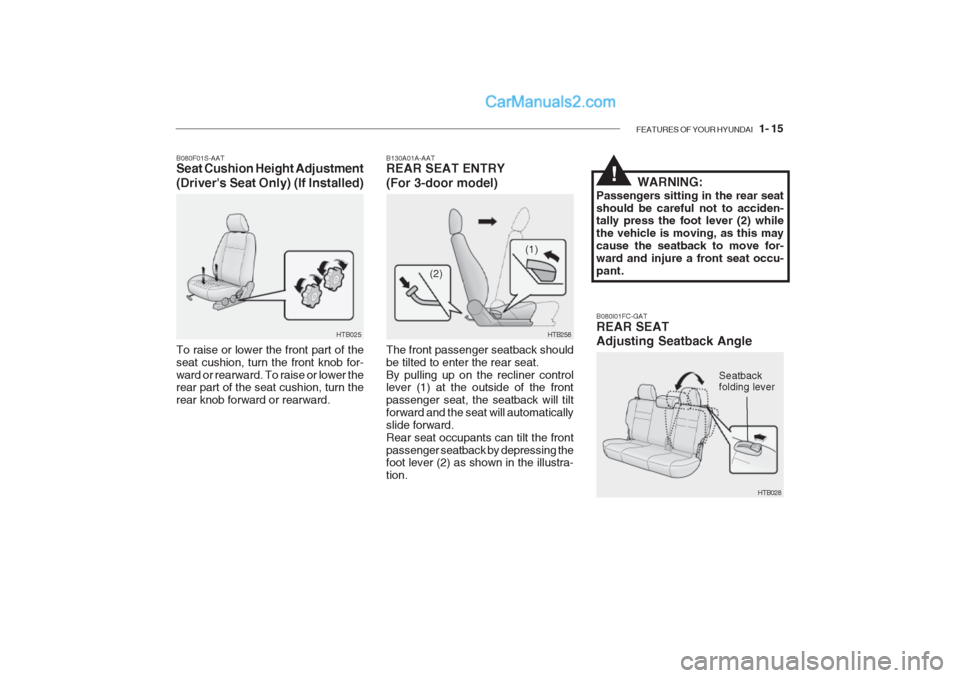
B080F01S-AAT Seat Cushion Height Adjustment (Driver's Seat Only) (If Installed) To raise or lower the front part of the seat cushion, turn the front knob for-ward or rearward. To raise or lower the rear part of the seat cushion, turn the rear knob forward or rearward. B130A01A-AAT REAR SEAT ENTRY (For 3-door model) The front passenger seatback should be tilted to enter the rear seat.By pulling up on the recliner control lever (1) at the outside of the front passenger seat, the seatback will tiltforward and the seat will automaticallyslide forward.Rear seat occupants can tilt the frontpassenger seatback by depressing the foot lever (2) as shown in the illustra- tion. WARNING:
Passengers sitting in the rear seatshould be careful not to acciden- tally press the foot lever (2) while the vehicle is moving, as this maycause the seatback to move for-ward and injure a front seat occu-pant.
HTB258
!
HTB028
Seatback folding lever
B080I01FC-GAT REAR SEAT Adjusting Seatback Angle
(1)
(2)
Page 29 of 428
1- 16 FEATURES OF YOUR HYUNDAI
Lock Knob
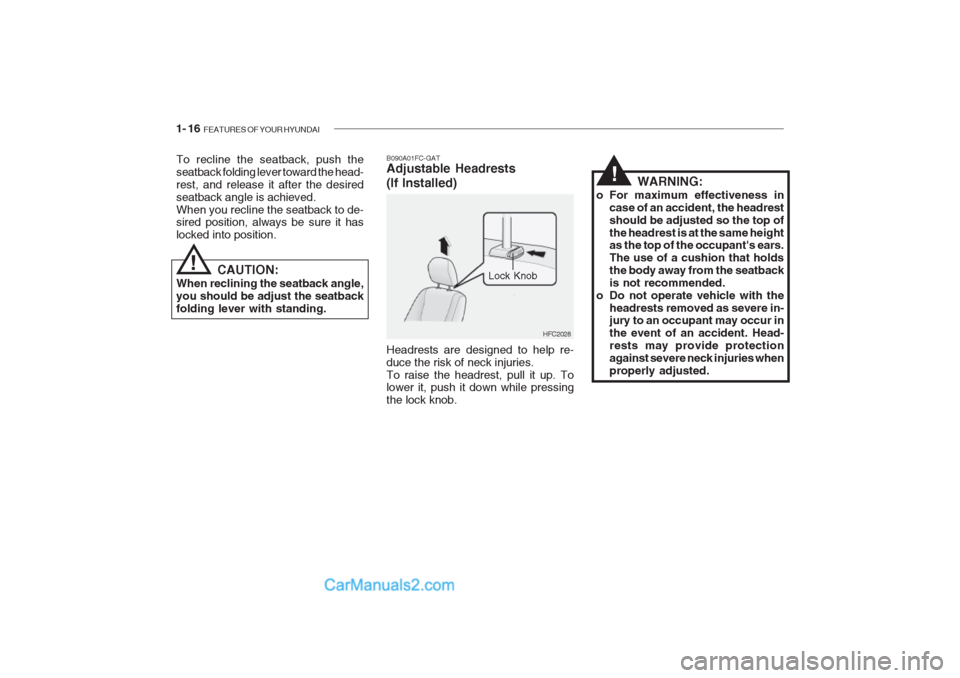
B090A01FC-GAT Adjustable Headrests
(If Installed) Headrests are designed to help re- duce the risk of neck injuries.To raise the headrest, pull it up. To lower it, push it down while pressing the lock knob.
To recline the seatback, push theseatback folding lever toward the head-rest, and release it after the desiredseatback angle is achieved.When you recline the seatback to de- sired position, always be sure it has locked into position.
CAUTION:
When reclining the seatback angle,you should be adjust the seatbackfolding lever with standing.
!
HFC2028WARNING:
o For maximum effectiveness in case of an accident, the headrest should be adjusted so the top ofthe headrest is at the same height as the top of the occupant's ears.
The use of a cushion that holdsthe body away from the seatbackis not recommended.
o Do not operate vehicle with the headrests removed as severe in- jury to an occupant may occur in the event of an accident. Head-rests may provide protectionagainst severe neck injuries whenproperly adjusted.
!
Page 35 of 428
1- 22 FEATURES OF YOUR HYUNDAI
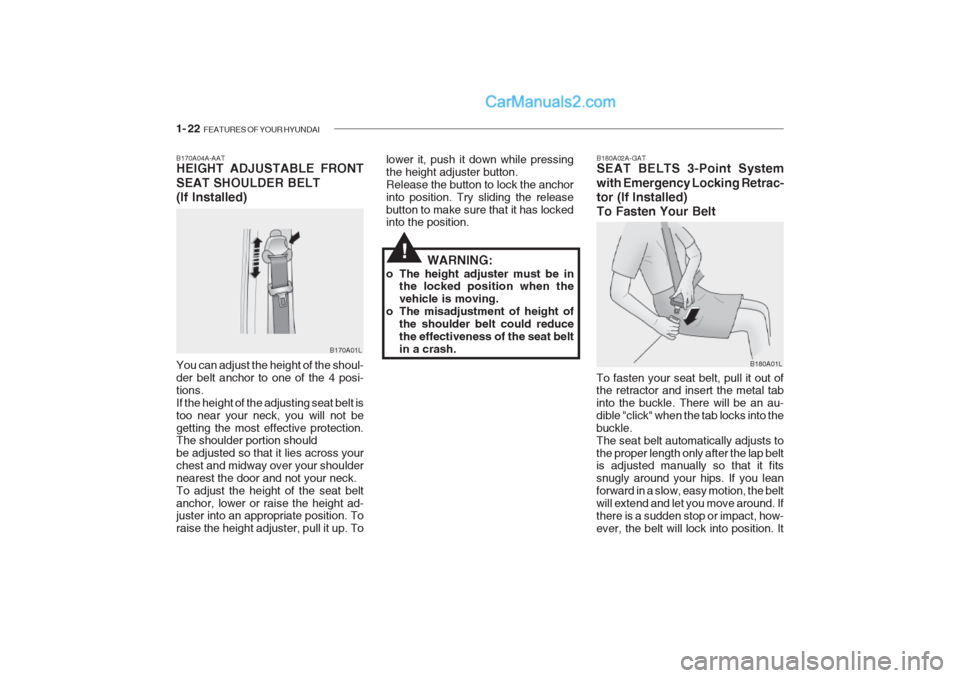
B180A02A-GAT SEAT BELTS 3-Point System with Emergency Locking Retrac-
tor (If Installed)To Fasten Your Belt
B180A01L
To fasten your seat belt, pull it out of the retractor and insert the metal tab into the buckle. There will be an au-dible "click" when the tab locks into thebuckle.The seat belt automatically adjusts tothe proper length only after the lap belt is adjusted manually so that it fits snugly around your hips. If you leanforward in a slow, easy motion, the beltwill extend and let you move around. Ifthere is a sudden stop or impact, how-ever, the belt will lock into position. It
B170A04A-AAT HEIGHT ADJUSTABLE FRONT SEAT SHOULDER BELT (If Installed)
B170A01L
You can adjust the height of the shoul- der belt anchor to one of the 4 posi-tions.If the height of the adjusting seat belt istoo near your neck, you will not begetting the most effective protection. The shoulder portion should be adjusted so that it lies across yourchest and midway over your shouldernearest the door and not your neck.To adjust the height of the seat beltanchor, lower or raise the height ad- juster into an appropriate position. To raise the height adjuster, pull it up. To lower it, push it down while pressingthe height adjuster button.Release the button to lock the anchorinto position. Try sliding the releasebutton to make sure that it has locked into the position.
WARNING:
o The height adjuster must be in the locked position when the vehicle is moving.
o The misadjustment of height of the shoulder belt could reducethe effectiveness of the seat beltin a crash.
!
Page 39 of 428
1- 26 FEATURES OF YOUR HYUNDAI
o Children who are too large to be in
a child restraint should sit in the rear seat and be restrained withthe available lap/shoulder belts. Never allow children to ride in the front passenger seat.
o Always make sure that the shoul- der belt portion of the outboardlap/shoulder belt is positioned midway over the shoulder, never across the neck or behind theback. Moving the child closer tothe center of the vehicle may helpprovide a good shoulder belt fit.The lap belt portion of the lap/ shoulder belt or the center seat lap belt must always be posi-tioned as low as possible on thechild's hips and as snug as pos-sible.
o If the seat belt will not properly fit the child, Hyundai recommendsthe use of an approved boosterseat in the rear seat in order toraise the child's seating height sothat the seat belt will properly fit the child.B230A03A-GAT CHILD RESTRAINT SYSTEM (If Installed) Children riding in the car should sit in the rear seat and must always beproperly restrained to minimize therisk of injury in an accident, suddenstop or sudden maneuver. According to accident statistics, children are safer when properly restrained in the rearseats than in the front seat. Largerchildren not in a child restraint shoulduse one of the seat belts provided.You are required by law to use safety restraints for children. If small children ride in your vehicle you must put themin a child restraint system (safety seat).Children could be injured or killed in acrash if their restraints are not properlysecured. For small children and ba- bies, a child seat or infant seat must be used. Before buying a particular childrestraint system, make sure it fits yourcar and seat belts, and fits your child.Follow all the instructions provided bythe manufacturer when installing the child restraint system. WARNING:
o A child restraint system must be placed in the rear seat. Never install a child or infant seat onthe front passenger's seat. Should an accident occur and cause the passenger side airbagto deploy, it could severely in-jure or kill an infant or child seatedin an infant or child seat. Thus,only use a child restraint in the rear seat of your vehicle.
o Since a safety belt or child re- straint system can become very hot if it is left in a closed vehicle,be sure to check the seat cover and buckles before placing a child there.
o When the child restraint system is not in use, store it in the trunk orfasten it with a safety belt so that it will not be thrown forward in the case of a sudden stop or an acci-dent.
!
Page 121 of 428
1- 108 FEATURES OF YOUR HYUNDAI
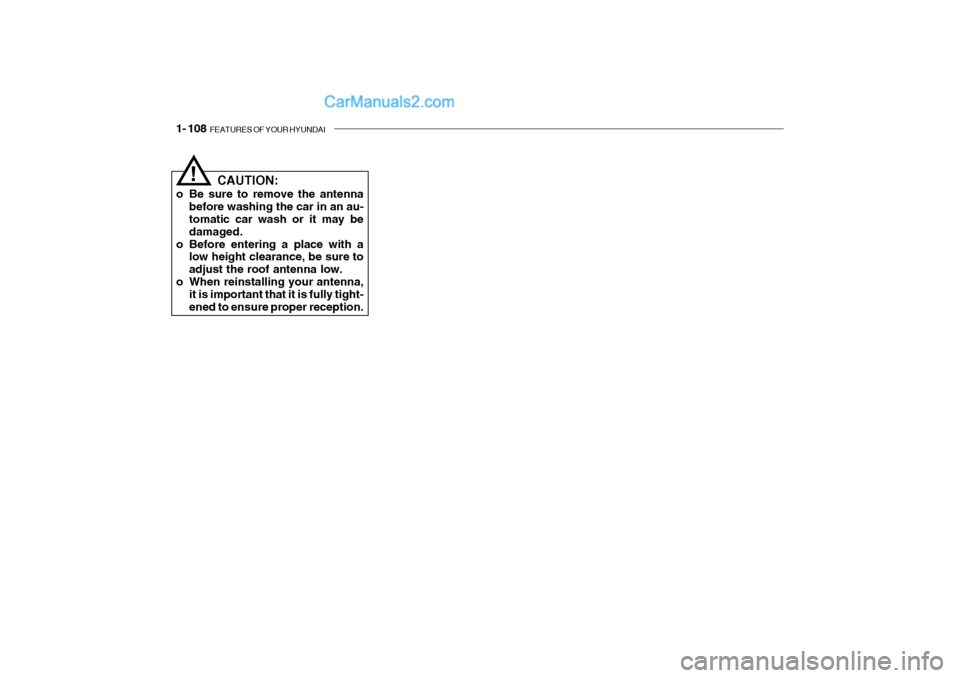
CAUTION:
o Be sure to remove the antenna before washing the car in an au- tomatic car wash or it may be damaged.
o Before entering a place with a low height clearance, be sure toadjust the roof antenna low.
o When reinstalling your antenna, it is important that it is fully tight-ened to ensure proper reception.!
Page 135 of 428

2- 14 DRIVING YOUR HYUNDAI
o Drive at a moderate speed. The
faster you drive, the more fuel your car uses. Driving at a moderatespeed, especially on the highway, is one of the most effective ways to reduce fuel consumption.
o Don't "ride" the brake or clutch pedal. This can increase fuel consumptionand also increase wear on thesecomponents. In addition, driving with your foot resting on the brake pedal may cause the brakes to overheat,which reduces their effectiveness and may lead to more serious con- sequences.
o Take care of your tires. Keep them inflated to the recommended pres-sure. Incorrect inflation, either toomuch or too little, results in unnec- essary tire wear. Check the tire pres- sures at least once a month.
o Be sure that the wheels are aligned correctly. Improper alignment canresult from hitting curbs or drivingtoo fast over irregular surfaces. Poor alignment causes faster tire wear and may also result in other prob-lems as well as greater fuel con- sumption.
WARNING:
ABS will not prevent accidents due to improper or dangerous driving maneuvers. Even though vehicle control is improved during emer-gency braking, always maintain a safe distance between you and ob- jects ahead. Vehicle speeds shouldalways be reduced during extreme road conditions. The braking distance for cars equipped with an anti-lock braking system may be longer than for those without it in the following road con-ditions.
o Driving on rough, gravel or snow- covered roads.
o Driving with tire chains installed.
o Driving on roads where the road
surface is pitted or has different surface height.
!During these conditions, the ve- hicle should be driven at reduced speeds. The safety features of anABS equipped vehicle should not be tested by high speed driving or cornering. This could endanger thesafety of yourself or others.
C140A01A-GAT DRIVING FOR ECONOMY You can save fuel and get more kilo- meters from your car if you follow these suggestions:
o Drive smoothly. Accelerate at amoderate rate. Don't make "jack- rabbit" starts or full-throttle shifts and maintain a steady cruisingspeed. Don't race between stop- lights. Try to adjust your speed to that of the other traffic so you don'thave to change speeds unneces- sarily. Avoid heavy traffic whenever possible.Always maintain a safe distance from other vehicles so you can avoid unnecessary braking. This also re-duces brake wear.
Page 225 of 428

9- 2 VEHICLE SPECIFICATIONS
1.3 L
1.6 L
Type Wheel free playRack stroke Oil pump type 3,810 (150) 1,665(65.6) 1,495(58.9) 1,490(58.7)2,455(96.7) 1,450(57.1) 1,440(56.7)
Overall lengthOverall width Overall height (unladen)Wheel base Wheel tread J030A02TB-GAT TIRE1.1 L
13.5V,70A
Dual hydraulic with brake booster Ventilated disc DrumCable
J010A01TB-GAT MEASUREMENT
J060A01TB-GAT FUEL SYSTEM
Rack and pinion 0 ~ 30 mm (0 ~ 1.18 in.) 132 mm (5.20 in.)140 mm (5.5 in.) Vane type
155/80R13, 165/65R14 175/65R14, 185/55R15
StandardOption
Front Rear
mm (in.)
J020A01TB-GAT POWER STEERING
Fuel tank Capacity Liter
45 Imp.gal
9.9
J040A03TB-GAT ELECTRICAL
Item Battery Alternator
J050A01FC-GAT BRAKE Type Front brake typeRear brake type Parking brake
J035A01TB-GAT SPARE TIRE
T105/70D14(Temporary) Full size
Standard Option
DIESEL
1.5 L
60AH
12V, 90AGASOLINE
GEN EC
Manual Power 13.5V, 90A
45AH, 55AH
Page 230 of 428
INDEX 10- 3
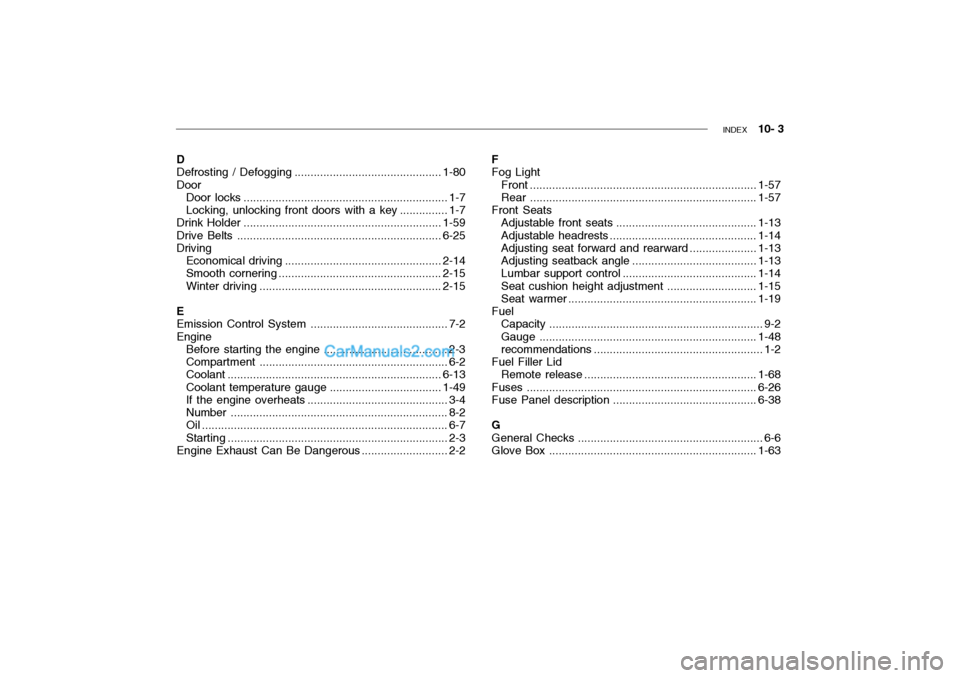
D Defrosting / Defogging .............................................. 1-80
Door Door locks ................................................................ 1-7
Locking, unlocking front doors with a key ............... 1-7
Drink Holder .............................................................. 1-59
Drive Belts ................................................................ 6-25
Driving
Economical driving ................................................. 2-14
Smooth cornering ................................................... 2-15
Winter driving ......................................................... 2-15
EEmission Control Syst em ........................................... 7-2
Engine Before starting the engine ....................................... 2-3
Compartment ........................................................... 6-2
Coolant ................................................................... 6-13
Coolant temperature gauge ................................... 1-49
If the engine overheats ............................................ 3-4
Number .................................................................... 8-2
Oil ............................................................................. 6-7
Starting ..................................................................... 2-3
Engine Exhaust Can Be Dangerous ........................... 2-2F Fog Light
Front ....................................................................... 1-57
Rear ....................................................................... 1-57
Front Seats Adjustable front seats ............................................ 1-13
Adjustable headrest s .............................................. 1-14
Adjusting seat forward and rear ward..................... 1-13
Adjusting seatback angle .......................................1-13
Lumbar support control .................. ........................ 1-14
Seat cushion height adjustment............................ 1-15
Seat warmer ........................................................... 1-19
Fuel Capacity ................................................................... 9-2
Gauge .................................................................... 1-48
recommendations ..................................................... 1-2
Fuel Filler Lid Remote release ...................................................... 1-68
Fuses ........................................................................ 6-26
Fuse Panel description ............................................. 6-38
G General Checks .......................................................... 6-6
Glove Box ................................................................. 1-63
Page 232 of 428

INDEX 10- 5
P Parking Brake ........................................................... 1-67
Power Steering Fluid Level ............................. ..........6-30
Power Windows ........................................................ 1-12
R Rear Seat .................................................................. 1-15
Rear Window Defroster Switch ................................ 1-56
SSeat Front ....................................................................... 1-13
Seatback Holder ....................................................... 1-70
Seat Pocket .............................................................. 1-70
Seat Warmer ............................................................. 1-19
Seat Belts
3-Point system ....................................................... 1-22
Adjustable height .................................................... 1-22
Adjusting your seat be lt .........................................1-23
Care of seat belts .................................................. 1-21
Precautions ............................................................ 1-20
Spark Plugs ............................................................... 6-15
Spectacle Case ......................................................... 1-63
Speedometer ............................................................. 1-49
Starting ........................................................................ 2-5
Steering Wheel Freeplay .................. ........................ 6-24
Steering Wheel Tilt Lever .............. ...........................1-74
Stereo Radio Operation (K210/K220, K240, H280)
............................................................ 1-86, 1-91, 1-96Stereo Sound System
............................................... 1-84
Sun Visor .................................................................. 1-73
Sunroof ...................................................................... 1-60
T Tachometer ............................................................... 1-49
Tail gate .................................................................... 1-69
Theft-Alarm system ..................................................... 1-9
Tires Balancing .................................................................. 8-5
Chains ...................................................................... 8-4
If you have a flat tire ............................................... 3-6
Information ............................................................... 8-3
Pressure ................................................................... 8-3
Replacement ............................................................ 8-7
Rotation .................................................................... 8-5
Snow tires ................................................................ 8-4
Spare tire ................................................................. 3-5
Traction .................................................................... 8-5
Towing
A trailer (or vehicle) ............................................... 2-18
Emergency ............................................................. 3-13
If your car must be towed .....................................3-11
Trailer or Vehicle towing ........................................... 2-18
Transaxle Automatic ................................................................. 2-9
Automatic transaxle fluid checking ........................6-19
Manual ..................................................................... 2-7
Manual transaxle Oil checking............................... 6-18
Trip Computer ........................................................... 1-51
Trip Odometer ........................................................... 1-50