Sound system Hyundai Getz 2003 User Guide
[x] Cancel search | Manufacturer: HYUNDAI, Model Year: 2003, Model line: Getz, Model: Hyundai Getz 2003Pages: 444, PDF Size: 13.82 MB
Page 131 of 444
1- 116 FEATURES OF YOUR HYUNDAI
NOTE:
o When replacing the fuse, replace
it with a fuse having the correct capacity.
o This equipment is designed to be used only in a 12 volt DC batterysystem with negative ground.
o This unit is made of precision parts. Do not attempt to disas-semble or adjust any parts.
o When driving your vehicle, be sure to keep the volume of the unit setlow enough to allow you to hearsounds coming from the outside.
! CAUTION:
Do not insert warped or poor quality discs into the CD changer as damageto the unit may occur.
Page 138 of 444

2- 2 DRIVING YOUR HYUNDAI
C010A01O-AAT
WARNING: ENGINE EXHAUST CAN BE DANGEROUS!
Engine exhaust fumes can be extremely dangerous. If, at any time, you smell exhaust fumes inside the vehicle, open the windows immediately. o Do not inhale exhaust fumes. Exhaust fumes contain carbon monoxide, a colorless, odorless gas that can cause unconsciousness and death by asphyxiation. o Be sure the exhaust system does not leak. The exhaust system should be checked whenever the vehicle is raised to change the oil or for any other purpose. If you hear a change in the sound of the exhaust or if you drive over something that strikes the underneath side of the car, have the exhaust system checked as soon as possible by your Hyundai dealer. o Do not run the engine in an enclosed area. Letting the engine idle in your garage, even with the garage door open, is a hazardous practice. Never run the engine in your garage any longer than it takes to start the engine and back the car out. o Avoid idling the engine for prolonged periods with people inside the car. If it is necessary to idle the engine for a prolonged period with people inside the car, be sure to do so only in an open area with the air intake set at "Fresh" and fan operating at one of the higher speeds so fresh air is drawn into the interior. If you must drive with the tail gate open because you are carrying objects that make this necessary: 1. Close all windows. 2. Open side vents. 3. Set the air intake control at "Fresh", the air flow control at "Floor" or "Face" and the fan at one of the higher speeds.
To assure proper operation of the ventilation system, be sure the ventilation air intakes located just in front ofthe windshield are kept clear of snow, ice, leaves or other obstructions.
!
Page 247 of 444
INDEX 10- 5
P
Parking Brake ........................................................... 1-67
Power Steering Fluid Level ....................................... 6-30
Power Windows ........................................................ 1-12 R
Rear Seat .................................................................. 1-15
Rear Window Defroster Switch ................................ 1-56 S Seat
Front ....................................................................... 1-13
Seatback Holder ....................................................... 1-70
Seat Pocket .............................................................. 1-70
Seat Warmer ............................................................. 1-19 Seat Belts 3-Point system ....................................................... 1-22
Adjustable height .................................................... 1-22
Adjusting your seat belt ......................................... 1-23
Care of seat belts .................................................. 1-21
Precautions ............................................................ 1-20
Spark Plugs ............................................................... 6-15
Spectacle Case ......................................................... 1-63
Speedometer ............................................................. 1-49
Starting ........................................................................ 2-5
Steering Wheel Freeplay .......................................... 6-24
Steering Wheel Tilt Lever ......................................... 1-74 Stereo Radio Operation (K210/K220, K240, H280, HMP280)
................................................. 1-86, 1-91, 1-96, 1-105 Stereo Sound System ............................................... 1-84
Sun Visor .................................................................. 1-73
Sunroof ...................................................................... 1-60 T
Tachometer ............................................................... 1-49
Tail gate .................................................................... 1-69
Theft-Alarm system ..................................................... 1-9 Tires
Balancing .................................................................. 8-5
Chains ...................................................................... 8-4
If you have a flat tire ............................................... 3-6
Information ............................................................... 8-3
Pressure ................................................................... 8-3
Replacement ............................................................ 8-7
Rotation .................................................................... 8-5
Snow tires ................................................................ 8-4
Spare tire ................................................................. 3-5
Traction .................................................................... 8-5
Towing
A trailer (or vehicle) ............................................... 2-18
Emergency ............................................................. 3-13
If your car must be towed ..................................... 3-11
Trailer or Vehicle towing ........................................... 2-18Transaxle Automatic ................................................................. 2-9
Automatic transaxle fluid checking ........................ 6-19
Manual ..................................................................... 2-7
Manual transaxle Oil checking ............................... 6-18
Trip Computer ........................................................... 1-51
Trip Odometer ........................................................... 1-50
Page 261 of 444
1. FEATURES OF YOUR HYUNDAI
Fuel Recommendations ................................................................... 1-2
Running In ........................................................................................ 1-3
Immobilizer system .......................................................................... 1-4
Door locks (Theft-alarm system) ..................................................... 1-5Power windows.............................................................................. 1-10
Seat ................................................................................................ 1-11
Seat Belt ......................................................................................... 1-16
Child restraint system .................................................................... 1-21
Supplemental restraint (AIRBAG) system .....................................1-29
Instrument cluster and indicator lights ............................................1-35
Warning Light and Indicator ............................................................ 1-37
Trip computer ................................................................................. 1-44
Multi-Function Light Sw itch ............................................................ 1-46
Windshield wiper/Washer Switch ...................................................1-48
Sunroof ........................................................................................... 1-53
Mirror .............................................................................................. 1-57
Bonnet Release .............................................................................. 1-60
How to use luggage Room ............................................................. 1-63
Heating and cooling control ............................................................ 1-68
Stereo sound system ..................................................................... 1-77
Antenna .......................................................................................... 1-81
1
Page 268 of 444
1- 8 FEATURES OF YOUR HYUNDAI
HTB202
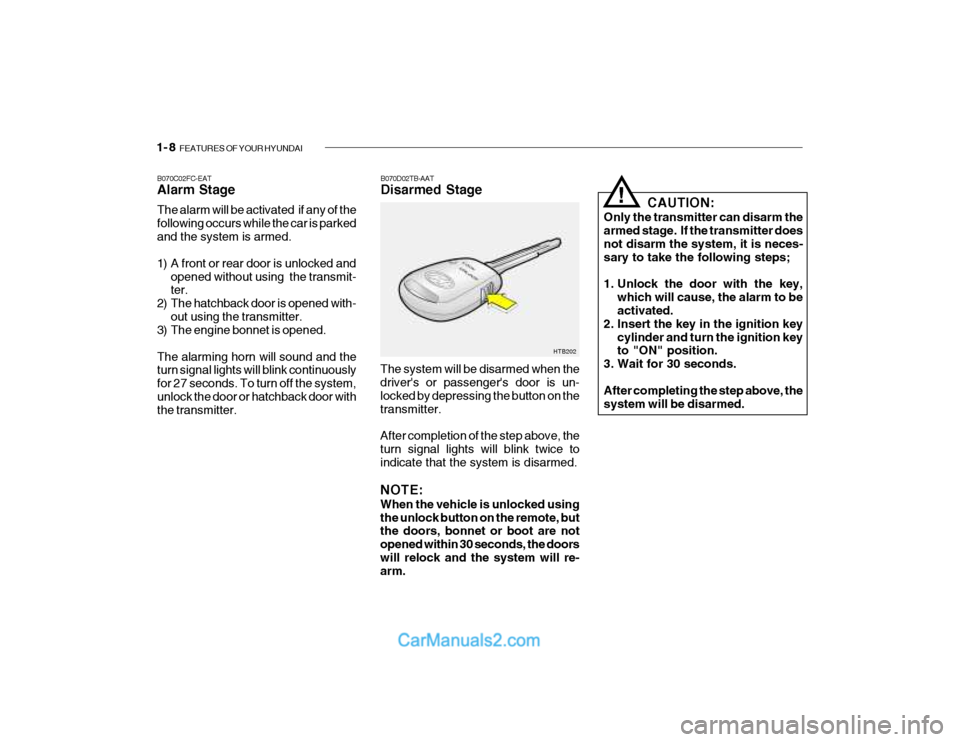
B070D02TB-AAT Disarmed Stage
B070C02FC-EATAlarm Stage The alarm will be activated if any of the following occurs while the car is parkedand the system is armed.
1) A front or rear door is unlocked and
opened without using the transmit- ter.
2) The hatchback door is opened with-
out using the transmitter.
3) The engine bonnet is opened. The alarming horn will sound and the turn signal lights will blink continuously for 27 seconds. To turn off the system,unlock the door or hatchback door with the transmitter. The system will be disarmed when thedriver's or passenger's door is un- locked by depressing the button on thetransmitter. After completion of the step above, the turn signal lights will blink twice to indicate that the system is disarmed. NOTE: When the vehicle is unlocked using the unlock button on the remote, but the doors, bonnet or boot are not opened within 30 seconds, the doorswill relock and the system will re- arm. CAUTION:
Only the transmitter can disarm thearmed stage. If the transmitter does not disarm the system, it is neces-sary to take the following steps;
1. Unlock the door with the key, which will cause, the alarm to be activated.
2. Insert the key in the ignition key cylinder and turn the ignition keyto "ON" position.
3. Wait for 30 seconds. After completing the step above, the system will be disarmed.
!
Page 285 of 444
FEATURES OF YOUR HYUNDAI 1- 25
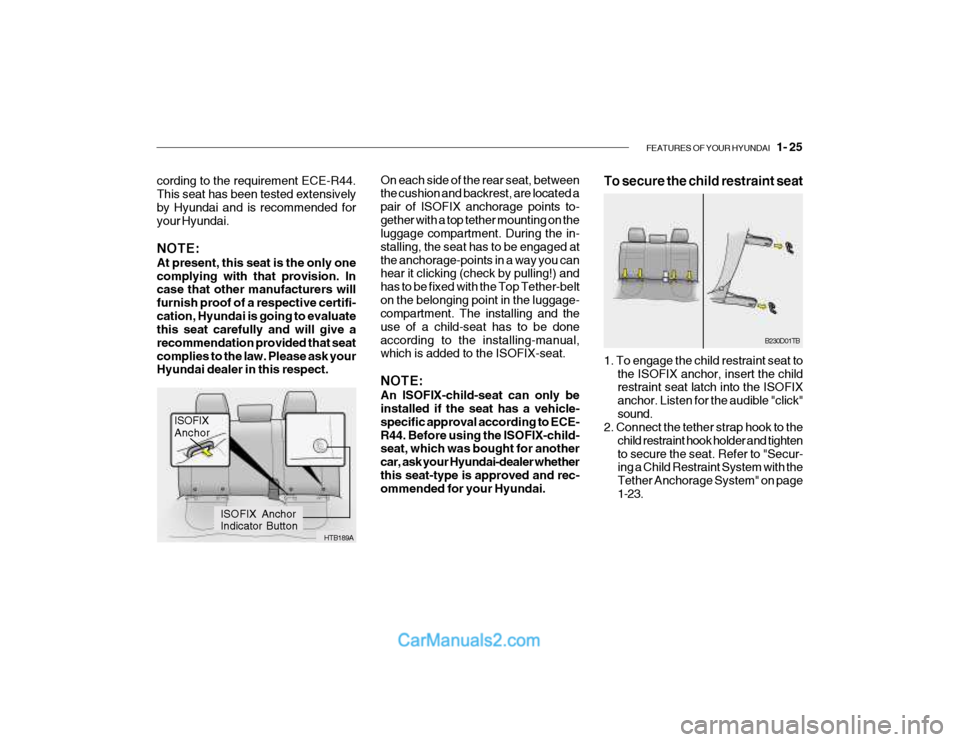
On each side of the rear seat, between the cushion and backrest, are located a pair of ISOFIX anchorage points to-gether with a top tether mounting on the luggage compartment. During the in- stalling, the seat has to be engaged atthe anchorage-points in a way you can hear it clicking (check by pulling!) and has to be fixed with the Top Tether-belton the belonging point in the luggage- compartment. The installing and the use of a child-seat has to be doneaccording to the installing-manual, which is added to the ISOFIX-seat. NOTE: An ISOFIX-child-seat can only be installed if the seat has a vehicle- specific approval according to ECE-R44. Before using the ISOFIX-child- seat, which was bought for another car, ask your Hyundai-dealer whetherthis seat-type is approved and rec- ommended for your Hyundai. B230D01TB
1. To engage the child restraint seat to the ISOFIX anchor, insert the childrestraint seat latch into the ISOFIX anchor. Listen for the audible "click"sound.
2. Connect the tether strap hook to the
child restraint hook holder and tightento secure the seat. Refer to "Secur- ing a Child Restraint System with the Tether Anchorage System" on page1-23.
To secure the child restraint seatcording to the requirement ECE-R44. This seat has been tested extensivelyby Hyundai and is recommended for your Hyundai. NOTE: At present, this seat is the only one complying with that provision. In case that other manufacturers will furnish proof of a respective certifi-cation, Hyundai is going to evaluate this seat carefully and will give a recommendation provided that seatcomplies to the law. Please ask your Hyundai dealer in this respect.
HTB189A
ISOFIX Anchor
ISOFIX Anchor Indicator Button
Page 337 of 444
FEATURES OF YOUR HYUNDAI 1- 77
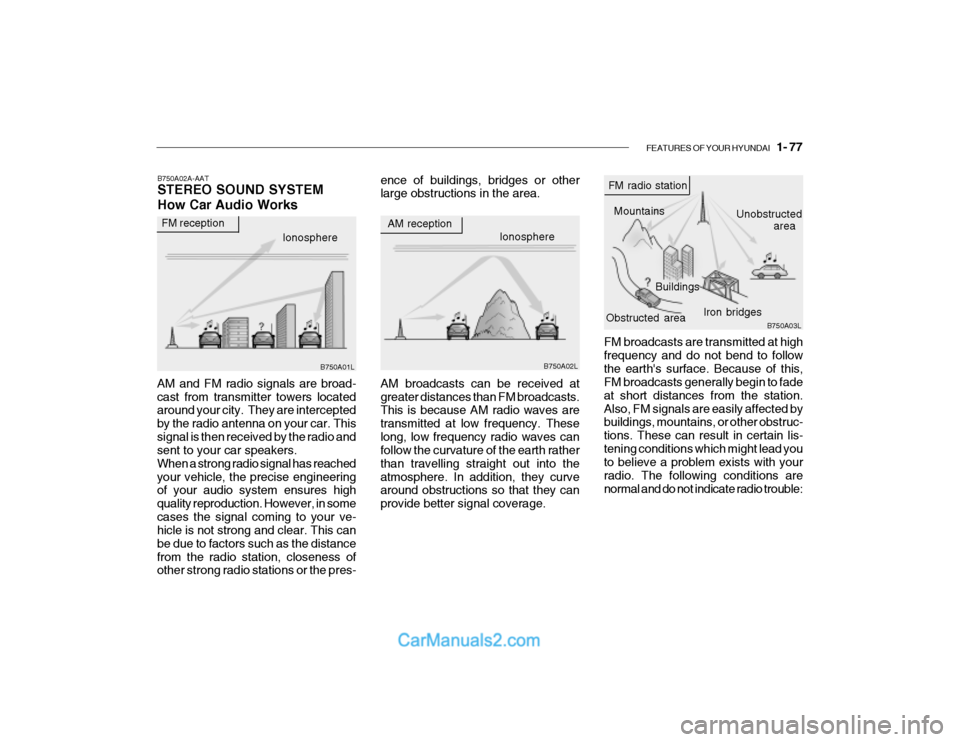
Ionosphere
B750A02L
AM reception
Mountains
Buildings Unobstructed
area
FM radio station
B750A03L
Ionosphere
FM reception
B750A01L Obstructed area
Iron bridges
FM broadcasts are transmitted at high frequency and do not bend to followthe earth's surface. Because of this, FM broadcasts generally begin to fade at short distances from the station.Also, FM signals are easily affected by buildings, mountains, or other obstruc- tions. These can result in certain lis-tening conditions which might lead you to believe a problem exists with your radio. The following conditions arenormal and do not indicate radio trouble:
AM broadcasts can be received atgreater distances than FM broadcasts. This is because AM radio waves are transmitted at low frequency. Theselong, low frequency radio waves can follow the curvature of the earth rather than travelling straight out into theatmosphere. In addition, they curve around obstructions so that they can provide better signal coverage.
B750A02A-AAT STEREO SOUND SYSTEM How Car Audio Works
AM and FM radio signals are broad- cast from transmitter towers located around your city. They are intercepted by the radio antenna on your car. Thissignal is then received by the radio and sent to your car speakers. When a strong radio signal has reachedyour vehicle, the precise engineering of your audio system ensures high quality reproduction. However, in somecases the signal coming to your ve- hicle is not strong and clear. This can be due to factors such as the distancefrom the radio station, closeness of other strong radio stations or the pres- ence of buildings, bridges or otherlarge obstructions in the area.
Page 338 of 444
1- 78 FEATURES OF YOUR HYUNDAI
!
B750A04L B750A05L
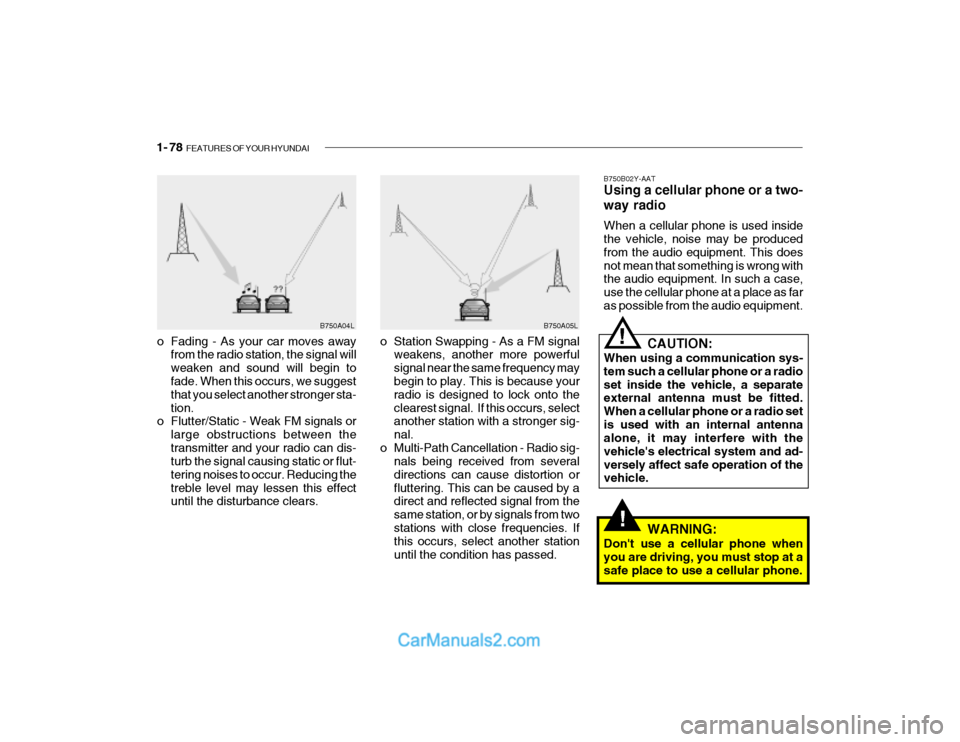
o Station Swapping - As a FM signal weakens, another more powerful signal near the same frequency may begin to play. This is because your radio is designed to lock onto theclearest signal. If this occurs, select another station with a stronger sig- nal.
o Multi-Path Cancellation - Radio sig- nals being received from severaldirections can cause distortion orfluttering. This can be caused by a direct and reflected signal from the same station, or by signals from twostations with close frequencies. If this occurs, select another station until the condition has passed.
o Fading - As your car moves away
from the radio station, the signal willweaken and sound will begin to fade. When this occurs, we suggest that you select another stronger sta-tion.
o Flutter/Static - Weak FM signals or
large obstructions between thetransmitter and your radio can dis- turb the signal causing static or flut- tering noises to occur. Reducing thetreble level may lessen this effect until the disturbance clears. B750B02Y-AAT Using a cellular phone or a two- way radio When a cellular phone is used inside the vehicle, noise may be produced from the audio equipment. This doesnot mean that something is wrong with the audio equipment. In such a case, use the cellular phone at a place as faras possible from the audio equipment.
!
CAUTION:
When using a communication sys- tem such a cellular phone or a radio set inside the vehicle, a separate external antenna must be fitted. When a cellular phone or a radio setis used with an internal antenna alone, it may interfere with the vehicle's electrical system and ad-versely affect safe operation of the vehicle.
WARNING:
Don't use a cellular phone when you are driving, you must stop at a safe place to use a cellular phone.
Page 444 of 444
INDEX 10- 5
SUPPLEMENTAL RESTRAINT (AIRBAG)
SYSTEM ............................................................... 1-29
STARTING THE ENGINE ........................................... 2-5 STEERING WHEEL FREEPLAY ..............................6-21
STEERING WHEEL LOCK ......................................... 2-4STEERING WHEEL TILT LEVER ............................. 1-67
STEREO SOUND SYSTEM ......................................1-77
SUN-VISOR .............................................................. 1-66
SUNROOF ................................................................ 1-53
TTACHOMETER ......................................................... 1-43
TAIL GATE ................................................................ 1-62
TOWING ATTACHMENTS ................ .......................2-17
TRAILER AND CARAVAN TOWING ........................2-17
TRIP ODOMETER .................................................... 1-43
TRIP COMPUTER .................................................... 1-44
TYPE PRESSURES .................................................... 8-3
TYRE BALANCING ..................................................... 8-5
TYRE CHAINS ............................................................ 8-4
TYRE REPLACEMENT ............................................... 8-5
TYRE ROTATION ....................................................... 8-4
U
UNDERBODY COATINGS ......................................... 4-2 V VALETING
.................................................................. 4-3
VEHICLE IDENTIFICATION NUMBER ....................... 8-2
VEHICLE SPECIFICATION ........................................ 9-2 VEHICLE TOWING OR RECOVERY ....................... 3-11
VENTILATION .......................................................... 1-68
WWHEEL REPLACEMENT ........................................... 8-5
WINDSCREEN WASHER RESERVOIR REPLENISHMENT ................................................ 6-15
WINDSCREEN WIPER BLADES ..............................6-14
WINDSHIELD WIPER/WASHER SWITCH ...............1-48
WINTER MOTORING ............................................... 2-15