ECU Hyundai Getz 2003 Service Manual
[x] Cancel search | Manufacturer: HYUNDAI, Model Year: 2003, Model line: Getz, Model: Hyundai Getz 2003Pages: 444, PDF Size: 13.82 MB
Page 388 of 444
5- 8 VEHICLE MAINTENANCE REQUIREMENTS
6ZF070C1-A
o Engine coolant
The coolant should be changed at the intervals specified in the mainte- nance schedule.
6ZF060H1-A
o Air cleaner filter
A Genuine Hyundai air cleaner filter is
recommended when filter is replaced.
6ZF060J1-A
o Spark plugs
Make sure to install new spark plugs
of the correct heat range.
6ZF070B1-A
o Cooling system
Check the cooling system part, such as radiator, coolant reservoir, hoses and connections for leakage and dam- age. Replace any damaged parts. 6ZF070D1-A
o Manual transaxle oil
Inspect the manual transaxle oil ac-
cording to the maintenance schedule. NOTE:
If the oil level is low, check for
possible leaks before adding oil. Do not overfill.
F070E03A-AAT
o Automatic transaxle fluid
The fluid level should be in the "HOT"
range of the dipstick, after engine and transaxle are at normal operating tem- perature. Check the Automatic Transaxle Fluid level with the enginerunning and the transaxle in neutral, with the parking brake properly ap- plied. Use DIAMOND ATF SP-III orSK ATF SP-III when adding or chang- ing fluid.
6ZF060G1-A o Vapour hose and fuel filler cap The vapour hose and fuel filler cap should be inspected at those intervals specified in the maintenance sched- ule. Make sure that a new vapourhose or fuel filler cap is correctly re- placed. 6ZF060F1-A
o Vacuum, crankcase
ventilation hoses
Inspect the surface of hoses for evi- dence of heat and/or mechanical dam-age. Hard and brittle rubber, cracking, tears, cuts, abrasions, and excessive swelling indicate deterioration. Par-ticular attention should be paid to ex- amining those hose surfaces nearest to high heat sources, such as theexhaust manifold.Inspect the hose routing to assurethat the hoses do not come in contact with any heat source, sharp edges or moving component which might causeheat damage or mechanical wear. Inspect all hose connections, such as clamps and couplings, to make surethey are secure, and that no leaks are present. Hoses should be replaced immediately if there is any evidence of deterioration or damage.
Page 399 of 444
DO-IT-YOURSELF MAINTENANCE 6- 9
Oil filler cap 1.3L
F040A01TB HTB222
Oil filter
Drain plug Oil filler cap
Drain plug Oil filter
1.1L
.........
More engine oil may be consumed under severe driving conditions such as high speeds, frequent accelera-tion and deceleration, compared to normal driving.
1.6L
F040A02TBOil filler cap
Drain plug
Oil filter
.........
Diesel (RHD)
KCHB001A-1
Engine oil drain plugOil filter................
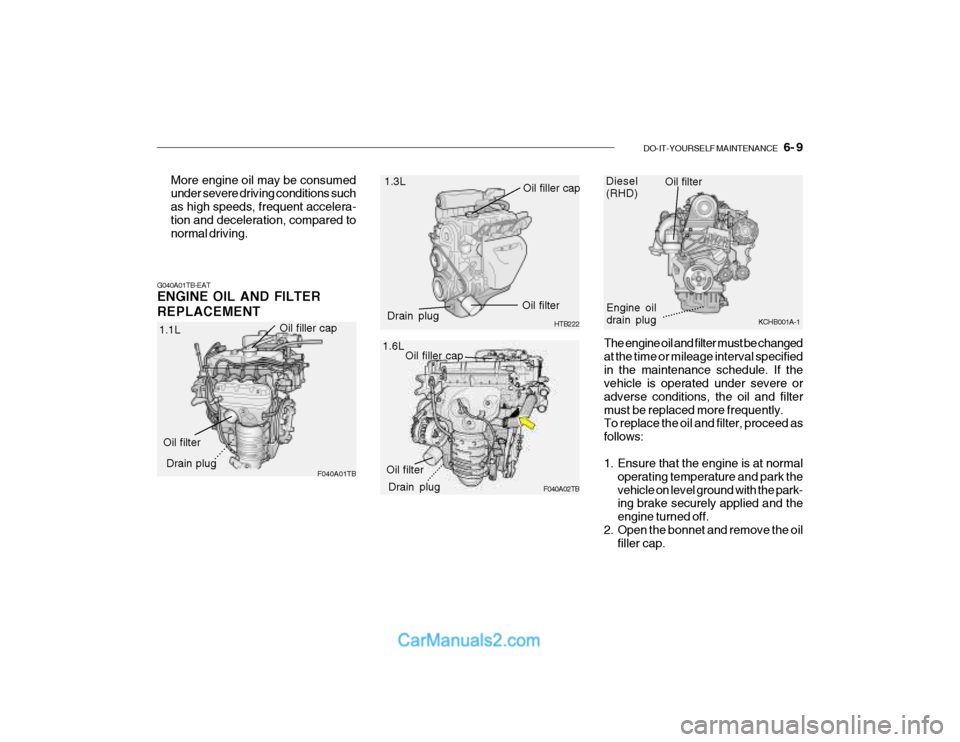
G040A01TB-EAT ENGINE OIL AND FILTER REPLACEMENT
The engine oil and filter must be changed at the time or mileage interval specifiedin the maintenance schedule. If the vehicle is operated under severe or adverse conditions, the oil and filtermust be replaced more frequently. To replace the oil and filter, proceed as follows:
1. Ensure that the engine is at normaloperating temperature and park the vehicle on level ground with the park- ing brake securely applied and the engine turned off.
2. Open the bonnet and remove the oil filler cap.
Page 407 of 444
DO-IT-YOURSELF MAINTENANCE 6- 17
!
!
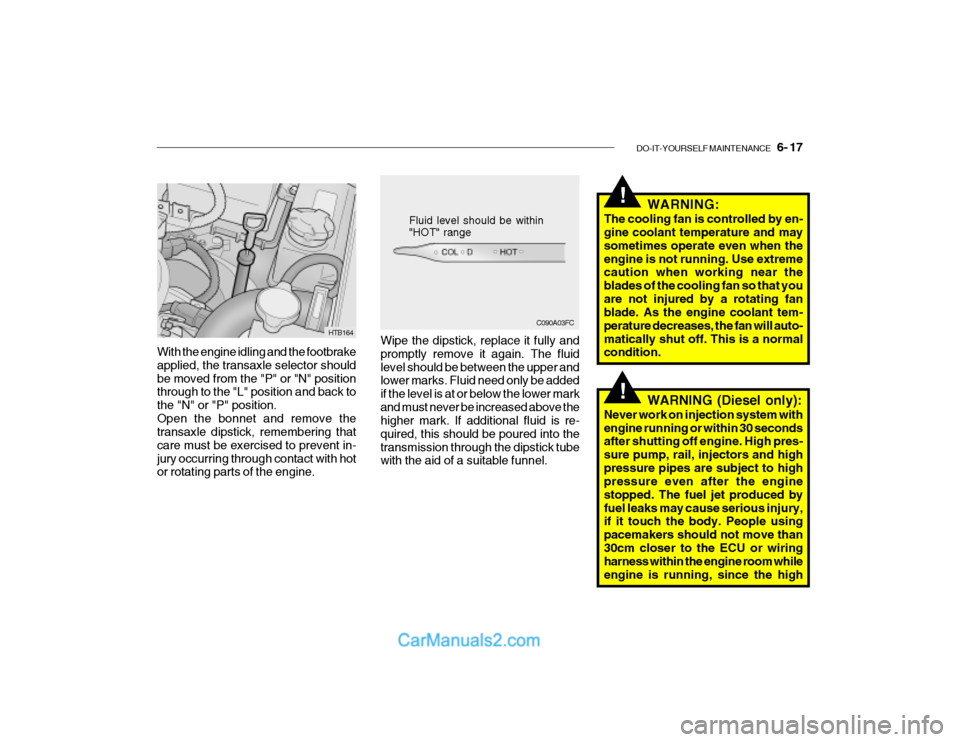
With the engine idling and the footbrake applied, the transaxle selector shouldbe moved from the "P" or "N" position through to the "L" position and back to the "N" or "P" position.Open the bonnet and remove the transaxle dipstick, remembering that care must be exercised to prevent in-jury occurring through contact with hot or rotating parts of the engine.
C090A03FC
Fluid level should be within "HOT" range
HTB164 Wipe the dipstick, replace it fully and promptly remove it again. The fluid level should be between the upper and lower marks. Fluid need only be added if the level is at or below the lower markand must never be increased above the higher mark. If additional fluid is re- quired, this should be poured into thetransmission through the dipstick tube with the aid of a suitable funnel. WARNING:
The cooling fan is controlled by en-gine coolant temperature and may sometimes operate even when theengine is not running. Use extreme caution when working near the blades of the cooling fan so that youare not injured by a rotating fan blade. As the engine coolant tem- perature decreases, the fan will auto-matically shut off. This is a normal condition.
WARNING (Diesel only):
Never work on injection system with engine running or within 30 seconds after shutting off engine. High pres- sure pump, rail, injectors and highpressure pipes are subject to high pressure even after the engine stopped. The fuel jet produced byfuel leaks may cause serious injury, if it touch the body. People using pacemakers should not move than30cm closer to the ECU or wiring harness within the engine room while engine is running, since the high
Page 424 of 444
6- 34 DO-IT-YOURSELF MAINTENANCE
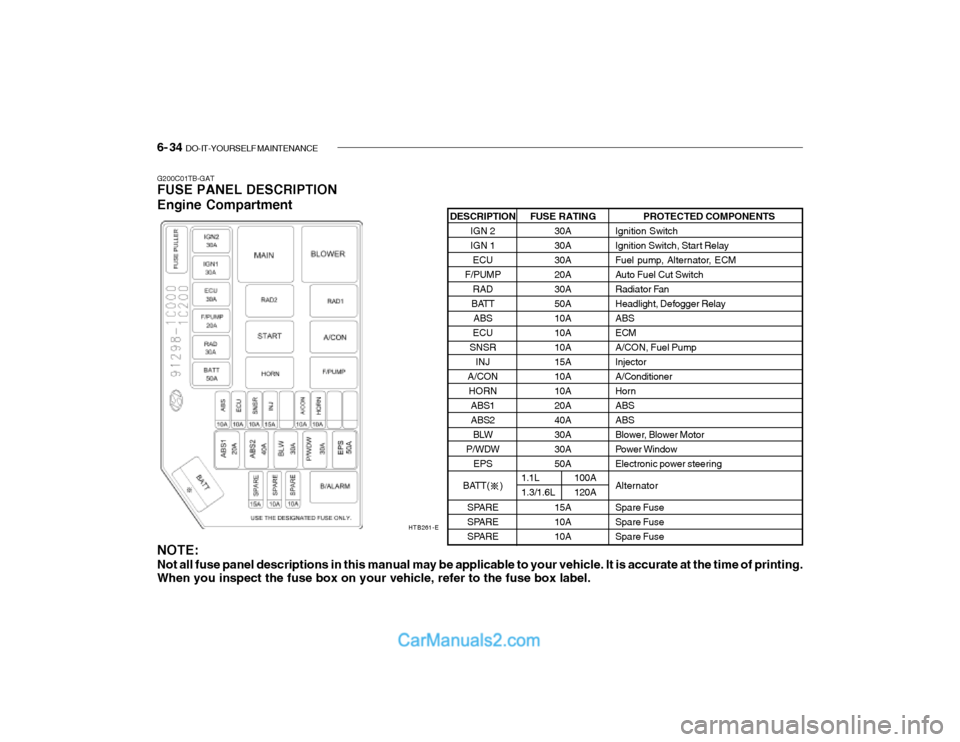
G200C01TB-GAT FUSE PANEL DESCRIPTION Engine Compartment
HTB261-EPROTECTED COMPONENTS
Ignition Switch
Ignition Switch, Start Relay
Fuel pump, Alternator, ECM
Auto Fuel Cut Switch
Radiator Fan
Headlight, Defogger RelayABSECMA/CON, Fuel PumpInjectorA/Conditioner
HornABSABS
Blower, Blower Motor
Power Window
Electronic power steering AlternatorSpare Fuse Spare FuseSpare Fuse
FUSE RATING
30A30A30A20A30A50A10A10A10A15A10A10A20A40A30A30A50A 15A 10A10A
DESCRIPTION
IGN 2IGN 1ECU
F/PUMP RAD
BATT ABS
ECU
SNSR INJ
A/CON HORN ABS1ABS2 BLW
P/WDW EPS
BATT( ) SPARE
SPARE
SPARE
NOTE:
Not all fuse panel descriptions in this manual may be applicable to your vehicle. It is accurate at the time of printing. When you inspect the fuse box on your vehicle, refer to the fuse box label.
1.1L 1.3/1.6L 100A120A
Page 425 of 444
DO-IT-YOURSELF MAINTENANCE 6- 35
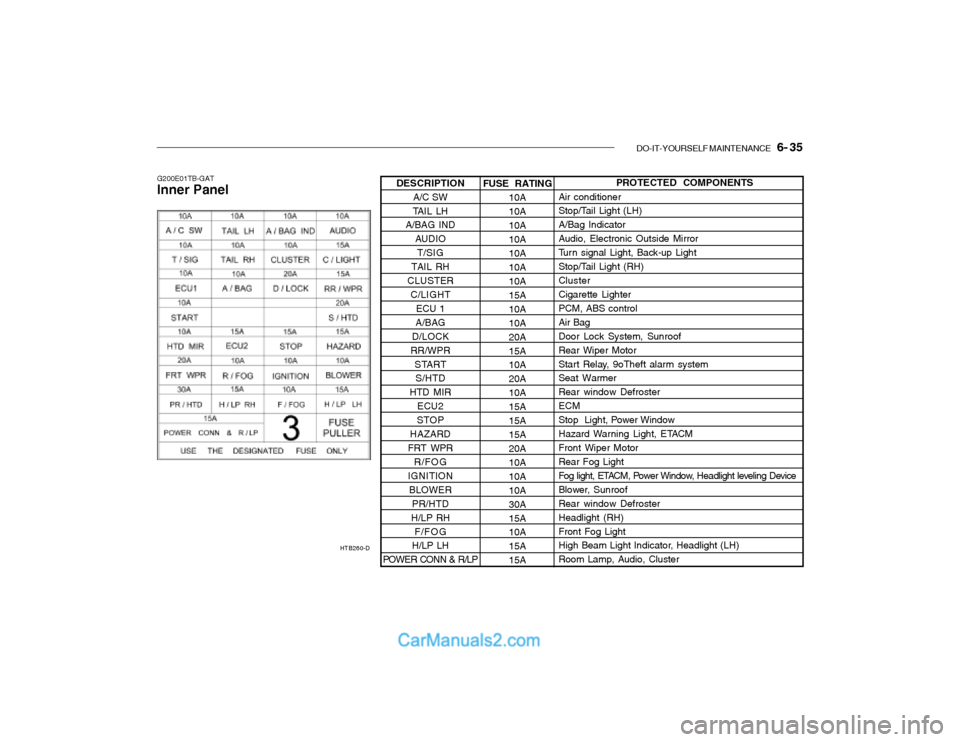
G200E01TB-GAT Inner Panel
HTB260-DFUSE RATING10A 10A10A10A10A10A 10A 15A10A10A20A15A 10A 20A10A15A15A15A 20A 10A10A10A30A15A 10A 15A15APROTECTED COMPONENTS
Air conditioner
Stop/Tail Light (LH) A/Bag IndicatorAudio, Electronic Outside Mirror
Turn signal Light, Back-up Light
Stop/Tail Light (RH)Cluster Cigarette Lighter PCM, ABS controlAir BagDoor Lock System, SunroofRear Wiper Motor
Start Relay, 9oTheft alarm system Seat Warmer Rear window DefrosterECM
Stop Light, Power Window
Hazard Warning Light, ETACMFront Wiper Motor Rear Fog Light
Fog light, ETACM, Power Window, Headlight leveling Device
Blower, SunroofRear window DefrosterHeadlight (RH)Front Fog Light
High Beam Light Indicator, Headlight (LH) Room Lamp, Audio, Cluster
DESCRIPTION
A/C SW
TAIL LH
A/BAG IND
AUDIO
T/SIG
TAIL RH
CLUSTER C/LIGHT ECU 1
A/BAG
D/LOCK
RR/WPR STARTS/HTD
HTD MIR ECU2
STOP
HAZARD
FRT WPR R/FOG
IGNITION BLOWER PR/HTD
H/LP RH
F/FOG
H/LP LH
POWER CONN & R/LP
Page 427 of 444
7- 2 EMISSION CONTROL SYSTEMS
SH010A1-E EMISSION CONTROL SYSTEMS (Not all models) Depending upon the market for which the vehicle is destined, the emissioncontrol system will comprise one or more of the following emission con- trol devices. 1) Crankcase emission control sys-
tem
2) Evaporative emission control sys-
tem
z3) Exhaust emission control systemIn order that the proper functioning of the emission control systems may be ensured, it is recommended that the vehicle is inspected and maintainedby an authorized Hyundai dealer in accordance with the maintenance schedule in this manual. SH010B1-E
1. CRANKCASE EMISSION
CONTROLSYSTEM
The positive crankcase ventilation
system is employed to prevent airpollution caused by blow-by gasesbeing emitted from the crankcase by introducing fresh air to the crankcase through the air cleaner where thismixes with blow-by gases and then passes through the PCV valve into the intake manifold from where it sub-sequently enters the combustion chamber and is burned.
SH010C1-E
2. EVAPORATIVE EMISSION
CONTROL SYSTEM
The Evaporative Emission Control
System is designed to prevent fuel vapours from escaping into the atmo- sphere through the fuel tank ventila- tion system.
Whilst the engine is not running, fuel
vapours generated inside the fuel tankare absorbed and stored in a char-coal canister. When the engine is started, the vapours stored in the canister are drawn into the induction SH010D1-E
3. EXHAUST EMISSION CON
TROL SYSTEM
The exhaust emission control system
is a highly effective system whichcontrols exhaust emission while main- taining good vehicle performance.
system through the purge control so-lenoid valve and are subsequently burned.
The purge control solenoid valve is
controlled by the ECU; when the en-gine coolant temperature is low or the engine is idling, the purge control valve is closed and fuel vapours re-main stored in the canister. Under normal running conditions when the engine is warm, the valve opens andthe vapours are drawn into the inlet tract and subsequently burned in the combustion chamber.