warning Hyundai Getz 2003 Workshop Manual
[x] Cancel search | Manufacturer: HYUNDAI, Model Year: 2003, Model line: Getz, Model: Hyundai Getz 2003Pages: 444, PDF Size: 13.82 MB
Page 121 of 444
1- 106 FEATURES OF YOUR HYUNDAI
!
HMP280B01TB-GAT
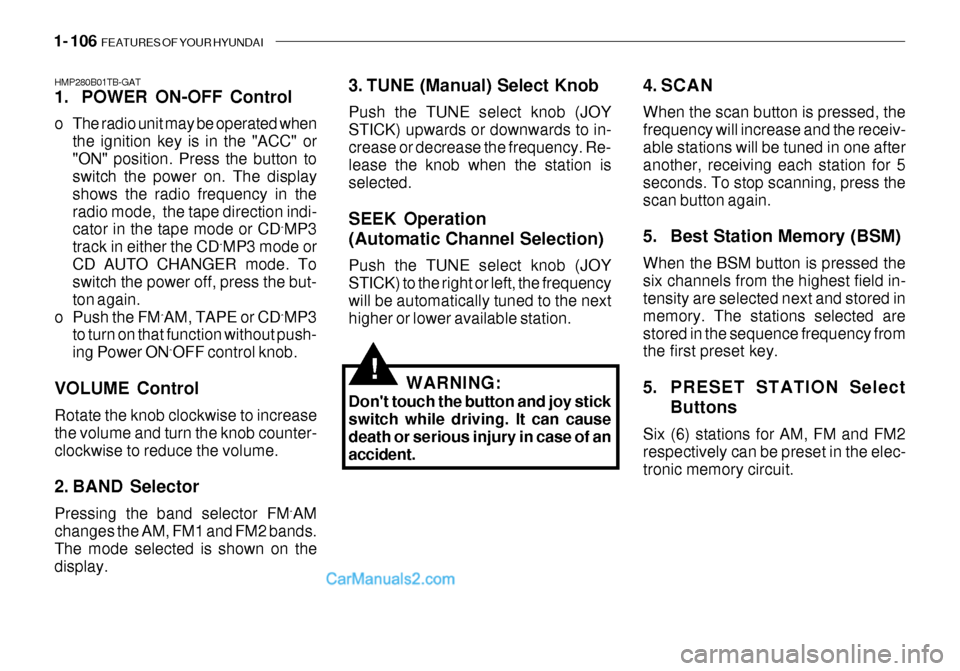
1. POWER ON-OFF Control
o The radio unit may be operated when
the ignition key is in the "ACC" or "ON" position. Press the button to switch the power on. The display shows the radio frequency in theradio mode, the tape direction indi- cator in the tape mode or CD ˆ
MP3
track in either the CD ˆ
MP3 mode or
CD AUTO CHANGER mode. Toswitch the power off, press the but- ton again.
o Push the FM ˆ
AM, TAPE or CD ˆ
MP3
to turn on that function without push-ing Power ON ˆ
OFF control knob.
VOLUME Control Rotate the knob clockwise to increase the volume and turn the knob counter-clockwise to reduce the volume.
2. BAND Selector Pressing the band selector FM ˆ
AM
changes the AM, FM1 and FM2 bands. The mode selected is shown on thedisplay. 3. TUNE (Manual) Select Knob Push the TUNE select knob (JOY STICK) upwards or downwards to in-crease or decrease the frequency. Re- lease the knob when the station is selected. SEEK Operation (Automatic Channel Selection) Push the TUNE select knob (JOY STICK) to the right or left, the frequencywill be automatically tuned to the next higher or lower available station.
4. SCAN When the scan button is pressed, the frequency will increase and the receiv-able stations will be tuned in one after another, receiving each station for 5 seconds. To stop scanning, press thescan button again.
5. Best Station Memory (BSM) When the BSM button is pressed the six channels from the highest field in- tensity are selected next and stored in memory. The stations selected arestored in the sequence frequency from the first preset key.
5. PRESET STATION Select
Buttons
Six (6) stations for AM, FM and FM2 respectively can be preset in the elec- tronic memory circuit.
WARNING:
Don't touch the button and joy stickswitch while driving. It can causedeath or serious injury in case of an accident.
Page 138 of 444

2- 2 DRIVING YOUR HYUNDAI
C010A01O-AAT
WARNING: ENGINE EXHAUST CAN BE DANGEROUS!
Engine exhaust fumes can be extremely dangerous. If, at any time, you smell exhaust fumes inside the vehicle, open the windows immediately. o Do not inhale exhaust fumes. Exhaust fumes contain carbon monoxide, a colorless, odorless gas that can cause unconsciousness and death by asphyxiation. o Be sure the exhaust system does not leak. The exhaust system should be checked whenever the vehicle is raised to change the oil or for any other purpose. If you hear a change in the sound of the exhaust or if you drive over something that strikes the underneath side of the car, have the exhaust system checked as soon as possible by your Hyundai dealer. o Do not run the engine in an enclosed area. Letting the engine idle in your garage, even with the garage door open, is a hazardous practice. Never run the engine in your garage any longer than it takes to start the engine and back the car out. o Avoid idling the engine for prolonged periods with people inside the car. If it is necessary to idle the engine for a prolonged period with people inside the car, be sure to do so only in an open area with the air intake set at "Fresh" and fan operating at one of the higher speeds so fresh air is drawn into the interior. If you must drive with the tail gate open because you are carrying objects that make this necessary: 1. Close all windows. 2. Open side vents. 3. Set the air intake control at "Fresh", the air flow control at "Floor" or "Face" and the fan at one of the higher speeds.
To assure proper operation of the ventilation system, be sure the ventilation air intakes located just in front ofthe windshield are kept clear of snow, ice, leaves or other obstructions.
!
Page 139 of 444

DRIVING YOUR HYUNDAI 2- 3
C020A01O-GAT BEFORE STARTING THE EN- GINE Before you start the engine, you should always:
1. Look around the vehicle to be sure
there are no flat tires, puddles of oil, water or other indications of pos-sible trouble.
2. After entering the car, check to be
sure the parking brake is engaged.
3. Check that all windows, and lights are clean.
4. Check that the interior and exterior mirrors are clean and in position.
5. Check your seat, seatback and
headrest to be sure they are in theirproper positions.
6. Lock all the doors.
7. Fasten your seat belt and be sure
that all other occupants have fas- tened theirs.
8. Turn off all lights and accessories
that are not needed.
9. When you turn the ignition switch to
"ON", check that all appropriate warning lights are operating and that you have sufficient fuel. 10.Check the operation of warning
lights and all bulbs when key is in the "ON" position.
!WARNING: (DIESEL ENGINE)
To ensure that sufficient vacuum exists within the brake system dur-ing cold weather start-up condi- tions, it is necessary to run the engine at idle for several secondsafter starting the engine. C030A01A-GAT COMBINATION IGNITION SWITCHTo Start the Engine
o If your Hyundai is equipped with a
manual transaxle, place the shift lever in neutral and depress theclutch pedal fully.
o If your Hyundai has an automatic
transaxle, place the shift lever in "P"(park).
o To start the engine, insert the igni-
tion key and turn it to the "START"position. Release it as soon as the engine starts. Do not hold the key in the "START" position for more than15 seconds.
NOTE: For safety, the engine will not start if the shift lever is not in "P" or "N"Position (Automatic transaxle).
Page 140 of 444

2- 4 DRIVING YOUR HYUNDAI
C070C01E
C070C01A-AAT
To Remove The Ignition Key
1. Turn the ignition key to the "ACC"
position.
2. Simultaneously push and turn the
ignition key counterclockwise from the "ACC" position to the "LOCK" position.
3. The key can be removed in the "LOCK" position.LOCK
ACC
ON
START
o "START" The engine is started in this position. It will crank until you release the key. NOTE: Do not hold the key in the "START" position for more than 15 seconds.
o "ON" When the key is in the "ON" position, the ignition is on and all accessories may be turned on. If the engine is notrunning, the key should not be left in the "ON" position. This will discharge the battery and may also damage theignition system.
o "ACC" With the key in the "ACC" position, some electrical accessories (radio etc.)may be operated.
o "LOCK" The key can be removed or inserted in this position. To protect against theft, the steering wheel locks by removing the key. NOTE: To unlocking the steering wheel, insert the key, and then turn the steering wheel and key simulta-neously.
C040A01A-AAT KEY POSITIONS
WARNING:
The engine should not be turned off or the key removed from the ignition key cylinder while the ve-hicle is in motion. The steering wheel is locked by removing the key.
C040A01E
LOCK
ACC
ON
START
!
Page 141 of 444
DRIVING YOUR HYUNDAI 2- 5
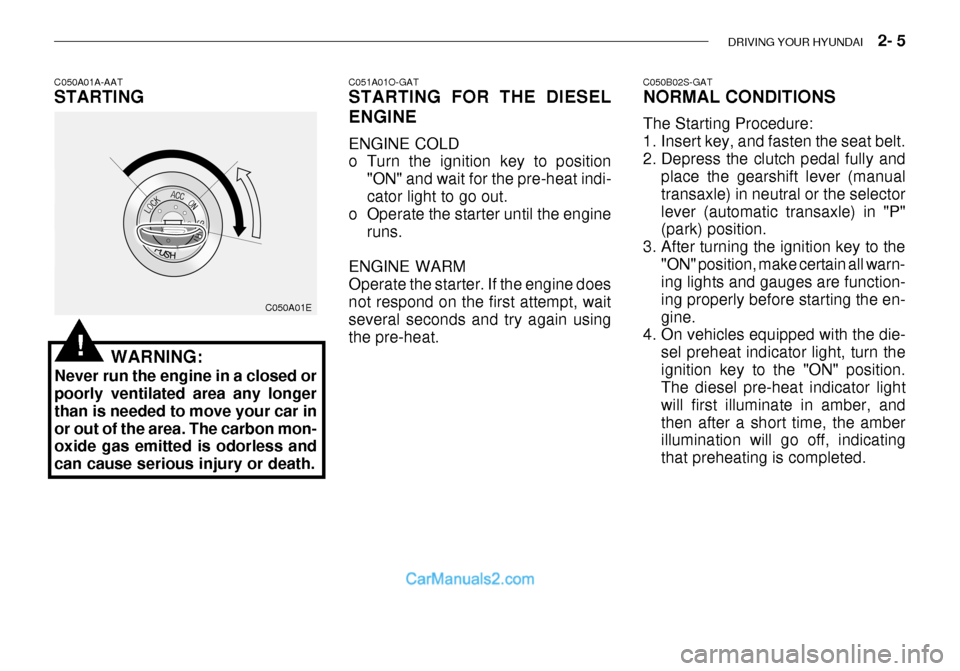
C050A01A-AAT STARTING
C050A01E
WARNING:
Never run the engine in a closed or poorly ventilated area any longer than is needed to move your car inor out of the area. The carbon mon- oxide gas emitted is odorless and can cause serious injury or death.
!
C051A01O-GAT STARTING FOR THE DIESEL ENGINE ENGINE COLD
o Turn the ignition key to position "ON" and wait for the pre-heat indi- cator light to go out.
o Operate the starter until the engine
runs.
ENGINE WARMOperate the starter. If the engine doesnot respond on the first attempt, wait several seconds and try again using the pre-heat. C050B02S-GAT NORMAL CONDITIONS The Starting Procedure:
1. Insert key, and fasten the seat belt.
2. Depress the clutch pedal fully and
place the gearshift lever (manualtransaxle) in neutral or the selectorlever (automatic transaxle) in "P" (park) position.
3. After turning the ignition key to the "ON" position, make certain all warn-ing lights and gauges are function- ing properly before starting the en-gine.
4. On vehicles equipped with the die-
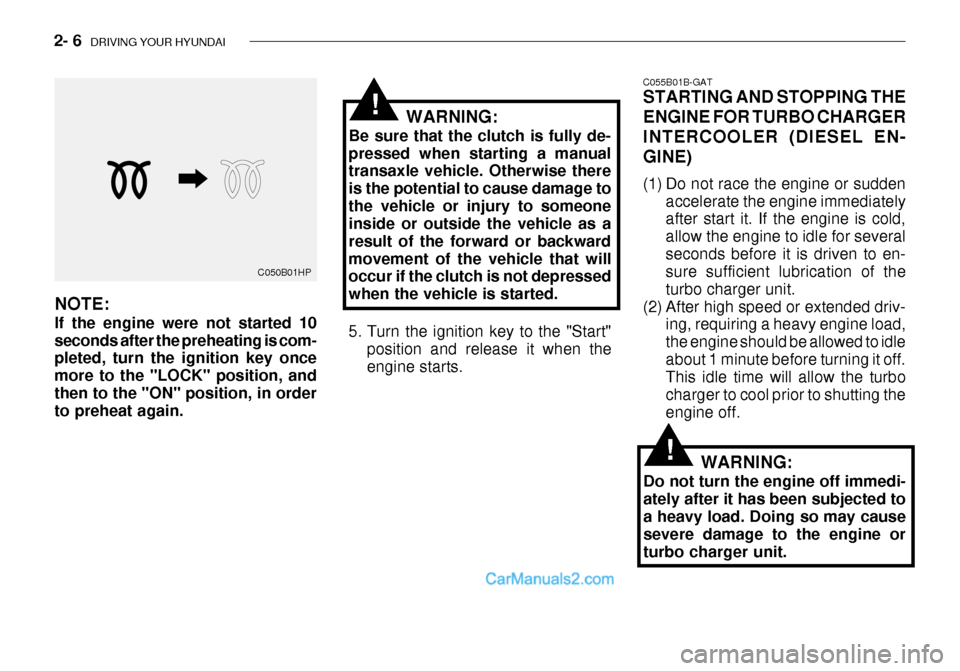
sel preheat indicator light, turn theignition key to the "ON" position. The diesel pre-heat indicator light will first illuminate in amber, andthen after a short time, the amber illumination will go off, indicating that preheating is completed.
Page 142 of 444
2- 6 DRIVING YOUR HYUNDAI
C055B01B-GAT STARTING AND STOPPING THE ENGINE FOR TURBO CHARGERINTERCOOLER (DIESEL EN-GINE)
(1) Do not race the engine or sudden
accelerate the engine immediately after start it. If the engine is cold, allow the engine to idle for severalseconds before it is driven to en- sure sufficient lubrication of the turbo charger unit.
(2) After high speed or extended driv- ing, requiring a heavy engine load,the engine should be allowed to idleabout 1 minute before turning it off. This idle time will allow the turbo charger to cool prior to shutting theengine off.
!WARNING:
Do not turn the engine off immedi- ately after it has been subjected toa heavy load. Doing so may cause severe damage to the engine or turbo charger unit.
C050B01HP
NOTE: If the engine were not started 10 seconds after the preheating is com- pleted, turn the ignition key once more to the "LOCK" position, andthen to the "ON" position, in order to preheat again. WARNING:
Be sure that the clutch is fully de- pressed when starting a manual transaxle vehicle. Otherwise there is the potential to cause damage tothe vehicle or injury to someone inside or outside the vehicle as a result of the forward or backwardmovement of the vehicle that will occur if the clutch is not depressed when the vehicle is started.
5. Turn the ignition key to the "Start" position and release it when the engine starts.
!
Page 144 of 444
2- 8 DRIVING YOUR HYUNDAI
o Exercise extreme caution when driv-
ing on a slippery surface. Be espe- cially careful when braking, acceler-ating or shifting gears. On a slippery surface, an abrupt change in ve- hicle speed can cause the drivewheels to lose traction and the ve- hicle to go out of control.
WARNING:
o The risk of rollover is greatly in- creased if you lose control of your vehicle at highway speeds.
o Loss of control often occurs if
two or more wheels drop off theroadway and the driver oversteers to reenter the roadway.
o In the event your vehicle leaves
the roadway, do not steer sharply.Instead, slow down before pull- ing back into the travel lanes.
o In a collision crash, an unbelted person is significantly more likelyto die than a person wearing aseatbelt.
!
C070D02A-AAT Good Driving Practices
o Never take the car out of gear and
coast down a hill. This is extremely hazardous. Always leave the car in gear.
o Don't "ride" the brakes. This can
cause them to overheat and mal-function. Instead, when you are driv- ing down a long hill, slow down andshift to a lower gear. When you do this, engine braking will help slow the car.
o Slow down before shifting to a lower gear. This will help avoid over-rev-ving the engine, which can causedamage.
o Slow down when you encounter
cross winds. This gives you muchbetter control of your car.
o Be sure the car is completely stopped
before you attempt to shift into re-verse. The transaxle can be dam- aged if you do not. To shift into reverse, depress the clutch, movethe shift lever to neutral, wait three seconds, then shift to the reverse position.
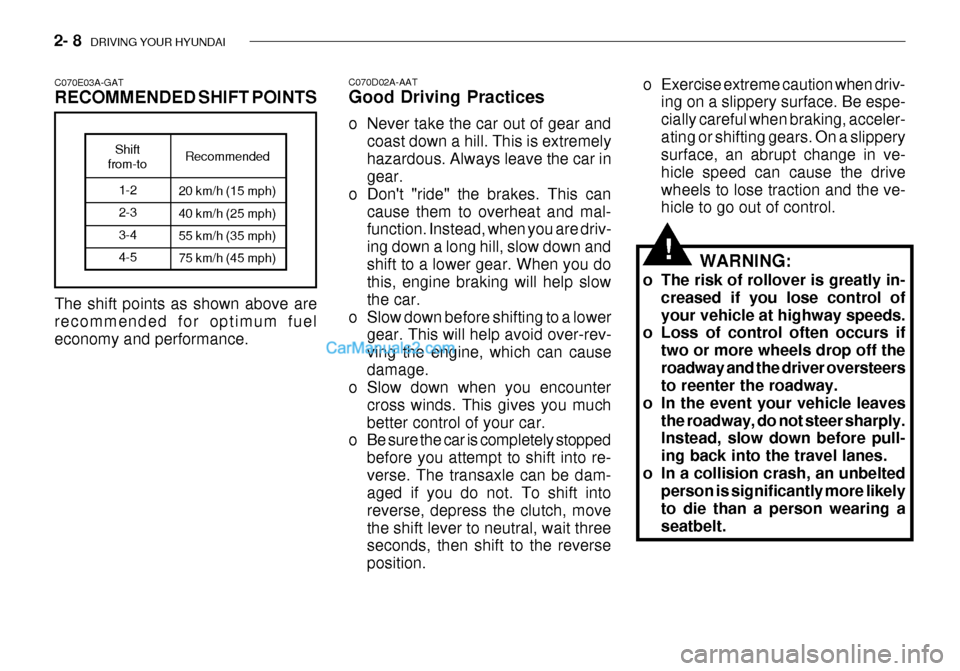
C070E03A-GAT RECOMMENDED SHIFT POINTS
1-2 2-33-4 4-5
Shift
from-to Recommended
20 km/h (15 mph) 40 km/h (25 mph) 55 km/h (35 mph) 75 km/h (45 mph)
The shift points as shown above are recommended for optimum fueleconomy and performance.
Page 148 of 444
2- 12 DRIVING YOUR HYUNDAI
C130A01A-AAT GOOD BRAKING PRACTICES
WARNING:
Nothing should be carried on top of the shelf panel behind the rear seat. If there were an accident or a sud-den stop, such objects could move forward and cause damage to the vehicle or injure the occupants.
o After being parked, check to be sure the parking brake is not engaged and that the parking brake indicator light is out before driving away.
o Driving through water may get the
brakes wet. They can also get wet
when the car is washed. Wet brakes can be dangerous! Your car will not
stop as quickly if the brakes are wet. Wet brakes may cause the car to pull to one side. To dry the brakes,apply the brakes lightly until the braking action returns to normal, taking care to keep the car undercontrol at all times. If the braking
action does not return to normal, stop as soon as it is safe to do soand call your Hyundai dealer for assistance.
!
HTB217
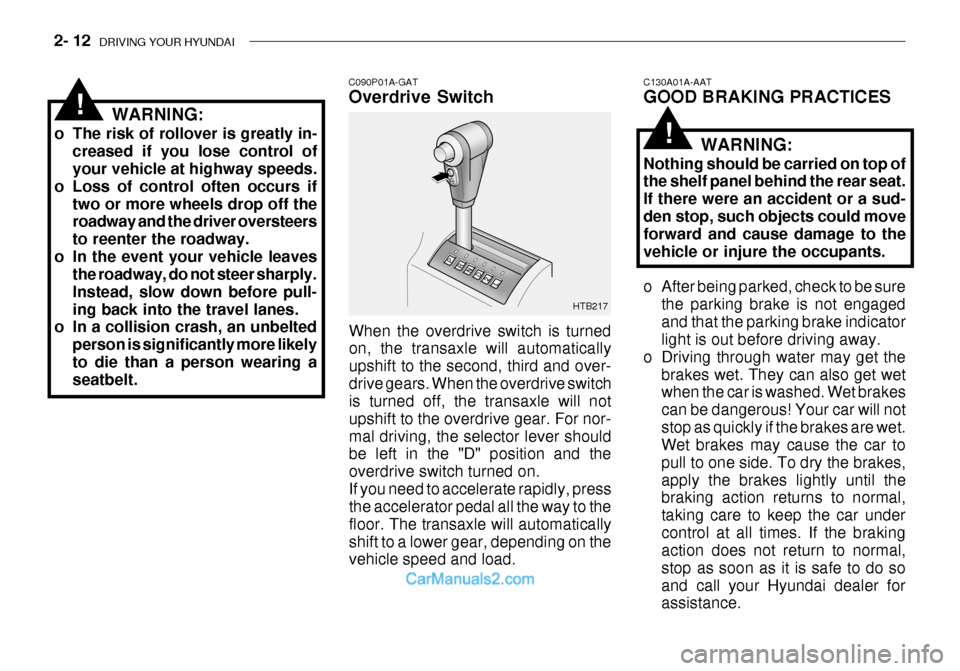
C090P01A-GAT Overdrive Switch
When the overdrive switch is turned on, the transaxle will automatically upshift to the second, third and over-drive gears. When the overdrive switch is turned off, the transaxle will not upshift to the overdrive gear. For nor-mal driving, the selector lever should be left in the "D" position and the overdrive switch turned on.If you need to accelerate rapidly, press the accelerator pedal all the way to the floor. The transaxle will automaticallyshift to a lower gear, depending on the vehicle speed and load.
!WARNING:
o The risk of rollover is greatly in- creased if you lose control of your vehicle at highway speeds.
o Loss of control often occurs if
two or more wheels drop off theroadway and the driver oversteers to reenter the roadway.
o In the event your vehicle leaves the roadway, do not steer sharply.Instead, slow down before pull-ing back into the travel lanes.
o In a collision crash, an unbelted
person is significantly more likelyto die than a person wearing a seatbelt.
Page 150 of 444
2- 14 DRIVING YOUR HYUNDAI
o Drive at a moderate speed. The
faster you drive, the more fuel your car uses. Driving at a moderatespeed, especially on the highway, is one of the most effective ways to reduce fuel consumption.
o Don't "ride" the brake or clutch pedal. This can increase fuel consumptionand also increase wear on thesecomponents. In addition, driving with your foot resting on the brake pedal may cause the brakes to overheat,which reduces their effectiveness and may lead to more serious con- sequences.
o Take care of your tires. Keep them inflated to the recommended pres-sure. Incorrect inflation, either toomuch or too little, results in unnec- essary tire wear. Check the tire pres- sures at least once a month.
o Be sure that the wheels are aligned correctly. Improper alignment canresult from hitting curbs or drivingtoo fast over irregular surfaces. Poor alignment causes faster tire wear and may also result in other prob-lems as well as greater fuel con- sumption.
WARNING:
ABS will not prevent accidents due to improper or dangerous driving maneuvers. Even though vehicle control is improved during emer-gency braking, always maintain a safe distance between you and ob- jects ahead. Vehicle speeds shouldalways be reduced during extreme road conditions. The braking distance for cars equipped with an anti-lock braking system may be longer than for those without it in the following road con-ditions.
o Driving on rough, gravel or snow- covered roads.
o Driving with tire chains installed.
o Driving on roads where the road
surface is pitted or has different surface height.
!During these conditions, the ve- hicle should be driven at reduced speeds. The safety features of anABS equipped vehicle should not be tested by high speed driving or cornering. This could endanger thesafety of yourself or others.
C140A01A-GAT DRIVING FOR ECONOMY You can save fuel and get more kilo- meters from your car if you follow these suggestions:
o Drive smoothly. Accelerate at amoderate rate. Don't make "jack- rabbit" starts or full-throttle shifts and maintain a steady cruisingspeed. Don't race between stop- lights. Try to adjust your speed to that of the other traffic so you don'thave to change speeds unneces- sarily. Avoid heavy traffic whenever possible.Always maintain a safe distance from other vehicles so you can avoid unnecessary braking. This also re-duces brake wear.
Page 156 of 444
2- 20 DRIVING YOUR HYUNDAI
C190F02A-GAT Trailer or Vehicle Towing Tips
1. Before towing, check hitch and
safety chain connections as well as proper operation of the trailerrunning lights, brake lights, and turn signals.
2. Always drive your vehicle at a mod- erate speed (Less than 100 km/h).
3. Trailer towing requires more fuel
than normal conditions.
4. To maintain engine braking effi- ciency and electrical charging per- formance, do not use fifth gear(manual transaxle) or overdrive (au- tomatic transaxle).
5. Always secure items in the trailer
to prevent load shift while driving.
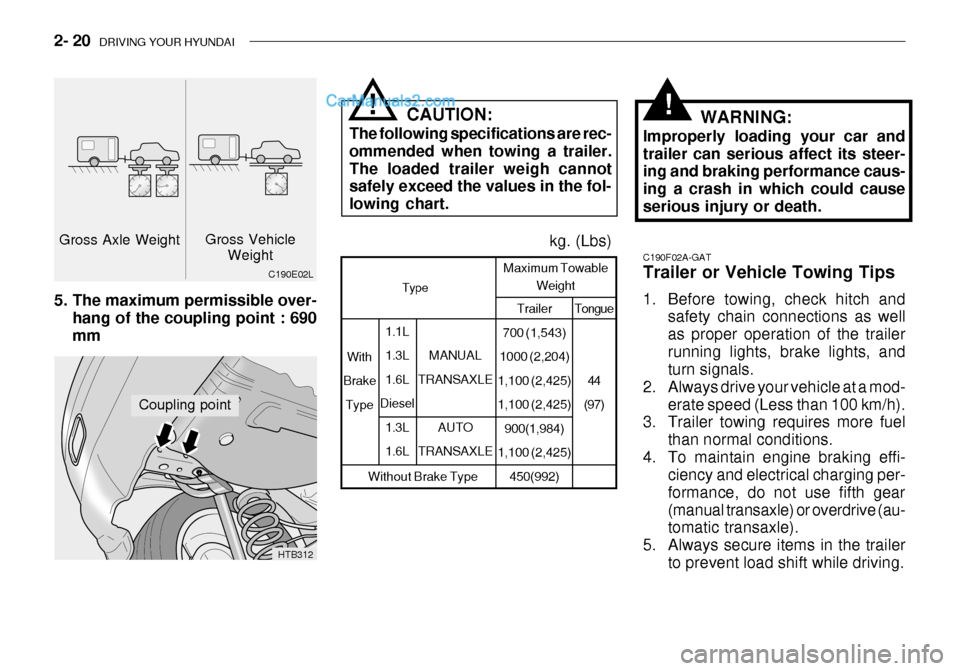
Tongue
44
(97)
Without Brake Type Trailer
700 (1,543)
1000 (2,204)
1,100 (2,425) 1,100 (2,425) 900(1,984)
1,100 (2,425) 450(992)
MANUAL
TRANSAXLE
AUTO
TRANSAXLE
1.1L 1.3L1.6L
Diesel 1.3L1.6L
With
Brake Type
kg. (Lbs)
Coupling point
HTB312
C190E02L
Gross Axle Weight
Gross Vehicle
Weight
!!
Maximum Towable
Weight
5. The maximum permissible over-
hang of the coupling point : 690 mm CAUTION:
The following specifications are rec-ommended when towing a trailer.The loaded trailer weigh cannot safely exceed the values in the fol- lowing chart. WARNING:
Improperly loading your car andtrailer can serious affect its steer- ing and braking performance caus- ing a crash in which could causeserious injury or death.
Type