key Hyundai Getz 2003 Manual PDF
[x] Cancel search | Manufacturer: HYUNDAI, Model Year: 2003, Model line: Getz, Model: Hyundai Getz 2003Pages: 444, PDF Size: 13.82 MB
Page 349 of 444
DRIVING YOUR HYUNDAI 2- 7
!
!
C055B01B-GAT STARTING AND STOPPING THE ENGINE FOR TURBO CHARGERINTERCOOLER (DIESEL EN-GINE)
(1) Do not race the engine or sudden
accelerate the engine immediately after start it. If the engine is cold, allow the engine to idle for severalseconds before it is driven to en- sure sufficient lubrication of the turbo charger unit.
(2) After high speed or extended driv- ing, requiring a heavy engine load,the engine should be allowed to idleabout 1 minute before turning it off. This idle time will allow the turbo charger to cool prior to shutting theengine off.
WARNING:
Do not turn the engine off immedi- ately after it has been subjected to a heavy load. Doing so may causesevere damage to the engine or turbo charger unit.
WARNING:
Be sure that the clutch is fully de- pressed when starting a manualtransaxle vehicle. Otherwise there is the potential to cause damage to the vehicle or injury to someoneinside or outside the vehicle as a result of the forward or backward movement of the vehicle that willoccur if the clutch is not depressed when the vehicle is started. SC060B1-E FUEL ECONOMY The following suggestions are made to assist in achieving the greatest degreeof fuel economy.
o Maintaining a constant check on
fuel consumption will enable the most economical use pattern and driving style to be adopted.
o Avoid using the vehicle for very short journeys if possible, particu-larly when a cold start is involved.
o Ensure that tyre pressures are main- tained at the correct level.
o Use only the recommended grade of fuel.
o Avoid carrying unnecessary weight,
and if a roof rack is in use, removeit as soon as possible after use.
o Anticipate the road and conditions
ahead to enable adjustments inspeed to be made smoothly. Avoid heavy acceleration and sharp brak- ing.
o Avoid cruising at unnecessary high speeds.
5. Turn the ignition key to the "Start"
position and release it when theengine starts.
Page 358 of 444

2- 16 DRIVING YOUR HYUNDAI
ZC170C1-E Anti-freeze/Corrosion inhibitor The cooling system must always con- tain an Ethylene-Glycol based anti-freeze solution. The system is filled during manufacture with solution of the correct strength which should bechecked before the onset of winter and adjusted or changed as required. NOTE: The anti-freeze solution contains a corrosion inhibitor to prevent deg- radation of the aluminum castings contained within the engine. There-fore, never, drain the system and refill with water only. In addition, anti-freeze solution must ALWAYS be used in vehicles fitted with air conditioning, to prevent theheater matrix from freezing and sub- sequently bursting with the refrigera- tion system in use. SC170E1-E Windscreen Washers and Wip- ers The windscreen washer bottle should be filled with a solution of water and a proprietary winter screen wash addi-tive. The windscreen wipers should not be used if the blades are frozen to the windscreen or if they are coveredwith snow, before this is removed. NOTE: Never allow undiluted screen washer fluid additive to spill upon the paintwork or use engine cool- ant anti-freeze since damage to thepaintwork may result.
o When driving in extreme conditions,
the windscreen wiper blades may fail to clear the screen properly due to the formation of ice upon theblade edge. It will therefore be nec- essary to periodically remove such ice to restore their efficiency.
o If the power operated door mirrors become frozen, attempts to adjustthese may damage the mechanism.
ZC170D1-E Door Locks Should the door lock mechanism be- come frozen, a proprietary lock de-icer should be used. Alternatively, warm- ing the door key may thaw the doorlock. However, the key should be handled carefully to avoid burning the fingers.Never attempt to thaw a frozen door lock using hot water, since the water will eventually freeze and compoundthe problem. NOTE: The proper temperature for using the immobilizer key is from -40°F to 176°F (-40°C to 80°C). If you heat the immobilizer key over 176°F (80°C)to open the frozen lock, it may cause damage to the transponder in its head.
Page 363 of 444
3. WHAT TO DO IN AN EMERGENCY
If the engine will not start ................................................................ 3-2
Jump starting .................................................................................. 3-3
If the engine overheats ................................................................... 3-4
Spare tyre ....................................................................................... 3-5
In the event of a puncture ............................................................... 3-6
Vehicle Towing or Recovery .........................................................3-11
Emergency towing ........................................................................ 3-13
If you lose your keys ..................................................................... 3-13
3
Page 374 of 444
3- 12 WHAT TO DO IN AN EMERGENCY
!
CAUTION:
The following restriction must be observed in order to avoid seriousdamage to the transaxle . The vehicle must never be towed from the rear with the front wheelson the ground. The vehicle must not be towed until transaxle fluid has been added tobring the level up to the "HOT" marking on the dipstick. (The level will need to be reduced again aftertowing). The vehicle must not be towed at speeds faster than 25 mph. or dis-tances greater than fifty miles. The general points regarding the steer- ing lock etc. described in the pre-ceding section (Manual transaxle vehicle) should be observed.
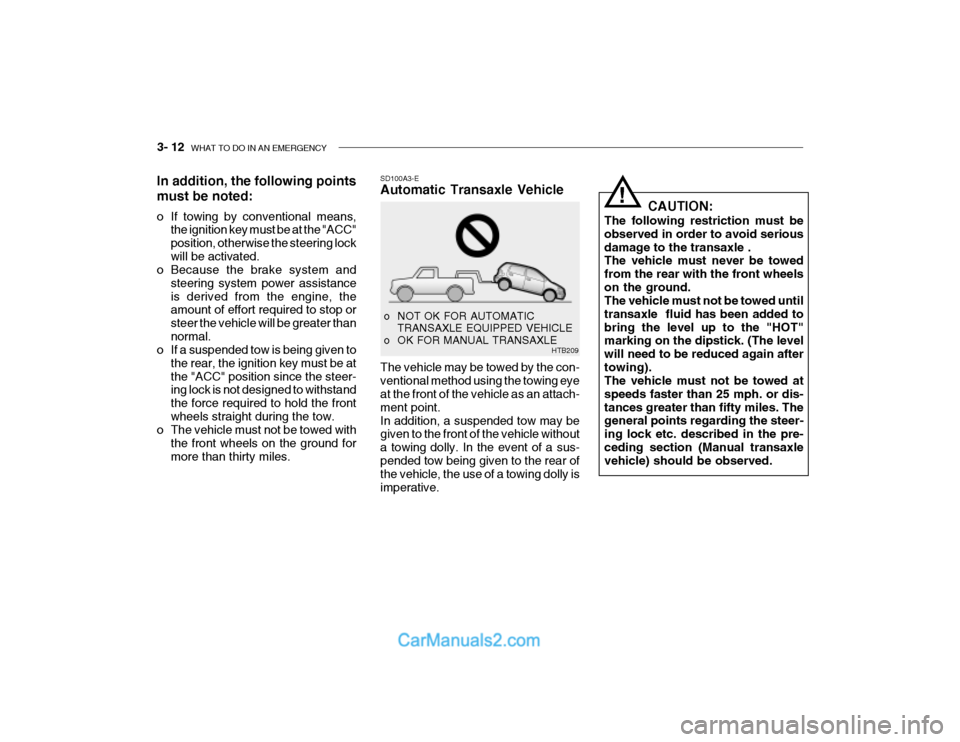
SD100A3-E Automatic Transaxle Vehicle The vehicle may be towed by the con- ventional method using the towing eye at the front of the vehicle as an attach- ment point.In addition, a suspended tow may be given to the front of the vehicle without a towing dolly. In the event of a sus-pended tow being given to the rear of the vehicle, the use of a towing dolly is imperative.
o NOT OK FOR AUTOMATIC
TRANSAXLE EQUIPPED VEHICLE
o OK FOR MANUAL TRANSAXLE HTB209
In addition, the following points must be noted:
o If towing by conventional means,
the ignition key must be at the "ACC" position, otherwise the steering lockwill be activated.
o Because the brake system and
steering system power assistanceis derived from the engine, the amount of effort required to stop or steer the vehicle will be greater thannormal.
o If a suspended tow is being given to
the rear, the ignition key must be atthe "ACC" position since the steer- ing lock is not designed to withstand the force required to hold the frontwheels straight during the tow.
o The vehicle must not be towed with
the front wheels on the ground formore than thirty miles.
Page 375 of 444
WHAT TO DO IN AN EMERGENCY 3- 13
D120A01A-EAT IF YOU LOSE YOUR KEYS Information about the key of immobi- lizer system will be found on page 1-4.CAUTION:
If the car is being towed with allfour wheels on the ground, it can be towed only from the front. Besure that the transaxle is in neu- tral. Do not tow at speeds greater
than 30 mph (50 km/h) and for more
than 15 miles(25 km). Be sure the steering is unlocked by placing the key in the "ACC" posi- tion. A driver must be in the towed vehicle to operate the steering andbrakes.
!
(3)Attach a tow cable, chain or strap to
one of the tie-down hooks under the front of your car.
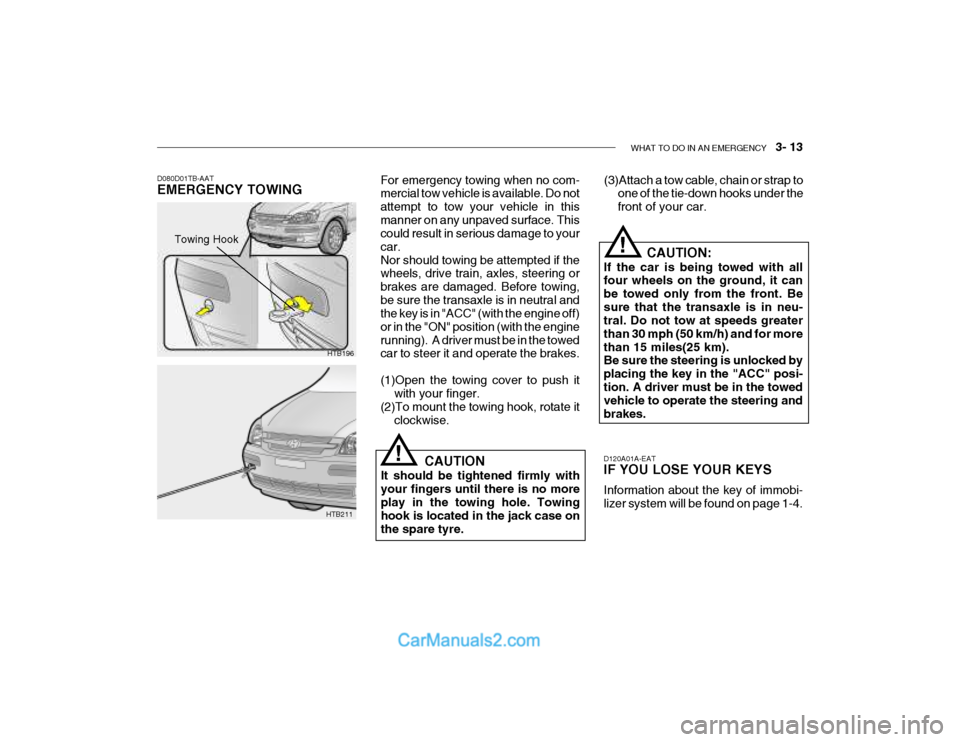
D080D01TB-AAT EMERGENCY TOWING For emergency towing when no com- mercial tow vehicle is available. Do not attempt to tow your vehicle in thismanner on any unpaved surface. This could result in serious damage to your car.Nor should towing be attempted if the wheels, drive train, axles, steering or brakes are damaged. Before towing,be sure the transaxle is in neutral and the key is in "ACC" (with the engine off) or in the "ON" position (with the enginerunning). A driver must be in the towed car to steer it and operate the brakes. (1)Open the towing cover to push it
with your finger.
(2)To mount the towing hook, rotate it clockwise.
HTB196
HTB211 CAUTION
It should be tightened firmly with your fingers until there is no moreplay in the towing hole. Towing hook is located in the jack case on the spare tyre.
!
Towing Hook
Page 417 of 444

DO-IT-YOURSELF MAINTENANCE 6- 27
!
5. Open the bonnet.
6. Draw the vertical line (through the
center of each headlight beam pat-tern) and the horizontal line (throughthe center of each headlight beam pattern) on the aiming screen. And then, draw the horizontal paral- lel line at 1.18 in. (30 mm ) under the horizontal line.
7. Adjust each cut-off line of the low beam to the parallel line with a phillipsscrewdriver - VERTICAL AIMING.
8. Adjust each cut-off line of the low
beam to each vertical line with aphillips screwdriver - HORIZONTAL AIMING. HTB269
Horizontal Aiming
Vertical Aiming
G290A01FC-EAT HEADLIGHT AIMING ADJUST- MENT Before performing aiming adjustment, make sure of the following.
1. Keep all tires inflated to the correct pressure.
2. Place the vehicle on level ground
and press the front bumper and rear bumper down several times. Place the vehicle at a distance of 118 in. (3,000 mm) from the test wall.
3. See that the vehicle is unloaded (except for full levels of coolant,engine oil and fuel, and spare tire,jack, and tools).
4. Clean the head lights lens and turn
on the headlight (low beam). WARNING:
Be sure to carefully wipe away anywater drained out in this manner, because the fuel mixed in the water might be ignited and result in a fire.
1. Remove the engine cover.
2. Disconnect the air intake hose from air cleaner cover.
3. Loosen the drain plug at the bottom
of the fuel filter.
4. Tighten the drain plug when water no longer comes out.
5. Check to be sure that the warning lamp illuminates when the ignition key is turned to "ON", and that it goes off when the engine is started.If in doubt, consult your nearest au- thorized HYUNDAI dealer.
G300B01FC
Page 442 of 444

INDEX 10- 3
ENGINE OIL REPLENISHMENT ................................ 6-8
ENGINE OI L ............................................................... 6-6
F FRONT ASHTRAY .................................................... 1-52
FRONT SEAT ........................................................... 1-11
FRONT FOG LIGHT SWITCH .................................. 1-50
FUEL ECONOMY ....................................................... 2-7
FUEL GAUGE ........................................................... 1-41
FUEL RECOMMENDATIONS ..................................... 1-1
FUSE PANEL DESCRIPTION ..................................6-34
FUSIBLE LINKS ........................................................ 6-24
GGLOVE BOX ............................................................. 1-57
HHAZARD WARNI NG SYSTEM................................. 1-49
HEADLIGHT AIMING ADJUSTEM ENT ....................6-27
HEADLIGHT BULB ................................................... 6-28
HEADLIGHT LEVELING DEVICE SYSTEM .............1-53
HEAD RESTRAINT ADJ USTMENT .......................... 1-12
HEATED REAR WINDOW .............. .......................... 1-50
HEATING AND COOLING CONTROL .....................1-68
HEIGHT ADJUSTABLE FRONT SEAT SHOULDER BELT ................................................ 1-18
HORN ........................................................................ 1-67
HOW TO USE LUGGAGE ROOM ............................1-63I
IF THE ENGINE CANNOT BE CRANKED
................. 3-2
IF THE ENGINE OVERHEATS ................................... 3-4
IF THE ENGINE WILL NOT START ........................... 3-2
IF THE EVENT OF A PUNCTURE ............................. 3-6
IMMOBILISER SYSTEM ............................................. 1-4
INDIVIDUAL CIRCUIT FUSES .................................6-24
INSTRUMENT CLUSTER AND INDICATORS.........1-35
INTERIOR LIGHT ..................................................... 1-56
INTERIOR REAR VIEW MIRROR ............................ 1-59
JJUMP STARTING ....................................................... 3-3
KKEY POSITI ONS ........................................................ 2-3
LLIGHTING SW ITCH .................................................. 1-47
LUGGAGE BOARD ................................................... 1-65
LUGGAGE NET ........................................................ 1-65
LUGGAGE ROOM .................................................... 1-63
LUGGAGE UNDER TRAY .... .................................... 1-64
LUMBAR SUPPORT ADJUSTMENT ........................1-12