starting motor Hyundai Getz 2003 Owner's Manual
[x] Cancel search | Manufacturer: HYUNDAI, Model Year: 2003, Model line: Getz, Model: Hyundai Getz 2003Pages: 444, PDF Size: 13.82 MB
Page 179 of 444
5- 2 VEHICLE MAINTENANCE REQUIREMENTS
F010C01A-GAT
Specified Scheduled Procedures
These are the procedures such as
inspections, adjustments and replace- ments that are listed in the mainte- nance charts starting on page 5-4.These procedures must be performed at the intervals shown in the mainte- nance schedule to assure that yourwarranty remains in effect. Although it is strongly recommended that they be performed by the factory-trained ordistributor-trained technicians at your Hyundai dealer, these procedures may be performed at any qualified servicefacility. It is suggested that genuine Hyundai F010D01A-GAT
General Checks
These are the regular checks youshould perform when you drive your Hyundai or you fill the fuel tank. A list of these items will be found on page6-6.
F010A01A-GAT MAINTENANCE INTERVALS Service Requirements To assure that you receive the great- est number of kilometers of satisfyingoperation from your Hyundai, certain maintenance procedures must be performed. Although careful designand engineering have reduced these to a minimum, those that are required are of the utmost importance.It is your responsibility to have thesemaintenance procedures performedto comply with the terms of the war- ranties covering your new Hyundai. The Service Passport supplied withyour new vehicle provides further in- formation about these warranties.
F010B01A-AAT
Maintenance Requirements
The maintenance required for your
Hyundai can be divided into threemain areas:
o Specified scheduled procedures
o General checks
o Do-it-yourself maintenance service parts be used for any required repairs or replacements. Other parts of equivalent quality such as engineoil, engine coolant, manual or auto transaxle oil, brake fluid and so on which are not supplied by HyundaiMotor Company or its distributor may be used without affecting your war- ranty coverage but you should alwaysbe sure these are equivalent to the quality of the original Hyundai parts. Your Service Passport provides fur-ther information about your warranty coverage.
Page 347 of 444
DRIVING YOUR HYUNDAI 2- 5
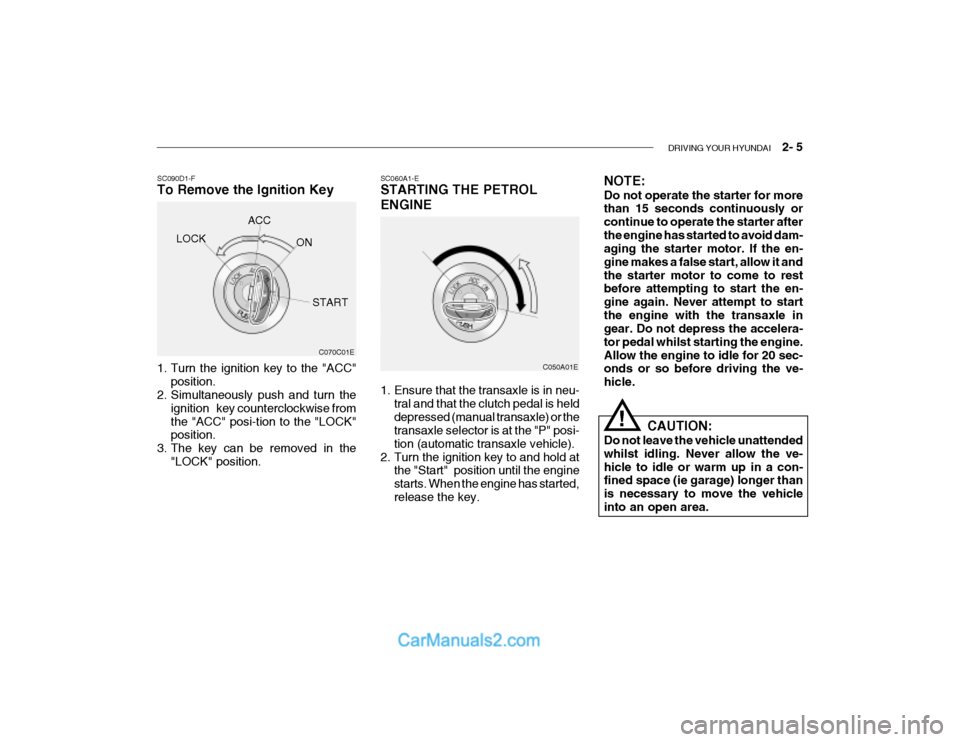
SC060A1-E STARTING THE PETROL ENGINE
C050A01E
1. Ensure that the transaxle is in neu- tral and that the clutch pedal is held depressed (manual transaxle) or the transaxle selector is at the "P" posi- tion (automatic transaxle vehicle).
2. Turn the ignition key to and hold at the "Start" position until the enginestarts. When the engine has started,release the key.
C070C01E
SC090D1-F To Remove the Ignition Key
1. Turn the ignition key to the "ACC"
position.
2. Simultaneously push and turn the
ignition key counterclockwise from the "ACC" posi-tion to the "LOCK" position.
3. The key can be removed in the "LOCK" position.LOCK
ACC
ON
START NOTE: Do not operate the starter for more than 15 seconds continuously or continue to operate the starter afterthe engine has started to avoid dam- aging the starter motor. If the en- gine makes a false start, allow it andthe starter motor to come to rest before attempting to start the en- gine again. Never attempt to startthe engine with the transaxle in gear. Do not depress the accelera- tor pedal whilst starting the engine.Allow the engine to idle for 20 sec- onds or so before driving the ve- hicle.
CAUTION:
Do not leave the vehicle unattendedwhilst idling. Never allow the ve-hicle to idle or warm up in a con- fined space (ie garage) longer than is necessary to move the vehicleinto an open area.
!
Page 365 of 444
WHAT TO DO IN AN EMERGENCY 3- 3
!
HTB218
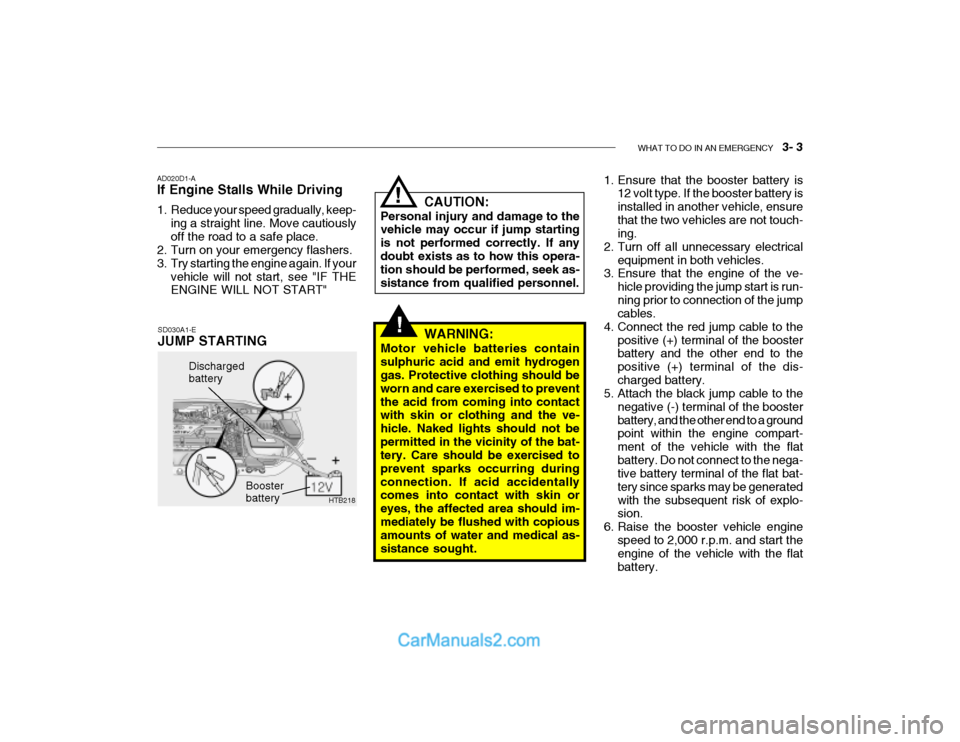
Discharged battery
Booster battery
CAUTION:
Personal injury and damage to the vehicle may occur if jump starting is not performed correctly. If anydoubt exists as to how this opera- tion should be performed, seek as- sistance from qualified personnel.
SD030A1-E JUMP STARTING
AD020D1-AIf Engine Stalls While Driving
1. Reduce your speed gradually, keep-
ing a straight line. Move cautiously off the road to a safe place.
2. Turn on your emergency flashers.
3. Try starting the engine again. If your
vehicle will not start, see "IF THE ENGINE WILL NOT START"!
WARNING:
Motor vehicle batteries contain sulphuric acid and emit hydrogen gas. Protective clothing should be worn and care exercised to preventthe acid from coming into contact with skin or clothing and the ve- hicle. Naked lights should not bepermitted in the vicinity of the bat- tery. Care should be exercised to prevent sparks occurring duringconnection. If acid accidentally comes into contact with skin or eyes, the affected area should im-mediately be flushed with copious amounts of water and medical as- sistance sought. 1. Ensure that the booster battery is
12 volt type. If the booster battery isinstalled in another vehicle, ensurethat the two vehicles are not touch- ing.
2. Turn off all unnecessary electrical equipment in both vehicles.
3. Ensure that the engine of the ve-
hicle providing the jump start is run- ning prior to connection of the jump cables.
4. Connect the red jump cable to the positive (+) terminal of the boosterbattery and the other end to the positive (+) terminal of the dis-charged battery.
5. Attach the black jump cable to the
negative (-) terminal of the boosterbattery, and the other end to a ground point within the engine compart- ment of the vehicle with the flatbattery. Do not connect to the nega- tive battery terminal of the flat bat- tery since sparks may be generatedwith the subsequent risk of explo- sion.
6. Raise the booster vehicle engine speed to 2,000 r.p.m. and start theengine of the vehicle with the flat battery.
Page 444 of 444
INDEX 10- 5
SUPPLEMENTAL RESTRAINT (AIRBAG)
SYSTEM ............................................................... 1-29
STARTING THE ENGINE ........................................... 2-5 STEERING WHEEL FREEPLAY ..............................6-21
STEERING WHEEL LOCK ......................................... 2-4STEERING WHEEL TILT LEVER ............................. 1-67
STEREO SOUND SYSTEM ......................................1-77
SUN-VISOR .............................................................. 1-66
SUNROOF ................................................................ 1-53
TTACHOMETER ......................................................... 1-43
TAIL GATE ................................................................ 1-62
TOWING ATTACHMENTS ................ .......................2-17
TRAILER AND CARAVAN TOWING ........................2-17
TRIP ODOMETER .................................................... 1-43
TRIP COMPUTER .................................................... 1-44
TYPE PRESSURES .................................................... 8-3
TYRE BALANCING ..................................................... 8-5
TYRE CHAINS ............................................................ 8-4
TYRE REPLACEMENT ............................................... 8-5
TYRE ROTATION ....................................................... 8-4
U
UNDERBODY COATINGS ......................................... 4-2 V VALETING
.................................................................. 4-3
VEHICLE IDENTIFICATION NUMBER ....................... 8-2
VEHICLE SPECIFICATION ........................................ 9-2 VEHICLE TOWING OR RECOVERY ....................... 3-11
VENTILATION .......................................................... 1-68
WWHEEL REPLACEMENT ........................................... 8-5
WINDSCREEN WASHER RESERVOIR REPLENISHMENT ................................................ 6-15
WINDSCREEN WIPER BLADES ..............................6-14
WINDSHIELD WIPER/WASHER SWITCH ...............1-48
WINTER MOTORING ............................................... 2-15