engine Hyundai Getz 2004 Owners Manual
[x] Cancel search | Manufacturer: HYUNDAI, Model Year: 2004, Model line: Getz, Model: Hyundai Getz 2004Pages: 445, PDF Size: 12.16 MB
Page 234 of 445
CONSUMER INFORMATION 8- 3
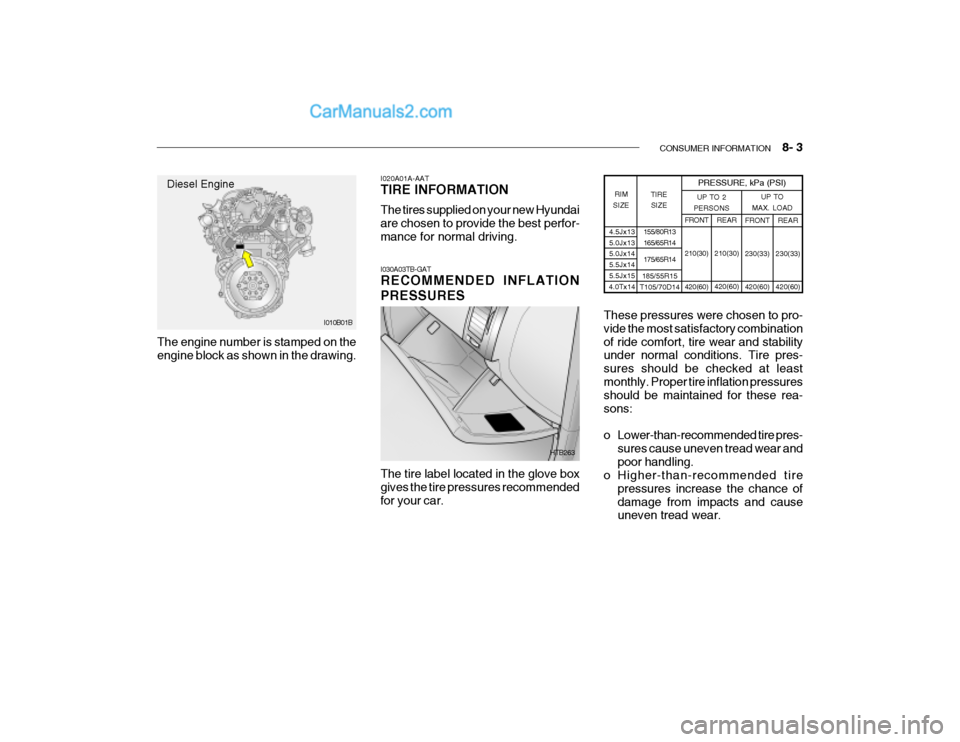
4.5Jx13 5.0Jx13 5.0Jx14 5.5Jx145.5Jx15
4.0Tx14 TIRE
SIZE
RIM
SIZE PRESSURE, kPa (PSI)
155/80R13165/65R14 175/65R14
185/55R15
T105/70D14 REAR
210(30) 420(60) FRONT
230(33) 420(60)
UP TO 2
PERSONS UP TO
MAX. LOAD
REAR
230(33)420(60)
FRONT 210(30) 420(60)
The engine number is stamped on the engine block as shown in the drawing. I020A01A-AAT TIRE INFORMATION The tires supplied on your new Hyundai are chosen to provide the best perfor-mance for normal driving. I030A03TB-GAT RECOMMENDED INFLATION PRESSURES The tire label located in the glove box gives the tire pressures recommended for your car.These pressures were chosen to pro- vide the most satisfactory combinationof ride comfort, tire wear and stability under normal conditions. Tire pres- sures should be checked at leastmonthly. Proper tire inflation pressures should be maintained for these rea- sons:
o Lower-than-recommended tire pres-
sures cause uneven tread wear and poor handling.
o Higher-than-recommended tire
pressures increase the chance ofdamage from impacts and cause uneven tread wear.
I010B01B
HTB263
Diesel Engine
Page 238 of 445
9. VEHICLE SPECIFICATIONS
Measurement ................................................................................... 9-2
Engine .............................................................................................. 9-3
Lubrication chart ............................................................................... 9-4
9
Page 240 of 445
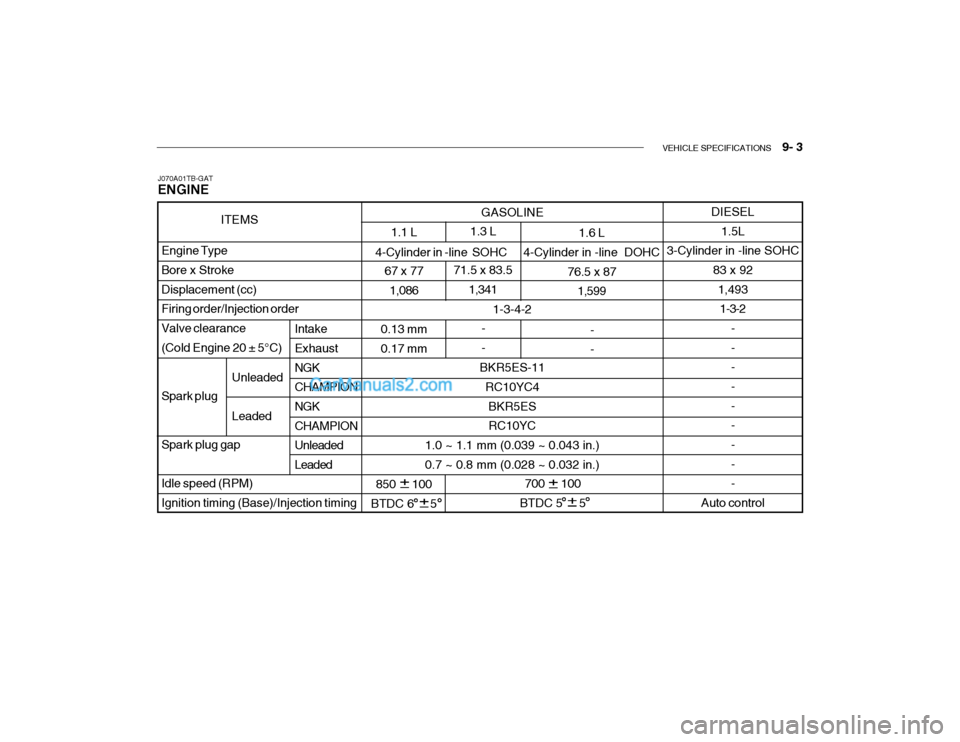
VEHICLE SPECIFICATIONS 9- 3
700 100
BTDC 5 5
GASOLINE
1-3-4-2
BKR5ES-11 RC10YC4
BKR5ES RC10YC
1.0 ~ 1.1 mm (0.039 ~ 0.043 in.) 0.7 ~ 0.8 mm (0.028 ~ 0.032 in.) 1.3 L
71.5 x 83.5 1,341
--
1.1 L
67 x 77 1,086
0.13 mm0.17 mm
850 100
BTDC 6 5 1.6 L
76.5 x 87 1,599
- -
Engine TypeBore x Stroke Displacement (cc) Firing order/Injection orderValve clearance (Cold Engine 20 ± 5°C) Spark plugSpark plug gap Idle speed (RPM) Ignition timing (Base)/Injection timing IntakeExhaust NGK CHAMPIONNGK CHAMPION UnleadedLeaded
J070A01TB-GAT ENGINE
DIESEL
1.5L
3-Cylinder in -line SOHC
83 x 921,493
1-3-2
- -- - -- - --
Auto control
Unleaded Leaded
ITEMS
4-Cylinder in -line SOHC 4-Cylinder in -line DOHC
Page 241 of 445
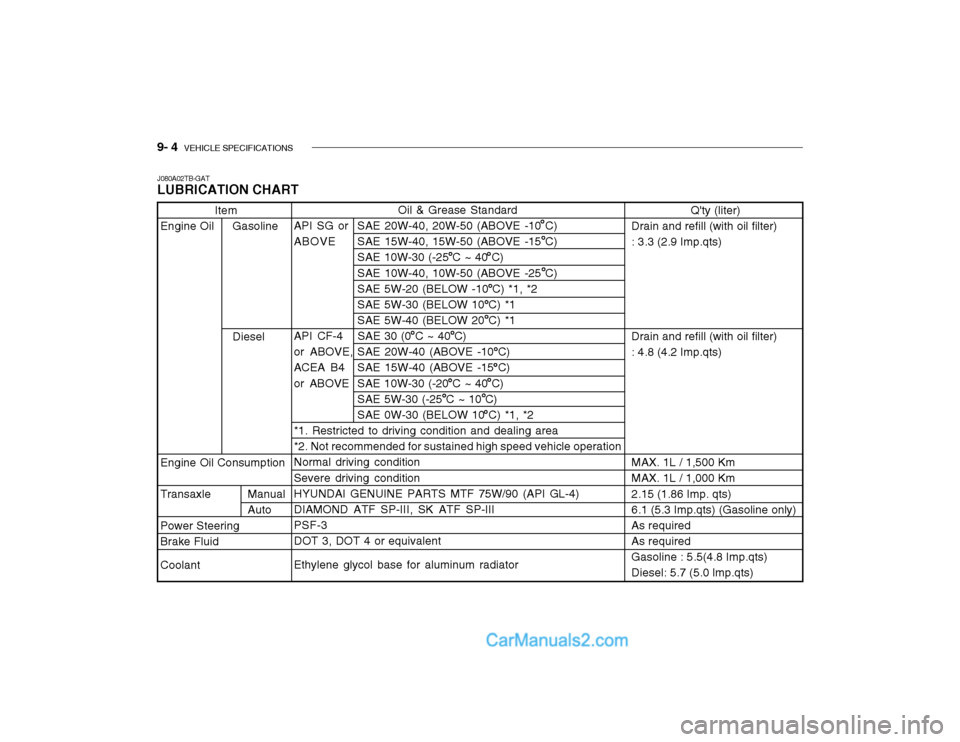
9- 4 VEHICLE SPECIFICATIONS
Oil & Grease Standard
API SG or SAE 20W-40, 20W-50 (ABOVE -10 C) ABOVE SAE 15W-40, 15W-50 (ABOVE -15 C)SAE 10W-30 (-25 C ~ 40 C) SAE 10W-40, 10W-50 (ABOVE -25 C) SAE 5W-20 (BELOW -10 C) *1, *2SAE 5W-30 (BELOW 10 C) *1 SAE 5W-40 (BELOW 20 C) *1
API CF-4 SAE 30 (0 C ~ 40 C)
or ABOVE, SAE 20W-40 (ABOVE -10 C)
ACEA B4 SAE 15W-40 (ABOVE -15 C)
or ABOVE SAE 10W-30 (-20 C ~ 40 C) SAE 5W-30 (-25 C ~ 10 C) SAE 0W-30 (BELOW 10 C) *1, *2
*1. Restricted to driving condition and dealing area*2. Not recommended for sustained high speed vehicle operationNormal driving condition Severe driving condition HYUNDAI GENUINE PARTS MTF 75W/90 (API GL-4)DIAMOND ATF SP-III, SK ATF SP-III PSF-3 DOT 3, DOT 4 or equivalent Ethylene glycol base for aluminum radiator
Item
Engine Oil Gasoline
Diesel
Engine Oil Consumption
Transaxle Manual Auto
Power Steering
Brake Fluid Coolant
J080A02TB-GAT LUBRICATION CHARTQ'ty (liter)
Drain and refill (with oil filter) : 3.3 (2.9 Imp.qts) Drain and refill (with oil filter) : 4.8 (4.2 Imp.qts) MAX. 1L / 1,500 Km MAX. 1L / 1,000 Km 2.15 (1.86 Imp. qts) 6.1 (5.3 Imp.qts) (Gasoline only)As required As required Gasoline : 5.5(4.8 Imp.qts)Diesel: 5.7 (5.0 lmp.qts)
Page 244 of 445

INDEX 10- 3
D Defrosting / Defogging .............................................. 1-80
Door Door locks ................................................................ 1-7
Locking, unlocking front doors with a key ............... 1-7
Drink Holder .............................................................. 1-59
Drive Belts ................................................................ 6-25
Driving
Economical driving ................................................. 2-14
Smooth cornering ................................................... 2-15
Winter driving ......................................................... 2-15
EEmission Control Syst em ........................................... 7-2
Engine Before starting the engine ....................................... 2-3
Compartment ........................................................... 6-2
Coolant ................................................................... 6-13
Coolant temperature gauge ................................... 1-49
If the engine overheats ............................................ 3-4
Number .................................................................... 8-2
Oil ............................................................................. 6-7
Starting ..................................................................... 2-3
Engine Exhaust Can Be Dangerous ........................... 2-2F Fog Light
Front ....................................................................... 1-57
Rear ....................................................................... 1-57
Front Seats Adjustable front seats ............................................ 1-13
Adjustable headrest s .............................................. 1-14
Adjusting seat forward and rear ward..................... 1-13
Adjusting seatback angle .......................................1-13
Lumbar support control .................. ........................ 1-14
Seat cushion height adjustment............................ 1-15
Seat warmer ........................................................... 1-19
Fuel Capacity ................................................................... 9-2
Gauge .................................................................... 1-48
recommendations ..................................................... 1-2
Fuel Filler Lid Remote release ...................................................... 1-68
Fuses ........................................................................ 6-26
Fuse Panel description ............................................. 6-38
G General Checks .......................................................... 6-6
Glove Box ................................................................. 1-63
Page 251 of 445
SA030A1-EFOREWORD
Hyundai Motor Company wish to take this opportunity to thank you for purchasing a Hyundai product and to welcome you to the ever increasing number of discriminating motorists who drive Hyundai vehicles. The advanced engineering and construction methods employed during both design and production of the Hyundaimarque are something of which we are proud, and this commitment to providing a high quality product is supported by a comprehensive after sales and warranty service of which we are equally proud. This owners manual will introduce the operating and maintenance requirements for the vehicle and it is recommended that it is carefully read to ensure that the maximum performance and durability along with safe and satisfactory operation are obtained. The recommended routine maintenance servicing along with anyrunning repairs that may be required should be entrusted to a franchised Hyundai dealer to ensure that only the latest methods and genuine Hyundai replacement parts are used for the continued reliability, safety and performance of the vehicle. Should any question or query exist regarding any aspect of your Hyundai please contact the nearest Hyundai dealer who will be only too pleased to assist wherever possible. Note: This owners manual should be considered as part of the vehicle and should be kept in the vehicle at
all times for ease of reference. In the event of the vehicle being sold please ensure that this manual is left in the vehicle for the reference of the new owner.
CAUTION:
Severe engine and transaxle damage may result from the use of poor quality fuels and lubricants that do not meet Hyundai specifications. You must always use high quality fuels and lubricants that meet the specifications listed on Page 9-4 in the Vehicle Specifications section of the Owner's Manual. Copyright 2004 Hyundai Motor Company. All rights reserved. No part of this publication may be reproduced, stored in any retrieval system or transmitted in any form or by any means without the prior written permissionof Hyundai Motor Company.
!
tbuk-0.p65 3/23/04, 4:21 PM
5
Page 254 of 445
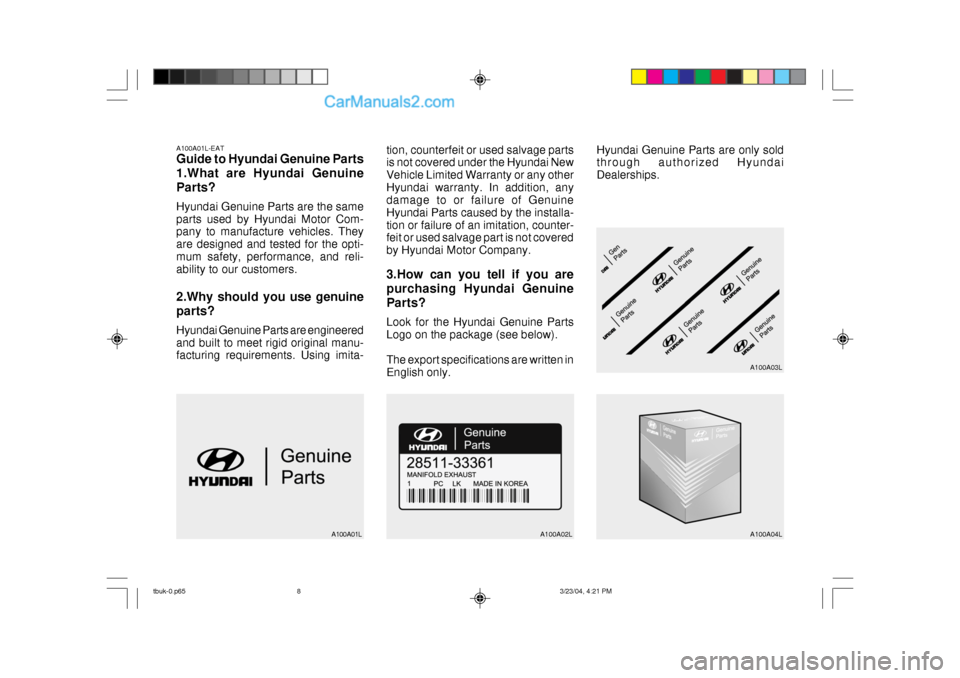
A100A01L-EAT Guide to Hyundai Genuine Parts 1.What are Hyundai GenuineParts? Hyundai Genuine Parts are the same parts used by Hyundai Motor Com- pany to manufacture vehicles. They are designed and tested for the opti-mum safety, performance, and reli- ability to our customers. 2.Why should you use genuine parts? Hyundai Genuine Parts are engineered and built to meet rigid original manu- facturing requirements. Using imita-A100A01Ltion, counterfeit or used salvage partsis not covered under the Hyundai New Vehicle Limited Warranty or any otherHyundai warranty. In addition, any damage to or failure of Genuine Hyundai Parts caused by the installa-tion or failure of an imitation, counter- feit or used salvage part is not covered by Hyundai Motor Company. 3.How can you tell if you are purchasing Hyundai GenuineParts? Look for the Hyundai Genuine Parts Logo on the package (see below). The export specifications are written in English only.
A100A02L A100A04L
A100A03L
Hyundai Genuine Parts are only sold through authorized Hyundai Dealerships.
tbuk-0.p65
3/23/04, 4:21 PM
8
Page 260 of 445
1- 2 FEATURES OF YOUR HYUNDAI
B010A03O-EAT
FUEL RECOMMENDATIONS
Petrol Engines
THIS VEHICLE MUST ONLY BE OP-
ERATED WITH UNLEADED FUEL.
SERIOUS DAMAGE WILL RESULT
FROM THE USE OF LEADED FUEL. The use of leaded fuel in this vehicle will
result in irreversible pollution of the
catalyst element. Such pollution will
prevent correct operation of the cata-
lyst and give rise to increased operating
temperatures leading to the catalyst
element melting and restricting the ex-
haust flow along with an increase in
exhaust emission levels.
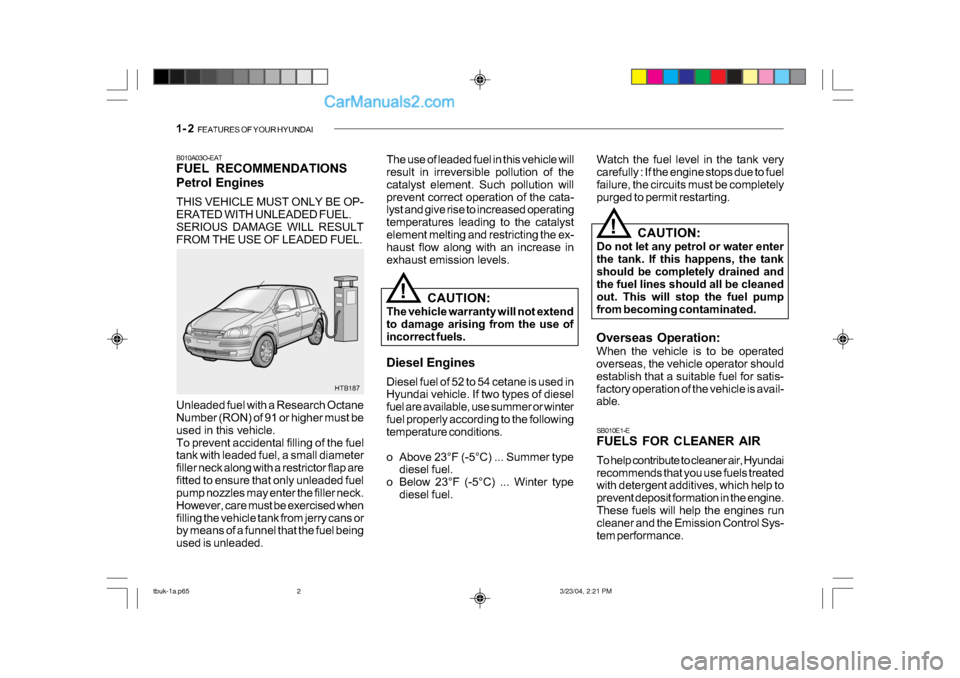
Unleaded fuel with a Research Octane
Number (RON) of 91 or higher must be
used in this vehicle.
To prevent accidental filling of the fuel
tank with leaded fuel, a small diameter
filler neck along with a restrictor flap are
fitted to ensure that only unleaded fuel
pump nozzles may enter the filler neck.
However, care must be exercised when
filling the vehicle tank from jerry cans or
by means of a funnel that the fuel being
used is unleaded. HTB187
!
CAUTION:
The vehicle warranty will not extend
to damage arising from the use of
incorrect fuels.
Diesel Engines
Diesel fuel of 52 to 54 cetane is used in
Hyundai vehicle. If two types of diesel
fuel are available, use summer or winter
fuel properly according to the following
temperature conditions.
o Above 23°F (-5°C) ... Summer type diesel fuel.
o Below 23°F (-5°C) ... Winter type diesel fuel.
! Watch the fuel level in the tank very
carefully : If the engine stops due to fuel
failure, the circuits must be completely
purged to permit restarting.
CAUTION:
Do not let any petrol or water enter
the tank. If this happens, the tank
should be completely drained and
the fuel lines should all be cleaned
out. This will stop the fuel pump
from becoming contaminated.
Overseas Operation:
When the vehicle is to be operated
overseas, the vehicle operator should
establish that a suitable fuel for satis-
factory operation of the vehicle is avail-
able. SB010E1-E
FUELS FOR CLEANER AIR
To help contribute to cleaner air, Hyundai
recommends that you use fuels treated
with detergent additives, which help to
prevent deposit formation in the engine.
These fuels will help the engines run
cleaner and the Emission Control Sys-
tem performance.
tbuk-1a.p65 3/23/04, 2:21 PM
2
Page 261 of 445
FEATURES OF YOUR HYUNDAI 1- 3
B020A01FC-EAT
RUNNING IN YOUR NEW
HYUNDAI (Petrol Engine)
The longevity and performance of the
vehicle are greatly affected by the care
exercised during the first 1,000 miles of
motoring. Because of modern manu-
facturing techniques, rigid guidelines
regarding maximum road speeds have
become unnecessary. However, cer-
tain precautions should be observed in
order to obtain the best possible perfor-
mance and useful life from the vehicle.
1) Do not race the engine without a load
(i.e revving the engine in neutral).
2) During the first 500 miles the maxi-
mum engine speed should be re-
stricted to 3,000 rpm and gradually
increased thereafter.
3) Avoid prolonged constant speed op- eration. The internal components of
the engine will become more quickly
run in if the operation speed is varied
during the running-in period.
4) Never allow the engine to labour. Use
the gearbox freely and avoid large
throttle openings when the engine
speed is below 1,500 rpm.
5) Avoid rapid acceleration and maxi- mum throttle openings.
6) Avoid harsh braking during the first
100 miles of urban motoring or 1,000
miles of motorway driving to allow
the friction facings of the brake pads
and shoes to bed against the discs
and drums properly.
7) No trailer towing should be under-
taken during the running-in period.
B020B01FC-EAT
(Diesel Engine)
The longevity and performance of the
vehicle are greatly affected by the care
exercised during the first 1,000 miles of
motoring. Because of modern manu-
facturing techniques, rigid guidelines
regarding maximum road speeds have
become unnecessary. However, cer-
tain precautions should be observed in
order to obtain the best possible perfor-
mance and useful life from the vehicle. 1) Do not race the engine without a load
(i.e revving the engine in neutral).
2) During the first 600 miles the maxi- mum engine speed should be re-
stricted to 3,000 rpm and gradually
increased thereafter. And while driv-
ing, keep under three quarters of
maximum vehicle speed.
3) Avoid prolonged constant speed op- eration. The internal components of
the engine will become more quickly
run in if the operation speed is varied
during the running in period.
4) Never allow the engine to labour. Use
the gearbox freely and avoid large
throttle openings when the engine
speed is below 1,500 rpm.
5) Avoid rapid acceleration and maxi- mum throttle openings.
6) Avoid harsh braking during the first
100 miles of urban motoring or 1,000
miles of motorway driving to allow
the friction facings of the brake pads
and shoes to bed against the discs
and drums properly.
7) No trailer towing should be under
taken during the running in period.
tbuk-1a.p65 3/23/04, 2:21 PM
3
Page 262 of 445
1- 4 FEATURES OF YOUR HYUNDAI
6SB035A1-FE
IMMOBILISER SYSTEM
The immobiliser system is an anti-theft
device, designed to prevent and deter
vehicle theft.
B880B03A-GAT
Keys
All of the locks fitted to the vehicle are
operated by the same key. However,
since it is possible to lock the doors
without the use of the key, care should
be exercised to ensure that the key
does not become locked inside the
vehicle by mistake.
NOTE:
If you make your own duplicate key,
you will not be able to cancel the
system or start the engine. B880C02A-GAT
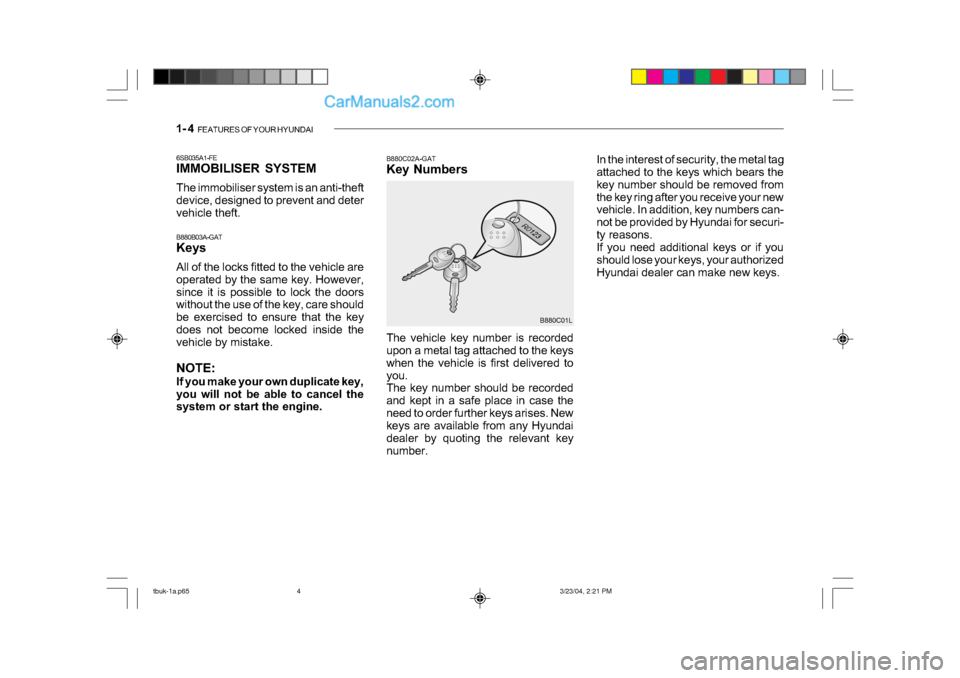
Key Numbers
The vehicle key number is recorded
upon a metal tag attached to the keys
when the vehicle is first delivered to
you.
The key number should be recorded
and kept in a safe place in case the
need to order further keys arises. New
keys are available from any Hyundai
dealer by quoting the relevant key
number.
B880C01L
In the interest of security, the metal tag
attached to the keys which bears the
key number should be removed from
the key ring after you receive your new
vehicle. In addition, key numbers can-
not be provided by Hyundai for securi-
ty reasons.
If you need additional keys or if you
should lose your keys, your authorized
Hyundai dealer can make new keys.
tbuk-1a.p65
3/23/04, 2:21 PM
4