engine Hyundai Getz 2004 Owner's Manual
[x] Cancel search | Manufacturer: HYUNDAI, Model Year: 2004, Model line: Getz, Model: Hyundai Getz 2004Pages: 445, PDF Size: 12.16 MB
Page 346 of 445
DRIVING YOUR HYUNDAI 2- 3
!
C020A01O-EAT BEFORE STARTING THE EN- GINE Before you start the engine, you should always:
1. Look around the vehicle to be sure
there are no flat tyres, puddles of oil or water or other indications of pos- sible trouble.
2. After entering the car, check to be
sure the parking brake is engaged.
3. Check that all windows, and lights are clean.
4. Check that the interior and exterior
mirrors are clean and in position.
5. Check your seat, seatback and
headrestraint to be sure they are intheir proper positions.
6. Close all the doors.
7. Fasten your seat belt and be sure
that all other occupants have fas- tened theirs.
8. Turn off all lights and accessories that are not needed.
9. When you turn the ignition switch to "ON" check that all appropriate warn-ing lights are operating and that youhave sufficient fuel. 10.Check the operation of warning
lights and all bulbs when key is inthe "ON" position.
WARNING: (DIESEL ENGINE)
To ensure that sufficient vacuum exists within the brake system dur-ing cold weather start-up condi-tions, it is necessary to run theengine at idle for several seconds after starting the engine. SC040A1-F COMBINATION IGNITION SWITCH AND STEERING LOCK To Start the Engine
o If your Hyundai is equipped with a
manual transaxle, place the shift lever in neutral and depress theclutch pedal fully.
o If your Hyundai has an automatic
transaxle, place the shift lever in "P" (park).
o To start the engine, insert the igni-
tion key and turn it to the "START" position. Release it as soon as theengine starts. Do not hold the key inthe "START" position for more that 15 seconds.
NOTE: For safety, the engine will not start if the shift lever is not in "P" or "N"Position (automatic transaxle).
tbuk-2.p65 3/23/04, 4:55 PM
3
Page 347 of 445
2- 4 DRIVING YOUR HYUNDAI
!
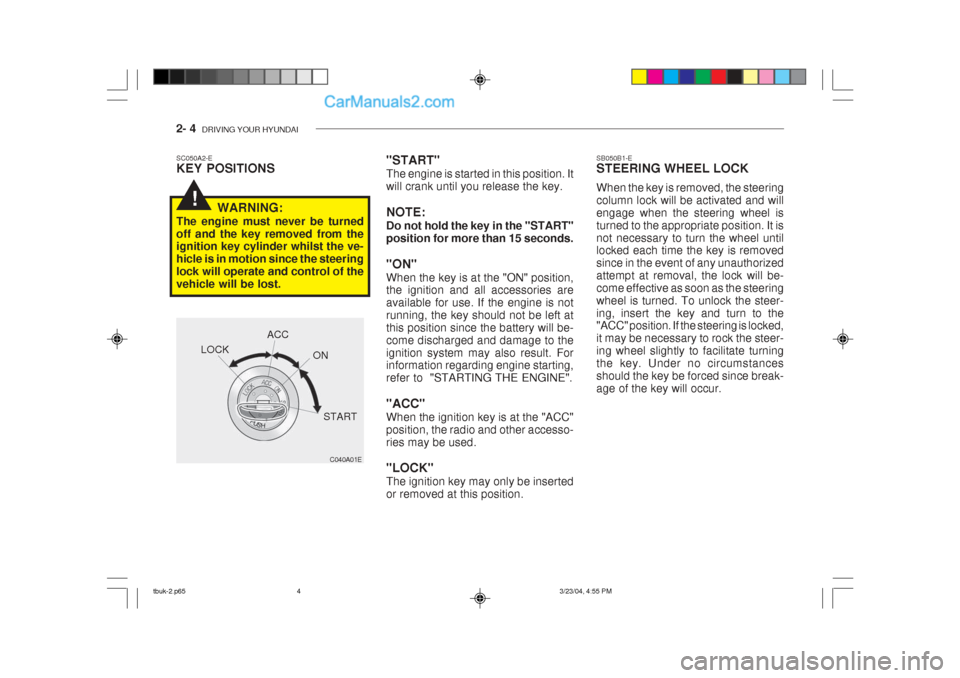
"START" The engine is started in this position. It will crank until you release the key. NOTE: Do not hold the key in the "START" position for more than 15 seconds. "ON" When the key is at the "ON" position, the ignition and all accessories are available for use. If the engine is notrunning, the key should not be left atthis position since the battery will be-come discharged and damage to theignition system may also result. For information regarding engine starting, refer to "STARTING THE ENGINE". "ACC" When the ignition key is at the "ACC" position, the radio and other accesso-ries may be used. "LOCK" The ignition key may only be inserted or removed at this position.SC050A2-E KEY POSITIONS
C040A01E
LOCK
ACC
ON
START
WARNING:
The engine must never be turned off and the key removed from the ignition key cylinder whilst the ve- hicle is in motion since the steeringlock will operate and control of thevehicle will be lost. SB050B1-E STEERING WHEEL LOCK When the key is removed, the steering column lock will be activated and willengage when the steering wheel isturned to the appropriate position. It isnot necessary to turn the wheel until locked each time the key is removed since in the event of any unauthorizedattempt at removal, the lock will be-come effective as soon as the steeringwheel is turned. To unlock the steer-ing, insert the key and turn to the "ACC" position. If the steering is locked, it may be necessary to rock the steer-ing wheel slightly to facilitate turningthe key. Under no circumstancesshould the key be forced since break-age of the key will occur.
tbuk-2.p65
3/23/04, 4:55 PM
4
Page 348 of 445
DRIVING YOUR HYUNDAI 2- 5
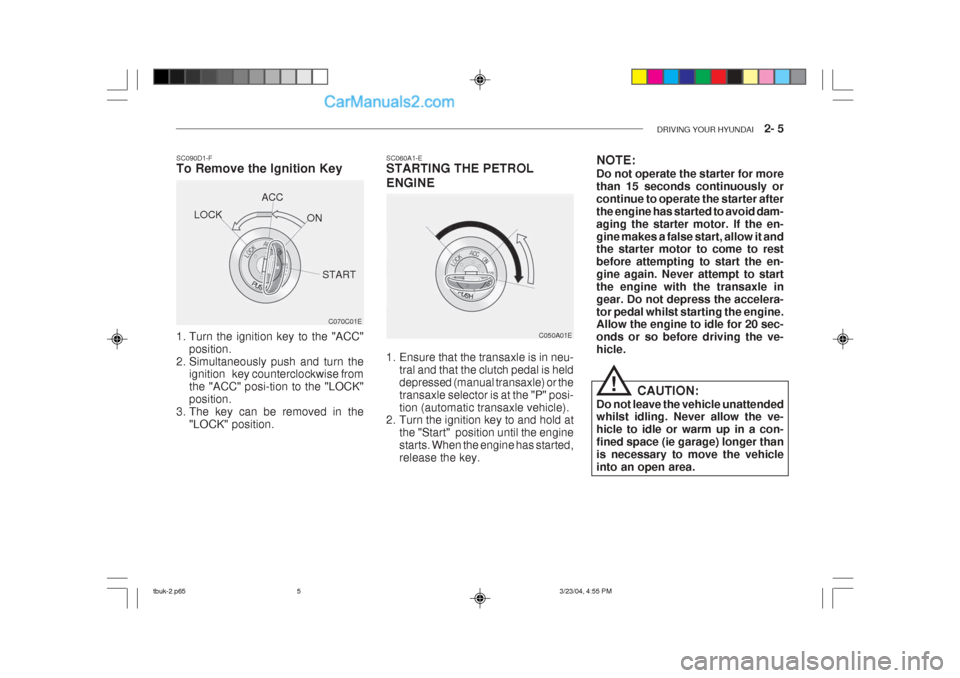
SC060A1-E STARTING THE PETROL ENGINE
C050A01E
1. Ensure that the transaxle is in neu- tral and that the clutch pedal is held depressed (manual transaxle) or thetransaxle selector is at the "P" posi-tion (automatic transaxle vehicle).
2. Turn the ignition key to and hold at
the "Start" position until the enginestarts. When the engine has started,release the key.
C070C01E
SC090D1-F To Remove the Ignition Key
1. Turn the ignition key to the "ACC"
position.
2. Simultaneously push and turn the ignition key counterclockwise from the "ACC" posi-tion to the "LOCK"position.
3. The key can be removed in the
"LOCK" position.LOCK
ACC
ON
START NOTE: Do not operate the starter for more than 15 seconds continuously orcontinue to operate the starter afterthe engine has started to avoid dam-aging the starter motor. If the en-gine makes a false start, allow it and the starter motor to come to rest before attempting to start the en-gine again. Never attempt to startthe engine with the transaxle ingear. Do not depress the accelera-tor pedal whilst starting the engine. Allow the engine to idle for 20 sec- onds or so before driving the ve-hicle.
CAUTION:
Do not leave the vehicle unattended whilst idling. Never allow the ve- hicle to idle or warm up in a con-fined space (ie garage) longer thanis necessary to move the vehicleinto an open area.
!
tbuk-2.p65 3/23/04, 4:55 PM
5
Page 349 of 445
2- 6 DRIVING YOUR HYUNDAI
C050B01HP
NOTE: If the engine were not started 10 seconds after the preheating is com- pleted, turn the ignition key oncemore to the "LOCK" position, andthen to the "ON" position, in orderto preheat again.
C051A01O-EAT STARTING THE DIESEL ENGINE ENGINE COLD
o Turn the ignition key to position
"ON" and wait for the pre-heat indi-cator light to go out.
o Operate the starter until the engine runs.
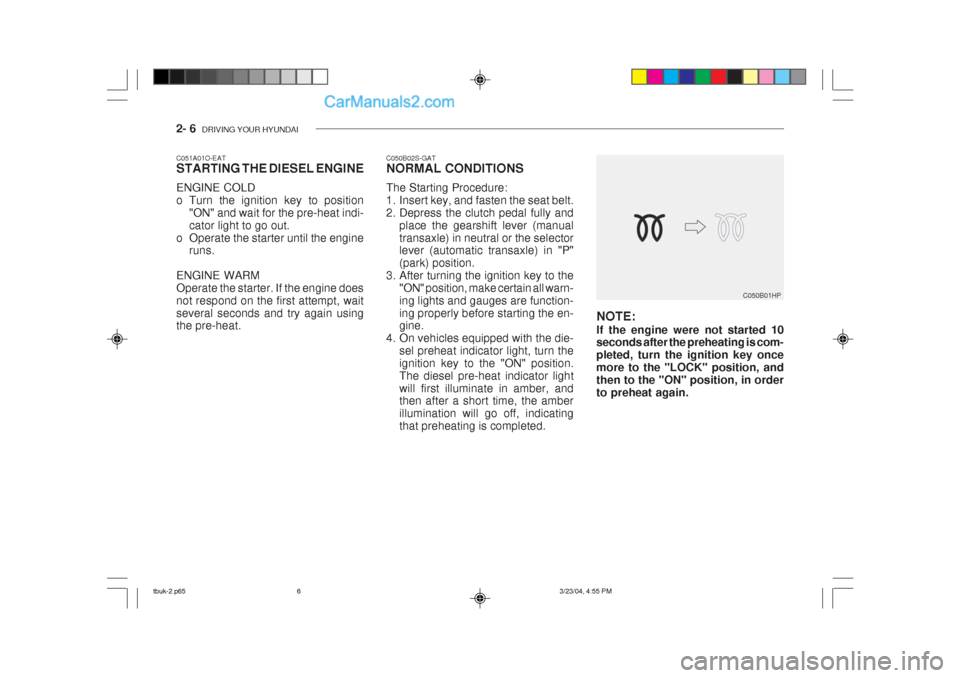
ENGINE WARMOperate the starter. If the engine doesnot respond on the first attempt, waitseveral seconds and try again using the pre-heat. C050B02S-GAT NORMAL CONDITIONS The Starting Procedure:
1. Insert key, and fasten the seat belt.
2. Depress the clutch pedal fully and
place the gearshift lever (manualtransaxle) in neutral or the selector lever (automatic transaxle) in "P" (park) position.
3. After turning the ignition key to the
"ON" position, make certain all warn-ing lights and gauges are function-ing properly before starting the en- gine.
4. On vehicles equipped with the die-
sel preheat indicator light, turn the ignition key to the "ON" position.The diesel pre-heat indicator lightwill first illuminate in amber, and then after a short time, the amber illumination will go off, indicatingthat preheating is completed.
tbuk-2.p65 3/23/04, 4:55 PM
6
Page 350 of 445
DRIVING YOUR HYUNDAI 2- 7
!
!
C055B01B-GAT STARTING AND STOPPING THE ENGINE FOR TURBO CHARGER INTERCOOLER (DIESEL EN-GINE)
(1) Do not race the engine or sudden
accelerate the engine immediately after start it. If the engine is cold,allow the engine to idle for severalseconds before it is driven to en-sure sufficient lubrication of the turbo charger unit.
(2) After high speed or extended driv- ing, requiring a heavy engine load, the engine should be allowed to idleabout 1 minute before turning it off.This idle time will allow the turbo charger to cool prior to shutting the engine off.
WARNING:
Do not turn the engine off immedi-ately after it has been subjected to a heavy load. Doing so may cause severe damage to the engine orturbo charger unit.
WARNING:
Be sure that the clutch is fully de-pressed when starting a manualtransaxle vehicle. Otherwise thereis the potential to cause damage tothe vehicle or injury to someone inside or outside the vehicle as a result of the forward or backwardmovement of the vehicle that willoccur if the clutch is not depressedwhen the vehicle is started. SC060B1-E FUEL ECONOMY The following suggestions are made to assist in achieving the greatest degreeof fuel economy.
o Maintaining a constant check on
fuel consumption will enable the most economical use pattern anddriving style to be adopted.
o Avoid using the vehicle for very short journeys if possible, particu-larly when a cold start is involved.
o Ensure that tyre pressures are main-
tained at the correct level.
o Use only the recommended grade
of fuel.
o Avoid carrying unnecessary weight,
and if a roof rack is in use, remove it as soon as possible after use.
o Anticipate the road and conditions ahead to enable adjustments in speed to be made smoothly. Avoidheavy acceleration and sharp brak-ing.
o Avoid cruising at unnecessary high
speeds.
5. Turn the ignition key to the "Start"
position and release it when theengine starts.
tbuk-2.p65 3/23/04, 4:55 PM
7
Page 351 of 445
2- 8 DRIVING YOUR HYUNDAI
HTB206 CAUTION:
o Do not attempt to engage reverse gear when the car is in motion.
o To avoid damaging the selector mechanism, do not use the gear shift lever as a hand rest. Releasethe lever immediately the shift iscompleted.
o To avoid premature clutch wear,
do not use the clutch pedal as afoot rest, and do not hold thevehicle on a gradient using theclutch.
o Ensure that the engine is not over-revved by upshifting beforethe tachometer needle enters thered zone.
o Do not coast with the shift lever at the neutral position.
o When descending long gradi- ents, make use of the engine brak-ing to assist the footbrake toavoid brake fade or over-heating.
o When slippery conditions are en- countered, increased cautionshould be exercised when gear changing, braking or accelerat-
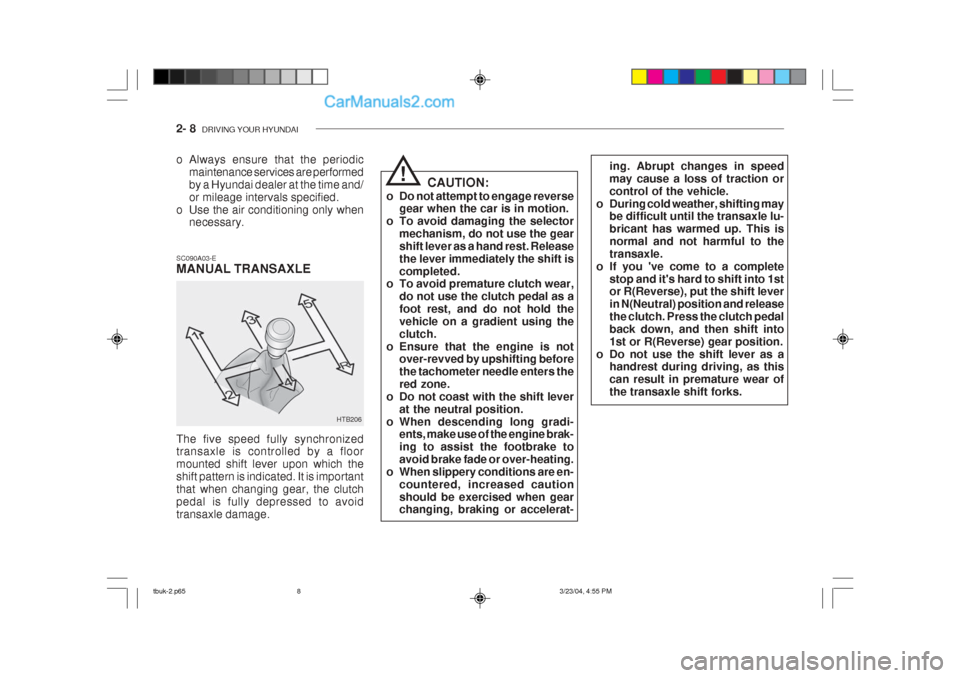
SC090A03-EMANUAL TRANSAXLE The five speed fully synchronized transaxle is controlled by a floor mounted shift lever upon which theshift pattern is indicated. It is importantthat when changing gear, the clutchpedal is fully depressed to avoidtransaxle damage. ing. Abrupt changes in speedmay cause a loss of traction orcontrol of the vehicle.
o During cold weather, shifting may be difficult until the transaxle lu-bricant has warmed up. This isnormal and not harmful to thetransaxle.
o If you 've come to a complete
stop and it's hard to shift into 1st or R(Reverse), put the shift lever in N(Neutral) position and releasethe clutch. Press the clutch pedalback down, and then shift into1st or R(Reverse) gear position.
o Do not use the shift lever as a handrest during driving, as thiscan result in premature wear ofthe transaxle shift forks.
o Always ensure that the periodic
maintenance services are performedby a Hyundai dealer at the time and/or mileage intervals specified.
o Use the air conditioning only when necessary.
!
tbuk-2.p65 3/23/04, 4:55 PM
8
Page 353 of 445
2- 10 DRIVING YOUR HYUNDAI
YC090A1-E SELECTOR POSITIONS o P (Park): With the selector in this position, no drive is transmitted from the engineand the transaxle output and thereforethe front wheels locked. The enginemay be started with the selector in this position.
!
CAUTION:
The selector must NEVER be shifted to the "P" position whilst the ve-hicle is in motion, otherwise seri-ous transaxle damage will result. DC110C1-E o R (Reverse): With the selector in this position, re- verse gear will be engaged. The en-gine may not be started with the selec-tor in this position.
CAUTION:
The selector must NEVER be shiftedto the "R" position whilst the ve-hicle is in motion.
! DC110D1-E o N (Neutral): With the selector in this position, no gear is selected and no drive is trans-mitted from the engine. The enginemay be started with the selector in thisposition.
!
CAUTION:
Do not coast with the selector at the "N" position. DC110E1-E o D (Drive): With the selector in this position, first gear will be engaged from rest and thetransmission will automatically upshiftto second, third and fourth depending upon the vehicle speed, throttle posi- tion and the position of the overdriveswitch. The engine may not be startedwith the selector in this position. DC110F1-E o 2 (Second Gear): With the selector in this position, first gear will be engaged from rest. Thetransmission will upshift to second geardepending upon the vehicle speed andthrottle position. No upshift to third or fourth will occur. The engine may not be started with the selector in thisposition. DC110G2-E o L (Low Gear): With the selector in this position, first gear will be engaged from rest. Noupshift will occur regardless of vehiclespeed and throttle opening. The en-gine may not be started with the selec-tor in this position.
!
CAUTION:
Do not move the selector to the "L" position when the vehicle speed isin excess of 50 m.p.h.
tbuk-2.p65 3/23/04, 4:55 PM
10
Page 354 of 445
DRIVING YOUR HYUNDAI 2- 11
C090H01A-EAT NOTE:
o The brake pedal should be de-
pressed when shifting from NEU- TRAL to a forward or reversegear.
o The brake pedal fully depressed
in order to move the shift lever from the "P" (Park) position to any of the other positions.
o It is always possible to shift from "R", "N", "D", "2", "L" position.
!
C090I02A-EAT
CAUTION:
o Shift into "R" and "P" only when the vehicle has completely stopped.
o Do not accelerate the engine in reverse or any of the forward positions with the brakes applied.
o Always apply the footbrake when shifting from "P" or "N", to "R", "D", "2" or "L" position.
o Do not use the "P" (Park) posi- tion in place of the parking brake. Always set the parking brake,shift the transaxle into "P" (Park)and turn off the ignition when you leave the vehicle, even mo- mentarily. Never leave the vehicleunattended whilst the engine isrunning.
o Check the automatic transaxle fluid level regularly, and add fluid as necessary. See the maintenance schedulefor the proper fluid recommen-dation. FC120D1-E General Operating Instructions
o The button in the selector handle
must be depressed before the se- lector can be moved.
o The engine may only be started
when the selector is at position "P" or "N".
o Ensure that the footbrake is firmly applied when shifting from "P" or "N" to "D", "2", "L" or "R" and viceversa.
o Always engage the parking brake when the vehicle is unattended,never use the "P" position in place ofthe parking brake.
o Under normal circumstances, the selector should be placed in the "D"position and the transaxle allowed to select the most ideal ratio for the circumstances. In this position maxi-mum fuel economy will be achieved.
o When descending steep gradients where engine braking is required,the selector should be placed at the "2" or "L" position depending upon the vehicle speed.
tbuk-2.p65 3/23/04, 4:55 PM
11
Page 355 of 445
2- 12 DRIVING YOUR HYUNDAI
HTB217-D
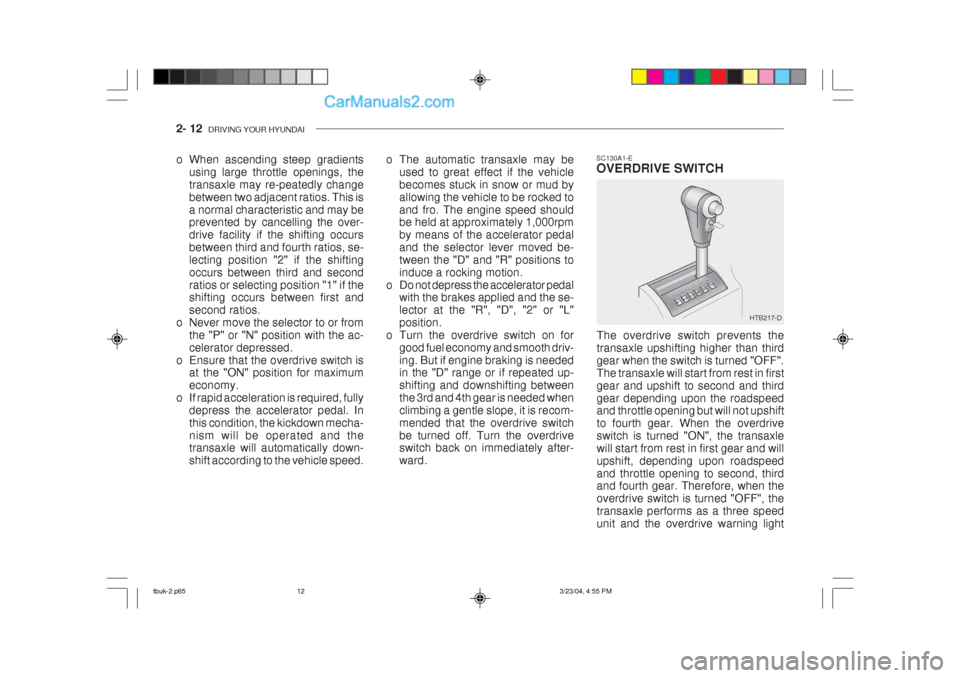
SC130A1-E OVERDRIVE SWITCH
The overdrive switch prevents the transaxle upshifting higher than thirdgear when the switch is turned "OFF".The transaxle will start from rest in firstgear and upshift to second and thirdgear depending upon the roadspeed and throttle opening but will not upshift to fourth gear. When the overdriveswitch is turned "ON", the transaxlewill start from rest in first gear and willupshift, depending upon roadspeedand throttle opening to second, third and fourth gear. Therefore, when the overdrive switch is turned "OFF", thetransaxle performs as a three speedunit and the overdrive warning light
o When ascending steep gradients
using large throttle openings, thetransaxle may re-peatedly changebetween two adjacent ratios. This isa normal characteristic and may be prevented by cancelling the over- drive facility if the shifting occursbetween third and fourth ratios, se-lecting position "2" if the shiftingoccurs between third and secondratios or selecting position "1" if the shifting occurs between first and second ratios.
o Never move the selector to or from
the "P" or "N" position with the ac-celerator depressed.
o Ensure that the overdrive switch is at the "ON" position for maximumeconomy.
o If rapid acceleration is required, fully
depress the accelerator pedal. Inthis condition, the kickdown mecha-nism will be operated and the transaxle will automatically down- shift according to the vehicle speed. o The automatic transaxle may be
used to great effect if the vehiclebecomes stuck in snow or mud byallowing the vehicle to be rocked toand fro. The engine speed should be held at approximately 1,000rpm by means of the accelerator pedaland the selector lever moved be-tween the "D" and "R" positions toinduce a rocking motion.
o Do not depress the accelerator pedal with the brakes applied and the se-lector at the "R", "D", "2" or "L"position.
o Turn the overdrive switch on for good fuel economy and smooth driv-ing. But if engine braking is needed in the "D" range or if repeated up- shifting and downshifting betweenthe 3rd and 4th gear is needed whenclimbing a gentle slope, it is recom-mended that the overdrive switchbe turned off. Turn the overdrive switch back on immediately after- ward.
tbuk-2.p65 3/23/04, 4:55 PM
12
Page 356 of 445
DRIVING YOUR HYUNDAI 2- 13
SC140B1-E ANTI-LOCK BRAKE SYSTEM (Not all models) The Anti-Lock Brake System (ABS) is designed to prevent wheel lock-upduring sudden braking or on hazard-ous road surfaces. The ABS controlmodule monitors the wheel speed and controls the pressure applied to each brake. Thus, in emergency situationsor on slick roads, ABS will increasevehicle control during braking. NOTE: During ABS operation, a slight pul- sation may be felt in the brake pedal when the brakes are applied. Also, a noise may be heard in the enginecompartment whilst braking. Theseconditions are normal and indicatethat the anti-lock brake system isfunctioning properly.
located in the instrument cluster will beilluminated. When the overdrive switchis turned "ON", the transaxle functionsas a fully automatic four speed unitwith the maximum fuel economy po- tential of the vehicle being realized. SC140A1-E EFFECTIVE BRAKING Braking system performance and fric- tion material life are greatly affected by the driving style adopted. The follow-ing suggestions are made to assist inachieving the best results from thebraking system.
o Anticipate the road and conditions
ahead in order that heavy braking may be avoided.
o When descending long gradients,
use the engine to assist in retardingthe vehicle to minimize the possibil- ity of brake fade occurring.
o When trailer towing, ensure that the
trailer brakes function correctly and use engine braking to assist thevehicle braking system. o Use only genuine Hyundai replace-
ment brake pads and shoes to en-sure consistent friction characteris-tics and wear rates.
o After driving through deep water (e.g. fording), the brakes may be-come wet and performance reduced.Always check brake efficiency afteremerging from the water and dry thebrakes by lightly depressing thebrake pedal several times whilst driving slowly.
o Apply the parking brake only when the vehicle is at rest.
o Since the power assistance pro- vided by the brake servo is derived from the engine, coasting with the engine turned off or towing of the vehicle with the engine turned offwill result in greatly increased pedalpressures being required to stop thevehicle.
o Do not hold the vehicle on the up- grade with the accelerator pedal.This can cause the transmission tooverheat. Always use the brakepedal or parking brake.
tbuk-2.p65 3/23/04, 4:55 PM
13