brakes Hyundai Getz 2004 User Guide
[x] Cancel search | Manufacturer: HYUNDAI, Model Year: 2004, Model line: Getz, Model: Hyundai Getz 2004Pages: 445, PDF Size: 12.16 MB
Page 156 of 445
DRIVING YOUR HYUNDAI 2- 21
6. Check the condition and air pres-
sure of all tires on the trailer and your car. Low tire pressure canseriously affect the handling. Also check the spare tire.
7. The vehicle/trailer combination is more affected by crosswind andbuffeting. When being passed by a largevehicle, keep a constant speed and steer straight ahead. If there is too much wind buffeting slow downto get out of the other vehicle's air turbulence.
8. When parking your car and trailer, especially on a hill, be sure to fol-low all the normal precautions. Turn your front wheel into the curb, setthe parking brake firmly, and put the transaxle in 1st or Reverse (manual) or Park (automatic). Inaddition, place wheel chocks at each of the trailer's tires.
9. If the trailer has electric brakes, start your vehicle and trailer mov-ing, and then apply the trailer brake controller by hand to be sure thebrakes are working. This lets you check your electrical connection at the same time. 10. During your trip, check occasion-
ally to be sure that the load issecure, and that the lights andany trailer brakes are still working.
11. Avoid jerky starts, sudden accel-
eration or sudden stops.
12. Avoid sharp turns and rapid lane changes.
13. Avoid holding the brake pedal down
too long or too frequently. This could cause the brakes to over- heat, resulting in reduced brakingefficiency.
14. When going down a hill, shift into a
lower gear and use the engine brak-ing effect. When ascending a long grade, downshift the transaxle to a lowergear and reduce speed to reduce chances of engine overloading and/ or overheating.
15. If you have to stop while going uphill, do not hold the vehicle inplace by pressing on the accelera-tor. This can cause the automatic transaxle to overheat. Use the park- ing brake or footbrake.
NOTE: When towing check transaxle fluid more frequently. CAUTION:
If overheating should occur whentowing, (temperature gauge readsnear red zone), taking the following action may reduce or eliminate the problem.
1. Turn off the air conditioner.
2. Reduce highway speed.
3. Select a lower gear when going uphill.
4. While in stop and go traffic, place the gear selection in park or neutral and idle the engine at a higher speed.
!
Page 162 of 445
3- 6 WHAT TO DO IN AN EMERGENCY
HTB154
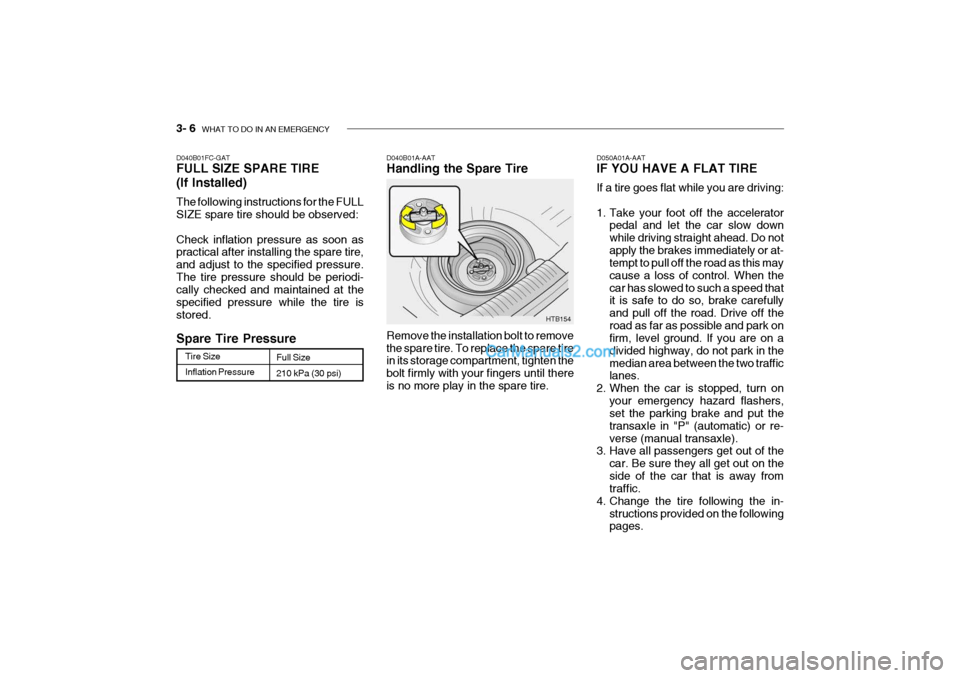
D040B01A-AAT Handling the Spare Tire Remove the installation bolt to remove the spare tire. To replace the spare tire in its storage compartment, tighten the bolt firmly with your fingers until thereis no more play in the spare tire. D050A01A-AAT IF YOU HAVE A FLAT TIRE If a tire goes flat while you are driving:
1. Take your foot off the accelerator
pedal and let the car slow down while driving straight ahead. Do notapply the brakes immediately or at- tempt to pull off the road as this may cause a loss of control. When thecar has slowed to such a speed that it is safe to do so, brake carefully and pull off the road. Drive off theroad as far as possible and park on firm, level ground. If you are on a divided highway, do not park in themedian area between the two traffic lanes.
2. When the car is stopped, turn on your emergency hazard flashers,set the parking brake and put the transaxle in "P" (automatic) or re-verse (manual transaxle).
3. Have all passengers get out of the
car. Be sure they all get out on theside of the car that is away from traffic.
4. Change the tire following the in- structions provided on the followingpages.
Inflation Pressure
Tire Size
D040B01FC-GAT FULL SIZE SPARE TIRE (If Installed) The following instructions for the FULL SIZE spare tire should be observed: Check inflation pressure as soon as practical after installing the spare tire, and adjust to the specified pressure.The tire pressure should be periodi- cally checked and maintained at the specified pressure while the tire isstored. Spare Tire Pressure
Full Size 210 kPa (30 psi)
Page 169 of 445
WHAT TO DO IN AN EMERGENCY 3- 13
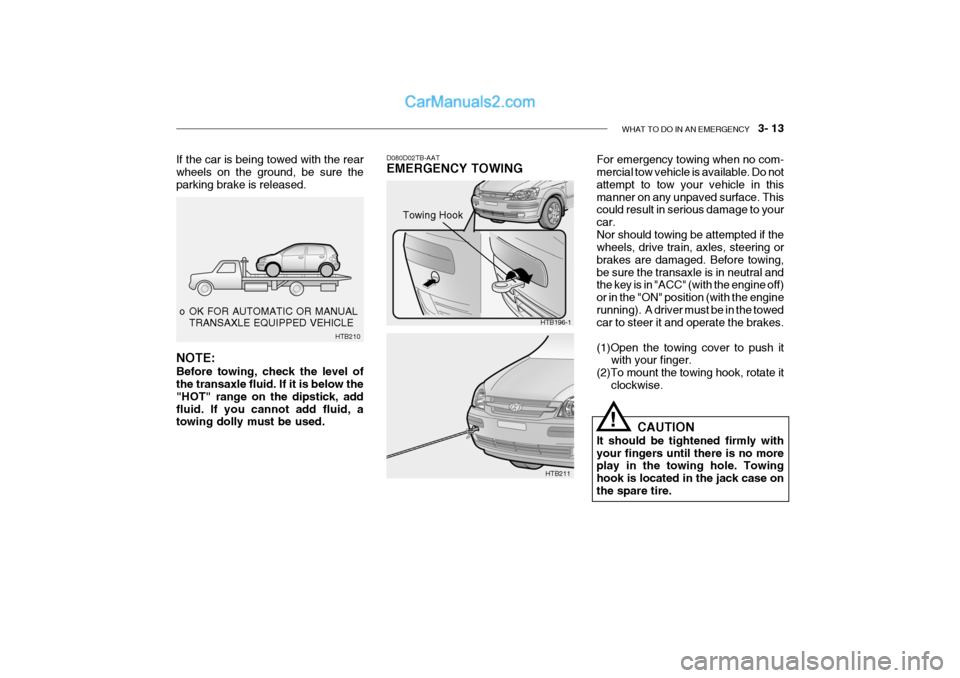
o OK FOR AUTOMATIC OR MANUAL
TRANSAXLE EQUIPPED VEHICLE
HTB210
If the car is being towed with the rear wheels on the ground, be sure the parking brake is released. NOTE: Before towing, check the level of the transaxle fluid. If it is below the "HOT" range on the dipstick, addfluid. If you cannot add fluid, a towing dolly must be used. D080D02TB-AAT EMERGENCY TOWING
For emergency towing when no com- mercial tow vehicle is available. Do not attempt to tow your vehicle in thismanner on any unpaved surface. This could result in serious damage to your car.Nor should towing be attempted if the wheels, drive train, axles, steering or brakes are damaged. Before towing,be sure the transaxle is in neutral and the key is in "ACC" (with the engine off) or in the "ON" position (with the enginerunning). A driver must be in the towed car to steer it and operate the brakes. (1)Open the towing cover to push it
with your finger.
(2)To mount the towing hook, rotate it clockwise.
HTB196-1
HTB211 CAUTION
It should be tightened firmly with your fingers until there is no more play in the towing hole. Towing hook is located in the jack case onthe spare tire.
!
Towing Hook
Page 170 of 445
3- 14 WHAT TO DO IN AN EMERGENCY
D120A01A-GAT IF YOU LOSE YOUR KEYS If you lose your keys, many Hyundai dealers can make you a new key if youhave your key number. If you lock the keys inside your car and you cannot obtain a new key, manyHyundai dealers can use special tools to open the door for you. Information about the key of immobi- lizer system (if installed) will be found on page 1-5.
CAUTION:
If the car is being towed with all four wheels on the ground, it can be towed only from the front. Be surethat the transaxle is in neutral. Do not tow at speeds greater than 50 km/h (30 mph) and for more than 25km (15 miles). Be sure the steering is unlocked by placing the key in the "ACC" posi-tion. A driver must be in the towed vehicle to operate the steering and brakes.
!
(3)Attach a tow cable, chain or strap to
the towing hook on the front bumper.
Page 188 of 445
6. Do-It-Yourself Maintenance
Engine compartment ...................................................................... 6-2
General checks ................................................................................ 6-6
Checking the engine oil .................................................................... 6-7
Changing the oil and filter ................................................................. 6-9
Checking and changing the engine coolant....................................6-13
Spark plugs .................................................................................... 6-15
Changing the air cleaner filter ......................................................... 6-17
Checking the transaxle oil (Manual)............................................... 6-18
Checking the transaxle fluid (Automatic)....................................... 6-19
Checking the brakes ...................................................................... 6-21
Air conditioning care ....................................................................... 6-22
Checking drive belts ...................................................................... 6-25
Checking and replacing fuses ........................................................ 6-26
Power steering fluid level ............................................................... 6-30
Replacement of bulbs .................................................................... 6-32
Fuse panel description ................................................................... 6-38
6
Page 207 of 445
6- 20 DO-IT-YOURSELF MAINTENANCE
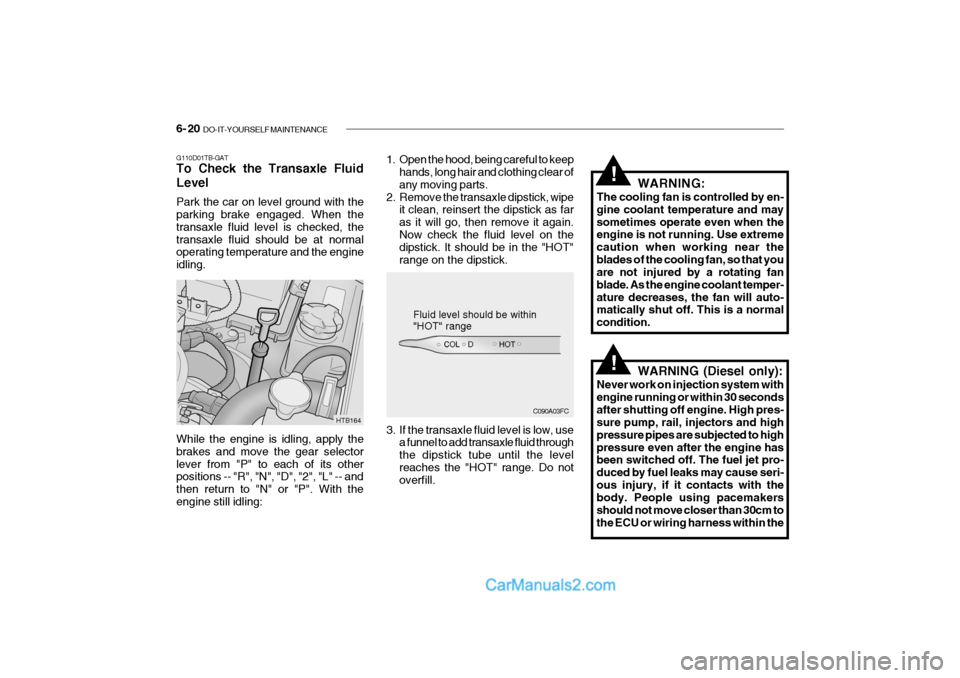
G110D01TB-GAT To Check the Transaxle Fluid Level Park the car on level ground with the parking brake engaged. When the transaxle fluid level is checked, thetransaxle fluid should be at normal operating temperature and the engine idling. While the engine is idling, apply the brakes and move the gear selectorlever from "P" to each of its other positions -- "R", "N", "D", "2", "L" -- and then return to "N" or "P". With theengine still idling: 3. If the transaxle fluid level is low, use
a funnel to add transaxle fluid throughthe dipstick tube until the levelreaches the "HOT" range. Do not overfill. WARNING:
The cooling fan is controlled by en- gine coolant temperature and maysometimes operate even when the engine is not running. Use extreme caution when working near theblades of the cooling fan, so that you are not injured by a rotating fan blade. As the engine coolant temper-ature decreases, the fan will auto- matically shut off. This is a normal condition.
C090A03FC
Fluid level should be within "HOT" range
HTB164 1. Open the hood, being careful to keep
hands, long hair and clothing clear of any moving parts.
2. Remove the transaxle dipstick, wipe it clean, reinsert the dipstick as faras it will go, then remove it again.Now check the fluid level on the dipstick. It should be in the "HOT" range on the dipstick.
!
WARNING (Diesel only):
Never work on injection system with engine running or within 30 secondsafter shutting off engine. High pres- sure pump, rail, injectors and high pressure pipes are subjected to highpressure even after the engine has been switched off. The fuel jet pro- duced by fuel leaks may cause seri-ous injury, if it contacts with the body. People using pacemakers should not move closer than 30cm tothe ECU or wiring harness within the!
Page 208 of 445
DO-IT-YOURSELF MAINTENANCE 6- 21
G120A01A-AAT CHECKING THE BRAKES G120B01A-AATChecking the Brake Fluid Level
!
CAUTION:
Because brakes are essential to the safe operation of the car, it is sug- gested that they be checked andinspected by your Hyundai dealer. The brakes should be checked and inspected for wear at those inter-vals specified in the vehicle mainte- nance schedule in Section 5. WARNING:
Use caution when handling brake fluid. It can damage your vision if it gets into your eyes. It will also dam- age your vehicle's paint if spilledon it and not removed immediately.
!
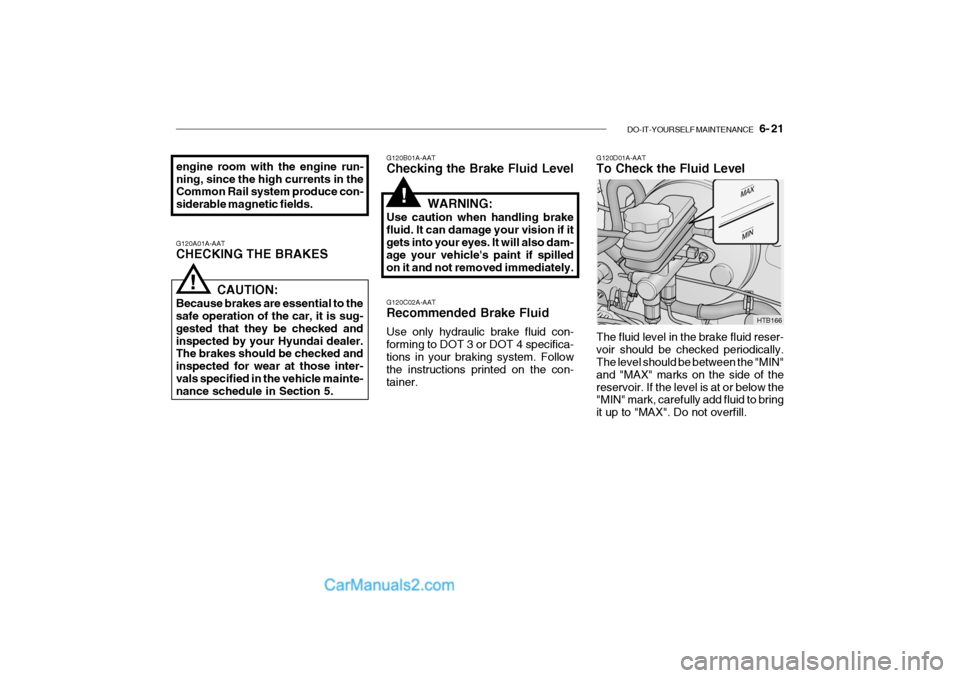
G120C02A-AAT Recommended Brake Fluid Use only hydraulic brake fluid con- forming to DOT 3 or DOT 4 specifica- tions in your braking system. Follow the instructions printed on the con-tainer. G120D01A-AAT To Check the Fluid Level
HTB166
The fluid level in the brake fluid reser- voir should be checked periodically. The level should be between the "MIN" and "MAX" marks on the side of thereservoir. If the level is at or below the "MIN" mark, carefully add fluid to bring it up to "MAX". Do not overfill.
engine room with the engine run- ning, since the high currents in the Common Rail system produce con- siderable magnetic fields.
Page 243 of 445
10- 2 INDEX
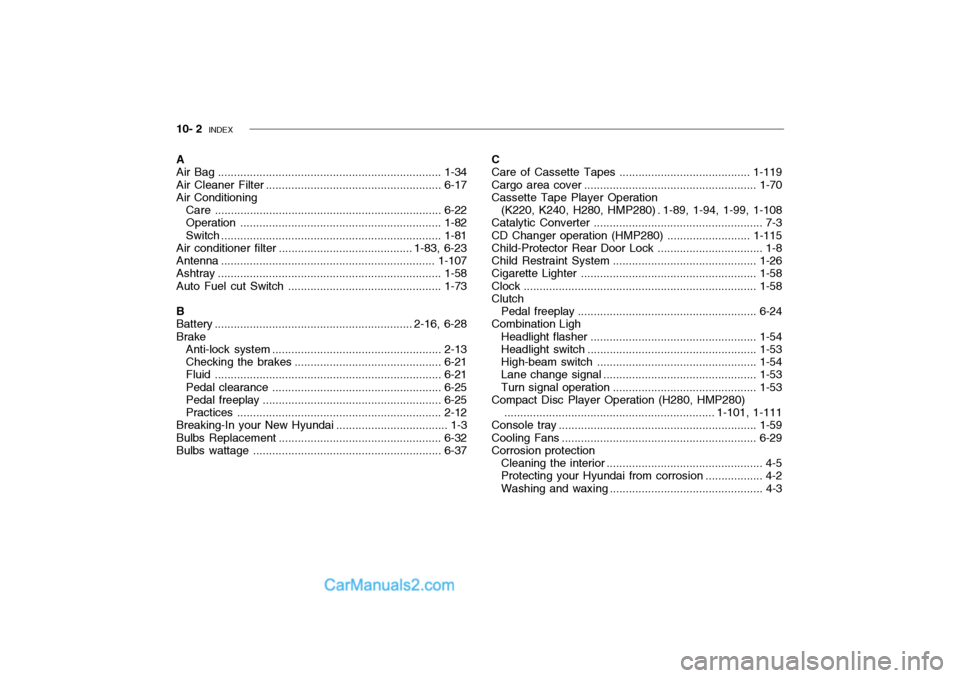
A Air Bag ...................................................................... 1-34
Air Cleaner Filter ....................................................... 6-17
Air Conditioning
Care ....................................................................... 6-22
Operation ............................................................... 1-82
Switch ..................................................................... 1-81
Air conditioner filter .......................................... 1-83, 6-23 Antenna ................................................................... 1-107
Ashtray ...................................................................... 1-58
Auto Fuel cut Switch................................................ 1-73
B
Battery .............................................................. 2-16, 6-28 Brake Anti-lock system ..................................................... 2-13
Checking the brakes .............................................. 6-21
Fluid ....................................................................... 6-21
Pedal clearance ..................................................... 6-25
Pedal freepl ay ........................................................ 6-25
Practices ................................................................ 2-12
Breaking-In your New Hyundai ................................... 1-3
Bulbs Repl acement ................................................... 6-32
Bulbs wattage ........................................................... 6-37C
Care of Cassette Tapes ....................
..................... 1-119
Cargo area cover ...................................................... 1-70
Cassette Tape Player Operation
(K220, K240, H280, HMP280) . 1-89, 1-94, 1-99, 1-108
Catalytic Converter ..................................................... 7-3
CD Changer operation (HMP280) .......................... 1-115
Child-Protector Rear Door Lock ................................. 1-8
Child Restraint System............................................. 1-26
Cigarette Lighter ....................................................... 1-58
Clock ......................................................................... 1-58
Clutch
Pedal freepl ay ........................................................ 6-24
Combination Ligh
Headlight flasher .................................................... 1-54
Headlight swi tch ..................................................... 1-53
High-beam swi tch .................................................. 1-54
Lane change si gnal ................................................ 1-53
Turn signal oper ation............................................. 1-53
Compact Disc Player Operation (H280, HMP280)
.................................................................. 1-101, 1-111
Console tray .............................................................. 1-59
Cooling Fans ............................................................. 6-29
Corrosion protection
Cleaning the interior ................................................. 4-5
Protecting your Hyundai from corrosion .................. 4-2
Washing and waxing ................................................ 4-3
Page 320 of 445
1- 62 FEATURES OF YOUR HYUNDAI
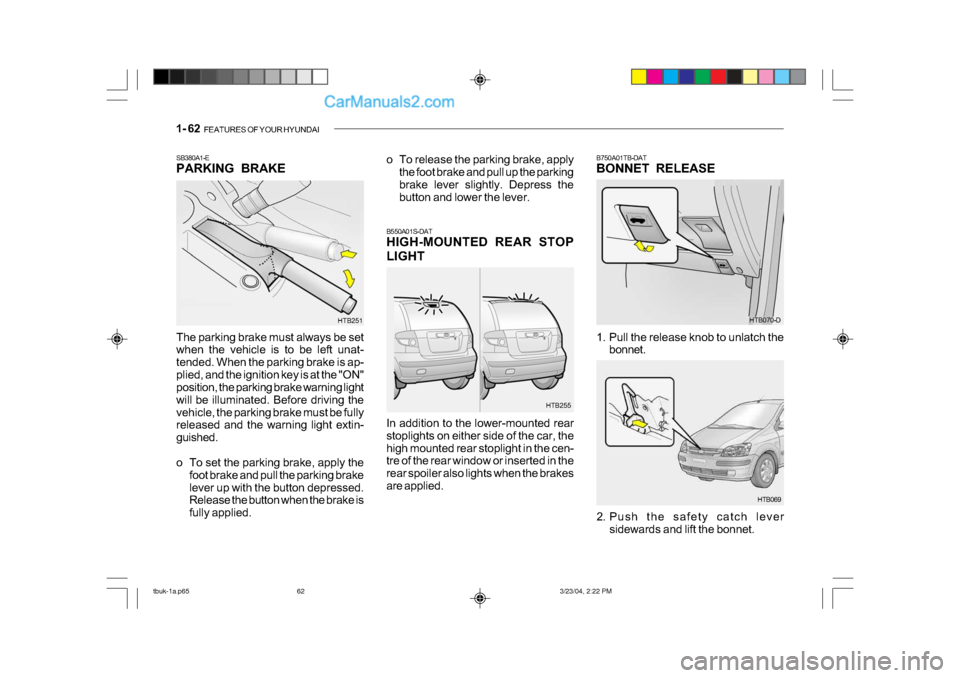
The parking brake must always be set
when the vehicle is to be left unat-
tended. When the parking brake is ap-
plied, and the ignition key is at the "ON"
position, the parking brake warning light
will be illuminated. Before driving the
vehicle, the parking brake must be fully
released and the warning light extin-
guished.
o To set the parking brake, apply the
foot brake and pull the parking brake
lever up with the button depressed.
Release the button when the brake is
fully applied.
SB380A1-E
PARKING BRAKE
B550A01S-DAT
HIGH-MOUNTED REAR STOP
LIGHT
In addition to the lower-mounted rear
stoplights on either side of the car, the
high mounted rear stoplight in the cen-
tre of the rear window or inserted in the
rear spoiler also lights when the brakes
are applied.
HTB251
HTB255
o To release the parking brake, apply
the foot brake and pull up the parking
brake lever slightly. Depress the
button and lower the lever.
B750A01TB-DAT
BONNET RELEASE
HTB070-D
1. Pull the release knob to unlatch the bonnet.
HTB069
2. Push the safety catch lever sidewards and lift the bonnet.
tbuk-1a.p65 3/23/04, 2:22 PM
62
Page 354 of 445
DRIVING YOUR HYUNDAI 2- 11
C090H01A-EAT NOTE:
o The brake pedal should be de-
pressed when shifting from NEU- TRAL to a forward or reversegear.
o The brake pedal fully depressed
in order to move the shift lever from the "P" (Park) position to any of the other positions.
o It is always possible to shift from "R", "N", "D", "2", "L" position.
!
C090I02A-EAT
CAUTION:
o Shift into "R" and "P" only when the vehicle has completely stopped.
o Do not accelerate the engine in reverse or any of the forward positions with the brakes applied.
o Always apply the footbrake when shifting from "P" or "N", to "R", "D", "2" or "L" position.
o Do not use the "P" (Park) posi- tion in place of the parking brake. Always set the parking brake,shift the transaxle into "P" (Park)and turn off the ignition when you leave the vehicle, even mo- mentarily. Never leave the vehicleunattended whilst the engine isrunning.
o Check the automatic transaxle fluid level regularly, and add fluid as necessary. See the maintenance schedulefor the proper fluid recommen-dation. FC120D1-E General Operating Instructions
o The button in the selector handle
must be depressed before the se- lector can be moved.
o The engine may only be started
when the selector is at position "P" or "N".
o Ensure that the footbrake is firmly applied when shifting from "P" or "N" to "D", "2", "L" or "R" and viceversa.
o Always engage the parking brake when the vehicle is unattended,never use the "P" position in place ofthe parking brake.
o Under normal circumstances, the selector should be placed in the "D"position and the transaxle allowed to select the most ideal ratio for the circumstances. In this position maxi-mum fuel economy will be achieved.
o When descending steep gradients where engine braking is required,the selector should be placed at the "2" or "L" position depending upon the vehicle speed.
tbuk-2.p65 3/23/04, 4:55 PM
11