speaker Hyundai Getz 2004 User Guide
[x] Cancel search | Manufacturer: HYUNDAI, Model Year: 2004, Model line: Getz, Model: Hyundai Getz 2004Pages: 445, PDF Size: 12.16 MB
Page 133 of 445
1- 120 FEATURES OF YOUR HYUNDAI
Head
Cotton applicator
HTB216
B860A02L
o Be sure that the cassette label is not
loose or peeling off or tape ejection may be difficult.
o Never touch or soil the actual audio
tape surfaces.
o Keep all magnetized objects, such as electric motors, speakers or trans-formers away from your cassettetapes and tape player unit.
o Store cassettes in a cool, dry place
with the open side facing down toprevent dust from setting in the cas- sette body.
o We strongly recommend against the
use of tapes longer than C-60 (60 minutes total). Tapes such as C-120 or C-180 are very thin and do not perform as well in the automo- tive environment. o Avoid repeated fast reverse usage
to replay one given tune or tapesection. This can cause poor tapewinding to occur, and eventually cause excessive internal drag and poor audio quality in the cassette. Ifthis occurs, it can sometimes be corrected by fast winding the tape from end to end several times. If thisdoes not correct the problem, do not continue to use the tape in your vehicle.
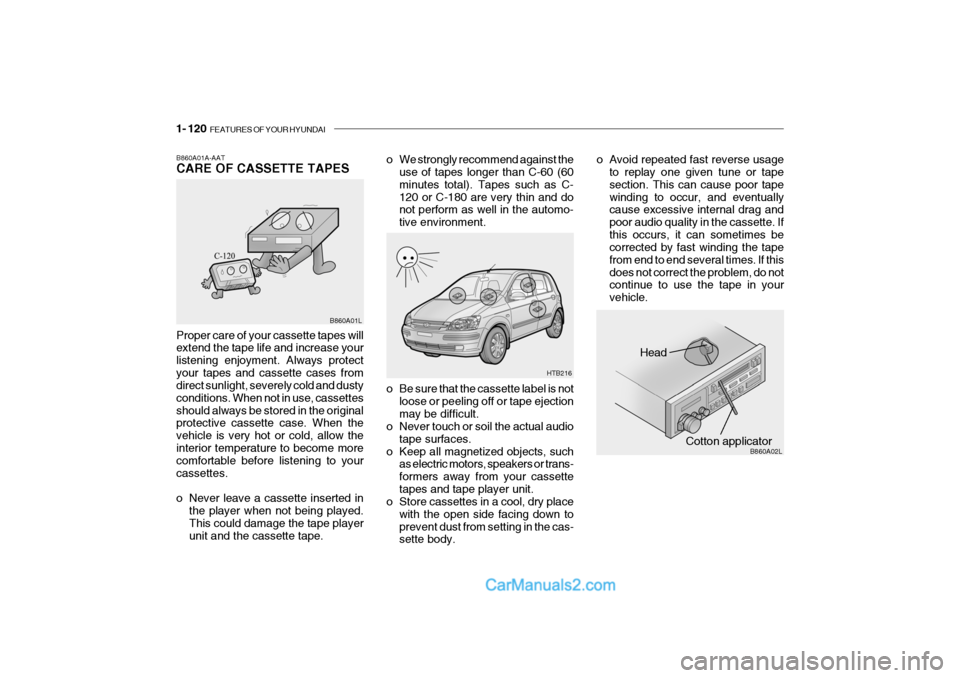
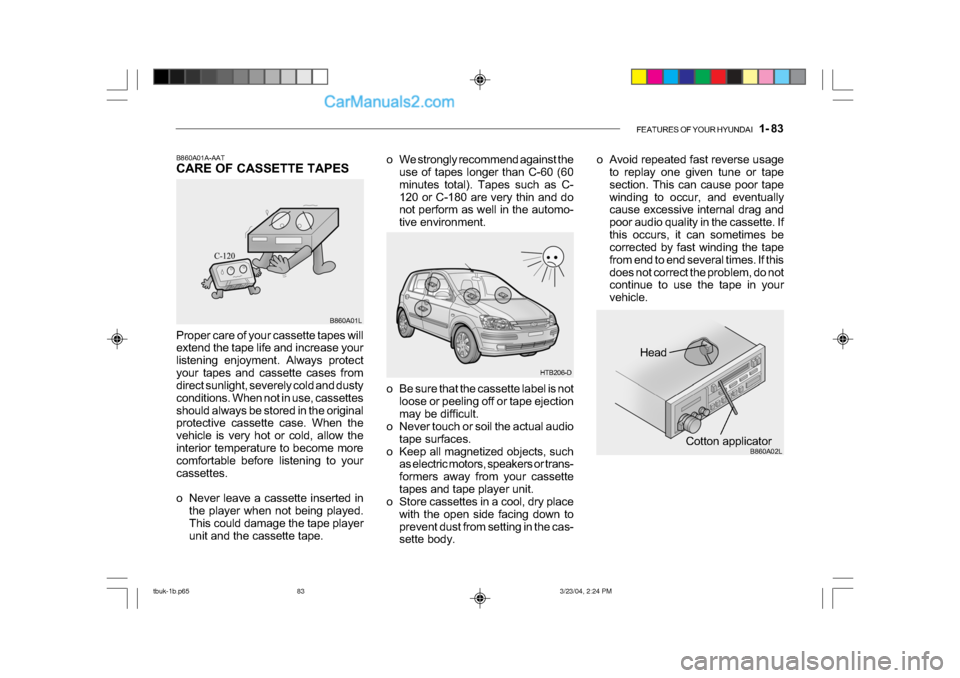
B860A01A-AAT CARE OF CASSETTE TAPES Proper care of your cassette tapes will extend the tape life and increase your listening enjoyment. Always protectyour tapes and cassette cases from direct sunlight, severely cold and dusty conditions. When not in use, cassettesshould always be stored in the original protective cassette case. When the vehicle is very hot or cold, allow theinterior temperature to become more comfortable before listening to your cassettes.
o Never leave a cassette inserted in
the player when not being played. This could damage the tape player unit and the cassette tape. B860A01L
Page 338 of 445
1- 80 FEATURES OF YOUR HYUNDAI
Ionosphere
B750A02L
AM reception
Mountains
Buildings Unobstructed
area
FM radio station
B750A03L
Ionosphere
FM reception
B750A01L Obstructed area
Iron bridges
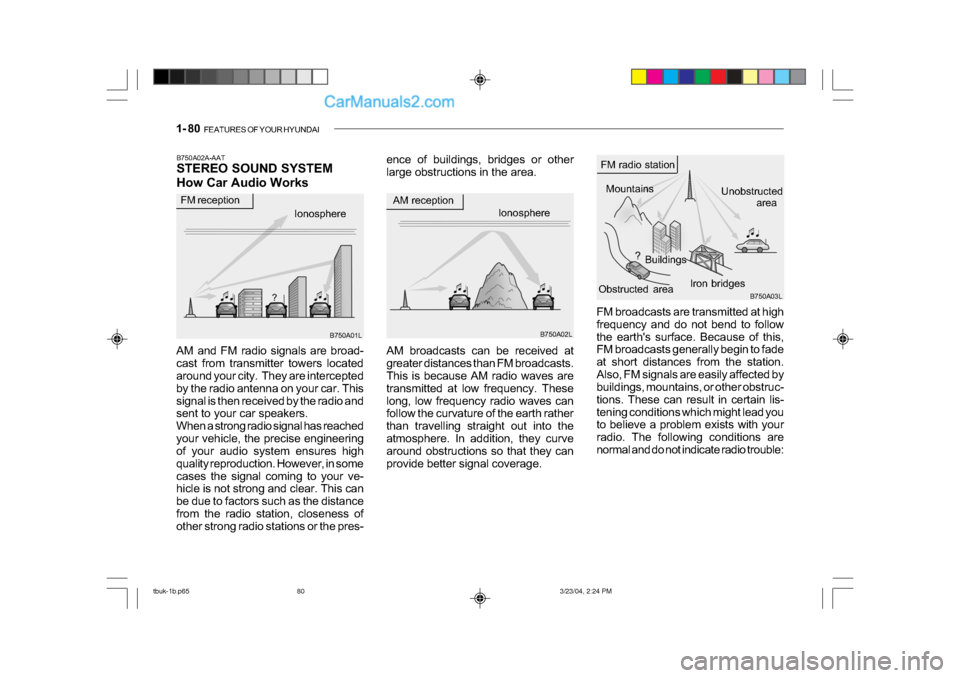
FM broadcasts are transmitted at high
frequency and do not bend to follow
the earth's surface. Because of this,
FM broadcasts generally begin to fade
at short distances from the station.
Also, FM signals are easily affected by
buildings, mountains, or other obstruc-
tions. These can result in certain lis-
tening conditions which might lead you
to believe a problem exists with your
radio. The following conditions are
normal and do not indicate radio trouble:
AM broadcasts can be received at
greater distances than FM broadcasts.
This is because AM radio waves are
transmitted at low frequency. These
long, low frequency radio waves can
follow the curvature of the earth rather
than travelling straight out into the
atmosphere. In addition, they curve
around obstructions so that they can
provide better signal coverage.
B750A02A-AAT
STEREO SOUND SYSTEM
How Car Audio Works
AM and FM radio signals are broad-
cast from transmitter towers located
around your city. They are intercepted
by the radio antenna on your car. This
signal is then received by the radio and
sent to your car speakers.
When a strong radio signal has reached
your vehicle, the precise engineering
of your audio system ensures high
quality reproduction. However, in some
cases the signal coming to your ve-
hicle is not strong and clear. This can
be due to factors such as the distance
from the radio station, closeness of
other strong radio stations or the pres- ence of buildings, bridges or other
large obstructions in the area.
tbuk-1b.p65
3/23/04, 2:24 PM
80
Page 341 of 445
FEATURES OF YOUR HYUNDAI 1- 83
Head
Cotton applicator B860A02L
o Be sure that the cassette label is not
loose or peeling off or tape ejection
may be difficult.
o Never touch or soil the actual audio
tape surfaces.
o Keep all magnetized objects, such as electric motors, speakers or trans-
formers away from your cassette
tapes and tape player unit.
o Store cassettes in a cool, dry place
with the open side facing down to
prevent dust from setting in the cas-
sette body.
o We strongly recommend against the
use of tapes longer than C-60 (60
minutes total). Tapes such as C-
120 or C-180 are very thin and do
not perform as well in the automo-
tive environment. o Avoid repeated fast reverse usage
to replay one given tune or tape
section. This can cause poor tape
winding to occur, and eventually
cause excessive internal drag and
poor audio quality in the cassette. If
this occurs, it can sometimes be
corrected by fast winding the tape
from end to end several times. If this
does not correct the problem, do not
continue to use the tape in your
vehicle.
B860A01A-AAT
CARE OF CASSETTE TAPES
Proper care of your cassette tapes will
extend the tape life and increase your
listening enjoyment. Always protect
your tapes and cassette cases from
direct sunlight, severely cold and dusty
conditions. When not in use, cassettes
should always be stored in the original
protective cassette case. When the
vehicle is very hot or cold, allow the
interior temperature to become more
comfortable before listening to your
cassettes.
o Never leave a cassette inserted in
the player when not being played.
This could damage the tape player
unit and the cassette tape. B860A01L
HTB206-D
tbuk-1b.p65
3/23/04, 2:24 PM
83