ECU Hyundai Getz 2004 Owner's Guide
[x] Cancel search | Manufacturer: HYUNDAI, Model Year: 2004, Model line: Getz, Model: Hyundai Getz 2004Pages: 445, PDF Size: 12.16 MB
Page 207 of 445
6- 20 DO-IT-YOURSELF MAINTENANCE
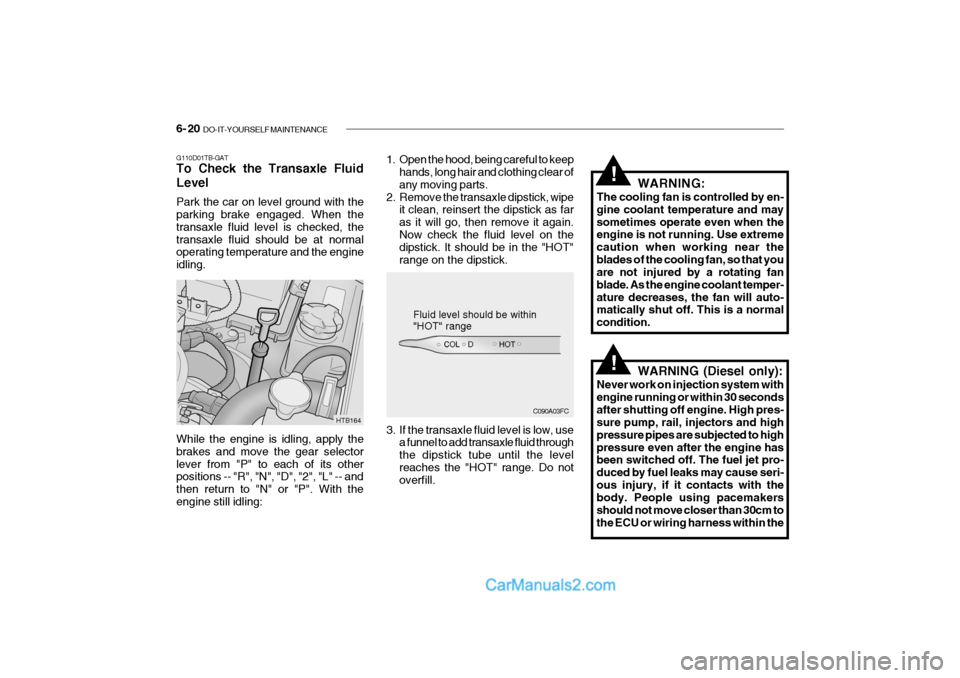
G110D01TB-GAT To Check the Transaxle Fluid Level Park the car on level ground with the parking brake engaged. When the transaxle fluid level is checked, thetransaxle fluid should be at normal operating temperature and the engine idling. While the engine is idling, apply the brakes and move the gear selectorlever from "P" to each of its other positions -- "R", "N", "D", "2", "L" -- and then return to "N" or "P". With theengine still idling: 3. If the transaxle fluid level is low, use
a funnel to add transaxle fluid throughthe dipstick tube until the levelreaches the "HOT" range. Do not overfill. WARNING:
The cooling fan is controlled by en- gine coolant temperature and maysometimes operate even when the engine is not running. Use extreme caution when working near theblades of the cooling fan, so that you are not injured by a rotating fan blade. As the engine coolant temper-ature decreases, the fan will auto- matically shut off. This is a normal condition.
C090A03FC
Fluid level should be within "HOT" range
HTB164 1. Open the hood, being careful to keep
hands, long hair and clothing clear of any moving parts.
2. Remove the transaxle dipstick, wipe it clean, reinsert the dipstick as faras it will go, then remove it again.Now check the fluid level on the dipstick. It should be in the "HOT" range on the dipstick.
!
WARNING (Diesel only):
Never work on injection system with engine running or within 30 secondsafter shutting off engine. High pres- sure pump, rail, injectors and high pressure pipes are subjected to highpressure even after the engine has been switched off. The fuel jet pro- duced by fuel leaks may cause seri-ous injury, if it contacts with the body. People using pacemakers should not move closer than 30cm tothe ECU or wiring harness within the!
Page 216 of 445
DO-IT-YOURSELF MAINTENANCE 6- 29
o If battery fluid is on your skin, flush
the affected areas with water for at least 15 minutes and then seekmedical assistance.
o If battery fluid is in your eyes, rinse
out your eyes with water and getmedical assistance as soon as pos- sible. While you are being driven to get medical assistance, continue torinse your eyes by using a sponge or soft cloth saturated with water.
o If you swallow battery fluid, drink a large quantity of water or milk fol-lowed by milk of magnesia, eat a raw egg or drink vegetable oil. Getmedical assistance as soon as pos- sible.
While batteries are being charged (ei-ther by a battery charger or by the vehicle's alternator), they produce ex-plosive gases. Always observe these warnings to prevent injuries from oc- curring:
o Charge batteries only in a well ven- tilated area.
o Do not permit flames, sparks or smoking in the area.
o Keep children away from the area. G220B01A-AAT Checking Engine Cooling Fan The engine coolant fan should come on automatically if the engine coolanttemperature is high. G220C01TB-AAT Checking Condenser Cooling Fan When the air conditioning is in opera- tion, the condenser cooling fan comes on automatically to be controlled by ECU.
G210B01A-AAT Checking the Battery Keep the battery clean. Any evidence of corrosion around the battery postsor terminals should be removed using a solution of household baking soda and warm water. After the battery ter-minals are dry, cover them with a light coating of grease. G220A01A-AAT CHECKING ELECTRIC COOL- ING FANS
WARNING:
The cooling fan is controlled by engine coolant temperature andmay sometimes operate even when the engine is not running. Use ex- treme caution when working nearthe blades of the coolant fan, so that you are not injured by a rotat- ing fan blade. As the engine cool-ant temperature decreases the fan will automatically shut off. This is a normal condition.
!
Page 225 of 445
6- 38 DO-IT-YOURSELF MAINTENANCE
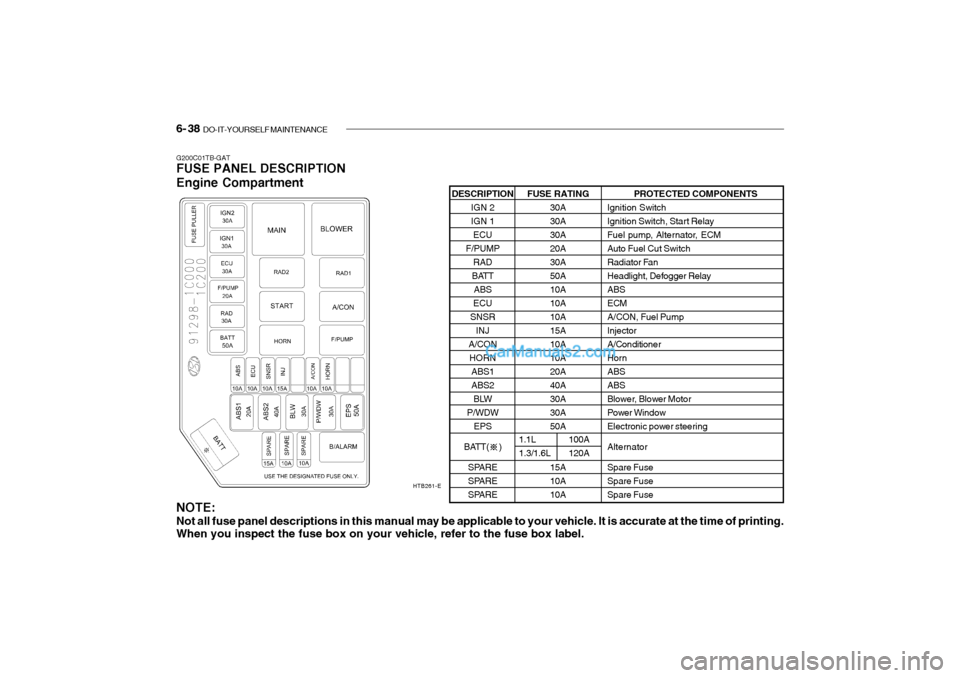
G200C01TB-GAT FUSE PANEL DESCRIPTION Engine Compartment
HTB261-EPROTECTED COMPONENTS
Ignition Switch
Ignition Switch, Start Relay
Fuel pump, Alternator, ECM
Auto Fuel Cut Switch
Radiator Fan
Headlight, Defogger RelayABSECMA/CON, Fuel PumpInjectorA/Conditioner
HornABSABS
Blower, Blower Motor
Power Window
Electronic power steering AlternatorSpare Fuse Spare FuseSpare Fuse
FUSE RATING
30A30A30A20A30A50A10A10A10A15A10A10A20A40A30A30A50A 15A 10A10A
DESCRIPTION
IGN 2IGN 1ECU
F/PUMP RAD
BATT ABS
ECU
SNSR INJ
A/CON HORN ABS1ABS2 BLW
P/WDW EPS
BATT( ) SPARE
SPARE
SPARE
NOTE:
Not all fuse panel descriptions in this manual may be applicable to your vehicle. It is accurate at the time of printing. When you inspect the fuse box on your vehicle, refer to the fuse box label.
1.1L 1.3/1.6L 100A120A
Page 226 of 445

DO-IT-YOURSELF MAINTENANCE 6- 39
PROTECTED COMPONENTS
Room Lamp, Audio, Cluster
High Beam Light Indicator, Headlight (LH)
Front Fog LightHeadlight (RH)
Rear window Defroster
Blower, Sunroof
Fog light, ETACM, Power Window,Headlight leveling Device
Rear Fog Light
Front Wiper Motor
Hazard Warning Light, ETACM
Stop Light, Power Window ECM
Rear window Defroster
Seat Warmer
Daytime Running Light
Start Relay, Theft alarm system
Rear Wiper Motor
Door Lock System, SunroofAir BagPCM, ABS controlCigarette LighterCluster
STOP/Tail Light (RH)
Turn Signal Light, Back-up Light
Audio, Electronic Outside MirrorA/Bag, Indicator
Stop/Tail Light (LH)Air conditioner
G200D01TB-GAT Inner Panel (Left hand drive type)
HTB260-EFUSE RATING15A 15A 10A 15A30A10A10A10A 20A 15A15A15A10A20A 10A 10A15A20A10A10A 15A 10A10A10A10A10A 10A 10A
DESCRIPTION
POWER CONN & R/LP
H/LP LH
F/FOG
H/LP RH PR/HTD
BLOWER
IGNITION
R/FOG
FRT WPR
HAZARD STOPECU2
HTD MIR
S/HTDDRL
START
RR/WPR D/LOCK
A/BAGECU1
C/LIGHT
CLUSTER TAIL RH T/SIG
AUDIO
A/BAG IND TAIL LH
A/C SW
Page 227 of 445
6- 40 DO-IT-YOURSELF MAINTENANCE
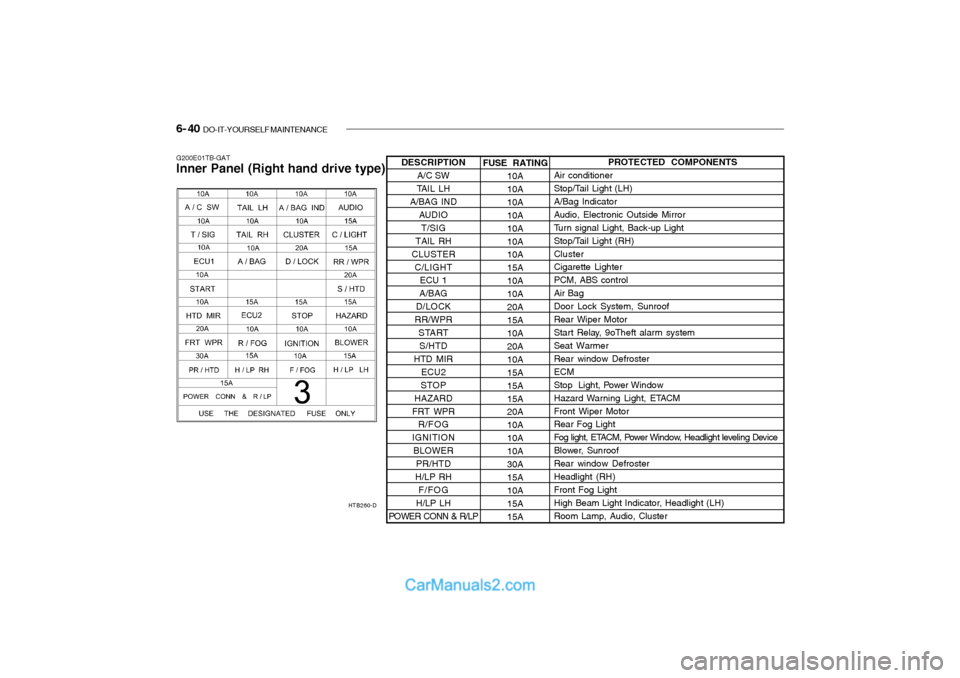
G200E01TB-GAT Inner Panel (Right hand drive type)
HTB260-DFUSE RATING10A 10A10A10A10A10A 10A 15A10A10A20A15A 10A 20A10A15A15A15A 20A 10A10A10A30A15A 10A 15A15APROTECTED COMPONENTS
Air conditioner
Stop/Tail Light (LH) A/Bag IndicatorAudio, Electronic Outside Mirror
Turn signal Light, Back-up Light
Stop/Tail Light (RH)Cluster Cigarette Lighter PCM, ABS controlAir BagDoor Lock System, SunroofRear Wiper Motor
Start Relay, 9oTheft alarm system Seat Warmer Rear window DefrosterECM
Stop Light, Power Window
Hazard Warning Light, ETACMFront Wiper Motor Rear Fog Light
Fog light, ETACM, Power Window, Headlight leveling Device
Blower, SunroofRear window DefrosterHeadlight (RH)Front Fog Light
High Beam Light Indicator, Headlight (LH) Room Lamp, Audio, Cluster
DESCRIPTION
A/C SW
TAIL LH
A/BAG IND
AUDIO
T/SIG
TAIL RH
CLUSTER C/LIGHT ECU 1
A/BAG
D/LOCK
RR/WPR STARTS/HTD
HTD MIR ECU2
STOP
HAZARD
FRT WPR R/FOG
IGNITION BLOWER PR/HTD
H/LP RH F/FOG
H/LP LH
POWER CONN & R/LP
Page 262 of 445
1- 4 FEATURES OF YOUR HYUNDAI
6SB035A1-FE
IMMOBILISER SYSTEM
The immobiliser system is an anti-theft
device, designed to prevent and deter
vehicle theft.
B880B03A-GAT
Keys
All of the locks fitted to the vehicle are
operated by the same key. However,
since it is possible to lock the doors
without the use of the key, care should
be exercised to ensure that the key
does not become locked inside the
vehicle by mistake.
NOTE:
If you make your own duplicate key,
you will not be able to cancel the
system or start the engine. B880C02A-GAT
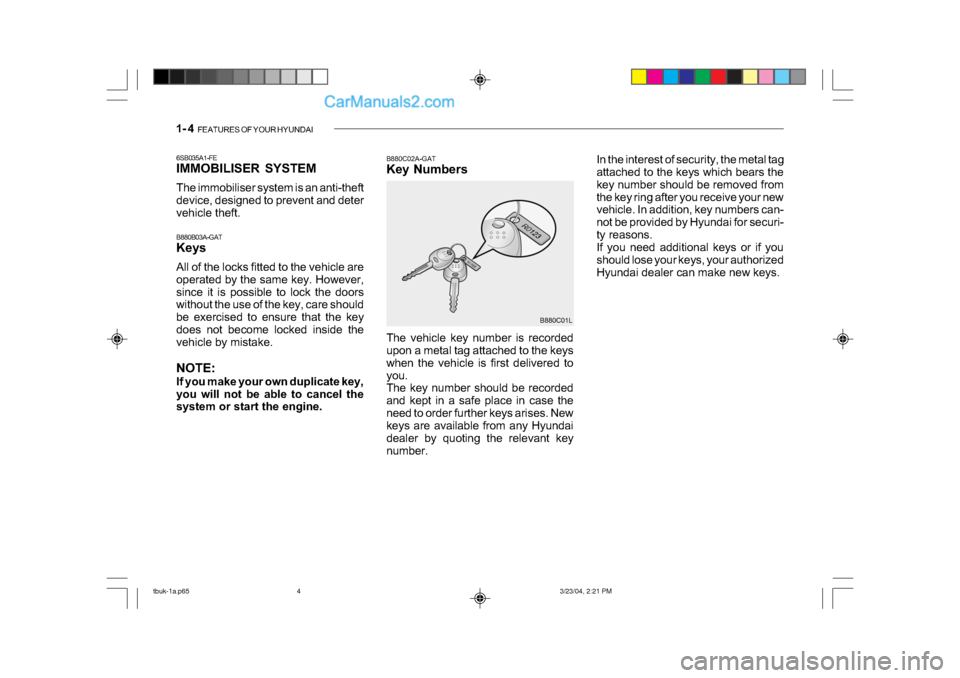
Key Numbers
The vehicle key number is recorded
upon a metal tag attached to the keys
when the vehicle is first delivered to
you.
The key number should be recorded
and kept in a safe place in case the
need to order further keys arises. New
keys are available from any Hyundai
dealer by quoting the relevant key
number.
B880C01L
In the interest of security, the metal tag
attached to the keys which bears the
key number should be removed from
the key ring after you receive your new
vehicle. In addition, key numbers can-
not be provided by Hyundai for securi-
ty reasons.
If you need additional keys or if you
should lose your keys, your authorized
Hyundai dealer can make new keys.
tbuk-1a.p65
3/23/04, 2:21 PM
4
Page 263 of 445
FEATURES OF YOUR HYUNDAI 1- 5
B040A02Y-EAT
DOOR LOCKS B040B01A-AAT
Locking and Unlocking Front
Doors With a Key
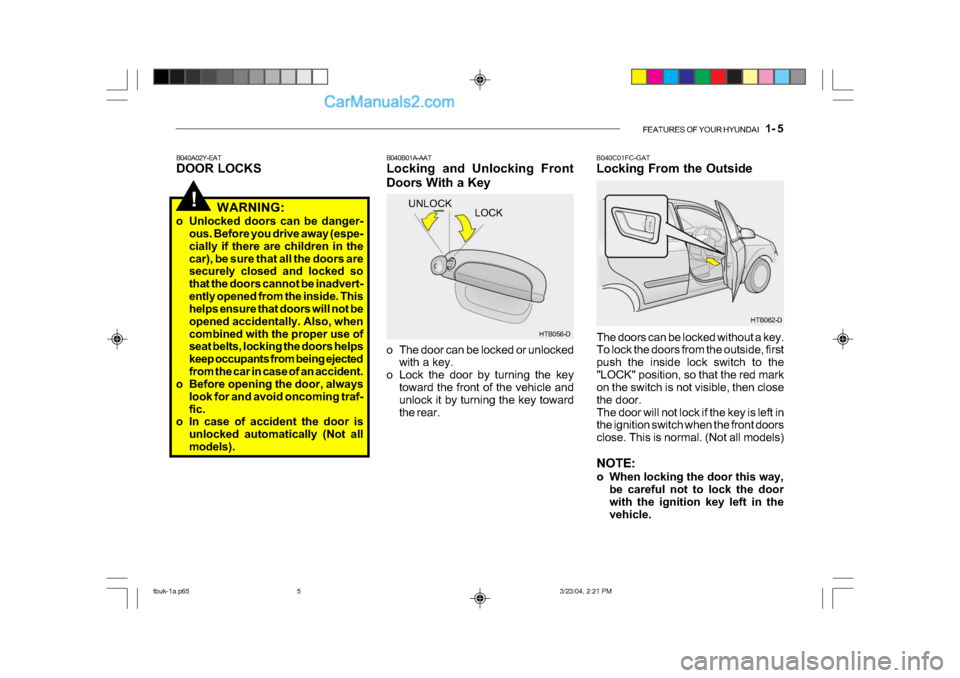
o The door can be locked or unlocked
with a key.
o Lock the door by turning the key toward the front of the vehicle and
unlock it by turning the key toward
the rear. B040C01FC-GAT
Locking From the Outside
The doors can be locked without a key.
To lock the doors from the outside, first
push the inside lock switch to the
"LOCK" position, so that the red mark
on the switch is not visible, then close
the door.
The door will not lock if the key is left in
the ignition switch when the front doors
close. This is normal. (Not all models)
NOTE:
o When locking the door this way, be careful not to lock the door
with the ignition key left in the
vehicle.
LOCK
HTB056-D
UNLOCK
HTB062-D
!WARNING:
o Unlocked doors can be danger- ous. Before you drive away (espe-
cially if there are children in the
car), be sure that all the doors are
securely closed and locked so
that the doors cannot be inadvert-
ently opened from the inside. This
helps ensure that doors will not be
opened accidentally. Also, when
combined with the proper use of
seat belts, locking the doors helps
keep occupants from being ejected
from the car in case of an accident.
o Before opening the door, always
look for and avoid oncoming traf-
fic.
o In case of accident the door is
unlocked automatically (Not all
models).
tbuk-1a.p65 3/23/04, 2:21 PM
5
Page 274 of 445
1- 16 FEATURES OF YOUR HYUNDAI
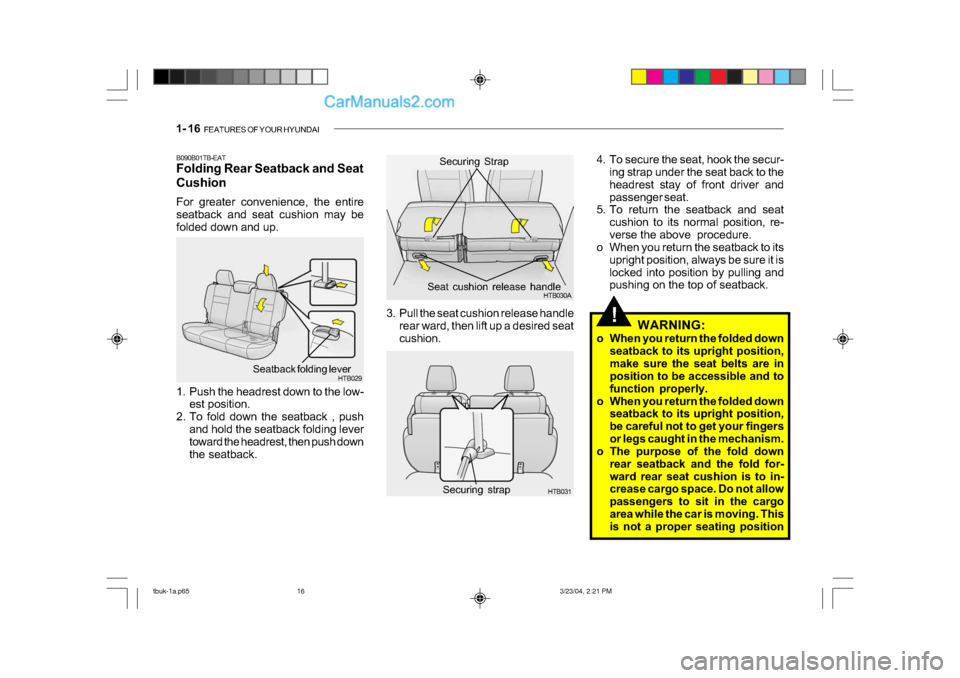
3. Pull the seat cushion release handle
rear ward, then lift up a desired seat
cushion.!WARNING:
o When you return the folded down seatback to its upright position,
make sure the seat belts are in
position to be accessible and to
function properly.
o When you return the folded down seatback to its upright position,
be careful not to get your fingers
or legs caught in the mechanism.
o The purpose of the fold down
rear seatback and the fold for-
ward rear seat cushion is to in-
crease cargo space. Do not allow
passengers to sit in the cargo
area while the car is moving. This
is not a proper seating position
4. To secure the seat, hook the secur-
ing strap under the seat back to the
headrest stay of front driver and
passenger seat.
5. To return the seatback and seat
cushion to its normal position, re-
verse the above procedure.
o When you return the seatback to its
upright position, always be sure it is
locked into position by pulling and
pushing on the top of seatback.
HTB030A
Seat cushion release handle
HTB031Securing strap
Securing Strap
B090B01TB-EAT
Folding Rear Seatback and Seat
Cushion
For greater convenience, the entire
seatback and seat cushion may be
folded down and up.
1. Push the headrest down to the low-
est position.
2. To fold down the seatback , push and hold the seatback folding lever
toward the headrest, then push down
the seatback. HTB029
Seatback folding lever
tbuk-1a.p65
3/23/04, 2:21 PM
16
Page 280 of 445
1- 22 FEATURES OF YOUR HYUNDAI
!
B220C01Y-DAT
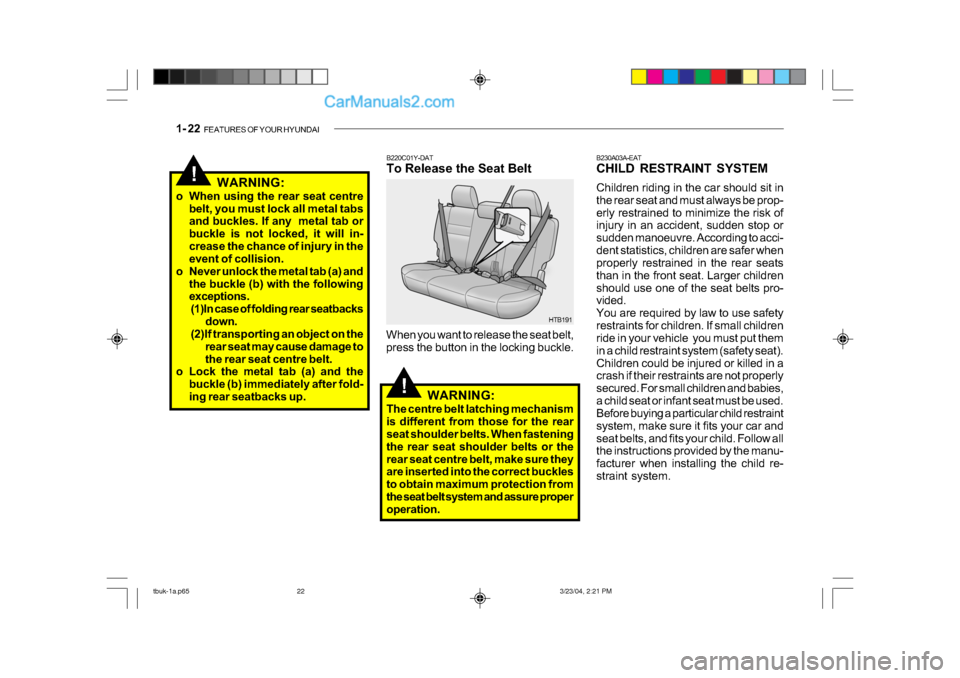
To Release the Seat Belt
When you want to release the seat belt,
press the button in the locking buckle. HTB191
WARNING:
The centre belt latching mechanism
is different from those for the rear
seat shoulder belts. When fastening
the rear seat shoulder belts or the
rear seat centre belt, make sure they
are inserted into the correct buckles
to obtain maximum protection from
the seat belt system and assure proper
operation. B230A03A-EAT
CHILD RESTRAINT SYSTEM
Children riding in the car should sit in
the rear seat and must always be prop-
erly restrained to minimize the risk of
injury in an accident, sudden stop or
sudden manoeuvre. According to acci-
dent statistics, children are safer when
properly restrained in the rear seats
than in the front seat. Larger children
should use one of the seat belts pro-
vided.
You are required by law to use safety
restraints for children. If small children
ride in your vehicle you must put them
in a child restraint system (safety seat).
Children could be injured or killed in a
crash if their restraints are not properly
secured. For small children and babies,
a child seat or infant seat must be used.
Before buying a particular child restraint
system, make sure it fits your car and
seat belts, and fits your child. Follow all
the instructions provided by the manu-
facturer when installing the child re-
straint system.
!WARNING:
o When using the rear seat centre belt, you must lock all metal tabs
and buckles. If any metal tab or
buckle is not locked, it will in-
crease the chance of injury in the
event of collision.
o Never unlock the metal tab (a) and
the buckle (b) with the following
exceptions.(1)In case of folding rear seatbacks down.
(2)If transporting an object on the
rear seat may cause damage to
the rear seat centre belt.
o Lock the metal tab (a) and the
buckle (b) immediately after fold-
ing rear seatbacks up.
tbuk-1a.p65 3/23/04, 2:21 PM
22
Page 281 of 445
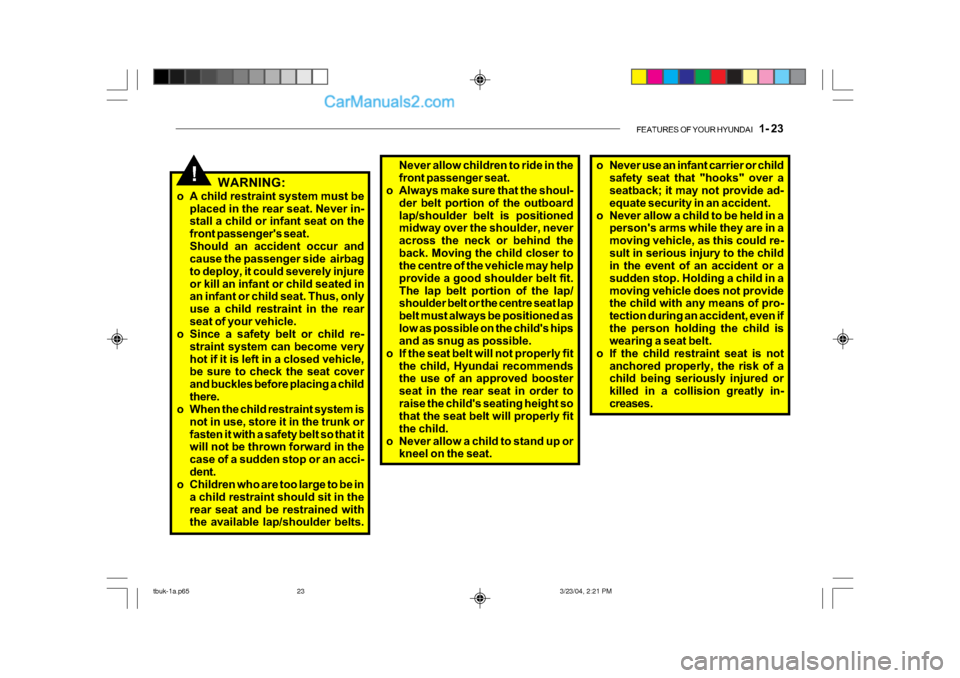
FEATURES OF YOUR HYUNDAI 1- 23
Never allow children to ride in the
front passenger seat.
o Always make sure that the shoul-
der belt portion of the outboard
lap/shoulder belt is positioned
midway over the shoulder, never
across the neck or behind the
back. Moving the child closer to
the centre of the vehicle may help
provide a good shoulder belt fit.
The lap belt portion of the lap/
shoulder belt or the centre seat lap
belt must always be positioned as
low as possible on the child's hips
and as snug as possible.
o If the seat belt will not properly fit the child, Hyundai recommends
the use of an approved booster
seat in the rear seat in order to
raise the child's seating height so
that the seat belt will properly fit
the child.
o Never allow a child to stand up or kneel on the seat. o Never use an infant carrier or child
safety seat that "hooks" over a
seatback; it may not provide ad-
equate security in an accident.
o Never allow a child to be held in a person's arms while they are in a
moving vehicle, as this could re-
sult in serious injury to the child
in the event of an accident or a
sudden stop. Holding a child in a
moving vehicle does not provide
the child with any means of pro-
tection during an accident, even if
the person holding the child is
wearing a seat belt.
o If the child restraint seat is not
anchored properly, the risk of a
child being seriously injured or
killed in a collision greatly in-
creases.
WARNING:
o A child restraint system must be placed in the rear seat. Never in-
stall a child or infant seat on the
front passenger's seat.
Should an accident occur and
cause the passenger side airbag
to deploy, it could severely injure
or kill an infant or child seated in
an infant or child seat. Thus, only
use a child restraint in the rear
seat of your vehicle.
o Since a safety belt or child re-
straint system can become very
hot if it is left in a closed vehicle,
be sure to check the seat cover
and buckles before placing a child
there.
o When the child restraint system is
not in use, store it in the trunk or
fasten it with a safety belt so that it
will not be thrown forward in the
case of a sudden stop or an acci-
dent.
o Children who are too large to be in
a child restraint should sit in the
rear seat and be restrained with
the available lap/shoulder belts.!
tbuk-1a.p65 3/23/04, 2:21 PM
23