engine coolant Hyundai Getz 2004 Owner's Guide
[x] Cancel search | Manufacturer: HYUNDAI, Model Year: 2004, Model line: Getz, Model: Hyundai Getz 2004Pages: 445, PDF Size: 12.16 MB
Page 394 of 445
DO-IT-YOURSELF MAINTENANCE 6- 3
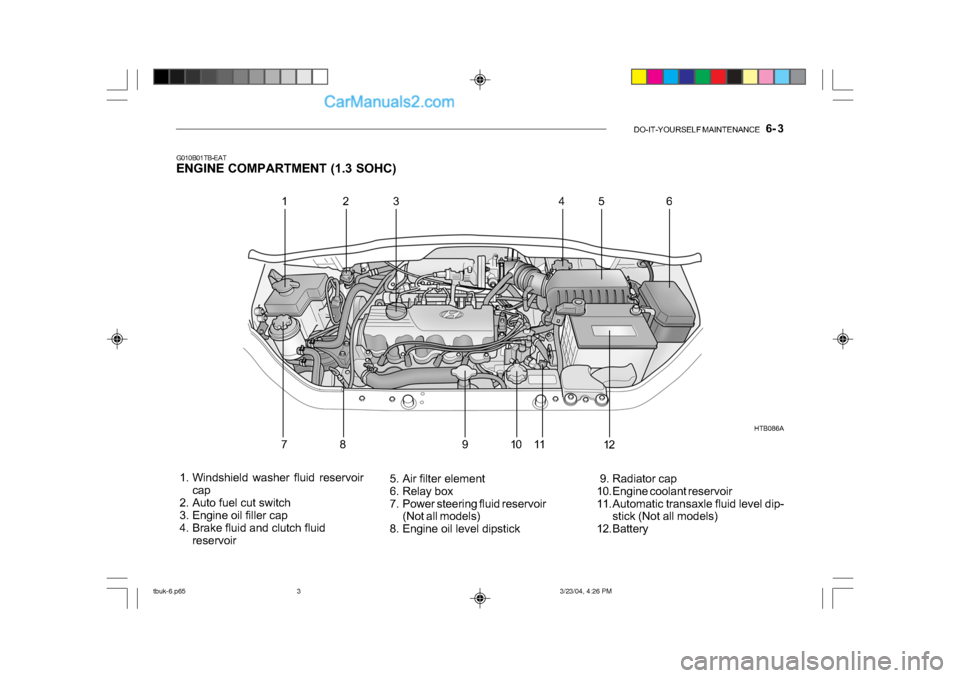
G010B01TB-EAT
ENGINE COMPARTMENT (1.3 SOHC)
1. Windshield washer fluid reservoir
cap
2. Auto fuel cut switch
3. Engine oil filler cap
4. Brake fluid and clutch fluid reservoir 5. Air filter element
6. Relay box
7. Power steering fluid reservoir
(Not all models)
8. Engine oil level dipstick 9. Radiator cap
10. Engine coolant reservoir
11. Automatic transaxle fluid level dip-
stick (Not all models)
12. Battery HTB086A
123
456
78 91 011
12
tbuk-6.p65 3/23/04, 4:26 PM
3
Page 395 of 445
6- 4 DO-IT-YOURSELF MAINTENANCE
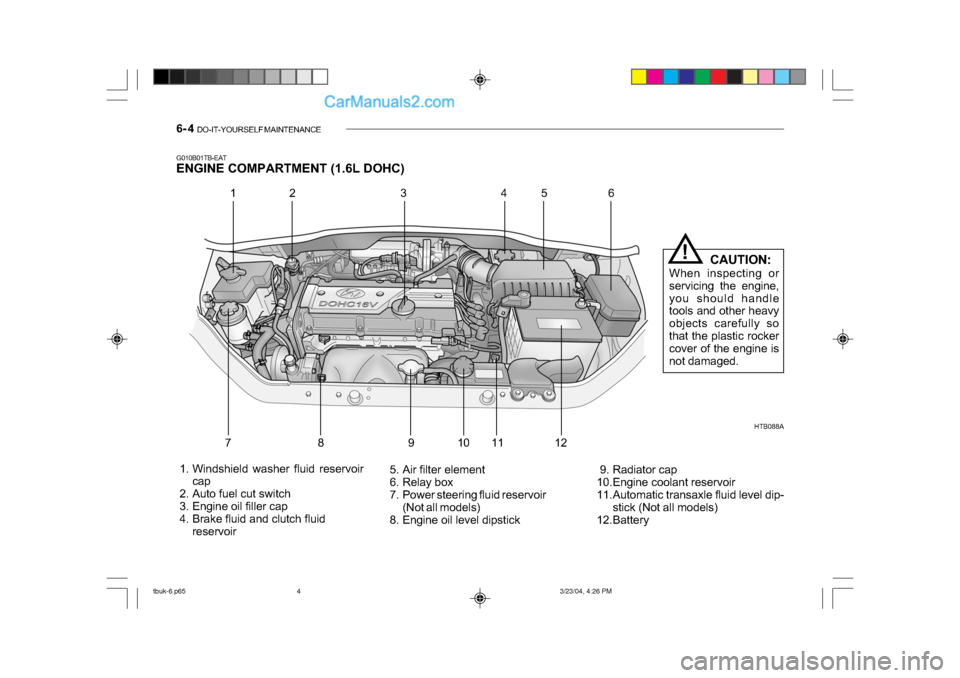
G010B01TB-EAT
ENGINE COMPARTMENT (1.6L DOHC)
HTB088A
1. Windshield washer fluid reservoir cap
2. Auto fuel cut switch
3. Engine oil filler cap
4. Brake fluid and clutch fluid reservoir 5. Air filter element
6. Relay box
7. Power steering fluid reservoir
(Not all models)
8. Engine oil level dipstick 9. Radiator cap
10.Engine coolant reservoir
11.Automatic transaxle fluid level dip-
stick (Not all models)
12.Battery
1 2 34
56
789 10 11 12 CAUTION:
When inspecting or
servicing the engine,
you should handle
tools and other heavy
objects carefully so
that the plastic rocker
cover of the engine is
not damaged.
!
tbuk-6.p65 3/23/04, 4:26 PM
4
Page 396 of 445
DO-IT-YOURSELF MAINTENANCE 6- 5
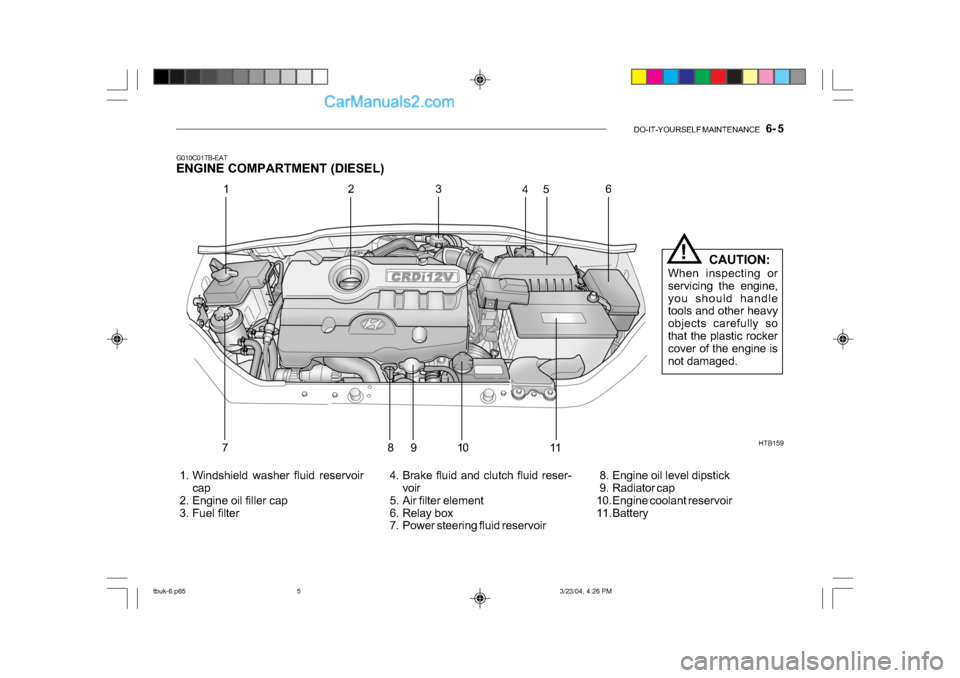
G010C01TB-EAT
ENGINE COMPARTMENT (DIESEL)
HTB159
1. Windshield washer fluid reservoir cap
2. Engine oil filler cap
3. Fuel filter 4. Brake fluid and clutch fluid reser-
voir
5. Air filter element
6. Relay box
7. Power steering fluid reservoir 8. Engine oil level dipstick
9. Radiator cap
10. Engine coolant reservoir
11. Battery
12
3
45 6
78 910
11 CAUTION:
When inspecting or
servicing the engine,
you should handle
tools and other heavy
objects carefully so
that the plastic rocker
cover of the engine is
not damaged.
!
tbuk-6.p65 3/23/04, 4:26 PM
5
Page 397 of 445
6- 6 DO-IT-YOURSELF MAINTENANCE
SG020B1-E
DAILY OPERATING CHECKS
The following items should be checked
on a daily basis or whenever the vehicle
is refuelled, whichever occurs sooner.
o Engine oil level.
o Engine coolant level.
o Power steering fluid level.
o Brake fluid level.
o Windscreen washer fluid level.
o Battery condition.
o Tyre condition and pressures.
o Operation and cleanliness of all light-
ing equipment.
o Windscreen wiper and washer opera- tion.
o Horn operation.
o Warning light operation.
o Adjustment and cleanliness of mir- rors.
o Seat and seat belt adjustment and operation.
o Fluid leakage.
The vehicle must not be driven if the
daily operating checks indicate that
any item of equipment related to the
safety or roadworthiness of the vehicle
is not functioning correctly. G030B02A-EAT
Recommended Oil
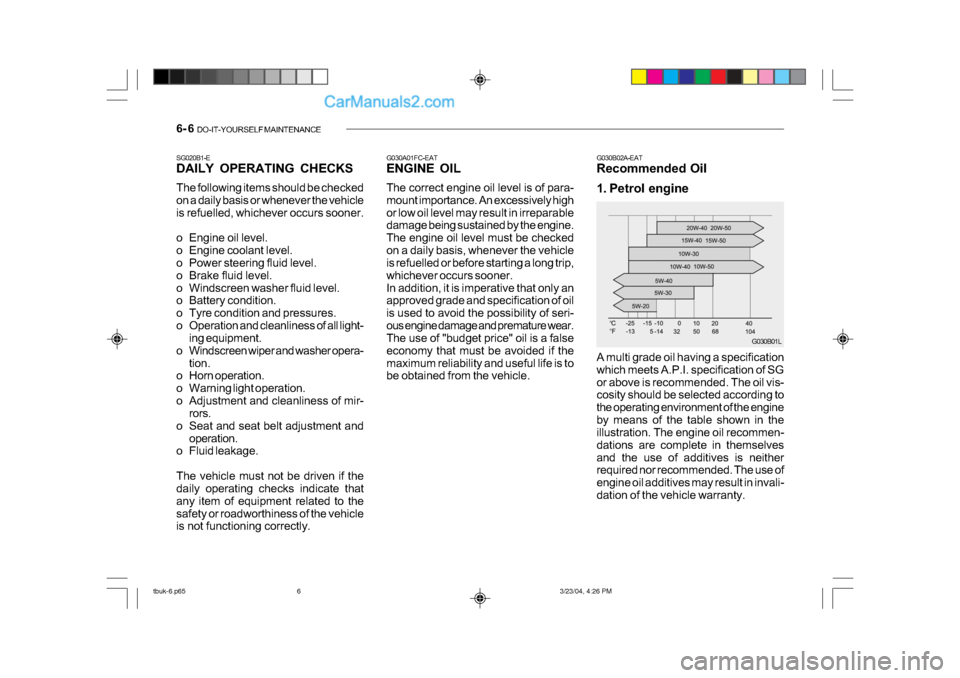
1. Petrol engine
A multi grade oil having a specification
which meets A.P.I. specification of SG
or above is recommended. The oil vis-
cosity should be selected according to
the operating environment of the engine
by means of the table shown in the
illustration. The engine oil recommen-
dations are complete in themselves
and the use of additives is neither
required nor recommended. The use of
engine oil additives may result in invali-
dation of the vehicle warranty.
G030A01FC-EAT
ENGINE OIL
The correct engine oil level is of para-
mount importance. An excessively high
or low oil level may result in irreparable
damage being sustained by the engine.
The engine oil level must be checked
on a daily basis, whenever the vehicle
is refuelled or before starting a long trip,
whichever occurs sooner.
In addition, it is imperative that only an
approved grade and specification of oil
is used to avoid the possibility of seri-
ous engine damage and premature wear.
The use of "budget price" oil is a false
economy that must be avoided if the
maximum reliability and useful life is to
be obtained from the vehicle.
G030B01L
tbuk-6.p65
3/23/04, 4:26 PM
6
Page 401 of 445
6- 10 DO-IT-YOURSELF MAINTENANCE
!
!
HTB170
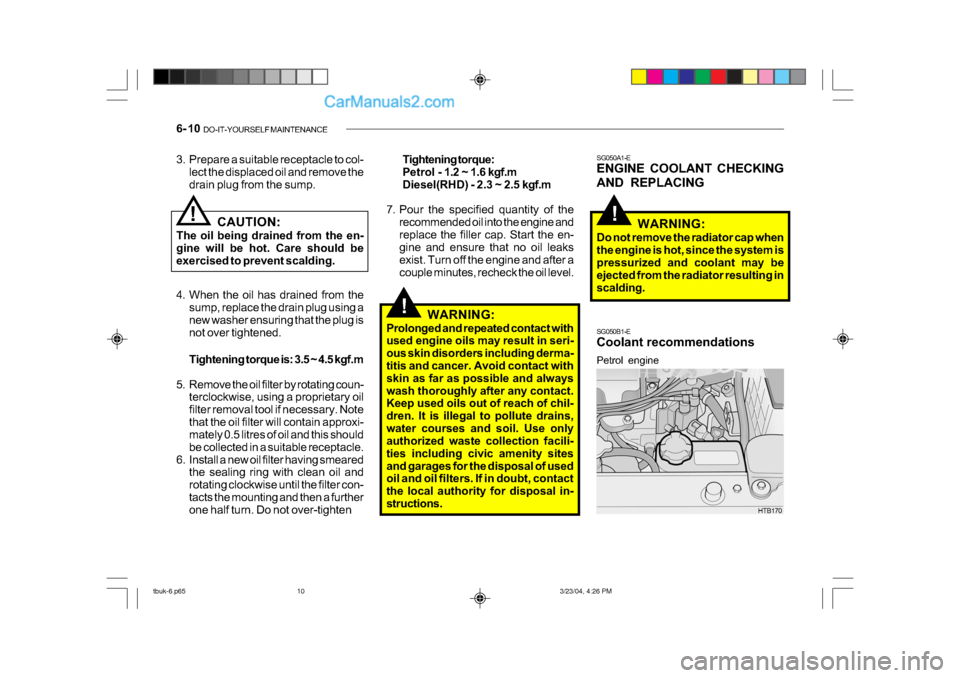
Petrol engine SG050A1-E
ENGINE COOLANT CHECKING
AND REPLACING
SG050B1-E
Coolant recommendations WARNING:
Do not remove the radiator cap when
the engine is hot, since the system is
pressurized and coolant may be
ejected from the radiator resulting in
scalding.
3. Prepare a suitable receptacle to col-
lect the displaced oil and remove the
drain plug from the sump.
4. When the oil has drained from the sump, replace the drain plug using a
new washer ensuring that the plug is
not over tightened.
Tightening torque is: 3.5 ~ 4.5 kgf.m
5. Remove the oil filter by rotating coun- terclockwise, using a proprietary oil
filter removal tool if necessary. Note
that the oil filter will contain approxi-
mately 0.5 litres of oil and this should
be collected in a suitable receptacle.
6. Install a new oil filter having smeared the sealing ring with clean oil and
rotating clockwise until the filter con-
tacts the mounting and then a further
one half turn. Do not over-tighten CAUTION:
The oil being drained from the en-
gine will be hot. Care should be
exercised to prevent scalding.
! Tightening torque:
Petrol -
1.2 ~ 1.6 kgf.m
Diesel(RHD) - 2.3 ~ 2.5 kgf.m
7. Pour the specified quantity of the recommended oil into the engine and
replace the filler cap. Start the en-
gine and ensure that no oil leaks
exist. Turn off the engine and after a
couple minutes, recheck the oil level.
WARNING:
Prolonged and repeated contact with
used engine oils may result in seri-
ous skin disorders including derma-
titis and cancer. Avoid contact with
skin as far as possible and always
wash thoroughly after any contact.
Keep used oils out of reach of chil-
dren. It is illegal to pollute drains,
water courses and soil. Use only
authorized waste collection facili-
ties including civic amenity sites
and garages for the disposal of used
oil and oil filters. If in doubt, contact
the local authority for disposal in-
structions.
tbuk-6.p65 3/23/04, 4:26 PM
10
Page 402 of 445
DO-IT-YOURSELF MAINTENANCE 6- 11
HTB170A
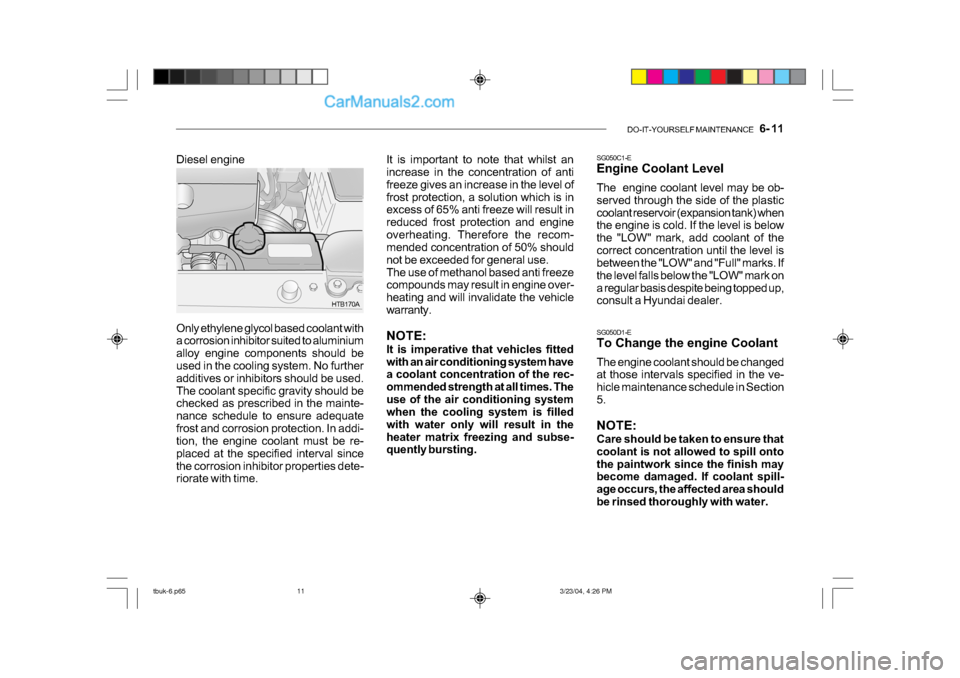
Diesel engine
Only ethylene glycol based coolant with
a corrosion inhibitor suited to aluminium
alloy engine components should be
used in the cooling system. No further
additives or inhibitors should be used.
The coolant specific gravity should be
checked as prescribed in the mainte-
nance schedule to ensure adequate
frost and corrosion protection. In addi-
tion, the engine coolant must be re-
placed at the specified interval since
the corrosion inhibitor properties dete-
riorate with time. It is important to note that whilst an
increase in the concentration of anti
freeze gives an increase in the level of
frost protection, a solution which is in
excess of 65% anti freeze will result in
reduced frost protection and engine
overheating. Therefore the recom-
mended concentration of 50% should
not be exceeded for general use.
The use of methanol based anti freeze
compounds may result in engine over-
heating and will invalidate the vehicle
warranty.
NOTE:
It is imperative that vehicles fitted
with an air conditioning system have
a coolant concentration of the rec-
ommended strength at all times. The
use of the air conditioning system
when the cooling system is filled
with water only will result in the
heater matrix freezing and subse-
quently bursting.
SG050C1-E
Engine Coolant Level
The engine coolant level may be ob-
served through the side of the plastic
coolant reservoir (expansion tank) when
the engine is cold. If the level is below
the "LOW" mark, add coolant of the
correct concentration until the level is
between the "LOW" and "Full" marks. If
the level falls below the "LOW" mark on
a regular basis despite being topped up,
consult a Hyundai dealer.
SG050D1-E
To Change the engine Coolant
The engine coolant should be changed
at those intervals specified in the ve-
hicle maintenance schedule in Section
5.
NOTE:
Care should be taken to ensure that
coolant is not allowed to spill onto
the paintwork since the finish may
become damaged. If coolant spill-
age occurs, the affected area should
be rinsed thoroughly with water.
tbuk-6.p65
3/23/04, 4:26 PM
11
Page 403 of 445
6- 12 DO-IT-YOURSELF MAINTENANCE
!
HTB172
HTB171
1. Park the vehicle on level ground and
ensure that the parking brake is firmly
applied, and the engine allowed to
cool.
Do not attempt this operation whilst
the engine is hot since burning or
scalding may result.
2. Prepare a suitable receptacle to col-
lect the displaced coolant and posi-
tion this under the radiator drain tap.
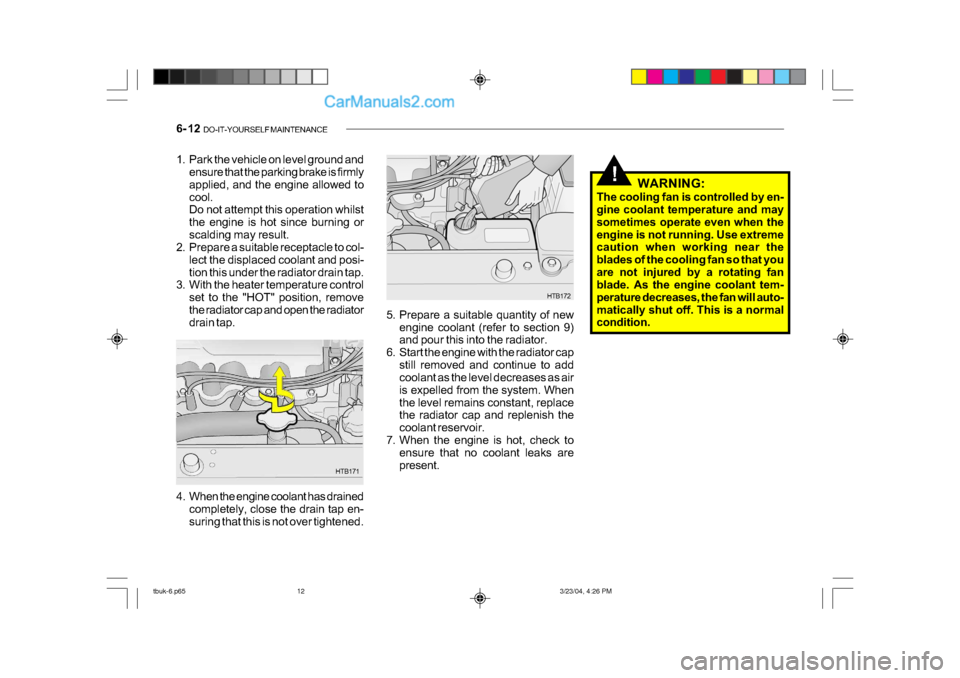
3. With the heater temperature control
set to the "HOT" position, remove
the radiator cap and open the radiator
drain tap. 5. Prepare a suitable quantity of new
engine coolant (refer to section 9)
and pour this into the radiator.
6. Start the engine with the radiator cap
still removed and continue to add
coolant as the level decreases as air
is expelled from the system. When
the level remains constant, replace
the radiator cap and replenish the
coolant reservoir.
7. When the engine is hot, check to ensure that no coolant leaks are
present.
4. When the engine coolant has drained completely, close the drain tap en-
suring that this is not over tightened. WARNING:
The cooling fan is controlled by en-
gine coolant temperature and may
sometimes operate even when the
engine is not running. Use extreme
caution when working near the
blades of the cooling fan so that you
are not injured by a rotating fan
blade. As the engine coolant tem-
perature decreases, the fan will auto-
matically shut off. This is a normal
condition.
tbuk-6.p65 3/23/04, 4:26 PM
12
Page 406 of 445
DO-IT-YOURSELF MAINTENANCE 6- 15
!
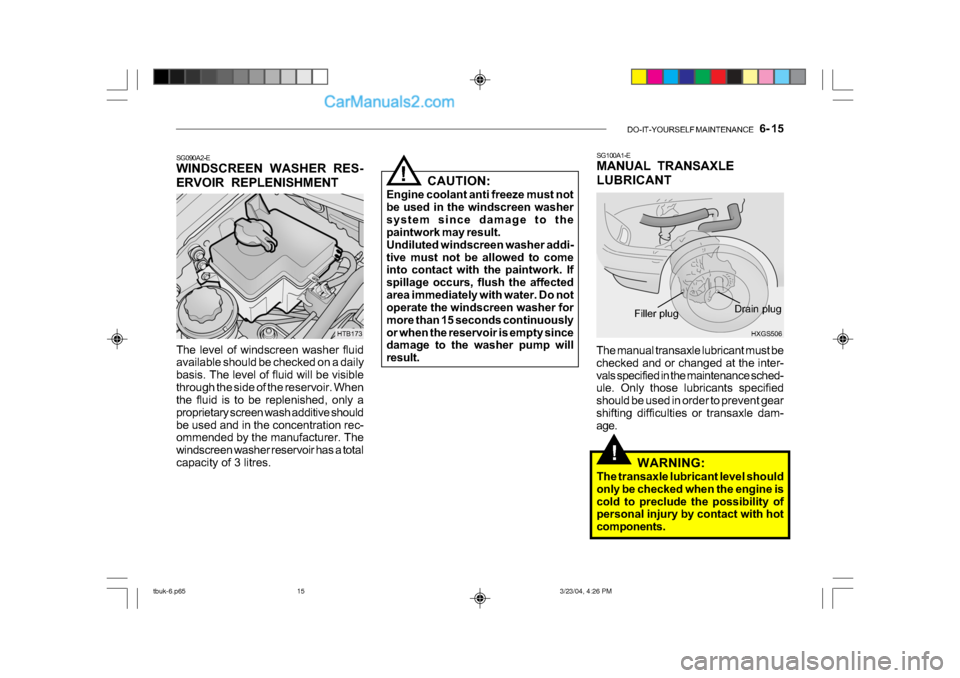
SG100A1-E
MANUAL TRANSAXLE
LUBRICANT
SG090A2-E
WINDSCREEN WASHER RES-
ERVOIR REPLENISHMENT
The level of windscreen washer fluid
available should be checked on a daily
basis. The level of fluid will be visible
through the side of the reservoir. When
the fluid is to be replenished, only a
proprietary screen wash additive should
be used and in the concentration rec-
ommended by the manufacturer. The
windscreen washer reservoir has a total
capacity of 3 litres. CAUTION:
Engine coolant anti freeze must not
be used in the windscreen washer
system since damage to the
paintwork may result.
Undiluted windscreen washer addi-
tive must not be allowed to come
into contact with the paintwork. If
spillage occurs, flush the affected
area immediately with water. Do not
operate the windscreen washer for
more than 15 seconds continuously
or when the reservoir is empty since
damage to the washer pump will
result.
!
HTB173
HXGS506
Drain plug
Filler plug
The manual transaxle lubricant must be
checked and or changed at the inter-
vals specified in the maintenance sched-
ule. Only those lubricants specified
should be used in order to prevent gear
shifting difficulties or transaxle dam-
age.
WARNING:
The transaxle lubricant level should
only be checked when the engine is
cold to preclude the possibility of
personal injury by contact with hot
components.
tbuk-6.p65 3/23/04, 4:26 PM
15
Page 408 of 445
DO-IT-YOURSELF MAINTENANCE 6- 17
!
!
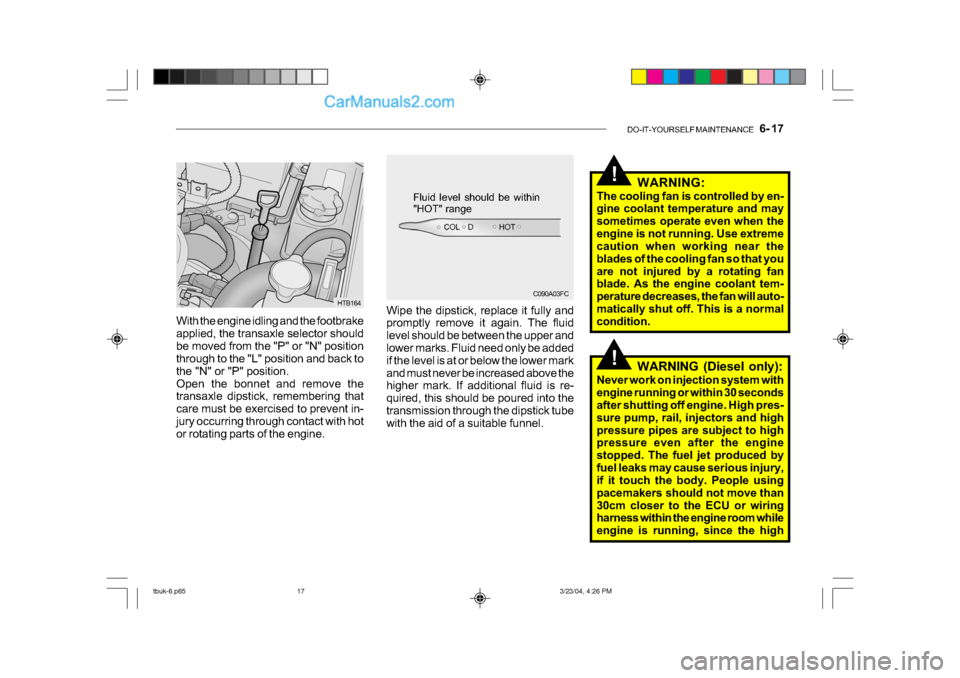
With the engine idling and the footbrake
applied, the transaxle selector should
be moved from the "P" or "N" position
through to the "L" position and back to
the "N" or "P" position.
Open the bonnet and remove the
transaxle dipstick, remembering that
care must be exercised to prevent in-
jury occurring through contact with hot
or rotating parts of the engine.
C090A03FC
Fluid level should be within
"HOT" range
HTB164 Wipe the dipstick, replace it fully and
promptly remove it again. The fluid
level should be between the upper and
lower marks. Fluid need only be added
if the level is at or below the lower mark
and must never be increased above the
higher mark. If additional fluid is re-
quired, this should be poured into the
transmission through the dipstick tube
with the aid of a suitable funnel. WARNING:
The cooling fan is controlled by en-
gine coolant temperature and may
sometimes operate even when the
engine is not running. Use extreme
caution when working near the
blades of the cooling fan so that you
are not injured by a rotating fan
blade. As the engine coolant tem-
perature decreases, the fan will auto-
matically shut off. This is a normal
condition.
WARNING (Diesel only):
Never work on injection system with
engine running or within 30 seconds
after shutting off engine. High pres-
sure pump, rail, injectors and high
pressure pipes are subject to high
pressure even after the engine
stopped. The fuel jet produced by
fuel leaks may cause serious injury,
if it touch the body. People using
pacemakers should not move than
30cm closer to the ECU or wiring
harness within the engine room while
engine is running, since the high
tbuk-6.p65 3/23/04, 4:26 PM
17
Page 416 of 445
DO-IT-YOURSELF MAINTENANCE 6- 25
!
!
o If battery electrolyte is spilled onto
skin or into eyes, the effected area
must be flushed with copious
amounts of water and medical assis-
tance sought.
o If battery electrolyte is ingested, copious amounts of water or milk
followed by an ant-acid (raw egg or
milk of magnesia) must be drunk.
Vomiting should not be induced and
medical assistance must be sought.
o Batteries must only be charged in well venti-lated areas from which
naked lights or sources of sparks are
excluded.
o Ensure that children, pets or other unauthorized persons are kept away
from batteries.
o Do not allow anything to bridge the positive (+) and negative (-) termi-
nals of the battery.
o Never invert the battery.
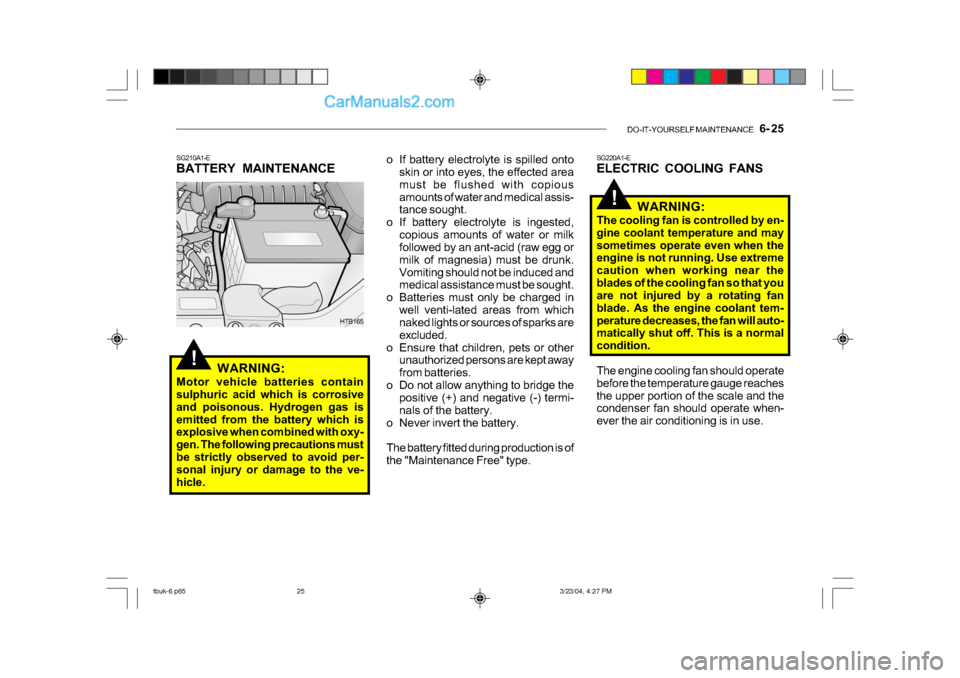
The battery fitted during production is of
the "Maintenance Free" type.
SG210A1-E
BATTERY MAINTENANCE
WARNING:
Motor vehicle batteries contain
sulphuric acid which is corrosive
and poisonous. Hydrogen gas is
emitted from the battery which is
explosive when combined with oxy-
gen. The following precautions must
be strictly observed to avoid per-
sonal injury or damage to the ve-
hicle.
HTB165 SG220A1-E
ELECTRIC COOLING FANS
WARNING:
The cooling fan is controlled by en-
gine coolant temperature and may
sometimes operate even when the
engine is not running. Use extreme
caution when working near the
blades of the cooling fan so that you
are not injured by a rotating fan
blade. As the engine coolant tem-
perature decreases, the fan will auto-
matically shut off. This is a normal
condition.
The engine cooling fan should operate
before the temperature gauge reaches
the upper portion of the scale and the
condenser fan should operate when-
ever the air conditioning is in use.
tbuk-6.p65 3/23/04, 4:27 PM
25