wheel Hyundai Getz 2004 Workshop Manual
[x] Cancel search | Manufacturer: HYUNDAI, Model Year: 2004, Model line: Getz, Model: Hyundai Getz 2004Pages: 445, PDF Size: 12.16 MB
Page 357 of 445
2- 14 DRIVING YOUR HYUNDAI
!WARNING:
ABS will not prevent accidents due to improper or dangerous drivingmaneuvers. Even though vehicle control is improved during emer- gency braking, always maintain asafe distance between you and ob-jects ahead. Vehicle speeds shouldalways be reduced during extremeroad conditions. The braking distance for cars equipped with an anti-lock brakingsystem may be longer than for thosewithout it in the following road con-ditions.
o Driving on rough, gravel or snow- covered roads.
o Driving with tyre chains installed.
o Driving on roads where the road
surface is pitted or has differentsurface height. These roads should be driven at reduced speeds. The safety features of an ABS equipped vehicle shouldnot be tested by high speed drivingor cornering. This could endangerthe safety of yourself or others. SC150A1-F DRIVING FOR ECONOMY You can save fuel and get more miles from your car if you follow these sug-gestions:
o Drive smoothly. Accelerate at a
moderate rate. Don't make "jack- rabbit" starts or full-throttle shiftsand maintain a steady cruisingspeed. Don't race between stop-lights. Try to adjust your speed tothat of the other traffic so you don't have to change speeds unneces- sarily.Avoid heavy traffic whenever pos-sible. Al-ways maintain a safe dis-tance from other vehicles so youcan avoid unnecessary braking. This also reduces brake wear. o Drive at a moderate speed. The
faster you drive, the more fuel your car uses. Driving at a moderatespeed, especially on the highway, isone of the most effective ways to reduce fuel consumption.
o Don't "ride" the brake or clutch pedal. This can increase fuel consumption and also increase wear on thesecomponents. In addition, driving withyour foot resting on the brake pedal may cause the brakes to overheat, which reduces their effectivenessand may lead to more serious con-sequences.
o Take care of your tyres. Keep them inflated to the recommended pres- sure. Incorrect infla-tion, either too much or too little, results in unnec-essary tyre wear. Check the tyrepres-sures at least once a month.
o Be sure that the wheels are aligned correctly. Improper alignment can result from hitting curbs or driving too fast over irregular surfaces. Pooralignment causes faster tyre wearand may also result in other prob-lems as well as greater fuel con-sumption.
tbuk-2.p65 3/23/04, 4:55 PM
14
Page 360 of 445
DRIVING YOUR HYUNDAI 2- 17
!
o The formation of snow or ice built up
inside the wheel arches may inter- fere with the road wheels or steeringmechanism. In such instances, un-usual noises or an increase in steer- ing effort may result. Therefore, ensure that the wheel arches arechecked periodically and any accu-mulated snow or ice removed.
o It is advisable to carry emergency equipment including, torch, shovel, tow rope, blankets etc., if a journey is to be undertaken into areas ofsevere road conditions.
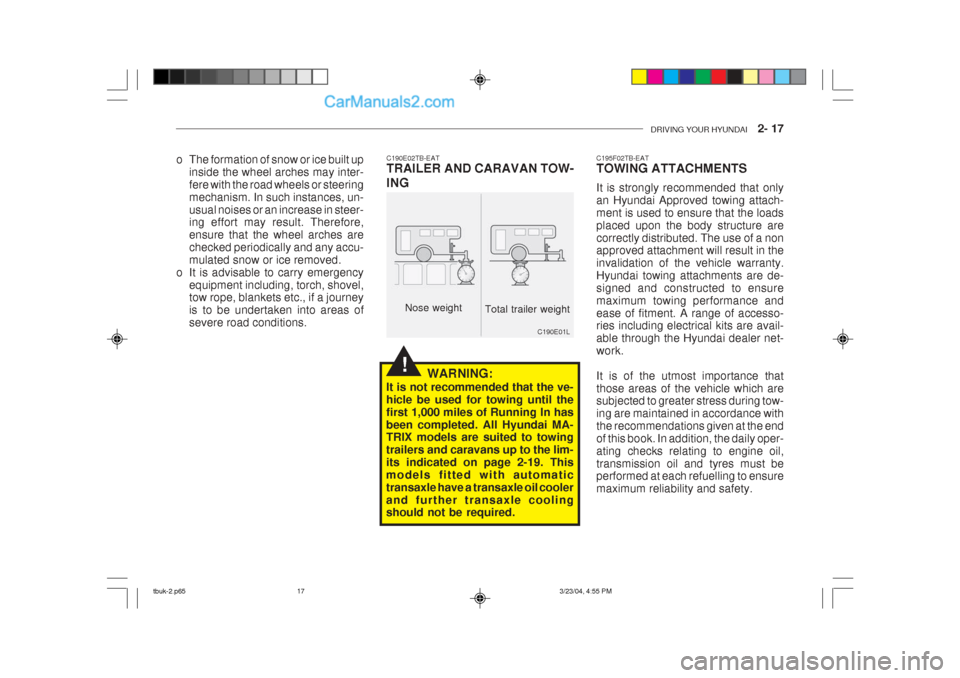
Nose weight Total trailer weight
C190E01L C195F02TB-EAT TOWING ATTACHMENTS It is strongly recommended that only an Hyundai Approved towing attach-ment is used to ensure that the loadsplaced upon the body structure arecorrectly distributed. The use of a non approved attachment will result in the invalidation of the vehicle warranty.Hyundai towing attachments are de-signed and constructed to ensuremaximum towing performance andease of fitment. A range of accesso- ries including electrical kits are avail- able through the Hyundai dealer net-work. It is of the utmost importance that those areas of the vehicle which are subjected to greater stress during tow- ing are maintained in accordance withthe recommendations given at the endof this book. In addition, the daily oper-ating checks relating to engine oil,transmission oil and tyres must be performed at each refuelling to ensure maximum reliability and safety.
C190E02TB-EAT TRAILER AND CARAVAN TOW- ING
WARNING:
It is not recommended that the ve- hicle be used for towing until thefirst 1,000 miles of Running In hasbeen completed. All Hyundai MA- TRIX models are suited to towing trailers and caravans up to the lim-its indicated on page 2-19. Thismodels fitted with automatictransaxle have a transaxle oil coolerand further transaxle cooling should not be required.
tbuk-2.p65 3/23/04, 4:55 PM
17
Page 361 of 445
2- 18 DRIVING YOUR HYUNDAI
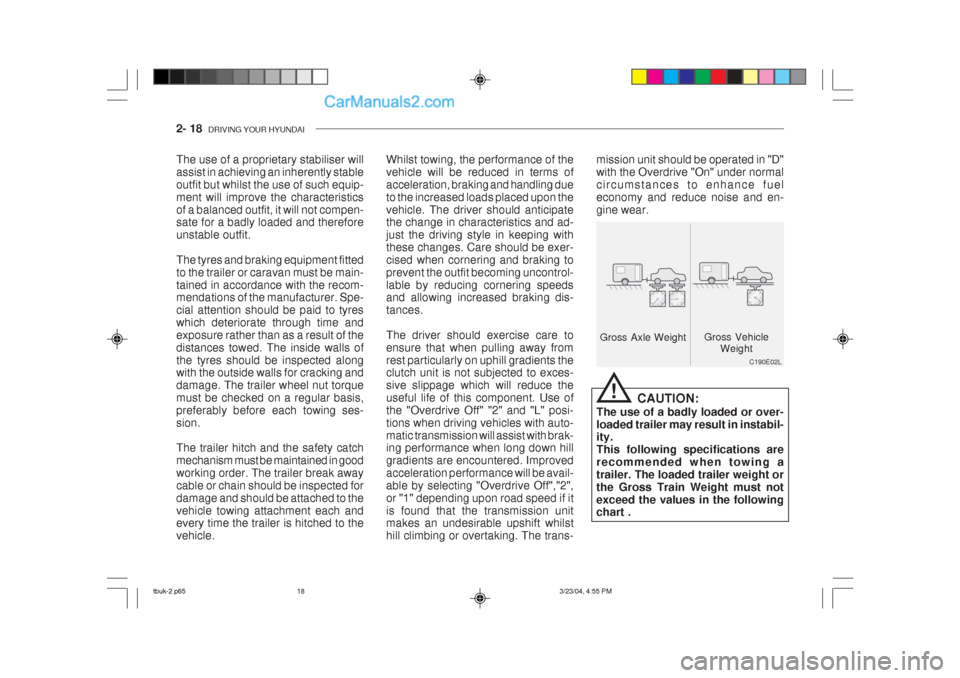
C190E02L
Gross Axle Weight
Gross Vehicle
Weight
The use of a proprietary stabiliser will assist in achieving an inherently stableoutfit but whilst the use of such equip-ment will improve the characteristicsof a balanced outfit, it will not compen- sate for a badly loaded and therefore unstable outfit. The tyres and braking equipment fitted to the trailer or caravan must be main-tained in accordance with the recom- mendations of the manufacturer. Spe- cial attention should be paid to tyreswhich deteriorate through time andexposure rather than as a result of thedistances towed. The inside walls ofthe tyres should be inspected along with the outside walls for cracking and damage. The trailer wheel nut torquemust be checked on a regular basis,preferably before each towing ses-sion. The trailer hitch and the safety catch mechanism must be maintained in goodworking order. The trailer break awaycable or chain should be inspected fordamage and should be attached to thevehicle towing attachment each and every time the trailer is hitched to the vehicle. Whilst towing, the performance of thevehicle will be reduced in terms ofacceleration, braking and handling dueto the increased loads placed upon thevehicle. The driver should anticipate the change in characteristics and ad- just the driving style in keeping withthese changes. Care should be exer-cised when cornering and braking toprevent the outfit becoming uncontrol-lable by reducing cornering speeds and allowing increased braking dis- tances. The driver should exercise care to ensure that when pulling away fromrest particularly on uphill gradients the clutch unit is not subjected to exces- sive slippage which will reduce theuseful life of this component. Use ofthe "Overdrive Off" "2" and "L" posi-tions when driving vehicles with auto-matic transmission will assist with brak- ing performance when long down hill gradients are encountered. Improvedacceleration performance will be avail-able by selecting "Overdrive Off","2",or "1" depending upon road speed if itis found that the transmission unit makes an undesirable upshift whilst hill climbing or overtaking. The trans- mission unit should be operated in "D"with the Overdrive "On" under normalcircumstances to enhance fueleconomy and reduce noise and en-gine wear.
CAUTION:
The use of a badly loaded or over-loaded trailer may result in instabil- ity. This following specifications arerecommended when towing atrailer. The loaded trailer weight orthe Gross Train Weight must notexceed the values in the following chart .
!
tbuk-2.p65 3/23/04, 4:55 PM
18
Page 363 of 445
2- 20 DRIVING YOUR HYUNDAI
When being passed by a large ve- hicle, keep a constant speed andsteer straight ahead. If there is toomuch wind buffeting slow down toget out of the other vehicle's air turbulence.
8. When parking your car and trailer, especially on a hill, be sure to follow all the normal precautions. Turn yourfront wheel into the curb, set theparking brake firmly, and put the transaxle in 1st or Reverse (manual) or Park (automatic). In addition,place wheel chocks at each of thetrailer's tyres.
9. If the trailer has electric brakes,
start your vehicle and trailer mov- ing, and then apply the trailer brake controller by hand to be sure thebrakes are working. This lets youcheck your electrical connection atthe same time.
10. During your trip, check occasion- ally to be sure that the load issecure, and that the lights andany trailer brakes are still working.
11. Avoid jerky starts, sudden accel- eration or sudden stops.
12. Avoid sharp turns and rapid lane changes. 13. Avoid holding the brake pedal
down too long or too frequently.This could cause the brakes tooverheat, resulting in reduced brak-ing efficiency.
14. When going down a hill, shift into
a lower gear and use the enginebraking effect.When ascending a long grade,
downshift the transaxle to a lowergear and reduce speed to reduce chances of engine overloading and/ or overheating.
15. If you have to stop while going
uphill, do not hold the vehicle inplace by pressing on the accelera-tor. This can cause the automatic transaxle to overheat. Use the park- ing brake or footbrake.
NOTE: When towing check transaxle fluid more frequently. CAUTION:
If overheating should occur whentowing, (temperature gauge reads near red zone), taking the following action may reduce or eliminate theproblem.
1. Turn off the air conditioner.
2. Reduce highway speed.
3. Select a lower gear when going uphill.
4. While in stop and go traffic, place the gear selection in park or neu- tral and idle the engine at a higherspeed.
!
tbuk-2.p65 3/23/04, 4:55 PM
20
Page 369 of 445
3- 6 WHAT TO DO IN AN EMERGENCY
SD060A1-E
IN THE EVENT OF A PUNCTURE
If a puncture occurs whilst driving the
vehicle:
1. Bring the car to rest as soon as it is
safe to do so and with the minimum
amount of braking required which
will assist in maintaining the maxi-
mum amount of control. The vehicle
should be parked wherever pos-
sible upon firm level ground to facili-
tate wheel changing.
2. If the vehicle is creating a hazard and the road conditions do not per-
mit the wheel to be changed safely,
assistance should be sought.
3. Passengers must not be allowed to
remain inside the vehicle during
wheel changing. If a puncture oc-
curs whilst the vehicle is on a
motorway, the passengers should
take refuge on the motorway em-
bankment to avoid the possibility of
injury occurring should the vehicle
be struck by other motorway traffic.
4. Wheel changing should be per-
formed according to the following
instructions.
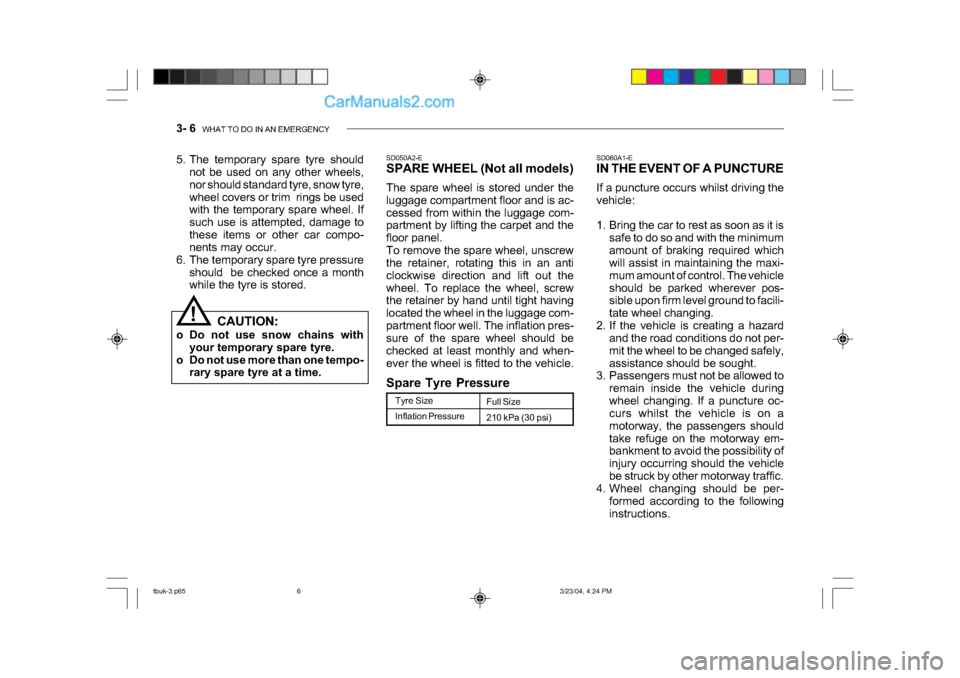
SD050A2-E
SPARE WHEEL (Not all models)
The spare wheel is stored under the
luggage compartment floor and is ac-
cessed from within the luggage com-
partment by lifting the carpet and the
floor panel.
To remove the spare wheel, unscrew
the retainer, rotating this in an anti
clockwise direction and lift out the
wheel. To replace the wheel, screw
the retainer by hand until tight having
located the wheel in the luggage com-
partment floor well. The inflation pres-
sure of the spare wheel should be
checked at least monthly and when-
ever the wheel is fitted to the vehicle.
Inflation Pressure
Tyre Size
Spare Tyre Pressure
Full Size
210 kPa (30 psi)
CAUTION:
o Do not use snow chains with your temporary spare tyre.
o Do not use more than one tempo- rary spare tyre at a time.
!
5. The temporary spare tyre should
not be used on any other wheels,
nor should standard tyre, snow tyre,
wheel covers or trim rings be used
with the temporary spare wheel. If
such use is attempted, damage to
these items or other car compo-
nents may occur.
6. The temporary spare tyre pressure should be checked once a month
while the tyre is stored.
tbuk-3.p65 3/23/04, 4:24 PM
6
Page 370 of 445
WHAT TO DO IN AN EMERGENCY 3- 7
HTB153
HTB152
Groove
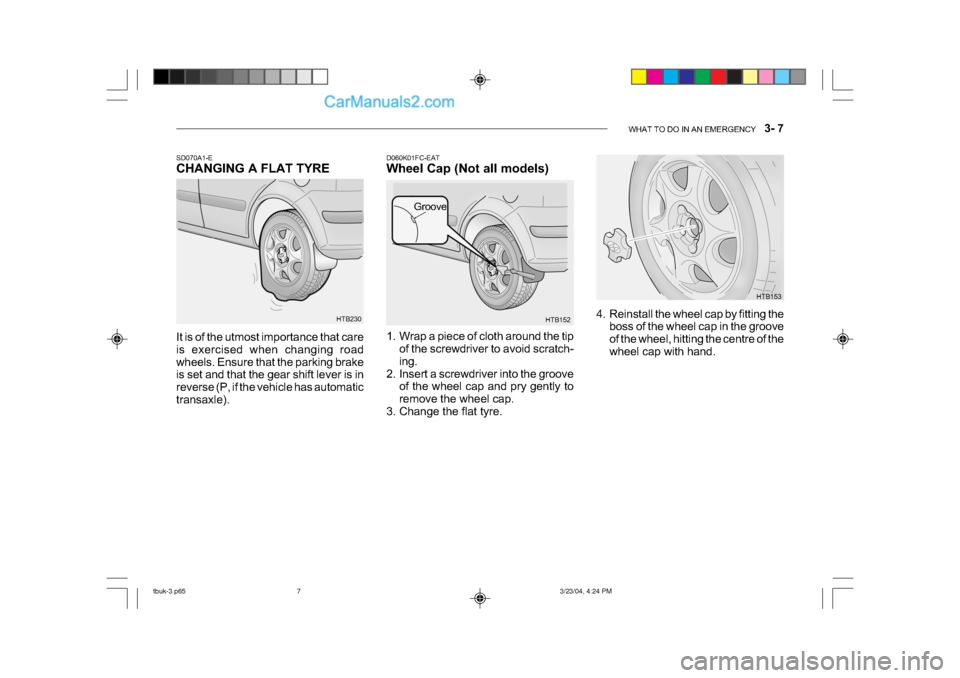
D060K01FC-EAT
Wheel Cap (Not all models)
1. Wrap a piece of cloth around the tip
of the screwdriver to avoid scratch-
ing.
2. Insert a screwdriver into the groove of the wheel cap and pry gently to
remove the wheel cap.
3. Change the flat tyre. 4. Reinstall the wheel cap by fitting the
boss of the wheel cap in the groove
of the wheel, hitting the centre of the
wheel cap with hand.
HTB230
SD070A1-E
CHANGING A FLAT TYRE
It is of the utmost importance that care
is exercised when changing road
wheels. Ensure that the parking brake
is set and that the gear shift lever is in
reverse (P, if the vehicle has automatic
transaxle).
tbuk-3.p65
3/23/04, 4:24 PM
7
Page 371 of 445
3- 8 WHAT TO DO IN AN EMERGENCY
HTB149
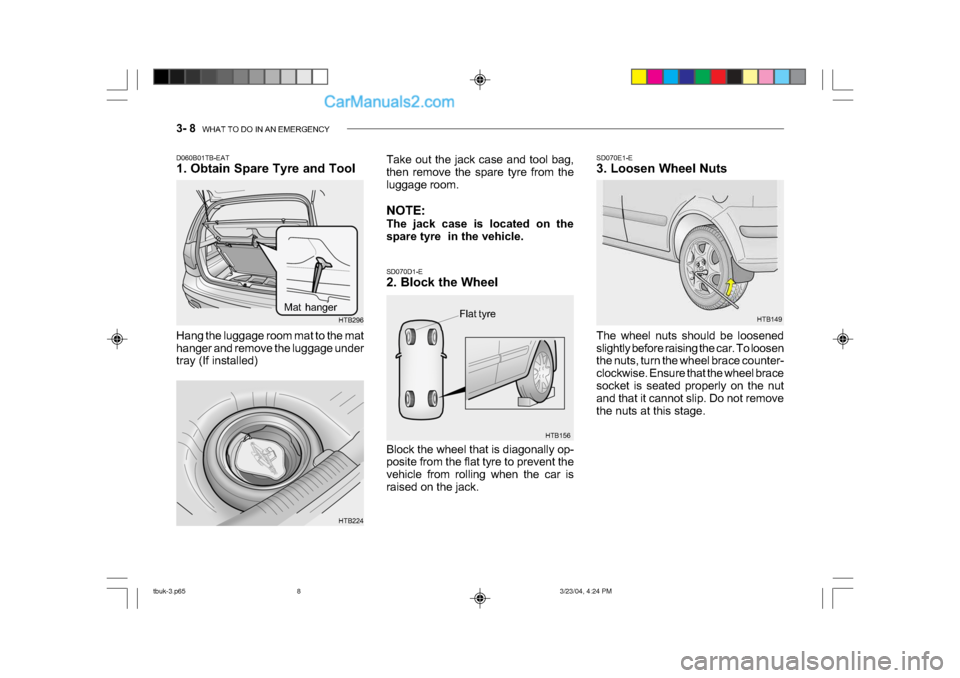
SD070E1-E
3. Loosen Wheel Nuts
The wheel nuts should be loosened
slightly before raising the car. To loosen
the nuts, turn the wheel brace counter-
clockwise. Ensure that the wheel brace
socket is seated properly on the nut
and that it cannot slip. Do not remove
the nuts at this stage.Flat tyre
HTB156
SD070D1-E
2. Block the Wheel
Block the wheel that is diagonally op-
posite from the flat tyre to prevent the
vehicle from rolling when the car is
raised on the jack.
Take out the jack case and tool bag,
then remove the spare tyre from the
luggage room.
NOTE:
The jack case is located on the
spare tyre in the vehicle.
Hang the luggage room mat to the mat
hanger and remove the luggage under
tray (If installed)
D060B01TB-EAT
1. Obtain Spare Tyre and Tool
HTB224
HTB296
Mat hanger
tbuk-3.p65
3/23/04, 4:24 PM
8
Page 372 of 445
WHAT TO DO IN AN EMERGENCY 3- 9
!
SD070H1-E
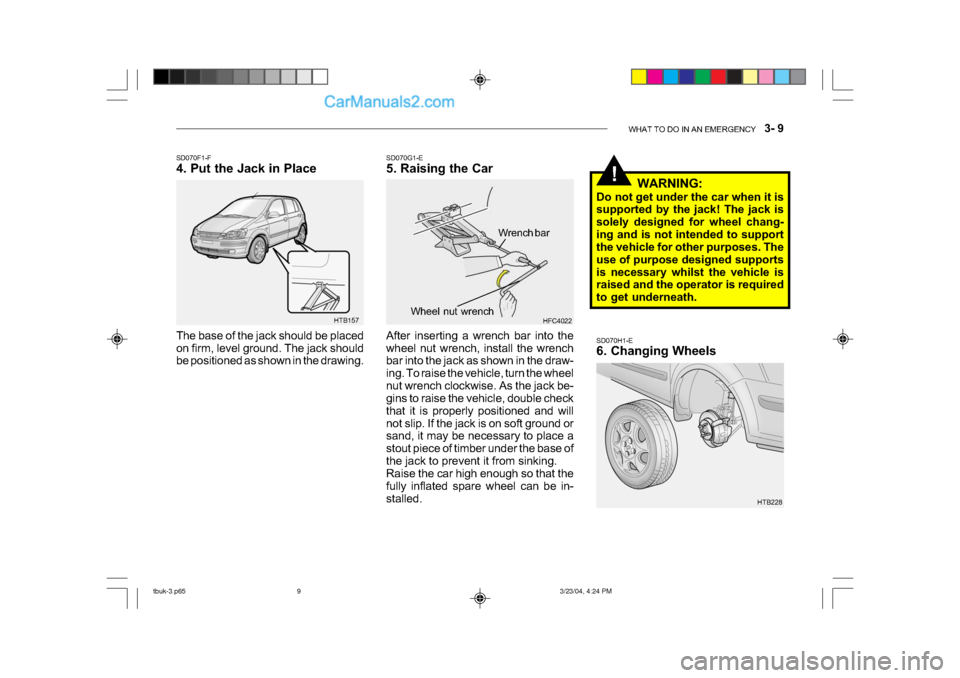
6. Changing Wheels
HTB157
SD070F1-F
4. Put the Jack in Place
The base of the jack should be placed
on firm, level ground. The jack should
be positioned as shown in the drawing.
SD070G1-E
5. Raising the Car
After inserting a wrench bar into the
wheel nut wrench, install the wrench
bar into the jack as shown in the draw-
ing. To raise the vehicle, turn the wheel
nut wrench clockwise. As the jack be-
gins to raise the vehicle, double check
that it is properly positioned and will
not slip. If the jack is on soft ground or
sand, it may be necessary to place a
stout piece of timber under the base of
the jack to prevent it from sinking.
Raise the car high enough so that the
fully inflated spare wheel can be in-
stalled. HFC4022
Wrench bar
Wheel nut wrench
WARNING:
Do not get under the car when it is
supported by the jack! The jack is
solely designed for wheel chang-
ing and is not intended to support
the vehicle for other purposes. The
use of purpose designed supports
is necessary whilst the vehicle is
raised and the operator is required
to get underneath.
HTB228
tbuk-3.p65 3/23/04, 4:24 PM
9
Page 373 of 445
3- 10 WHAT TO DO IN AN EMERGENCY
!
HTB150
SD070J2-E
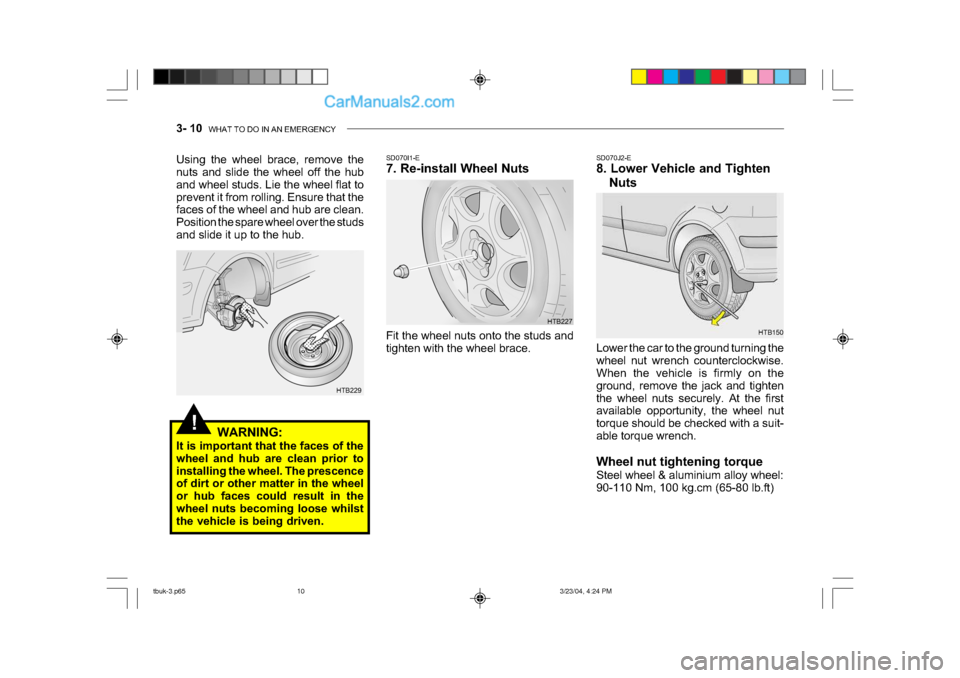
8. Lower Vehicle and Tighten
Nuts
Lower the car to the ground turning the
wheel nut wrench counterclockwise.
When the vehicle is firmly on the
ground, remove the jack and tighten
the wheel nuts securely. At the first
available opportunity, the wheel nut
torque should be checked with a suit-
able torque wrench.
Wheel nut tightening torque
Steel wheel & aluminium alloy wheel:
90-110 Nm, 100 kg.cm (65-80 lb.ft)
SD070I1-E
7. Re-install Wheel NutsFit the wheel nuts onto the studs and
tighten with the wheel brace.
HTB227
Using the wheel brace, remove the
nuts and slide the wheel off the hub
and wheel studs. Lie the wheel flat to
prevent it from rolling. Ensure that the
faces of the wheel and hub are clean.
Position the spare wheel over the studs
and slide it up to the hub.
HTB229
WARNING:
It is important that the faces of the
wheel and hub are clean prior to
installing the wheel. The prescence
of dirt or other matter in the wheel
or hub faces could result in the
wheel nuts becoming loose whilst
the vehicle is being driven.
tbuk-3.p65 3/23/04, 4:24 PM
10
Page 374 of 445
WHAT TO DO IN AN EMERGENCY 3- 11
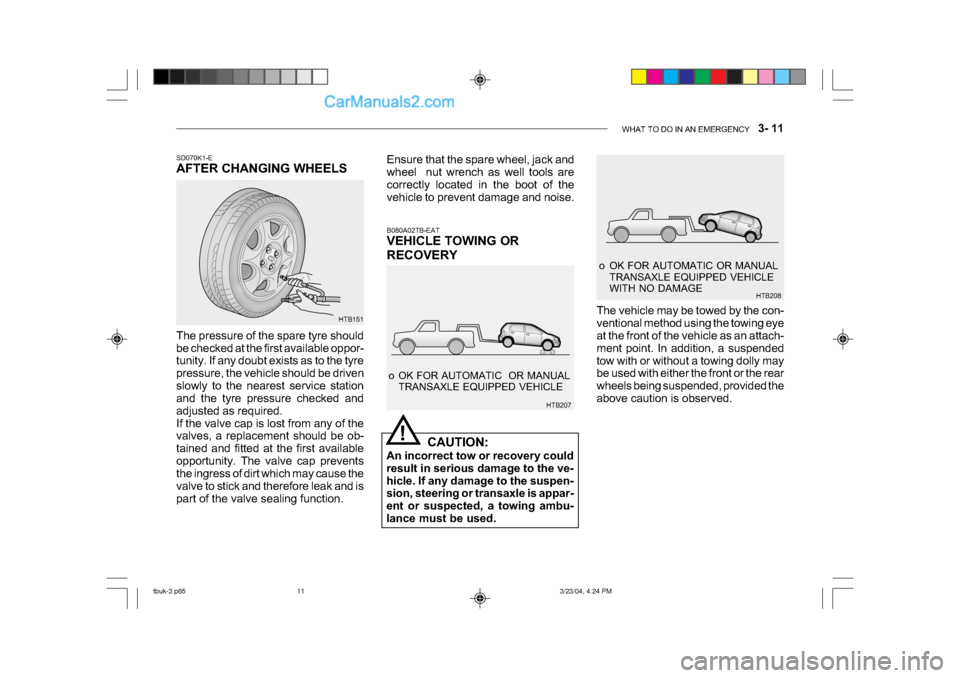
o OK FOR AUTOMATIC OR MANUAL
TRANSAXLE EQUIPPED VEHICLE
WITH NO DAMAGE HTB208
HTB151B080A02TB-EAT
VEHICLE TOWING OR
RECOVERY
CAUTION:
An incorrect tow or recovery could
result in serious damage to the ve-
hicle. If any damage to the suspen-
sion, steering or transaxle is appar-
ent or suspected, a towing ambu-
lance must be used. o OK FOR AUTOMATIC OR MANUAL
TRANSAXLE EQUIPPED VEHICLE
HTB207
!
SD070K1-E
AFTER CHANGING WHEELS
The pressure of the spare tyre should
be checked at the first available oppor-
tunity. If any doubt exists as to the tyre
pressure, the vehicle should be driven
slowly to the nearest service station
and the tyre pressure checked and
adjusted as required.
If the valve cap is lost from any of the
valves, a replacement should be ob-
tained and fitted at the first available
opportunity. The valve cap prevents
the ingress of dirt which may cause the
valve to stick and therefore leak and is
part of the valve sealing function. Ensure that the spare wheel, jack and
wheel nut wrench as well tools are
correctly located in the boot of the
vehicle to prevent damage and noise.
The vehicle may be towed by the con-
ventional method using the towing eye
at the front of the vehicle as an attach-
ment point. In addition, a suspended
tow with or without a towing dolly may
be used with either the front or the rear
wheels being suspended, provided the
above caution is observed.
tbuk-3.p65 3/23/04, 4:24 PM
11