maintenance schedule Hyundai Getz 2006 User Guide
[x] Cancel search | Manufacturer: HYUNDAI, Model Year: 2006, Model line: Getz, Model: Hyundai Getz 2006Pages: 455, PDF Size: 11.23 MB
Page 202 of 455
DO-IT-YOURSELF MAINTENANCE 6- 15
WARNING:
It is always better to check the transaxle oil level when the engine is cool or cold. If the engine is hot, you should exercise great cautionto avoid burning yourself on hot engine or exhaust parts.!
G110A02E-AAT CHECKING THE TRANSAXLE FLUID (AUTOMATIC) Transaxle fluid in the automatic transaxle should be checked at those intervals specified in the vehicle main-tenance schedule in Section 5. NOTE: Automatic transaxle fluid is basi- cally a red color. As driving distance increases, the fluid color turns dark- ish red gradually. It is normal condi-tion and you should not judge the need to replace based upon the changing color.You must replace the automatic transaxle fluid in accordance with intervals specified in the vehiclemaintenance schedule in section 5.
NOTE: It is recommended that the manual transaxle fluid should be checked by an authorized Hyundai dealer. G110B04A-AAT Recommended Fluid Your Hyundai automatic transaxle is specially designed to operate withHyundai Genuine ATF SP-III, DIA- MOND ATF SP-III, SK ATF SP-III or other brands approved by Hyundai MotorCo., Damage caused by a nonspecified fluid is not covered by your new vehicle limited warranty.
Page 204 of 455
DO-IT-YOURSELF MAINTENANCE 6- 17
WARNING:
The cooling fan is controlled by en- gine coolant temperature and maysometimes operate even when the engine is not running. Use extreme caution when working near theblades of the cooling fan, so that you are not injured by a rotating fan blade. As the engine coolant temper-ature decreases, the fan will auto- matically shut off. This is a normal condition.!
WARNING (DIESEL ONLY):
Never work on injection system with engine running or within 30 secondsafter shutting off engine. High pres- sure pump, rail, injectors and high pressure pipes are subjected to highpressure even after the engine has been switched off. The fuel jet pro- duced by fuel leaks may cause seri-ous injury, if it contacts with the body. People using pacemakers should not move closer than 30cm tothe ECU or wiring harness within the
!
G120A01A-AAT CHECKING THE BRAKES G120B01A-AATChecking the Brake Fluid Level
!
CAUTION:
Because brakes are essential to the safe operation of the car, it is sug- gested that they be checked and inspected by your Hyundai dealer.The brakes should be checked and inspected for wear at those inter- vals specified in the vehicle mainte-nance schedule in Section 5. WARNING:
Use caution when handling brakefluid. It can damage your vision if it gets into your eyes. It will also dam- age your vehicle's paint if spilledon it and not removed immediately.
!
engine room with the engine run- ning, since the high currents in theCommon Rail system produce con- siderable magnetic fields.
G120C02A-AAT Recommended Brake Fluid Use only hydraulic brake fluid con- forming to DOT 3 or DOT 4 specifica- tions in your braking system. Follow the instructions printed on the con-tainer.
Page 209 of 455
6- 22 DO-IT-YOURSELF MAINTENANCE
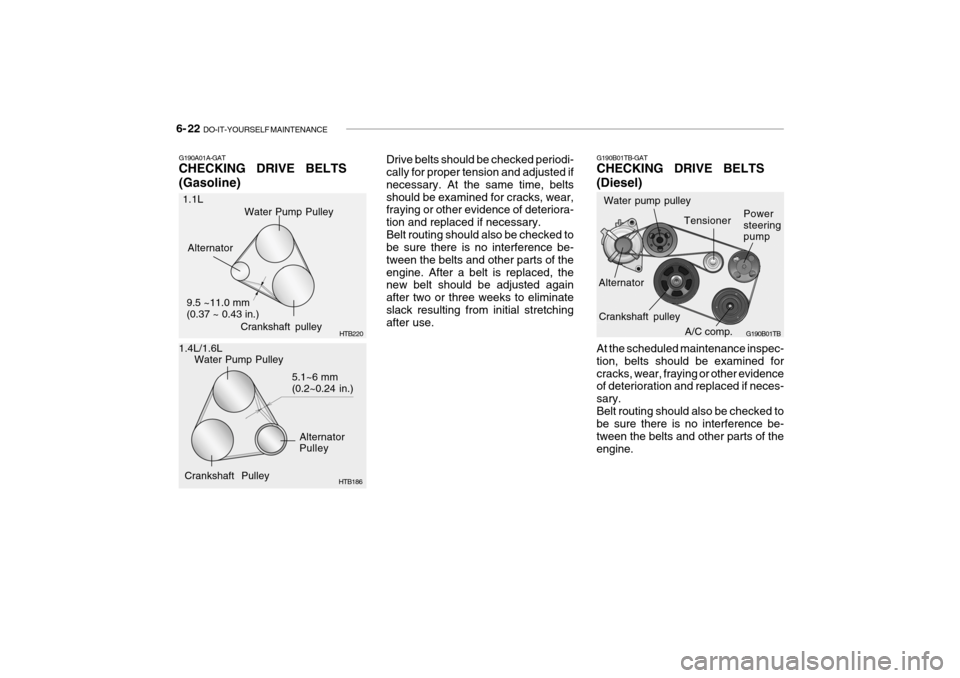
Drive belts should be checked periodi- cally for proper tension and adjusted if necessary. At the same time, beltsshould be examined for cracks, wear, fraying or other evidence of deteriora- tion and replaced if necessary.Belt routing should also be checked to be sure there is no interference be- tween the belts and other parts of theengine. After a belt is replaced, the new belt should be adjusted again after two or three weeks to eliminateslack resulting from initial stretching after use. G190B01TB-GAT CHECKING DRIVE BELTS (Diesel)
A/C comp.
Water pump pulley
G190B01TB
Alternator Power steering pump
At the scheduled maintenance inspec- tion, belts should be examined forcracks, wear, fraying or other evidence of deterioration and replaced if neces- sary.Belt routing should also be checked to be sure there is no interference be- tween the belts and other parts of theengine.Water Pump Pulley
Alternator Pulley
Crankshaft Pulley 5.1~6 mm(0.2~0.24 in.)
G190A01A-GAT CHECKING DRIVE BELTS (Gasoline)
HTB186
1.1L
1.4L/1.6L Crankshaft pulley
Alternator
HTB220
Water Pump Pulley
9.5 ~11.0 mm (0.37 ~ 0.43 in.)Tensioner
Crankshaft pulley
Page 228 of 455

7- 2 EMISSION CONTROL SYSTEMS
H010A01A-GAT
EMISSION CONTROL SYSTEM (If Installed)
Your Hyundai is equipped with an
emission control system to meet all requirements of the Emission prohibi- tion rules of your province.
There are three emission control sys-
tems which are as follows.
1) Crankcase emission control sys-
tem
2) Evaporative emission control sys- tem
3) Exhaust emission control system
In order to assure the proper function
of the emission control systems, it is recommended that you have your carinspected and maintained by an au- thorized Hyundai dealer in accordance with the maintenance schedule in thismanual. H010B01A-AAT
1. Crankcase Emission Control
System
The positive crankcase ventilation
system is employed to prevent airpollution caused by blow-by gases being emitted from the crankcase. This system supplies fresh air to thecrankcase through the air intake hose. Inside the crankcase, the fresh air mixes with blow-by gases, which thenpass through the PCV valve and into the induction system.
H010C02E-GAT
2. Evaporative Emission Control
System
The Evaporative Emission Control
System is designed to prevent fuel vapors from escaping into the atmo-sphere. Canister
While the engine is inoperative, fuel
vapors generated inside the fuel tank are absorbed and stored in the canis- ter. When the engine is running, the fuel vapors absorbed in the canister are drawn into the induction system through the purge control solenoid valve. Purge Control Solenoid Valve (PCSV)
The purge control solenoid valve is
controlled by the Engine Control Mod- ule (ECM); when the engine coolanttemperature is low during idling, the PCSV closes so that evaporated fuel is not taken into the engine. After theengine warms-up during ordinary driv- ing, the PCSV opens so as to intro- duce evaporated fuel to the engine. H010D01A-AAT
3. Exhaust Emission Control
System
The exhaust emission control system is a highly effective system whichcontrols exhaust emission while main- taining good vehicle performance.
Page 244 of 455

10- 4 INDEX
H Hazard Warning System ............................................. 1-64
Headlight Aiming Adjustm ent ...................................... 6-31
Headlight Leveling Device S ystem .............................1-68
Headlight flasher ......................................................... 1-62
Headlight switch ......................................................... 1-62
Heating and cooling control ........................................ 1-86
Heating and Ventilation ............................................... 1-87
Air flow control ......................................................... 1-88
Air intake control ..................................................... 1-88
Bi-level heating ........................................................ 1-91
Fan speed control .................................................... 1-87
Temperature control ................................................. 1-90
High-Mounted Rear Stop Light.................................... 1-76
Hood Release ............................................................. 1-77
How to use luggage room ........................................... 1-80
Horn ............................................................................ 1-84
IIgnition Switch ............................................................. 2-3
Immobilizer System ..................................................... 1-5
Instrument Cluster and Indicator light ......................... 1-46
IInterior Light Interior light .............................................................. 1-72
Map light .................................................................. 1-71
Intermittent Wiper ....................................................... 1-64
JJump Starting .............................................................. 3-3 K
Key .............................................................................. 1-4
If you lose your keys .............................................. 3-14
Positions ................................................................... 2-4
Keyless entry system ................................................. 1-11
LLane change si gnal ..................................................... 1-61
Lubrication Chart .......................................................... 9-4
Luggage Net ............................................................... 1-81
Luggage Board ............................................................ 1-81
Luggage Under Tray ................................................... 1-80
Lumbar Support Control .............................................. 1-15
MMaintenance Intervals Explanation of scheduled maintenance items................................................................................. 5-8
Maintenance under severe usage conditions ............ 5-7
Scheduled maintenance ............................................ 5-4
Service requirements ................................................ 5-2
Mirrors
Day-night inside rearview ......... ................................1-76
Outside rearview mirror heater .................................1-75
O
Odometer .................................................................... 1-58
Outside rear view mirror ............................................. 1-73
Electric type ............................................................ 1-74
Manual type ............................................................. 1-73
Page 250 of 455
Responsibilty For Maintenance
It is the responsibility of the vehicle owner/driver to ensure that all routine mainte- nance services are undertaken in line with the recommendations specified in Section 5 of this manual. In addition, in order to ensure continued validity of the new vehiclewarranty and safe operation of the vehicle, non scheduled maintenance/running repairers should be undertaken at the earliest available opportunity. Under severe operating conditions, more frequent maintenance is required. Detailsof the maintenance schedule for such conditions are also given in section 5. It is recommended that all maintenance operations and repairers are entrusted to a Hyundai authorised repairer to ensure that the latest repairer methods, specializedtooling and genuine Hyundai parts are used to ensure the continued reliability and safety of the vehicle.
SA020A1-E
tbuk-0.p65
3/6/2007, 10:20 AM
5
Page 363 of 455
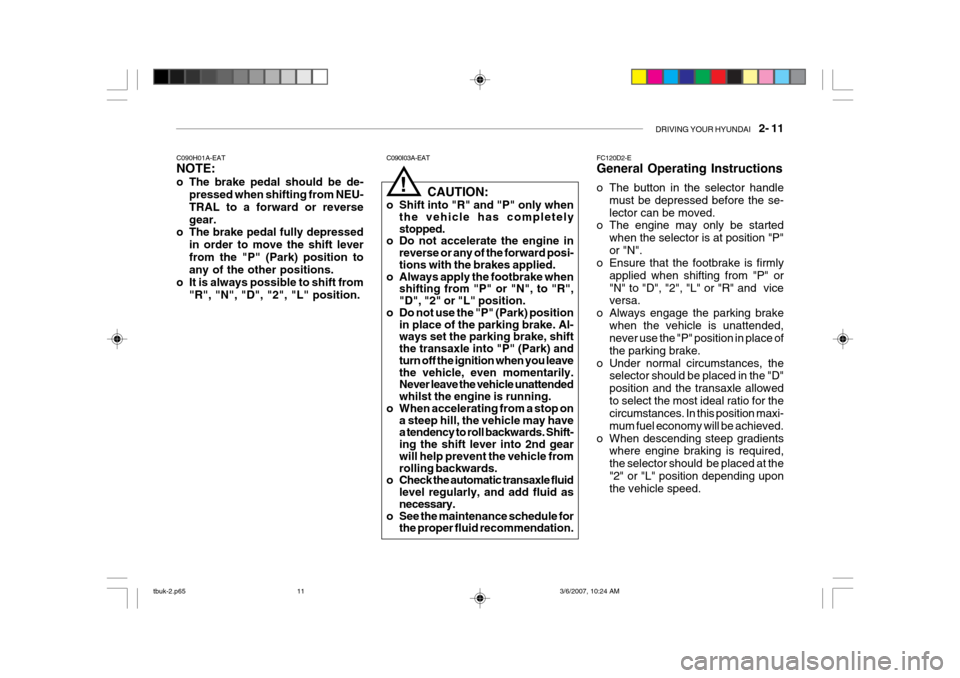
DRIVING YOUR HYUNDAI 2- 11
C090H01A-EAT NOTE:
o The brake pedal should be de-
pressed when shifting from NEU- TRAL to a forward or reversegear.
o The brake pedal fully depressed
in order to move the shift leverfrom the "P" (Park) position to any of the other positions.
o It is always possible to shift from "R", "N", "D", "2", "L" position.
!
C090I03A-EAT
CAUTION:
o Shift into "R" and "P" only when the vehicle has completely stopped.
o Do not accelerate the engine in
reverse or any of the forward posi- tions with the brakes applied.
o Always apply the footbrake when shifting from "P" or "N", to "R", "D", "2" or "L" position.
o Do not use the "P" (Park) position
in place of the parking brake. Al- ways set the parking brake, shift the transaxle into "P" (Park) and turn off the ignition when you leave the vehicle, even momentarily. Never leave the vehicle unattended whilst the engine is running.
o When accelerating from a stop on
a steep hill, the vehicle may have a tendency to roll backwards. Shift- ing the shift lever into 2nd gear will help prevent the vehicle from rolling backwards.
o Check the automatic transaxle fluid
level regularly, and add fluid as necessary.
o See the maintenance schedule for the proper fluid recommendation. FC120D2-E General Operating Instructions
o The button in the selector handle
must be depressed before the se- lector can be moved.
o The engine may only be started
when the selector is at position "P"or "N".
o Ensure that the footbrake is firmly
applied when shifting from "P" or"N" to "D", "2", "L" or "R" and vice versa.
o Always engage the parking brake when the vehicle is unattended,never use the "P" position in place of the parking brake.
o Under normal circumstances, the selector should be placed in the "D"position and the transaxle allowedto select the most ideal ratio for the circumstances. In this position maxi- mum fuel economy will be achieved.
o When descending steep gradients where engine braking is required,the selector should be placed at the"2" or "L" position depending upon the vehicle speed.
tbuk-2.p65 3/6/2007, 10:24 AM
11
Page 368 of 455

2- 16 DRIVING YOUR HYUNDAI
o Don't "ride" the brake or clutch pedal.
This can increase fuel consumption and also increase wear on thesecomponents. In addition, driving with your foot resting on the brake pedal may cause the brakes to overheat,which reduces their effectiveness and may lead to more serious con- sequences.
o Take care of your tyres. Keep them inflated to the recommended pres-sure. Incorrect infla-tion, either toomuch or too little, results in unnec- essary tyre wear. Check the tyre pressures at least once a month.
o Be sure that the wheels are aligned correctly. Improper alignment canresult from hitting curbs or drivingtoo fast over irregular surfaces. Poor alignment causes faster tyre wear and may also result in other prob-lems as well as greater fuel con- sumption. o Keep your car in good condition. For
better fuel economy and reduced maintenance costs, maintain yourcar in accordance with the mainte- nance schedule in Section 5. If you drive your car in severe conditions,more frequent maintenance is re- quired (see Section 5 for details).
o Keep your car clean. For maximum
service, your car should be keptclean and free of corrosive materi- als. It is especially important thatmud, dirt, ice, etc. not be allowed to accumulate on the underside of the car. This extra weight can result inincreased fuel consumption and also contribute to corrosion.
o Travel lightly. Don't carry unneces-
sary weight in your car. Weight is anenemy of good fuel economy.
o Don't let the engine idle longer than
necessary. If you are waiting (andnot in traffic), turn off your engine and restart only when you're readyto go.
SC150A1-F DRIVING FOR ECONOMY You can save fuel and get more miles from your car if you follow these sug-gestions:
o Drive smoothly. Accelerate at a
moderate rate. Don't make "jack- rabbit" starts or full-throttle shifts and maintain a steady cruisingspeed. Don't race between stop- lights. Try to adjust your speed to that of the other traffic so you don'thave to change speeds unneces- sarily. Avoid heavy traffic whenever pos-sible. Always maintain a safe dis- tance from other vehicles so you can avoid unnecessary braking. Thisalso reduces brake wear.
o Drive at a moderate speed. The faster
you drive, the more fuel your caruses. Driving at a moderate speed, especially on the highway, is one of the most effective ways to reducefuel consumption.
tbuk-2.p65 3/6/2007, 10:24 AM
16
Page 394 of 455

5. VEHICLE MAINTENANCEREQUIREMENTS
Maintenance and Servicing Requirements ....................................... 5-2
Scheduled maintenance ................................................................... 5-3
Maintenance under severe usage conditions ................................... 5-6
Explanation of scheduled maintenance items .................................. 5-7
5
tbuk-5.p65 3/6/2007, 10:25 AM
1
Page 395 of 455

5- 2 VEHICLE MAINTENANCE REQUIREMENTS
SF020A1-E MAINTENANCE AND SERVICING REQUIREMENTS To ensure the continued reliability and safety of the vehicle, certain routinemaintenance operations are required at specific mileage or time intervals. It is the responsibility of the vehicle owner to ensure that the maintenance schedules shown in both this OwnersManual and the Warranty and Service Passport are adhered to. The new vehicle warranty may be invalidated if the routine maintenance operations are not performed in line with the recommendations outlinedand the safety and durability of the vehicle adversely affected. It is recommended that all mainte- nance operations with the exception of the daily operating checks are en-trusted to a Hyundai authorised re- pairer to ensure that the latest repairer and maintenance procedures andspecialised servicing tools are em- ployed. In addition, the use of genuine Hyundai replacement parts will ensurethat the vehicle safety and perfor- mance will not be compromised. NOTE:
The inspection and testing of cer-
tain electronic fuel injection/engine management and automatic trans- mission control systems require specialised electronic equipmentspecifically designed for Hyundai vehicles. The use of general pur- pose electrical test equipment mayresult in damage to the control unit microprocessors.
SF020C2-E
Specified Scheduled Procedures
The Specified scheduled procedures
are listed in the maintenance charts beginning at page 5-3. The opera- tions specified must be performed at the time or mileage intervals shownirrespective of whether the mileage interval has been reached before the specified time interval. Certain lubricants and components
degrade with both time and mileage(e.g. engine oil and brake fluid) and therefore it is not permissable to base the maintenance schedule upon mile-age alone. It is strongly recommended that the maintenance operations are performed by the factory-trained ordistributor-trained technicians at your Hyundai authorised repairer becauseof the need for specialised knowledge and tooling and to ensure that no possibility of invalidating the manufac-turers warranty exists.
The maintenance schedules relate to
vehicles operated under normal con- ditions, vehicles which are operated under adverse conditions will requiremore frequent maintenance which is described at page 5-6. NOTE:
Service schedules may change de-
pending on individual country needs. Please ask your localHyundai authorised repairer for a copy of the service schedule that relates to that country.
SF030B1-E
SERVICE HISTORY
It is important that all scheduled main-
tenance services are recorded in thewarranty and service passport to en-sure that proof of maintenance is avail- able when warranty service is required.
tbuk-5.p65 3/6/2007, 10:25 AM
2