towing Hyundai Getz 2006 User Guide
[x] Cancel search | Manufacturer: HYUNDAI, Model Year: 2006, Model line: Getz, Model: Hyundai Getz 2006Pages: 455, PDF Size: 11.23 MB
Page 169 of 455
WHAT TO DO IN AN EMERGENCY 3- 13
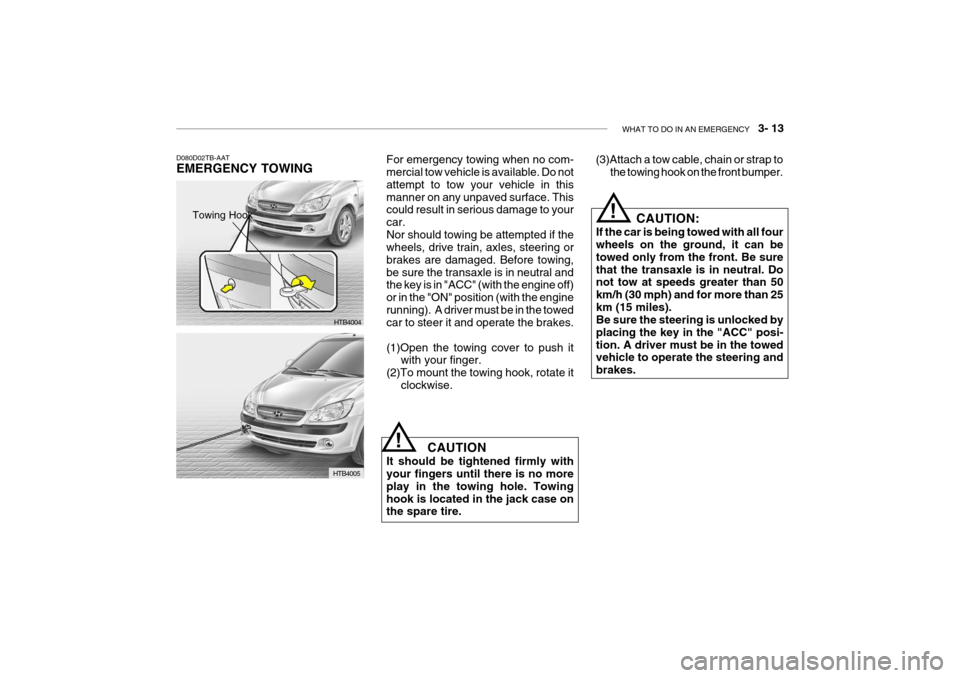
D080D02TB-AAT EMERGENCY TOWING
HTB4004
HTB4005
Towing Hook
CAUTION:
If the car is being towed with all four wheels on the ground, it can be towed only from the front. Be surethat the transaxle is in neutral. Do not tow at speeds greater than 50 km/h (30 mph) and for more than 25km (15 miles). Be sure the steering is unlocked by placing the key in the "ACC" posi-tion. A driver must be in the towed vehicle to operate the steering and brakes.!
(3)Attach a tow cable, chain or strap to
the towing hook on the front bumper.
For emergency towing when no com- mercial tow vehicle is available. Do not attempt to tow your vehicle in thismanner on any unpaved surface. This could result in serious damage to your car.Nor should towing be attempted if the wheels, drive train, axles, steering or brakes are damaged. Before towing,be sure the transaxle is in neutral and the key is in "ACC" (with the engine off) or in the "ON" position (with the enginerunning). A driver must be in the towed car to steer it and operate the brakes. (1)Open the towing cover to push it
with your finger.
(2)To mount the towing hook, rotate it clockwise.
CAUTION
It should be tightened firmly with your fingers until there is no more play in the towing hole. Towinghook is located in the jack case on the spare tire.
!
Page 183 of 455

VEHICLE MAINTENANCE REQUIREMENTS 5- 7
SEVERE DRIVING CONDITIONS
A - Repeatly driving short distance of less than 8km(5miles) in normal
tempera ture or less than 16km(10miles) in freezing temperature
B - Extensive engine idling or low speed driving for long distances
C - Driving on rough, dusty, muddy, unpaved, graveled or salt-spread roads
D - Driving in areas using salt or other corrosive materials or in very cold weather E - Driving in sandy areas
F - Driving in heavy traffic area over 32°C(90°F)
G - Driving on uphill, downhill, or mountain road
H - Towing a Trailer, or using a camper, or roof rack
I - Driving as a patrol car, taxi, other commercial use or vehicle towing
J - Driving over 170 Km/h(100 MPH)
K - Frequently driving in stop-and-go conditions
R R RR
I I I I
RR R
European community Only Except European community
ENGINE OIL AND FILTER AIR CLEANER FILTER SPARK PLUGSTIMING BELT BRAKE PADS, CALIPERS AND ROTORS REAR BRAKE DRUMS/LININGS/PADS,PARKING BRAKE STEERING GEAR BOX, LINKAGE & BOOTS/LOWER ARM BALL JOINTDRIVESHAFTS AND BOOTS MANUAL TRANSAXLE OIL AUTOMATIC TRANSAXLEFLUID
AIR CONDITIONER FILTER (For Evaporator and Blower unit)
F040A01TB-GAT
MAINTENANCE UNDER SEVERE USAGE CONDITIONS
The following items must be serviced more frequently on cars normally used under severe driving conditions. Refer to the chart below for the appropriate maintenance intervals. R : Replace I : Inspect and, after inspection, clean, adjust, repair or replace if necessary
MAINTENANCE ITEM
EVERY 7,500 KM OR 6 MONTHS MORE FREQUENTLY MORE FREQUENTLYEVERY 60,000 KM OR 48 MONTHS MORE FREQUENTLY MORE FREQUENTLY MORE FREQUENTLY EVERY 15,000 KM OR 12 MONTHS EVERY 100,000 KM EVERY 45,000 KMEVERY 40,000 KM MORE FREQUENTLY A, B, C, D, E, F, G, H, I, KC, E B, HD, E, F, G, I C, D, G, H C, D, G, H C, D, E, F C, D, E, F C, D, E, G, H, I, J A, C, E, F, G, H, I C, E
MAINTENANCE
INTERVALS DRIVING
CONDITION
MAINTENANCE
OPERATION
Page 236 of 455
8- 6 CONSUMER INFORMATION
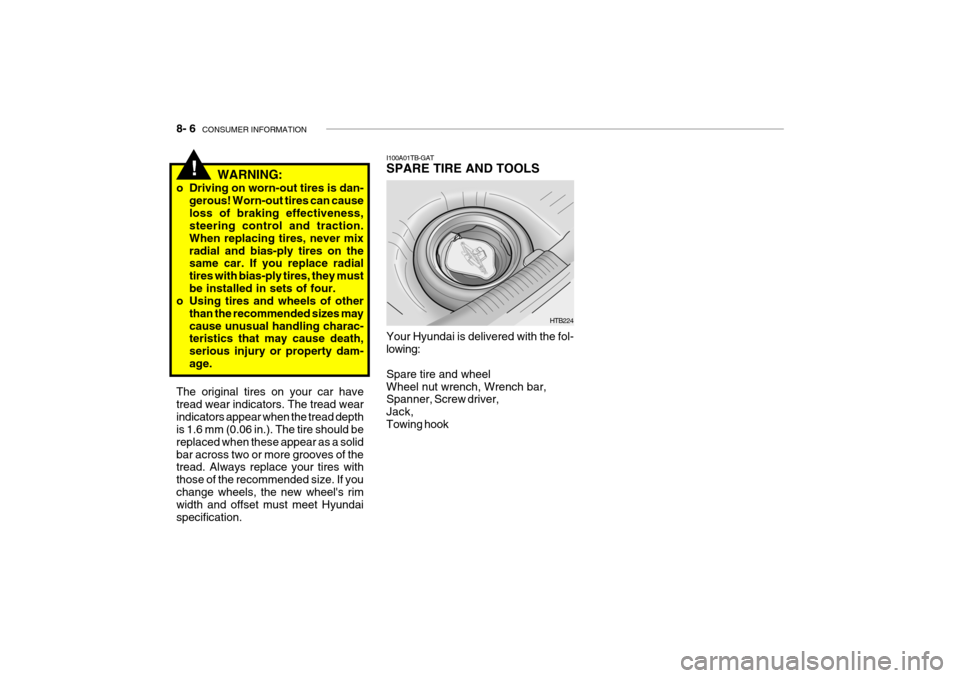
I100A01TB-GAT SPARE TIRE AND TOOLS Your Hyundai is delivered with the fol- lowing: Spare tire and wheel Wheel nut wrench, Wrench bar, Spanner, Screw driver, Jack,Towing hook HTB224
WARNING:
o Driving on worn-out tires is dan- gerous! Worn-out tires can causeloss of braking effectiveness, steering control and traction.
When replacing tires, never mixradial and bias-ply tires on the same car. If you replace radial tires with bias-ply tires, they mustbe installed in sets of four.
o Using tires and wheels of other
than the recommended sizes maycause unusual handling charac- teristics that may cause death, serious injury or property dam-age.
!
The original tires on your car have tread wear indicators. The tread wearindicators appear when the tread depth is 1.6 mm (0.06 in.). The tire should be replaced when these appear as a solidbar across two or more grooves of the tread. Always replace your tires with those of the recommended size. If youchange wheels, the new wheel's rim width and offset must meet Hyundai specification.
Page 246 of 455

10- 6 INDEX
Towing
A trailer (or vehicle) ................................................. 2-19
Emergency .............................................................. 3-13
If your vehicle must be towed ................................. 3-11
Trailer or Vehicl e towing ............................................. 2-19
Transaxle
Automa tic ................................................................. 2-9
Automatic transaxle fluid checking .......................... 6-15
Manual ...................................................................... 2-7
Manual transaxle Oil checking ................................ 6-14
Trip Computer ............................................................. 1-59
Trip Odometer ............................................................. 1-58
Turn signal operation .................................................. 1-61
V Vehicle Identifi cation Number ...................................... 8-2
Ventilation ................................................................... 1-86
Ventilator
Center ventilator ...................................................... 1-86
Side ventilator .......................................................... 1-87
W Warning Lights ............................................................ 1-50
Window glass ............................................................. 1-12
Windshield washer operation ......................................1-63
Windshield Wiper and Washer sw itch .........................1-63
Windshield Wiper Blades ............................................ 6-12
Winter Driving ............................................................. 2-16
Page 261 of 455
1- 4 FEATURES OF YOUR HYUNDAI
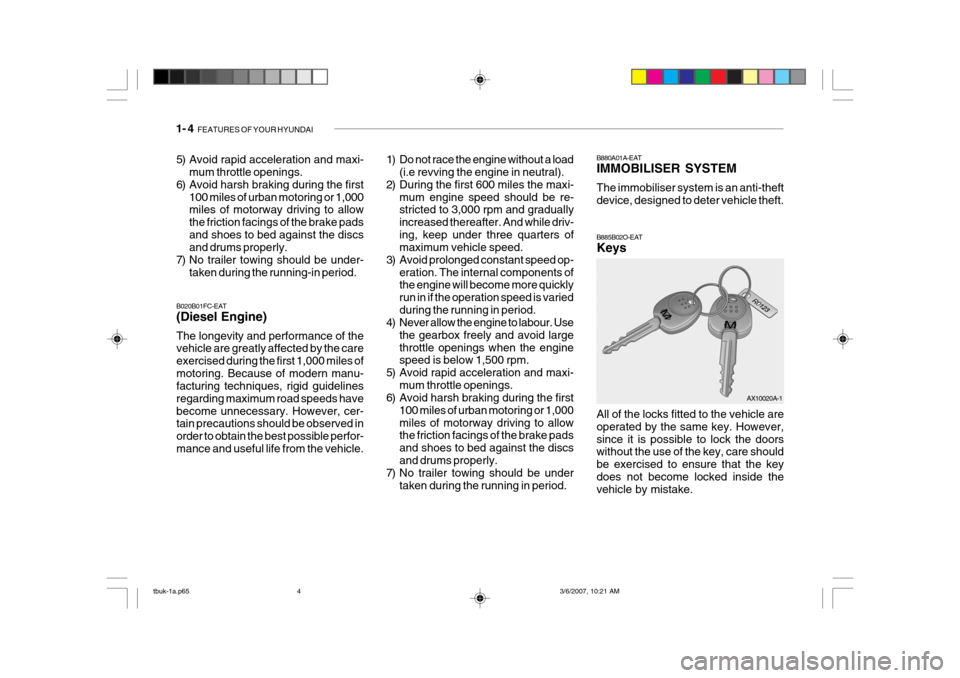
B880A01A-EAT IMMOBILISER SYSTEM The immobiliser system is an anti-theft device, designed to deter vehicle theft. B885B02O-EAT Keys
5) Avoid rapid acceleration and maxi-
mum throttle openings.
6) Avoid harsh braking during the first 100 miles of urban motoring or 1,000 miles of motorway driving to allow the friction facings of the brake padsand shoes to bed against the discs and drums properly.
7) No trailer towing should be under- taken during the running-in period.
B020B01FC-EAT (Diesel Engine) The longevity and performance of the vehicle are greatly affected by the care exercised during the first 1,000 miles ofmotoring. Because of modern manu- facturing techniques, rigid guidelines regarding maximum road speeds havebecome unnecessary. However, cer- tain precautions should be observed in order to obtain the best possible perfor-mance and useful life from the vehicle. 1) Do not race the engine without a load
(i.e revving the engine in neutral).
2) During the first 600 miles the maxi- mum engine speed should be re- stricted to 3,000 rpm and gradually increased thereafter. And while driv-ing, keep under three quarters of maximum vehicle speed.
3) Avoid prolonged constant speed op- eration. The internal components ofthe engine will become more quickly run in if the operation speed is variedduring the running in period.
4) Never allow the engine to labour. Use
the gearbox freely and avoid largethrottle openings when the engine speed is below 1,500 rpm.
5) Avoid rapid acceleration and maxi- mum throttle openings.
6) Avoid harsh braking during the first
100 miles of urban motoring or 1,000 miles of motorway driving to allow the friction facings of the brake pads and shoes to bed against the discsand drums properly.
7) No trailer towing should be under
taken during the running in period. All of the locks fitted to the vehicle areoperated by the same key. However,since it is possible to lock the doors without the use of the key, care should be exercised to ensure that the keydoes not become locked inside the vehicle by mistake.
AX10020A-1
tbuk-1a.p65
3/6/2007, 10:21 AM
4
Page 353 of 455

2. DRIVING YOUR HYUNDAI
Before starting the engine .............................................................. 2-3
Key positions .................................................................................... 2-4Starting ............................................................................................. 2-5
Operating the manual transaxle ....................................................... 2-8
Automatic transaxle ......................................................................... 2-9Effective Braking ............................................................................ 2-13
Anti-Lock brake system (ABS) ...................................................... 2-14
Electronic Stability Program (ESP) ................................................ 2-14
Driving for economy ....................................................................... 2-15
Winter Driving ................................................................................. 2-17
Trailer and Caravan Towing........................................................... 2-19
2
tbuk-2.p65 3/6/2007, 10:24 AM
1
Page 364 of 455
2- 12 DRIVING YOUR HYUNDAI
o When climbing steep gradients us-
ing large throttle openings, the transaxle may re-peatedly changebetween two adjacent ratios. This is a normal characteristic and may be prevented by cancelling the over-drive facility if the shifting occurs between third and fourth ratios, se- lecting position "2" if the shiftingoccurs between third and second ratios or selecting position "1" if the shifting occurs between first andsecond ratios.
o Never move the selector to or from
the "P" or "N" position with the ac-celerator depressed.
o Ensure that the overdrive switch is
at the "ON" position for maximumeconomy.
o If rapid acceleration is required, fully
depress the accelerator pedal. Inthis condition, the kickdown mecha- nism will be operated and the transaxle will automatically down-shift according to the vehicle speed. o The automatic transaxle may be used
to great effect if the vehicle becomesstuck in snow or mud by allowing thevehicle to be rocked to and fro. The engine speed should be held at ap- proximately 1,000rpm by means ofthe accelerator pedal and the selec- tor lever moved between the "D" and "R" positions to induce a rockingmotion.
o Do not depress the accelerator pedal
with the brakes applied and the se-lector at the "R", "D", "2" or "L" position.
o Turn the overdrive switch on for
good fuel economy and smooth driv-ing. But if engine braking is needed in the "D" range or if repeated up-shifting and downshifting between the 3rd and 4th gear is needed when climbing a gentle slope, it is recom-mended that the overdrive switch be turned off. Turn the overdrive switch back on immediately after-ward.
!WARNING:
o Avoid high cornering speeds.
o Do not make quick steering wheel movements, such as sharp lane changes or fast, sharp turns.
o Always wear your seat belts. In a collision crash, an unbeltedperson is significantly more likely to die than a person wearing aseatbelt.
o The risk of rollover is greatly in-
creased if you lose control of yourvehicle at highway speeds.
o Loss of control often occurs if two
or more wheels drop off the road-way and the driver oversteers to reenter the roadway.
o In the event your vehicle leaves the roadway, do not steer sharply.Instead, slow down before pulling back into the travel lanes.
o Never exceed posted speed limits.
o Excessive depressing of the
accelerater pedal under the tire slip condition such as moving out of the mud or fresh snow etc, may cause severe damage to thetransaxle. At this time, take other way such as towing.
tbuk-2.p65 3/6/2007, 10:24 AM
12
Page 365 of 455
DRIVING YOUR HYUNDAI 2- 13
HTB217-D
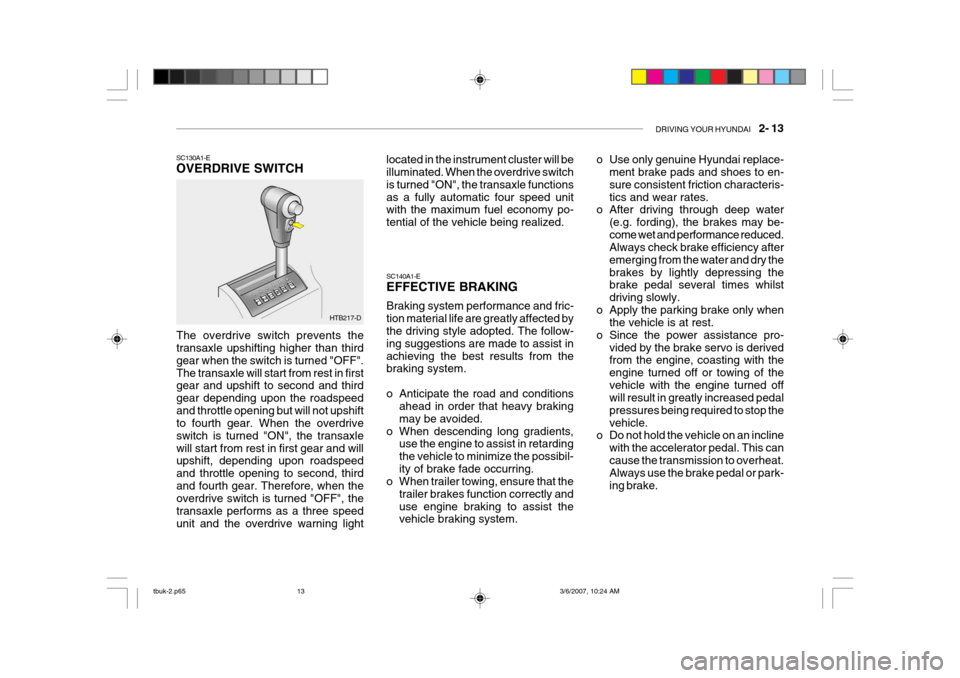
SC130A1-E OVERDRIVE SWITCH
The overdrive switch prevents the transaxle upshifting higher than third gear when the switch is turned "OFF".The transaxle will start from rest in first gear and upshift to second and third gear depending upon the roadspeedand throttle opening but will not upshift to fourth gear. When the overdrive switch is turned "ON", the transaxlewill start from rest in first gear and will upshift, depending upon roadspeed and throttle opening to second, thirdand fourth gear. Therefore, when the overdrive switch is turned "OFF", the transaxle performs as a three speedunit and the overdrive warning light located in the instrument cluster will be illuminated. When the overdrive switch is turned "ON", the transaxle functionsas a fully automatic four speed unit with the maximum fuel economy po- tential of the vehicle being realized. SC140A1-E EFFECTIVE BRAKING Braking system performance and fric- tion material life are greatly affected by the driving style adopted. The follow- ing suggestions are made to assist inachieving the best results from the braking system.
o Anticipate the road and conditions
ahead in order that heavy braking may be avoided.
o When descending long gradients, use the engine to assist in retardingthe vehicle to minimize the possibil-ity of brake fade occurring.
o When trailer towing, ensure that the
trailer brakes function correctly anduse engine braking to assist the vehicle braking system. o Use only genuine Hyundai replace-
ment brake pads and shoes to en- sure consistent friction characteris-tics and wear rates.
o After driving through deep water
(e.g. fording), the brakes may be-come wet and performance reduced. Always check brake efficiency after emerging from the water and dry thebrakes by lightly depressing the brake pedal several times whilst driving slowly.
o Apply the parking brake only when the vehicle is at rest.
o Since the power assistance pro- vided by the brake servo is derived from the engine, coasting with the engine turned off or towing of thevehicle with the engine turned off will result in greatly increased pedal pressures being required to stop thevehicle.
o Do not hold the vehicle on an incline
with the accelerator pedal. This cancause the transmission to overheat. Always use the brake pedal or park- ing brake.
tbuk-2.p65 3/6/2007, 10:24 AM
13
Page 371 of 455
DRIVING YOUR HYUNDAI 2- 19
The use of a proprietary stabiliser will assist in achieving an inherently stable outfit but whilst the use of such equip-ment will improve the characteristics of a balanced outfit, it will not compen- sate for a badly loaded and thereforeunstable outfit. The tyres and braking equipment fitted to the trailer or caravan must be main- tained in accordance with the recom- mendations of the manufacturer. Spe-cial attention should be paid to tyres which deteriorate through time and exposure rather than as a result of thedistances towed. The inside walls of the tyres should be inspected along with the outside walls for cracking anddamage. The trailer wheel nut torque must be checked on a regular basis, preferably before each towing ses-sion.
!
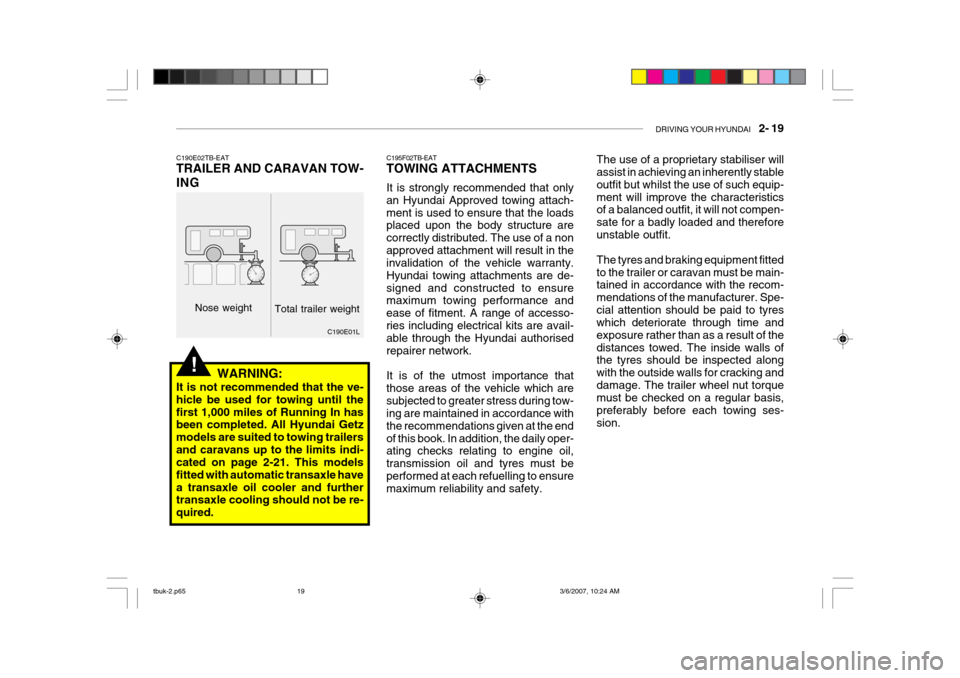
Nose weight
Total trailer weight
C190E01L C195F02TB-EAT TOWING ATTACHMENTS It is strongly recommended that only an Hyundai Approved towing attach-ment is used to ensure that the loads placed upon the body structure are correctly distributed. The use of a nonapproved attachment will result in the invalidation of the vehicle warranty. Hyundai towing attachments are de-signed and constructed to ensure maximum towing performance and ease of fitment. A range of accesso-ries including electrical kits are avail- able through the Hyundai authorised repairer network. It is of the utmost importance that those areas of the vehicle which aresubjected to greater stress during tow- ing are maintained in accordance with the recommendations given at the endof this book. In addition, the daily oper- ating checks relating to engine oil, transmission oil and tyres must beperformed at each refuelling to ensure maximum reliability and safety.
C190E02TB-EAT TRAILER AND CARAVAN TOW- ING
WARNING:
It is not recommended that the ve- hicle be used for towing until thefirst 1,000 miles of Running In has been completed. All Hyundai Getz models are suited to towing trailersand caravans up to the limits indi- cated on page 2-21. This models fitted with automatic transaxle havea transaxle oil cooler and further transaxle cooling should not be re- quired.
tbuk-2.p65 3/6/2007, 10:24 AM
19
Page 372 of 455
2- 20 DRIVING YOUR HYUNDAI
C190E02L
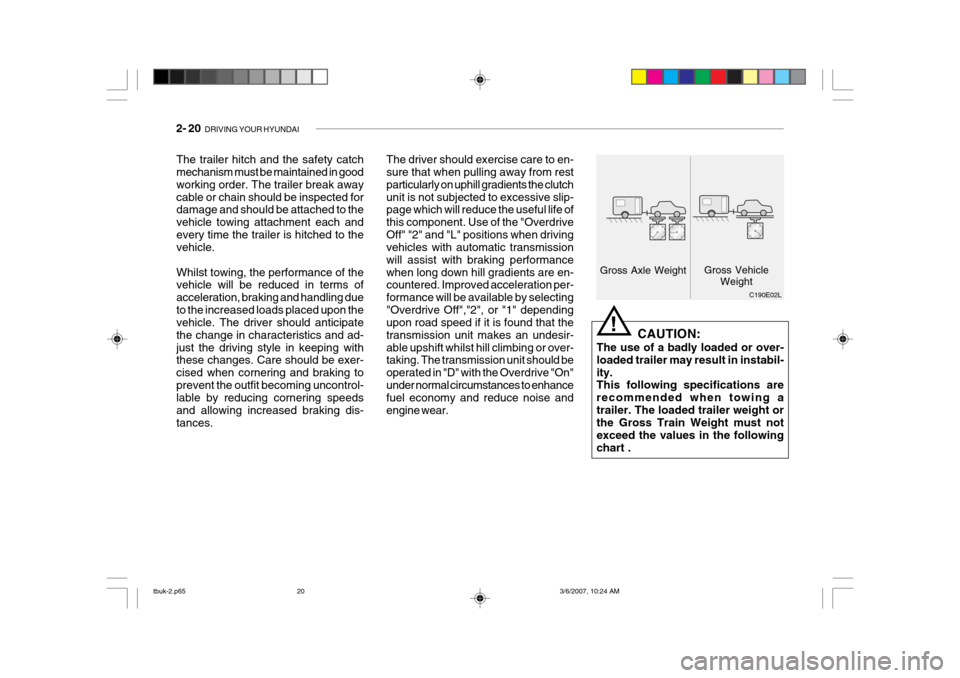
Gross Axle Weight
Gross Vehicle
Weight
The trailer hitch and the safety catch mechanism must be maintained in good working order. The trailer break awaycable or chain should be inspected for damage and should be attached to the vehicle towing attachment each andevery time the trailer is hitched to the vehicle. Whilst towing, the performance of the vehicle will be reduced in terms of acceleration, braking and handling dueto the increased loads placed upon the vehicle. The driver should anticipate the change in characteristics and ad-just the driving style in keeping with these changes. Care should be exer- cised when cornering and braking toprevent the outfit becoming uncontrol- lable by reducing cornering speeds and allowing increased braking dis-tances. The driver should exercise care to en- sure that when pulling away from rest particularly on uphill gradients the clutchunit is not subjected to excessive slip- page which will reduce the useful life of this component. Use of the "OverdriveOff" "2" and "L" positions when driving vehicles with automatic transmission will assist with braking performancewhen long down hill gradients are en- countered. Improved acceleration per- formance will be available by selecting"Overdrive Off","2", or "1" depending upon road speed if it is found that the transmission unit makes an undesir-able upshift whilst hill climbing or over- taking. The transmission unit should be operated in "D" with the Overdrive "On"under normal circumstances to enhance fuel economy and reduce noise and engine wear.
CAUTION:
The use of a badly loaded or over-loaded trailer may result in instabil-ity. This following specifications are recommended when towing atrailer. The loaded trailer weight or the Gross Train Weight must not exceed the values in the followingchart .
!
tbuk-2.p65 3/6/2007, 10:24 AM
20