brake Hyundai Getz 2006 Repair Manual
[x] Cancel search | Manufacturer: HYUNDAI, Model Year: 2006, Model line: Getz, Model: Hyundai Getz 2006Pages: 455, PDF Size: 11.23 MB
Page 306 of 455
FEATURES OF YOUR HYUNDAI 1- 49
SB210M1-E
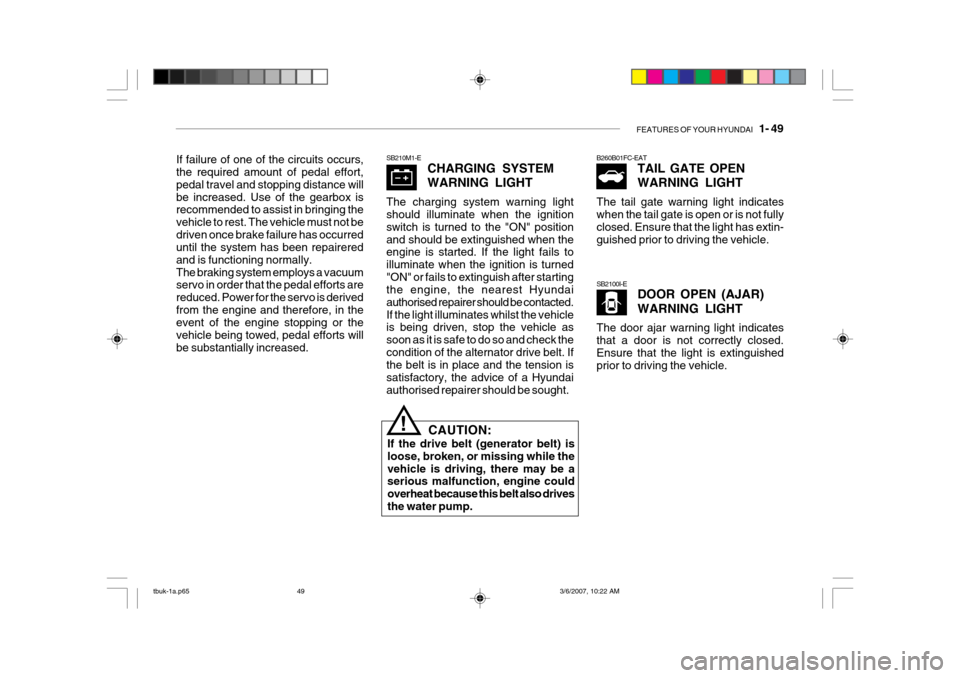
CHARGING SYSTEM WARNING LIGHT
The charging system warning light should illuminate when the ignition switch is turned to the "ON" positionand should be extinguished when the engine is started. If the light fails to illuminate when the ignition is turned"ON" or fails to extinguish after starting the engine, the nearest Hyundai authorised repairer should be contacted.If the light illuminates whilst the vehicle is being driven, stop the vehicle as soon as it is safe to do so and check thecondition of the alternator drive belt. If the belt is in place and the tension is satisfactory, the advice of a Hyundaiauthorised repairer should be sought. SB2100I-E
DOOR OPEN (AJAR) WARNING LIGHT
The door ajar warning light indicates that a door is not correctly closed. Ensure that the light is extinguished prior to driving the vehicle.
B260B01FC-EAT
TAIL GATE OPEN WARNING LIGHT
The tail gate warning light indicates when the tail gate is open or is not fully closed. Ensure that the light has extin-guished prior to driving the vehicle.
CAUTION:
If the drive belt (generator belt) is loose, broken, or missing while thevehicle is driving, there may be a serious malfunction, engine could overheat because this belt also drivesthe water pump.!
If failure of one of the circuits occurs, the required amount of pedal effort, pedal travel and stopping distance willbe increased. Use of the gearbox is recommended to assist in bringing the vehicle to rest. The vehicle must not bedriven once brake failure has occurred until the system has been repairered and is functioning normally.The braking system employs a vacuum servo in order that the pedal efforts are reduced. Power for the servo is derivedfrom the engine and therefore, in the event of the engine stopping or the vehicle being towed, pedal efforts willbe substantially increased.
tbuk-1a.p65 3/6/2007, 10:22 AM
49
Page 310 of 455
FEATURES OF YOUR HYUNDAI 1- 53
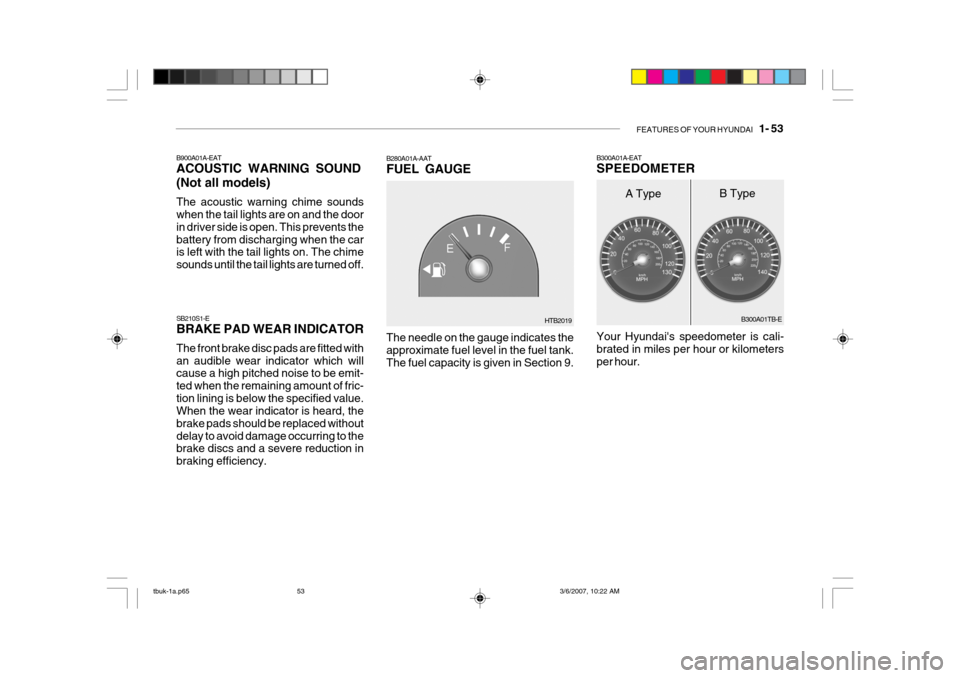
B300A01A-EAT SPEEDOMETER
B300A01TB-E
Your Hyundai's speedometer is cali- brated in miles per hour or kilometers per hour.
A Type B Type
SB210S1-E BRAKE PAD WEAR INDICATOR The front brake disc pads are fitted with an audible wear indicator which will cause a high pitched noise to be emit- ted when the remaining amount of fric-tion lining is below the specified value. When the wear indicator is heard, the brake pads should be replaced withoutdelay to avoid damage occurring to the brake discs and a severe reduction in braking efficiency.
B900A01A-EAT ACOUSTIC WARNING SOUND (Not all models) The acoustic warning chime sounds when the tail lights are on and the door in driver side is open. This prevents thebattery from discharging when the car is left with the tail lights on. The chime sounds until the tail lights are turned off.
The needle on the gauge indicates the approximate fuel level in the fuel tank.The fuel capacity is given in Section 9.
B280A01A-AAT FUEL GAUGE
HTB2019
tbuk-1a.p65 3/6/2007, 10:22 AM
53
Page 329 of 455
1- 72 FEATURES OF YOUR HYUNDAI
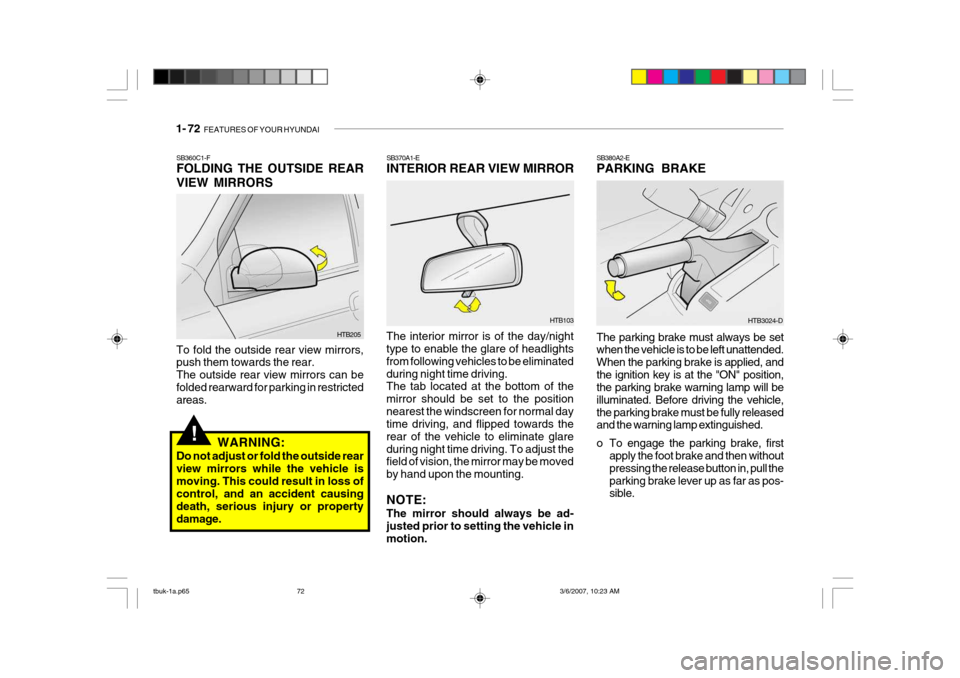
The parking brake must always be set when the vehicle is to be left unattended. When the parking brake is applied, andthe ignition key is at the "ON" position, the parking brake warning lamp will be illuminated. Before driving the vehicle,the parking brake must be fully released and the warning lamp extinguished.
o To engage the parking brake, first
apply the foot brake and then without pressing the release button in, pull theparking brake lever up as far as pos- sible.
SB380A2-E PARKING BRAKE
HTB3024-D
!
SB370A1-E INTERIOR REAR VIEW MIRROR
The interior mirror is of the day/night type to enable the glare of headlights from following vehicles to be eliminatedduring night time driving. The tab located at the bottom of the mirror should be set to the positionnearest the windscreen for normal day time driving, and flipped towards the rear of the vehicle to eliminate glareduring night time driving. To adjust the field of vision, the mirror may be moved by hand upon the mounting. NOTE: The mirror should always be ad- justed prior to setting the vehicle inmotion. HTB103SB360C1-F FOLDING THE OUTSIDE REAR VIEW MIRRORS To fold the outside rear view mirrors, push them towards the rear. The outside rear view mirrors can befolded rearward for parking in restricted areas.
HTB205
WARNING:
Do not adjust or fold the outside rear view mirrors while the vehicle ismoving. This could result in loss of control, and an accident causing death, serious injury or propertydamage.
tbuk-1a.p65 3/6/2007, 10:23 AM
72
Page 330 of 455
FEATURES OF YOUR HYUNDAI 1- 73
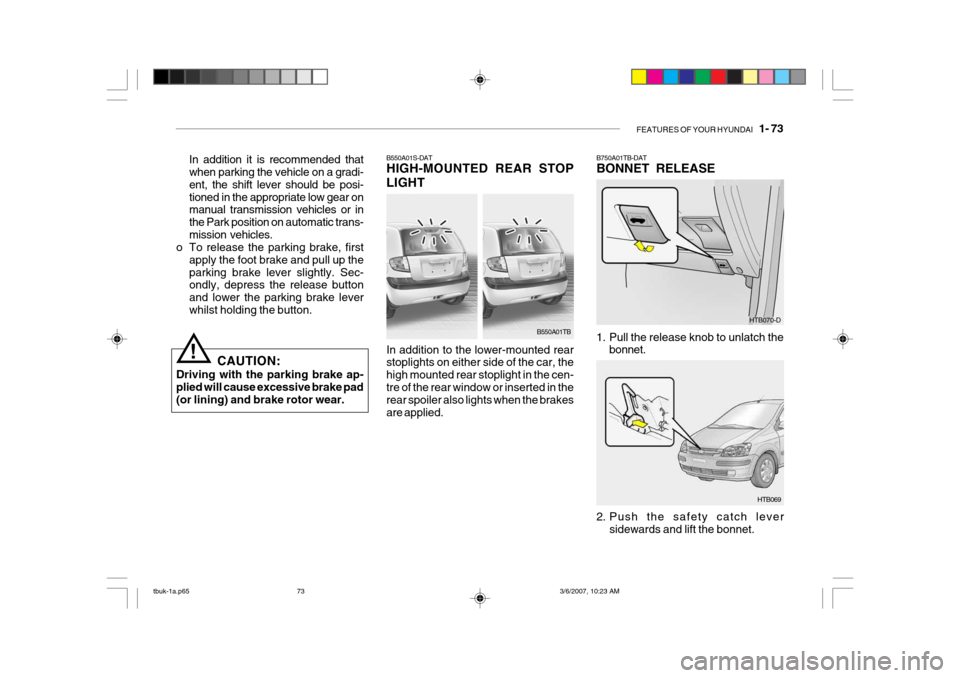
B550A01S-DAT HIGH-MOUNTED REAR STOP LIGHT In addition to the lower-mounted rear stoplights on either side of the car, the high mounted rear stoplight in the cen-tre of the rear window or inserted in the rear spoiler also lights when the brakes are applied. B550A01TB
In addition it is recommended that when parking the vehicle on a gradi- ent, the shift lever should be posi-tioned in the appropriate low gear on manual transmission vehicles or in the Park position on automatic trans-mission vehicles.
o To release the parking brake, first
apply the foot brake and pull up theparking brake lever slightly. Sec- ondly, depress the release button and lower the parking brake leverwhilst holding the button.B750A01TB-DAT BONNET RELEASE
HTB070-D
1. Pull the release knob to unlatch the bonnet.
HTB069
2. Push the safety catch lever sidewards and lift the bonnet.
CAUTION:
Driving with the parking brake ap- plied will cause excessive brake pad (or lining) and brake rotor wear.
!
tbuk-1a.p65 3/6/2007, 10:23 AM
73
Page 353 of 455
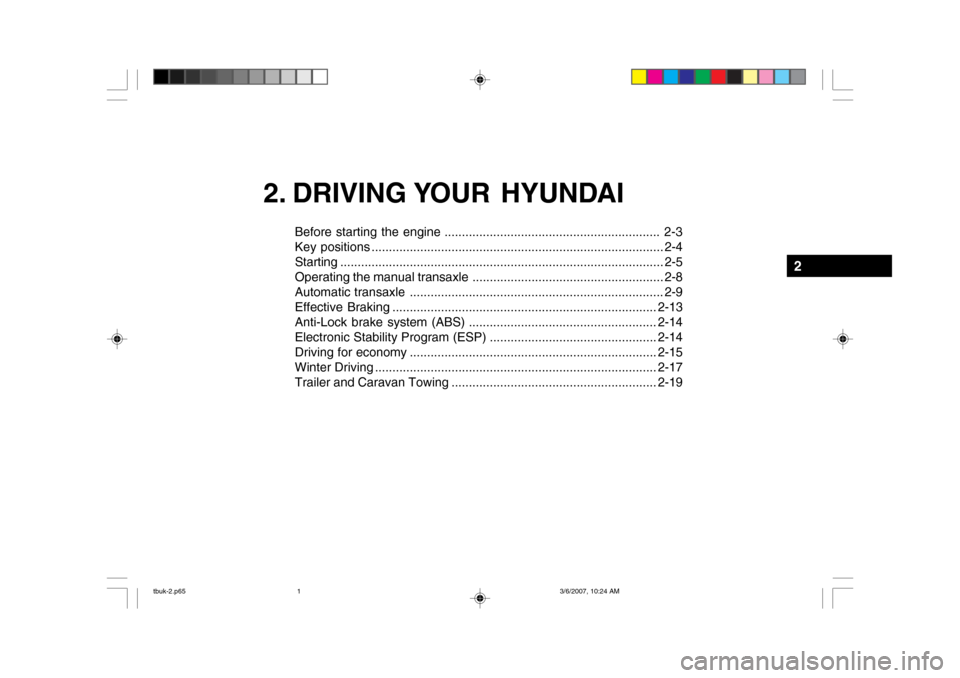
2. DRIVING YOUR HYUNDAI
Before starting the engine .............................................................. 2-3
Key positions .................................................................................... 2-4Starting ............................................................................................. 2-5
Operating the manual transaxle ....................................................... 2-8
Automatic transaxle ......................................................................... 2-9Effective Braking ............................................................................ 2-13
Anti-Lock brake system (ABS) ...................................................... 2-14
Electronic Stability Program (ESP) ................................................ 2-14
Driving for economy ....................................................................... 2-15
Winter Driving ................................................................................. 2-17
Trailer and Caravan Towing........................................................... 2-19
2
tbuk-2.p65 3/6/2007, 10:24 AM
1
Page 355 of 455
DRIVING YOUR HYUNDAI 2- 3
!
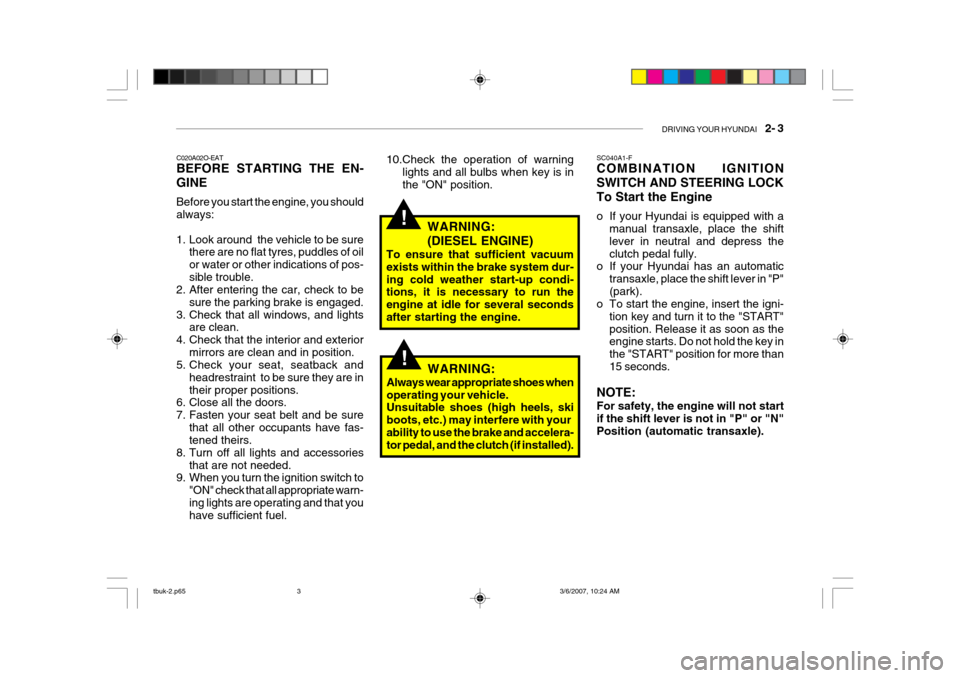
C020A02O-EAT BEFORE STARTING THE EN- GINE Before you start the engine, you should always:
1. Look around the vehicle to be sure
there are no flat tyres, puddles of oil or water or other indications of pos-sible trouble.
2. After entering the car, check to be
sure the parking brake is engaged.
3. Check that all windows, and lights are clean.
4. Check that the interior and exterior mirrors are clean and in position.
5. Check your seat, seatback and
headrestraint to be sure they are intheir proper positions.
6. Close all the doors.
7. Fasten your seat belt and be sure
that all other occupants have fas- tened theirs.
8. Turn off all lights and accessories that are not needed.
9. When you turn the ignition switch to
"ON" check that all appropriate warn- ing lights are operating and that you have sufficient fuel. 10.Check the operation of warning
lights and all bulbs when key is in the "ON" position.
WARNING: (DIESEL ENGINE)
To ensure that sufficient vacuum exists within the brake system dur-ing cold weather start-up condi- tions, it is necessary to run the engine at idle for several secondsafter starting the engine. SC040A1-F COMBINATION IGNITION SWITCH AND STEERING LOCKTo Start the Engine
o If your Hyundai is equipped with a
manual transaxle, place the shift lever in neutral and depress theclutch pedal fully.
o If your Hyundai has an automatic
transaxle, place the shift lever in "P"(park).
o To start the engine, insert the igni-
tion key and turn it to the "START"position. Release it as soon as the engine starts. Do not hold the key in the "START" position for more than15 seconds.
NOTE: For safety, the engine will not start if the shift lever is not in "P" or "N"Position (automatic transaxle).
!WARNING:
Always wear appropriate shoes when operating your vehicle. Unsuitable shoes (high heels, ski boots, etc.) may interfere with yourability to use the brake and accelera- tor pedal, and the clutch (if installed).
tbuk-2.p65 3/6/2007, 10:24 AM
3
Page 360 of 455
2- 8 DRIVING YOUR HYUNDAI
C070A01TB CAUTION:
o Do not attempt to engage reverse gear when the car is in motion.
o To avoid damaging the selector
mechanism, do not use the gear shift lever as a hand rest. Release the lever immediately the shift is completed.
o To avoid premature clutch wear, do not use the clutch pedal as afoot rest, and do not hold thevehicle on a gradient using the clutch.
o Ensure that the engine is not
over-revved by upshifting beforethe tachometer needle enters the red zone.
o Do not coast with the shift lever at the neutral position.
o When descending long gradi- ents, make use of the engine brak- ing to assist the footbrake to avoid brake fade or over-heating.
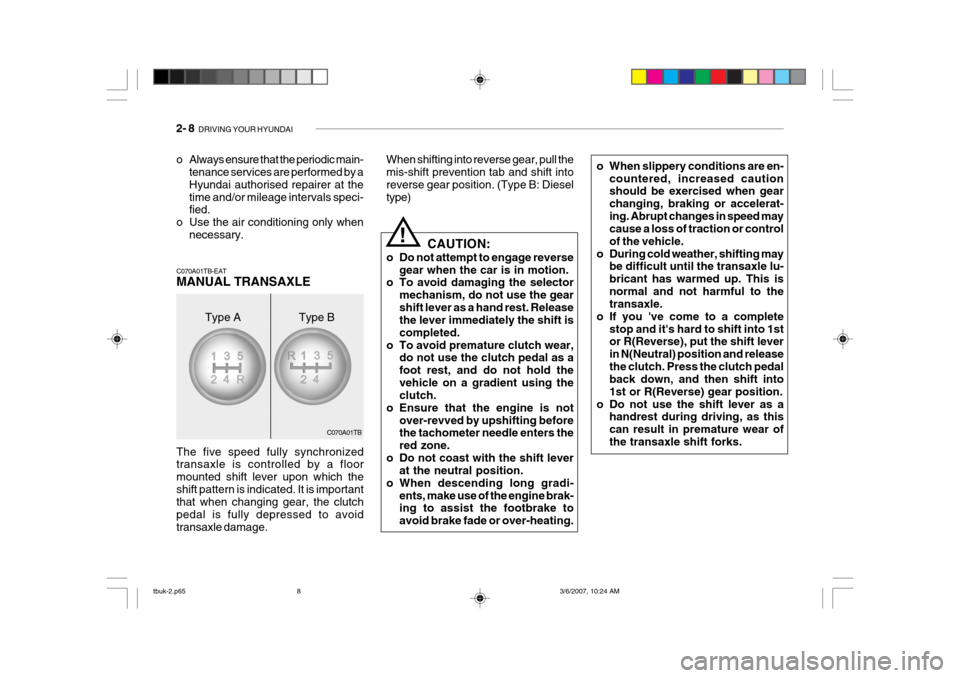
C070A01TB-EAT MANUAL TRANSAXLE The five speed fully synchronized transaxle is controlled by a floor mounted shift lever upon which theshift pattern is indicated. It is important that when changing gear, the clutch pedal is fully depressed to avoidtransaxle damage. o When slippery conditions are en-
countered, increased caution should be exercised when gear changing, braking or accelerat-ing. Abrupt changes in speed may cause a loss of traction or control of the vehicle.
o During cold weather, shifting may be difficult until the transaxle lu-bricant has warmed up. This isnormal and not harmful to the transaxle.
o If you 've come to a complete stop and it's hard to shift into 1stor R(Reverse), put the shift lever in N(Neutral) position and releasethe clutch. Press the clutch pedal back down, and then shift into 1st or R(Reverse) gear position.
o Do not use the shift lever as a handrest during driving, as thiscan result in premature wear ofthe transaxle shift forks.
o Always ensure that the periodic main-
tenance services are performed by aHyundai authorised repairer at thetime and/or mileage intervals speci- fied.
o Use the air conditioning only when necessary.
!
Type A Type B When shifting into reverse gear, pull the mis-shift prevention tab and shift into reverse gear position. (Type B: Dieseltype)
tbuk-2.p65
3/6/2007, 10:24 AM
8
Page 361 of 455
DRIVING YOUR HYUNDAI 2- 9
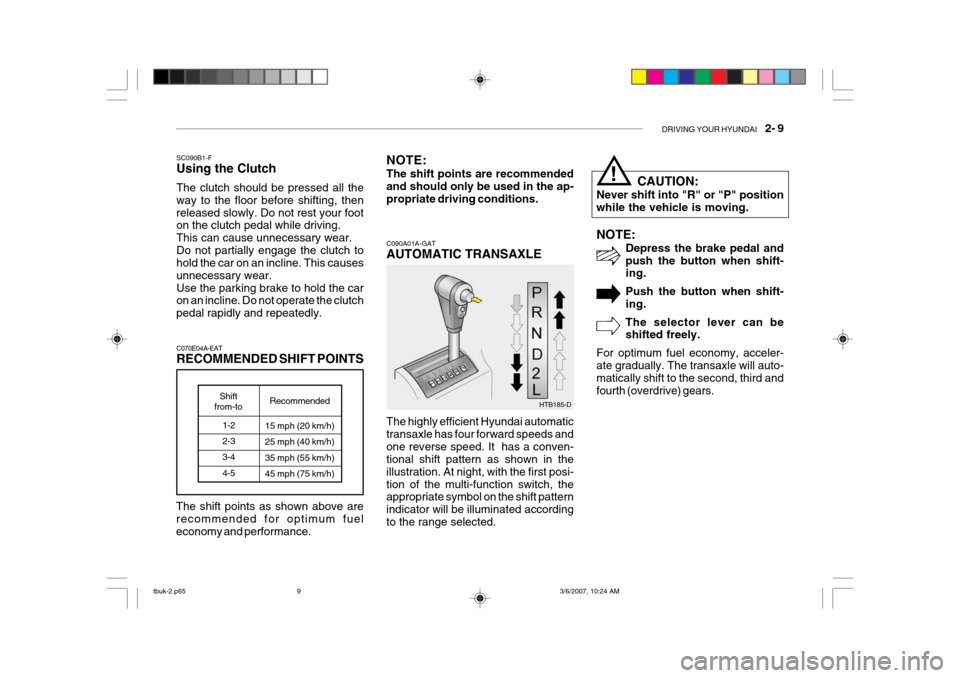
C070E04A-EAT RECOMMENDED SHIFT POINTS
1-2 2-3 3-44-5
Shift
from-to Recommended
15 mph (20 km/h)25 mph (40 km/h)35 mph (55 km/h) 45 mph (75 km/h)
The shift points as shown above are recommended for optimum fuel economy and performance. SC090B1-F Using the Clutch The clutch should be pressed all the way to the floor before shifting, thenreleased slowly. Do not rest your foot on the clutch pedal while driving. This can cause unnecessary wear.Do not partially engage the clutch to hold the car on an incline. This causes unnecessary wear.Use the parking brake to hold the car on an incline. Do not operate the clutch pedal rapidly and repeatedly.
HTB185-D
C090A01A-GAT AUTOMATIC TRANSAXLE The highly efficient Hyundai automatic transaxle has four forward speeds andone reverse speed. It has a conven- tional shift pattern as shown in the illustration. At night, with the first posi-tion of the multi-function switch, the appropriate symbol on the shift pattern indicator will be illuminated accordingto the range selected. CAUTION:
Never shift into "R" or "P" positionwhile the vehicle is moving. NOTE: Depress the brake pedal and push the button when shift- ing. Push the button when shift- ing. The selector lever can be shifted freely.
For optimum fuel economy, acceler-ate gradually. The transaxle will auto- matically shift to the second, third andfourth (overdrive) gears.
!
NOTE: The shift points are recommended and should only be used in the ap- propriate driving conditions.
tbuk-2.p65 3/6/2007, 10:24 AM
9
Page 363 of 455
DRIVING YOUR HYUNDAI 2- 11
C090H01A-EAT NOTE:
o The brake pedal should be de-
pressed when shifting from NEU- TRAL to a forward or reversegear.
o The brake pedal fully depressed
in order to move the shift leverfrom the "P" (Park) position to any of the other positions.
o It is always possible to shift from "R", "N", "D", "2", "L" position.
!
C090I03A-EAT
CAUTION:
o Shift into "R" and "P" only when the vehicle has completely stopped.
o Do not accelerate the engine in
reverse or any of the forward posi- tions with the brakes applied.
o Always apply the footbrake when shifting from "P" or "N", to "R", "D", "2" or "L" position.
o Do not use the "P" (Park) position
in place of the parking brake. Al- ways set the parking brake, shift the transaxle into "P" (Park) and turn off the ignition when you leave the vehicle, even momentarily. Never leave the vehicle unattended whilst the engine is running.
o When accelerating from a stop on
a steep hill, the vehicle may have a tendency to roll backwards. Shift- ing the shift lever into 2nd gear will help prevent the vehicle from rolling backwards.
o Check the automatic transaxle fluid
level regularly, and add fluid as necessary.
o See the maintenance schedule for the proper fluid recommendation. FC120D2-E General Operating Instructions
o The button in the selector handle
must be depressed before the se- lector can be moved.
o The engine may only be started
when the selector is at position "P"or "N".
o Ensure that the footbrake is firmly
applied when shifting from "P" or"N" to "D", "2", "L" or "R" and vice versa.
o Always engage the parking brake when the vehicle is unattended,never use the "P" position in place of the parking brake.
o Under normal circumstances, the selector should be placed in the "D"position and the transaxle allowedto select the most ideal ratio for the circumstances. In this position maxi- mum fuel economy will be achieved.
o When descending steep gradients where engine braking is required,the selector should be placed at the"2" or "L" position depending upon the vehicle speed.
tbuk-2.p65 3/6/2007, 10:24 AM
11
Page 364 of 455
2- 12 DRIVING YOUR HYUNDAI
o When climbing steep gradients us-
ing large throttle openings, the transaxle may re-peatedly changebetween two adjacent ratios. This is a normal characteristic and may be prevented by cancelling the over-drive facility if the shifting occurs between third and fourth ratios, se- lecting position "2" if the shiftingoccurs between third and second ratios or selecting position "1" if the shifting occurs between first andsecond ratios.
o Never move the selector to or from
the "P" or "N" position with the ac-celerator depressed.
o Ensure that the overdrive switch is
at the "ON" position for maximumeconomy.
o If rapid acceleration is required, fully
depress the accelerator pedal. Inthis condition, the kickdown mecha- nism will be operated and the transaxle will automatically down-shift according to the vehicle speed. o The automatic transaxle may be used
to great effect if the vehicle becomesstuck in snow or mud by allowing thevehicle to be rocked to and fro. The engine speed should be held at ap- proximately 1,000rpm by means ofthe accelerator pedal and the selec- tor lever moved between the "D" and "R" positions to induce a rockingmotion.
o Do not depress the accelerator pedal
with the brakes applied and the se-lector at the "R", "D", "2" or "L" position.
o Turn the overdrive switch on for
good fuel economy and smooth driv-ing. But if engine braking is needed in the "D" range or if repeated up-shifting and downshifting between the 3rd and 4th gear is needed when climbing a gentle slope, it is recom-mended that the overdrive switch be turned off. Turn the overdrive switch back on immediately after-ward.
!WARNING:
o Avoid high cornering speeds.
o Do not make quick steering wheel movements, such as sharp lane changes or fast, sharp turns.
o Always wear your seat belts. In a collision crash, an unbeltedperson is significantly more likely to die than a person wearing aseatbelt.
o The risk of rollover is greatly in-
creased if you lose control of yourvehicle at highway speeds.
o Loss of control often occurs if two
or more wheels drop off the road-way and the driver oversteers to reenter the roadway.
o In the event your vehicle leaves the roadway, do not steer sharply.Instead, slow down before pulling back into the travel lanes.
o Never exceed posted speed limits.
o Excessive depressing of the
accelerater pedal under the tire slip condition such as moving out of the mud or fresh snow etc, may cause severe damage to thetransaxle. At this time, take other way such as towing.
tbuk-2.p65 3/6/2007, 10:24 AM
12