ABS Hyundai Getz 2006 Owner's Manual
[x] Cancel search | Manufacturer: HYUNDAI, Model Year: 2006, Model line: Getz, Model: Hyundai Getz 2006Pages: 455, PDF Size: 11.23 MB
Page 13 of 455

YOUR VEHICLE AT A GLANCE
B255A01TB-GAT INDICATOR SYMBOLS ON THE INSTRUMENT PANEL * A detail explanations of these items will be found on page 1-50
SRS (Airbag) Service Reminder Indicator ABS Service Reminder Indicator Turn Signal Indicator Lights High Beam Indicator Light Low Oil Pressure Warning Light Parking Brake/Brake Fluid Level Warning Light Charging System Warning LightTail Gate Open Warning Light Door Ajar Warning Light and Chime
Low Fuel Level Warning Light Malfunction Indicator Light Seat Belt Warning Light
O/D OFF Indicator (Automatic transaxle only)
Electric Power Steering System (EPS)Warning Light
Diesel Pre-heat Indicator Light (Diesel only)
Fuel Filter Warning Light (Diesel only)
Immobilizer Warning Light
Passenger's Front Airbag OFFIndicator Light (If Installed)
Electronic Stability Program Indicator Lights (If Installed)
Engine Coolant Temperature Indicator
Page 40 of 455
FEATURES OF YOUR HYUNDAI 1- 27
your hips. If you lean forward in a slow, easy motion, the belt will extend and let you move around. If there is asudden stop or impact, the belt will lock into position. It will also lock if you try to lean forward too quickly. WARNING:
o When using the rear seat center belt, you must lock all metal tabs and buckles. If any metal tab or buckle is not locked, it will in-crease the chance of injury in the event of collision.
o Never unlock the metal tab (a)
and the buckle (b) with the fol-lowing exceptions.(1)In case of folding rear
seatbacks down.
(2)If transporting an object on
the rear seat may cause dam-age to the rear seat center belt.
o Lock the metal tab (a) and the buckle (b) immediately after fold-ing rear seatbacks up.
!
B220A02Y-DB220D02TB
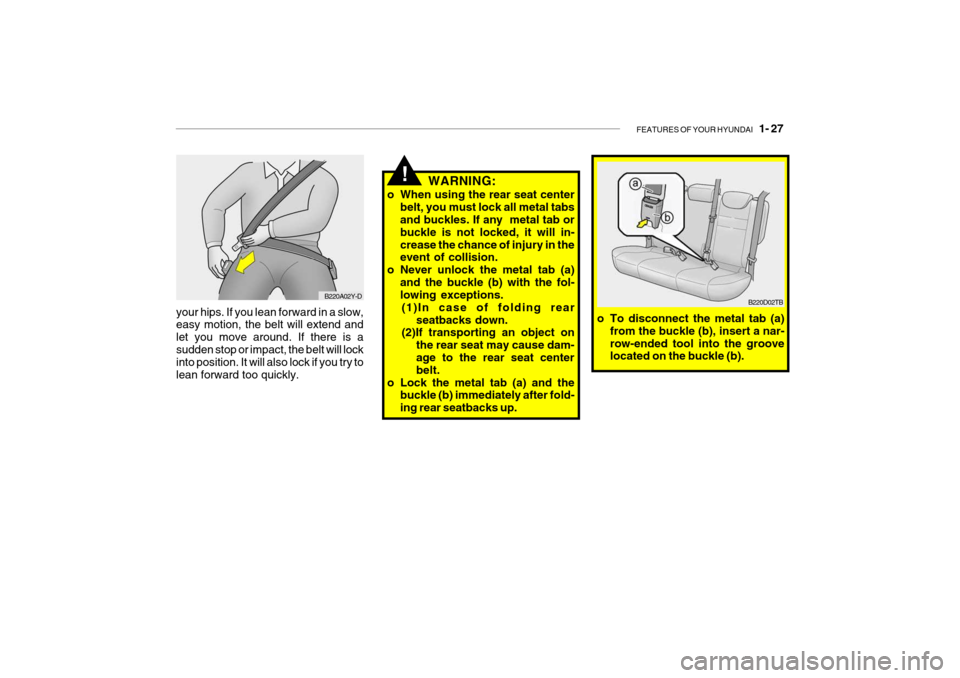
o To disconnect the metal tab (a) from the buckle (b), insert a nar- row-ended tool into the groove located on the buckle (b).
Page 46 of 455
FEATURES OF YOUR HYUNDAI 1- 33
Unlatched metal latch plates or tabs may allow the child to reach the unretracted seat belts which may result in strangulation and aserious injury or death to the child in the child restraint.
o Do not mount more than one child restraint to a child restraint loweranchorage point. The improper increased load may cause the an-chorage points or tether anchor to break, causing serious injury or death.
o Attach the ISOFIX or ISOFIX-com- patible child restraint seat only tothe appropriate locations shownin the illustration.
o Always follow the installation and
use instructions provided by themanufacturer of the child restraint.
WARNING:
o Do not install a child restraint seat at the center of the rear seat usingthe vehicle's outboard rear seat ISOFIX anchors. The ISOFIX an- chors are only provided for the leftand right outboard rear seating positions. Do not misuse the ISOFIX anchors by attempting toattach a child restraint seat in the middle of the rear seat to the ISOFIX anchors. In a crash, the child re-straint seat ISOFIX attachments may not be strong enough to se- cure the child restraint seat prop- erly in the center of the rear seat and may break, causing seriousinjury or death.
o When using the vehicle’s “ISOFIX”
system to install a child restraintsystem in the rear seat, all unused vehicle rear seat belt metal latch plates or tabs must be latchedsecurely in their seat belt buckles and the seat belt webbing must be retracted behind the child restraintto prevent the child from reaching and taking hold of unretracted seat belts. !
Page 60 of 455

FEATURES OF YOUR HYUNDAI 1- 47
1. Tail Gate Open Warning Light
2. Immobilizer Warning Indicator Light (If installed)
3. Tachometer
4. Turn Signal Indicator Light
5. Automatic Transaxle Position Indicator Light
(If installed)
6. Fuel Gauge
7. Odometer/Trip Odometer
8. Speedometer
9. Electric Power Steering Warning Light (If installed)
10. Malfunction Indicator Light (MIL) (If installed)
11. Diesel Pre-heat Indicator Light (Diesel only)
12. High Beam Indicator Light
13. Engine Coolant Temperature Indicator Light
14. Parking Brake/Brake Fluid Level Warning Light 15. Door Ajar Warning Light
16. Passenger's Front Airbag OFF Indicator Light
(If installed)
17. SRS (Airbag) Warning Light
(If installed)
18. Low Fuel Warning Light
19. Electronic Stability Program (ESP) Indicator Light (If installed)
20. ABS Warning Light (If installed)
21. Fuel Filter Warning Light (Diesel only)
22. Seat Belt Warning Light
23. Oil Pressure Warning Light
24. Charging System Warning Light
25. Overdrive off Indicator Light (Auto T/A only)
Page 62 of 455

FEATURES OF YOUR HYUNDAI 1- 49
1. Tail Gate Open Warning Light
2. Immobilizer Warning Indicator Light (If installed)
3. Tachometer
4. Turn Signal Indicator Light
5. Automatic Transaxle Position Indicator Light
(If installed)
6. Odometer/Trip Odometer
7. Fuel Gauge
8. Trip Computer (If installed)
9. Speedometer
10. Electric Power Steering Warning Light (If installed)
11. Malfunction Indicator Light (MIL) (If installed)
12. Diesel Pre-heat Indicator Light (Diesel only)
13. High Beam Indicator Light 14. Engine Coolant Temperature Indicator Light
15. Parking Brake/Brake Fluid Level Warning Light
16. Door Ajar Warning Light
17. Passenger's Front Airbag OFF Indicator Light
(If installed)
18. SRS (Airbag) Warning Light (If installed)
19. Low Fuel Warning Light
20. Electronic Stability Program (ESP) Indicator Light (If installed)
21. ABS Warning Light (If installed)
22. Fuel Filter Warning Light (Diesel only)
23. Seat Belt Warning Light
24. Oil Pressure Warning Light
25. Charging System Warning Light
26. Overdrive Off Indcator Light (Auto T/A only)
Page 64 of 455
FEATURES OF YOUR HYUNDAI 1- 51
B260P02Y-GAT
ABS Service Reminder Indicator (SRI)(If Installed)
When the key is turned to the "ON" position, the Anti-Lock Brake System will come on and then go off in a fewseconds. If the ABS SRI remains on, comes on while driving, or does not come on when the key is turned to the"ON" position, this indicates that there may be a problem with the ABS. If this occurs, have your vehiclechecked by your Hyundai dealer as soon as possible. The normal braking system will still be operational, butwithout the assistance of the anti-lock brake system. B260C01A-AAT
O/D OFF Indicator (Automatic transaxleonly) (If Installed)
When the overdrive switch is turned on, the overdrive off indicator will go out. This amber indicator will be illumi- nated when the overdrive switch isturned off. B260D01A-AAT
Turn Signal Indicator Lights
The blinking green arrows on the in- strument panel show the direction indi- cated by the turn signals. If the arrow comes on but does not blink, blinksmore rapidly than normal, or does not illuminate at all, a malfunction in the turn signal system is indicated. Yourdealer should be consulted for repairs.
WARNING:
If both ABS SRI and Parking Brake/ Brake fluid level warning lights re- main "ON" or come on while driv-ing, there may be a problem with E.B.D (Electronic Brake Force Dis- tribution).If this occurs, avoid sudden stops and have your vehicle checked by your Hyundai dealer as soon aspossible.
!
B260F01A-AAT High Beam Indicator Light
The high beam indicator light comes on whenever the headlights are switched to the high beam or flashposition.
Page 134 of 455

2. DRIVING YOUR HYUNDAI
2
Before starting the engine ................................................................ 2-3
Key position ..................................................................................... 2-4Starting ............................................................................................. 2-5
Operating the manual transaxle ....................................................... 2-7
Automatic transaxle ......................................................................... 2-9Good braking practices .................................................................. 2-12
Anti-Lock brake system (ABS) ...................................................... 2-13
Electronic Stability Program (ESP) ................................................ 2-14
Driving for economy ....................................................................... 2-15
Winter Driving ................................................................................. 2-16
Trailer or vehicle towing ............................. .................................... 2-19
Page 146 of 455

DRIVING YOUR HYUNDAI 2- 13
ing action returns to normal, taking care to keep the car under control at
all times. If the braking action doesnot return to normal, stop as soon as it is safe to do so and call your Hyundai dealer for assistance.
o Don't coast down hills with the car out of gear. This is extremely haz-
ardous. Keep the car in gear at alltimes, use the brakes to slow down,
then shift to a lower gear so that engine braking will help you main-tain a safe speed.
o Don't "ride" the brake pedal. Rest-
ing your foot on the brake pedal
while driving can be dangerous be- cause it can result in the brakes overheating and losing their effec-tiveness. It also increases the wear of the brake components.
o If a tire goes flat while you are driving, apply the brakes gently andkeep the car pointed straight ahead while you slow down. When you are
moving slowly enough for it to be safe to do so, pull off the road and stop in a safe place.
o If your car is equipped with an auto- matic transaxle, don't let your carcreep forward. To avoid creepingforward, keep your foot on the brake
pedal when the car is stopped. o Use caution when parking on a hill.
Engage the parking brake and place
the gear selector lever in "P" (auto-matic transaxle) or in first or reverse gear (manual transaxle). If your car is facing downhill, turn the frontwheels into the curb to help keep the car from rolling. If your car is facing
uphill, turn the front wheels awayfrom the curb to help keep the car from rolling. If there is no curb or if it is requiredby other conditions to keep the car from rolling, block the wheels.
o Under some conditions your park-
ing brake can freeze in the engagedposition. This is most likely to hap- pen when there is an accumulationof snow or ice around or near the rear brakes or if the brakes are wet. If there is a risk that the parkingbrake may freeze, apply it only tem- porarily while you put the gear se- lector lever in "P" (automatic) or infirst or reverse gear (manual transaxle) and block the rear wheels so the car cannot roll. Then releasethe parking brake. C120A03A-AAT ANTI-LOCK BRAKE SYSTEM (If Installed) The Anti-Lock Brake System (ABS) is designed to prevent wheel lock-up during sudden braking or on hazard-ous road surfaces. The ABS control module monitors the wheel speed and controls the pressure applied to eachbrake. Thus, in emergency situations or on slick roads, ABS will increase vehicle control during braking. NOTE:
o A click sound may be heard in the
engine compartment when the ve- hicle begins to move after the en- gine is started. These conditions are normal and indicate that theanti-lock brake system (Electronic Stability Program) is functioning properly.
o During ABS (ESP) operation, a slight pulsation may be felt in the
o Do not hold the vehicle on the up-
grade with the accelerator pedal. Thiscan cause the transmission to over-heat. Always use the brake pedal or parking brake.
Page 147 of 455
2- 14 DRIVING YOUR HYUNDAI
WARNING:
ABS (ESP) will not prevent accidents due to improper or dangerous driv- ing maneuvers. Even though vehicle control is improved during emer-gency braking, always maintain a safe distance between you and ob- jects ahead. Vehicle speeds shouldalways be reduced during extreme road conditions. The braking distance for cars equipped with an anti-lock braking system may be longer than for those without it in the following road con-ditions.
o Driving on rough, gravel or snow- covered roads.
o Driving with tire chains installed.
o Driving on roads where the road surface is pitted or has different surface height.!
During these conditions, the vehicle should be driven at reduced speeds. The safety features of an ABS (ESP)equipped vehicle should not be tested by high speed driving or cornering. This could endanger the safety ofyourself or others.
CAUTION:
Driving with varying tire or wheel size may cause the ESP system to malfunction. When replacing tires, make sure they are the same size asyour original tires.!
C310A01JM-AAT ELECTRONIC STABILITY PROGRAM (ESP)(If Installed) ESP checks where you are steering and where the vehicle is actually going. ESP applies the brakes at individualwheels and intervenes in the engine management system to stabilize the vehicle. The Electronic Stability Program (ESP) system is an electronic system de-signed to help the driver maintain ve- hicle control under adverse conditions. It is not a substitute for safe drivingpractices. Factors including speed, road conditions and driver steering input can all affect whether ESP will be effectivein preventing a loss of control. It is still your responsibility to drive and corner at reasonable speeds and to leave asufficient margin of safety.
C310A01TB
The Electronic Stability Program (ESP)system is designed to stabilize thevehicle during cornering maneuvers.
brake pedal when the brakes are applied. Also, a noise may be heard in the engine compartment whilebraking. These conditions are normal and indicate that the anti- lock brake system is functioningproperly.
Page 174 of 455

4- 4 CORROSION PREVENTION AND APPEARANCE CARE
trol chemicals are used, you should pay particular attention to the under- side of the car. Start by rinsing the carto remove dust and loose dirt. In win- ter, or if you have driven through mud or muddy water, be sure to thoroughlyclean the underside as well. Use a hard direct stream of water to remove accumulations of mud or corrosivematerials. Use a good quality car-wash- ing solution and follow the manufacturer's directions on the pack-age. These are available at your Hyundai dealer or auto parts outlet. Don't use strong household detergents,gasoline, strong solvents or abrasive cleaning powders as these may dam- age the finish.Use a clean sponge or cloth, rinse it frequently and don't damage the finish by rubbing too hard. For stubborn spots,dampen them frequently and remove them a little at a time. To clean whitewall tires, use a stiffbrush or soapy steel-wool scouring pad. To clean plastic wheel covers, use aclean sponge or soft cloth and water. To clean cast aluminum alloy wheels, use a mild soap or neutral detergent. Do not use abrasive cleaners. Protectthe bare-metal surfaces by cleaning, polishing and waxing. Because alumi- num is subject to corrosion, be sure togive aluminum alloy wheels special attention in winter. If you drive on salted roads, clean the wheels thor-oughly afterwards. After washing, be sure to rinse thor- oughly. If soapy water dries on the finish, streaking will result. When the weather is warm and the humidity low, you may find it neces- sary to rinse each section immediatelyafter washing to avoid streaking. After rinsing, dry the car using a damp chamois or soft, absorbent cloth. The reason for drying the car is to remove water from the car so it will dry withoutwater spots. Don't rub, this can dam- age the finish.
If you find any nicks or scratches inthe paint, use touch-up paint to cover them to prevent corrosion. To protectthe paintwork of the car against corro- sion, you must clean your Hyundai (at least once a month). Give special at-tention to the removal of salt, mud and other substances on the underside of the splashboards of the car. Makesure that the outlets and the underside of the doors are open. Paint damage can be caused by small accumulationof tar, industrial precipitation, tree resin, insects and bird droppings, when not removed immediately. If water alone isnot strong enough to remove the accu- mulated dirt, use a mild car washing solution. Be sure to rinse the surfaceafter washing to remove the solution. Never allow the solution to dry on the painted surfaces.