water pump Hyundai Getz 2006 Owner's Manual
[x] Cancel search | Manufacturer: HYUNDAI, Model Year: 2006, Model line: Getz, Model: Hyundai Getz 2006Pages: 455, PDF Size: 11.23 MB
Page 15 of 455
1- 2 FEATURES OF YOUR HYUNDAI
B010B01A-AAT What About Gasohol? Gasohol (a mixture of 90% unleaded gasoline and 10% ethanol or grainalcohol) may be used in your Hyundai. However, if your engine develops driveability problems, the use of 100%unleaded gasoline is recommended. Fuels with unspecified quantities of alcohol, or alcohols other than ethanol,should not be used.
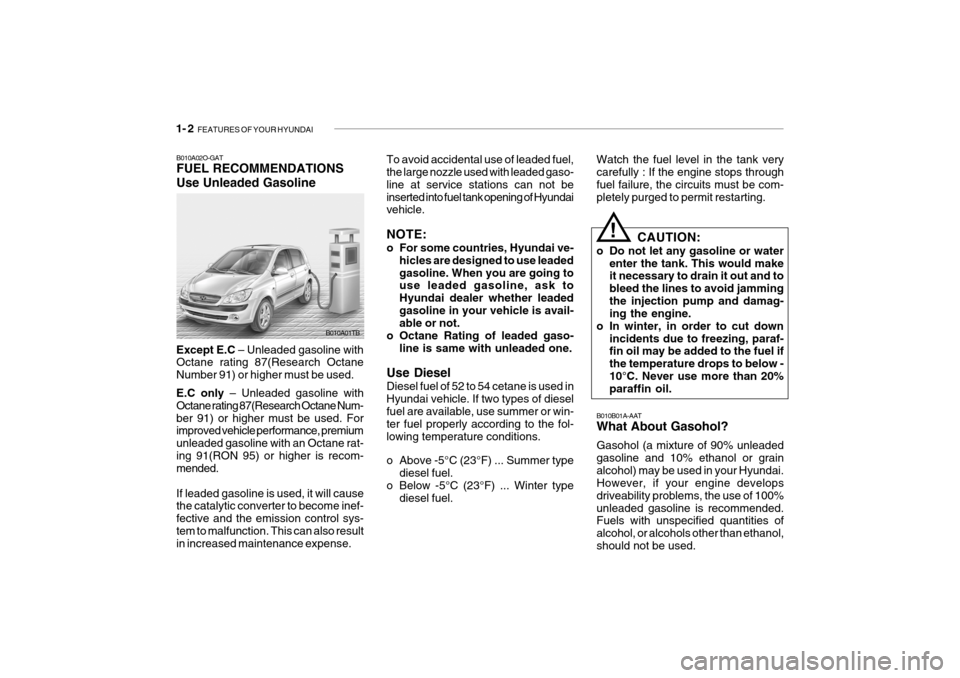
B010A02O-GAT FUEL RECOMMENDATIONS Use Unleaded Gasoline
To avoid accidental use of leaded fuel, the large nozzle used with leaded gaso- line at service stations can not beinserted into fuel tank opening of Hyundai vehicle. NOTE:
o For some countries, Hyundai ve-
hicles are designed to use leaded gasoline. When you are going to use leaded gasoline, ask to Hyundai dealer whether leadedgasoline in your vehicle is avail- able or not.
o Octane Rating of leaded gaso- line is same with unleaded one.
Use Diesel Diesel fuel of 52 to 54 cetane is used in Hyundai vehicle. If two types of diesel fuel are available, use summer or win- ter fuel properly according to the fol-lowing temperature conditions.
o Above -5°C (23°F) ... Summer type diesel fuel.
o Below -5°C (23°F) ... Winter type diesel fuel.
Except E.C
– Unleaded gasoline with
Octane rating 87(Research Octane Number 91) or higher must be used. E.C only – Unleaded gasoline with
Octane rating 87(Research Octane Num- ber 91) or higher must be used. For improved vehicle performance, premium unleaded gasoline with an Octane rat-ing 91(RON 95) or higher is recom- mended. If leaded gasoline is used, it will cause the catalytic converter to become inef- fective and the emission control sys-tem to malfunction. This can also result in increased maintenance expense. B010A01TB
CAUTION:
o Do not let any gasoline or water enter the tank. This would makeit necessary to drain it out and to bleed the lines to avoid jammingthe injection pump and damag- ing the engine.
o In winter, in order to cut down
incidents due to freezing, paraf-fin oil may be added to the fuel if the temperature drops to below -10°C. Never use more than 20% paraffin oil.
!
Watch the fuel level in the tank very carefully : If the engine stops through fuel failure, the circuits must be com-pletely purged to permit restarting.
Page 66 of 455

FEATURES OF YOUR HYUNDAI 1- 53
B260J01S-GAT
Charging System Warning Light
The charging system warning light should come on when the ignition isturned on, then go out when the engine is running. If the light stays on while the engine is running, there is a malfunc-tion in the electrical charging system. If the light comes on while you are driv- ing, stop, turn off the engine and checkunder the hood. First, make certain the generator drive belt is in place. If it is, check the tension of the belt.And then, have the system checked by your Hyundai dealer. B260L01A-GAT
Door Ajar Warning Light
The door ajar warning light warns youthat a door is not completely closed.
B260K01B-GAT
Tail Gate Open Warning Light
This light remains on unless the tail gate is completely closed. B260M01A-AAT Low Fuel Level Warning Light
The low fuel level warning light comes on when the fuel tank is approaching empty. When it comes on, you shouldadd fuel as soon as possible. Driving with the fuel level warning light on or with the fuel level below "E" can causethe engine to misfire and damage the catalytic converter.
CAUTION:
If the drive belt (generator belt) is loosen, broken, or mission while thevehicle is driving, there may be a serious malfunction, engine could overheat because this belt alsodrives the water pump.!
B260N02FC-GAT Malfunction Indicator Light (If installed)
This light illuminates when there is a malfunction of an exhaust gas related component, and the system is not
functioning properly so that the exhaust gas regulation values are not satisfied. This light will illuminate when the igni-tion key is tuned to the "ON" position, and will go out after the engine start. If it illuminates while driving, or does notilluminate when the ignition key is turned to the "ON" position, take your car to your nearest authorized Hyundai dealerand have the system checked.
B260E01TB-GAT Seat Belt Warning Light
(Except E.C)
The seat belt warning light blinks for about 6 seconds when the ignition keyis turned from the "OFF" position to the "ON".
Page 69 of 455
1- 56 FEATURES OF YOUR HYUNDAI
B270A01A-AAT BRAKE PAD WEAR WARNING SOUND The front disc brake pads have wear indicators that should make a high- pitched squealing or scraping noisewhen new pads are needed. The sound may come and go or be heard all the time when the vehicle is moving. Itmay also be heard when the brake pedal is pushed down firmly. Exces- sive rotor damage will result if the wornpads are not replaced. See your Hyundai dealer immediately.
B900A01A-GAT ACOUSTIC WARNING SOUND (If Installed) The acoustic warning chime sounds when the tail lights are on and the door in driver side is open. This prevents thebattery from discharging when the car is left with the tail lights on. The chime sounds until the tail lights are turnedoff.
B265A01B-GAT
Fuel Filter Warning Light-Red (Diesel Engine)
This light illuminates when the ignition switch is set to the "ON" position and goes off after the engine has started. Ifit lights up while the engine is running, it indicates that water has accumu- lated inside the fuel filter. If this hap-pens, remove the water from the fuel
filter. (Refer to "6-28 page")
B290A01TB-AAT Engine Coolant Tempera-
ture Indicator
WARNING:
Never remove the radiator cap when the engine is hot. The engine cool-ant is under pressure and could erupt and cause severe burns. Wait until the engine is cool before re-moving the radiator cap.
!
These indicators show the temperature of the engine coolant when the ignition switch is ON. Red indicator illuminatesif the temperature of the engine coolant is above 120±3°C (248±37.4°F). Blue indicator Illuminates if the tem-
perature of the engine coolant is below 60±3°C (140±37.4°F). If the red indicator illuminates, pull overand stop as soon as possible and turn off the engine. Then open the hood and check the coolant level (See "If theengine overheats" on the page 3-4.) and the water pump drive belt. If you sus- pect cooling system trouble, have yourcooling system checked by a Hyundai dealer as soon as possible. NOTE: If the red engine temperature indica- tor illuminates, it indicates overheat- ing that may damage the engine.
Page 150 of 455

DRIVING YOUR HYUNDAI 2- 17
C160B01A-GAT Snowy or Icy Conditions To drive your vehicle in deep snow, it may be necessary to use snow tires orto install tire chains on your tires. If snow tires are needed, it is necessary to select tires equivalent in size andtype to the original equipment tires. Failure to do so may adversely affect the safety and handling of your car.Speeding, rapid acceleration, sudden brake applications, and sharp turns are potentially very hazardous prac-tices. During deceleration, use engine braking to the fullest extent. Sudden brake applications on snowy or icyroads may cause skids to occur. You need to keep sufficient distance be- tween the vehicle in front and yourvehicle. Also, apply the brake gently. It should be noted that installing tire chains on the tire will provide a greaterdriving force, but will not prevent side skids. NOTE: Tire chains are not legal in all prov- inces. Check province laws before fitting tire chains. C160C01A-AAT Use High Quality Ethylene Glycol Coolant Your Hyundai is delivered with high quality ethylene glycol coolant in the cooling system. It is the only type ofcoolant that should be used because it helps prevent corrosion in the cooling system, lubricates the water pump andprevents freezing. Be sure to replace or replenish your coolant in accor- dance with the maintenance schedulein Section 5. Before winter, have your coolant tested to assure that its freez- ing point is sufficient for the tempera-tures anticipated during the winter.
C160D01A-AAT Check Battery and Cables Winter puts additional burdens on the battery system. Visually inspect thebattery and cables as described in Section 6. The level of charge in your battery can be checked by your Hyun-dai dealer or a service station. C160E01A-AAT Change to "Winter Weight" Oil if Necessary In some climates it is recommended that a lower viscosity "winter weight" oil be used during cold weather. See Section 9 for recommendations. If youaren't sure what weight oil you should use, consult your Hyundai dealer.
Page 160 of 455
3- 4 WHAT TO DO IN AN EMERGENCY
D030A02TB-AAT IF THE ENGINE OVERHEATS If your temperature gauge indicates overheating, you experience a loss of power, or hear loud pinging or knock- ing, the engine is probably too hot. Ifthis happens to you, you should:
1. Pull off the road and stop as soon as
it is safe to do so.
2. Place the gear selector lever in "P"
(automatic), or neutral (manual transaxle) and set the parking brake. If the air conditioning is on, turn it off.
6. Carefully remove the jumper cables
in the reverse order of attachment.
If you do not know why your battery became discharged (because the lights were left on, etc.), have the chargingsystem checked by your Hyundai dealer. 3. If engine coolant is running out un-
der the car or steam is coming out from the hood, stop the engine. Donot open the hood until the engine coolant has stopped running or the steaming has stopped. If there is novisible loss of engine coolant and no steam, leave the engine running and check to be sure the enginecooling fan is operating. If the fan is not running, turn the engine off.
4. Check to see if the water pump drive belt is missing. If it is not missing,check to see that it is tight. If the drive belt seems to be satisfactory,check for coolant leaking from the radiator, hoses or under the car. (If the air conditioning had been in use,it is normal for cold water to be draining from it when you stop). WARNING (Diesel only):
Never work on injection system with engine running or within 30 sec- onds after shutting off engine. High pressure pump, rail, injectors andhigh pressure pipes are subject to high pressure even after the engine stopped. The fuel jet produced byfuel leaks may cause serious in- jury, if it touch the body. People using pacemakers should not movethan 30cm closer to the ECU or wiring harness within the engine room while engine is running, sincethe high currents in the Common Rail system produce considerable magnetic fields.
WARNING:
While the engine is running, keep hair, hands, and clothing away from moving parts such as the fan anddrive belts to prevent injury.
!
!
5. If the water pump drive belt is bro- ken or coolant is leaking out, stop the engine immediately and call the nearest Hyundai dealer for assis-tance.
Page 180 of 455

5- 4 VEHICLE MAINTENANCE REQUIREMENTS
ENGINE CONTROL SYSTEM MAINTENANCE (GASOLINE)
1 ENGINE OIL & FILTER
2 DRIVE BELT (WATER PUMP, ALTERNATOR & A/CON)
3 FUEL FILTER (MPI)
4 FUEL LINES, FUEL HOSES & CONNECTIONS
5 TIMING BELT
6 VAPOR HOSE & FUEL FILLER CAP
7 VACUUM & CRANKCASE VENTILATION HOSES
8 AIR CLEANER FILTER
9 SPARK PLUGS
10 VALVE CLEARANCE (1.1 L)
F030A01A-GAT SCHEDULED MAINTENANCE The following maintenance services must be performed to assure good vehicle control and performance. Keep receipts for all vehicle services to protect your warranty.Where both mileage and time are shown, the frequency of service is determined by whichever occurs first.
NO. DESCRIPTION105
84
R I I I 120
96
R I
R
I I I
R
I
9072
R I I
R I I
R
I
7560
R I I I
60 48
R I
R
II I I
R
I
4536
R I I I
30 24
R I II I
R
I
1512
R I I I
KILOMETERS X 1000 MONTHS
F030B04TB-GAT R : Replace I : Inspect and, after inspection, clean, adjust, repair or replace if necessary
Note : FOR EVERY 40,000KM: "R"
See Note
Page 209 of 455
6- 22 DO-IT-YOURSELF MAINTENANCE
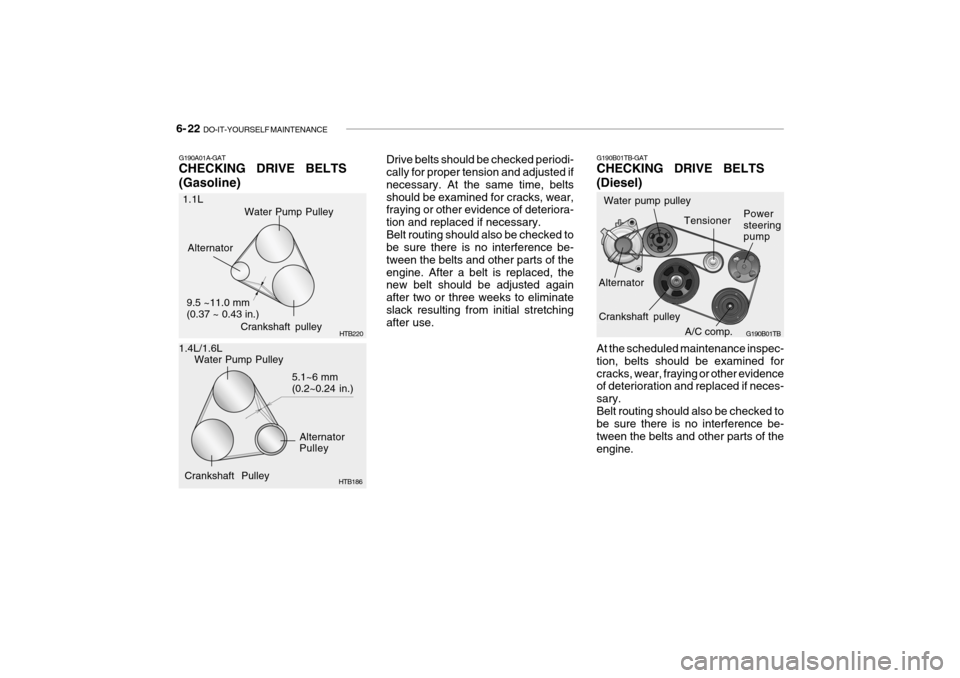
Drive belts should be checked periodi- cally for proper tension and adjusted if necessary. At the same time, beltsshould be examined for cracks, wear, fraying or other evidence of deteriora- tion and replaced if necessary.Belt routing should also be checked to be sure there is no interference be- tween the belts and other parts of theengine. After a belt is replaced, the new belt should be adjusted again after two or three weeks to eliminateslack resulting from initial stretching after use. G190B01TB-GAT CHECKING DRIVE BELTS (Diesel)
A/C comp.
Water pump pulley
G190B01TB
Alternator Power steering pump
At the scheduled maintenance inspec- tion, belts should be examined forcracks, wear, fraying or other evidence of deterioration and replaced if neces- sary.Belt routing should also be checked to be sure there is no interference be- tween the belts and other parts of theengine.Water Pump Pulley
Alternator Pulley
Crankshaft Pulley 5.1~6 mm(0.2~0.24 in.)
G190A01A-GAT CHECKING DRIVE BELTS (Gasoline)
HTB186
1.1L
1.4L/1.6L Crankshaft pulley
Alternator
HTB220
Water Pump Pulley
9.5 ~11.0 mm (0.37 ~ 0.43 in.)Tensioner
Crankshaft pulley
Page 259 of 455
1- 2 FEATURES OF YOUR HYUNDAI
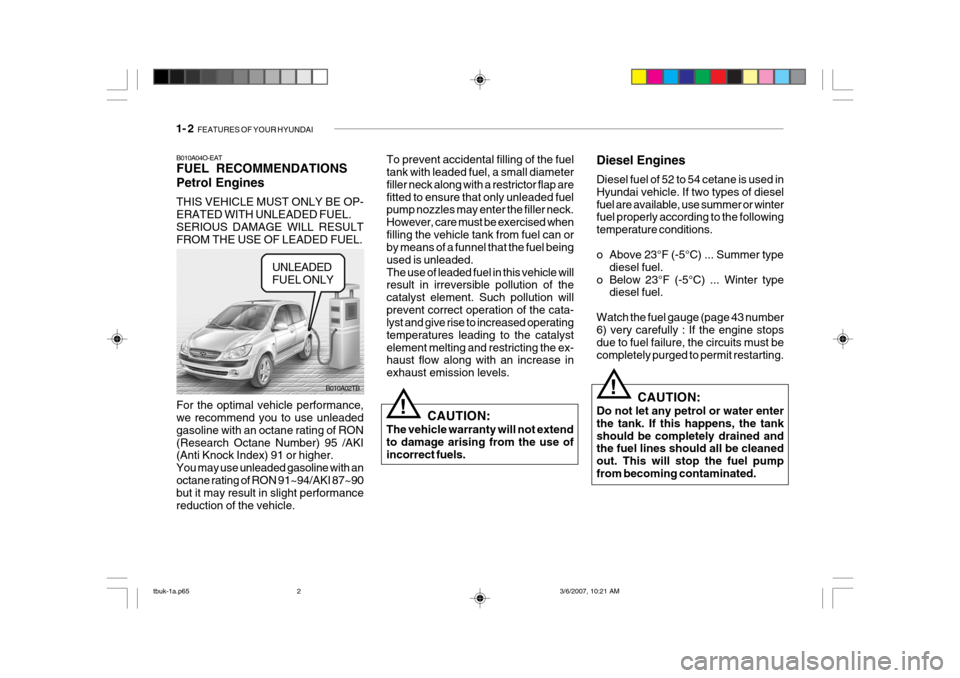
B010A04O-EAT FUEL RECOMMENDATIONS Petrol Engines THIS VEHICLE MUST ONLY BE OP- ERATED WITH UNLEADED FUEL. SERIOUS DAMAGE WILL RESULTFROM THE USE OF LEADED FUEL. To prevent accidental filling of the fuel tank with leaded fuel, a small diameter filler neck along with a restrictor flap arefitted to ensure that only unleaded fuel pump nozzles may enter the filler neck. However, care must be exercised whenfilling the vehicle tank from fuel can or by means of a funnel that the fuel being used is unleaded.The use of leaded fuel in this vehicle will result in irreversible pollution of the catalyst element. Such pollution willprevent correct operation of the cata- lyst and give rise to increased operating temperatures leading to the catalystelement melting and restricting the ex- haust flow along with an increase in exhaust emission levels.
For the optimal vehicle performance, we recommend you to use unleaded gasoline with an octane rating of RON(Research Octane Number) 95 /AKI (Anti Knock Index) 91 or higher. You may use unleaded gasoline with anoctane rating of RON 91~94/AKI 87~90 but it may result in slight performance reduction of the vehicle. B010A02TB
!
CAUTION:
The vehicle warranty will not extend to damage arising from the use of incorrect fuels.
! Diesel Engines Diesel fuel of 52 to 54 cetane is used in Hyundai vehicle. If two types of dieselfuel are available, use summer or winter fuel properly according to the following temperature conditions.
o Above 23°F (-5°C) ... Summer type
diesel fuel.
o Below 23°F (-5°C) ... Winter type diesel fuel.
Watch the fuel gauge (page 43 number 6) very carefully : If the engine stops due to fuel failure, the circuits must becompletely purged to permit restarting.
UNLEADEDFUEL ONLY
CAUTION:
Do not let any petrol or water enterthe tank. If this happens, the tankshould be completely drained and the fuel lines should all be cleaned out. This will stop the fuel pumpfrom becoming contaminated.
tbuk-1a.p65 3/6/2007, 10:21 AM
2
Page 306 of 455
FEATURES OF YOUR HYUNDAI 1- 49
SB210M1-E
CHARGING SYSTEM WARNING LIGHT
The charging system warning light should illuminate when the ignition switch is turned to the "ON" positionand should be extinguished when the engine is started. If the light fails to illuminate when the ignition is turned"ON" or fails to extinguish after starting the engine, the nearest Hyundai authorised repairer should be contacted.If the light illuminates whilst the vehicle is being driven, stop the vehicle as soon as it is safe to do so and check thecondition of the alternator drive belt. If the belt is in place and the tension is satisfactory, the advice of a Hyundaiauthorised repairer should be sought. SB2100I-E
DOOR OPEN (AJAR) WARNING LIGHT
The door ajar warning light indicates that a door is not correctly closed. Ensure that the light is extinguished prior to driving the vehicle.
B260B01FC-EAT
TAIL GATE OPEN WARNING LIGHT
The tail gate warning light indicates when the tail gate is open or is not fully closed. Ensure that the light has extin-guished prior to driving the vehicle.
CAUTION:
If the drive belt (generator belt) is loose, broken, or missing while thevehicle is driving, there may be a serious malfunction, engine could overheat because this belt also drivesthe water pump.!
If failure of one of the circuits occurs, the required amount of pedal effort, pedal travel and stopping distance willbe increased. Use of the gearbox is recommended to assist in bringing the vehicle to rest. The vehicle must not bedriven once brake failure has occurred until the system has been repairered and is functioning normally.The braking system employs a vacuum servo in order that the pedal efforts are reduced. Power for the servo is derivedfrom the engine and therefore, in the event of the engine stopping or the vehicle being towed, pedal efforts willbe substantially increased.
tbuk-1a.p65 3/6/2007, 10:22 AM
49
Page 309 of 455
1- 52 FEATURES OF YOUR HYUNDAI
If the red indicator illuminates, pull over and stop as soon as possible and turn off the engine. Then open the bonnetand check the coolant level (See "If the engine overheats" on the page 3-4.) and the water pump drive belt. If you sus-pect cooling system trouble, have your cooling system checked by a Hyundai dealer as soon as possible. NOTE: If the red engine temperature indica- tor illuminates, it indicates overheat-ing that may damage the engine.
B265A01FC-EAT
FUEL FILTER WARNING LIGHT-RED(Diesel Engine)
This light illuminates when the engine has started and go off after a approimately seconds. If it lights upwhile the engine is running, it indicates that water has accumulated inside the fuel filter. If this happens, remove thewater from the fuel filter. (Refer to "6-24 page")B290A01TB-EAT ENGINE COOLANT TEM-
PERATURE INDICATOR
WARNING:
Never remove the radiator cap when the engine is hot. The engine coolantis under pressure and could erupt and cause severe burns. Wait until the engine is cool before removingthe radiator cap.
!
These indicators show the temperature of the engine coolant when the ignition switch is ON. Red indicator illuminatesif the temperature of the engine coolant is above 120±3°C (248±37.4°F). Blue indicator Illuminates if the tem-perature of the engine coolant is below 60±3°C (140±37.4°F).
tbuk-1a.p65 3/6/2007, 10:22 AM
52