brakes Hyundai Getz 2008 User Guide
[x] Cancel search | Manufacturer: HYUNDAI, Model Year: 2008, Model line: Getz, Model: Hyundai Getz 2008Pages: 383, PDF Size: 9.23 MB
Page 162 of 383
2- 22 DRIVING YOUR HYUNDAI
6. Check the condition and air pres-
sure of all tires on the trailer and your car. Low tire pressure canseriously affect the handling. Also check the spare tire.
7. The vehicle/trailer combination is more affected by crosswind andbuffeting. When being passed by a largevehicle, keep a constant speed and steer straight ahead. If there is too much wind buffeting slow downto get out of the other vehicle's air turbulence.
8. When parking your car and trailer, especially on a hill, be sure to fol-low all the normal precautions. Turn your front wheel into the curb, setthe parking brake firmly, and put the transaxle in 1st or Reverse (manual) or Park (automatic). Inaddition, place wheel chocks at each of the trailer's tires.
9. If the trailer has electric brakes, start your vehicle and trailer mov-ing, and then apply the trailer brake controller by hand to be sure thebrakes are working. This lets you check your electrical connection at the same time. 10. During your trip, check occasion-
ally to be sure that the load issecure, and that the lights andany trailer brakes are still working.
11. Avoid jerky starts, sudden accel-
eration or sudden stops.
12. Avoid sharp turns and rapid lane changes.
13. Avoid holding the brake pedal down
too long or too frequently. This could cause the brakes to over- heat, resulting in reduced brakingefficiency.
14. When going down a hill, shift into a
lower gear and use the engine brak-ing effect. When ascending a long grade, downshift the transaxle to a lowergear and reduce speed to reduce chances of engine overloading and/ or overheating.
15. If you have to stop while going uphill, do not hold the vehicle inplace by pressing on the accelera-tor. This can cause the automatic transaxle to overheat. Use the park- ing brake or footbrake.
C190F02A-GAT Trailer or Vehicle Towing Tips
1. Before towing, check hitch and
safety chain connections as well as proper operation of the trailerrunning lights, brake lights, and turn signals.
2. Always drive your vehicle at a mod- erate speed (Less than 100 km/h).
3. Trailer towing requires more fuel
than normal conditions.
4. To maintain engine braking effi- ciency and electrical charging per- formance, do not use fifth gear(manual transaxle) or overdrive (au- tomatic transaxle).
5. Always secure items in the trailer to prevent load shift while driving.
!WARNING:
Improperly loading your car and trailer can serious affect its steering and braking performance causing a crash in which could cause seriousinjury or death.
Page 169 of 383
3- 6 WHAT TO DO IN AN EMERGENCY
HTB154
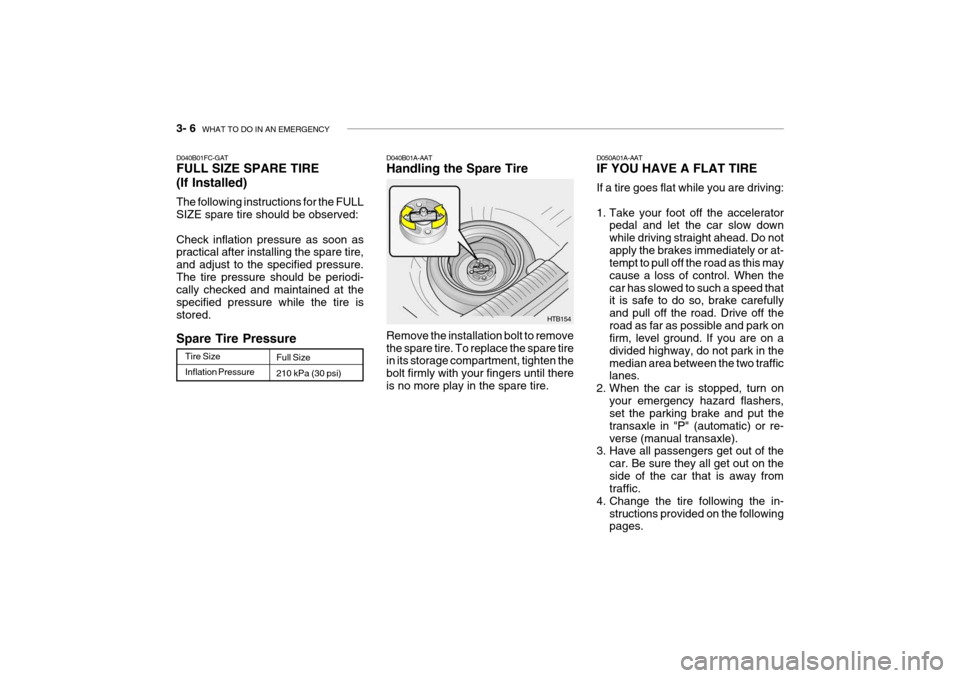
D040B01A-AAT Handling the Spare Tire Remove the installation bolt to remove the spare tire. To replace the spare tire in its storage compartment, tighten the bolt firmly with your fingers until thereis no more play in the spare tire. D050A01A-AAT IF YOU HAVE A FLAT TIRE If a tire goes flat while you are driving:
1. Take your foot off the accelerator
pedal and let the car slow down while driving straight ahead. Do notapply the brakes immediately or at- tempt to pull off the road as this may cause a loss of control. When thecar has slowed to such a speed that it is safe to do so, brake carefully and pull off the road. Drive off theroad as far as possible and park on firm, level ground. If you are on a divided highway, do not park in themedian area between the two traffic lanes.
2. When the car is stopped, turn on your emergency hazard flashers,set the parking brake and put the transaxle in "P" (automatic) or re-verse (manual transaxle).
3. Have all passengers get out of the
car. Be sure they all get out on theside of the car that is away from traffic.
4. Change the tire following the in- structions provided on the followingpages.
Inflation Pressure
Tire Size
D040B01FC-GAT FULL SIZE SPARE TIRE (If Installed) The following instructions for the FULL SIZE spare tire should be observed: Check inflation pressure as soon as practical after installing the spare tire, and adjust to the specified pressure.The tire pressure should be periodi- cally checked and maintained at the specified pressure while the tire isstored. Spare Tire Pressure
Full Size 210 kPa (30 psi)
Page 176 of 383
WHAT TO DO IN AN EMERGENCY 3- 13
D080D02TB-AAT EMERGENCY TOWING
HTB4004
HTB4005
Towing Hook
CAUTION:
If the car is being towed with all four wheels on the ground, it can be towed only from the front. Be surethat the transaxle is in neutral. Do not tow at speeds greater than 50 km/h (30 mph) and for more than 25km (15 miles). Be sure the steering is unlocked by placing the key in the "ACC" posi-tion. A driver must be in the towed vehicle to operate the steering and brakes.!
(3)Attach a tow cable, chain or strap to
the towing hook on the front bumper.
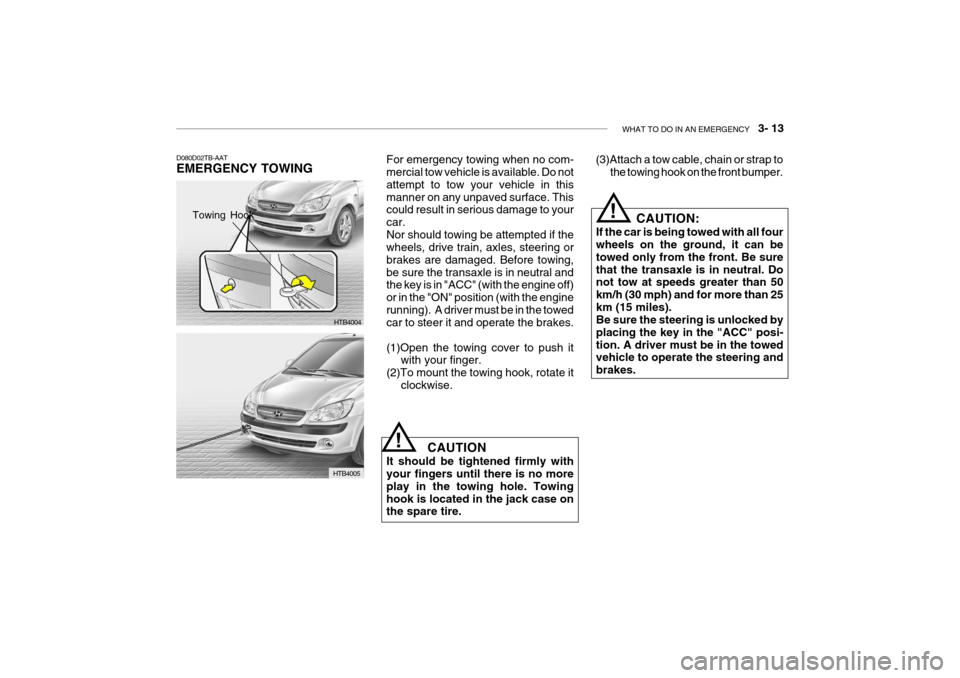
For emergency towing when no com- mercial tow vehicle is available. Do not attempt to tow your vehicle in thismanner on any unpaved surface. This could result in serious damage to your car.Nor should towing be attempted if the wheels, drive train, axles, steering or brakes are damaged. Before towing,be sure the transaxle is in neutral and the key is in "ACC" (with the engine off) or in the "ON" position (with the enginerunning). A driver must be in the towed car to steer it and operate the brakes. (1)Open the towing cover to push it
with your finger.
(2)To mount the towing hook, rotate it clockwise.
CAUTION
It should be tightened firmly with your fingers until there is no more play in the towing hole. Towinghook is located in the jack case on the spare tire.
!
Page 196 of 383

6. Do-It-Yourself Maintenance
Engine compartment ........................................................................ 6-2
General checks ................................................................................ 6-5
Checking the engine oil .................................................................... 6-6
Checking the engine coolant ............................................................ 6-9Changing the air cleaner filter ......................................................... 6-11
Filling the washer reservoir ............................................................ 6-13
Checking the transaxle oil (manual)............................................... 6-14
Checking the transaxle fluid (Automatic)....................................... 6-15
Checking the brakes ...................................................................... 6-17
Air conditioning care ....................................................................... 6-18
Changing the climate control air fil ter .............................................6-19
Checking drive belts ...................................................................... 6-22
Checking and replacing fuses ........................................................ 6-23
Checking the battery ...................................................................... 6-25
Checking electric cooling fans ....................................................... 6-26
Power steering fluid level ............................................................... 6-27
Replacement of bulbs .................................................................... 6-30
Fuse panel description ................................................................... 6-36
6
Page 212 of 383
DO-IT-YOURSELF MAINTENANCE 6- 17
WARNING (DIESEL ONLY):
Never work on injection system with engine running or within 30 secondsafter shutting off engine. High pres- sure pump, rail, injectors and high pressure pipes are subjected to highpressure even after the engine has been switched off. The fuel jet pro- duced by fuel leaks may cause seri-ous injury, if it contacts with the body. People using pacemakers should not move closer than 30cm tothe ECU or wiring harness within the engine room with the engine run- ning, since the high currents in the Common Rail system produce con- siderable magnetic fields.
!
G120A01A-AAT CHECKING THE BRAKES G120B01A-AATChecking the Brake Fluid Level
!
CAUTION:
Because brakes are essential to the safe operation of the car, it is sug- gested that they be checked and inspected by your Hyundai dealer.The brakes should be checked and inspected for wear at those inter- vals specified in the vehicle mainte-nance schedule in Section 5. WARNING:
Use caution when handling brakefluid. It can damage your vision if it gets into your eyes. It will also dam- age your vehicle's paint if spilledon it and not removed immediately.!
G120C02A-AAT Recommended Brake Fluid Use only hydraulic brake fluid con- forming to DOT 3 or DOT 4 specifica- tions in your braking system. Follow the instructions printed on the con-tainer.
Page 250 of 383

10- 2 INDEX
A Active Headrests ........................................................ 1-15
Adjustable headrests .................................................. 1-15
Adjusting arm rest angle .............................................. 1-16
Air Bag ....................................................................... 1-36
Passenger's front airbag O N/OFF switch ................1-40
Side impact airbag ................................................... 1-41
Air Cleaner Filter ......................................................... 6-11
Air Conditioning Care ......................................................................... 6-18
Operation ................................................................. 1-93
Switch ...................................................................... 1-92
Antenna .................................................................... 1-128
Ashtray ....................................................................... 1-67
Audio remote control switch .......................................1-84
Auto Fuel cut Switch .................................................. 1-82
B Battery .............................................................. 2-17, 6-28
Before starting the engine ........................................... 2-3Brake Anti-lock system ...................................................... 2-13
Checking the brakes ................................................ 6-17
Fluid ......................................................................... 6-17
Pedal clearance ....................................................... 6-21
Pedal free play .......................................................... 6-21
Practices ................................................................. 2-12
Breaking-In your New Hyundai .................................... 1-4
Bulbs Replacem ent ..................................................... 6-30
Bulbs wa ttage ............................................................. 6-35C
Care of Cassette Tapes ...........................................
1-126
Care of Disc ............................................................. 1-126
Cargo area cover ........................................................ 1-80
Cassette Tape Player Operation (K220, K240, M280) ........................1-100, 1-105, 1-110
Catalytic Converter ...................................................... 7-3
Central Door Lock ........................................................ 1-9
Child-Protector Rear Door Lock ................................... 1-8
Child Restraint System ............................................... 1-28
Cigarette Lighter ......................................................... 1-66
Climate Control Air Filter .................................. 1-94, 6-19
Clock .......................................................................... 1-66
Clutch
Pedal freep lay .......................................................... 6-21
Combination Light
Headlight flasher ...................................................... 1-60
Headlight swi tch ...................................................... 1-59
High-beam switch .................................................... 1-60
Lane change si gnal .................................................. 1-59
Turn signal operation ............................................... 1-59
Compact Disc Player Operation
(M280, H446) .............................................. 1-113, 1-121
Console tray ............................................................... 1-68
Cooling Fans .............................................................. 6-26
Corrosion protection
Cleaning the interior .................................................. 4-5
Protecting your Hyundai from corrosion ................... 4-2
Washing and waxing ................................................. 4-3
Page 289 of 383

DRIVING YOUR HYUNDAI 2- 11
C090H01A-EAT NOTE:
o The brake pedal should be de-
pressed when shifting from NEU- TRAL to a forward or reversegear.
o The brake pedal fully depressed
in order to move the shift leverfrom the "P" (Park) position to any of the other positions.
o It is always possible to shift from "R", "N", "D", "2", "L" position.
!
C090I04A-EAT
CAUTION:
o Shift into "R", "D" and "P" only when the vehicle has completely stopped.
o Do not accelerate the engine in
reverse or any of the forward posi- tions with the brakes applied.
o Always apply the footbrake when shifting from "P" or "N", to "R", "D", "2" or "L" position.
o Do not use the "P" (Park) position
in place of the parking brake. Al- ways set the parking brake, shift the transaxle into "P" (Park) and turn off the ignition when you leave the vehicle, even momentarily. Never leave the vehicle unattended whilst the engine is running.
o When accelerating from a stop on
a steep hill, the vehicle may have a tendency to roll backwards. Shift- ing the shift lever into 2nd gear will help prevent the vehicle from rolling backwards.
o Check the automatic transaxle fluid
level regularly, and add fluid as necessary.
o See the maintenance schedule for the proper fluid recommendation. FC120D2-E General Operating Instructions
o The button in the selector handle
must be depressed before the se- lector can be moved.
o The engine may only be started
when the selector is at position "P"or "N".
o Ensure that the footbrake is firmly
applied when shifting from "P" or"N" to "D", "2", "L" or "R" and vice versa.
o Always engage the parking brake when the vehicle is unattended,never use the "P" position in place of the parking brake.
o Under normal circumstances, the selector should be placed in the "D"position and the transaxle allowedto select the most ideal ratio for the circumstances. In this position maxi- mum fuel economy will be achieved.
o When descending steep gradients where engine braking is required,the selector should be placed at the"2" or "L" position depending upon the vehicle speed.
Page 290 of 383
2- 12 DRIVING YOUR HYUNDAI
o When climbing steep gradients us-
ing large throttle openings, the transaxle may re-peatedly changebetween two adjacent ratios. This is a normal characteristic and may be prevented by cancelling the over-drive facility if the shifting occurs between third and fourth ratios, se- lecting position "2" if the shiftingoccurs between third and second ratios or selecting position "1" if the shifting occurs between first andsecond ratios.
o Never move the selector to or from
the "P" or "N" position with the ac-celerator depressed.
o Ensure that the overdrive switch is
at the "ON" position for maximumeconomy.
o If rapid acceleration is required, fully
depress the accelerator pedal. Inthis condition, the kickdown mecha- nism will be operated and the transaxle will automatically down-shift according to the vehicle speed. o The automatic transaxle may be used
to great effect if the vehicle becomesstuck in snow or mud by allowing thevehicle to be rocked to and fro. The engine speed should be held at ap- proximately 1,000rpm by means ofthe accelerator pedal and the selec- tor lever moved between the "D" and "R" positions to induce a rockingmotion.
o Do not depress the accelerator pedal
with the brakes applied and the se-lector at the "R", "D", "2" or "L" position.
o Turn the overdrive switch on for
good fuel economy and smooth driv-ing. But if engine braking is needed in the "D" range or if repeated up-shifting and downshifting between the 3rd and 4th gear is needed when climbing a gentle slope, it is recom-mended that the overdrive switch be turned off. Turn the overdrive switch back on immediately after-ward.
!WARNING:
o Avoid high cornering speeds.
o Do not make quick steering wheel movements, such as sharp lane changes or fast, sharp turns.
o Always wear your seat belts. In a collision crash, an unbeltedperson is significantly more likely to die than a person wearing aseatbelt.
o The risk of rollover is greatly in-
creased if you lose control of yourvehicle at highway speeds.
o Loss of control often occurs if two
or more wheels drop off the road-way and the driver oversteers to reenter the roadway.
o In the event your vehicle leaves the roadway, do not steer sharply.Instead, slow down before pulling back into the travel lanes.
o Never exceed posted speed limits.
o Excessive depressing of the
accelerater pedal under the tire slip condition such as moving out of the mud or fresh snow etc, may cause severe damage to thetransaxle. At this time, take other way such as towing.
Page 291 of 383
DRIVING YOUR HYUNDAI 2- 13
HTB217-D
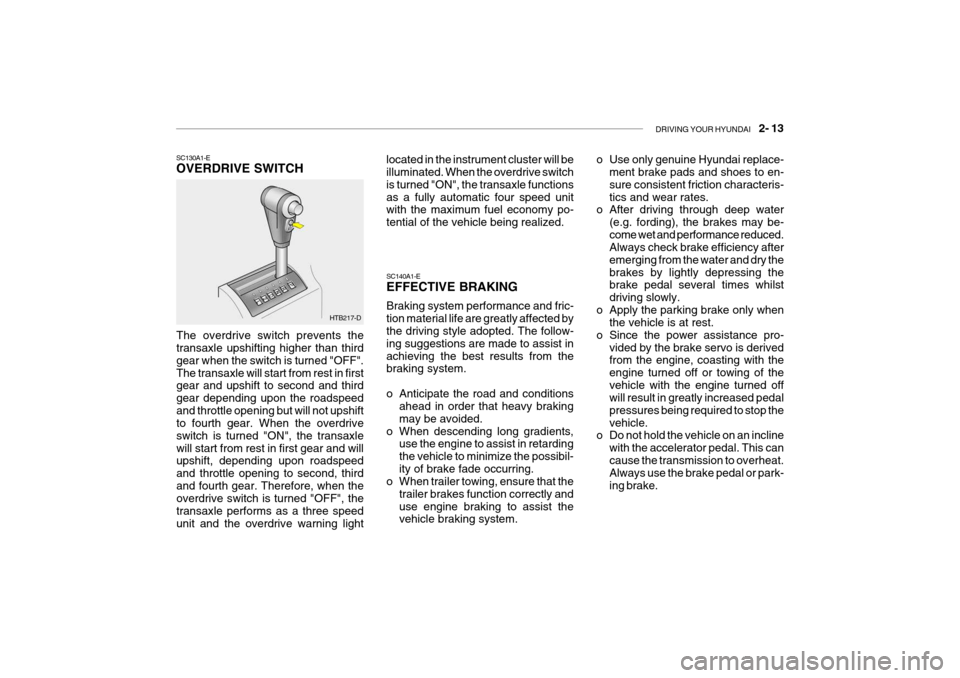
SC130A1-E OVERDRIVE SWITCH
The overdrive switch prevents the transaxle upshifting higher than third gear when the switch is turned "OFF".The transaxle will start from rest in first gear and upshift to second and third gear depending upon the roadspeedand throttle opening but will not upshift to fourth gear. When the overdrive switch is turned "ON", the transaxlewill start from rest in first gear and will upshift, depending upon roadspeed and throttle opening to second, thirdand fourth gear. Therefore, when the overdrive switch is turned "OFF", the transaxle performs as a three speedunit and the overdrive warning light located in the instrument cluster will be illuminated. When the overdrive switch is turned "ON", the transaxle functionsas a fully automatic four speed unit with the maximum fuel economy po- tential of the vehicle being realized. SC140A1-E EFFECTIVE BRAKING Braking system performance and fric- tion material life are greatly affected by the driving style adopted. The follow- ing suggestions are made to assist inachieving the best results from the braking system.
o Anticipate the road and conditions
ahead in order that heavy braking may be avoided.
o When descending long gradients, use the engine to assist in retardingthe vehicle to minimize the possibil-ity of brake fade occurring.
o When trailer towing, ensure that the
trailer brakes function correctly anduse engine braking to assist the vehicle braking system. o Use only genuine Hyundai replace-
ment brake pads and shoes to en- sure consistent friction characteris-tics and wear rates.
o After driving through deep water
(e.g. fording), the brakes may be-come wet and performance reduced. Always check brake efficiency after emerging from the water and dry thebrakes by lightly depressing the brake pedal several times whilst driving slowly.
o Apply the parking brake only when the vehicle is at rest.
o Since the power assistance pro- vided by the brake servo is derived from the engine, coasting with the engine turned off or towing of thevehicle with the engine turned off will result in greatly increased pedal pressures being required to stop thevehicle.
o Do not hold the vehicle on an incline
with the accelerator pedal. This cancause the transmission to overheat. Always use the brake pedal or park- ing brake.
Page 292 of 383
2- 14 DRIVING YOUR HYUNDAI
!WARNING:
ABS will not prevent accidents due to improper or dangerous driving maneuvers. Even though vehicle control is improved during emer-gency braking, always maintain a safe distance between you and ob- jects ahead. Vehicle speeds shouldalways be reduced during extreme road conditions. The braking distance for carsequipped with an anti-lock braking system may be longer than for those without it in the following road con- ditions.
o Driving on rough, gravel or snow- covered roads.
o Driving with tyre chains installed.
o Driving on roads where the road surface is pitted or has differentsurface height.
These roads should be driven atreduced speeds. The safety featuresof an ABS equipped vehicle should not be tested by high speed driving or cornering. This could endangerthe safety of yourself or others.
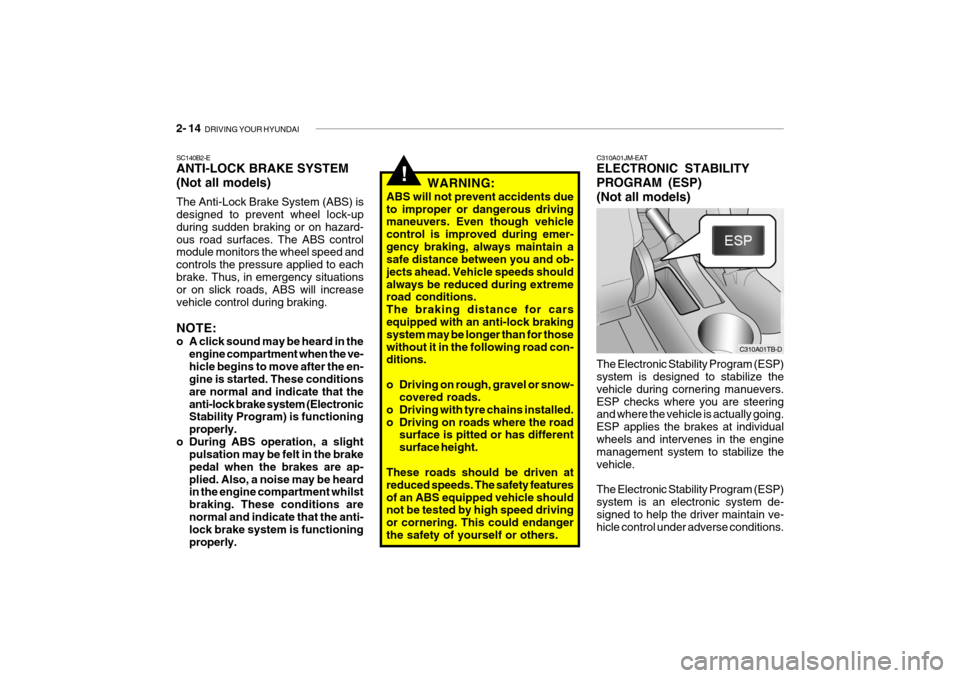
SC140B2-E ANTI-LOCK BRAKE SYSTEM (Not all models) The Anti-Lock Brake System (ABS) is designed to prevent wheel lock-up during sudden braking or on hazard-ous road surfaces. The ABS control module monitors the wheel speed and controls the pressure applied to eachbrake. Thus, in emergency situations or on slick roads, ABS will increase vehicle control during braking. NOTE:
o A click sound may be heard in the
engine compartment when the ve- hicle begins to move after the en- gine is started. These conditions are normal and indicate that theanti-lock brake system (Electronic Stability Program) is functioning properly.
o During ABS operation, a slight pulsation may be felt in the brakepedal when the brakes are ap-plied. Also, a noise may be heard in the engine compartment whilst braking. These conditions arenormal and indicate that the anti- lock brake system is functioning properly.
C310A01JM-EAT ELECTRONIC STABILITY PROGRAM (ESP)(Not all models) The Electronic Stability Program (ESP) system is designed to stabilize the vehicle during cornering manuevers.ESP checks where you are steering and where the vehicle is actually going. ESP applies the brakes at individualwheels and intervenes in the engine management system to stabilize the vehicle. The Electronic Stability Program (ESP) system is an electronic system de-signed to help the driver maintain ve- hicle control under adverse conditions. C310A01TB-D