service Hyundai Getz 2008 Owner's Guide
[x] Cancel search | Manufacturer: HYUNDAI, Model Year: 2008, Model line: Getz, Model: Hyundai Getz 2008Pages: 383, PDF Size: 9.23 MB
Page 201 of 383
6- 6 DO-IT-YOURSELF MAINTENANCE
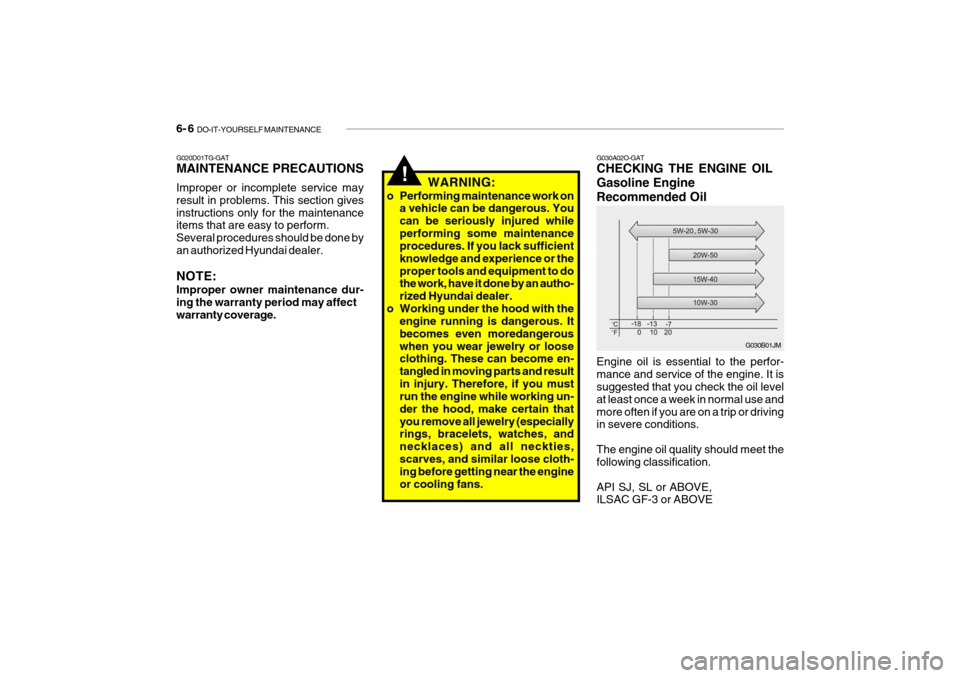
G030A02O-GAT CHECKING THE ENGINE OIL Gasoline EngineRecommended Oil Engine oil is essential to the perfor- mance and service of the engine. It is suggested that you check the oil level at least once a week in normal use andmore often if you are on a trip or driving in severe conditions. The engine oil quality should meet the following classification. API SJ, SL or ABOVE, ILSAC GF-3 or ABOVE G030B01JM
!
G020D01TG-GAT MAINTENANCE PRECAUTIONS Improper or incomplete service may result in problems. This section givesinstructions only for the maintenance items that are easy to perform. Several procedures should be done byan authorized Hyundai dealer. NOTE: Improper owner maintenance dur- ing the warranty period may affectwarranty coverage.
WARNING:
o Performing maintenance work on a vehicle can be dangerous. Youcan be seriously injured whileperforming some maintenance procedures. If you lack sufficient knowledge and experience or theproper tools and equipment to do the work, have it done by an autho- rized Hyundai dealer.
o Working under the hood with the engine running is dangerous. Itbecomes even moredangerouswhen you wear jewelry or loose clothing. These can become en- tangled in moving parts and resultin injury. Therefore, if you must run the engine while working un- der the hood, make certain thatyou remove all jewelry (especially rings, bracelets, watches, and necklaces) and all neckties,scarves, and similar loose cloth- ing before getting near the engine or cooling fans.
Page 202 of 383
DO-IT-YOURSELF MAINTENANCE 6- 7
G030B01TB
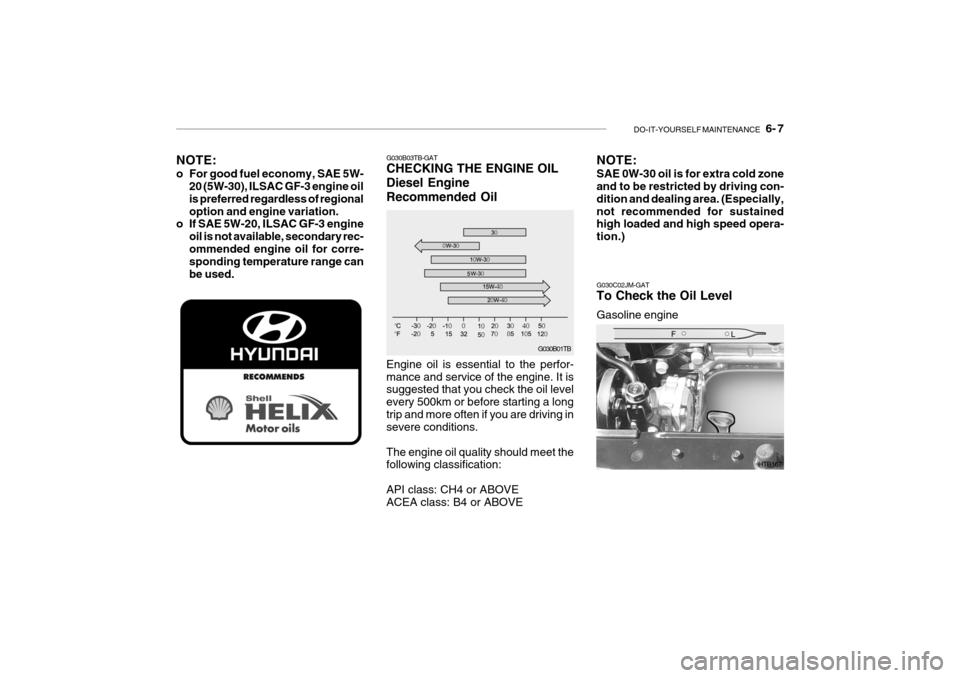
G030B03TB-GAT CHECKING THE ENGINE OIL Diesel EngineRecommended Oil Engine oil is essential to the perfor- mance and service of the engine. It is suggested that you check the oil level every 500km or before starting a longtrip and more often if you are driving in severe conditions. The engine oil quality should meet the following classification: API class: CH4 or ABOVE ACEA class: B4 or ABOVE
NOTE:
o For good fuel economy, SAE 5W-
20 (5W-30), ILSAC GF-3 engine oil is preferred regardless of regionaloption and engine variation.
o If SAE 5W-20, ILSAC GF-3 engine
oil is not available, secondary rec-ommended engine oil for corre- sponding temperature range can be used.
G030C02JM-GAT To Check the Oil Level Gasoline engine
HTB167
NOTE: SAE 0W-30 oil is for extra cold zone and to be restricted by driving con- dition and dealing area. (Especially,not recommended for sustained high loaded and high speed opera- tion.)
Page 204 of 383
DO-IT-YOURSELF MAINTENANCE 6- 9
G350A01A-GAT ENGINE OIL CONSUMPTION Function of Engine Oil Engine oil has the primary function of lubricating and cooling the inside of the engine. Engine oil consumption It is normal that an engine should consume some engine oil while nor-mal driving. The cause of oil consump- tion in a normal engine are as follows;
o Engine oil is used to lubricate pis-
tons, piston rings and cylinders. A thin film of oil is left on the cylinderwall when a piston moves down- wards in the cylinder. High negative pressure generated during engineoperation sucks some of the oil into the combustion chamber. This oil with some oil of the cylinderwall is burned by the high tempera-
ture combustion gases during the combustion process.
o The engine oil consumption is strongly effected by the viscosityand quality of oil, engine rpm anddriving condition etc. The engine oil is more consumed under severe driving conditions such as highspeeds and frequent acceleration and deceleration than normal driv- ing condition.
!
NOTE:
o It is recommended that the engine oil and filter should be changed by an authorized Hyundai dealer.
o Always dispose of used engine oil in an environmentally acceptablemanner. It is suggested that it beplaced in a sealed container and taken to a service station for recla- mation. Do not pour the oil on theground or put it into the house- hold trash.
WARNING:
Used motor oil may cause irritation or cancer of the skin if left in contact with the skin for prolonged periods of time. Wash your hands thoroughlywith soap and warm water as soon as possible after handling used oil. G050A01TG-AAT CHECKING THE ENGINE COOL- ANT
WARNING:
Do not remove the radiator cap when the engine is hot. When the engine is hot, the engine coolant is underpressure and may erupt through the opening if the cap is removed. You could be seriously burned ifyou do not observe this precau- tion. Do not remove the radiator cap until the radiator is cool to thetouch.
!
NOTE: It is recommended that the engine coolant should be changed by an authorized Hyundai dealer.
Page 244 of 383
8- 6 CONSUMER INFORMATION
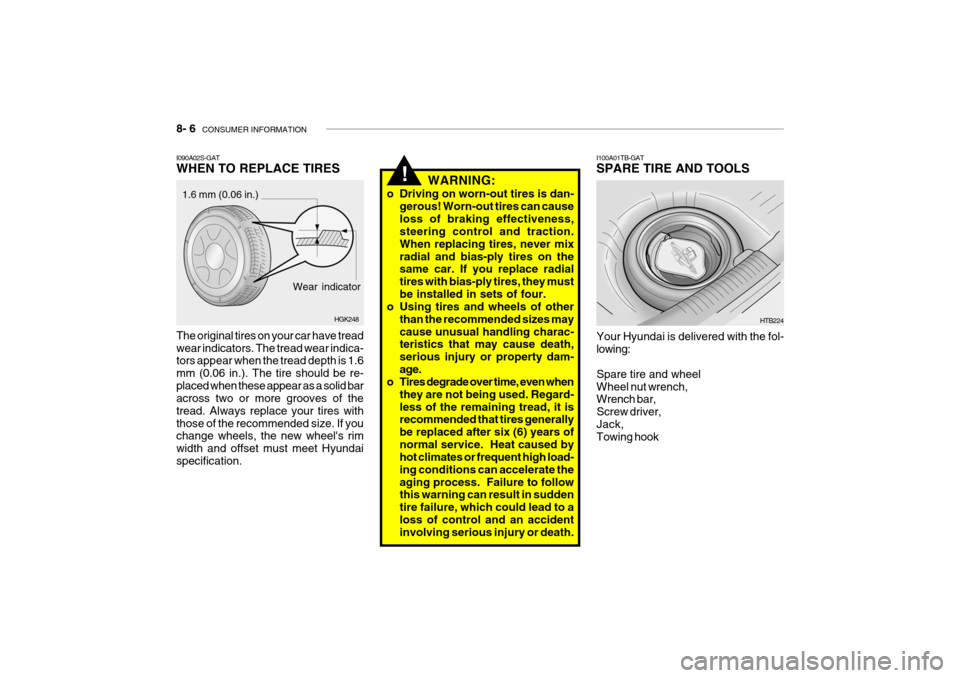
I100A01TB-GAT SPARE TIRE AND TOOLS
Your Hyundai is delivered with the fol- lowing: Spare tire and wheel Wheel nut wrench, Wrench bar, Screw driver,Jack, Towing hook HTB224
WARNING:
o Driving on worn-out tires is dan- gerous! Worn-out tires can cause
loss of braking effectiveness, steering control and traction. When replacing tires, never mixradial and bias-ply tires on the same car. If you replace radial tires with bias-ply tires, they mustbe installed in sets of four.
o Using tires and wheels of other
than the recommended sizes maycause unusual handling charac- teristics that may cause death, serious injury or property dam-age.
o Tires degrade over time, even when
they are not being used. Regard-less of the remaining tread, it is recommended that tires generally be replaced after six (6) years ofnormal service. Heat caused by hot climates or frequent high load- ing conditions can accelerate theaging process. Failure to follow this warning can result in sudden tire failure, which could lead to aloss of control and an accident involving serious injury or death.
!
The original tires on your car have tread wear indicators. The tread wear indica- tors appear when the tread depth is 1.6 mm (0.06 in.). The tire should be re-placed when these appear as a solid bar across two or more grooves of the tread. Always replace your tires withthose of the recommended size. If you change wheels, the new wheel's rim width and offset must meet Hyundaispecification.
I090A02S-GAT WHEN TO REPLACE TIRES
Wear indicator
1.6 mm (0.06 in.)
HGK248
Page 252 of 383

10- 4 INDEX
H Hazard Warning System ............................................. 1-64
Headlight Aiming Adjustm ent ...................................... 6-31
Headlight Leveling Device S ystem .............................1-68
Headlight flasher ......................................................... 1-60
Headlight switch ......................................................... 1-59
Heating and cooling control ........................................ 1-86
Heating and Ventilation ............................................... 1-87
Air flow control ......................................................... 1-88
Air intake control ..................................................... 1-88
Bi-level heating ........................................................ 1-91
Fan speed control .................................................... 1-87
Temperature control ................................................. 1-90
High-Mounted Rear Stop Light.................................... 1-76
Hood Release ............................................................. 1-77
How to use luggage room ........................................... 1-80
Horn ............................................................................ 1-84
IIgnition Switch ............................................................. 2-3
Immobilizer System ..................................................... 1-5
Instrument Cluster and Indicator light ......................... 1-46
IInterior Light Interior light .............................................................. 1-72
Map light .................................................................. 1-71
Intermittent Wiper ....................................................... 1-63
JJump Starting .............................................................. 3-3 K
Key .............................................................................. 1-4
If you lose your keys .............................................. 3-14
Positions ................................................................... 2-4
Keyless entry system ................................................. 1-11
LLane change si gnal ..................................................... 1-59
Lubrication Chart .......................................................... 9-4
Luggage Net ............................................................... 1-81
Luggage Board ............................................................ 1-81
Luggage Under Tray ................................................... 1-80
Lumbar Support Control .............................................. 1-16
MMaintenance Intervals Explanation of scheduled maintenance items................................................................................. 5-8
Maintenance under severe usage conditions ............ 5-7
Scheduled maintenance ............................................ 5-4
Service requirements ................................................ 5-2
Mirrors
Day-night inside rearview ......... ................................1-75
Outside rearview mirror heater .................................1-75
O
Odometer .................................................................... 1-56
Outside rear view mirror ............................................. 1-73
Electric type ............................................................ 1-74
Manual type ............................................................. 1-73
Page 258 of 383

F2
Responsibilty For Maintenance
It is the responsibility of the vehicle owner/driver to ensure that all routine mainte- nance services are undertaken in line with the recommendations specified in Section 5 of this manual. In addition, in order to ensure continued validity of the new vehiclewarranty and safe operation of the vehicle, non scheduled maintenance/running repairers should be undertaken at the earliest available opportunity. Under severe operating conditions, more frequent maintenance is required. Detailsof the maintenance schedule for such conditions are also given in section 5. It is recommended that all maintenance operations and repairers are entrusted to a Hyundai authorised repairer to ensure that the latest repairer methods, specializedtooling and genuine Hyundai parts are used to ensure the continued reliability and safety of the vehicle.
SA020A1-E
Page 259 of 383

F3
SA030A1-E
FOREWORD
Hyundai Motor Company wish to take this opportunity to thank you for purchasing a Hyundai product and to welcome you to the ever increasing number of discriminating motorists who drive Hyundai vehicles. The advanced engineering and construction methods employed during both design and production of the Hyundaimarque are something of which we are proud, and this commitment to providing a high quality product is supported by a comprehensive after sales and warranty service of which we are equally proud. This owners manual will introduce the operating and maintenance requirements for the vehicle and it is recommended that it is carefully read to ensure that the maximum performance and durability along with safe and satisfactory operation are obtained. The recommended routine maintenance servicing along with anyrunning repairers that may be required should be entrusted to a Hyundai authorised repairer to ensure that only the latest methods and genuine Hyundai replacement parts are used for the continued reliability, safety and performance of the vehicle. Should any question or query exist regarding any aspect of your Hyundai please contact the nearest Hyundai authorised repairer who will be only too pleased to assist wherever possible. Note: This owners manual should be considered as part of the vehicle and should be kept in the vehicle at
all times for ease of reference. In the event of the vehicle being sold please ensure that this manual is left in the vehicle for the reference of the new owner.
CAUTION:
Severe engine and transaxle damage may result from the use of poor quality fuels and lubricants that do not meet Hyundai specifications. You must always use high quality fuels and lubricants that meet the specifications listed on Page 9-4 in the Vehicle Specifications section of the Owner's Manual. Copyright 2008 Hyundai Motor Company. All rights reserved. No part of this publication may be reproduced, stored in any retrieval system or transmitted in any form or by any means without the prior written permissionof Hyundai Motor Company.
!
Page 266 of 383

YOUR VEHICLE AT A GLANCE
F10
B255A01TB-EAT INDICATOR SYMBOLS ON THE INSTRUMENT PANEL * A detail explanations of these items will be found on page 1-46.
SRS (Airbag) Service Reminder Indicator ABS Service Reminder Indicator Turn Signal Indicator Lights High Beam Indicator Light Low Oil Pressure Warning Light Parking Brake/Brake Fluid Level Warning Light Charging System Warning LightTail Gate Open Warning Light Door Open (Ajar) Warning Light and Chime
Low Fuel Level Warning Light Malfunction Indicator Light Seat Belt Warning Light
O/D OFF Indicator (Automatic transaxle only)
Electric Power Steering System (EPS)Warning Light
Diesel Pre-heat Indicator Light (Diesel only)
Fuel Filter Warning Light (Diesel only)
Immobilizer Warning Light
Passenger's Front Airbag OFFIndicator Light
Electronic Stability Program Indicator Lights (If Installed)
Engine Coolant Temperature Indicator
Page 285 of 383
DRIVING YOUR HYUNDAI 2- 7
!
!
C055B01B-GAT STARTING AND STOPPING THE ENGINE FOR TURBO CHARGERINTERCOOLER (DIESEL EN-GINE)
(1) Do not race the engine or sudden
accelerate the engine immediately after start it. If the engine is cold, allow the engine to idle for severalseconds before it is driven to en- sure sufficient lubrication of the turbo charger unit.
(2) After high speed or extended driv- ing, requiring a heavy engine load,the engine should be allowed to idleabout 1 minute before turning it off. This idle time will allow the turbo charger to cool prior to shutting theengine off.
WARNING:
Do not turn the engine off immedi- ately after it has been subjected to a heavy load. Doing so may causesevere damage to the engine or turbo charger unit.
WARNING:
Be sure that the clutch is fully de- pressed when starting a manualtransaxle vehicle. Otherwise there is the potential to cause damage to the vehicle or injury to someoneinside or outside the vehicle as a result of the forward or backward movement of the vehicle that willoccur if the clutch is not depressed when the vehicle is started. SC060B1-E FUEL ECONOMY The following suggestions are made to assist in achieving the greatest degreeof fuel economy.
o Maintaining a constant check on
fuel consumption will enable the most economical use pattern and driving style to be adopted.
o Avoid using the vehicle for very short journeys if possible, particu-larly when a cold start is involved.
o Ensure that tyre pressures are main- tained at the correct level.
o Use only the recommended grade of fuel.
o Avoid carrying unnecessary weight,
and if a roof rack is in use, removeit as soon as possible after use.
o Anticipate the road and conditions
ahead to enable adjustments in speedto be made smoothly. Avoid heavy acceleration and sharp braking.
o Avoid cruising at unnecessary high speeds.
o Always ensure that the periodic main-
tenance services are performed by a Hyundai authorised repairer at the time and/or mileage intervals specified.
o Use the air conditioning only when necessary.
5. Turn the ignition key to the "Start"
position and release it when the engine starts.
Page 294 of 383

2- 16 DRIVING YOUR HYUNDAI
o Don't "ride" the brake or clutch pedal.
This can increase fuel consumption and also increase wear on thesecomponents. In addition, driving with your foot resting on the brake pedal may cause the brakes to overheat,which reduces their effectiveness and may lead to more serious con- sequences.
o Take care of your tyres. Keep them inflated to the recommended pres-sure. Incorrect infla-tion, either toomuch or too little, results in unnec- essary tyre wear. Check the tyre pressures at least once a month.
o Be sure that the wheels are aligned correctly. Improper alignment canresult from hitting curbs or drivingtoo fast over irregular surfaces. Poor alignment causes faster tyre wear and may also result in other prob-lems as well as greater fuel con- sumption. o Keep your car in good condition. For
better fuel economy and reduced maintenance costs, maintain yourcar in accordance with the mainte- nance schedule in Section 5. If you drive your car in severe conditions,more frequent maintenance is re- quired (see Section 5 for details).
o Keep your car clean. For maximum
service, your car should be keptclean and free of corrosive materi- als. It is especially important thatmud, dirt, ice, etc. not be allowed to accumulate on the underside of the car. This extra weight can result inincreased fuel consumption and also contribute to corrosion.
o Travel lightly. Don't carry unneces-
sary weight in your car. Weight is anenemy of good fuel economy.
o Don't let the engine idle longer than
necessary. If you are waiting (andnot in traffic), turn off your engine and restart only when you're readyto go.
SC150A1-F DRIVING FOR ECONOMY You can save fuel and get more miles from your car if you follow these sug-gestions:
o Drive smoothly. Accelerate at a
moderate rate. Don't make "jack- rabbit" starts or full-throttle shifts and maintain a steady cruisingspeed. Don't race between stop- lights. Try to adjust your speed to that of the other traffic so you don'thave to change speeds unneces- sarily. Avoid heavy traffic whenever pos-sible. Always maintain a safe dis- tance from other vehicles so you can avoid unnecessary braking. Thisalso reduces brake wear.
o Drive at a moderate speed. The faster
you drive, the more fuel your caruses. Driving at a moderate speed, especially on the highway, is one of the most effective ways to reducefuel consumption.