service Hyundai Getz 2008 Owner's Guide
[x] Cancel search | Manufacturer: HYUNDAI, Model Year: 2008, Model line: Getz, Model: Hyundai Getz 2008Pages: 383, PDF Size: 9.23 MB
Page 311 of 383
WHAT TO DO IN AN EMERGENCY 3- 11
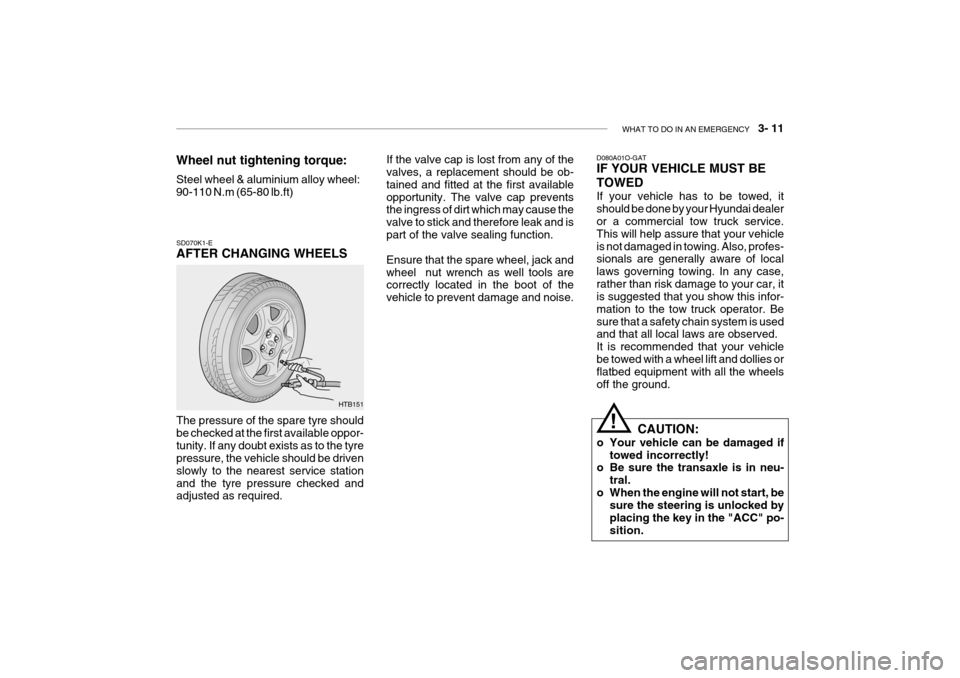
HTB151
SD070K1-E AFTER CHANGING WHEELS The pressure of the spare tyre should be checked at the first available oppor-tunity. If any doubt exists as to the tyre pressure, the vehicle should be driven slowly to the nearest service stationand the tyre pressure checked and adjusted as required. D080A01O-GAT IF YOUR VEHICLE MUST BE TOWED If your vehicle has to be towed, it should be done by your Hyundai dealer or a commercial tow truck service. This will help assure that your vehicleis not damaged in towing. Also, profes- sionals are generally aware of local laws governing towing. In any case,rather than risk damage to your car, it is suggested that you show this infor- mation to the tow truck operator. Besure that a safety chain system is used and that all local laws are observed. It is recommended that your vehiclebe towed with a wheel lift and dollies or flatbed equipment with all the wheels off the ground.
!
CAUTION:
o Your vehicle can be damaged if towed incorrectly!
o Be sure the transaxle is in neu-
tral.
o When the engine will not start, be sure the steering is unlocked by placing the key in the "ACC" po-sition.
Wheel nut tightening torque: Steel wheel & aluminium alloy wheel: 90-110 N.m (65-80 lb.ft)
If the valve cap is lost from any of the valves, a replacement should be ob- tained and fitted at the first availableopportunity. The valve cap prevents the ingress of dirt which may cause the valve to stick and therefore leak and ispart of the valve sealing function. Ensure that the spare wheel, jack and wheel nut wrench as well tools are correctly located in the boot of the vehicle to prevent damage and noise.
Page 321 of 383

5- 2 VEHICLE MAINTENANCE REQUIREMENTS
SF020A1-E MAINTENANCE AND SERVICING REQUIREMENTS To ensure the continued reliability and safety of the vehicle, certain routinemaintenance operations are required at specific mileage or time intervals. It is the responsibility of the vehicle owner to ensure that the maintenance schedules shown in both this OwnersManual and the Warranty and Service Passport are adhered to. The new vehicle warranty may be invalidated if the routine maintenance operations are not performed in line with the recommendations outlinedand the safety and durability of the vehicle adversely affected. It is recommended that all mainte- nance operations with the exception of the daily operating checks are en-trusted to a Hyundai authorised re- pairer to ensure that the latest repairer and maintenance procedures andspecialised servicing tools are em- ployed. In addition, the use of genuine Hyundai replacement parts will ensurethat the vehicle safety and perfor- mance will not be compromised. NOTE:
The inspection and testing of cer-
tain electronic fuel injection/engine management and automatic trans- mission control systems require specialised electronic equipmentspecifically designed for Hyundai vehicles. The use of general pur- pose electrical test equipment mayresult in damage to the control unit microprocessors.
SF020C2-E
Specified Scheduled Procedures
The Specified scheduled procedures
are listed in the maintenance charts beginning at page 5-3. The opera- tions specified must be performed at the time or mileage intervals shownirrespective of whether the mileage interval has been reached before the specified time interval. Certain lubricants and components
degrade with both time and mileage(e.g. engine oil and brake fluid) and therefore it is not permissable to base the maintenance schedule upon mile-age alone. It is strongly recommended that the maintenance operations are performed by the factory-trained ordistributor-trained technicians at your Hyundai authorised repairer becauseof the need for specialised knowledge and tooling and to ensure that no possibility of invalidating the manufac-turers warranty exists.
The maintenance schedules relate to
vehicles operated under normal con- ditions, vehicles which are operated under adverse conditions will requiremore frequent maintenance which is described at page 5-6. NOTE:
Service schedules may change de-
pending on individual country needs. Please ask your localHyundai authorised repairer for a copy of the service schedule that relates to that country.
SF030B1-E
SERVICE HISTORY
It is important that all scheduled main-
tenance services are recorded in thewarranty and service passport to en-sure that proof of maintenance is avail- able when warranty service is required.
Page 322 of 383

VEHICLE MAINTENANCE REQUIREMENTS 5- 3
ENGINE CONTROL SYSTEM MAINTENANCE (PETROL)
1 ENGINE OIL & FILTER
2 DRIVE BELT (WATER PUMP, ALTERNATOR & A/CON)
3 FUEL FILTER (MPI) See Note (1)
4 FLUID LEAKS
5 TIMING BELT
6 VENTILATION HOSES
7 AIR CLEANER FILTER
8 SPARK PLUGS
9 VALVE CLEARANCE (1.1L)
AF040C4-E
SCHEDULED MAINTENANCE
In order to ensure the continued safety, reliability and longevity of the vehicle, the following maintenance service operations should be performed at the time or mileage intervals specified. It is recommended that all routine maintenance services are entrusted to a Hyundai authorised repairer to ensure that the manufacturers recommended procedures are employed and that only genuine Hyundai replacement parts are used. Incorrect maintenance techniques or the use of non genuine replacement parts may invalidate the vehicle warranty. F030B05TB-EAT R : Replace I : Inspect and, after inspection, clean, adjust, repairer or replace if necessary
Note : (1) IN CASE OF HARD STARTING OR ABNORMAL FUEL PRESSURE, REPLACE THE FUEL FILTER IMME- DIATELY REGARDLESS OF MAINTENANCE SCHEDULE.
(2) FOR EVERY 25,000 MILES : "R" (3) INSPECT AND ADJUST EVERY 60,000 MILE OR 48 MONTHS.
NO. DESCRIPTION60 72
5060
4048
3036
2024
1012
MILES X 1000 MONTHS
R
I II
R
R
I
R
I
R
I I I I I
R
II
R
R
I II I
R
I I
See Note (2) See Note (3)
Page 325 of 383

5- 6 VEHICLE MAINTENANCE REQUIREMENTS
MAINTENANCE UNDER SEVERE USAGE CONDITIONS
The following items must be serviced more frequently on cars normally used under severe driving conditions. Refer to the chart below for the appropriate maintenance intervals. R : REPLACE I : INSPECT AND, AFTER INSPECTION, CLEAN, ADJUST, REPAIRER OR REPLACE IF NECESSARY
F040A02TB-EAT
ENGINE OIL AND FILTER AIR CLEANER FILTERSPARK PLUGSTIMING BELTBRAKE PADSREAR BRAKE LININGS AND CYLINDERSSUSPENSION AND STEERING SYSTEM MANUAL TRANSAXLE OIL AUTOMATIC TRANSAXLE FLUIDPOLLEN FILTER(FOR EVAPORATOR AND BLOWER UNIT) EVERY 6,000 MILESMORE FREQUENTLY
MORE FREQUENTLY EVERY 37,000 MILES OR 48 MONTHSMORE FREQUENTLYMORE FREQUENTLY MORE FREQUENTLY EVERY 60,000 MILESEVERY 27,000 MILES
MORE FREQUENTLY
MAINTENANCE OPERATIONMAINTENANCE ITEM
R RR RI II
RR R A, B, C, D, E, F, G, H, I, K C, EB, I D, E, F, G, I C, D, G, HC, D, G, HC, D, E, F C, D, E, G, H, I, J E, F, G, H, I C,E
MAINTENANCE INTERVALS
DRIVING
CONDITION
SEVERE DRIVING CONDITIONS
A - Repeatly driving short distance of less than 5miles(8km) in normal temperature or less than 10miles(16km) in freezing temperature
B - Extensive engine idling or low speed driving for long distances
C - Driving on rough, dusty, muddy, unpaved, graveled or salt- spread roads
D - Driving in areas using salt or other corrosive materials or in very cold weather E - Driving in sandy areas
F - Driving in heavy traffic area over 90°F(32°C) G - Driving on uphill, downhill, or mountain roadH - Towing a Trailer, or using a camper, or roof rack
I - Driving as a patrol car, taxi, other commercial use or vehicle towing
J - Driving over 100 MPH(170 Km/h)K - Frequently driving in stop-and-go conditions
Page 328 of 383

VEHICLE MAINTENANCE REQUIREMENTS 5- 9
F070C01A-AAT
o Engine coolant
The coolant should be changed at
the intervals specified in the mainte- nance schedule. F070B01A-GAT
o Cooling system
Check the cooling system part, suchas radiator, coolant reservoir, hoses and connections for leakage and dam- age. Replace any damaged parts. F070D01A-AAT
o Manual transaxle oil
Inspect the manual transaxle oil ac- cording to the maintenance schedule.
NOTE: If the oil level is low, check forpossible leaks before adding oil. Do not overfill. F070F01A-AAT
o Brake hoses and lines
Visually check for proper installation,
chafing, cracks, deterioration and any leakage. Replace any deteriorated or damaged parts immediately. F070G02A-AAT o Brake fluid Check brake fluid level in the brake fluid reservoir. The level should be between "MIN" and "MAX" marks on the side of the reservoir. Use onlyhydraulic brake fluid conforming to DOT 3 or DOT 4. F070H01B-AAT o Rear brake drums and linings/ parking brake Check the rear brake drums and lin- ings for scoring, burning, leaking fluid, broken parts, and excessive wear. Inspect the parking brake system in-cluding the parking brake lever and cables. For detailed service proce- dures, refer to the Shop Manual.
F070E05A-AAT
o Automatic Transaxle Fluid
The fluid level should be in the "HOT"
range of the dipstick, after the engine and transaxle are at normal operating temperature. Check the automatictransaxle fluid level with the engine running and the transaxle in neutral, with the parking brake properly ap-plied. Use Hyundai Genuine ATF SP- III, DIAMOND ATF SP-III, SK ATF SP-III or other brands approved byHyundai Motor Co., when adding or changing fluid.
Page 334 of 383
DO-IT-YOURSELF MAINTENANCE 6- 5
!
G020D01TG-EAT MAINTENANCE PRECAUTIONS Improper or incomplete service may result in problems. This section givesinstructions only for the maintenance items that are easy to perform. Several procedures should be done byan authorised Hyundai dealer. NOTE: Improper owner maintenance dur- ing the warranty period may affectwarranty coverage. WARNING:
o Performing maintenance work on a vehicle can be dangerous. You can be seriously injured while performing some maintenanceprocedures. If you lack sufficient knowledge and experience or the proper tools and equipment to dothe work, have it done by an authorised Hyundai dealer.
o Working under the hood with the engine running is dangerous. Itbecomes even more dangerous when you wear jewelry or looseclothing. These can become en- tangled in moving parts and result in injury. Therefore, if you mustrun the engine while working un- der the hood, make certain that you remove all jewelry (especiallyrings, bracelets, watches, and necklaces) and all neckties, scarves, and similar loose cloth-ing before getting near the engine or cooling fans.
SG020B1-E DAILY OPERATING CHECKS The following items should be checked on a daily basis or whenever the vehicleis refuelled, whichever occurs sooner.
o Engine oil level.
o Engine coolant level.
o Power steering fluid level.
o Brake fluid level.
o Windscreen washer fluid level.
o Battery condition.
o Tyre condition and pressures.
o Operation and cleanliness of all light-
ing equipment.
o Windscreen wiper and washer opera- tion.
o Horn operation.
o Warning light operation.
o Adjustment and cleanliness of mir- rors.
o Seat and seat belt adjustment and operation.
o Fluid leakage. The vehicle must not be driven if the daily operating checks indicate that any item of equipment related to thesafety or roadworthiness of the vehicle is not functioning correctly.
Page 352 of 383
DO-IT-YOURSELF MAINTENANCE 6- 23
!
SG220A1-E ELECTRIC COOLING FANS
WARNING:
The cooling fan is controlled by en- gine coolant temperature and maysometimes operate even when the engine is not running. Use extreme caution when working near theblades of the cooling fan so that you are not injured by a rotating fan blade. As the engine coolant tem-perature decreases, the fan will auto- matically shut off. This is a normal condition. The engine cooling fan should operate before the temperature gauge reachesthe upper portion of the scale and the condenser fan should operate when- ever the air conditioning is in use. SG230B1-E POWER STEERING HOSES Power steering hoses should be checked for damage, deterioration and leakage at each service.
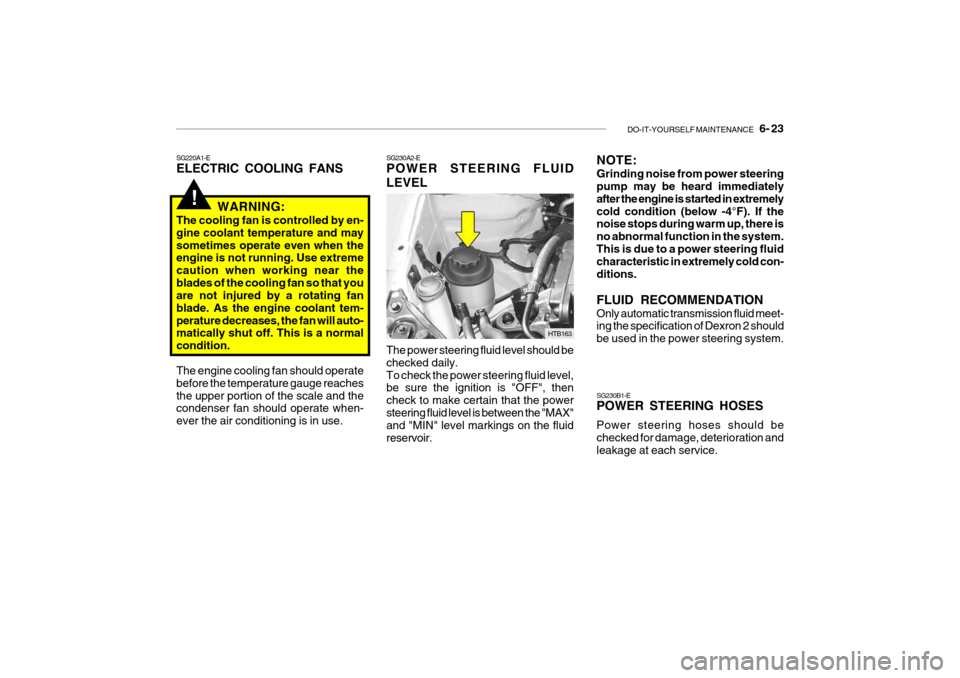
NOTE: Grinding noise from power steering pump may be heard immediately after the engine is started in extremelycold condition (below -4°F). If the noise stops during warm up, there is no abnormal function in the system.This is due to a power steering fluid characteristic in extremely cold con- ditions. FLUID RECOMMENDATION Only automatic transmission fluid meet- ing the specification of Dexron 2 should be used in the power steering system.SG230A2-E POWER STEERING FLUID LEVEL The power steering fluid level should be checked daily.To check the power steering fluid level, be sure the ignition is "OFF", then check to make certain that the powersteering fluid level is between the "MAX" and "MIN" level markings on the fluid reservoir.
HTB163
Page 365 of 383
EMISSION CONTROL SYSTEMS 7- 3
H020A01TB-EAT
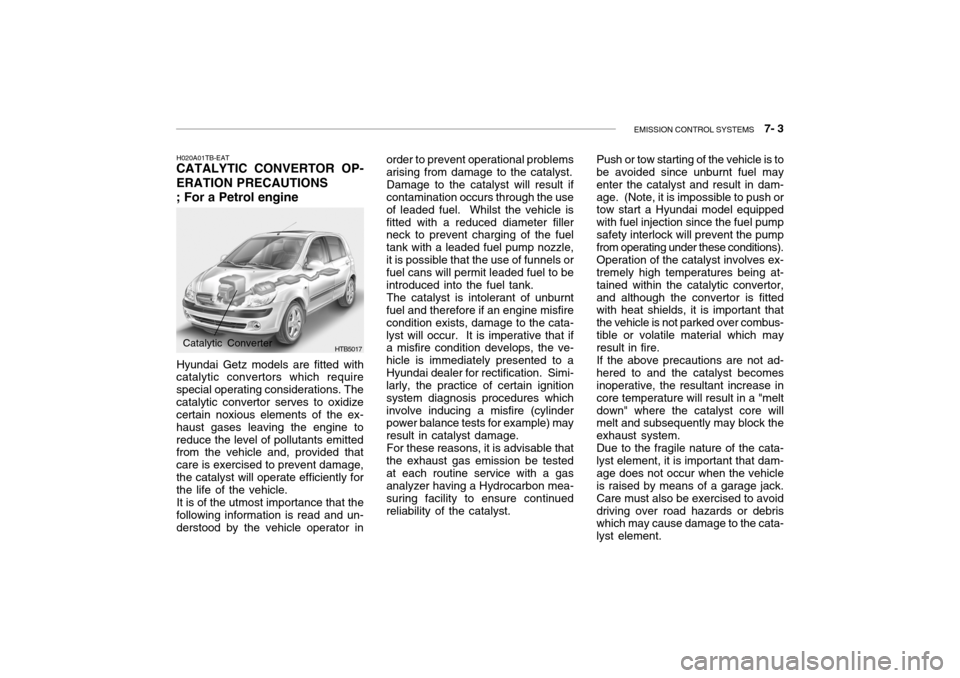
CATALYTIC CONVERTOR OP- ERATION PRECAUTIONS ; For a Petrol engine
Hyundai Getz models are fitted with
catalytic convertors which require special operating considerations. Thecatalytic convertor serves to oxidize certain noxious elements of the ex- haust gases leaving the engine toreduce the level of pollutants emitted from the vehicle and, provided that care is exercised to prevent damage,the catalyst will operate efficiently for the life of the vehicle.
It is of the utmost importance that the
following information is read and un-derstood by the vehicle operator in
HTB5017Catalytic Converter order to prevent operational problems arising from damage to the catalyst.
Damage to the catalyst will result if
contamination occurs through the use of leaded fuel. Whilst the vehicle isfitted with a reduced diameter filler neck to prevent charging of the fuel tank with a leaded fuel pump nozzle,it is possible that the use of funnels or fuel cans will permit leaded fuel to be introduced into the fuel tank.
The catalyst is intolerant of unburnt
fuel and therefore if an engine misfirecondition exists, damage to the cata-lyst will occur. It is imperative that if a misfire condition develops, the ve- hicle is immediately presented to aHyundai dealer for rectification. Simi- larly, the practice of certain ignition system diagnosis procedures whichinvolve inducing a misfire (cylinder power balance tests for example) may result in catalyst damage.
For these reasons, it is advisable that
the exhaust gas emission be testedat each routine service with a gas analyzer having a Hydrocarbon mea- suring facility to ensure continuedreliability of the catalyst. Push or tow starting of the vehicle is to be avoided since unburnt fuel may enter the catalyst and result in dam-age. (Note, it is impossible to push or tow start a Hyundai model equipped with fuel injection since the fuel pumpsafety interlock will prevent the pump from operating under these conditions). Operation of the catalyst involves ex- tremely high temperatures being at- tained within the catalytic convertor,and although the convertor is fitted with heat shields, it is important that the vehicle is not parked over combus-tible or volatile material which may result in fire. If the above precautions are not ad- hered to and the catalyst becomes inoperative, the resultant increase in core temperature will result in a "meltdown" where the catalyst core will melt and subsequently may block the exhaust system.Due to the fragile nature of the cata-lyst element, it is important that dam-age does not occur when the vehicle is raised by means of a garage jack. Care must also be exercised to avoiddriving over road hazards or debris which may cause damage to the cata- lyst element.
Page 371 of 383
CONSUMER INFORMATION 8- 5
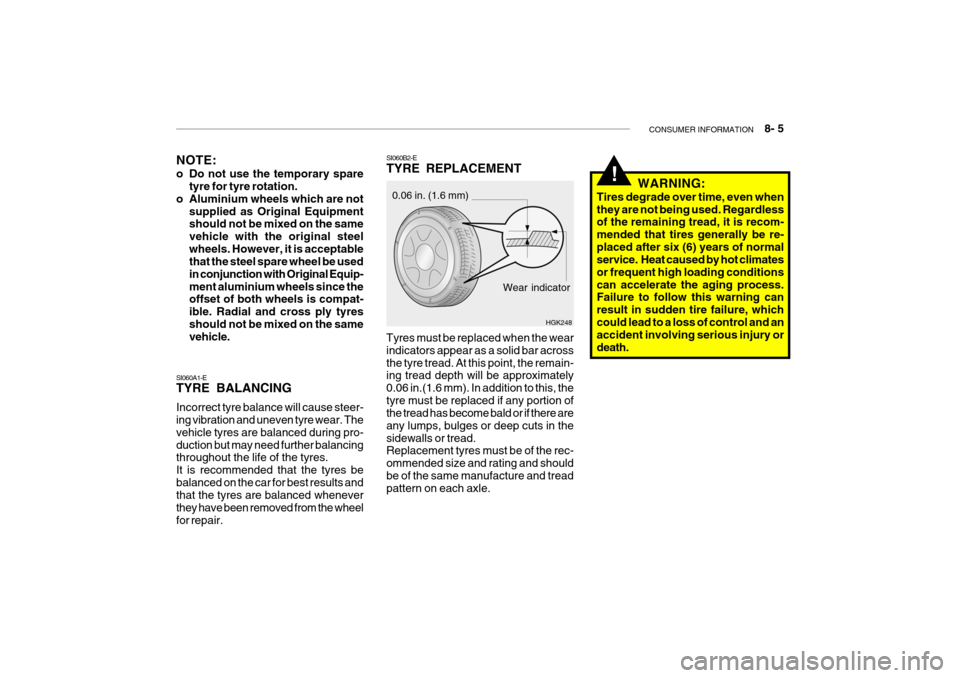
SI060B2-E TYRE REPLACEMENT
Wear indicator
0.06 in. (1.6 mm)
HGK248
NOTE:
o Do not use the temporary spare
tyre for tyre rotation.
o Aluminium wheels which are not
supplied as Original Equipment should not be mixed on the same vehicle with the original steelwheels. However, it is acceptable that the steel spare wheel be used in conjunction with Original Equip-ment aluminium wheels since the offset of both wheels is compat- ible. Radial and cross ply tyresshould not be mixed on the same vehicle.
SI060A1-E TYRE BALANCING Incorrect tyre balance will cause steer- ing vibration and uneven tyre wear. The vehicle tyres are balanced during pro-duction but may need further balancing throughout the life of the tyres. It is recommended that the tyres bebalanced on the car for best results and that the tyres are balanced whenever they have been removed from the wheelfor repair. Tyres must be replaced when the wearindicators appear as a solid bar acrossthe tyre tread. At this point, the remain- ing tread depth will be approximately 0.06 in.(1.6 mm). In addition to this, thetyre must be replaced if any portion of the tread has become bald or if there are any lumps, bulges or deep cuts in thesidewalls or tread. Replacement tyres must be of the rec- ommended size and rating and shouldbe of the same manufacture and tread pattern on each axle.
!WARNING:
Tires degrade over time, even when they are not being used. Regardless of the remaining tread, it is recom- mended that tires generally be re-placed after six (6) years of normal service. Heat caused by hot climates or frequent high loading conditionscan accelerate the aging process. Failure to follow this warning can result in sudden tire failure, whichcould lead to a loss of control and an accident involving serious injury or death.
Page 381 of 383

INDEX 10- 5
SEAT BELT PRECAUTIONS ......................................1-20
SEAT BELTS ............................................................. 1-22
SEAT POCKET .......................................................... 1-79
SEAT WARMER ......................................................... 1-19
SERVICE HISTORY .................................................... 5-2
SMOOTH CORNERING .............................................. 2-17
SNOW TYRES ............................................................. 8-4
SPARE TYRE .............................................................. 3-5
SPARE TYRE AND TOOLS ........................................ 8-6 SPARE WHEEL ........................................................... 3-6
SPECTACLE CASE .................................................... 1-71
SPEEDOMETER ........................................................ 1-53
SUPPLEMENTAL RESTRAINT (AIRBAG) SYSTEM ................................................................ 1-34
STARTING THE ENGINE ............................................ 2-5
STEERING WHEEL LOCK .......................................... 2-4STEERING WHEEL TILT LEVER ............................... 1-83
STEREO SOUND SYSTEM ....................................... 1-94
SUN-VISOR ................................................................ 1-82
SUNROOF .................................................................. 1-67
TTACHOMETER ........................................................... 1-54
TOWING ATTACHMENTS .......................................... 2-19
TRAILER AND CARAVAN TOWING ........................... 2-19TRIP ODOMETER
...................................................... 1-54
TRIP COMPUTER ...................................................... 1-55
TYPE PRESSURES .................................................... 8-3
TYRE BALANCING ...................................................... 8-5
TYRE CHAINS ............................................................. 8-4
TYRE REPLACEMENT ............................................... 8-5
TYRE ROTATION ........................................................ 8-4
UUNDERBODY COATINGS ........................................... 4-2
V VALETING ................................................................... 4-3
VEHICLE IDENTIFICATION NUMBER ........................ 8-2
VEHICLE SPECIFICATION ............ ............................. 9-2
VEHICLE TOWING OR RECOVERY .......................... 3-11
VENTILATION ............................................................ 1-85
W WHEEL REPLACEMENT ............................................ 8-6
WINDSCREEN WASHER RESERVOIR REPLENISHMENT ................................................. 6-13
WINDSCREEN WIPER BLADES ................................ 6-12
WINDSHIELD WIPER/WASHER SWITCH ..................1-59
WINTER MOTORING ................................................. 2-17