bonnet Hyundai Getz 2009 Owner's Manual - RHD (UK, Australia)
[x] Cancel search | Manufacturer: HYUNDAI, Model Year: 2009, Model line: Getz, Model: Hyundai Getz 2009Pages: 191, PDF Size: 6.3 MB
Page 9 of 191

YOUR VEHICLE AT A GLANCE
F9
1. Glove Box
2. Passenger's Airbag (If installed)
3. Audio System (If installed)
4. Hazard Warning Light
5. Digital Clock
6. Windshield Wiper/Washer Switch
7. Horn and Driver's Airbag (If installed)
8. Instrument Cluster
9. Multi-Function Light Switch
10. Front Fog Light Switch (If installed)
11. Rear Drink Holder
CAUTION:
When installing a container of liquid air freshener inside a vehicle, do not place it near the instrument cluster nor on the instrument panel pad surface. If there is any leakage from the airfreshener onto these areas (instrument cluster, instrument panel pad or air ventilator), it may damage these parts. If the liquid from the air freshener does leak onto these areas, wash them with water immediately. 12. Hand Brake Lever
13. Shift Lever (If installed)
14. Front Drink Holder
15. Ashtray
16. Power Outlelet
17. Heating/Air Conditioning Control Panel
(If installed)
18. Audio Remote Control Switch (If installed)
19. Fuse Box
20. Bonnet Release Lever
!
Page 12 of 191
1. FEATURES OF YOUR HYUNDAI
Fuel Recommendations ................................................................... 1-2
Running in Your New Hyundai ......................................................... 1-3
Immobiliser system .......................................................................... 1-3
Door locks ........................................................................................ 1-4Power windows.............................................................................. 1-11
Seat ................................................................................................ 1-11
Seat Belt ..... .................................................................................... 1-18
Child restraint system .................................................................... 1-23
Supplemental restraint (AIRBAG) system .....................................1-28
Instrument cluster and indicator lights ............................................1-35
Warning Light and Indicator ............................................................ 1-37
Trip computer ................................................................................. 1-44
Multi-Function Light Switch............................................................ 1-46
Windshield wiper/Washer Switch ...................................................1-48
Sunroof ........................................................................................... 1-54
Mirror ......... ..................................................................................... 1-58
Bonnet Release .............................................................................. 1-62
How to use luggage Room ............................................................. 1-66
Heating and cooling control ............................................................ 1-71
Stereo sound system ..................................................................... 1-80
Antenna .......................................................................................... 1-84
1
Page 18 of 191
FEATURES OF YOUR HYUNDAI 1- 7
B070B01TB-D
NOTE:
o When pushing the switch toward
the rear, all doors and tail gate will unlock.When pushing the switch toward the front, all doors and tail gate will lock.
o When the door is unlocked, the red mark on the switch is visibleand the character "LOCK" on theswitch is visible.
o The central door locking is oper-
ated by turning the key (with theft-alarm system: driver's door and passenger's door, without theft- alarm system: driver's door only)toward the front or rear of the vehicle.
o If the door is locked/unlocked mul- tiple times in rapid successionwith either the vehicle key or door lock switch, the system may stopoperating temporarily in order to protect the circuit and prevent damage to system components. B070A01A-DAT THEFT-ALARM SYSTEM (If Installed) This system is designed to provide protection from unauthorised entry into the car. This system is operated inthree stages: the first is the "Armed" stage, the second is the "Alarm" stage, and the third is the "Disarmed" stage.If triggered, the system provides an audible alarm with blinking of the turn signal lights.
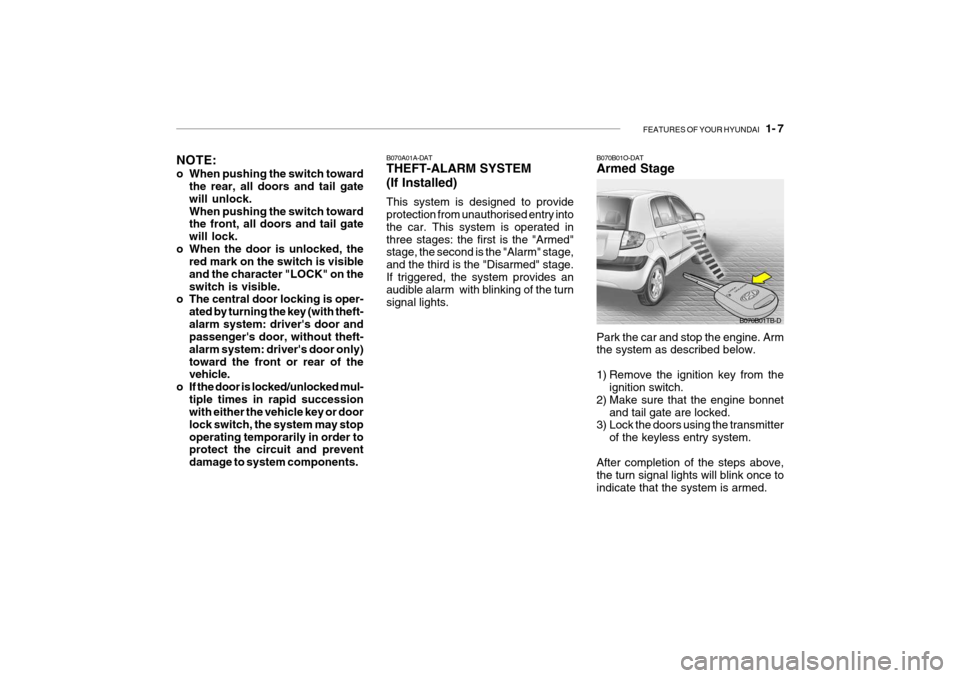
B070B01O-DAT Armed Stage Park the car and stop the engine. Arm the system as described below.
1) Remove the ignition key from the
ignition switch.
2) Make sure that the engine bonnet
and tail gate are locked.
3) Lock the doors using the transmitter
of the keyless entry system.
After completion of the steps above, the turn signal lights will blink once toindicate that the system is armed.
Page 19 of 191
1- 8 FEATURES OF YOUR HYUNDAI
HTB202
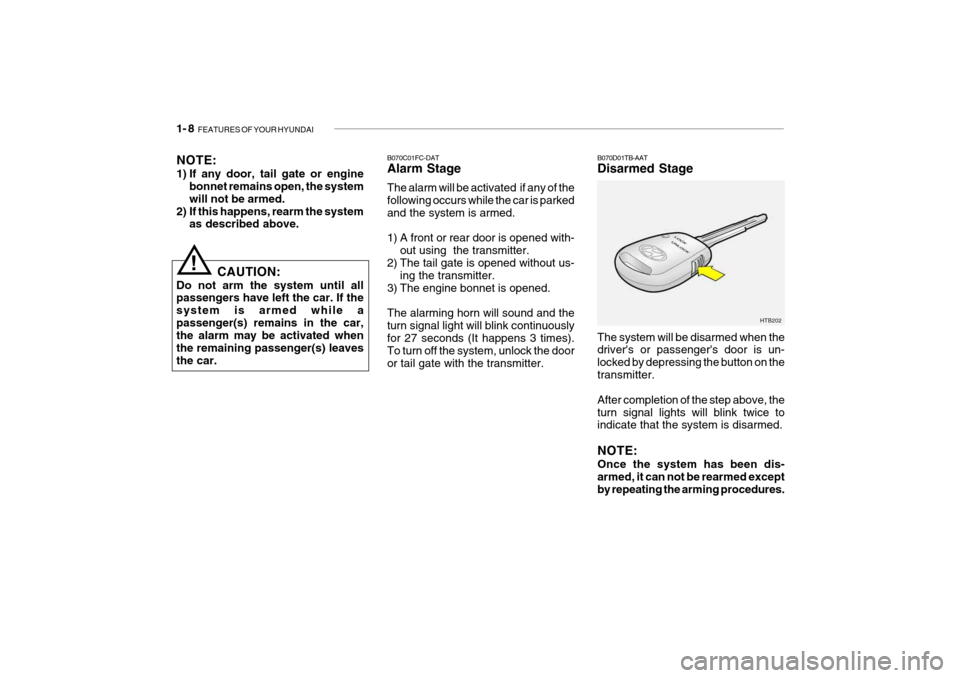
B070D01TB-AAT Disarmed Stage
B070C01FC-DATAlarm Stage The alarm will be activated if any of the following occurs while the car is parkedand the system is armed.
1) A front or rear door is opened with-
out using the transmitter.
2) The tail gate is opened without us-
ing the transmitter.
3) The engine bonnet is opened.The alarming horn will sound and the turn signal light will blink continuously for 27 seconds (It happens 3 times). To turn off the system, unlock the dooror tail gate with the transmitter. The system will be disarmed when the driver's or passenger's door is un- locked by depressing the button on thetransmitter. After completion of the step above, the turn signal lights will blink twice to indicate that the system is disarmed. NOTE: Once the system has been dis- armed, it can not be rearmed except by repeating the arming procedures.
NOTE:
1) If any door, tail gate or engine
bonnet remains open, the system will not be armed.
2) If this happens, rearm the system as described above.
! CAUTION:
Do not arm the system until all passengers have left the car. If the system is armed while apassenger(s) remains in the car, the alarm may be activated when the remaining passenger(s) leavesthe car.
Page 50 of 191
FEATURES OF YOUR HYUNDAI 1- 39
B260J01S-DAT
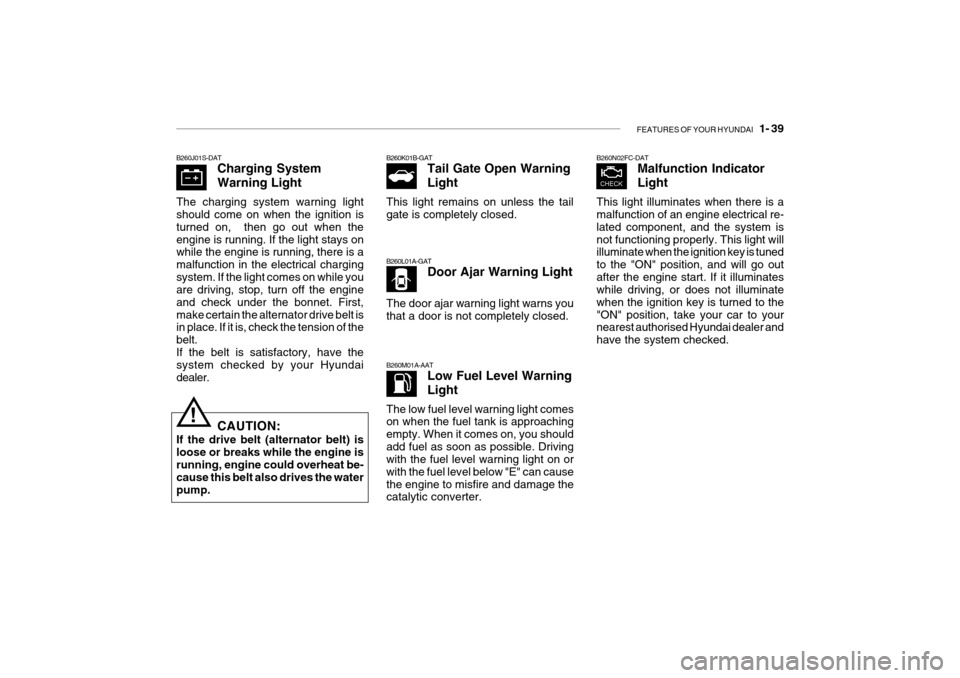
Charging System Warning Light
The charging system warning light should come on when the ignition is turned on, then go out when theengine is running. If the light stays on while the engine is running, there is a malfunction in the electrical chargingsystem. If the light comes on while you are driving, stop, turn off the engine and check under the bonnet. First,make certain the alternator drive belt is in place. If it is, check the tension of the belt.If the belt is satisfactory, have the system checked by your Hyundai dealer. B260L01A-GAT
Door Ajar Warning Light
The door ajar warning light warns you that a door is not completely closed.
B260K01B-GAT
Tail Gate Open Warning Light
This light remains on unless the tail gate is completely closed. B260M01A-AAT Low Fuel Level Warning Light
The low fuel level warning light comes on when the fuel tank is approaching empty. When it comes on, you shouldadd fuel as soon as possible. Driving with the fuel level warning light on or with the fuel level below "E" can causethe engine to misfire and damage the catalytic converter.
!
B260N02FC-DAT Malfunction Indicator Light
This light illuminates when there is a malfunction of an engine electrical re- lated component, and the system isnot functioning properly. This light will illuminate when the ignition key is tuned to the "ON" position, and will go outafter the engine start. If it illuminates while driving, or does not illuminate when the ignition key is turned to the"ON" position, take your car to your nearest authorised Hyundai dealer and have the system checked.
CAUTION:
If the drive belt (alternator belt) isloose or breaks while the engine isrunning, engine could overheat be- cause this belt also drives the water pump.
Page 73 of 191

1- 62 FEATURES OF YOUR HYUNDAI
B750A01TB-DAT BONNET RELEASE
HTB070-D
1. Pull the release knob to unlatch the bonnet. B570A01TB
2. Push the safety catch lever sidewards and lift the bonnet. 3. Pull the support rod from the bonnet.
HTB308
Page 74 of 191

FEATURES OF YOUR HYUNDAI 1- 63
!
B560A01A-DAT REMOTE FUEL-FILLER LID RELEASE The fuel filler lid may be opened from inside the vehicle by pulling up on thefuel filler lid opener located on the front floor area on the right side of the car. NOTE: If the fuel filler lid will not open because ice has formed around it,tap lightly or push on the lid to break the ice and release the lid. Do not pry on the lid. If necessary,spray around the lid with an ap-
proved de-icer fluid (do not use radiator anti-freeze) or move thevehicle to a warm place and allow the ice to melt. HTB115-D
4. Hold the bonnet open with the sup-
port rod.
Before closing the bonnet, return the support rod to its clip to prevent it fromrattling. Lower the bonnet until it is about 30 cm (1 ft.) above the closed position and let it drop. Make sure thatit locks into place.
HTB288 WARNING:
o Always double check to be sure that the bonnet is firmly latched before driving away. If it is notlatched, the bonnet could fly open while the vehicle is being driven, causing a total loss of visibility,which might result in an acci- dent.
o The support rod must be inserted completely into the hole providedin the bonnet whenever you in- spect the engine compartment.This will prevent the bonnet from falling and possibly injuring you.
o Do not move the vehicle with the bonnet in the raised position, asvision is obstructed and the bon- net could fall or be damaged.
CAUTION:
Make sure that the support rod hasbeen released prior to closing the bonnet.
!
Page 120 of 191
3- 4 WHAT TO DO IN AN EMERGENCY
!
!
WARNING:
Do not remove the radiator cap when the engine is hot. This can allow coolant to be blown out of the open- ing and cause serious burns.
6. If you cannot find the cause of the overheating, wait until the engine temperature has returned to nor- mal. Then, if the engine coolant has been lost, carefully remove the ra-diator cap and add engine coolant to bring the fluid level in the reservoir up to the halfway mark.
7. Proceed with caution, keeping alert for further signs of overheating. Ifoverheating happens again, call aHyundai dealer for assistance.
D030A01A-DAT IF THE ENGINE OVERHEATS If your temperature gauge indicates overheating, you experience a loss ofpower, or hear loud pinging or knock- ing, the engine is probably too hot. If this happens, you should:
1. Pull off the road and stop as soon as
it is safe to do so.
2. Place the gear selector lever in "P" (automatic), or neutral (manual transaxle) and set the hand brake. Ifthe air conditioning is on, turn it off.
6. Carefully remove the jumper cables
in the reverse order of attachment.
If you do not know why your battery became discharged (because the lights were left on, etc.), have the chargingsystem checked by your Hyundai dealer. 3. If coolant is running out under the car
or steam is coming out from the bonnet, stop the engine. Do notopen the bonnet until the coolant has stopped running or the steam- ing has stopped. If there is no visibleloss of coolant and no steam, leave the engine running and check to be sure the engine cooling fan is oper-ating. If the fan is not running, turn the engine off.
4. Check to see if the water pump drive belt is missing. If it is not missing,check to see that it is tight. If the drive belt seems to be satisfactory,check for engine coolant leaking from the radiator, hoses or under the car. (If the air conditioning hadbeen in use, it is normal for cold water to be draining from it when you stop).
WARNING:
While the engine is running, keephair, hands and clothing away frommoving parts such as the fan and drive belts to prevent injury. 5. If the water pump drive belt is broken
or engine coolant is leaking out, stop the engine immediately and call thenearest Hyundai dealer for assis- tance.
Page 145 of 191
DO-IT-YOURSELF MAINTENANCE 6- 3
G020A01A-AAT GENERAL CHECKS Engine Compartment The following should be checked regu-larly:
o Engine oil level and condition
o Transaxle fluid level and condition
o Brake fluid level
o Clutch fluid level
o Engine coolant level
o Windshield washer fluid level
o Accessory drive belt condition
o Engine coolant hose condition
o Fluid leaks (on or below compo-
nents)
o Power steering fluid level
o Battery condition G020C01A-DAT Vehicle Interior The following should be checked each time when the vehicle is driven:
o Lights operation
o Windshield wiper operation
o Horn operation
o Defroster, heating system operation
(and air conditioning, if installed)
o Steering operation and condition
o Mirror condition and operation
o Turn signal light operation
o Accelerator pedal operation
o Brake operation, including hand brake
o Manual transaxle operation, includ- ing clutch operation
o Automatic transaxle operation, in- cluding "Park" mechanism operation
o Seat control condition and operation
o Seat belt condition and operation
o Sunvisor operation If you notice anything that does not operate correctly or appears to be functioning incorrectly, inspect it care- fully and seek assistance from yourHyundai dealer if service is needed.
G020B01A-DAT Vehicle Exterior The following should be checked monthly:
o Overall appearance and condition
o Air filter condition
o Wheel condition and wheel nut torque
o Exhaust system condition
o Light condition and operation
o Windshield glass condition
o Wiper blade condition
o Paint condition and body corrosion
o Fluid leaks
o Door and bonnet lock condition
o Tyre pressure and condition (includ-
ing spare tyre)
Page 146 of 191
6- 4 DO-IT-YOURSELF MAINTENANCE
!
G020D01TG-DAT MAINTENANCE PRECAUTIONS Improper or incomplete service may result in problems. This section givesinstructions only for the maintenance items that are easy to perform. Several procedures should be done byan authorised Hyundai dealer. NOTE: Improper owner maintenance dur- ing the warranty period may affectwarranty coverage. WARNING:
o Performing maintenance work on a vehicle can be dangerous. Youcan be seriously injured whileperforming some maintenance procedures. If you lack sufficient knowledge and experience or theproper tools and equipment to do the work, have it done by an authorised Hyundai dealer.
o Working under the bonnet with the engine running is dangerous.It becomes even more dangerouswhen you wear jewelry or loose clothing. These can become en- tangled in moving parts and resultin injury. Therefore, if you must run the engine while working un- der the bonnet, make certain thatyou remove all jewelry (especially rings, bracelets, watches, and necklaces) and all neckties,scarves, and similar loose cloth- ing before getting near the engine or cooling fans.
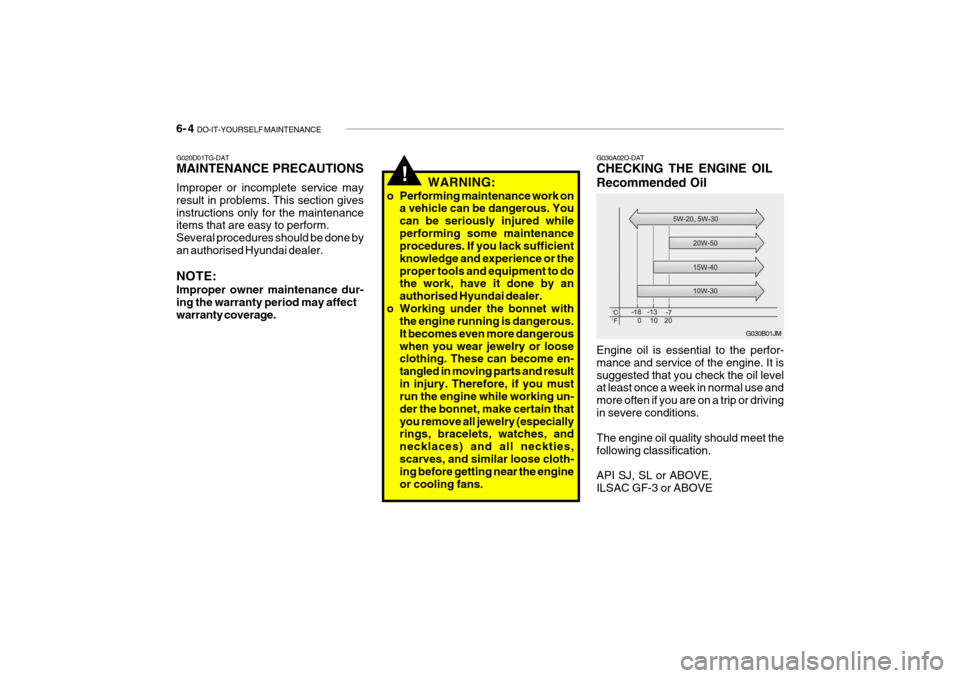
G030B01JM
G030A02O-DAT CHECKING THE ENGINE OIL Recommended Oil Engine oil is essential to the perfor- mance and service of the engine. It issuggested that you check the oil level at least once a week in normal use and more often if you are on a trip or drivingin severe conditions. The engine oil quality should meet the following classification. API SJ, SL or ABOVE, ILSAC GF-3 or ABOVE