stop start Hyundai Getz 2009 Owner's Manual - RHD (UK, Australia)
[x] Cancel search | Manufacturer: HYUNDAI, Model Year: 2009, Model line: Getz, Model: Hyundai Getz 2009Pages: 191, PDF Size: 6.3 MB
Page 14 of 191

FEATURES OF YOUR HYUNDAI 1- 3
B020A01S-DAT RUNNING IN YOUR NEW HYUNDAIDuring the First 2,000 km No formal running in period is required with your new Hyundai. However, you can contribute to the economical op-eration and durability of your Hyundai by observing the following recommen- dations during the first 2,000 km.
o Don't drive faster than 88 km/h.
o While driving, keep your engine
speed or revolutions per minute between 2,000 and 4,000 rpm.
o Use moderate acceleration. Don't use full-throttle starts.
o For the first 300 km, try to avoid
hard braking.
o Don't labour the engine (in other words, don't drive so slowly in too high a gear that the engine jumps:shift to a lower gear).
o Whether going fast or slow, vary
your speed from time to time.
o Don't let the engine idle longer than 3 minutes.
o Do not tow a trailer during the first 2,000 km of operation. B880A01A-DAT IMMOBILISER SYSTEM The immobiliser system is an anti-theft device, designed to deter automobile theft. B880B07A-GAT Keys
!
CAUTION:
o When starting the engine, do not use the key with other immobi- lizer keys in close proximity. Oth- erwise, the engine may not start or may stop soon after it starts.Keep each key separately not to have any malfunction after you receive your new vehicle.
o Do not put metal accessories near the key or ignition switch.The engine may not start for themetal accessories may interrupt the transponder signal from nor- mally transmitting.
OTB028002
All of the locks fitted to the vehicle are operated by the same key. However,since it is possible to lock the doors without the use of the key, care should be exercised to ensure that the keydoes not become locked inside the vehicle by mistake.
!WARNING:
In order to prevent theft of your ve- hicle, do not leave spare keys any- where in your vehicle.
NOTE: If you make your own duplicate key, you will not be able to cancel the system or start the engine.
Page 48 of 191
FEATURES OF YOUR HYUNDAI 1- 37
!
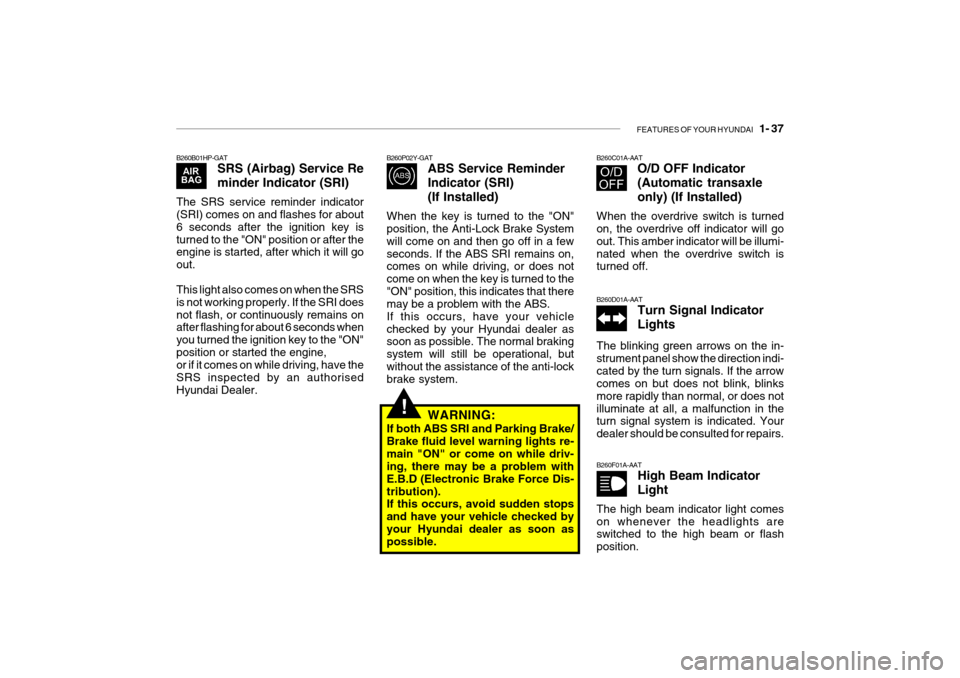
B260B01HP-GAT
SRS (Airbag) Service Re
minder Indicator (SRI)
The SRS service reminder indicator (SRI) comes on and flashes for about 6 seconds after the ignition key isturned to the "ON" position or after the engine is started, after which it will go out. This light also comes on when the SRS is not working properly. If the SRI doesnot flash, or continuously remains on after flashing for about 6 seconds when you turned the ignition key to the "ON"position or started the engine, or if it comes on while driving, have the SRS inspected by an authorisedHyundai Dealer. B260C01A-AAT
O/D OFF Indicator (Automatic transaxle
only) (If Installed)
When the overdrive switch is turned on, the overdrive off indicator will go out. This amber indicator will be illumi-nated when the overdrive switch is turned off. B260D01A-AAT Turn Signal Indicator Lights
The blinking green arrows on the in- strument panel show the direction indi-cated by the turn signals. If the arrow comes on but does not blink, blinks more rapidly than normal, or does notilluminate at all, a malfunction in the turn signal system is indicated. Your dealer should be consulted for repairs.B260P02Y-GAT ABS Service Reminder Indicator (SRI)(If Installed)
When the key is turned to the "ON" position, the Anti-Lock Brake System will come on and then go off in a fewseconds. If the ABS SRI remains on, comes on while driving, or does not come on when the key is turned to the"ON" position, this indicates that there may be a problem with the ABS. If this occurs, have your vehiclechecked by your Hyundai dealer as soon as possible. The normal braking system will still be operational, butwithout the assistance of the anti-lock brake system.
WARNING:
If both ABS SRI and Parking Brake/ Brake fluid level warning lights re-main "ON" or come on while driv- ing, there may be a problem with E.B.D (Electronic Brake Force Dis-tribution). If this occurs, avoid sudden stops and have your vehicle checked byyour Hyundai dealer as soon as possible.
B260F01A-AAT High Beam Indicator Light
The high beam indicator light comes on whenever the headlights are switched to the high beam or flash position.
Page 49 of 191

1- 38 FEATURES OF YOUR HYUNDAI
The brake warning light indicates that the brake fluid level in the brake master cylinder is low and hydraulic brake fluidconforming to DOT 3 or DOT 4 speci- fications should be added. After add- ing fluid, if no other trouble is found, thecar should be carefully driven to a Hyundai dealer for inspection. If fur- ther trouble is experienced, the vehicleshould not be driven at all but taken to a dealer by a professional towing ser- vice or some other safe method. YourHyundai is equipped with dual-diago- nal braking systems. This means you still have braking on two wheels even ifone of the dual systems should fail. With only one of the dual systems working, more than normal pedal traveland greater pedal pressure are re- quired to stop the car. Also, the car will not stop in as short a distance with onlya portion of the brake system working. If the brakes fail while you are driving, shift to a lower gear for additionalengine braking and stop the car as soon as it is safe to do so.
!
B260H03A-DAT
Hand Brake/Brake Fluid Level Warning Light
Warning Light Operation The hand brake/brake fluid level warn- ing light should come on when the hand brake is applied and the ignitionswitch is turned to "ON" or "START". After the engine is started, the light should go out when the hand brake isreleased. If the hand brake is not ap- plied, the warning light should come on when the ignition switch is turned to"ON" or "START", then go out when the engine starts. If the light comes on at any other time, you should slow thevehicle and bring it to a complete stop in a safe location off the roadway. WARNING:
If you suspect brake trouble, haveyour brakes checked by a Hyundai dealer as soon as possible. Drivingyour car with a problem in either the brake electrical system or brake hydraulic system is dangerous, andcould result in serious injury or death.
B260G01A-DAT
Oil Pressure Warning Light CAUTION:
The oil pressure warning light comes on whenever there is insuf- ficient oil pressure. In normal op-eration, it should come on when the ignition switch is turned on, then go out when the engine isstarted. If the oil pressure warning light stays on while the engine is running, there is a serious malfunc-tion. If this happens, stop the car as soon as it is safe to do so, turn off theengine and check the oil level. If the oil level is low, fill engine oil to the proper level and start the engineagain. If the light stays on with the engine running, turn the engine off immediately. In any instance wherethe oil light stays on when the engine is running, the engine should be checked by a Hyundai dealer beforethe car is driven again.
!
Page 50 of 191
FEATURES OF YOUR HYUNDAI 1- 39
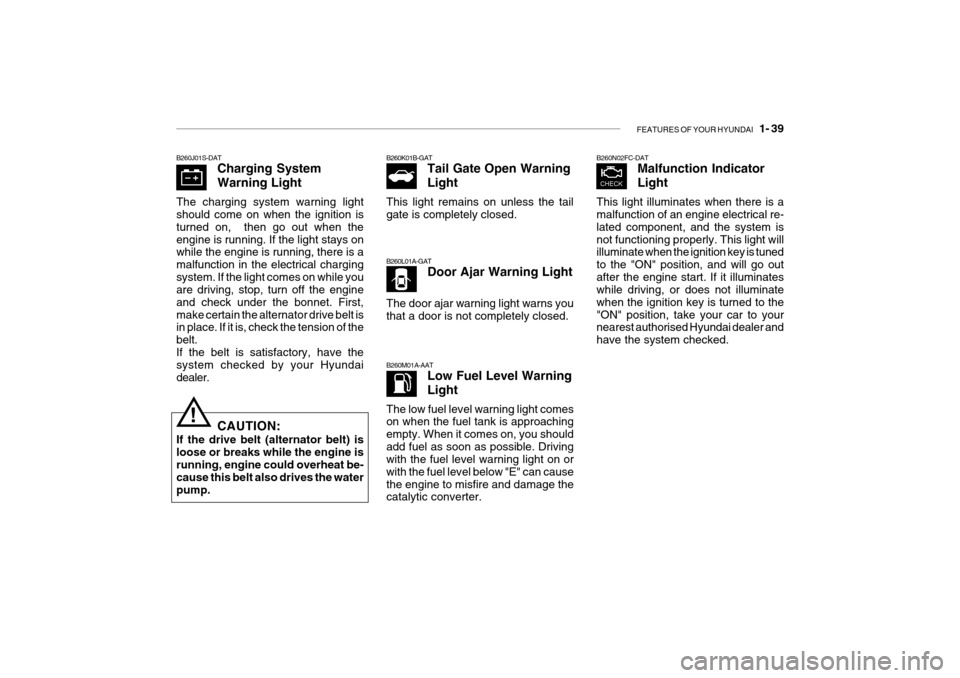
B260J01S-DAT
Charging System Warning Light
The charging system warning light should come on when the ignition is turned on, then go out when theengine is running. If the light stays on while the engine is running, there is a malfunction in the electrical chargingsystem. If the light comes on while you are driving, stop, turn off the engine and check under the bonnet. First,make certain the alternator drive belt is in place. If it is, check the tension of the belt.If the belt is satisfactory, have the system checked by your Hyundai dealer. B260L01A-GAT
Door Ajar Warning Light
The door ajar warning light warns you that a door is not completely closed.
B260K01B-GAT
Tail Gate Open Warning Light
This light remains on unless the tail gate is completely closed. B260M01A-AAT Low Fuel Level Warning Light
The low fuel level warning light comes on when the fuel tank is approaching empty. When it comes on, you shouldadd fuel as soon as possible. Driving with the fuel level warning light on or with the fuel level below "E" can causethe engine to misfire and damage the catalytic converter.
!
B260N02FC-DAT Malfunction Indicator Light
This light illuminates when there is a malfunction of an engine electrical re- lated component, and the system isnot functioning properly. This light will illuminate when the ignition key is tuned to the "ON" position, and will go outafter the engine start. If it illuminates while driving, or does not illuminate when the ignition key is turned to the"ON" position, take your car to your nearest authorised Hyundai dealer and have the system checked.
CAUTION:
If the drive belt (alternator belt) isloose or breaks while the engine isrunning, engine could overheat be- cause this belt also drives the water pump.
Page 61 of 191
1- 50 FEATURES OF YOUR HYUNDAI
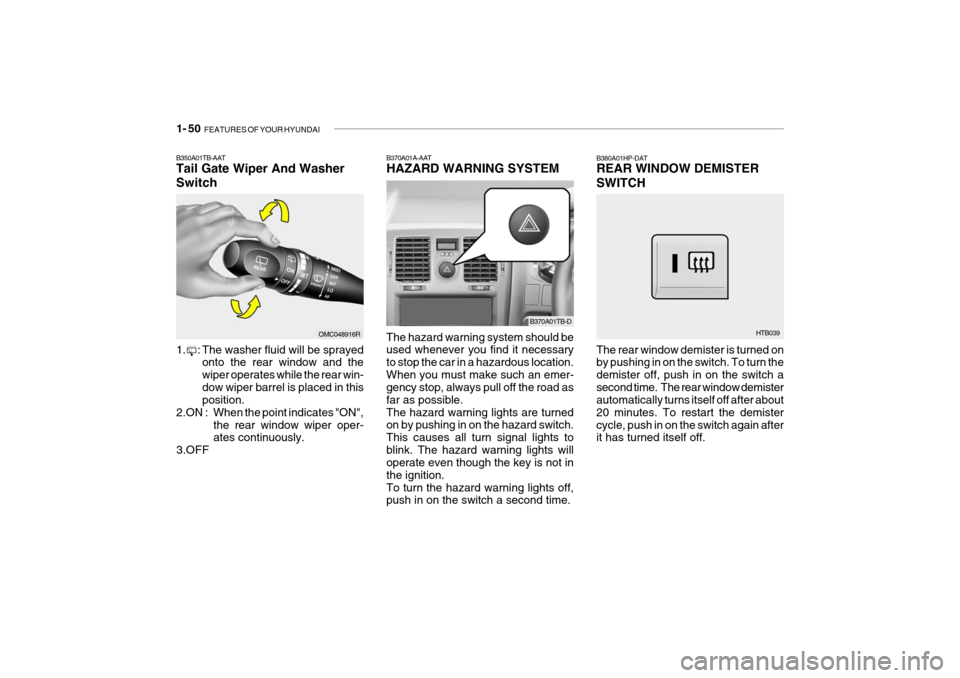
B370A01A-AAT HAZARD WARNING SYSTEM The hazard warning system should be used whenever you find it necessary to stop the car in a hazardous location.When you must make such an emer- gency stop, always pull off the road as far as possible.The hazard warning lights are turned on by pushing in on the hazard switch. This causes all turn signal lights toblink. The hazard warning lights will operate even though the key is not in the ignition.To turn the hazard warning lights off, push in on the switch a second time. B380A01HP-DAT REAR WINDOW DEMISTER SWITCH The rear window demister is turned on by pushing in on the switch. To turn the demister off, push in on the switch asecond time. The rear window demister automatically turns itself off after about 20 minutes. To restart the demistercycle, push in on the switch again after it has turned itself off.
HTB039
B350A01TB-AAT Tail Gate Wiper And Washer Switch
1. : The washer fluid will be sprayed onto the rear window and the wiper operates while the rear win-dow wiper barrel is placed in this position.
2.ON : When the point indicates "ON",
the rear window wiper oper-ates continuously.
3.OFF
B370A01TB-D
OMC048916R
Page 98 of 191
DRIVING YOUR HYUNDAI 2- 3
!
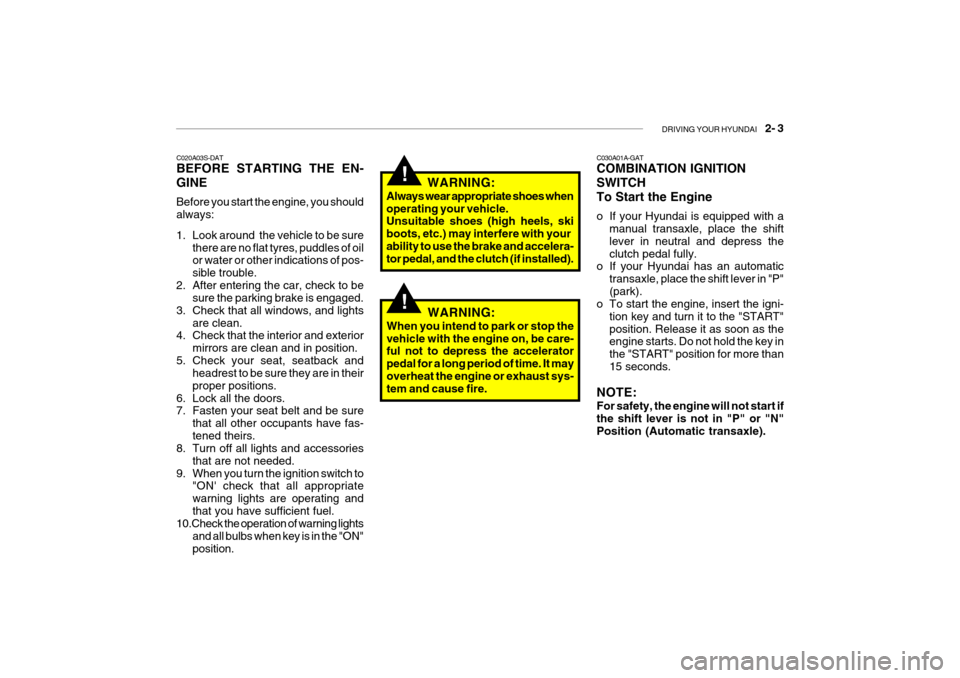
C020A03S-DAT BEFORE STARTING THE EN- GINE Before you start the engine, you should always:
1. Look around the vehicle to be sure
there are no flat tyres, puddles of oil or water or other indications of pos- sible trouble.
2. After entering the car, check to be sure the parking brake is engaged.
3. Check that all windows, and lights are clean.
4. Check that the interior and exterior
mirrors are clean and in position.
5. Check your seat, seatback and headrest to be sure they are in theirproper positions.
6. Lock all the doors.
7. Fasten your seat belt and be sure
that all other occupants have fas- tened theirs.
8. Turn off all lights and accessories
that are not needed.
9. When you turn the ignition switch to "ON' check that all appropriatewarning lights are operating andthat you have sufficient fuel.
10.Check the operation of warning lights
and all bulbs when key is in the "ON"position. WARNING:
Always wear appropriate shoes whenoperating your vehicle. Unsuitable shoes (high heels, ski boots, etc.) may interfere with yourability to use the brake and accelera- tor pedal, and the clutch (if installed). C030A01A-GAT COMBINATION IGNITION SWITCHTo Start the Engine
o If your Hyundai is equipped with a
manual transaxle, place the shift lever in neutral and depress theclutch pedal fully.
o If your Hyundai has an automatic
transaxle, place the shift lever in "P"(park).
o To start the engine, insert the igni-
tion key and turn it to the "START"position. Release it as soon as the engine starts. Do not hold the key in the "START" position for more than15 seconds.
NOTE: For safety, the engine will not start if the shift lever is not in "P" or "N"Position (Automatic transaxle).
!WARNING:
When you intend to park or stop the vehicle with the engine on, be care- ful not to depress the accelerator pedal for a long period of time. It mayoverheat the engine or exhaust sys- tem and cause fire.
Page 101 of 191

2- 6 DRIVING YOUR HYUNDAI
C070E03A-DAT RECOMMENDED SHIFT POINTS
1-2 2-33-4 4-5
Shift
from-to Recommended
20 km/h 40 km/h 55 km/h 75 km/h
The shift points as shown above are recommended for optimum fuel economy and performance.
NOTE:
o To shift into reverse, rest the lever
in neutral for at least 3 seconds after your car is completelystopped. Then move the lever into the reverse position.
o During cold weather, shifting may
be difficult until the transaxle lu-bricant has warmed up. This is normal and not harmful to thetransaxle.
o If you've come to a complete stop
and it's hard to shift into 1 st
or
R(Reverse), put the shift lever in N(Neutral) position and release the clutch. Press the clutch pedalback down, and then shift into 1 st
or R(Reverse) gear position.
o Do not use the shift lever as a
handrest during driving, as this can result in premature wear of the transaxle shift forks. CAUTION:
When downshifting from fifth gearto fourth gear, caution should be taken not to inadvertently press the gear lever sideways in such a man-ner that second gear is engaged. Such a drastic downshift may cause the engine speed to increase to thepoint that the tachometer will enter the red-zone. Such over-revving of the engine may possibly cause en-gine damage.
! C070B01A-DAT Using the Clutch The clutch should be pressed all the way to the floor before shifting, thenreleased slowly. The clutch pedal should fully return to the original posi- tion. Do not rest your foot on the clutchpedal while driving. This can cause unnecessary wear. Do not partially engage the clutch to hold the car on anincline. This causes unnecessary wear. Use the parking brake to hold the car on an incline. Do not operate the clutchpedal rapidly and repeatedly.
!WARNING:
If your vehicle has a manual transaxle not equipped with a ignition lockswitch, it may move and cause a serious accident when starting the engine without depressing the clutchpedal while the parking brake is re- leased and the shift never not in the N(Neutral) position.
Page 103 of 191

2- 8 DRIVING YOUR HYUNDAI
C090E02A-GAT o D (Drive): Use for normal driving. Bring the car to a complete stop before shifting the selector lever to "D" position. Thetransaxle will automatically shift through a four-gear sequence. Never downshift manually to "2" position or "L" positionwhen vehicle speed is more than 95 km/h (60 mph).
C090C01A-AAT o R(Reverse): Use for backing up the vehicle. Bring the car to a complete stop before shift-ing the selector lever to "R" position. C090D02A-AAT o N (Neutral): In the "N" position, the transaxle is in neutral, which means that no gearsare engaged. The engine can be started with the shift lever in "N" position, although this is not recommended ex- cept if the engine stalls while the car is moving.
NOTE:
Depress the brake pedal and push the button when shift- ing. Push the button when shift- ing. The selector lever can be shifted freely.
For optimum fuel economy, acceler-ate gradually. The transaxle will auto-matically shift to the second, third and overdrive gears. C090B01A-AAT The Function of Each Position Is As Follows: o P (Park): Use to hold the vehicle in place when parking or while starting the engine; shift the selector lever to the "P" (Park) position. Whenever parking the car,apply the parking brake and shift the selector lever to the "P" (Park) posi- tion.
CAUTION:
Never place the selector lever in the"P" (Park) position unless the ve-hicle is fully stopped. Failure to observe this caution will cause se- vere damage to the transaxle.
!
Page 109 of 191
2- 14 DRIVING YOUR HYUNDAI
C140A01A-DAT DRIVING FOR ECONOMY You can save fuel and get more kilo- meters from your car if you followthese suggestions:
o Drive smoothly. Accelerate at a
moderate rate. Don't make "kanga- roo" starts or full-throttle shifts. Maintain a steady cruising speed.Don't race between stoplights. Try to adjust your speed to that of the other traffic so you don't have tochange speeds unnecessarily. Avoid heavy traffic whenever possible. Always maintain a safe distancefrom other vehicles so you can avoid unnecessary braking. This also reduces brake wear.
o Drive at a moderate speed. The faster you drive, the more fuel yourcar uses. Driving at a moderatespeed, especially on the highway, is one of the most effective ways to reduce fuel consumption.
o Don't "ride" the brake. This can in- crease fuel consumption and alsoincrease wear on this components. o In addition, driving with your foot
resting on the brake pedal may causethe brakes to overheat, which re-duces their effectiveness and may
lead to more serious consequences.
o Take care of your tyres. Keep them inflated to the recommended pres-sure. Incorrect inflation, either too much or too little, results in unnec-essary tyre wear. Check the tyre pressures at least once a month.
o Be sure that the wheels are aligned correctly. Improper alignment canresult from hitting curbs or driving too fast over irregular surfaces Pooralignment causes faster tyre wear and may also result in other prob- lems as well as greater fuel con-sumption.
o Keep your car in good condition. For
better fuel economy and reducedmaintenance costs, maintain your car in accordance with the mainte- nance schedule in Section 5. If youdrive your car in severe conditions, more frequent maintenance is re- quired (see Section 5 for details).
C310D01JM-AAT Indicators and Warning The indicators should illuminate when the ignition key is turned to ON orSTART but should go out after three seconds. If the indicators do not illuminate, or theESP or ESP-OFF indicator does not go out after 3 seconds, have the vehicle checked by an authorized dealer. Should there be any unusual conditions in the device while driving, ESP-OFFindicator illuminates as a warning. If ESP-OFF indicator illuminates, pull your car to a safe place and stop theengine. Then, start the engine again to check if the ESP-OFF indicator goes out. If the indicator remains lit even after the engine has been started, have your carchecked by an authorized Hyundai dealer.
Page 116 of 191

DRIVING YOUR HYUNDAI 2- 21
14. When going down a hill, shift into a
lower gear and use the engine brak- ing effect. When ascending a longgrade, downshift the transmission to a lower gear and reduce speed to reduce chances of engine over-loading and/or overheating.
15.If you have to stop while going
uphill, do not hold the vehicle inplace by pressing on the accelera- tor. This can cause the automatic transmission to overheat. Use thehand brake or footbrake.
NOTE: When towing, check transaxle fluid more frequently. 1. Turn off the air conditioner.
2. Reduce highway speed.
3. Select a lower gear when going up-
hill.
4. While in stop and go traffic, place
the gear selection in park or neutraland idle the engine at a higher speed.
CAUTION:
If overheating should occur whentowing, (temperature gauge reads near red zone), taking the following action may reduce or eliminate theproblem.
!
8. When parking your car and trailer,
especially on a hill, be sure to follow all the normal precautions. Turnyour front wheel into the curb, set the hand brake firmly, and put the transmission in 1st or Reverse(manual) or Park (automatic). In addition, place wheel chocks at each of the trailer's tyres.
9. If the trailer has electric brakes, drive your vehicle with the trailerattached, and then apply the trailerbrakes by hand. This test confirms the operation of the trailer brakes and also checks your electrical con-nection at the same time.
10.During your trip, check occasion-
ally to be sure that the load issecure, and that the lights and any trailer brakes are still working.
11.Avoid jerky starts, sudden accel- eration or sudden stops.
12.Avoid sharp turns and rapid lane
changes.
13.Avoid holding the brake pedal down too long or too frequently. This could cause the brakes to overheat, re-sulting in reduced braking efficiency. D120A02A-DAT IF YOU LOSE YOUR KEYS If you happen to lose your leys, your vehicle will require towing to your Hyundai dealer to have the new set ofkeys programmed to your vehicle.