Transaxle Hyundai Getz 2009 Owner's Guide
[x] Cancel search | Manufacturer: HYUNDAI, Model Year: 2009, Model line: Getz, Model: Hyundai Getz 2009Pages: 254, PDF Size: 7.8 MB
Page 162 of 254
2- 22 DRIVING YOUR HYUNDAI
6. Check the condition and air pres-
sure of all tires on the trailer and your car. Low tire pressure canseriously affect the handling. Also check the spare tire.
7. The vehicle/trailer combination is more affected by crosswind andbuffeting. When being passed by a largevehicle, keep a constant speed and steer straight ahead. If there is too much wind buffeting slow downto get out of the other vehicle's air turbulence.
8. When parking your car and trailer, especially on a hill, be sure to fol-low all the normal precautions. Turn your front wheel into the curb, setthe parking brake firmly, and put the transaxle in 1st or Reverse (manual) or Park (automatic). Inaddition, place wheel chocks at each of the trailer's tires.
9. If the trailer has electric brakes, start your vehicle and trailer mov-ing, and then apply the trailer brake controller by hand to be sure thebrakes are working. This lets you check your electrical connection at the same time. 10. During your trip, check occasion-
ally to be sure that the load issecure, and that the lights andany trailer brakes are still working.
11. Avoid jerky starts, sudden accel-
eration or sudden stops.
12. Avoid sharp turns and rapid lane changes.
13. Avoid holding the brake pedal down
too long or too frequently. This could cause the brakes to over- heat, resulting in reduced brakingefficiency.
14. When going down a hill, shift into a
lower gear and use the engine brak-ing effect. When ascending a long grade, downshift the transaxle to a lowergear and reduce speed to reduce chances of engine overloading and/ or overheating.
15. If you have to stop while going uphill, do not hold the vehicle inplace by pressing on the accelera-tor. This can cause the automatic transaxle to overheat. Use the park- ing brake or footbrake.
C190F02A-GAT Trailer or Vehicle Towing Tips
1. Before towing, check hitch and
safety chain connections as well as proper operation of the trailerrunning lights, brake lights, and turn signals.
2. Always drive your vehicle at a mod- erate speed (Less than 100 km/h).
3. Trailer towing requires more fuel
than normal conditions.
4. To maintain engine braking effi- ciency and electrical charging per- formance, do not use fifth gear(manual transaxle) or overdrive (au- tomatic transaxle).
5. Always secure items in the trailer to prevent load shift while driving.
!WARNING:
Improperly loading your car and trailer can serious affect its steering and braking performance causing a crash in which could cause seriousinjury or death.
Page 163 of 254

DRIVING YOUR HYUNDAI 2- 23
!
NOTE: When towing check transaxle fluid more frequently.
CAUTION:
If overheating should occur whentowing, (temperature gauge reads near red zone), taking the followingaction may reduce or eliminate the problem.
1. Turn off the air conditioner.
2. Reduce highway speed.
3. Select a lower gear when going uphill.
4. While in stop and go traffic, place the gear selection in park or neu- tral and idle the engine at a higher speed.
Page 165 of 254
3- 2 WHAT TO DO IN AN EMERGENCY
HTB165
D010B02A-AAT If Engine Doesn't Turn Over or Turns Over Slowly
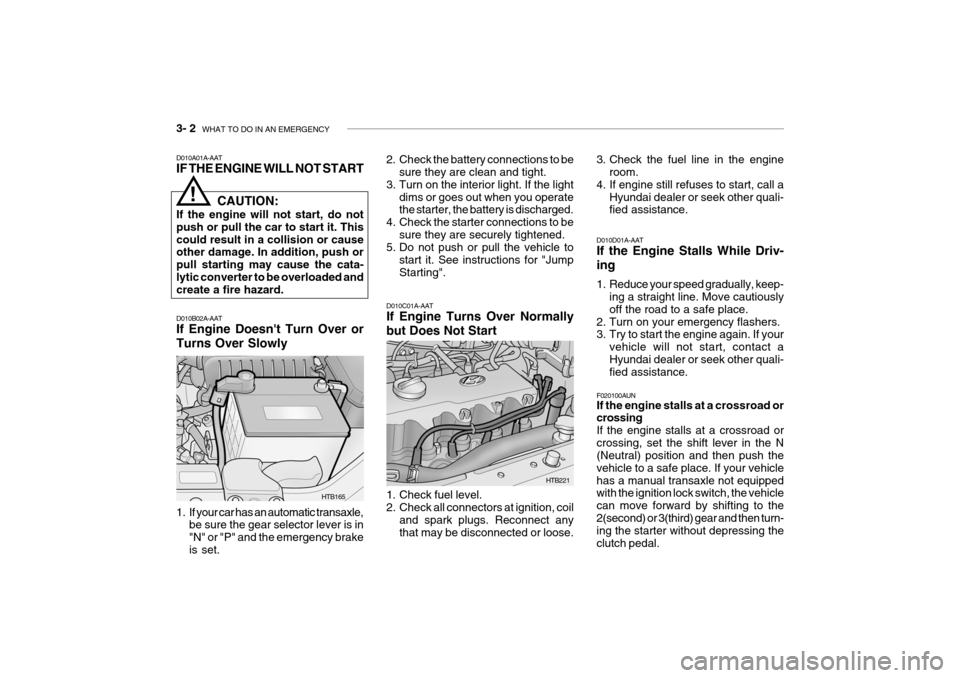
1. If your car has an automatic transaxle,
be sure the gear selector lever is in "N" or "P" and the emergency brakeis set. D010C01A-AAT If Engine Turns Over Normally but Does Not Start
1. Check fuel level.
2. Check all connectors at ignition, coil
and spark plugs. Reconnect any that may be disconnected or loose. D010D01A-AAT If the Engine Stalls While Driv- ing
1. Reduce your speed gradually, keep-
ing a straight line. Move cautiously off the road to a safe place.
2. Turn on your emergency flashers.
3. Try to start the engine again. If your vehicle will not start, contact a Hyundai dealer or seek other quali- fied assistance.
F020100AUN If the engine stalls at a crossroad or crossing If the engine stalls at a crossroad orcrossing, set the shift lever in the N (Neutral) position and then push the vehicle to a safe place. If your vehiclehas a manual transaxle not equipped with the ignition lock switch, the vehicle can move forward by shifting to the2(second) or 3(third) gear and then turn- ing the starter without depressing the clutch pedal.
D010A01A-AAT IF THE ENGINE WILL NOT START
CAUTION:
If the engine will not start, do not push or pull the car to start it. Thiscould result in a collision or cause other damage. In addition, push or pull starting may cause the cata-lytic converter to be overloaded and create a fire hazard.
!
HTB221
2. Check the battery connections to be
sure they are clean and tight.
3. Turn on the interior light. If the light dims or goes out when you operate the starter, the battery is discharged.
4. Check the starter connections to be sure they are securely tightened.
5. Do not push or pull the vehicle to
start it. See instructions for "Jump Starting". 3. Check the fuel line in the engine
room.
4. If engine still refuses to start, call a Hyundai dealer or seek other quali- fied assistance.
Page 167 of 254
3- 4 WHAT TO DO IN AN EMERGENCY
D030A02TB-AAT IF THE ENGINE OVERHEATS If your temperature gauge indicates overheating, you experience a loss of power, or hear loud pinging or knock- ing, the engine is probably too hot. Ifthis happens to you, you should:
1. Pull off the road and stop as soon as
it is safe to do so.
2. Place the gear selector lever in "P"
(automatic), or neutral (manual transaxle) and set the parking brake. If the air conditioning is on, turn it off.
6. Carefully remove the jumper cables
in the reverse order of attachment.
If you do not know why your battery became discharged (because the lights were left on, etc.), have the chargingsystem checked by your Hyundai dealer. 3. If engine coolant is running out under
the car or steam is coming out from the hood, stop the engine. Do notopen the hood until the engine cool- ant has stopped running or the steam- ing has stopped. If there is no visibleloss of engine coolant and no steam, leave the engine running and check to be sure the engine cooling fan isoperating. If the fan is not running, turn the engine off.
4. Check to see if the water pump drive belt is missing. If it is not missing,check to see that it is tight. If the drive belt seems to be satisfactory,check for coolant leaking from the radiator, hoses or under the car. (If the air conditioning had been in use,it is normal for cold water to be draining from it when you stop). WARNING (Diesel only):
Never work on injection system with engine running or within 30 sec- onds after shutting off engine. High pressure pump, rail, injectors andhigh pressure pipes are subject to high pressure even after the engine stopped. The fuel jet produced byfuel leaks may cause serious in- jury, if it touch the body. People using pacemakers should not movethan 30cm closer to the ECU or wiring harness within the engine room while engine is running, sincethe high currents in the Common Rail system produce considerable magnetic fields.
WARNING:
While the engine is running, keep hair, hands, and clothing away from moving parts such as the fan anddrive belts to prevent injury.
!
!
5. If the water pump drive belt is broken or coolant is leaking out, stop the engine immediately and call the near- est Hyundai dealer for assistance.
WARNING:
Page 169 of 254
3- 6 WHAT TO DO IN AN EMERGENCY
HTB154
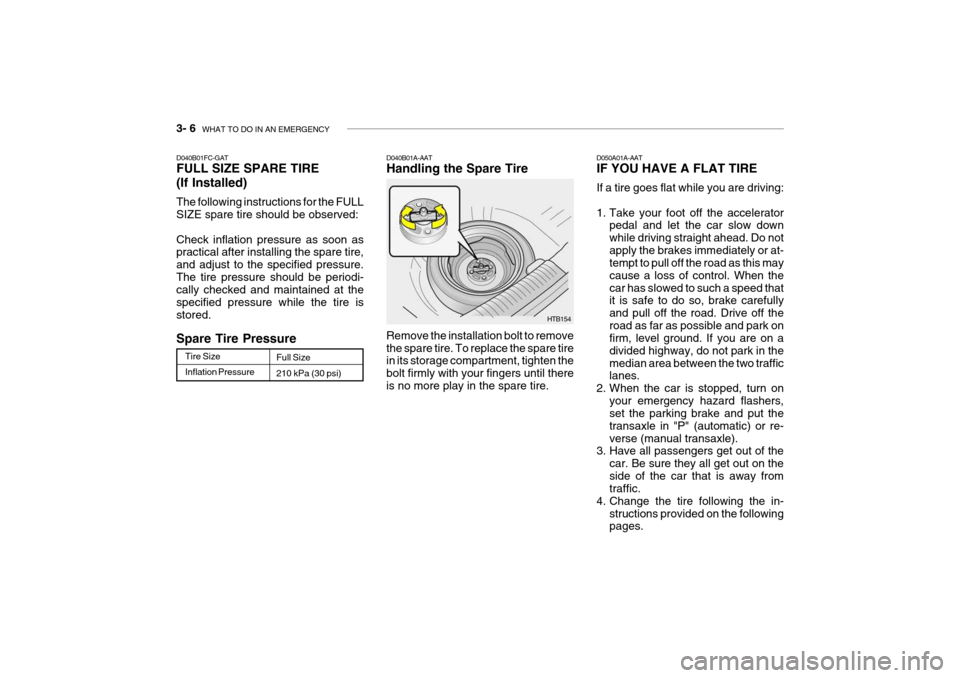
D040B01A-AAT Handling the Spare Tire Remove the installation bolt to remove the spare tire. To replace the spare tire in its storage compartment, tighten the bolt firmly with your fingers until thereis no more play in the spare tire. D050A01A-AAT IF YOU HAVE A FLAT TIRE If a tire goes flat while you are driving:
1. Take your foot off the accelerator
pedal and let the car slow down while driving straight ahead. Do notapply the brakes immediately or at- tempt to pull off the road as this may cause a loss of control. When thecar has slowed to such a speed that it is safe to do so, brake carefully and pull off the road. Drive off theroad as far as possible and park on firm, level ground. If you are on a divided highway, do not park in themedian area between the two traffic lanes.
2. When the car is stopped, turn on your emergency hazard flashers,set the parking brake and put the transaxle in "P" (automatic) or re-verse (manual transaxle).
3. Have all passengers get out of the
car. Be sure they all get out on theside of the car that is away from traffic.
4. Change the tire following the in- structions provided on the followingpages.
Inflation Pressure
Tire Size
D040B01FC-GAT FULL SIZE SPARE TIRE (If Installed) The following instructions for the FULL SIZE spare tire should be observed: Check inflation pressure as soon as practical after installing the spare tire, and adjust to the specified pressure.The tire pressure should be periodi- cally checked and maintained at the specified pressure while the tire isstored. Spare Tire Pressure
Full Size 210 kPa (30 psi)
Page 170 of 254
WHAT TO DO IN AN EMERGENCY 3- 7
HTB230
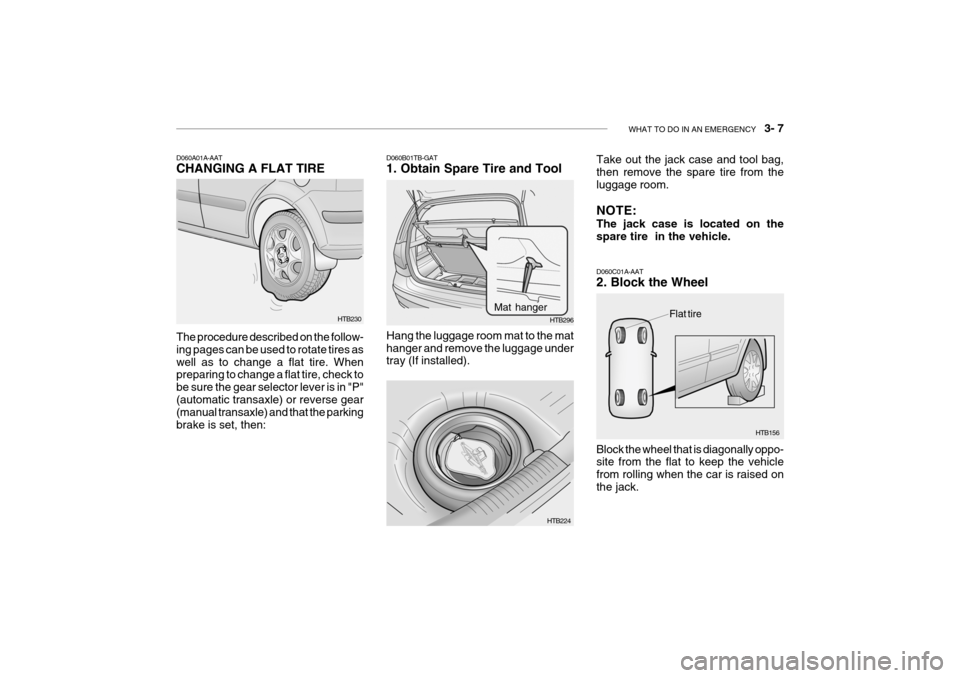
D060A01A-AAT CHANGING A FLAT TIRE The procedure described on the follow- ing pages can be used to rotate tires aswell as to change a flat tire. When preparing to change a flat tire, check to be sure the gear selector lever is in "P"(automatic transaxle) or reverse gear (manual transaxle) and that the parking brake is set, then:Flat tire
HTB156
D060C01A-AAT 2. Block the Wheel Block the wheel that is diagonally oppo- site from the flat to keep the vehicle from rolling when the car is raised onthe jack.
Take out the jack case and tool bag, then remove the spare tire from the luggage room. NOTE: The jack case is located on the spare tire in the vehicle.
Hang the luggage room mat to the mat hanger and remove the luggage under tray (If installed).
D060B01TB-GAT 1. Obtain Spare Tire and Tool
HTB224HTB296
Mat hanger
Page 174 of 254
WHAT TO DO IN AN EMERGENCY 3- 11
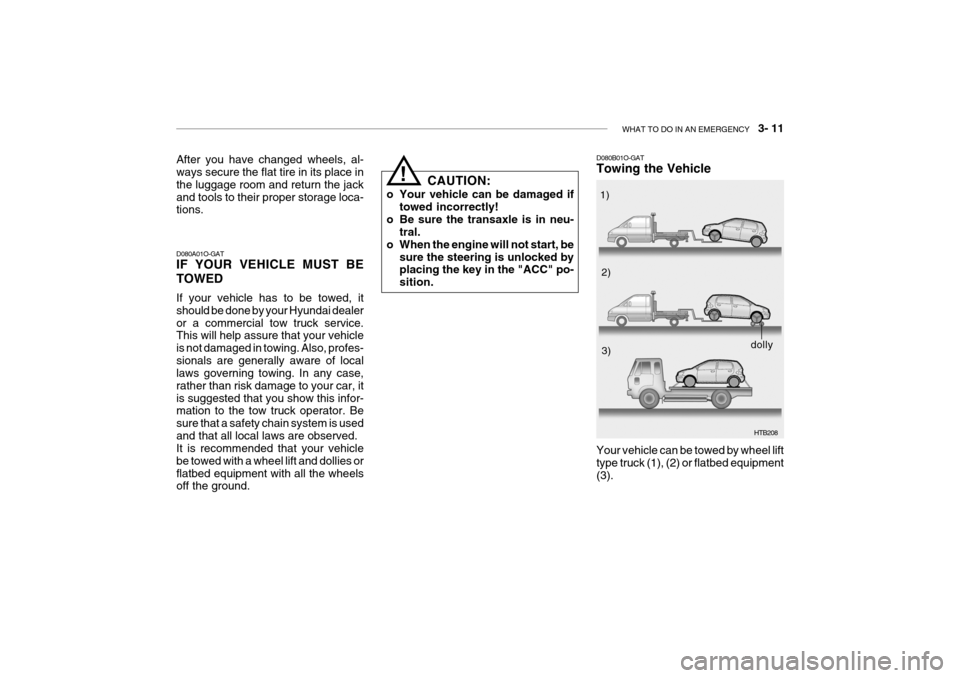
After you have changed wheels, al- ways secure the flat tire in its place in the luggage room and return the jackand tools to their proper storage loca- tions. D080A01O-GAT IF YOUR VEHICLE MUST BE TOWED If your vehicle has to be towed, it should be done by your Hyundai dealeror a commercial tow truck service. This will help assure that your vehicle is not damaged in towing. Also, profes-sionals are generally aware of local laws governing towing. In any case, rather than risk damage to your car, itis suggested that you show this infor- mation to the tow truck operator. Be sure that a safety chain system is usedand that all local laws are observed. It is recommended that your vehicle be towed with a wheel lift and dollies orflatbed equipment with all the wheels off the ground.
!
CAUTION:
o Your vehicle can be damaged if towed incorrectly!
o Be sure the transaxle is in neu- tral.
o When the engine will not start, be
sure the steering is unlocked by placing the key in the "ACC" po- sition. D080B01O-GAT Towing the Vehicle
HTB208
Your vehicle can be towed by wheel lift type truck (1), (2) or flatbed equipment(3). 1)
2)
3)
dolly
Page 175 of 254
3- 12 WHAT TO DO IN AN EMERGENCY
HTB210
!
1) If the vehicle is being towed with the
rear wheels on the ground, be sure the parking brake is released.
NOTE: Before towing, check the level of the automatic transaxle fluid. If it is below the "HOT" range on the dip- stick, add fluid. If you cannot addfluid, a towing dolly must be used.
2) If any of the loaded wheels or sus- pension components are damaged or the vehicle is being towed with the front wheels on the ground, usea towing dolly under the front wheels.
o Manual Transaxle:
If you do not use a towing dolly,place the ignition key in the "ACC" position and put the transaxle in "N (Neutral)".
CAUTION:
Do not tow with the key removed orin the "LOCK" position when tow-ing from the rear without a towing dolly. HTB209
!
o Automatic Transaxle:
Be sure to use a towing dolly under the front wheels.
CAUTION:
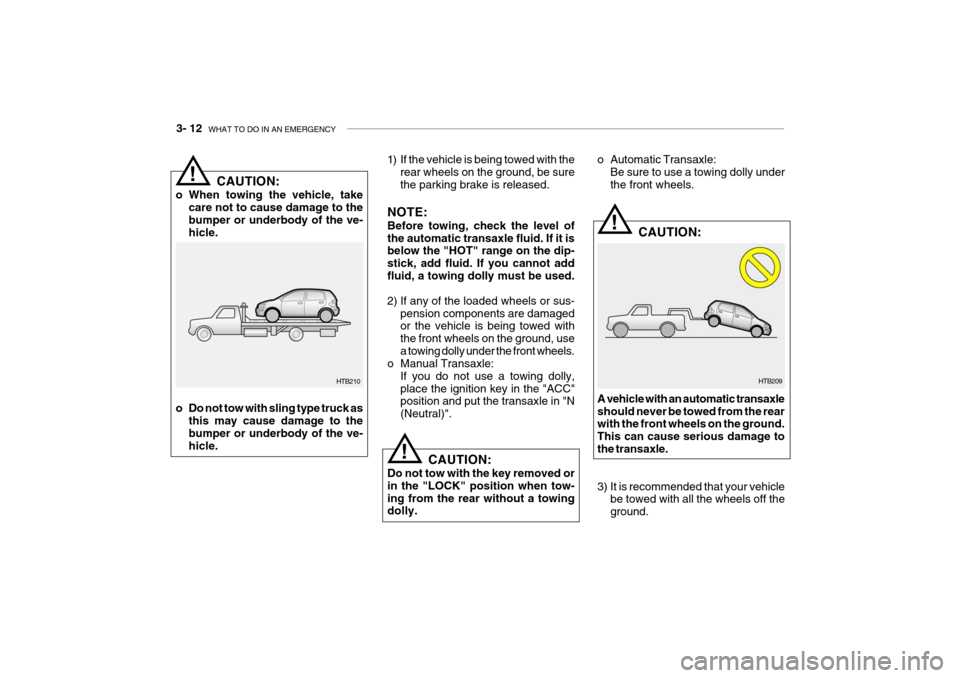
A vehicle with an automatic transaxleshould never be towed from the rear with the front wheels on the ground. This can cause serious damage tothe transaxle.
3) It is recommended that your vehicle be towed with all the wheels off the ground.
! CAUTION:
o When towing the vehicle, take care not to cause damage to the bumper or underbody of the ve- hicle.
o Do not tow with sling type truck as this may cause damage to thebumper or underbody of the ve- hicle.
Page 176 of 254
WHAT TO DO IN AN EMERGENCY 3- 13
D080D02TB-AAT EMERGENCY TOWING
HTB4004
HTB4005
Towing Hook
CAUTION:
If the car is being towed with all four wheels on the ground, it can be towed only from the front. Be surethat the transaxle is in neutral. Do not tow at speeds greater than 50 km/h (30 mph) and for more than 25km (15 miles). Be sure the steering is unlocked by placing the key in the "ACC" posi-tion. A driver must be in the towed vehicle to operate the steering and brakes.!
(3)Attach a tow cable, chain or strap to
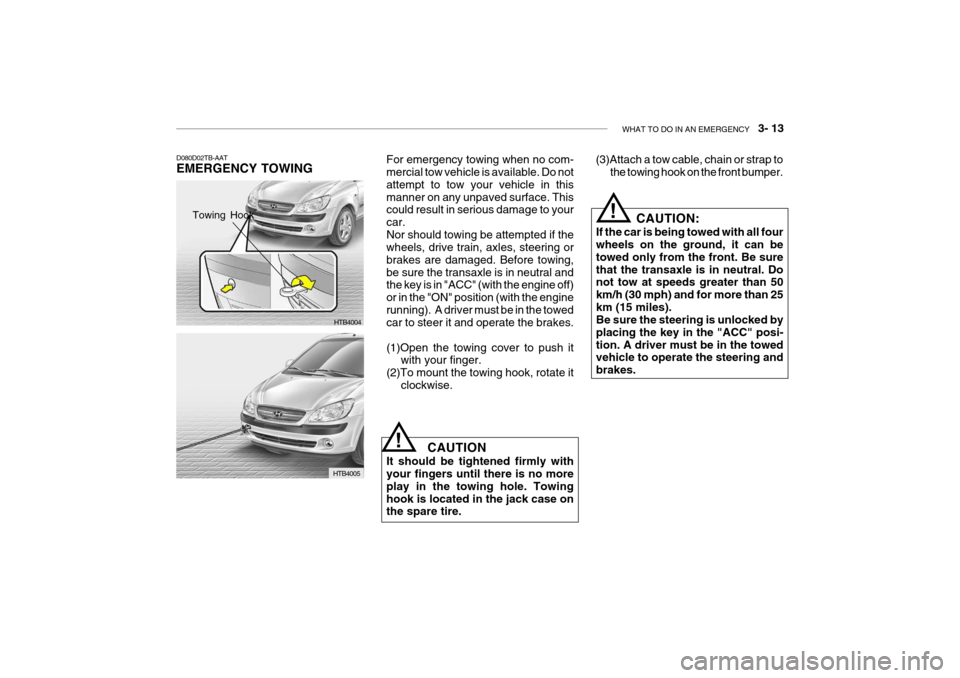
the towing hook on the front bumper.
For emergency towing when no com- mercial tow vehicle is available. Do not attempt to tow your vehicle in thismanner on any unpaved surface. This could result in serious damage to your car.Nor should towing be attempted if the wheels, drive train, axles, steering or brakes are damaged. Before towing,be sure the transaxle is in neutral and the key is in "ACC" (with the engine off) or in the "ON" position (with the enginerunning). A driver must be in the towed car to steer it and operate the brakes. (1)Open the towing cover to push it
with your finger.
(2)To mount the towing hook, rotate it clockwise.
CAUTION
It should be tightened firmly with your fingers until there is no more play in the towing hole. Towinghook is located in the jack case on the spare tire.
!
Page 186 of 254

5- 2 VEHICLE MAINTENANCE REQUIREMENTS
F010C01A-GAT
Specified Scheduled Procedures
These are the procedures such as
inspections, adjustments and replace- ments that are listed in the mainte- nance charts starting on page 5-4.These procedures must be performed at the intervals shown in the mainte- nance schedule to assure that yourwarranty remains in effect. Although it is strongly recommended that they be performed by the factory-trained ordistributor-trained technicians at your Hyundai dealer, these procedures may be performed at any qualified servicefacility. F010D01A-GAT
General Checks
These are the regular checks you should perform when you drive your Hyundai or you fill the fuel tank. A listof these items will be found on page 6-5.
F010A01A-GAT MAINTENANCE INTERVALS Service Requirements To assure that you receive the great- est number of kilometers of satisfyingoperation from your Hyundai, certain maintenance procedures must be performed. Although careful designand engineering have reduced these to a minimum, those that are required are of the utmost importance.It is your responsibility to have thesemaintenance procedures performedto comply with the terms of the war- ranties covering your new Hyundai. The Service Passport supplied withyour new vehicle provides further in- formation about these warranties.
F010B01A-AAT
Maintenance Requirements
The maintenance required for your
Hyundai can be divided into threemain areas:
o Specified scheduled procedures
o General checks
o Do-it-yourself maintenance It is suggested that genuine Hyundai
service parts be used for any requiredrepairs or replacements. Other parts ofequivalent quality such as engine oil, engine coolant, manual or auto transaxle oil, brake fluid and so onwhich are not supplied by Hyundai Motor Company or its distributor may be used without affecting your war-ranty coverage but you should always be sure these are equivalent to the quality of the original Hyundai parts.Your Service Passport provides fur- ther information about your warranty coverage.