od off Hyundai Getz 2009 Manual PDF
[x] Cancel search | Manufacturer: HYUNDAI, Model Year: 2009, Model line: Getz, Model: Hyundai Getz 2009Pages: 254, PDF Size: 7.8 MB
Page 180 of 254

CORROSION PREVENTION AND APPEARANCE CARE 4- 3
E020C01A-AAT Keep Your Garage Dry Don't park your car in a damp, poorly ventilated garage. This creates a fa- vorable environment for corrosion. This is particularly true if you wash your carin the garage or drive it into the garage when it is still wet or covered with snow, ice or mud. Even a heated ga-rage can contribute to corrosion un- less it is well ventilated so moisture is dispersed. E020D01A-AAT Keep Paint and Trim in Good Condition Scratches or chips in the finish should be covered with "touch-up" paint as soon as possible to reduce the possi-bility of corrosion. If bare metal is show- ing through, the attention of a qualified body and paint shop is recommended. E020E01A-AAT Don't Neglect the Interior Moisture can collect under the floor mats and carpeting to cause corro-sion. Check under the mats periodi- cally to be sure the carpeting is dry. Use particular care if you carry fertiliz-ers, cleaning materials or chemicals in the car. These should be carried only in propercontainers and any spills or leaks should be cleaned up, flushed with clear water and thoroughly dried.
E020B01A-AAT Keep Your Car Clean The best way to prevent corrosion is to keep your car clean and free of corro-sive materials. Attention to the under- side of the car is particularly important.
o If you live in a high-corrosion area —
where road salts are used, near the ocean, areas with industrial pollu-tion, acid rain, etc.—, you should take extra care to prevent corro- sion. In winter, hose off the under-side of your car at least once a month and be sure to clean the underside thoroughly when winteris over.
o When cleaning underneath the car,
give particular attention to the com-ponents under the fenders and other areas that are hidden from view. Do a thorough job; just dampening theaccumulated mud rather than wash- ing it away will accelerate corrosion rather than prevent it. Water underhigh pressure and steam are par- ticularly effective in removing accu- mulated mud and corrosive materi-als. o When cleaning lower door panels,
rocker panels and frame members,be sure that drain holes are keptopen so that moisture can escape and not be trapped inside to ac- celerate corrosion.
E030A02A-AAT WASHING AND WAXING Washing Your Hyundai Never wash your car when the surface is hot from being in the sun. Always wash your car in the shade. Wash your car frequently. Dirt is abra- sive and can scratch the paint if it is not removed. Air pollution or acid rain maydamage the paint and trim through chemical action if pollutants are al- lowed to remain in contact with thesurface. If you live near the ocean or in an area where road salts or dust con-
Page 182 of 254
CORROSION PREVENTION AND APPEARANCE CARE 4- 5
CAUTION:!
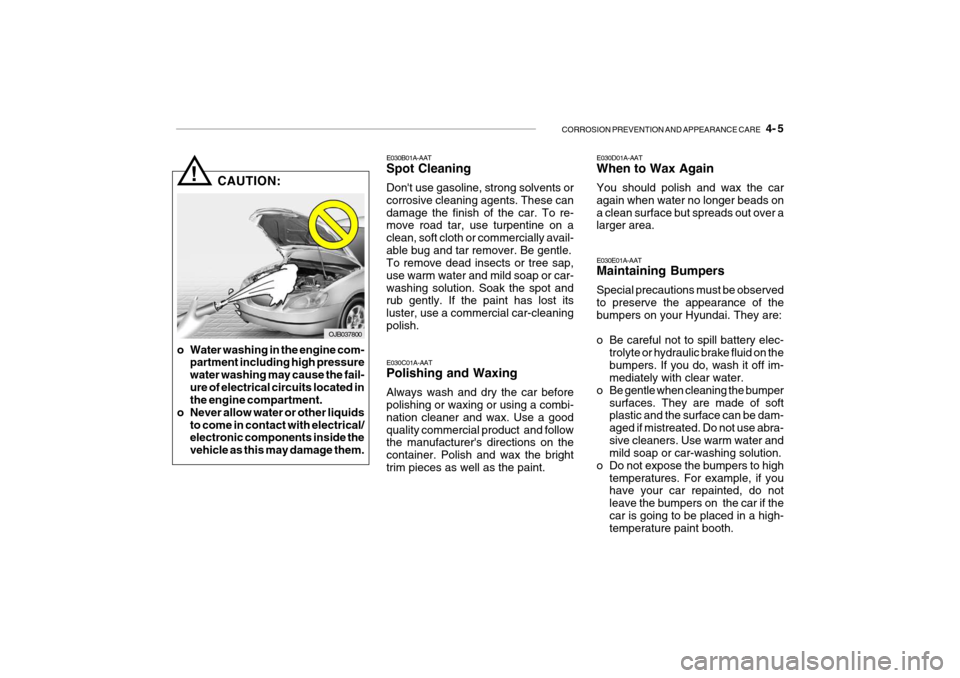
o Water washing in the engine com- partment including high pressure water washing may cause the fail-ure of electrical circuits located in the engine compartment.
o Never allow water or other liquids to come in contact with electrical/electronic components inside the vehicle as this may damage them.
OJB037800 E030D01A-AAT When to Wax Again You should polish and wax the car again when water no longer beads ona clean surface but spreads out over a larger area. E030E01A-AAT Maintaining Bumpers Special precautions must be observed to preserve the appearance of the bumpers on your Hyundai. They are:
o Be careful not to spill battery elec-
trolyte or hydraulic brake fluid on the bumpers. If you do, wash it off im- mediately with clear water.
o Be gentle when cleaning the bumper
surfaces. They are made of softplastic and the surface can be dam- aged if mistreated. Do not use abra-sive cleaners. Use warm water and mild soap or car-washing solution.
o Do not expose the bumpers to high
temperatures. For example, if youhave your car repainted, do not leave the bumpers on the car if thecar is going to be placed in a high- temperature paint booth.
E030B01A-AAT Spot Cleaning Don't use gasoline, strong solvents or corrosive cleaning agents. These candamage the finish of the car. To re- move road tar, use turpentine on a clean, soft cloth or commercially avail-able bug and tar remover. Be gentle. To remove dead insects or tree sap, use warm water and mild soap or car-washing solution. Soak the spot and rub gently. If the paint has lost its luster, use a commercial car-cleaningpolish. E030C01A-AAT Polishing and Waxing Always wash and dry the car before polishing or waxing or using a combi- nation cleaner and wax. Use a goodquality commercial product and follow the manufacturer's directions on the container. Polish and wax the brighttrim pieces as well as the paint.
Page 183 of 254

4- 6 CORROSION PREVENTION AND APPEARANCE CARE
E040D01A-AAT Cleaning the Seat Belts To clean the seat belts, use a cloth or sponge with mild soap or detergent and warm water. Do not use strongdetergents, dye, bleach or abrasive materials on the seat belts as this may weaken the fabric.While cleaning the belts, inspect them for excessive wear, cuts, fraying or other signs of damage and replacethem if necessary.
E040C01A-AAT Cleaning the Carpets Use a foam-type carpet cleaner. Clean- ers of this type are available in aerosolcans in liquid form or powder. Read the instructions and follow them exactly. Using a vacuum cleaner with the ap-propriate attachment, remove as much dirt from the carpets as possible. Apply the foam following the manufacturer'sdirections, then rub in overlapping circles. Do not add water. These clean- ers work best when the carpet is keptas dry as possible.
will keep your leather lustrous, beautiful and ensure you have many years of wear.Take a piece of cheese cloth and using any mild soap and lukewarm water, work up a good lather. Thoroughlywash the leather. Wipe clean with a slightly damp cloth and dry with soft cloth. Do this as often as the leatherbecomes soiled. During tanning operations, sufficient oils are incorporated through process- ing that none need be applied during the life of the leather. Oil applied to thefinished surface will in no way help the leather and may do more harm than good. Varnishes and furniture polishesshould never be used under any con- ditions.
E040A01A-AAT CLEANING THE INTERIOR To Clean the Vinyl Upholstery To clean the vinyl upholstery, first re- move loose dirt and dust with a vacuum cleaner. Then apply a solution of mildsoap or detergent and water using a clean sponge or soft cloth. Allow this to stay on the surface to loosen the dirt,then wipe with a clean damp sponge or cloth. If all the dirt stains are not re- moved, repeat this procedure until theupholstery is clean. Do not use gaso- line, solvent, paint thinner or other strong cleaners. E040B01A-AAT To Clean the Leather Upholstery (If installed) In the normal course of use, leather upholstered surfaces will, like any material, pick-up dust and dirt. This dust and dirt must be cleaned off or itmay work into the surface of the leather, causing damage. Fine leather needs care, and should be cleaned when necessary. Washing leather thoroughly with soap and water
Page 192 of 254
5- 8 VEHICLE MAINTENANCE REQUIREMENTS
F060A01A-AAT EXPLANATION OF SCHED- ULED MAINTENANCE ITEMS F060M01A-AAT
o Engine Oil and Filter The engine oil and filter should be changed at the intervals specified in the maintenance schedule. If the car is being driven in severe conditions,more frequent oil and filter changes are required. F060B01A-AAT
o Drive Belts Inspect all drive belts for evidence of cuts, cracks, excessive wear or oil and replace if necessary. Drive beltsshould be checked periodically for proper tension and adjusted as nec- essary. After installing a new filter, run the
engine for several minutes, and checkfor leaks at the connections. Fuel fil-ters should be installed by trained technicians.
F060D01TB-AAT
o Fuel Lines, Fuel Hoses and
Connections
Check the fuel lines, fuel hoses and
connections for leakage and damage. Have a trained technician replace anydamaged or leaking parts immedi- ately. F060E01A-AAT
o Timing Belt
Inspect all parts related to the timingbelt for damage and deformation. Replace any damaged parts immedi-ately. F060G01A-AAT
o Vapor Hose and Fuel Filler Cap
The vapor hose and fuel filler cap should be inspected at those intervals specified in the maintenance sched-ule. Make sure that a new vapor hose or fuel filler cap is correctly replaced.
F060C01A-AAT
o Fuel Filter A clogged filter can limit the speed at which the vehicle may be driven, dam- age the emission system and cause hard starting. If an excessive amountof foreign matter accumulates in the fuel tank, the filter may require re- placement more frequently.
!WARNING (Diesel only):
Never work on injection system with
engine running or within 30 sec- onds after shutting off engine. High pressure pump, rail, injectors and high pressure pipes are subjectedto high pressure even after the en- gine has been switched off. The fuel jet produced by fuel leaks maycause serious injury, if it contacts with the body. People using pace- makers should not move closerthan 30cm to the ECU or wiring harness within the engine room with the engine running, since the high currents in the Common Rail sys-tem produce considerable magnetic fields.
Page 194 of 254

5- 10 VEHICLE MAINTENANCE REQUIREMENTS
F070L01A-AAT
o Suspension Mounting Bolts
Check the suspension connections for
looseness or damage. Retighten to the specified torque. F070M01A-AAT
o Steering Gear Box, Linkage &
Boots/Lower arm Ball Joint
With the vehicle stopped and engine
off, check for excessive free-play inthe steering wheel. Check the linkage for bends or damage. Check the dust boots and ball joints for deterioration,cracks, or damage. Replace any dam- aged parts.
F070N01A-AAT
o Power Steering Pump, Belt
and Hoses
Check the power steering pump and
hoses for leakage and damage. Re- place any damaged or leaking parts immediately. Inspect the power steer- ing belt for evidence of cuts, cracks,excessive wear, oiliness and proper tension. Replace or adjust it if neces- sary.
F070J01A-AAT
o Brake Pads, Calipers and
Rotors
Check the pads for excessive wear,
discs for run out and wear, and cali-pers for fluid leakage.
F070K01A-AAT
o Exhaust Pipe and Muffler
Visually inspect the exhaust pipes,
muffler and hangers for cracks, dete-rioration, or damage. Start the engineand listen carefully for any exhaust gas leakage. Tighten connections or replace parts as necessary.
F070F01A-AAT
o Brake Hoses and Lines Visually check for proper installation, chafing, cracks, deterioration and any leakage. Replace any deteriorated or damaged parts immediately. F070G02A-AAT
o Brake Fluid Check brake fluid level in the brake fluid reservoir. The level should be between "MIN" and "MAX" marks onthe side of the reservoir. Use only hydraulic brake fluid conforming to DOT 3 or DOT 4. F070H01A-AAT
o Rear Brake Drums/Linings
Parking Brake
Check the rear brake drums and lin- ings for scoring, burning, leaking fluid, broken parts, and excessive wear. Inspect the parking brake system in-cluding the parking brake lever and cables. For detailed service proce- dures, refer to the Shop Manual.
Page 203 of 254
6- 8 DO-IT-YOURSELF MAINTENANCE
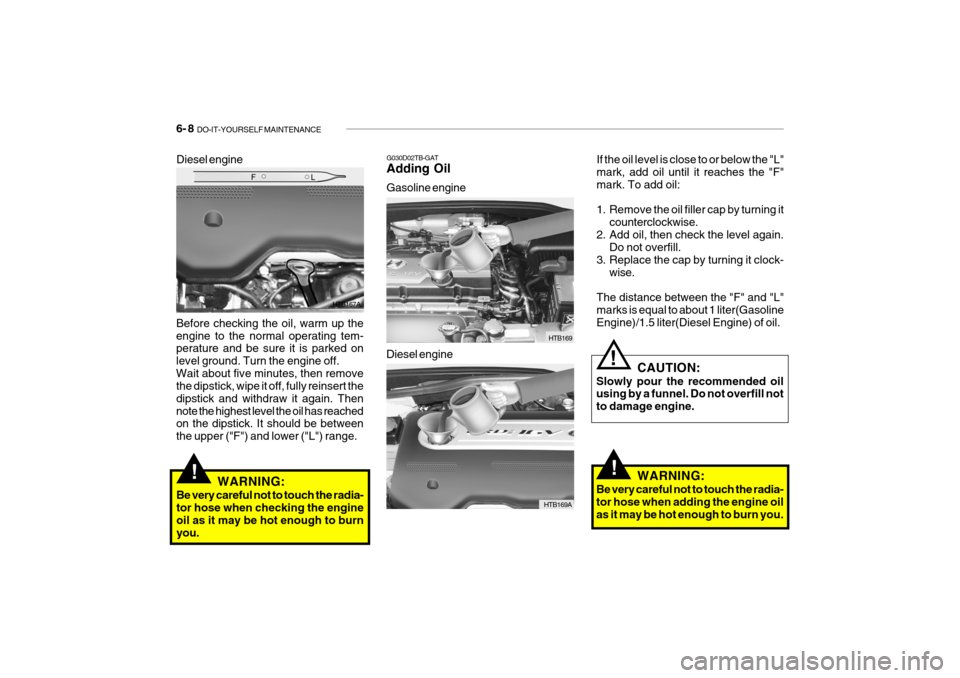
If the oil level is close to or below the "L" mark, add oil until it reaches the "F" mark. To add oil:
1. Remove the oil filler cap by turning it
counterclockwise.
2. Add oil, then check the level again. Do not overfill.
3. Replace the cap by turning it clock- wise.
The distance between the "F" and "L" marks is equal to about 1 liter(Gasoline Engine)/1.5 liter(Diesel Engine) of oil.G030D02TB-GAT Adding Oil Gasoline engine
Before checking the oil, warm up the engine to the normal operating tem- perature and be sure it is parked on level ground. Turn the engine off.Wait about five minutes, then remove the dipstick, wipe it off, fully reinsert the dipstick and withdraw it again. Thennote the highest level the oil has reached on the dipstick. It should be between the upper ("F") and lower ("L") range. HTB169
HTB169A
Diesel engine
!WARNING:
Be very careful not to touch the radia- tor hose when checking the engine oil as it may be hot enough to burn you.!
CAUTION:
Slowly pour the recommended oil using by a funnel. Do not overfill not to damage engine.
WARNING:
Be very careful not to touch the radia-tor hose when adding the engine oilas it may be hot enough to burn you.!
HTB167A
Diesel engine
Page 205 of 254
6- 10 DO-IT-YOURSELF MAINTENANCE
G050C02A-GAT To Check the Coolant Level The coolant level can be seen on the side of the plastic coolant reservoir.The level of the coolant should be between the "L" and "F" lines on the reservoir when the engine is cold. If thelevel is below the "L" mark, add engine coolant to bring it up between "L" and "F". If the level is low, inspect forcoolant leaks and recheck the fluid level frequently. If the level drops again, visit your Hyundai dealer for an inspec-tion and diagnosis of the reason.
HTB170
HTB170A
Gasoline engine Diesel engine
G050B01A-AAT Recommended Engine Coolant
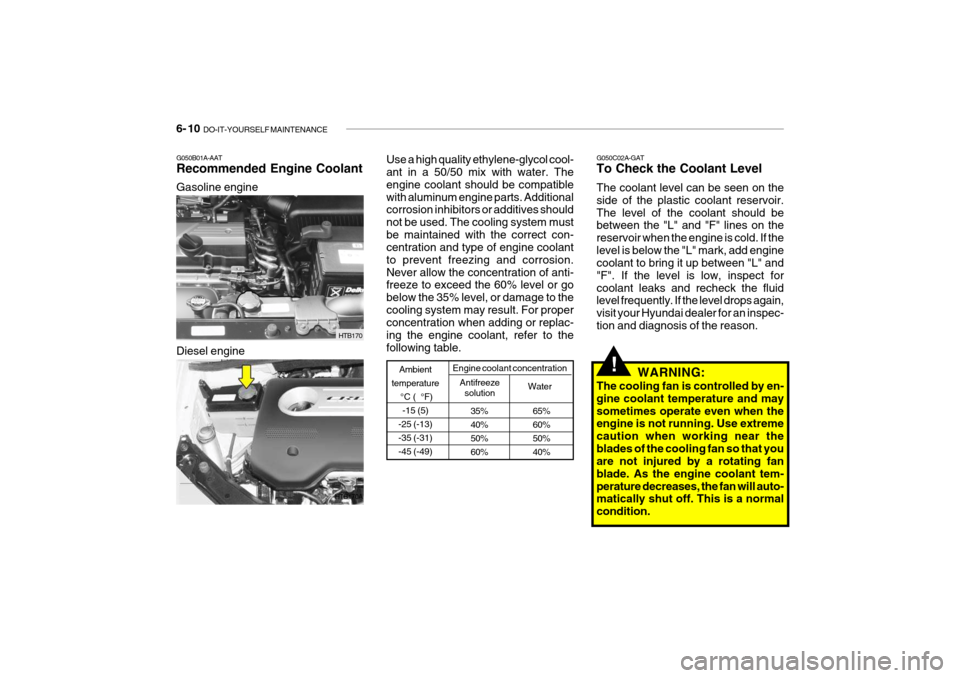
Use a high quality ethylene-glycol cool- ant in a 50/50 mix with water. The engine coolant should be compatiblewith aluminum engine parts. Additional corrosion inhibitors or additives should not be used. The cooling system mustbe maintained with the correct con- centration and type of engine coolant to prevent freezing and corrosion.Never allow the concentration of anti- freeze to exceed the 60% level or go below the 35% level, or damage to thecooling system may result. For proper concentration when adding or replac- ing the engine coolant, refer to thefollowing table.
35% 40%50%60%
Ambient
temperature °C ( °F)-15 (5)
-25 (-13)-35 (-31)-45 (-49)
Antifreeze solution Water
Engine coolant concentration
65% 60%50%40% WARNING:
The cooling fan is controlled by en- gine coolant temperature and maysometimes operate even when the engine is not running. Use extreme caution when working near theblades of the cooling fan so that you are not injured by a rotating fan blade. As the engine coolant tem-perature decreases, the fan will auto- matically shut off. This is a normal condition.
!
Page 206 of 254
DO-IT-YOURSELF MAINTENANCE 6- 11
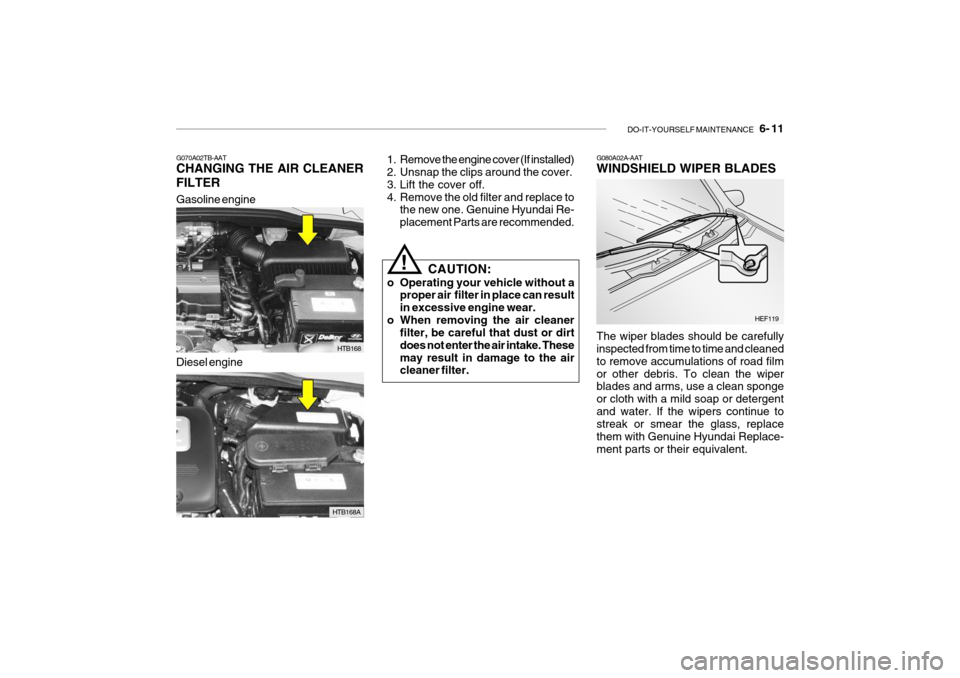
Gasoline engine
HTB168
G070A02TB-AAT CHANGING THE AIR CLEANER FILTER Diesel engine
HTB168A 1. Remove the engine cover (If installed)
2. Unsnap the clips around the cover.
3. Lift the cover off.
4. Remove the old filter and replace to
the new one. Genuine Hyundai Re-placement Parts are recommended.
CAUTION:
o Operating your vehicle without a proper air filter in place can resultin excessive engine wear.
o When removing the air cleaner filter, be careful that dust or dirtdoes not enter the air intake. Thesemay result in damage to the air cleaner filter.
!
G080A02A-AAT WINDSHIELD WIPER BLADES
HEF119
The wiper blades should be carefully inspected from time to time and cleaned to remove accumulations of road filmor other debris. To clean the wiper blades and arms, use a clean sponge or cloth with a mild soap or detergentand water. If the wipers continue to streak or smear the glass, replace them with Genuine Hyundai Replace-ment parts or their equivalent.
Page 207 of 254
6- 12 DO-IT-YOURSELF MAINTENANCE
CAUTION:
o Do not operate the wipers on dry glass. This can result in more rapid wear of the wiper blades and may scratch the glass.
o Keep the blade rubber out of con- tact with petroleum productssuch as engine oil, gasoline, etc.!
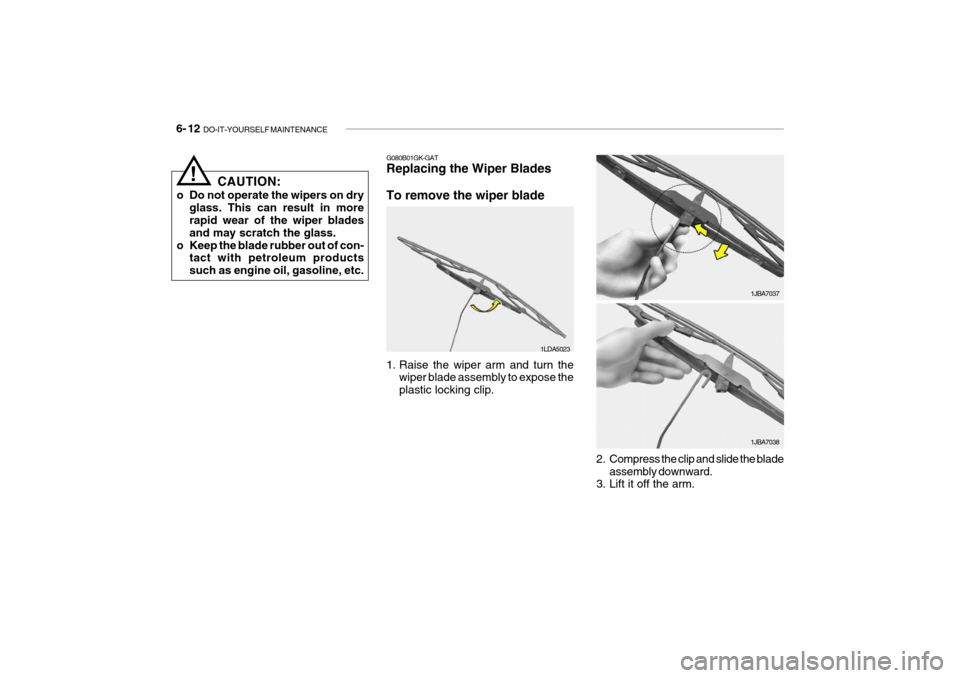
G080B01GK-GAT Replacing the Wiper Blades To remove the wiper blade
1. Raise the wiper arm and turn thewiper blade assembly to expose the plastic locking clip. 1LDA5023
2. Compress the clip and slide the bladeassembly downward.
3. Lift it off the arm. 1JBA7037
1JBA7038
Page 211 of 254
6- 16 DO-IT-YOURSELF MAINTENANCE
WARNING:
The cooling fan is controlled by en- gine coolant temperature and maysometimes operate even when the engine is not running. Use extreme caution when working near theblades of the cooling fan, so that you are not injured by a rotating fan blade. As the engine coolant temper-ature decreases, the fan will auto- matically shut off. This is a normal condition.!
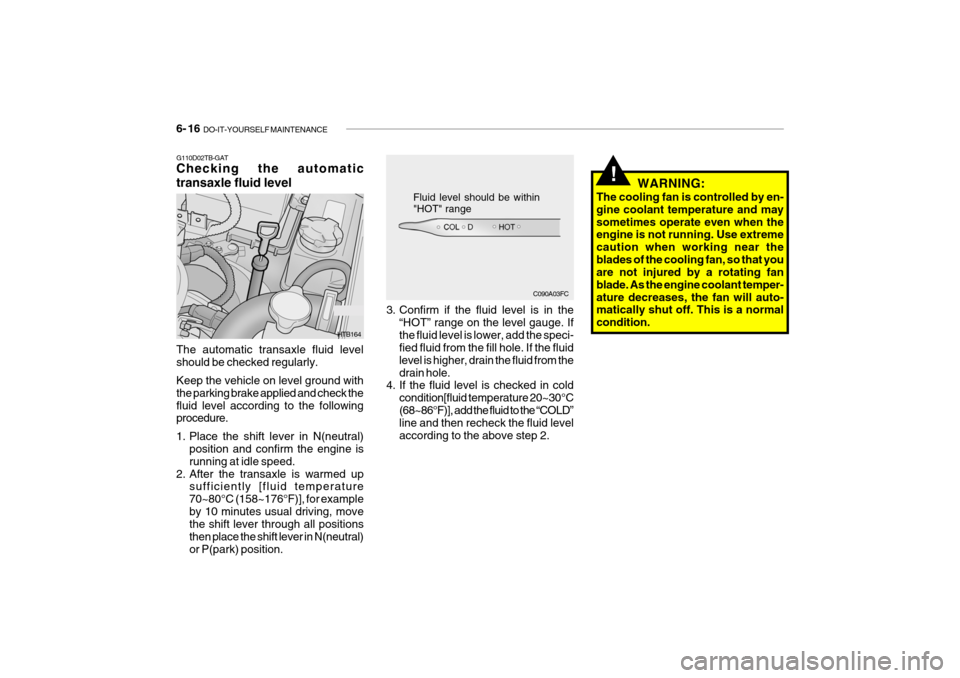
G110D02TB-GAT Checking the automatic transaxle fluid level
C090A03FC
Fluid level should be within "HOT" range
HTB164 3. Confirm if the fluid level is in the
“HOT” range on the level gauge. If the fluid level is lower, add the speci- fied fluid from the fill hole. If the fluid level is higher, drain the fluid from thedrain hole.
4. If the fluid level is checked in cold
condition[fluid temperature 20~30°C(68~86°F)], add the fluid to the “COLD” line and then recheck the fluid level according to the above step 2.
The automatic transaxle fluid levelshould be checked regularly. Keep the vehicle on level ground with the parking brake applied and check thefluid level according to the following procedure.
1. Place the shift lever in N(neutral)
position and confirm the engine is running at idle speed.
2. After the transaxle is warmed up sufficiently [fluid temperature70~80°C (158~176°F)], for exampleby 10 minutes usual driving, move the shift lever through all positions then place the shift lever in N(neutral)or P(park) position.