lock Hyundai Getz 2010 Workshop Manual
[x] Cancel search | Manufacturer: HYUNDAI, Model Year: 2010, Model line: Getz, Model: Hyundai Getz 2010Pages: 256, PDF Size: 7.84 MB
Page 156 of 256
2- 14 DRIVING YOUR HYUNDAI
WARNING:
ABS (ESP) will not prevent accidents due to improper or dangerous driv- ing maneuvers. Even though vehicle control is improved during emer-gency braking, always maintain a safe distance between you and ob- jects ahead. Vehicle speeds shouldalways be reduced during extreme road conditions. The braking distance for cars equipped with an anti-lock braking system may be longer than for those without it in the following road con-ditions.
o Driving on rough, gravel or snow- covered roads.
o Driving with tire chains installed.
o Driving on roads where the road surface is pitted or has different surface height.!
During these conditions, the vehicle should be driven at reduced speeds. The safety features of an ABS (ESP)equipped vehicle should not be tested by high speed driving or cornering. This could endanger the safety ofyourself or others.
CAUTION:
Driving with varying tire or wheel size may cause the ESP system to malfunction. When replacing tires, make sure they are the same size asyour original tires.!
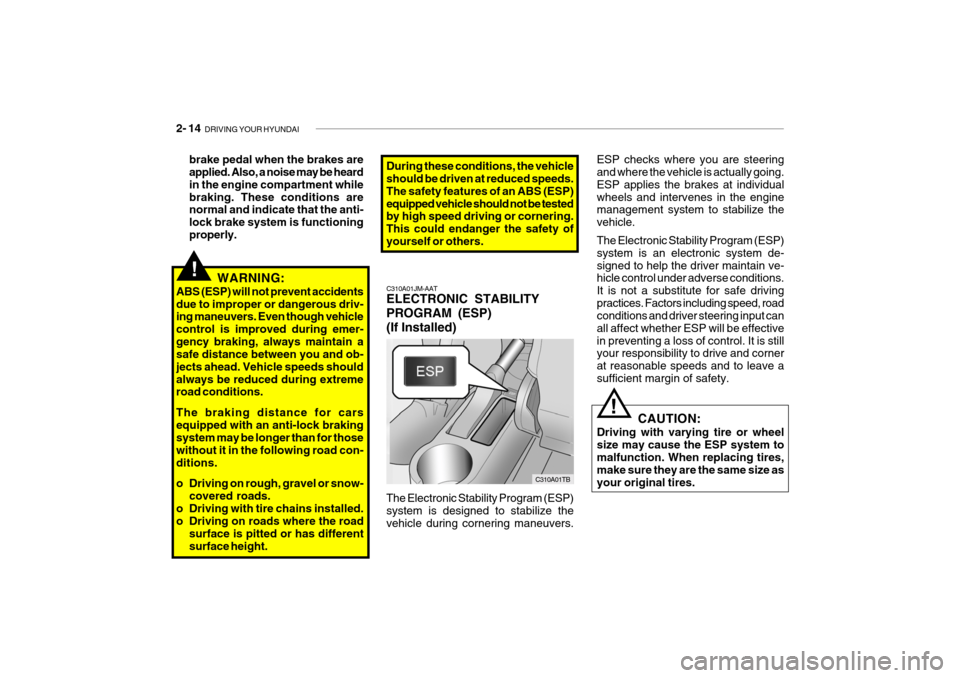
C310A01JM-AAT ELECTRONIC STABILITY PROGRAM (ESP)(If Installed) ESP checks where you are steering and where the vehicle is actually going. ESP applies the brakes at individualwheels and intervenes in the engine management system to stabilize the vehicle. The Electronic Stability Program (ESP) system is an electronic system de-signed to help the driver maintain ve- hicle control under adverse conditions. It is not a substitute for safe drivingpractices. Factors including speed, road conditions and driver steering input can all affect whether ESP will be effectivein preventing a loss of control. It is still your responsibility to drive and corner at reasonable speeds and to leave asufficient margin of safety.
C310A01TB
The Electronic Stability Program (ESP)system is designed to stabilize thevehicle during cornering maneuvers.
brake pedal when the brakes are applied. Also, a noise may be heard in the engine compartment whilebraking. These conditions are normal and indicate that the anti- lock brake system is functioningproperly.
Page 160 of 256

2- 18 DRIVING YOUR HYUNDAI
C160K01A-AAT Carry Emergency Equipment Depending on the severity of the weather where you drive your car, you should carry appropriate emergencyequipment. Some of the items you may want to carry include tire chains, tow straps or chains, flashlight, emer-gency flares, sand, a shovel, jumper cables, a window scraper, gloves, ground cloth, coveralls, a blanket, etc.
C160H01A-AAT Use Approved Anti-Freeze in
Window Washer System To keep the water in the window washer system from freezing, add an approved anti-freeze solution in accordance withinstructions on the container. Window washer anti-freeze is available from Hyundai dealers and most auto partsoutlets. Do not use engine coolant or other types of anti-freeze as these may damage the finish. C160I01A-AAT Don't Let Your Parking Brake Freeze Under some conditions your parking brake can freeze in the engaged posi- tion. This is most likely to happenwhen there is an accumulation of snow or ice around or near the rear brakes or if the brakes are wet. If there is a riskthe parking brake may freeze, apply it only temporarily while you put the gear selector lever in "P" (automatic) or infirst or reverse gear (manual transaxle) and block the rear wheels so the car cannot roll. Then release the parkingbrake. C160J01A-AAT Don't Let Ice and Snow Accumu- late Underneath Under some conditions, snow and ice can build up under the fenders and interfere with the steering. When driv-ing in severe winter conditions where this may happen, you should periodi- cally check underneath the car to besure the movement of the front wheels and the steering components is not obstructed.
C160G01A-GAT To Keep Locks from Freezing To keep the locks from freezing, squirt an approved de-icer fluid or glycerineinto the key opening. If a lock is cov- ered with ice, squirt it with an approved de-icing fluid to remove the ice. If thelock is frozen internally, you may be able to thaw it out by using a heated key. Handle the heated key with careto avoid burning your fingers. NOTE: The proper temperature for using the immobilizer key is from -40°C to 80°C. If you heat the immobilizer key over 80°C to open the frozenlock, it may cause damage to the transponder in its head.
C160F01A-AAT Check Spark Plugs and Ignition System Inspect your spark plugs as described in Section 6 and replace them if neces- sary. Also check all ignition wiring andcomponents to be sure they are not cracked, worn or damaged in any way.
Page 167 of 256
3- 2 WHAT TO DO IN AN EMERGENCY
HTB165
D010B02A-AAT If Engine Doesn't Turn Over or Turns Over Slowly
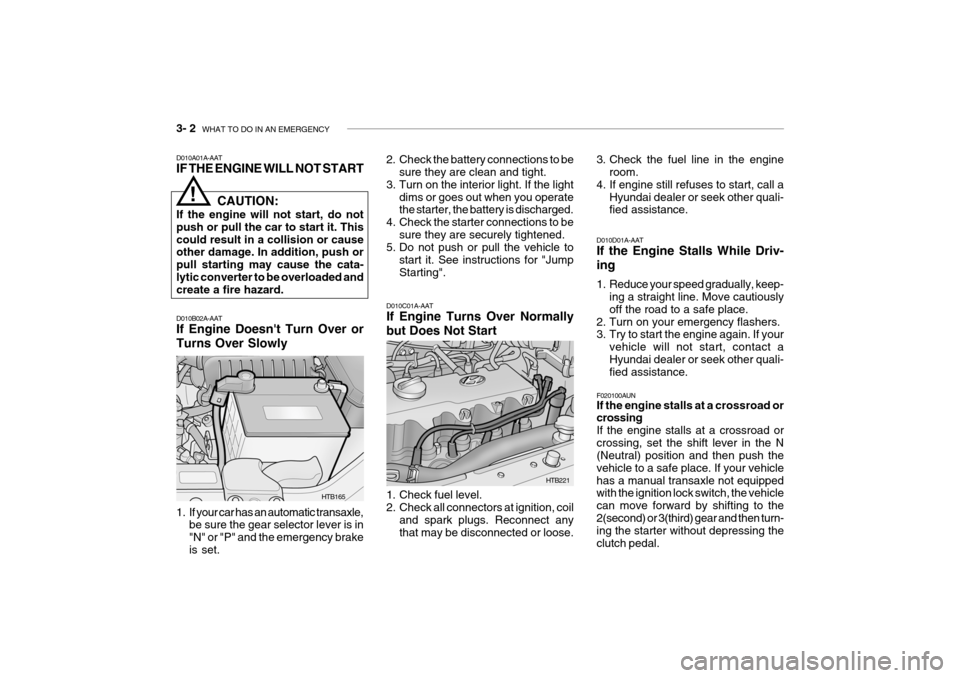
1. If your car has an automatic transaxle,
be sure the gear selector lever is in "N" or "P" and the emergency brakeis set. D010C01A-AAT If Engine Turns Over Normally but Does Not Start
1. Check fuel level.
2. Check all connectors at ignition, coil
and spark plugs. Reconnect any that may be disconnected or loose. D010D01A-AAT If the Engine Stalls While Driv- ing
1. Reduce your speed gradually, keep-
ing a straight line. Move cautiously off the road to a safe place.
2. Turn on your emergency flashers.
3. Try to start the engine again. If your vehicle will not start, contact a Hyundai dealer or seek other quali- fied assistance.
F020100AUN If the engine stalls at a crossroad or crossing If the engine stalls at a crossroad orcrossing, set the shift lever in the N (Neutral) position and then push the vehicle to a safe place. If your vehiclehas a manual transaxle not equipped with the ignition lock switch, the vehicle can move forward by shifting to the2(second) or 3(third) gear and then turn- ing the starter without depressing the clutch pedal.
D010A01A-AAT IF THE ENGINE WILL NOT START
CAUTION:
If the engine will not start, do not push or pull the car to start it. Thiscould result in a collision or cause other damage. In addition, push or pull starting may cause the cata-lytic converter to be overloaded and create a fire hazard.
!
HTB221
2. Check the battery connections to be
sure they are clean and tight.
3. Turn on the interior light. If the light dims or goes out when you operate the starter, the battery is discharged.
4. Check the starter connections to be sure they are securely tightened.
5. Do not push or pull the vehicle to
start it. See instructions for "Jump Starting". 3. Check the fuel line in the engine
room.
4. If engine still refuses to start, call a Hyundai dealer or seek other quali- fied assistance.
Page 172 of 256
WHAT TO DO IN AN EMERGENCY 3- 7
HTB230
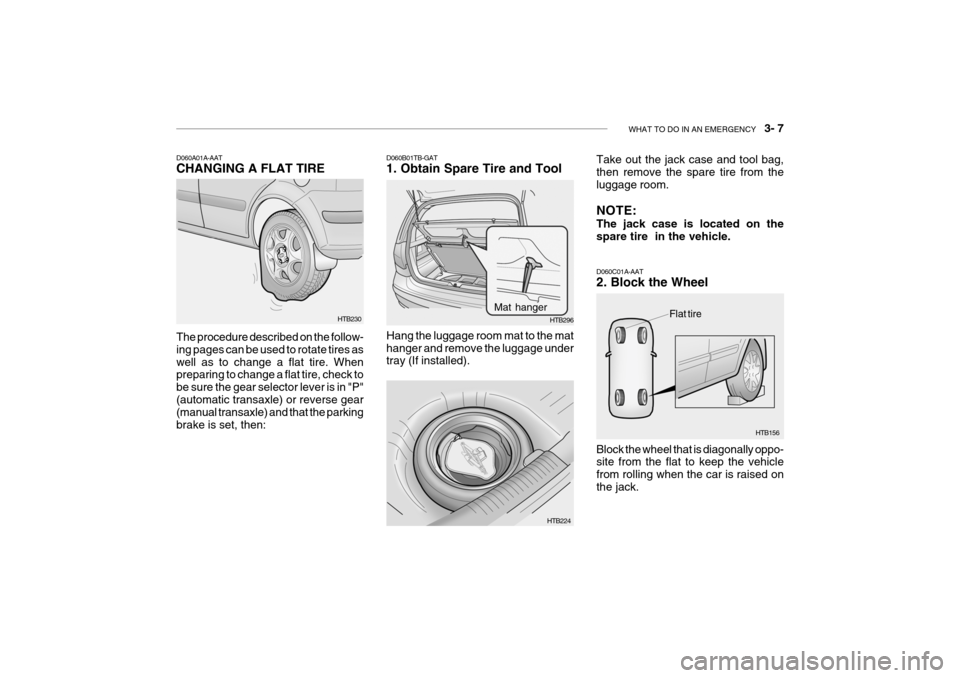
D060A01A-AAT CHANGING A FLAT TIRE The procedure described on the follow- ing pages can be used to rotate tires aswell as to change a flat tire. When preparing to change a flat tire, check to be sure the gear selector lever is in "P"(automatic transaxle) or reverse gear (manual transaxle) and that the parking brake is set, then:Flat tire
HTB156
D060C01A-AAT 2. Block the Wheel Block the wheel that is diagonally oppo- site from the flat to keep the vehicle from rolling when the car is raised onthe jack.
Take out the jack case and tool bag, then remove the spare tire from the luggage room. NOTE: The jack case is located on the spare tire in the vehicle.
Hang the luggage room mat to the mat hanger and remove the luggage under tray (If installed).
D060B01TB-GAT 1. Obtain Spare Tire and Tool
HTB224HTB296
Mat hanger
Page 173 of 256
3- 8 WHAT TO DO IN AN EMERGENCY
HTB149
HTB4003
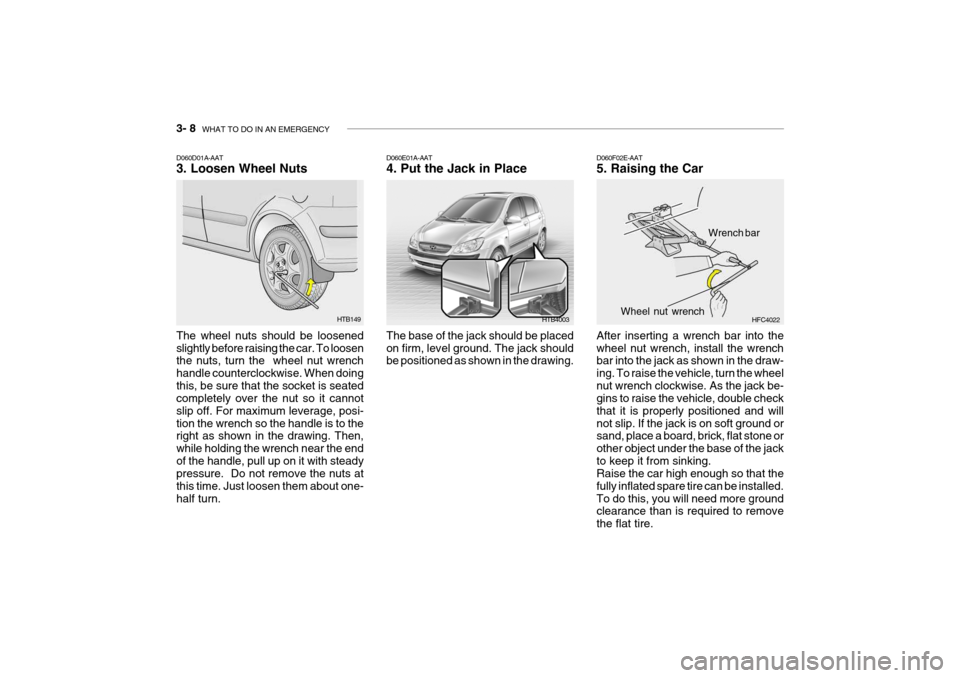
D060D01A-AAT 3. Loosen Wheel Nuts The wheel nuts should be loosened slightly before raising the car. To loosen the nuts, turn the wheel nut wrench handle counterclockwise. When doingthis, be sure that the socket is seated completely over the nut so it cannot slip off. For maximum leverage, posi-tion the wrench so the handle is to the right as shown in the drawing. Then, while holding the wrench near the endof the handle, pull up on it with steady pressure. Do not remove the nuts at this time. Just loosen them about one-half turn. D060E01A-AAT 4. Put the Jack in Place The base of the jack should be placed on firm, level ground. The jack should be positioned as shown in the drawing.
D060F02E-AAT 5. Raising the Car After inserting a wrench bar into the wheel nut wrench, install the wrench bar into the jack as shown in the draw- ing. To raise the vehicle, turn the wheelnut wrench clockwise. As the jack be- gins to raise the vehicle, double check that it is properly positioned and willnot slip. If the jack is on soft ground or sand, place a board, brick, flat stone or other object under the base of the jackto keep it from sinking. Raise the car high enough so that the fully inflated spare tire can be installed.To do this, you will need more ground clearance than is required to remove the flat tire.
HFC4022
Wrench bar
Wheel nut wrench
Page 175 of 256
3- 10 WHAT TO DO IN AN EMERGENCY
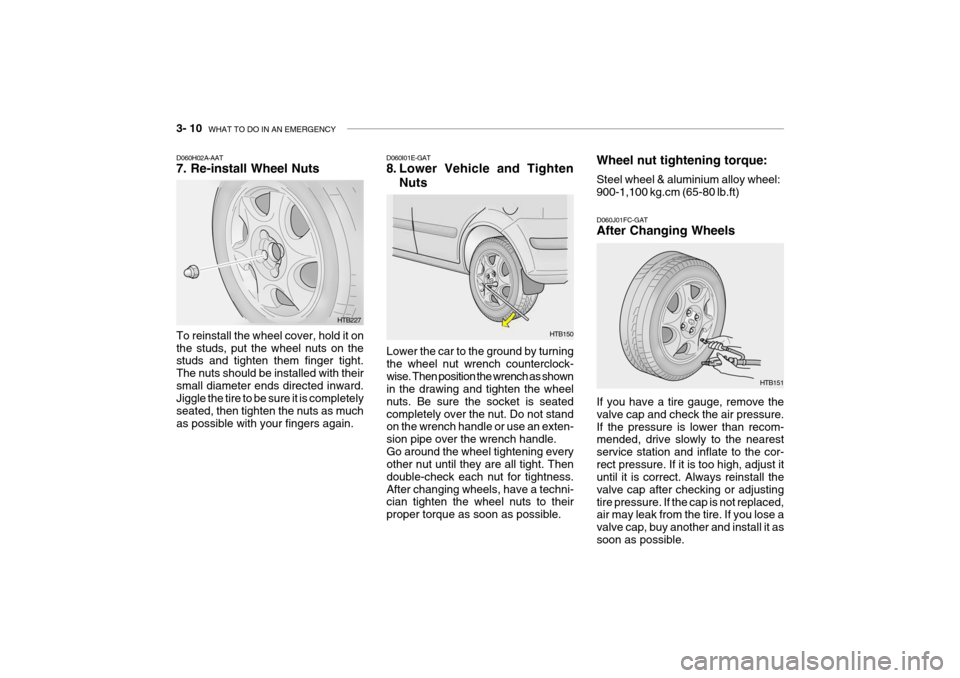
D060H02A-AAT 7. Re-install Wheel Nuts To reinstall the wheel cover, hold it on the studs, put the wheel nuts on the studs and tighten them finger tight. The nuts should be installed with theirsmall diameter ends directed inward. Jiggle the tire to be sure it is completely seated, then tighten the nuts as muchas possible with your fingers again. Lower the car to the ground by turningthe wheel nut wrench counterclock-wise. Then position the wrench as shown in the drawing and tighten the wheel nuts. Be sure the socket is seatedcompletely over the nut. Do not stand on the wrench handle or use an exten- sion pipe over the wrench handle.Go around the wheel tightening every other nut until they are all tight. Then double-check each nut for tightness.After changing wheels, have a techni- cian tighten the wheel nuts to their proper torque as soon as possible.
D060I01E-GAT
8. Lower Vehicle and Tighten
Nuts
D060J01FC-GATAfter Changing Wheels If you have a tire gauge, remove the valve cap and check the air pressure.If the pressure is lower than recom- mended, drive slowly to the nearest service station and inflate to the cor-rect pressure. If it is too high, adjust it until it is correct. Always reinstall the valve cap after checking or adjustingtire pressure. If the cap is not replaced, air may leak from the tire. If you lose a valve cap, buy another and install it assoon as possible.
HTB227 Wheel nut tightening torque: Steel wheel & aluminium alloy wheel: 900-1,100 kg.cm (65-80 lb.ft)
HTB150
HTB151
Page 176 of 256
WHAT TO DO IN AN EMERGENCY 3- 11
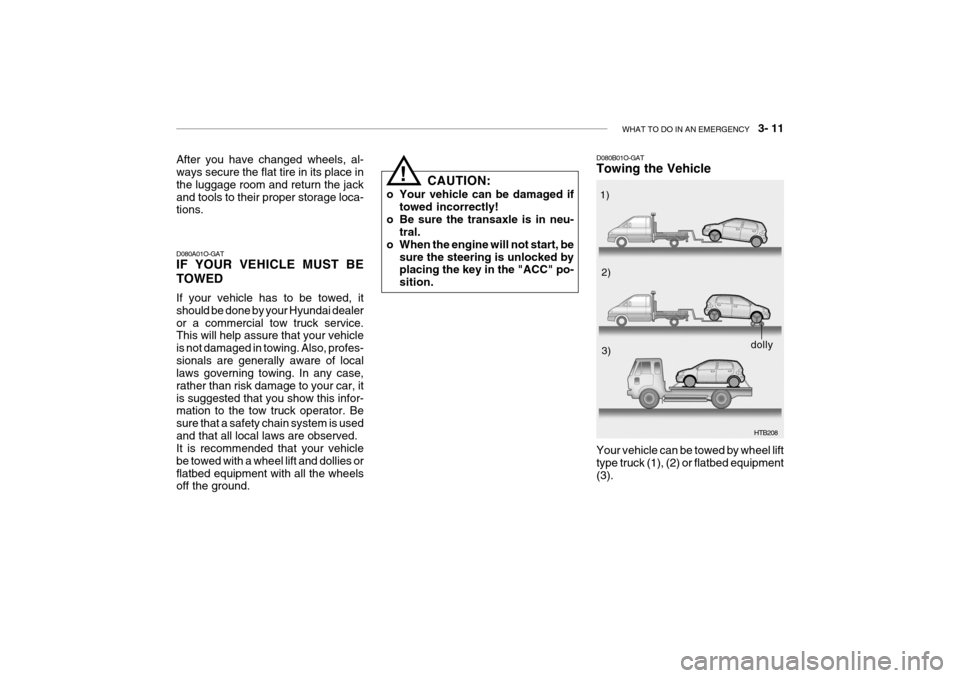
After you have changed wheels, al- ways secure the flat tire in its place in the luggage room and return the jackand tools to their proper storage loca- tions. D080A01O-GAT IF YOUR VEHICLE MUST BE TOWED If your vehicle has to be towed, it should be done by your Hyundai dealeror a commercial tow truck service. This will help assure that your vehicle is not damaged in towing. Also, profes-sionals are generally aware of local laws governing towing. In any case, rather than risk damage to your car, itis suggested that you show this infor- mation to the tow truck operator. Be sure that a safety chain system is usedand that all local laws are observed. It is recommended that your vehicle be towed with a wheel lift and dollies orflatbed equipment with all the wheels off the ground.
!
CAUTION:
o Your vehicle can be damaged if towed incorrectly!
o Be sure the transaxle is in neu- tral.
o When the engine will not start, be
sure the steering is unlocked by placing the key in the "ACC" po- sition. D080B01O-GAT Towing the Vehicle
HTB208
Your vehicle can be towed by wheel lift type truck (1), (2) or flatbed equipment(3). 1)
2)
3)
dolly
Page 177 of 256
3- 12 WHAT TO DO IN AN EMERGENCY
HTB210
!
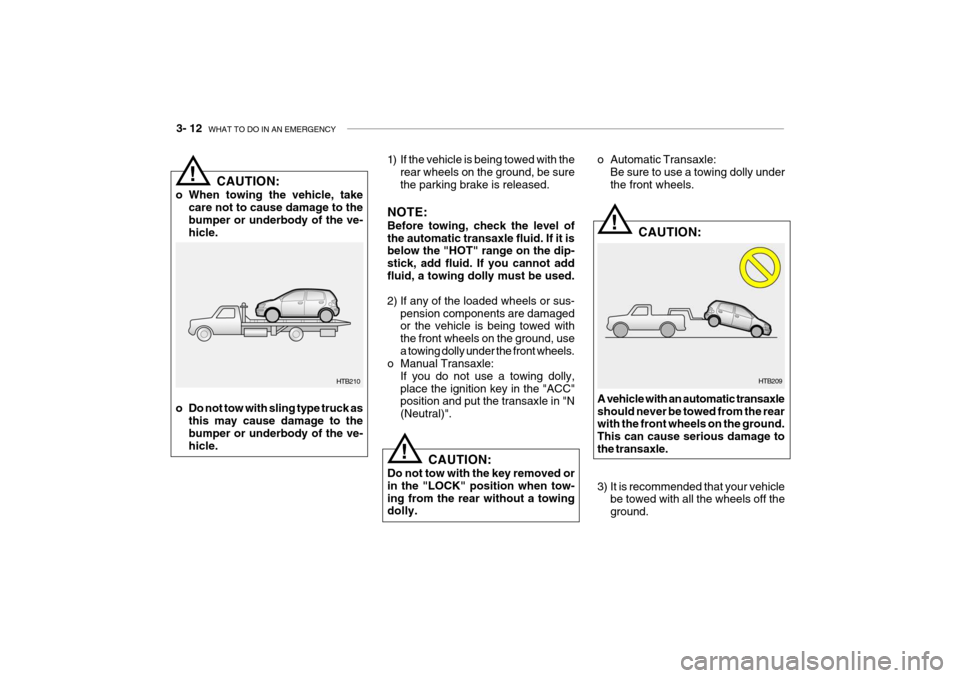
1) If the vehicle is being towed with the
rear wheels on the ground, be sure the parking brake is released.
NOTE: Before towing, check the level of the automatic transaxle fluid. If it is below the "HOT" range on the dip- stick, add fluid. If you cannot addfluid, a towing dolly must be used.
2) If any of the loaded wheels or sus- pension components are damaged or the vehicle is being towed with the front wheels on the ground, usea towing dolly under the front wheels.
o Manual Transaxle:
If you do not use a towing dolly,place the ignition key in the "ACC" position and put the transaxle in "N (Neutral)".
CAUTION:
Do not tow with the key removed orin the "LOCK" position when tow-ing from the rear without a towing dolly. HTB209
!
o Automatic Transaxle:
Be sure to use a towing dolly under the front wheels.
CAUTION:
A vehicle with an automatic transaxleshould never be towed from the rear with the front wheels on the ground. This can cause serious damage tothe transaxle.
3) It is recommended that your vehicle be towed with all the wheels off the ground.
! CAUTION:
o When towing the vehicle, take care not to cause damage to the bumper or underbody of the ve- hicle.
o Do not tow with sling type truck as this may cause damage to thebumper or underbody of the ve- hicle.
Page 178 of 256
WHAT TO DO IN AN EMERGENCY 3- 13
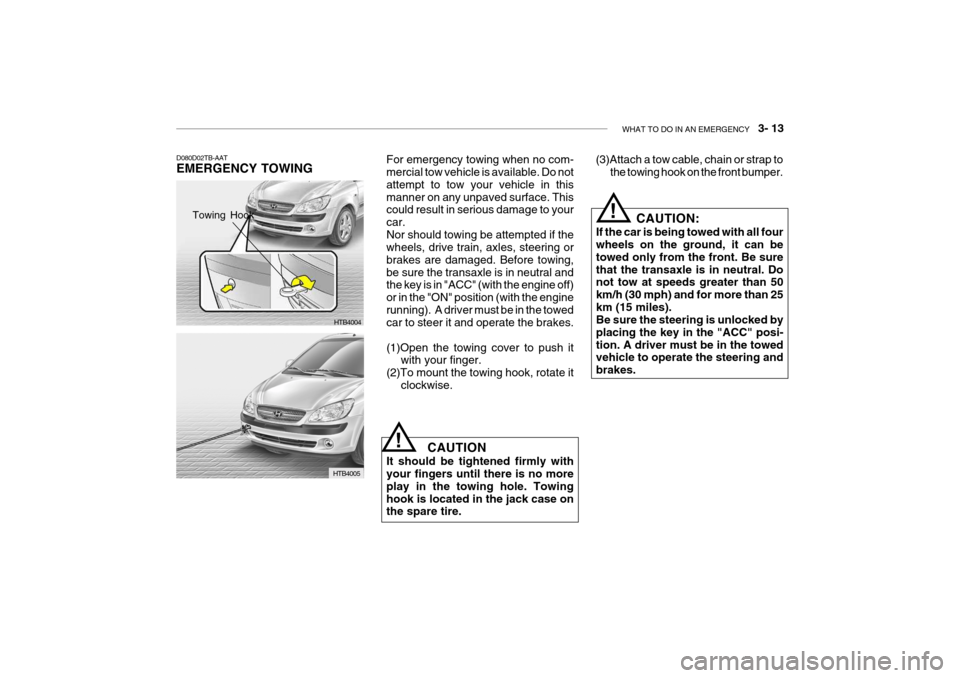
D080D02TB-AAT EMERGENCY TOWING
HTB4004
HTB4005
Towing Hook
CAUTION:
If the car is being towed with all four wheels on the ground, it can be towed only from the front. Be surethat the transaxle is in neutral. Do not tow at speeds greater than 50 km/h (30 mph) and for more than 25km (15 miles). Be sure the steering is unlocked by placing the key in the "ACC" posi-tion. A driver must be in the towed vehicle to operate the steering and brakes.!
(3)Attach a tow cable, chain or strap to
the towing hook on the front bumper.
For emergency towing when no com- mercial tow vehicle is available. Do not attempt to tow your vehicle in thismanner on any unpaved surface. This could result in serious damage to your car.Nor should towing be attempted if the wheels, drive train, axles, steering or brakes are damaged. Before towing,be sure the transaxle is in neutral and the key is in "ACC" (with the engine off) or in the "ON" position (with the enginerunning). A driver must be in the towed car to steer it and operate the brakes. (1)Open the towing cover to push it
with your finger.
(2)To mount the towing hook, rotate it clockwise.
CAUTION
It should be tightened firmly with your fingers until there is no more play in the towing hole. Towinghook is located in the jack case on the spare tire.
!
Page 179 of 256

3- 14 WHAT TO DO IN AN EMERGENCY
D120A01A-GAT IF YOU LOSE YOUR KEYS If you lose your keys, many Hyundai dealers can make you a new key if youhave your key number. If you lock the keys inside your car and you cannot obtain a new key, manyHyundai dealers can use special tools to open the door for you. Information about the key of immobi- lizer system (if installed) will be found on page 1-5.