trailer Hyundai Getz 2010 Owner's Manual
[x] Cancel search | Manufacturer: HYUNDAI, Model Year: 2010, Model line: Getz, Model: Hyundai Getz 2010Pages: 256, PDF Size: 7.84 MB
Page 16 of 256

1- 4 FEATURES OF YOUR HYUNDAI
B020A01S-GAT BREAKING IN YOUR NEW HYUNDAIDuring the First 2,000 Km (1,200Miles) (Gasoline Engine) No formal "break-in" procedure is re- quired with your new Hyundai. How- ever, you can contribute to the eco- nomical operation and durability of yourHyundai by observing the following recommendations during the first 2,000 km (1,200 miles).
o Don't drive faster than 88 km/h (55
mph).
o While driving, keep your engine speed (rpm, or revolutions per minute) between 2,000 rpm and4,000 rpm.
o Use moderate acceleration. Don't
start, depress the accelerator pedalfully.
o For the first 300 km (200 miles), try
to avoid hard stops.
o Don't lug the engine (in other words, don't drive so slowly in toohigh agear that the engine "bucks": shift toa lower gear).
o Whether going fast or slow, vary your
speed from time to time. o Don't let the engine idle longer than 3
minutes at one time.
o Don't tow a trailer during the first 2,000 km (1,200 miles) of operation.
B010E01A-AAT Gasolines for Cleaner Air To help contribute to cleaner air, Hyundai recommends that you usegasolines treated with detergent addi- tives, which help prevent deposit for- mation in the engine. These gasolineswill help the engine run cleaner and the Emission Control System performance. B010F01A-AAT Operation in Foreign Countries If you are going to drive your Hyundai in another country, be sure to:
o Observe all regulations regarding
registration and insurance.
o Determine that acceptable fuel is available.
Page 17 of 256
FEATURES OF YOUR HYUNDAI 1- 5
B020B01FC-GAT BREAKING IN YOUR NEW HYUNDAIDuring the First 1,000 Km (600Miles) (Diesel Engine) No formal "break-in" procedure is re- quired with your new Hyundai. However, you can contribute to the economical operation and durability of your Hyundaiby observing the following recommenda- tions during the first 1,000 km (600 miles).
o While driving, keep your engine speed
(rpm, or revolutions per minute) within 3,000 rpm.
o While driving, keep under three quar- ters of maximum speed.
o Use moderate acceleration. Don't start, depress the accelerator pedal fully.
o For the first 300 km (200 miles), try to
avoid hard stops.
o Don't lug the engine (in other words, don't drive so slowly in too-high a gearthat the engine "bucks": shift to a lowergear).
o Whether going fast or slow, vary your
speed from time to time.
o Don't let the engine idle longer than 3 minutes at one time.
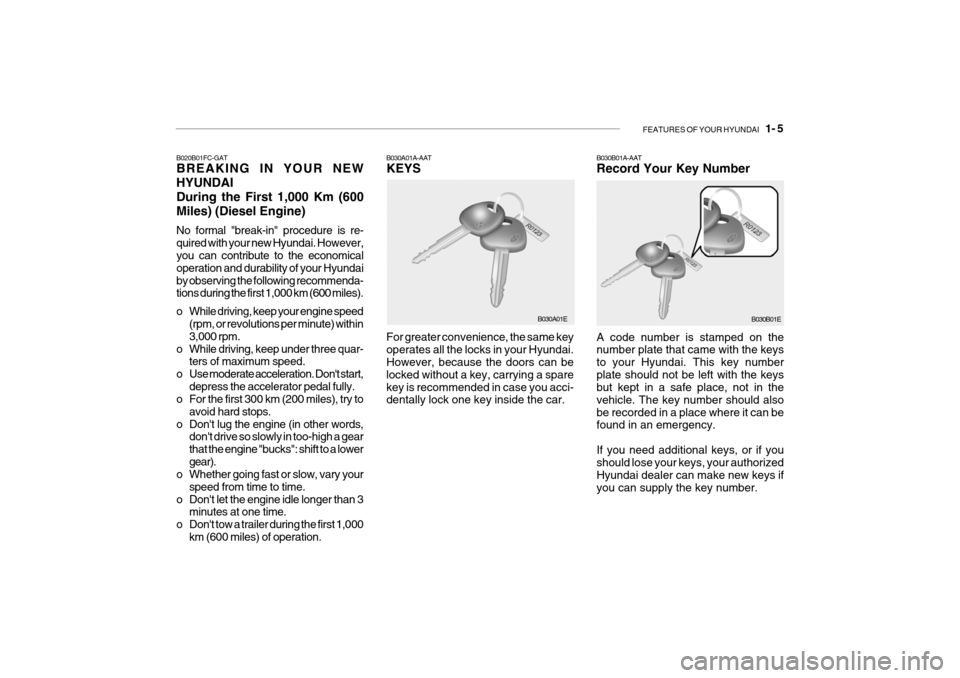
o Don't tow a trailer during the first 1,000 km (600 miles) of operation. B030A01A-AAT KEYS For greater convenience, the same key operates all the locks in your Hyundai. However, because the doors can be locked without a key, carrying a sparekey is recommended in case you acci- dentally lock one key inside the car.
B030A01EB030B01A-AAT Record Your Key Number A code number is stamped on the number plate that came with the keys to your Hyundai. This key numberplate should not be left with the keys but kept in a safe place, not in the vehicle. The key number should alsobe recorded in a place where it can be found in an emergency. If you need additional keys, or if you should lose your keys, your authorized Hyundai dealer can make new keys ifyou can supply the key number. B030B01E
Page 82 of 256
1- 70 FEATURES OF YOUR HYUNDAI
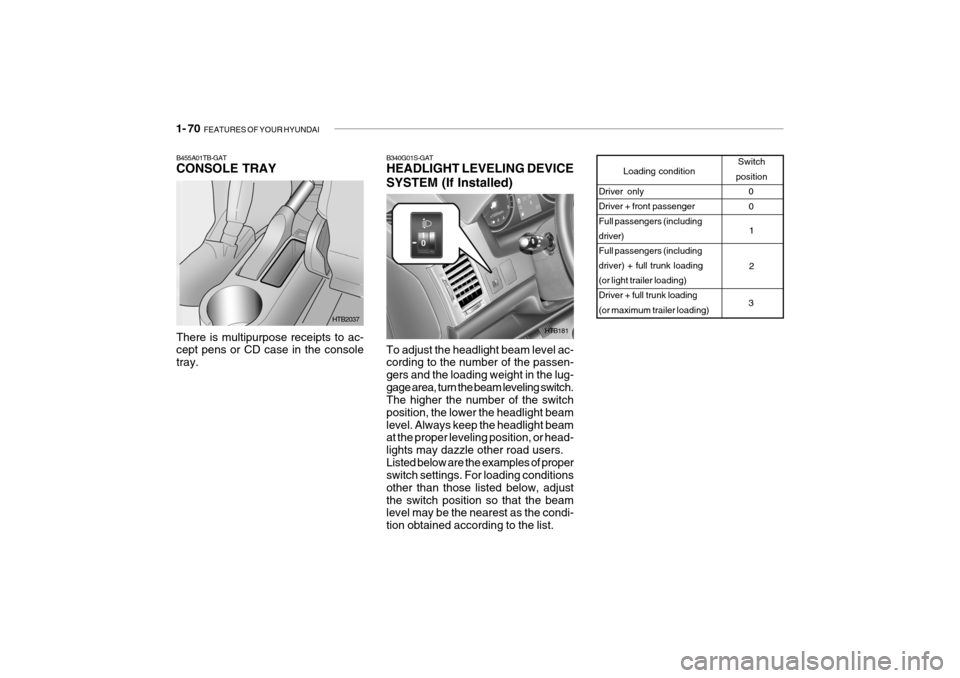
B340G01S-GAT HEADLIGHT LEVELING DEVICE SYSTEM (If Installed) To adjust the headlight beam level ac- cording to the number of the passen- gers and the loading weight in the lug-gage area, turn the beam leveling switch. The higher the number of the switch position, the lower the headlight beamlevel. Always keep the headlight beam at the proper leveling position, or head- lights may dazzle other road users.Listed below are the examples of proper switch settings. For loading conditions other than those listed below, adjustthe switch position so that the beam level may be the nearest as the condi- tion obtained according to the list. HTB181B455A01TB-GAT CONSOLE TRAY There is multipurpose receipts to ac- cept pens or CD case in the console tray.
HTB2037
Loading condition
Switch
position
Driver only Driver + front passenger Full passengers (including driver)Full passengers (including driver) + full trunk loading (or light trailer loading)Driver + full trunk loading (or maximum trailer loading) 0
1 2
3 0
Page 143 of 256

2. DRIVING YOUR HYUNDAI
2
Before starting the engine ................................................................ 2-3
Key position ..................................................................................... 2-4Starting ............................................................................................. 2-5
Operating the manual transaxle ....................................................... 2-7
Automatic transaxle ......................................................................... 2-9Good braking practices .................................................................. 2-12
Anti-Lock brake system (ABS) ...................................................... 2-13
Electronic Stability Program (ESP) ................................................ 2-14
Driving for economy ....................................................................... 2-15
Winter Driving ................................................................................. 2-16
Trailer or vehicle towing ............................. .................................... 2-19
Page 161 of 256

DRIVING YOUR HYUNDAI 2- 19
C170A01A-AAT HIGHER SPEED MOTORING Pre-Trip Inspections 1. Tires: Adjust the tire inflation pressures to specification. Low tire inflation pres- sures will result in overheating andpossible failure of the tires. Avoid using worn or damaged tires which may result in reduced traction ortire failure. NOTE: Never exceed the maximum tire in- flation pressure shown on the tires. 2. Fuel, engine coolant and en- gine oil: High speed travel consumes 1.5 times more fuel than urban motoring. Do not forget to check both engine coolantand engine oil. 3. Drive belt: A loose or damaged drive belt may result in overheating of the engine. C180A01A-AAT USE OF LIGHTS Check your lights regularly for correct operation and always keep them clean. When driving during the day in condi- tions of poor visibility, it is helpful todrive with headlights on low beam. This enables you to be seen as well as to see. C190A03A-GAT TRAILER OR VEHICLE TOWING If you are considering towing with your car, you should first check with your Province Department of Motor Vehiclesto determine their legal requirements. Since laws vary from province to prov- ince, the requirements for towing trail-ers, cars, other types of vehicles, or apparatus may differ. Ask your Hyundai dealer for further details before towing.
!
CAUTION
Do not do any towing with your car during its first 2,000 km (1,200 miles) in order to allow the engine to prop-erly break in. Failure to heed this caution may result in serious en- gine or transaxle damage. NOTE - For Europe
o The technically permissible maxi-
mum load on the rear axle(s) may be exceeded by not more than 15% and the technically permissible maximum laden mass of the ve- hicle may be exceeded by not morethan 10 % or 100 kg (220.4 lbs), whichever value is lower. In this case, do not exceed 100 km/h (62.1mph) for vehicle of category M1 or 80 km/h (49.7 mph) for vehicle of category N1.
o When a vehicle of category M1 is towing a trailer, the additional loadimposed at the trailer couplingdevice may cause the tire maxi- mum load ratings to be exceeded, but not by more than 15 %. In thiscase, do not exceed 100 km/h (62.1 mph) and increase the tire infla- tion pressure by at least 0.2 bar.
Page 162 of 256

2- 20 DRIVING YOUR HYUNDAI
C190D01A-GAT Safety Chains Should the hitch connection between your car and the trailer or vehicle youare towing fail, the trailer or vehicle could wander dangerously across other lanes of traffic and ultimately collidewith another vehicle. To eliminate this potentially dangerous situation, safety chains, attached between your car andthe trailer or towed vehicle, are re- quired in most provinces. cools down. You may proceedonce the engine has cooled suffi- ciently.
C190C04S-GAT Trailer Brakes If your trailer is equipped with a braking system, make sure it conforms to fed- eral and/or local regulations and that itis properly installed and operating cor- rectly. NOTE: If you tow a trailer or vehicle, your car will require more frequent main- tenance due to the additional load.See "Maintenance Under Severe Usage Conditions" on page 5-5.
CAUTION:
o Never connect a trailer brake sys- tem directly to the vehicle brake system.
o When towing a trailer on steep
grades (in excess of 6%) pay closeattention to the engine coolant temperature gauge to ensure the engine does not overheat. If theneedle of the coolant temperature gauge moves across the dial to- wards "H" (HOT), pull over andstop as soon as it is safe to do so, and allow the engine to idle until it
!
C190B01S-AAT Trailer Hitches Select the proper hitch and ball combi- nation, making sure that it's location iscompatible with that of the trailer or vehicle being towed. Use a quality non-equalizing hitch whichdistributes the tongue load uniformly throughout the chassis. The hitch should be bolted securely to the car and installed by a qualified technician. DO NOT USE A HITCHDESIGNED FOR TEMPORARY IN- STALLATION AND NEVER USE ONE THAT ATTACHES ONLY TO THEBUMPER.
Page 163 of 256
DRIVING YOUR HYUNDAI 2- 21
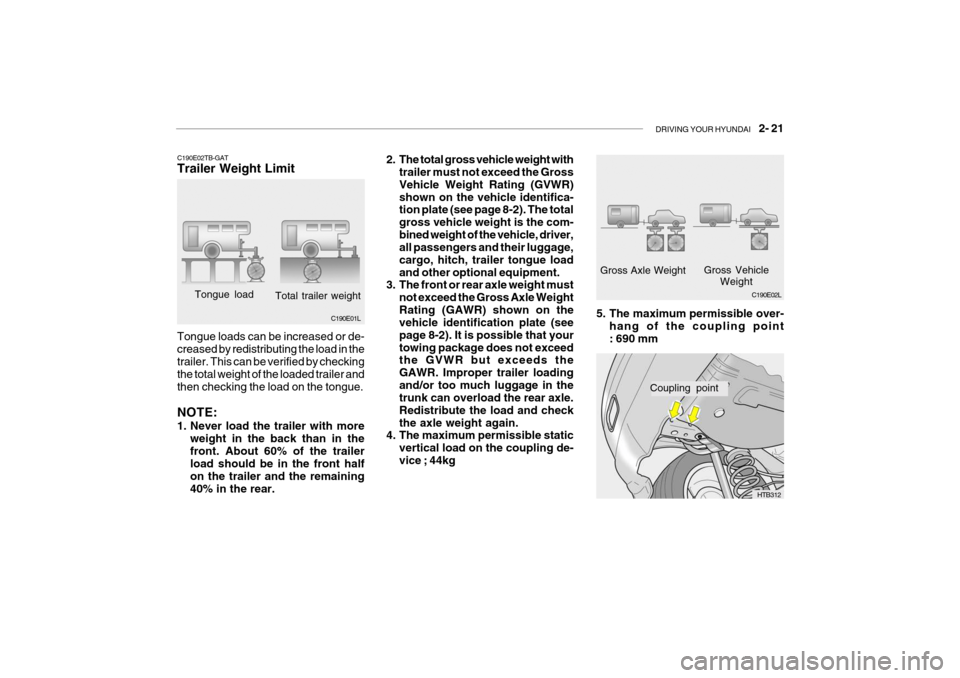
C190E02TB-GAT Trailer Weight Limit
Tongue load
Total trailer weight
C190E01L
Tongue loads can be increased or de- creased by redistributing the load in the trailer. This can be verified by checking the total weight of the loaded trailer andthen checking the load on the tongue. NOTE:
1. Never load the trailer with more weight in the back than in the front. About 60% of the trailer load should be in the front half on the trailer and the remaining40% in the rear. 2. The total gross vehicle weight with
trailer must not exceed the GrossVehicle Weight Rating (GVWR)shown on the vehicle identifica- tion plate (see page 8-2). The total gross vehicle weight is the com-bined weight of the vehicle, driver, all passengers and their luggage, cargo, hitch, trailer tongue loadand other optional equipment.
3. The front or rear axle weight must
not exceed the Gross Axle Weight
Rating (GAWR) shown on the vehicle identification plate (see
page 8-2). It is possible that yourtowing package does not exceed the GVWR but exceeds the GAWR. Improper trailer loadingand/or too much luggage in the trunk can overload the rear axle. Redistribute the load and checkthe axle weight again.
4. The maximum permissible static
vertical load on the coupling de-vice ; 44kg
Coupling point
HTB312
C190E02L
Gross Axle Weight
Gross Vehicle
Weight
5. The maximum permissible over- hang of the coupling point : 690 mm
Page 164 of 256
2- 22 DRIVING YOUR HYUNDAI
6. Check the condition and air pres-
sure of all tires on the trailer and your car. Low tire pressure canseriously affect the handling. Also check the spare tire.
7. The vehicle/trailer combination is more affected by crosswind andbuffeting. When being passed by a largevehicle, keep a constant speed and steer straight ahead. If there is too much wind buffeting slow downto get out of the other vehicle's air turbulence.
8. When parking your car and trailer, especially on a hill, be sure to fol-low all the normal precautions. Turn your front wheel into the curb, setthe parking brake firmly, and put the transaxle in 1st or Reverse (manual) or Park (automatic). Inaddition, place wheel chocks at each of the trailer's tires.
9. If the trailer has electric brakes, start your vehicle and trailer mov-ing, and then apply the trailer brake controller by hand to be sure thebrakes are working. This lets you check your electrical connection at the same time.
C190F02A-GAT Trailer or Vehicle Towing Tips
1. Before towing, check hitch and
safety chain connections as well as proper operation of the trailerrunning lights, brake lights, and turn signals.
2. Always drive your vehicle at a mod- erate speed (Less than 100 km/h).
3. Trailer towing requires more fuel
than normal conditions.
4. To maintain engine braking effi- ciency and electrical charging per- formance, do not use fifth gear(manual transaxle) or overdrive (au- tomatic transaxle).
5. Always secure items in the trailer to prevent load shift while driving.
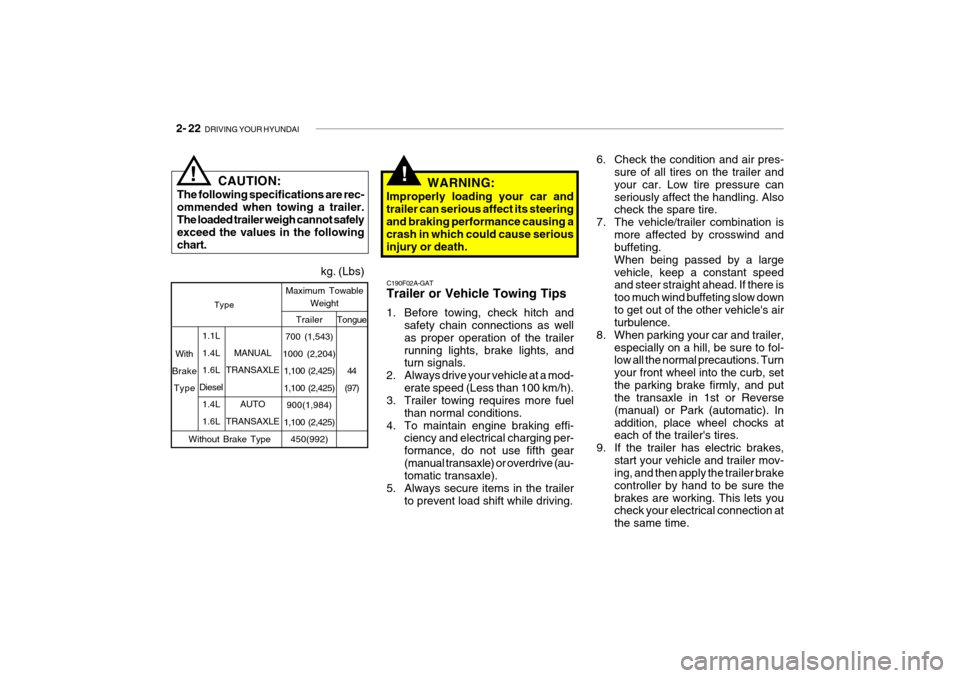
!WARNING:
Improperly loading your car and trailer can serious affect its steering and braking performance causing a crash in which could cause seriousinjury or death.
Tongue 44
(97)
Without Brake Type Trailer
700 (1,543)
1000 (2,204) 1,100 (2,425) 1,100 (2,425) 900(1,984)
1,100 (2,425) 450(992)
MANUAL
TRANSAXLE
AUTO
TRANSAXLE
1.1L 1.4L1.6L
Diesel 1.4L1.6L
With
Brake Type kg. (Lbs)
!
Maximum Towable
Weight
CAUTION:
The following specifications are rec- ommended when towing a trailer.The loaded trailer weigh cannot safely exceed the values in the following chart.
Type
Page 165 of 256

DRIVING YOUR HYUNDAI 2- 23
!
10. During your trip, check occasion-
ally to be sure that the load is secure, and that the lights andany trailer brakes are still working.
11. Avoid jerky starts, sudden accel-
eration or sudden stops.
12. Avoid sharp turns and rapid lane changes.
13. Avoid holding the brake pedal down too long or too frequently. This could cause the brakes to over- heat, resulting in reduced brakingefficiency.
14. When going down a hill, shift into a
lower gear and use the engine brak-ing effect. When ascending a long grade, downshift the transaxle to a lowergear and reduce speed to reduce chances of engine overloading and/ or overheating.
15. If you have to stop while going uphill, do not hold the vehicle inplace by pressing on the accelera-tor. This can cause the automatic transaxle to overheat. Use the park- ing brake or footbrake. NOTE: When towing check transaxle fluid more frequently.
CAUTION:
If overheating should occur whentowing, (temperature gauge reads near red zone), taking the followingaction may reduce or eliminate the problem.
1. Turn off the air conditioner.
2. Reduce highway speed.
3. Select a lower gear when going uphill.
4. While in stop and go traffic, place the gear selection in park or neu- tral and idle the engine at a higher speed.
Page 193 of 256

VEHICLE MAINTENANCE REQUIREMENTS 5- 7
SEVERE DRIVING CONDITIONS
A - Repeatly driving short distance of less than 8km(5miles) in normal
tempera ture or less than 16km(10miles) in freezing temperature
B - Extensive engine idling or low speed driving for long distances
C - Driving on rough, dusty, muddy, unpaved, graveled or salt-spread roads
D - Driving in areas using salt or other corrosive materials or in very cold weather E - Driving in sandy areas
F - Driving in heavy traffic area over 32°C(90°F)
G - Driving on uphill, downhill, or mountain road
H - Towing a Trailer, or using a camper, or roof rack
I - Driving as a patrol car, taxi, other commercial use or vehicle towing
J - Driving over 170 Km/h(100 MPH)
K - Frequently driving in stop-and-go conditions
R R RR
I I I I
RR R
European community Only Except European community
ENGINE OIL AND FILTER AIR CLEANER FILTER SPARK PLUGSTIMING BELT BRAKE PADS, CALIPERS AND ROTORS REAR BRAKE DRUMS/LININGS/PADS,PARKING BRAKE STEERING GEAR BOX, LINKAGE & BOOTS/LOWER ARM BALL JOINTDRIVESHAFTS AND BOOTS MANUAL TRANSAXLE OIL AUTOMATIC TRANSAXLEFLUID
AIR CONDITIONER FILTER (For Evaporator and Blower unit)
F040A02TB-GAT
MAINTENANCE UNDER SEVERE USAGE CONDITIONS
The following items must be serviced more frequently on cars normally used under severe driving conditions. Refer to the chart below for the appropriate maintenance intervals. R : Replace I : Inspect and, after inspection, clean, adjust, repair or replace if necessary
MAINTENANCE ITEM
EVERY 7,500 KM OR 6 MONTHS MORE FREQUENTLY MORE FREQUENTLYEVERY 60,000 KM OR 48 MONTHS MORE FREQUENTLY MORE FREQUENTLY MORE FREQUENTLY EVERY 15,000 KM OR 12 MONTHS EVERY 120,000 KM EVERY 90,000 KMEVERY 100,000 KM MORE FREQUENTLY A, B, C, D, E, F, G, H, I, KC, E B, HD, E, F, G, I C, D, G, H C, D, G, H C, D, E, F C, D, E, F C, D, E, G, H, I, J A, C, E, F, G, H, I C, E
MAINTENANCE
INTERVALS DRIVING
CONDITION
MAINTENANCE
OPERATION