Automatic transaxle Hyundai Grand i10 2015 User Guide
[x] Cancel search | Manufacturer: HYUNDAI, Model Year: 2015, Model line: Grand i10, Model: Hyundai Grand i10 2015Pages: 343, PDF Size: 29.47 MB
Page 203 of 343
515
Driving your vehicle
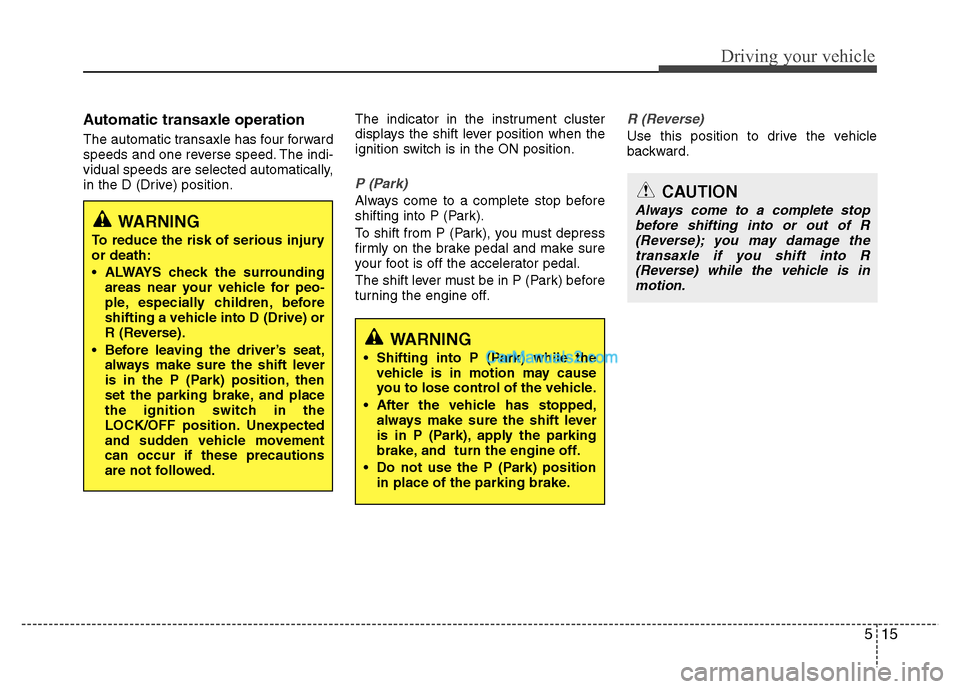
Automatic transaxle operation
The automatic transaxle has four forward
speeds and one reverse speed. The indi-
vidual speeds are selected automatically,
in the D (Drive) position.The indicator in the instrument cluster
displays the shift lever position when the
ignition switch is in the ON position.
P (Park)
Always come to a complete stop before
shifting into P (Park).
To shift from P (Park), you must depress
firmly on the brake pedal and make sure
your foot is off the accelerator pedal.
The shift lever must be in P (Park) before
turning the engine off.
R (Reverse)
Use this position to drive the vehicle
backward.
WARNING
To reduce the risk of serious injury or death:
ALWAYS check the surrounding areas near your vehicle for peo-
ple, especially children, before
shifting a vehicle into D (Drive) or
R (Reverse).
Before leaving the driver’s seat, always make sure the shift lever
is in the P (Park) position, then
set the parking brake, and place
the ignition switch in the
LOCK/OFF position. Unexpected
and sudden vehicle movementcan occur if these precautions
are not followed.
WARNING
Shifting into P (Park) while the vehicle is in motion may cause
you to lose control of the vehicle.
After the vehicle has stopped, always make sure the shift lever
is in P (Park), apply the parking
brake, and turn the engine off.
Do not use the P (Park) position in place of the parking brake.
CAUTION
Always come to a complete stop
before shifting into or out of R(Reverse); you may damage thetransaxle if you shift into R
(Reverse) while the vehicle is inmotion.
Page 204 of 343
Driving your vehicle
16
5
N (Neutral)
The wheels and transaxle are not engaged.
Use N (Neutral) if you need to restart a
stalled engine, or if it is necessary to stop
with the engine ON. Shift into P (Park) if
you need to leave your vehicle for anyreason.
Always depress the brake pedal when
you are shifting from N (Neutral) to
another gear.
D (Drive)
This is the normal driving position. The
transaxle will automatically shift through
a 4-gear sequence, providing the best
fuel economy and power.
For extra power when passing another
vehicle or driving uphill, depress the
accelerator fully. The transaxle will auto-
matically downshift to the next lower gear
(or gears, as appropriate).
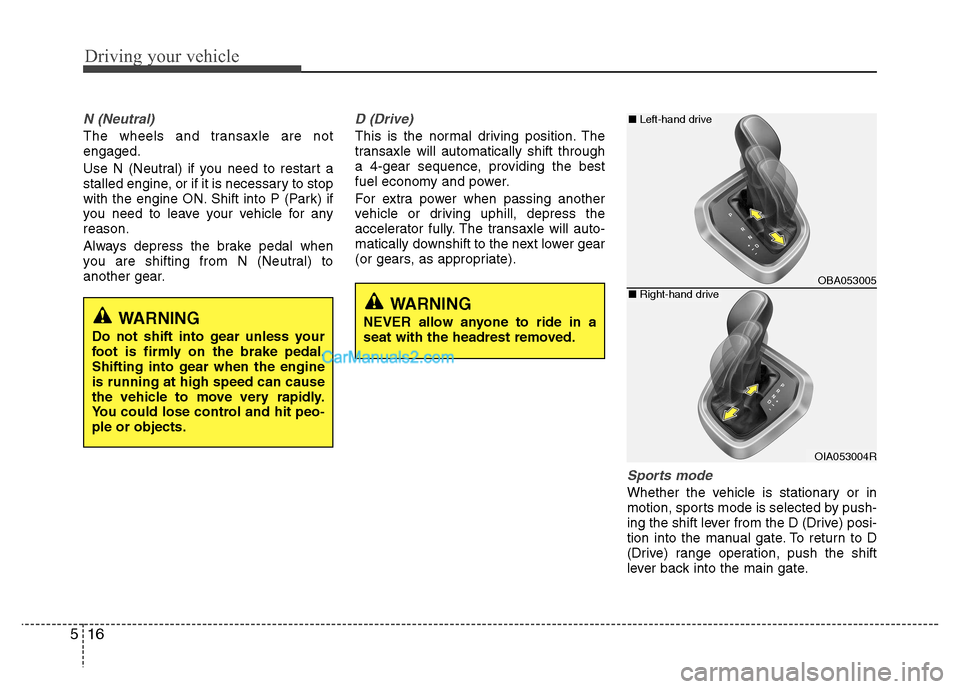
Sports mode
Whether the vehicle is stationary or in
motion, sports mode is selected by push-
ing the shift lever from the D (Drive) posi-
tion into the manual gate. To return to D
(Drive) range operation, push the shift
lever back into the main gate.
WARNING
Do not shift into gear unless your
foot is firmly on the brake pedal.
Shifting into gear when the engineis running at high speed can cause
the vehicle to move very rapidly.
You could lose control and hit peo-ple or objects.WARNING
NEVER allow anyone to ride in a
seat with the headrest removed.
OBA053005
OIA053004R
■ Left-hand drive
■Right-hand drive
Page 205 of 343
517
Driving your vehicle
In Sports Mode, moving the shift lever
backwards and forwards will allow you to
select the desired range of gears for the
current driving conditions.
+ (Up) : Push the lever forward once toshift up one gear.
- (Down) : Pull the lever backwards once to shift down one gear.✽✽
NOTICE
Only the four forward gears can be selected. To reverse or park the vehi-
cle, move the shift lever to the R
(Reverse) or P (Park) position as
required.
Downshifts are made automatically when the vehicle slows down. When
the vehicle stops, 1st gear is automati-
cally selected.
When the engine rpm approaches the red zone the transaxle will upshift
automatically.
If the driver presses the lever to + (Up)
or - (Down) position, the transaxle
may not make the requested gear
change if the next gear is outside of
the allowable engine rpm range. The
driver must execute upshifts in accor-
dance with road conditions, taking
care to keep the engine rpms below
the red zone.
When driving on a slippery road, push the shift lever forward into the +
(Up) position. This causes the
transaxle to shift into the 2nd gear
which is better for smooth driving on
a slippery road. Push the shift lever to
the - (Down) side to shift back to the
1st gear.Shift -lock system
For your safety, the automatic transaxle
has a shift-lock system which prevents
shifting the transaxle from P (Park) into R
(Reverse) unless the brake pedal isdepressed.
To shift the transaxle from P (Park) into R
(Reverse):
1. Depress and hold the brake pedal.
2. Press the shift button.
3. Move the shift lever.
Page 210 of 343
Driving your vehicle
22
5
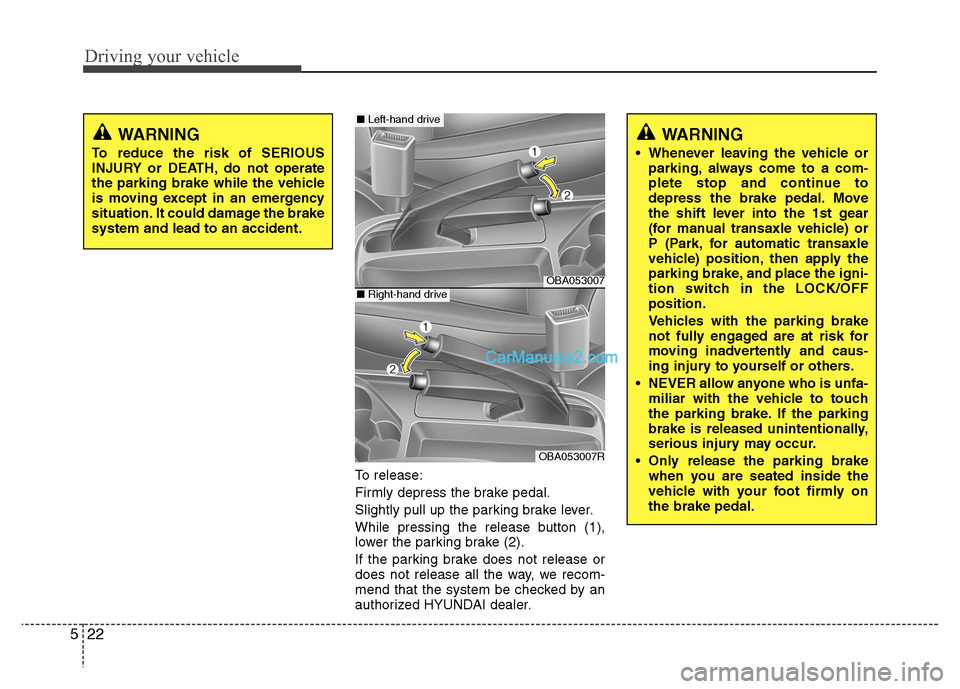
To release:
Firmly depress the brake pedal.
Slightly pull up the parking brake lever.
While pressing the release button (1),
lower the parking brake (2).
If the parking brake does not release or
does not release all the way, we recom-
mend that the system be checked by an
authorized HYUNDAI dealer.
WARNING
Whenever leaving the vehicle or parking, always come to a com-
plete stop and continue to
depress the brake pedal. Move
the shift lever into the 1st gear
(for manual transaxle vehicle) or
P (Park, for automatic transaxle
vehicle) position, then apply the
parking brake, and place the igni-
tion switch in the LOCK/OFFposition.
Vehicles with the parking brake
not fully engaged are at risk for
moving inadvertently and caus-
ing injury to yourself or others.
NEVER allow anyone who is unfa- miliar with the vehicle to touch
the parking brake. If the parking
brake is released unintentionally,
serious injury may occur.
Only release the parking brake when you are seated inside the
vehicle with your foot firmly onthe brake pedal.
OBA053007
OBA053007R
WARNING
To reduce the risk of SERIOUS
INJURY or DEATH, do not operate
the parking brake while the vehicle
is moving except in an emergency
situation. It could damage the brakesystem and lead to an accident.
■ Left-hand drive
■Right-hand drive
Page 218 of 343
Driving your vehicle
30
5
VSM OFF condition
To cancel VSM operation, press the ESC
OFF button. ESC OFF indicator light
( ) will illuminate.
To turn on VSM, press the ESC OFF but-
ton again. The ESC OFF indicator lightwill go out. Hill-Start Assist Control (HAC) (if equipped)
The Hill-Start Assist Control (HAC) pre-
vents the vehicle from rolling backwards
when starting a vehicle from a stop on a
hill. The system operates the brakes
automatically for approximately 1.5 sec-
onds and releases the brake when the
accelerator pedal is depressed or after
1.5 seconds.✽✽
NOTICE
The HAC does not operate when the shift lever is in P (Park) or N (Neutral)
(for automatic transaxle vehicle.)
The HAC operates when: - the shift lever is in N (Neutral) or D
(Drive) on up hill.
- the shift lever is in R (Reverses) on
down hill.
(for manual transaxle vehicle)
The HAC activates even though the ESC (Electronic Stability Control) is
off but does not activate when the
ESC has malfunctioned.
WARNING
If ESC indicator light ( ) or EPS
warning light ( ) stays on, your
vehicle may have a malfunction
with the VSM system. When thewarning light illuminates we recom-
mend that the vehicle be checked
by an authorized HYUNDAI dealer
as soon as possible.
WARNING
Always be ready to depress the
accelerator pedal when starting off
on a incline. The HAC activates only
for approximately 1.5 seconds.
CAUTION
Driving with varying tire or wheel sizes may cause the ESC system tomalfunction. When replacing tires,make sure they are the same size asyour original tires for this vehicle.
Page 219 of 343
531
Driving your vehicle
Emergency Stop Signal (ESS) (if equipped) The Emergency Stop Signal system
alerts the driver behind by blinking the
stop light when the vehicle brakes rapid-
ly and severely.
The system is activated when:
The vehicle suddenly stops (vehiclespeed is over 55km/h (34mph) and the
vehicle deceleration is greater than7m/s2).
The ABS is activating. When vehicle speed is under 40 km/h
(25mph) and the ABS deactivates or
the sudden stop situation is over, the
stop light will stop blinking. Instead, the
hazard warning flasher will turn on
automatically. The hazard warning
flasher will turn off when vehicle speed
is over 10km/h (6mph) after the vehicle
has stopped. Also, it will turn off when
the vehicle is driven at low speed for
some time. You can turn it off manually
by pressing the hazard warning flasher
switch. Good braking practices
Wet brakes can be dangerous! The
brakes may get wet if the vehicle is driv-
en through standing water or if it is
washed. Your vehicle will not stop as
quickly if the brakes are wet. Wet brakes
may cause the vehicle to pull to one side.
To dry the brakes, apply the brakes light-
ly until the braking action returns to nor-
mal, taking care to keep the vehicle
under control at all times. If the braking
action does not return to normal, stop as
soon as it is safe to do so and we rec-
ommend that you call an authorized
HYUNDAI dealer for assistance.
DO NOT drive with your foot resting on
the brake pedal. Even light, but constant
pedal pressure can result in the brakes
overheating, brake wear, and possibly
even brake failure.
If a tire goes flat while you are driving,
apply the brakes gently and keep the
vehicle pointed straight ahead while you
slow down. When you are moving slowly
enough for it to be safe to do so, pull off
the road and stop in a safe location.
Keep your foot firmly on the brake pedal
when the vehicle is stopped to prevent
the vehicle from rolling forward.
WARNING
Whenever leaving the vehicle or
parking, always come to a complete
stop and continue to depress the
brake pedal. Move the shift lever
into the 1st gear (for manual
transaxle vehicle) or P (Park, for
automatic transaxle vehicle) posi-
tion, then apply the parking brake,
and place the ignition switch in theLOCK/OFF position.
Vehicles with the parking brake not
fully engaged are at risk for moving
inadvertently and causing injury to
yourself or others.
Page 222 of 343
Driving your vehicle
34
5
Hazardous driving conditions
When hazardous driving conditions are
encountered such as water, snow, ice,
mud or sand:
Drive cautiously and allow extra distance
for braking.
Avoid sudden movements in braking or
steering.
If stuck in snow, mud, or sand, use sec-
ond gear. Accelerate slowly to avoid spin-
ning the drive wheels.
Use sand, rock salt, or other non-slip
material under the drive wheels to pro-
vide traction when stalled in ice, snow, or
mud. Rocking the vehicle
If it is necessary to rock the vehicle to
free it from snow, sand, or mud, first turn
the steering wheel right and left to clear
the area around your front wheels. Then,
shift back and forth between 1st and R
(Reverse, for manual transaxle vehicle)
or R (Reverse) and a forward gear (for
automatic transaxle vehicle). Try to avoid
spinning the wheels, and do not race the
engine.
To prevent transaxle wear, wait until the
wheels stop spinning before shifting
gears. Release the accelerator pedalwhile shifting, and press lightly on the
accelerator pedal while the transaxle is in
gear. Slowly spinning the wheels in for-
ward and reverse directions causes a
rocking motion that may free the vehicle.
SPECIAL DRIVING CONDITIONS
WARNING
Downshifting with an automatic
transaxle, while driving on slipperysurfaces can cause an accident.
The sudden change in tire speed
could cause the tires to skid. Be
careful when downshifting on slip-
pery surfaces.
WARNING
If the tires spin at high speed the
tires can explode, and you or oth-
ers may be injured. Do not attempt
this procedure if people or objects
are anywhere near the vehicle.
The vehicle can overheat causing
an engine compartment fire or
other damage. Spin the wheels as
little as possible and avoid spin-
ning the wheels at speeds over 56km/h (35 mph) as indicated on the
speedometer.
CAUTION
If you are still stuck after rocking the vehicle a few times, have thevehicle pulled out by a tow vehicle to avoid engine overheating, possi- ble damage to the transaxle, and
tire damage. See “Towing” in chap- ter 6.
To prevent damage to the transaxle,turn OFF the ESC (if equipped) priorto rocking the vehicle.
Page 231 of 343
63
What to do in an emergency
2. When the vehicle is stopped, turn onyour hazard warning flasher, set the
parking brake and put the transaxle in
P (automatic transaxle) or reverse
(manual transaxle).
3. Have all passengers get out of the vehicle. Be sure they all get out on the
side of the vehicle that is away from
traffic.
4. When changing a flat tire, follow the instruction provided later in this chap-
ter.
If the engine stalls while driving
1. Reduce your speed gradually, keeping a straight line. Move cautiously off the
road to a safe place.
2. Turn on your hazard warning flasher.
3. Try to start the engine again. Try to start the engine again. If your vehicle
will not start, we recommend that you
consult an authorized HYUNDAI deal-
er. If the engine doesn't turn over or
turns over slowly
1. If your vehicle has an automatic
transaxle, be sure the shift lever is in N
(Neutral) or P (Park) and the emer-
gency brake is set.
2. Check the battery connections to be sure they are clean and tight.
3. Turn on the interior light. If the light dims or goes out when you operate the
starter, the battery is discharged.
4. Check the starter connections to be sure they are securely tightened.
5. Do not push or pull the vehicle to start it. See instructions for "Jump starting". If the engine turns over normally
but does not start
1. Check the fuel level.
2. With the ignition switch in the LOCK/
OFF position, check all connectors at
the ignition coils and spark plugs.
Reconnect any that may be discon-
nected or loose.
3. Check the fuel line in the engine com- partment.
4. If the engine still does not start, we rec- ommend that you call an authorized
HYUNDAI dealer.
IF THE ENGINE DOES NOT START
WARNING
If the engine will not start, do not
push or pull the vehicle to start it.This could result in a collision or
cause other damage. In addition,
push or pull starting may cause the
catalytic converter to overload and
create a fire.
Page 233 of 343
65
What to do in an emergency
✽✽
NOTICE
An inappropriately disposedbattery can be harmful to the
environment and human health.
Dispose the battery according
to your local law(s) or regula-
tion.
Jump starting procedure
1. Position the vehicles close enough that the jumper cables will reach, but do not
allow the vehicles to touch.
2. Avoid fans or any moving parts in the engine compartment at all times, even
when the vehicles are turned off.
3. Turn off all electrical devices such as radios, lights, air conditioning, etc. Put
the vehicles in P (Park, for automatic
transaxle vehicle) or neutral (for manu-
al transaxle vehicle), and set the park-
ing brakes. Turn both vehicles OFF.
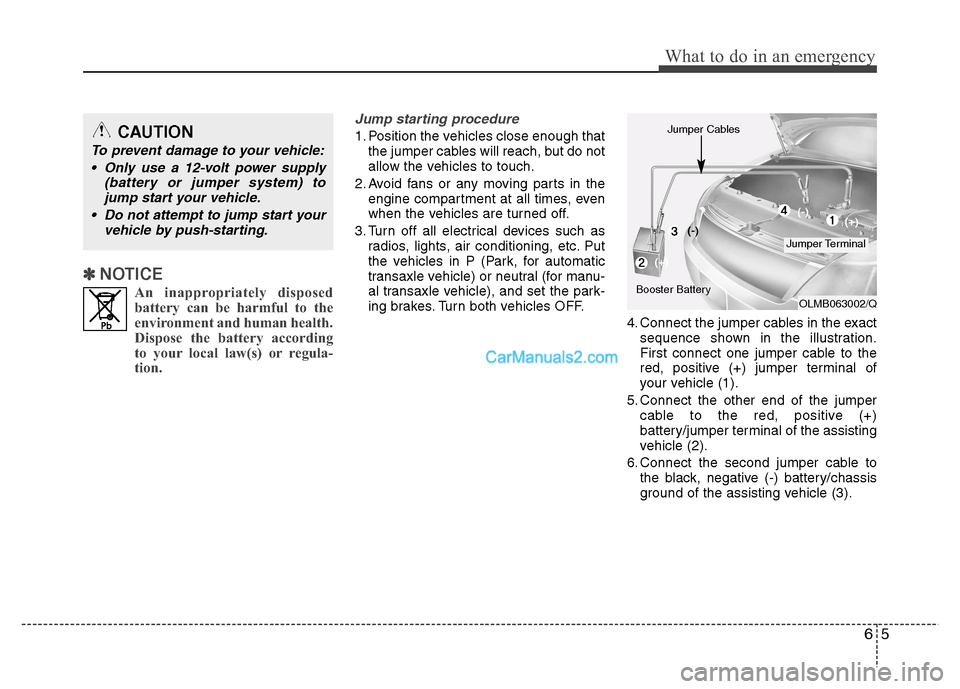
4. Connect the jumper cables in the exactsequence shown in the illustration.
First connect one jumper cable to the
red, positive (+) jumper terminal of
your vehicle (1).
5. Connect the other end of the jumper cable to the red, positive (+)
battery/jumper terminal of the assisting
vehicle (2).
6. Connect the second jumper cable to the black, negative (-) battery/chassis
ground of the assisting vehicle (3).CAUTION
To prevent damage to your vehicle:
Only use a 12-volt power supply (battery or jumper system) to
jump start your vehicle.
Do not attempt to jump start your vehicle by push-starting.
OLMB063002/Q
Jumper Terminal
Jumper Cables
Booster Battery(-)
(+) (+)
(-)
Page 235 of 343
67
What to do in an emergency
IF THE ENGINE OVERHEATS
If your temperature gauge indicates over-
heating, you will experience a loss of
power, or hear loud pinging or knocking
sound, the engine will probably be too
hot. If this happens, you should:
1. Pull the vehicle off the road and stop as soon as it is safe to do so.
2. Place the shift lever in P (automatic transaxle) or Neutral (manual
transaxle) and set the parking brake. If
the air conditioning is on, turn it off.
3. If engine coolant is running out under the vehicle or steam is coming out
from the hood, stop the engine. Do notopen the hood until the coolant has
stopped running or the steaming has
stopped. If there is no visible loss of
engine coolant and no steam, leave
the engine running and check to be
sure the engine cooling fan is operat-
ing. If the fan is not running, turn the
engine off.
4. Check to see if the water pump drive belt is missing. If it is not missing,
check to see that it is tight. If the drive
belt seems to be satisfactory, check
for coolant leakage from the radiator,
hoses or under the vehicle. (If the air
conditioning had been in use, it is nor-
mal for cold water to be draining from it
when you stop). 5. If the water pump drive belt is broken
or engine coolant is leaking out, stop
the engine immediately and we recom-
mend that you call an authorized
HYUNDAI dealer. 6. If you cannot find the cause of the
overheating, wait until the engine tem-
perature has returned to normal. Then,if coolant has been lost, carefully add
coolant to the reservoir to bring the
fluid level in the reservoir up to the
halfway mark.
7. Proceed with caution, keeping alert for further signs of overheating. If over-
heating happens again, we recom-
mend that you call an authorized
HYUNDAI dealer.
CAUTION
Serious loss of coolant indicates
there is a leak in the cooling system
and we recommend that the systembe checked by an authorized HYUNDAI dealer.
WARNING
While the engine is running, keep
hair, hands and clothing away from
moving parts such as the fan and
drive belts to prevent injury.
WARNING
Do not remove the radiator cap
when the engine is hot. This can
allow coolant to be blown out of the
opening and cause serious burns.