Automatic transaxle Hyundai Grand i10 2015 Owner's Guide
[x] Cancel search | Manufacturer: HYUNDAI, Model Year: 2015, Model line: Grand i10, Model: Hyundai Grand i10 2015Pages: 343, PDF Size: 29.47 MB
Page 274 of 343
727
Maintenance
AUTOMATIC TRANSAXLE FLUID (IF EQUIPPED)
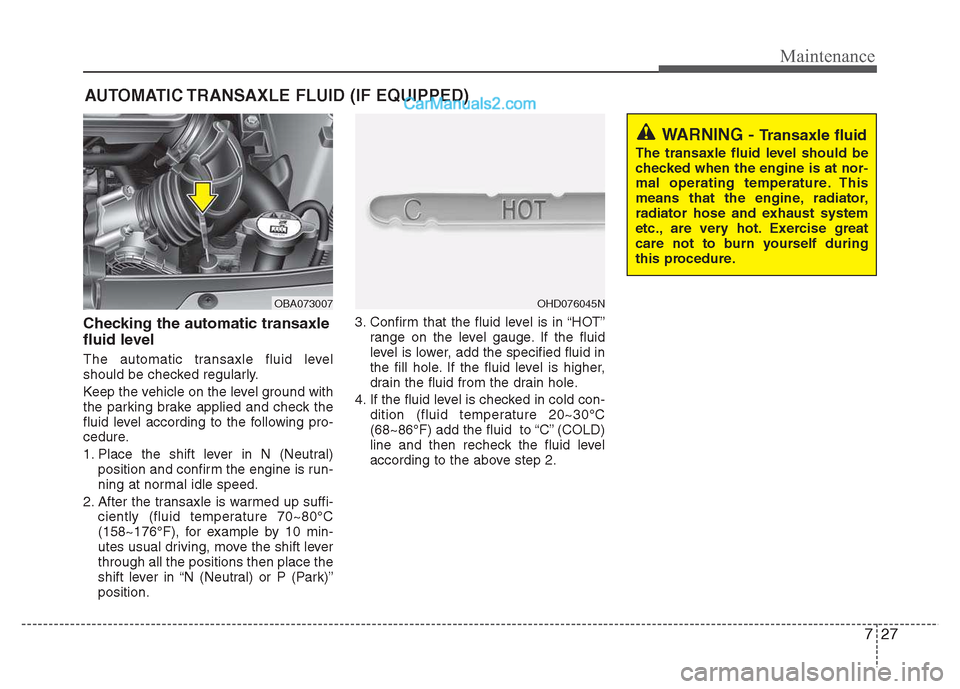
Checking the automatic transaxle
fluid level
The automatic transaxle fluid level
should be checked regularly.
Keep the vehicle on the level ground with
the parking brake applied and check the
fluid level according to the following pro-
cedure.
1. Place the shift lever in N (Neutral) position and confirm the engine is run-
ning at normal idle speed.
2. After the transaxle is warmed up suffi- ciently (fluid temperature 70~80°C
(158~176°F), for example by 10 min-
utes usual driving, move the shift leverthrough all the positions then place the
shift lever in “N (Neutral) or P (Park)”position. 3. Confirm that the fluid level is in “HOT”
range on the level gauge. If the fluid
level is lower, add the specified fluid in
the fill hole. If the fluid level is higher,
drain the fluid from the drain hole.
4. If the fluid level is checked in cold con- dition (fluid temperature 20~30°C
(68~86°F) add the fluid to “C” (COLD)
line and then recheck the fluid level
according to the above step 2.
OBA073007OHD076045N
WARNING - Transaxle fluid
The transaxle fluid level should be
checked when the engine is at nor-
mal operating temperature. This
means that the engine, radiator,
radiator hose and exhaust system
etc., are very hot. Exercise great
care not to burn yourself during
this procedure.
Page 275 of 343
Maintenance
28
7
✽✽
NOTICE
“C” (COLD) range is for reference only
and should NOT be used to determine
the transaxle fluid level. ✽
✽
NOTICE
A new automatic transaxle fluid should
be red. The red dye is added so the
assembly plant can identify it as auto-
matic transaxle fluid and distinguish it
from engine oil or antifreeze. The red
dye, which is not an indicator of fluid
quality, is not permanent. As the vehicle
is driven, the automatic transaxle fluid
will begin to look darker. The color may
eventually appear light brown.
Therefore, we recommend that the sys-
tem be replaced by an authorized
HYUNDAI dealer according to the
Scheduled Maintenance at the begin-
ning of this chapter.
Use only the specified automatic
transaxle fluid. (Refer to “Recommended
lubricants and capacities” in chapter 8.) Changing the automatic transaxle fluid
We recommend that the system be
replaced by an authorized HYUNDAI
dealer.
WARNING
- Parking brake
To avoid sudden movement of the
vehicle, apply the parking brake
and depress the brake pedal before
moving the shift lever.
CAUTION
Low fluid level causes transaxle shift slippage. Overfilling can
cause foaming, loss of fluid andtransaxle malfunction.
The use of a non-specified fluid could result in transaxle malfunc-
tion and failure.
Page 335 of 343
Specifications & Consumer information
4
8
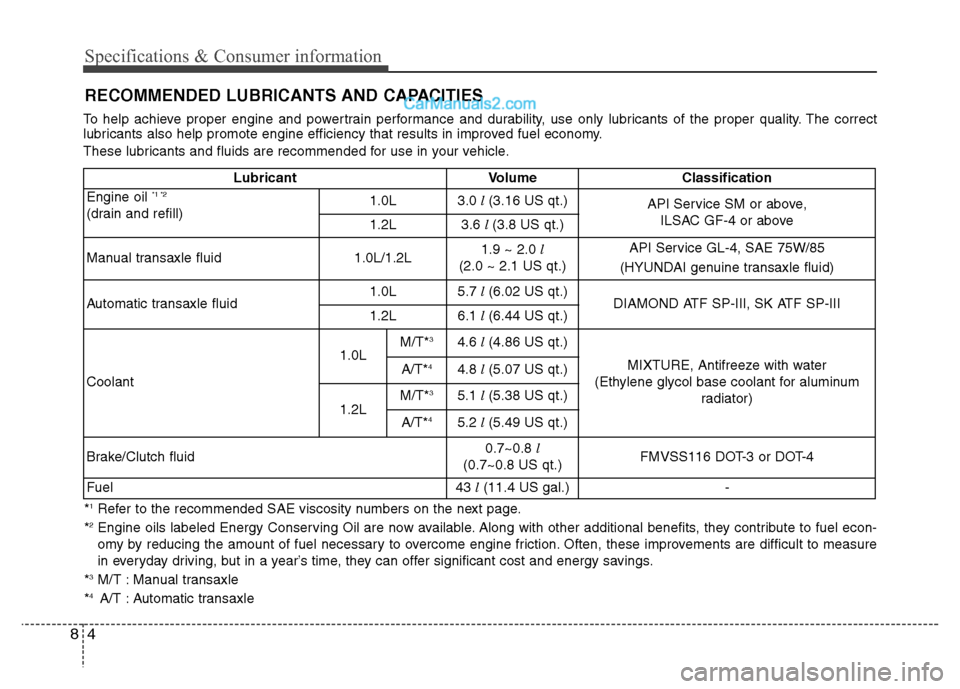
RECOMMENDED LUBRICANTS AND CAPACITIES
To help achieve proper engine and powertrain performance and durability, use only lubricants of the proper quality. The correct
lubricants also help promote engine efficiency that results in improved fuel economy.
These lubricants and fluids are recommended for use in your vehicle.
Lubricant Volume Classification
Engine oil *1 *2
(drain and refill)
1.0L 3.0
l (3.16 US qt.)
API Service SM or above,
ILSAC GF-4 or above
1.2L 3.6
l (3.8 US qt.)
Manual transaxle fluid
1.0L/1.2L 1.9 ~ 2.0
l
(2.0 ~ 2.1 US qt.) API Service GL-4, SAE 75W/85
(HYUNDAI genuine transaxle fluid)
Automatic transaxle fluid
1.0L 5.7
l (6.02 US qt.)
DIAMOND ATF SP-III, SK ATF SP-III
1.2L6.1
l (6.44 US qt.)
Coolant
1.0LM/T* 34.6
l (4.86 US qt.)
MIXTURE, Antifreeze with water
(Ethylene glycol base coolant for aluminum radiator)A/T*44.8
l (5.07 US qt.)
1.2LM/T* 35.1
l (5.38 US qt.)
A/T* 45.2
l (5.49 US qt.)
Brake/Clutch fluid0.7~0.8 l
(0.7~0.8 US qt.)FMVSS116 DOT-3 or DOT-4
Fuel43 l(11.4 US gal.)-
*1
Refer to the recommended SAE viscosity numbers on the next page.
* 2
Engine oils labeled Energy Conserving Oil are now available. Along with other additional benefits, they contribute to fuel econ-
omy by reducing the amount of fuel necessary to overcome engine friction. Often, these improvements are difficult to measure
in everyday driving, but in a year’s time, they can offer significant cost and energy savings.
* 3
M/T : Manual transaxle
* 4
A/T : Automatic transaxle