automatic transaxle Hyundai Grand Santa Fe 2014 Owner's Guide
[x] Cancel search | Manufacturer: HYUNDAI, Model Year: 2014, Model line: Grand Santa Fe, Model: Hyundai Grand Santa Fe 2014Pages: 718, PDF Size: 13.5 MB
Page 538 of 718
593
Driving your vehicle
If you do decide to pull a trail-
er
Here are some important points if
you decide to pull a trailer:
• Consider using a sway control. You
can ask a hitch dealer about sway
control.
• Do not do any towing with your car
during its first 2,000 km (1,200
miles) in order to allow the engine
to properly break in. Failure to
heed this caution may result in
serious engine or transaxle dam-
age.
• When towing a trailer, we recom-
mend that you consult an author-
ized HYUNDAI dealer on addition-
al requirements such as a towing
kit, etc.
• Always drive your vehicle at a mod-
erate speed (less than 100 km/h
(60 mph)).
• On a long uphill grade, do not
exceed 70 km/h (45 mph) or the
posted towing speed limit,
whichever is lower.
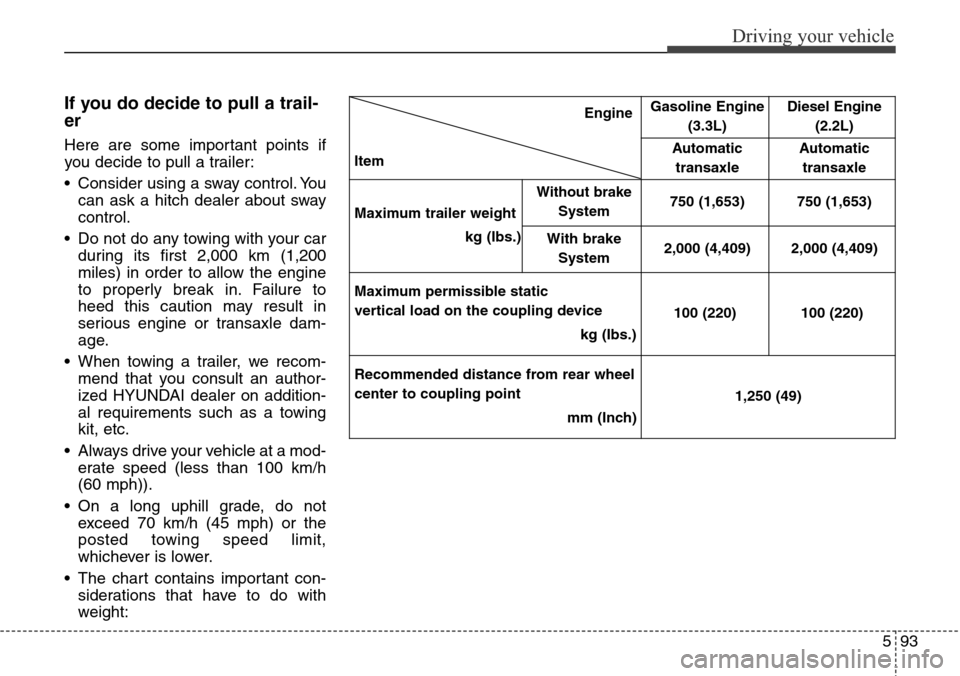
• The chart contains important con-
siderations that have to do with
weight:
Engine
ItemGasoline Engine
(3.3L)Diesel Engine
(2.2L)
Automatic
transaxleAutomatic
transaxle
Maximum trailer weight
kg (Ibs.)
Without brake
System750 (1,653) 750 (1,653)
With brake
System2,000 (4,409) 2,000 (4,409)
Maximum permissible static
vertical load on the coupling device
kg (Ibs.)100 (220) 100 (220)
Recommended distance from rear wheel
center to coupling point
mm (Inch)1,250 (49)
Page 545 of 718
What to do in an emergency
4 6
IF THE ENGINE DOES NOT START
If engine doesn't turn over or
turns over slowly
1.If your vehicle has an automatic
transaxle, be sure the shift lever is
in N (Neutral) or P (Park) and the
emergency brake is set.
2.Check the battery connections to
be sure they are clean and tight.
3.Turn on the interior light. If the light
dims or goes out when you operate
the starter, the battery is dis-
charged.
4.Check the starter connections to
be sure they are securely tight-
ened.
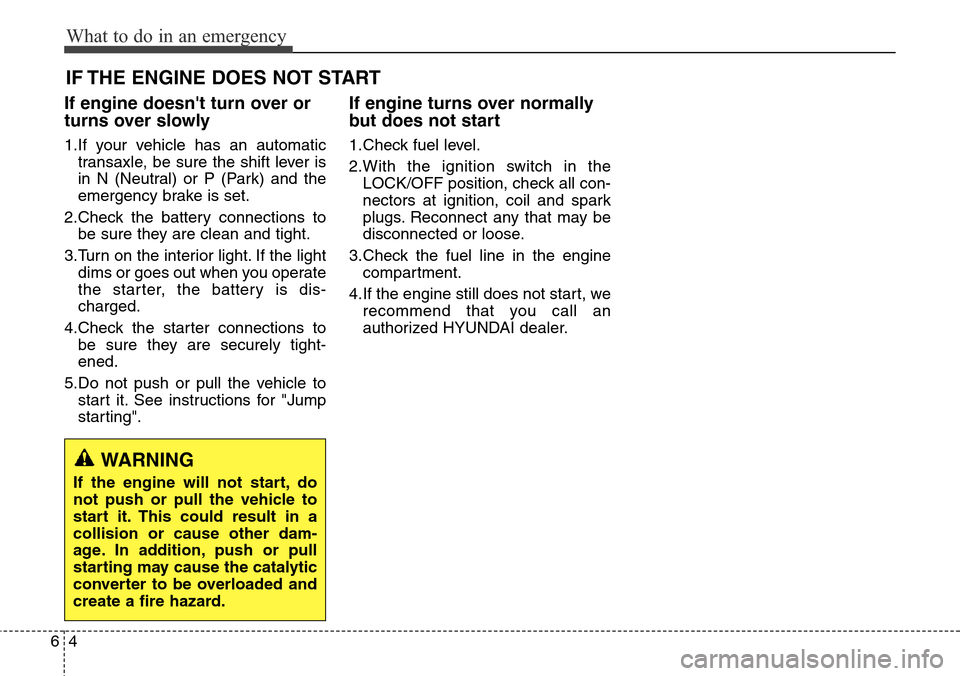
5.Do not push or pull the vehicle to
start it. See instructions for "Jump
starting".
If engine turns over normally
but does not start
1.Check fuel level.
2.With the ignition switch in the
LOCK/OFF position, check all con-
nectors at ignition, coil and spark
plugs. Reconnect any that may be
disconnected or loose.
3.Check the fuel line in the engine
compartment.
4.If the engine still does not start, we
recommend that you call an
authorized HYUNDAI dealer.
WARNING
If the engine will not start, do
not push or pull the vehicle to
start it. This could result in a
collision or cause other dam-
age. In addition, push or pull
starting may cause the catalytic
converter to be overloaded and
create a fire hazard.
Page 547 of 718
What to do in an emergency
6 6
Jump starting procedure
1.Make sure the booster battery is
12-volt and that its negative termi-
nal is grounded.
2.If the booster battery is in another
vehicle, do not allow the vehicles to
touch.
3.Turn off all unnecessary electrical
loads.
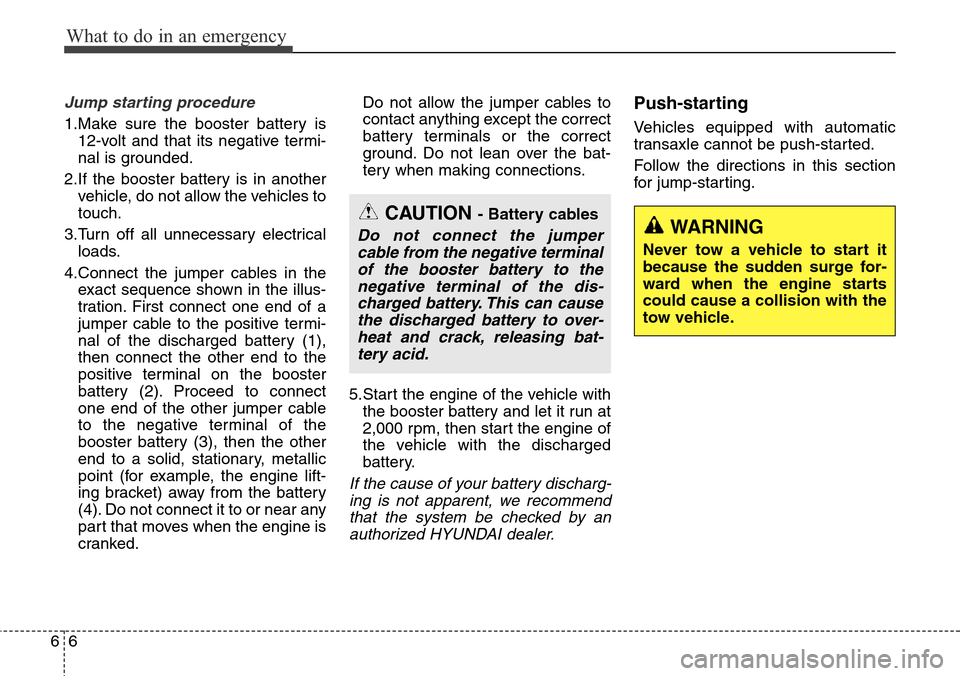
4.Connect the jumper cables in the
exact sequence shown in the illus-
tration. First connect one end of a
jumper cable to the positive termi-
nal of the discharged battery (1),
then connect the other end to the
positive terminal on the booster
battery (2). Proceed to connect
one end of the other jumper cable
to the negative terminal of the
booster battery (3), then the other
end to a solid, stationary, metallic
point (for example, the engine lift-
ing bracket) away from the battery
(4). Do not connect it to or near any
part that moves when the engine is
cranked.Do not allow the jumper cables to
contact anything except the correct
battery terminals or the correct
ground. Do not lean over the bat-
tery when making connections.
5.Start the engine of the vehicle with
the booster battery and let it run at
2,000 rpm, then start the engine of
the vehicle with the discharged
battery.
If the cause of your battery discharg-
ing is not apparent, we recommend
that the system be checked by an
authorized HYUNDAI dealer.
Push-starting
Vehicles equipped with automatic
transaxle cannot be push-started.
Follow the directions in this section
for jump-starting.
WARNING
Never tow a vehicle to start it
because the sudden surge for-
ward when the engine starts
could cause a collision with the
tow vehicle.
CAUTION - Battery cables
Do not connect the jumper
cable from the negative terminal
of the booster battery to the
negative terminal of the dis-
charged battery. This can cause
the discharged battery to over-
heat and crack, releasing bat-
tery acid.
Page 563 of 718
What to do in an emergency
22 6
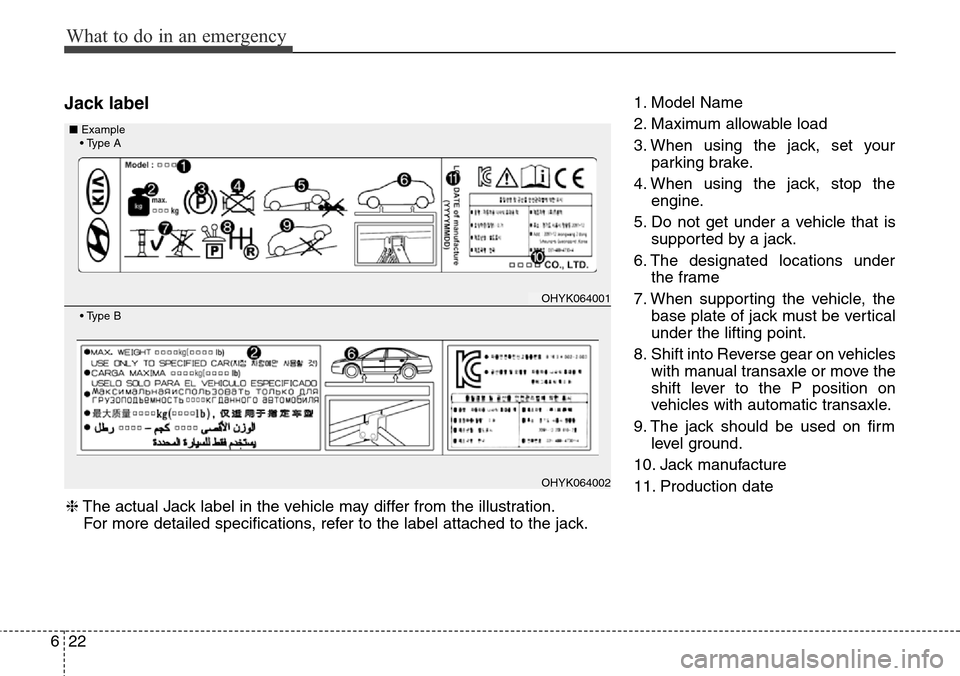
Jack label1. Model Name
2. Maximum allowable load
3. When using the jack, set your
parking brake.
4. When using the jack, stop the
engine.
5. Do not get under a vehicle that is
supported by a jack.
6. The designated locations under
the frame
7. When supporting the vehicle, the
base plate of jack must be vertical
under the lifting point.
8. Shift into Reverse gear on vehicles
with manual transaxle or move the
shift lever to the P position on
vehicles with automatic transaxle.
9. The jack should be used on firm
level ground.
10. Jack manufacture
11. Production date
OHYK064001
OHYK064002
• Type A■Example
• Type B
❈The actual Jack label in the vehicle may differ from the illustration.
For more detailed specifications, refer to the label attached to the jack.
Page 569 of 718
What to do in an emergency
28 6
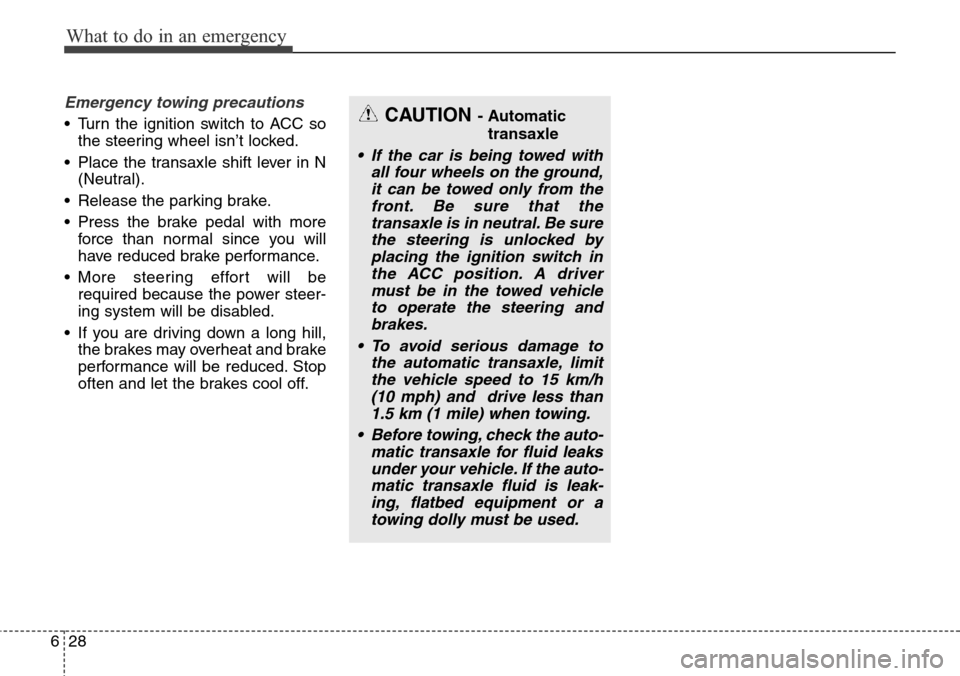
Emergency towing precautions
• Turn the ignition switch to ACC so
the steering wheel isn’t locked.
• Place the transaxle shift lever in N
(Neutral).
• Release the parking brake.
• Press the brake pedal with more
force than normal since you will
have reduced brake performance.
• More steering effort will be
required because the power steer-
ing system will be disabled.
• If you are driving down a long hill,
the brakes may overheat and brake
performance will be reduced. Stop
often and let the brakes cool off.CAUTION - Automatic
transaxle
• If the car is being towed with
all four wheels on the ground,
it can be towed only from the
front. Be sure that the
transaxle is in neutral. Be sure
the steering is unlocked by
placing the ignition switch in
the ACC position. A driver
must be in the towed vehicle
to operate the steering and
brakes.
• To avoid serious damage to
the automatic transaxle, limit
the vehicle speed to 15 km/h
(10 mph) and drive less than
1.5 km (1 mile) when towing.
• Before towing, check the auto-
matic transaxle for fluid leaks
under your vehicle. If the auto-
matic transaxle fluid is leak-
ing, flatbed equipment or a
towing dolly must be used.
Page 577 of 718
77
Maintenance
OWNER MAINTENANCE
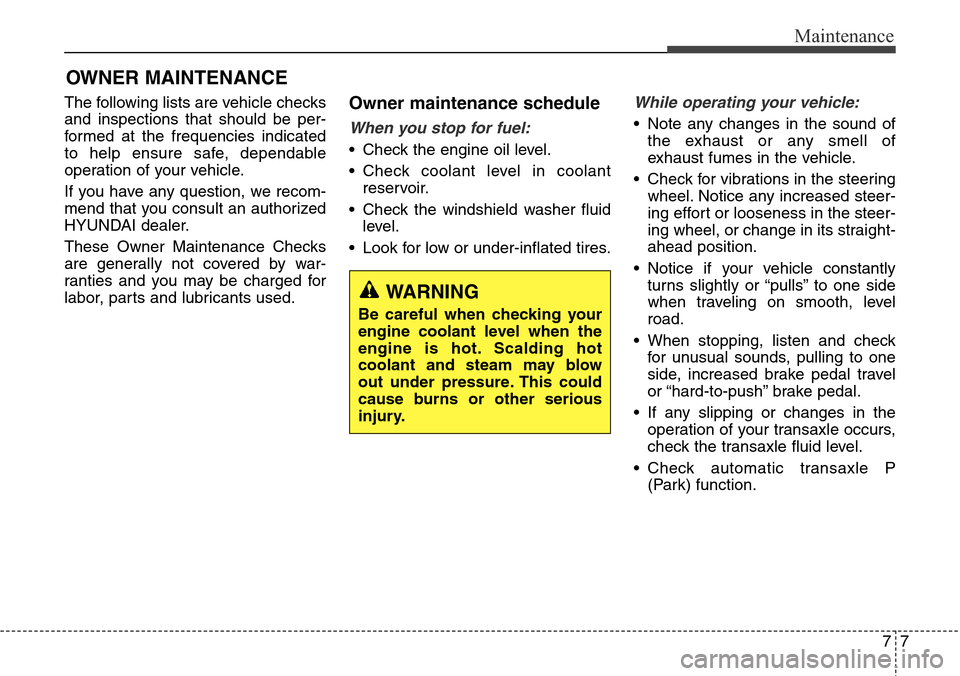
The following lists are vehicle checks
and inspections that should be per-
formed at the frequencies indicated
to help ensure safe, dependable
operation of your vehicle.
If you have any question, we recom-
mend that you consult an authorized
HYUNDAI dealer.
These Owner Maintenance Checks
are generally not covered by war-
ranties and you may be charged for
labor, parts and lubricants used.Owner maintenance schedule
When you stop for fuel:
• Check the engine oil level.
• Check coolant level in coolant
reservoir.
• Check the windshield washer fluid
level.
• Look for low or under-inflated tires.
While operating your vehicle:
• Note any changes in the sound of
the exhaust or any smell of
exhaust fumes in the vehicle.
• Check for vibrations in the steering
wheel. Notice any increased steer-
ing effort or looseness in the steer-
ing wheel, or change in its straight-
ahead position.
• Notice if your vehicle constantly
turns slightly or “pulls” to one side
when traveling on smooth, level
road.
• When stopping, listen and check
for unusual sounds, pulling to one
side, increased brake pedal travel
or “hard-to-push” brake pedal.
• If any slipping or changes in the
operation of your transaxle occurs,
check the transaxle fluid level.
• Check automatic transaxle P
(Park) function.
WARNING
Be careful when checking your
engine coolant level when the
engine is hot. Scalding hot
coolant and steam may blow
out under pressure. This could
cause burns or other serious
injury.
Page 578 of 718
Maintenance
8 7
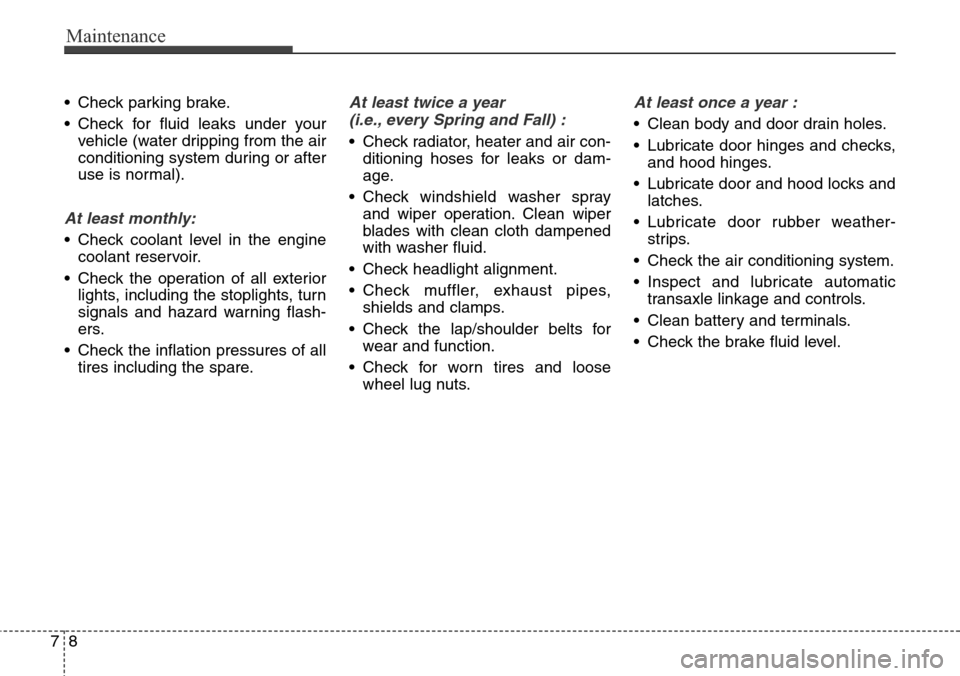
• Check parking brake.
• Check for fluid leaks under your
vehicle (water dripping from the air
conditioning system during or after
use is normal).
At least monthly:
• Check coolant level in the engine
coolant reservoir.
• Check the operation of all exterior
lights, including the stoplights, turn
signals and hazard warning flash-
ers.
• Check the inflation pressures of all
tires including the spare.
At least twice a year
(i.e., every Spring and Fall) :
• Check radiator, heater and air con-
ditioning hoses for leaks or dam-
age.
• Check windshield washer spray
and wiper operation. Clean wiper
blades with clean cloth dampened
with washer fluid.
• Check headlight alignment.
• Check muffler, exhaust pipes,
shields and clamps.
• Check the lap/shoulder belts for
wear and function.
• Check for worn tires and loose
wheel lug nuts.
At least once a year :
• Clean body and door drain holes.
• Lubricate door hinges and checks,
and hood hinges.
• Lubricate door and hood locks and
latches.
• Lubricate door rubber weather-
strips.
• Check the air conditioning system.
• Inspect and lubricate automatic
transaxle linkage and controls.
• Clean battery and terminals.
• Check the brake fluid level.
Page 583 of 718
713
Maintenance
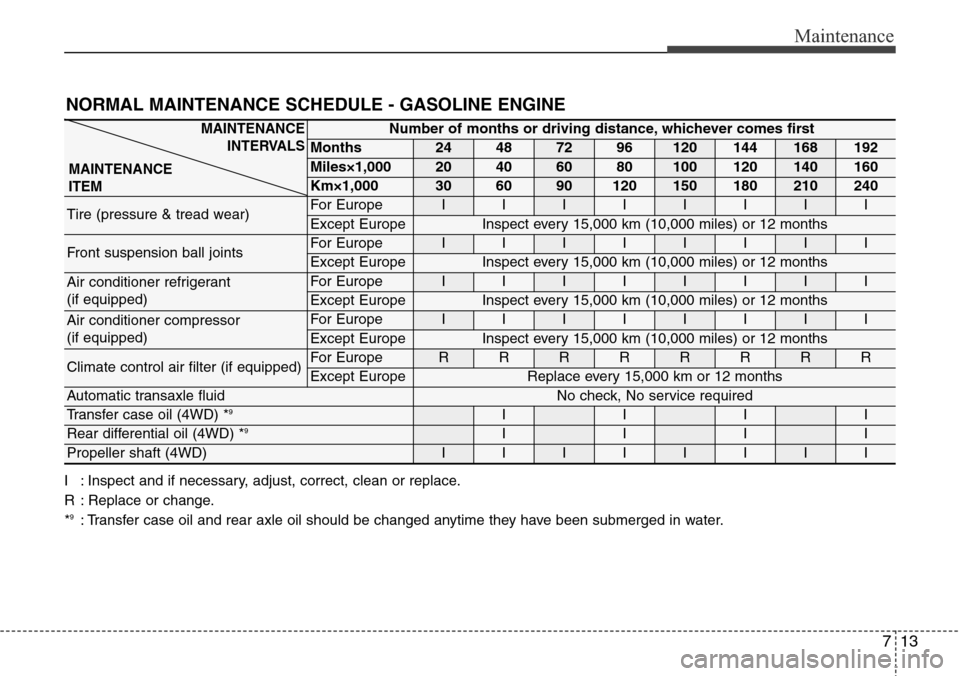
NORMAL MAINTENANCE SCHEDULE - GASOLINE ENGINE
Number of months or driving distance, whichever comes first
Months24487296120144168192
Miles×1,00020406080100120140160
Km×1,000306090120150180210240
Tire (pressure & tread wear) For EuropeIIIIIIII
Except EuropeInspect every 15,000 km (10,000 miles) or 12 months
Front suspension ball jointsFor EuropeIIIIIIII
Except EuropeInspect every 15,000 km (10,000 miles) or 12 months
Air conditioner refrigerant
(if equipped)For EuropeIIIIIIII
Except EuropeInspect every 15,000 km (10,000 miles) or 12 months
Air conditioner compressor
(if equipped)For EuropeIIIIIIII
Except EuropeInspect every 15,000 km (10,000 miles) or 12 months
Climate control air filter (if equipped)For EuropeRRRRRRRR
Except EuropeReplace every 15,000 km or 12 months
Automatic transaxle fluid No check, No service required
Transfer case oil (4WD) *9IIII
Rear differential oil (4WD) *9IIII
Propeller shaft (4WD)IIIIIIII
MAINTENANCE
INTERVALS
MAINTENANCE
ITEM
I : Inspect and if necessary, adjust, correct, clean or replace.
R : Replace or change.
*
9: Transfer case oil and rear axle oil should be changed anytime they have been submerged in water.
Page 585 of 718
715
Maintenance
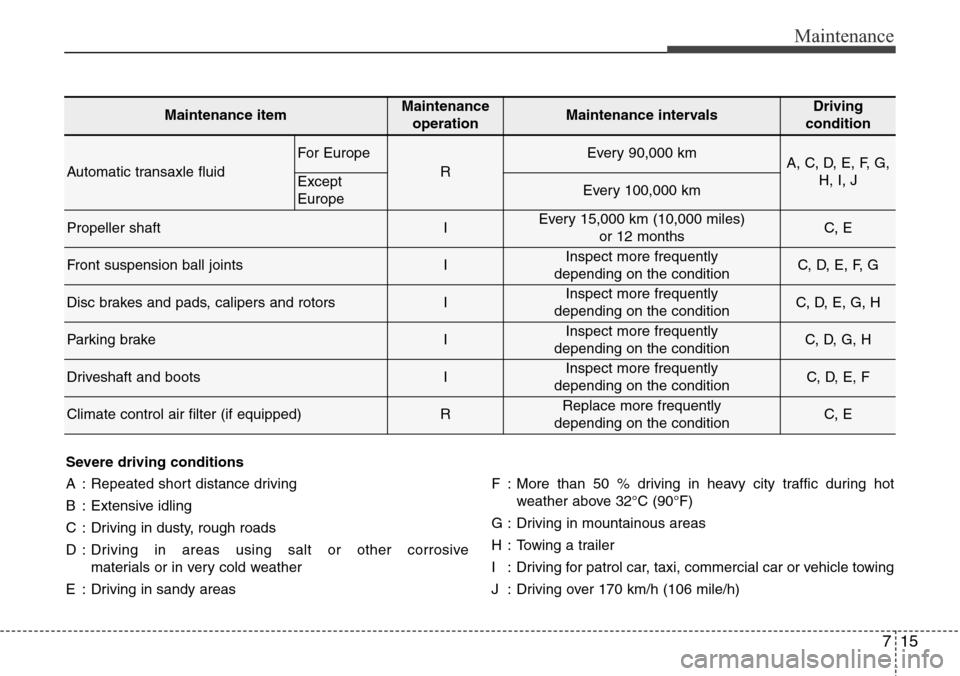
Maintenance itemMaintenance
operationMaintenance intervalsDriving
condition
Automatic transaxle fluid
For Europe
R
Every 90,000 kmA, C, D, E, F, G,
H, I, J
Except
EuropeEvery 100,000 km
Propeller shaftIEvery 15,000 km (10,000 miles)
or 12 monthsC, E
Front suspension ball jointsIInspect more frequently
depending on the conditionC, D, E, F, G
Disc brakes and pads, calipers and rotorsIInspect more frequently
depending on the conditionC, D, E, G, H
Parking brakeIInspect more frequently
depending on the conditionC, D, G, H
Driveshaft and bootsIInspect more frequently
depending on the conditionC, D, E, F
Climate control air filter (if equipped)RReplace more frequently
depending on the conditionC, E
Severe driving conditions
A : Repeated short distance driving
B : Extensive idling
C : Driving in dusty, rough roads
D : Driving in areas using salt or other corrosive
materials or in very cold weather
E : Driving in sandy areasF : More than 50 % driving in heavy city traffic during hot
weather above 32°C (90°F)
G : Driving in mountainous areas
H : Towing a trailer
I : Driving for patrol car, taxi, commercial car or vehicle towing
J : Driving over 170 km/h (106 mile/h)
Page 589 of 718
719
Maintenance
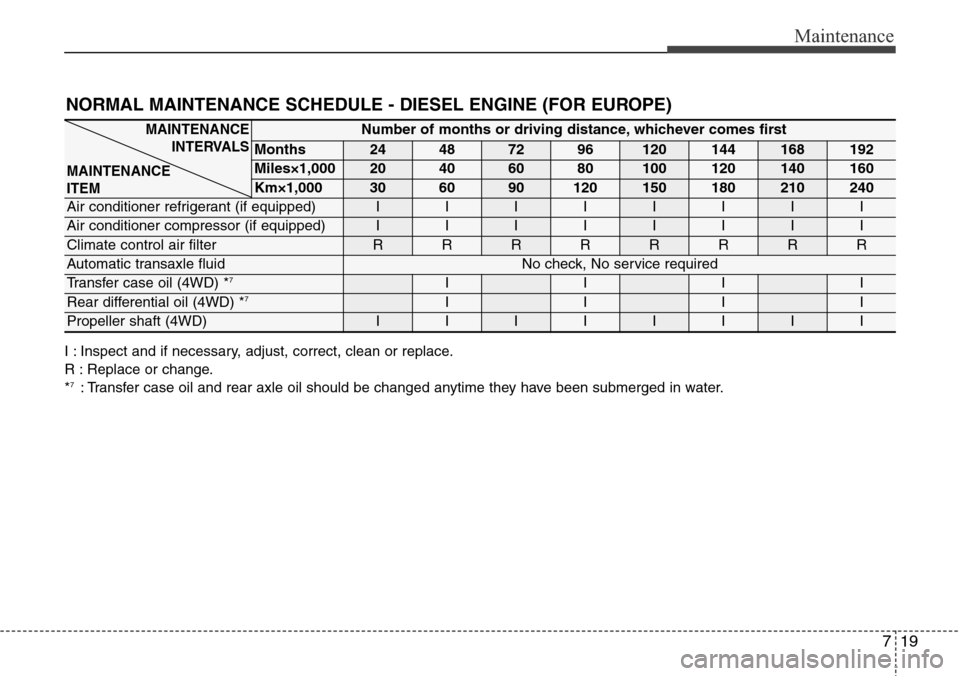
NORMAL MAINTENANCE SCHEDULE - DIESEL ENGINE (FOR EUROPE)
I : Inspect and if necessary, adjust, correct, clean or replace.
R : Replace or change.
*
7: Transfer case oil and rear axle oil should be changed anytime they have been submerged in water.
Number of months or driving distance, whichever comes first
Months24487296120144168192
Miles×1,00020406080100120140160
Km×1,000306090120150180210240
Air conditioner refrigerant (if equipped)IIIIIIII
Air conditioner compressor (if equipped)IIIIIIII
Climate control air filter RRRRRRRR
Automatic transaxle fluidNo check, No service required
Transfer case oil (4WD) *7IIII
Rear differential oil (4WD) *7IIII
Propeller shaft (4WD)IIIIIIII
MAINTENANCE
INTERVALS
MAINTENANCE
ITEM