tow Hyundai Grandeur 2003 Owner's Guide
[x] Cancel search | Manufacturer: HYUNDAI, Model Year: 2003, Model line: Grandeur, Model: Hyundai Grandeur 2003Pages: 235, PDF Size: 14.25 MB
Page 152 of 235
2- 20 DRIVING YOUR HYUNDAI
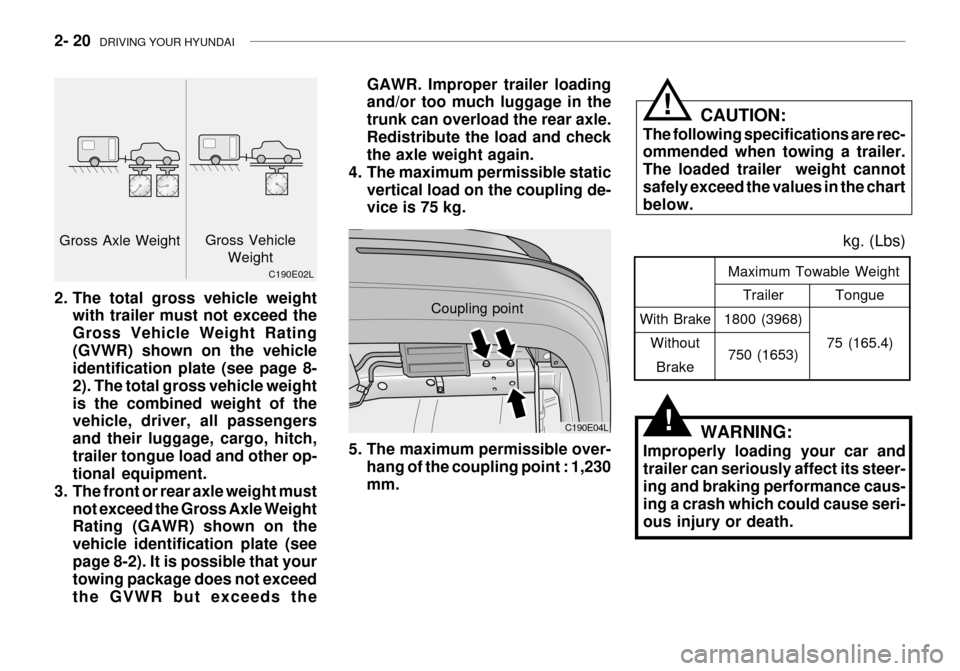
With Brake
WithoutBrake Tongue
75 (165.4)
Maximum Towable Weight
kg. (Lbs)
Trailer
1800 (3968)
750 (1653)
WARNING:
Improperly loading your car and trailer can seriously affect its steer- ing and braking performance caus- ing a crash which could cause seri-ous injury or death.
Coupling point
C190E04L
GAWR. Improper trailer loading and/or too much luggage in the trunk can overload the rear axle.Redistribute the load and check the axle weight again.
4. The maximum permissible static vertical load on the coupling de-vice is 75 kg. CAUTION:
The following specifications are rec-ommended when towing a trailer. The loaded trailer weight cannotsafely exceed the values in the chart below.
!
!
5. The maximum permissible over- hang of the coupling point : 1,230 mm.
2. The total gross vehicle weight
with trailer must not exceed theGross Vehicle Weight Rating(GVWR) shown on the vehicle identification plate (see page 8- 2). The total gross vehicle weightis the combined weight of the vehicle, driver, all passengers and their luggage, cargo, hitch,trailer tongue load and other op- tional equipment.
3. The front or rear axle weight must
not exceed the Gross Axle WeightRating (GAWR) shown on the vehicle identification plate (seepage 8-2). It is possible that your towing package does not exceed the GVWR but exceeds the
C190E02L
Gross Axle Weight
Gross Vehicle
Weight
Page 153 of 235

DRIVING YOUR HYUNDAI 2- 21
C190F01Y-GAT Trailer or Vehicle Towing Tips
1. Before towing, check hitch and
safety chain connections as well as proper operation of the trailer run- ning lights, brake lights, and turn signals.
2. Always drive your vehicle at a mod- erate speed (Less than 100 km/h)
3. Trailer towing requires more fuel than normal conditions.
4. To maintain engine braking effi-
ciency and electrical charging per-formance, do not use fifth gear (manual transaxle).
5. Always secure items in the trailer to
prevent load shift while driving.
6. Check the condition and air pres-
sure of all tires on the trailer and your car. Low tire pressure can seriously affect the handling. Also check the spare tire. 10.During your trip, check occasion-
ally to be sure that the load issecure, and that the lights and anytrailer brakes are still working.
11.Avoid jerky starts, sudden accel-
eration or sudden stops.
12.Avoid sharp turns and rapid lane changes.
13.Avoid holding the brake pedal down too long or too frequently. This could cause the brakes to overheat, re- sulting in reduced braking efficien-cy.
14.When going down a hill, shift into a
lower gear and use the engine brak-ing effect. When ascending a long grade, downshift the transaxle to a lowergear and reduce speed to reduce chances of engine overloading and/ or overheating.
15.If you have to stop while going uphill, do not hold the vehicle inplace by pressing on the accelera-tor. This can cause the automatic transaxle to overheat. Use the park- ing brake or footbrake.
7. The vehicle/trailer combination is
more affected by crosswind andbuffeting.When being passed by a large ve- hicle, keep a constant speed and steer straight ahead. If there is toomuch wind buffeting, slow down to get out of the other vehicle's air turbulence.
8. When parking your car and trailer, especially on a hill, be sure to followall the normal precautions. Turnyour front wheel into the curb, set the parking brake firmly, and put the transaxle in 1st or Reverse(manual) or Park (automatic). In addition, place wheel chocks at each of the trailer's tires.
9. If the trailer has electric brakes, start your vehicle and trailer mov-ing, and then apply the trailer brakecontroller by hand to be sure the brakes are working. This lets you check your electrical connection atthe same time.
Page 154 of 235

2- 22 DRIVING YOUR HYUNDAI
NOTE: When towing, check transaxle fluid more frequently.
CAUTION:
If overheating should occur whentowing, (temperature gauge reads near red zone), taking the followingaction may reduce or eliminate the problem.
1. Turn off the air conditioner.
2. Reduce highway speed.
3. Select a lower gear when going uphill.
4. While in stop and go traffic, place
the gear selector in park or neu-tral and idle the engine at a higher speed.
!
Page 155 of 235

3. WHAT TO DO IN AN EMERGENCYIf the Engine Will not Start .............................................................. 3-2
Jump Starting .................................................................................. 3-2
If the Engine Overheats .................................................................. 3-4
Spare Tire ....................................................................................... 3-5
If You Have a Flat Tire .................................................................... 3-5
If Your Car Must Be Towed .......................................................... 3-10
Emergency Towing ....................................................................... 3-12
If You Lose Your Keys .................................................................. 3-12
3
Page 164 of 235
3- 10 WHAT TO DO IN AN EMERGENCY
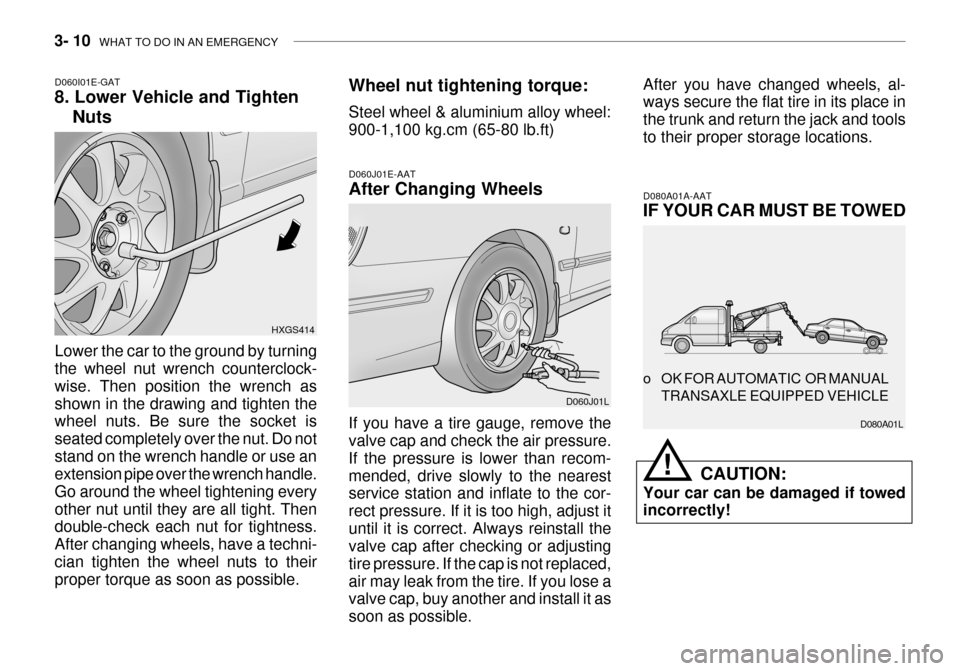
Lower the car to the ground by turning the wheel nut wrench counterclock- wise. Then position the wrench asshown in the drawing and tighten the wheel nuts. Be sure the socket is seated completely over the nut. Do not
stand on the wrench handle or use an extension pipe over the wrench handle. Go around the wheel tightening everyother nut until they are all tight. Then double-check each nut for tightness. After changing wheels, have a techni-cian tighten the wheel nuts to their proper torque as soon as possible.
D060I01E-GAT 8. Lower Vehicle and Tighten
Nuts
HXGS414Wheel nut tightening torque: Steel wheel & aluminium alloy wheel: 900-1,100 kg.cm (65-80 lb.ft)
D060J01E-AAT After Changing Wheels If you have a tire gauge, remove the valve cap and check the air pressure. If the pressure is lower than recom-mended, drive slowly to the nearest service station and inflate to the cor- rect pressure. If it is too high, adjust ituntil it is correct. Always reinstall the valve cap after checking or adjusting tire pressure. If the cap is not replaced,air may leak from the tire. If you lose a valve cap, buy another and install it as soon as possible.
D060J01LAfter you have changed wheels, al- ways secure the flat tire in its place in the trunk and return the jack and toolsto their proper storage locations.
D080A01A-AAT IF YOUR CAR MUST BE TOWED
CAUTION:
Your car can be damaged if towed incorrectly!
o OK FOR AUTOMATIC OR MANUAL
TRANSAXLE EQUIPPED VEHICLE
D080A01L
!
Page 165 of 235
WHAT TO DO IN AN EMERGENCY 3- 11
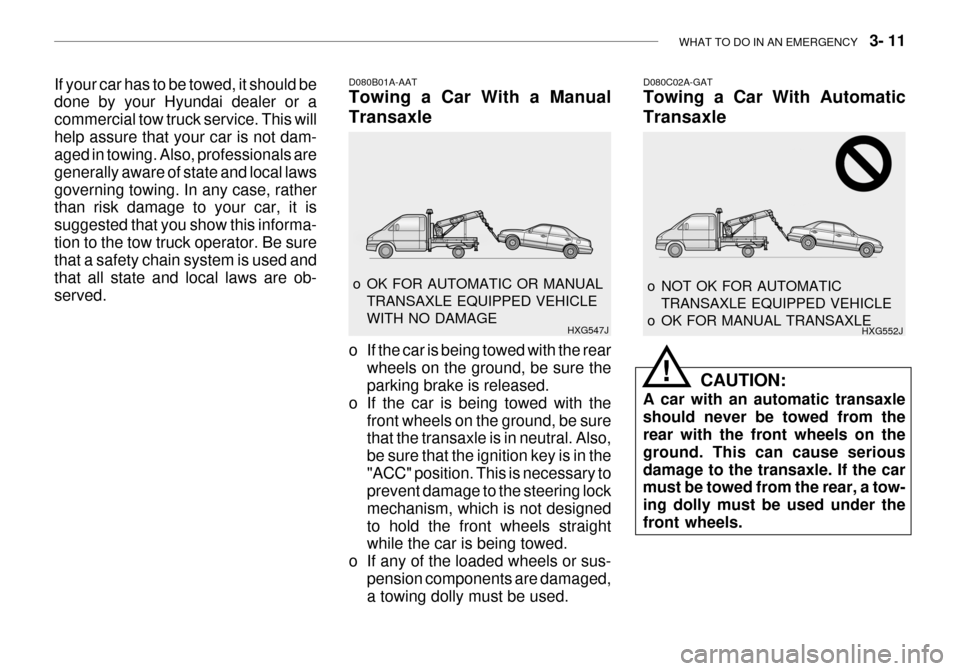
D080C02A-GAT Towing a Car With Automatic Transaxle
CAUTION:
A car with an automatic transaxle should never be towed from the rear with the front wheels on the ground. This can cause seriousdamage to the transaxle. If the car must be towed from the rear, a tow- ing dolly must be used under thefront wheels. o NOT OK FOR AUTOMATIC
TRANSAXLE EQUIPPED VEHICLE
o OK FOR MANUAL TRANSAXLE HXG552JD080B01A-AAT Towing a Car With a Manual Transaxle
o If the car is being towed with the rear wheels on the ground, be sure the parking brake is released.
o If the car is being towed with the
front wheels on the ground, be surethat the transaxle is in neutral. Also, be sure that the ignition key is in the"ACC" position. This is necessary to prevent damage to the steering lock mechanism, which is not designedto hold the front wheels straight while the car is being towed.
o If any of the loaded wheels or sus-
pension components are damaged,a towing dolly must be used.
o OK FOR AUTOMATIC OR MANUAL
TRANSAXLE EQUIPPED VEHICLE WITH NO DAMAGE HXG547J
If your car has to be towed, it should be done by your Hyundai dealer or a commercial tow truck service. This willhelp assure that your car is not dam- aged in towing. Also, professionals are generally aware of state and local lawsgoverning towing. In any case, rather than risk damage to your car, it is suggested that you show this informa-tion to the tow truck operator. Be sure that a safety chain system is used and that all state and local laws are ob-served.
!
Page 166 of 235
3- 12 WHAT TO DO IN AN EMERGENCY
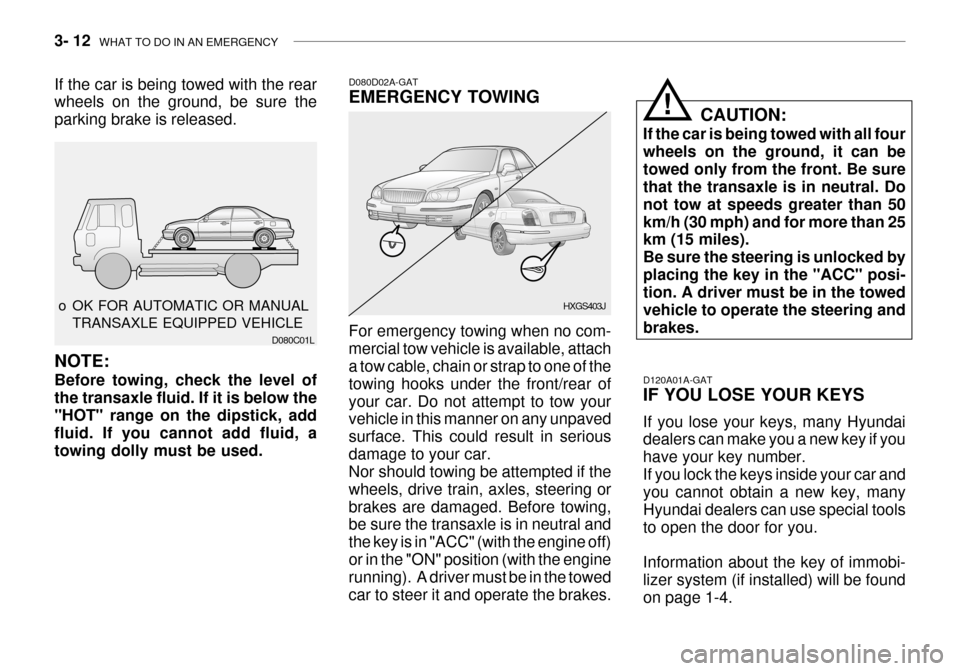
If the car is being towed with the rear wheels on the ground, be sure the parking brake is released.
o OK FOR AUTOMATIC OR MANUAL TRANSAXLE EQUIPPED VEHICLE D080C01LD080D02A-GAT EMERGENCY TOWING For emergency towing when no com- mercial tow vehicle is available, attach a tow cable, chain or strap to one of the towing hooks under the front/rear ofyour car. Do not attempt to tow your vehicle in this manner on any unpaved surface. This could result in seriousdamage to your car. Nor should towing be attempted if the wheels, drive train, axles, steering orbrakes are damaged. Before towing, be sure the transaxle is in neutral and the key is in "ACC" (with the engine off)or in the "ON" position (with the engine running). A driver must be in the towed car to steer it and operate the brakes. HXGS403J
CAUTION:
If the car is being towed with all fourwheels on the ground, it can betowed only from the front. Be sure that the transaxle is in neutral. Do not tow at speeds greater than 50km/h (30 mph) and for more than 25 km (15 miles). Be sure the steering is unlocked byplacing the key in the "ACC" posi- tion. A driver must be in the towed vehicle to operate the steering andbrakes. D120A01A-GAT IF YOU LOSE YOUR KEYS If you lose your keys, many Hyundai dealers can make you a new key if you have your key number.If you lock the keys inside your car and you cannot obtain a new key, many Hyundai dealers can use special toolsto open the door for you. Information about the key of immobi- lizer system (if installed) will be found on page 1-4.
!
NOTE: Before towing, check the level of the transaxle fluid. If it is below the"HOT" range on the dipstick, add fluid. If you cannot add fluid, a towing dolly must be used.
Page 178 of 235

5- 6 VEHICLE MAINTENANCE REQUIREMENTS
ENGINE OIL AND FILTER AIR CLEANER FILTERSPARK PLUGSTIMING BELTBRAKE PADS, CALIPERS AND ROTORSREAR BRAKE DRUMS/LININGS,PARKING BRAKE
STEERING GEAR BOX, LINKAGE& BOOTS/LOWER ARM BALL JOINT,UPPER ARM BALL JOINTDRIVESHAFTS & BOOTSMANUAL TRANSAXLE OILAUTOMATIC TRANSA-XLE FLUID AND FILTERAIR FILTER (FOR EVAP. AND BLOWER UNIT) European Community OnlyExcept European Community
F040A03L-GAT MAINTENANCE UNDER SEVERE USAGE CONDITIONS The following items must be serviced more frequently on cars normally used under severe driving conditions. Refer to the chart below for the appropriate maintenance intervals. R : Replace I : Inspect and, after inspection, clean, adjust, repair or replace if necessaryR RRR
I I I I
RRREVERY 7,500 KM OR 6 MONTHS MORE FREQUENTLYMORE FREQUENTLYEVERY 60,000 KM OR 48 MONTHSMORE FREQUENTLY MORE FREQUENTLY MORE FREQUENTLY EVERY 15,000 KM OR 12 MONTHS EVERY 100,000 KMEVERY 45,000 KMEVERY 40,000 KMMORE FREQUENTLY
SEVERE DRIVING CONDITIONS
A - Repeated short distance driving
B - Extensive idling
C - Driving in dusty, rough roads
D - Driving in areas using salt or other corrosive materials or in very cold weather
E - Driving in sandy areas
A, B, C, F, H C, EB, HD, E, F, GC, D, G, H C, D, G, H C, D, E, F C, D, E, F A, C, D, E, F, G, H, I, J A, C, E, F, G, H, I, JC, E DRIVING
CONDITION
MAINTENANCE INTERVALS
MAINTENANCE
OPERATION
MAINTENANCE ITEM
F - More than 50% driving in heavy city traffic during hot weatherabove 32°C (90°F)
G - Driving in mountainous areas
H - Towing a trailer
I - Driving as a patrol car, taxi, vehicle towing or other commercial use
J - Driving over 170 Km/h (100 MPH)
Page 203 of 235
6- 22 DO-IT-YOURSELF MAINTENANCE
Good
G200B02L
Burned out
CAUTION:
A burned-out fuse indicates that
there is a problem in the electrical circuit. If you replace a fuse and it blows as soon as the accessory is turned on, the problem is seriousand should be referred to a Hyundai dealer for diagnosis and repair. Never replace a fuse withanything except a fuse with the same or a lower amperage rating. A higher capacity fuse could causedamage and create a fire hazard.
NOTE: See page 6-34 for the junction box
descriptions.
!
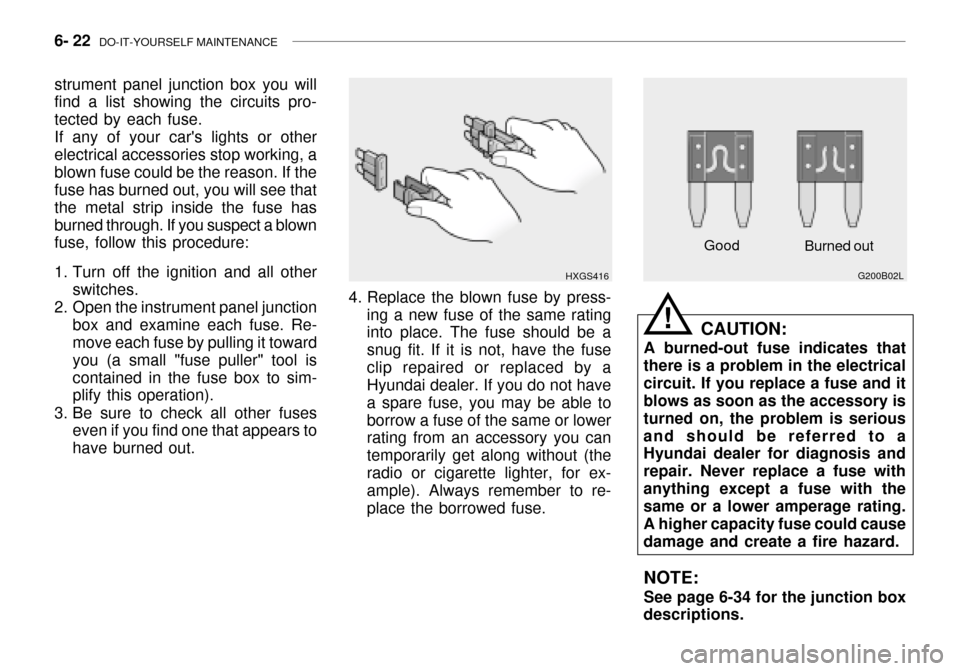
strument panel junction box you will find a list showing the circuits pro- tected by each fuse.
If any of your car's lights or other
electrical accessories stop working, ablown fuse could be the reason. If the fuse has burned out, you will see that the metal strip inside the fuse hasburned through. If you suspect a blown fuse, follow this procedure:
1. Turn off the ignition and all other switches.
2. Open the instrument panel junction box and examine each fuse. Re- move each fuse by pulling it toward you (a small "fuse puller" tool iscontained in the fuse box to sim- plify this operation).
3. Be sure to check all other fuses even if you find one that appears to have burned out.
HXGS416
4. Replace the blown fuse by press- ing a new fuse of the same rating into place. The fuse should be a snug fit. If it is not, have the fuseclip repaired or replaced by a Hyundai dealer. If you do not have a spare fuse, you may be able toborrow a fuse of the same or lower rating from an accessory you can temporarily get along without (theradio or cigarette lighter, for ex- ample). Always remember to re- place the borrowed fuse.
Page 233 of 235

INDEX 10- 5
Adjusting seat forward and rear ward..................... 1-14
Adjusting seatback angle .......................................1-15
Seat cushion height adjustment............................ 1-15
Power Steering Fluid Level .......................................6-24
R
Rear Seat Fold Down ............................................. 1-18 Rear Window Defroster Switch .................... 1-53 ~ 1-54
Replacement of light bul bs ....................................... 6-26
SSeat Front ........................................................... 1-11 ~ 1-15
Seat Warmer ............................................................. 1-17
Seat Belts 3-Point system ........................................... 1-21 ~ 1-23
Adjustable height ........................................ 1-21 ~ 1-22
Adjusting your seat belt ........... ..............................1-22
Care of seat belts .................................................. 1-20
Precautions ............................................................ 1-19
Spark Plugs ................................................... 6-10 ~ 6-11
Spectacle Case ......................................................... 1-62
Speedometer ............................................................. 1-46
Starting Procedure ...................................................... 2-4
Steering Wheel Freeplay .................... ...................... 6-19
Steering Wheel Electric T ilt and Telescopic ............. 1-73
Steering Wheel Tilt Lever ................ ......................... 1-72
Stereo Radio Operation (H940B, H940A)
......................................... 1-95 ~ 1-97, 1-103 ~ 1-105
Stereo Sound System ................................... 1-93 ~ 1-94 Sun Visor
.................................................................. 1-71
Sunroof .......................................................... 1-58 ~ 1-60
T Tachometer ............................................................... 1-47
Theft-Alarm system ........................................... 1-8 ~ 1-9Tires Balancing .................................................................. 8-4
Chains ...................................................................... 8-4
If you have a flat tire ................................... 3-5 ~ 3-10
Information ............................................................... 8-2
Pressure ......................................................... 8-2 ~ 8-3
Replacement ............................................................ 8-5
Rotation .................................................................... 8-4
Snow tires ................................................................ 8-3
Spare tire ................................................................. 3-5
Traction .................................................................... 8-4
Towing
A trailer (or vehicle) ................................... 2-18 ~ 2-21
Emergency ............................................................. 3-12
If your car must be towed ......................... 3-10 ~ 3-12
Traction Control System ............................... 2-12 ~ 2-13
Transaxle Automatic ..................................................... 2-7 ~ 2-11Automatic transaxle fluid checking ............ 6-14 ~ 6-15
Manual ..................................................................... 2-5
Manual transaxle Oil checking ................... 6-13 ~ 6-14
Trip Computer ............................................... 1-54 ~ 1-55
Trip Odometer ............................................... 1-47 ~ 1-48
Trunk Lid ....................................................... 1-65 ~ 1-67