height HYUNDAI GX350 L 2005 Owners Manual
[x] Cancel search | Manufacturer: HYUNDAI, Model Year: 2005, Model line: GX350 L, Model: HYUNDAI GX350 L 2005Pages: 247, PDF Size: 7.48 MB
Page 24 of 247
1FEATURES OF YOUR HYUNDAI12
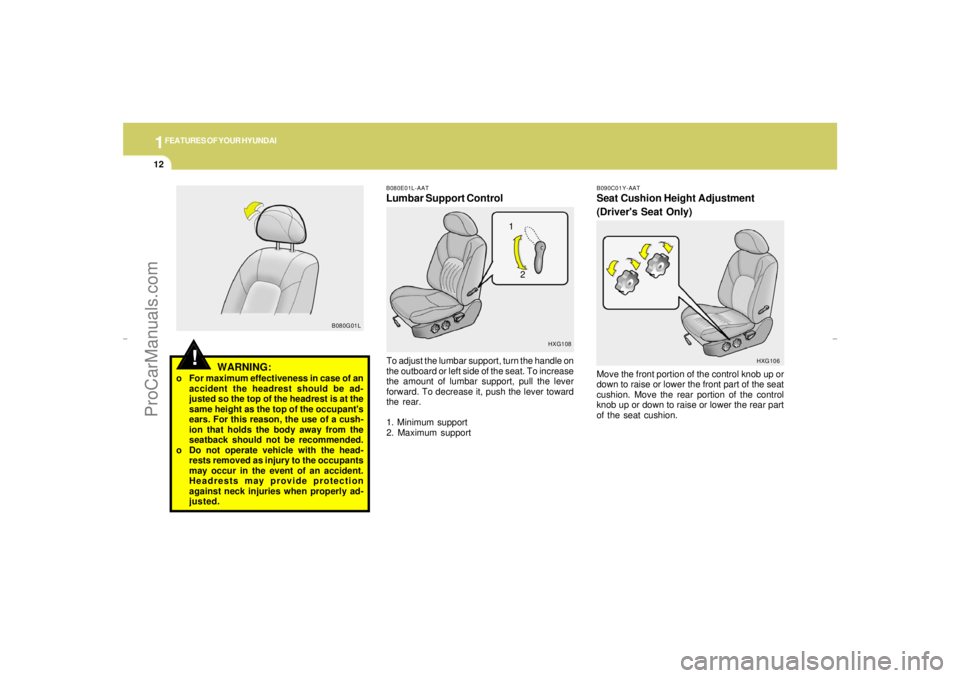
B090C01Y-AATSeat Cushion Height Adjustment
(Driver's Seat Only)Move the front portion of the control knob up or
down to raise or lower the front part of the seat
cushion. Move the rear portion of the control
knob up or down to raise or lower the rear part
of the seat cushion.
HXG106
!
WARNING:
o For maximum effectiveness in case of an
accident the headrest should be ad-
justed so the top of the headrest is at the
same height as the top of the occupant's
ears. For this reason, the use of a cush-
ion that holds the body away from the
seatback should not be recommended.
o Do not operate vehicle with the head-
rests removed as injury to the occupants
may occur in the event of an accident.
Headrests may provide protection
against neck injuries when properly ad-
justed.
B080G01LB080E01L-AAT
Lumbar Support ControlTo adjust the lumbar support, turn the handle on
the outboard or left side of the seat. To increase
the amount of lumbar support, pull the lever
forward. To decrease it, push the lever toward
the rear.
1. Minimum support
2. Maximum support
HXG108
2 1
xgflhma-1.p656/16/04, 3:02 PM 12
ProCarManuals.com
Page 25 of 247
1
FEATURES OF YOUR HYUNDAI
13
POWER SEAT!
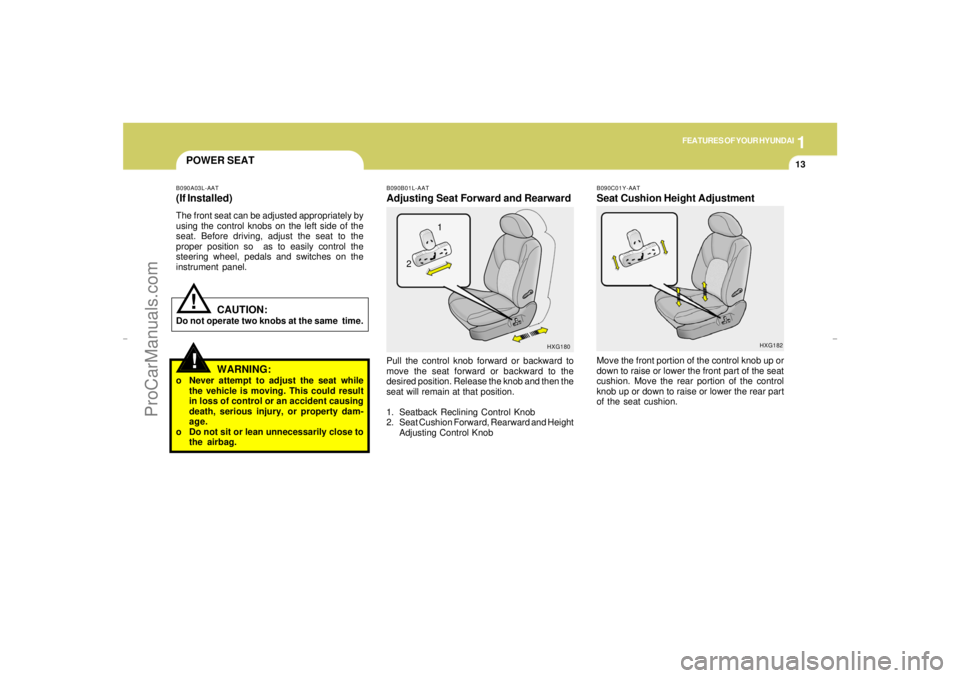
B090B01L-AATAdjusting Seat Forward and RearwardPull the control knob forward or backward to
move the seat forward or backward to the
desired position. Release the knob and then the
seat will remain at that position.
1. Seatback Reclining Control Knob
2. Seat Cushion Forward, Rearward and Height
Adjusting Control Knob
B090A03L-AAT(If Installed)The front seat can be adjusted appropriately by
using the control knobs on the left side of the
seat. Before driving, adjust the seat to the
proper position so as to easily control the
steering wheel, pedals and switches on the
instrument panel.
CAUTION:
Do not operate two knobs at the same time.
WARNING:
o Never attempt to adjust the seat while
the vehicle is moving. This could result
in loss of control or an accident causing
death, serious injury, or property dam-
age.
o Do not sit or lean unnecessarily close to
the airbag.
!
HXG180
1
2
B090C01Y-AATSeat Cushion Height AdjustmentMove the front portion of the control knob up or
down to raise or lower the front part of the seat
cushion. Move the rear portion of the control
knob up or down to raise or lower the rear part
of the seat cushion.
HXG182
xgflhma-1.p656/16/04, 3:02 PM 13
ProCarManuals.com
Page 30 of 247
1FEATURES OF YOUR HYUNDAI18
!
B150B04Y-AATInfant or Small ChildAll 50 states have child restraint laws. You
should be aware of the specific requirements in
your state. Child and/or infant safety seats must
be properly placed and installed in the rear seat.
Information about the use of these restraints
begins on page 1-24.
WARNING:
Every person in your vehicle needs to be
properly restrained at all times, including
infants and children. In a collision, an unre-
strained child can become a "missile" in-
side the car. The force required to hold a
child on your lap could be so great that you
could not hold the child. Any child riding in
the vehicle should always be in a proper
restraint in the rear seat of the vehicle.NOTE:Small children are best protected from in-
jury in an accident when properly restrained
in the rear seat by a child restraint system
that meets the requirements of the Federal
Motor Vehicle Safety Standards. Before
buying any child restraint system, make
sure that it has a label certifying that it
meets Federal Motor Vehicle Safety Stan-
B150C02A-AATLarger ChildrenChildren who are too large for child restraint
systems should always occupy the rear seat
and use the available lap/shoulder belts. The lap
portion should be fastened snug on the hips and
as low as possible. Check belt fit periodically. A
child's squirming could put the belt out of posi-
tion. Children are afforded the most safety in the
event of an accident when they are restrained
by a proper restraint system in the rear seat. If
a larger child (over age 13) must be seated in
the front seat, the child should be securely
restrained by the available lap/shoulder belt and
the seat should be placed in the rearmost
position. Children under the age of 13 should be
restrained securely in the rear seat. NEVER
place a child under the age of 13 in the front seat.
NEVER place a rear facing child seat in the front
seat of a vehicle.
B150D01A-AATPregnant WomenThe use of a seat belt is recommended for
pregnant women to lessen the chance of injury
in an accident. When a seat belt is used, the lap
belt portion should be placed as low and snugly
as possible on the hips, not across the abdo-
men. For specific recommendations, consult a
physician.B150E01A-AATInjured PersonA seat belt should be used when an injured
person is being transported. When this is nec-
essary, you should consult a physician for
recommendations.B150F01A-AATOne Person Per BeltTwo people (including children) should never
attempt to use a single seat belt. This could
increase the severity of injuries in case of an
accident. dard 213. The restraint must be appropriate
for your child's height and weight. Check
the label on the child restraint for this
information. See page 1-24.
xgflhma-1.p656/16/04, 3:02 PM 18
ProCarManuals.com
Page 32 of 247
1FEATURES OF YOUR HYUNDAI20
!
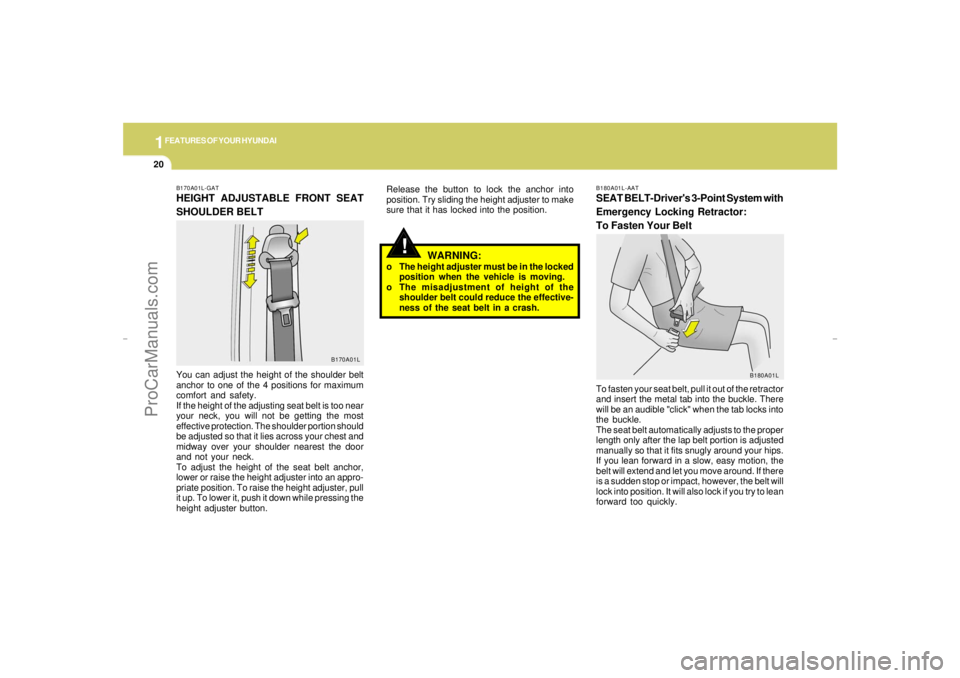
B170A01L-GATHEIGHT ADJUSTABLE FRONT SEAT
SHOULDER BELT
B170A01L
You can adjust the height of the shoulder belt
anchor to one of the 4 positions for maximum
comfort and safety.
If the height of the adjusting seat belt is too near
your neck, you will not be getting the most
effective protection. The shoulder portion should
be adjusted so that it lies across your chest and
midway over your shoulder nearest the door
and not your neck.
To adjust the height of the seat belt anchor,
lower or raise the height adjuster into an appro-
priate position. To raise the height adjuster, pull
it up. To lower it, push it down while pressing the
height adjuster button.
WARNING:
o The height adjuster must be in the locked
position when the vehicle is moving.
o The misadjustment of height of the
shoulder belt could reduce the effective-
ness of the seat belt in a crash.
B180A01L-AATSEAT BELT-Driver's 3-Point System with
Emergency Locking Retractor:
To Fasten Your BeltTo fasten your seat belt, pull it out of the retractor
and insert the metal tab into the buckle. There
will be an audible "click" when the tab locks into
the buckle.
The seat belt automatically adjusts to the proper
length only after the lap belt portion is adjusted
manually so that it fits snugly around your hips.
If you lean forward in a slow, easy motion, the
belt will extend and let you move around. If there
is a sudden stop or impact, however, the belt will
lock into position. It will also lock if you try to lean
forward too quickly.
B180A01L
Release the button to lock the anchor into
position. Try sliding the height adjuster to make
sure that it has locked into the position.
xgflhma-1.p656/16/04, 3:02 PM 20
ProCarManuals.com
Page 36 of 247
1FEATURES OF YOUR HYUNDAI24
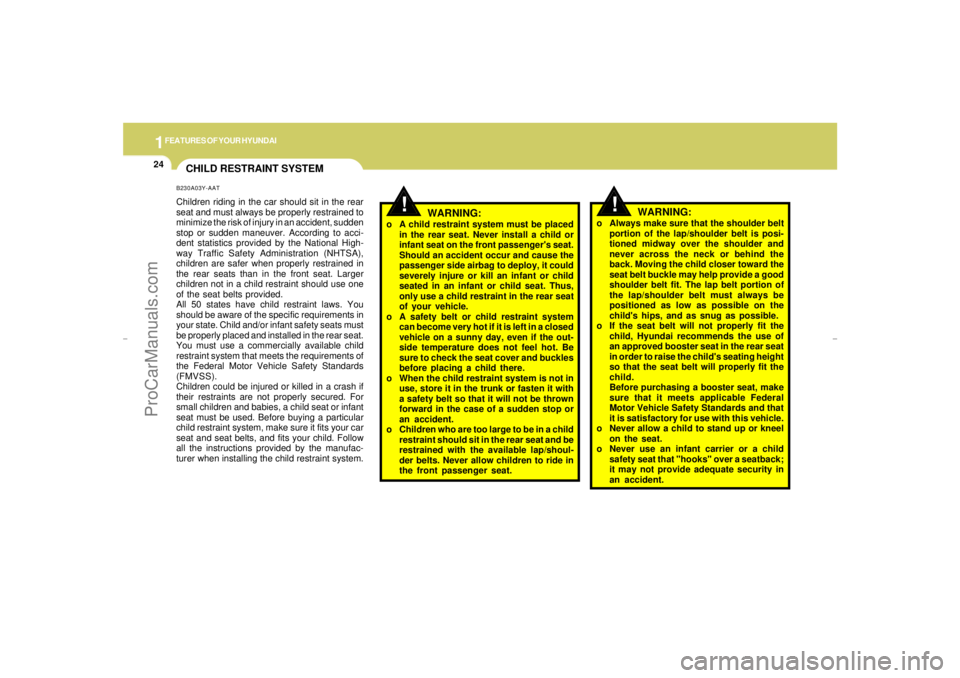
CHILD RESTRAINT SYSTEMB230A03Y-AATChildren riding in the car should sit in the rear
seat and must always be properly restrained to
minimize the risk of injury in an accident, sudden
stop or sudden maneuver. According to acci-
dent statistics provided by the National High-
way Traffic Safety Administration (NHTSA),
children are safer when properly restrained in
the rear seats than in the front seat. Larger
children not in a child restraint should use one
of the seat belts provided.
All 50 states have child restraint laws. You
should be aware of the specific requirements in
your state. Child and/or infant safety seats must
be properly placed and installed in the rear seat.
You must use a commercially available child
restraint system that meets the requirements of
the Federal Motor Vehicle Safety Standards
(FMVSS).
Children could be injured or killed in a crash if
their restraints are not properly secured. For
small children and babies, a child seat or infant
seat must be used. Before buying a particular
child restraint system, make sure it fits your car
seat and seat belts, and fits your child. Follow
all the instructions provided by the manufac-
turer when installing the child restraint system.
WARNING:
o A child restraint system must be placed
in the rear seat. Never install a child or
infant seat on the front passenger's seat.
Should an accident occur and cause the
passenger side airbag to deploy, it could
severely injure or kill an infant or child
seated in an infant or child seat. Thus,
only use a child restraint in the rear seat
of your vehicle.
o A safety belt or child restraint system
can become very hot if it is left in a closed
vehicle on a sunny day, even if the out-
side temperature does not feel hot. Be
sure to check the seat cover and buckles
before placing a child there.
o When the child restraint system is not in
use, store it in the trunk or fasten it with
a safety belt so that it will not be thrown
forward in the case of a sudden stop or
an accident.
o Children who are too large to be in a child
restraint should sit in the rear seat and be
restrained with the available lap/shoul-
der belts. Never allow children to ride in
the front passenger seat.
WARNING:
o Always make sure that the shoulder belt
portion of the lap/shoulder belt is posi-
tioned midway over the shoulder and
never across the neck or behind the
back. Moving the child closer toward the
seat belt buckle may help provide a good
shoulder belt fit. The lap belt portion of
the lap/shoulder belt must always be
positioned as low as possible on the
child's hips, and as snug as possible.
o If the seat belt will not properly fit the
child, Hyundai recommends the use of
an approved booster seat in the rear seat
in order to raise the child's seating height
so that the seat belt will properly fit the
child.
Before purchasing a booster seat, make
sure that it meets applicable Federal
Motor Vehicle Safety Standards and that
it is satisfactory for use with this vehicle.
o Never allow a child to stand up or kneel
on the seat.
o Never use an infant carrier or a child
safety seat that "hooks" over a seatback;
it may not provide adequate security in
an accident.
!
!
xgflhma-1.p656/16/04, 3:02 PM 24
ProCarManuals.com
Page 51 of 247
1
FEATURES OF YOUR HYUNDAI
39
!
WARNING:
o Sitting improperly or out of position can
result in serious injury or death in a
crash.
o Always sit upright, fully back in the seat,
with your seat belt on, and your feet on
the floor.Adding Equipment to or Modifying Your
Airbag-Equipped Vehicle.If you modify your vehicle by changing your
vehicle's frame, bumper system, front end or
side sheet metal or ride height, this may affect
the operation of your vehicle's airbag system.
xgflhma-1.p656/16/04, 3:02 PM 39
ProCarManuals.com
Page 139 of 247

DRIVING YOUR HYUNDAI
92
TRACTION CONTROL SYSTEM
(TCS)
!
!
WARNING:
Your ABS will not prevent accidents due to
improper or dangerous driving maneuvers.
Even though vehicle control is improved
during emergency braking, always main-
tain a safe distance between you and ob-
jects ahead. Vehicle speeds should always
be reduced during extreme road condi-
tions.
The braking distance for cars equipped
with an anti-lock braking system may be
longer than for those without it in the
following road conditions.
During these conditions the vehicle should
be driven at reduced speeds.
o Rough, gravel or snow-covered roads.
o With tire chains installed.
o On roads where the road surface is pit-
ted or has different surface height.
The safety features of an ABS equipped
vehicle should not be tested by high speed
driving or cornering. This could endanger
the safety of yourself or others.
C300A02Y-GAT(If Installed)
!
On slippery road surfaces, the traction control
system (TCS) limits the drive wheels from
spinning excessively, thus helping the car to
accelerate. It also provides sufficient driving
force and steering performance as the car turns
at accelerated speeds.SLIP ControlLimits the drive wheels from spinning exces-
sively during starting or while making acceler-
ated turns on slippery roads to avoid losing the
driving force of the front wheels.
CAUTION:
When the TCS indicator blinks, SLIP control
has been activated. It also means that the
road is slippery or your car is accelerating
excessively. In this situation, gently release
foot pressure from the accelerator pedal
and maintain moderate speed.
WARNING:
Traction control is only a driving aid; all
normal precautions for driving in inclement
weather and on slippery driving surfaces
should be observed.
C300A02L-A
Driving hintsTCS does not actively apply brakes. Be sure to
decelerate the car sufficiently before entering
curves.
xgflhma-2.p656/16/04, 3:00 PM 9
ProCarManuals.com
Page 226 of 247
8
CONSUMER INFORMATION & REPORTING SAFETY DEFECTS6
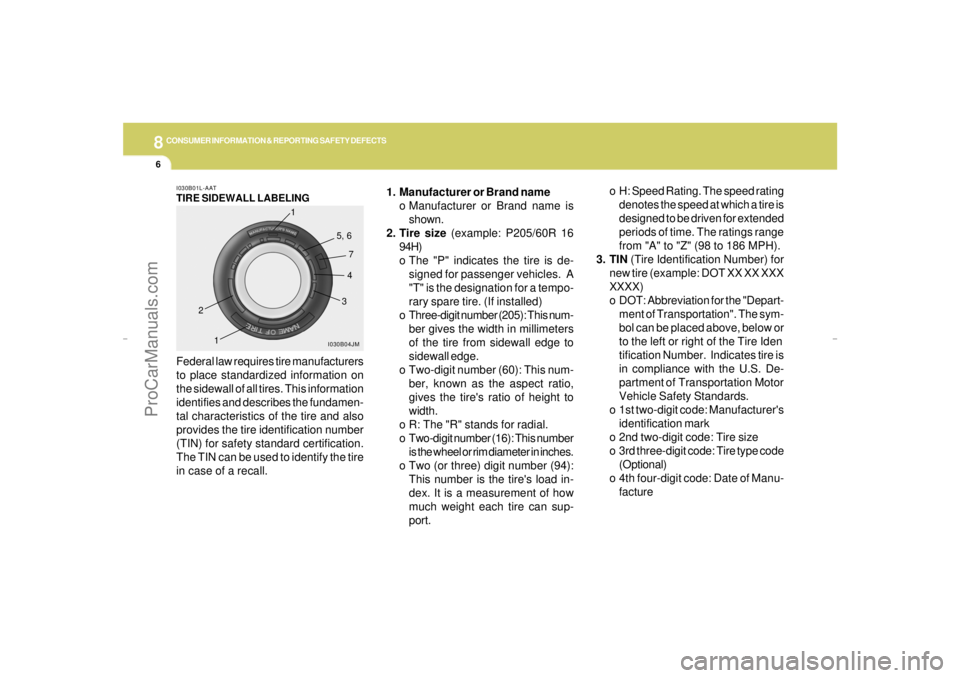
1. Manufacturer or Brand name
o Manufacturer or Brand name is
shown.
2. Tire size (example: P205/60R 16
94H)
o The "P" indicates the tire is de-
signed for passenger vehicles. A
"T" is the designation for a tempo-
rary spare tire. (If installed)
o Three-digit number (205): This num-
ber gives the width in millimeters
of the tire from sidewall edge to
sidewall edge.
o Two-digit number (60): This num-
ber, known as the aspect ratio,
gives the tire's ratio of height to
width.
o R: The "R" stands for radial.
o Two-digit number (16): This number
is the wheel or rim diameter in inches.
o Two (or three) digit number (94):
This number is the tire's load in-
dex. It is a measurement of how
much weight each tire can sup-
port.o H: Speed Rating. The speed rating
denotes the speed at which a tire is
designed to be driven for extended
periods of time. The ratings range
from "A" to "Z" (98 to 186 MPH).
3. TIN (Tire Identification Number) for
new tire (example: DOT XX XX XXX
XXXX)
o DOT: Abbreviation for the "Depart-
ment of Transportation". The sym-
bol can be placed above, below or
to the left or right of the Tire Iden
tification Number. Indicates tire is
in compliance with the U.S. De-
partment of Transportation Motor
Vehicle Safety Standards.
o 1st two-digit code: Manufacturer's
identification mark
o 2nd two-digit code: Tire size
o 3rd three-digit code: Tire type code
(Optional)
o 4th four-digit code: Date of Manu-
facture
Federal law requires tire manufacturers
to place standardized information on
the sidewall of all tires. This information
identifies and describes the fundamen-
tal characteristics of the tire and also
provides the tire identification number
(TIN) for safety standard certification.
The TIN can be used to identify the tire
in case of a recall.I030B01L-AATTIRE SIDEWALL LABELING
I030B04JM
1
234 5, 6
7
1
xgflhma-8.p656/16/04, 2:57 PM 6
ProCarManuals.com
Page 227 of 247
8
CONSUMER INFORMATION & REPORTING SAFETY DEFECTS
7
o Four numbers represent the week
and year the tire was built. For
example, the numbers 3105 means
the 31st week of 2005.
4. Tire ply composition and material
The number of layers or plies of
rubbercoated fabric in the tire. Tire
manufacturers also must indicate
the materials in the tire, which in-
clude steel, nylon, polyester, and
others. The letter "R" means radial
ply construction; the letter "D" means
diagonal or bias ply construction;
and the letter "B" means belted-bias
ply construction.
5. Maximum permissible inflation
pressure
This number is the greatest amount
of air pressure that should be put in
the tire. Do not exceed the maximum
permissible inflation pressure. Refer
to the Tire and Loading Information
label for recommended inflation pres-
sure.6. Maximum load rating
This number indicates the maximum
load in kilograms and pounds that
can be carried by the tire. When
replacing the tires on the vehicle,
always use a tire that has the same
load rating as the factory installed
tire.
7. Uniform Tire Quality Grading
(UTQG):
Tire manufacturers are required to
grade tires based on three perfor-
mance factors: treadwear, traction
and temperature resistance. For more
information, see Uniform Tire Qual-
ity Grading on page 8-14.
I030D01JM-AATTIRE TERMINOLOGY AND DEFINI-
TIONS
Air Pressure: The amount of air inside
the tire pressing outward on the tire. Air
pressure is expressed in pounds per
square inch (psi) or kilopascal (kPa).
Accessory Weight: This means the
combined weight of optional accesso-
ries. Some examples of optional ac-
cessories are, automatic transmission,
power seats, and air conditioning.
Aspect Ratio: The relationship of a
tire's height to its width.
Belt: A rubber coated layer of cords that
is located between the plies and the
tread. Cords may be made from steel or
other reinforcing materials.
Bead: The tire bead contains steel
wires wrapped by steel cords that hold
the tire onto the rim.
Bias Ply Tire: A pneumatic tire in which
the plies are laid at alternate angles
less than 90 degrees to the centerline of
the tread.
xgflhma-8.p656/16/04, 2:57 PM 7
ProCarManuals.com
Page 238 of 247
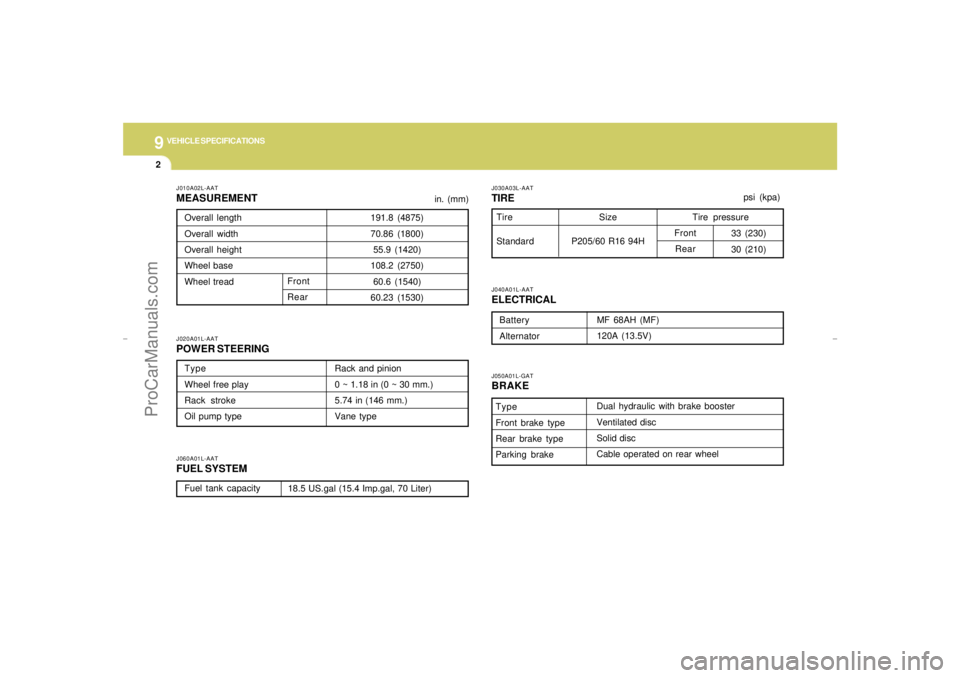
9
VEHICLE SPECIFICATIONS2
J060A01L-AATFUEL SYSTEM
J050A01L-GATBRAKEJ040A01L-AATELECTRICAL
J020A01L-AATPOWER STEERINGJ010A02L-AATMEASUREMENT
191.8 (4875)
70.86 (1800)
55.9 (1420)
108.2 (2750)
60.6 (1540)
60.23 (1530) Overall length
Overall width
Overall height
Wheel base
Wheel tread
Front
Rear
Type
Wheel free play
Rack stroke
Oil pump typeRack and pinion
0 ~ 1.18 in (0 ~ 30 mm.)
5.74 in (146 mm.)
Vane type
Battery
AlternatorMF 68AH (MF)
120A (13.5V)
Dual hydraulic with brake booster
Ventilated disc
Solid disc
Cable operated on rear wheel Type
Front brake type
Rear brake type
Parking brake
18.5 US.gal (15.4 Imp.gal, 70 Liter)
Fuel tank capacity
J030A03L-AATTIRE
Tire pressure
Tire
Standardpsi (kpa)
Size
P205/60 R16 94H in. (mm)
Front
Rear
33 (230)
30 (210)
xgflhma-9.p656/16/04, 2:56 PM 2
ProCarManuals.com