brake fluid Hyundai H-1 (Grand Starex) 2004 Owner's Manual
[x] Cancel search | Manufacturer: HYUNDAI, Model Year: 2004, Model line: H-1 (Grand Starex), Model: Hyundai H-1 (Grand Starex) 2004Pages: 273, PDF Size: 11.26 MB
Page 14 of 273
YOUR VEHICLE AT A GLANCE
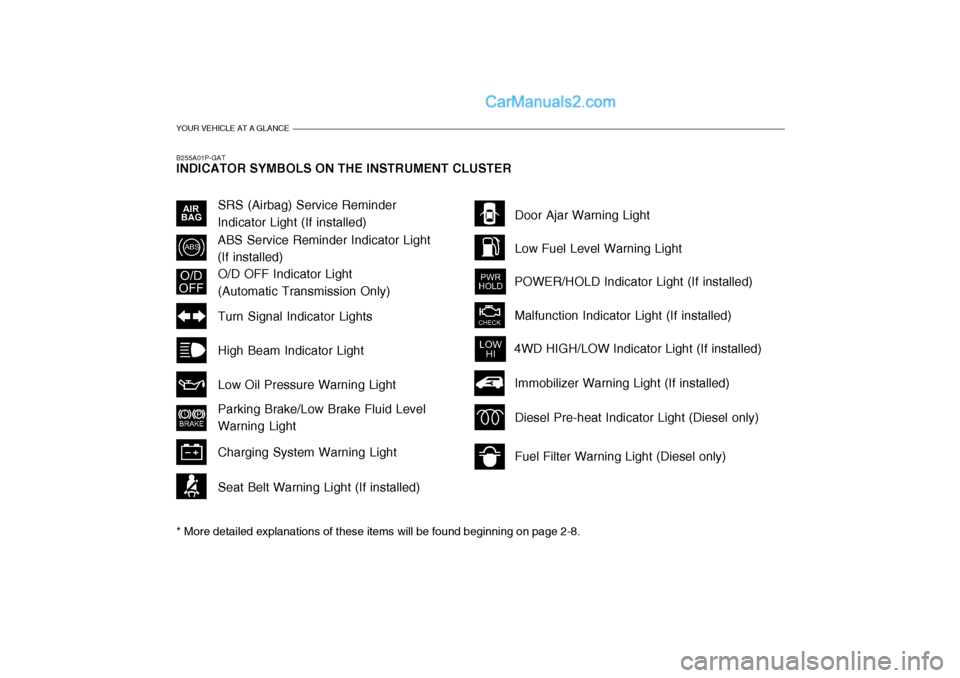
B255A01P-GAT INDICATOR SYMBOLS ON THE INSTRUMENT CLUSTER * More detailed explanations of these items will be found beginning on page 2-8.
O/D OFF Indicator Light (Automatic Transmission Only)
Fuel Filter Warning Light (Diesel only)
Diesel Pre-heat Indicator Light (Diesel only)
Immobilizer Warning Light (If installed)
SRS (Airbag) Service Reminder Indicator Light (If installed)
ABS Service Reminder Indicator Light(If installed)
Turn Signal Indicator Lights High Beam Indicator LightLow Oil Pressure Warning Light Parking Brake/Low Brake Fluid Level Warning Light Charging System Warning Light Seat Belt Warning Light (If installed) Door Ajar Warning Light Low Fuel Level Warning Light
POWER/HOLD Indicator Light (If installed) Malfunction Indicator Light (If installed)
4WD HIGH/LOW Indicator Light (If installed)
Page 16 of 273
1BEFORE DRIVING YOUR VEHICLE
2RUNNING-IN RECOMMEN- DATIONSBEFORE DRIVING YOUR VEHICLE SAFETY CHECKS
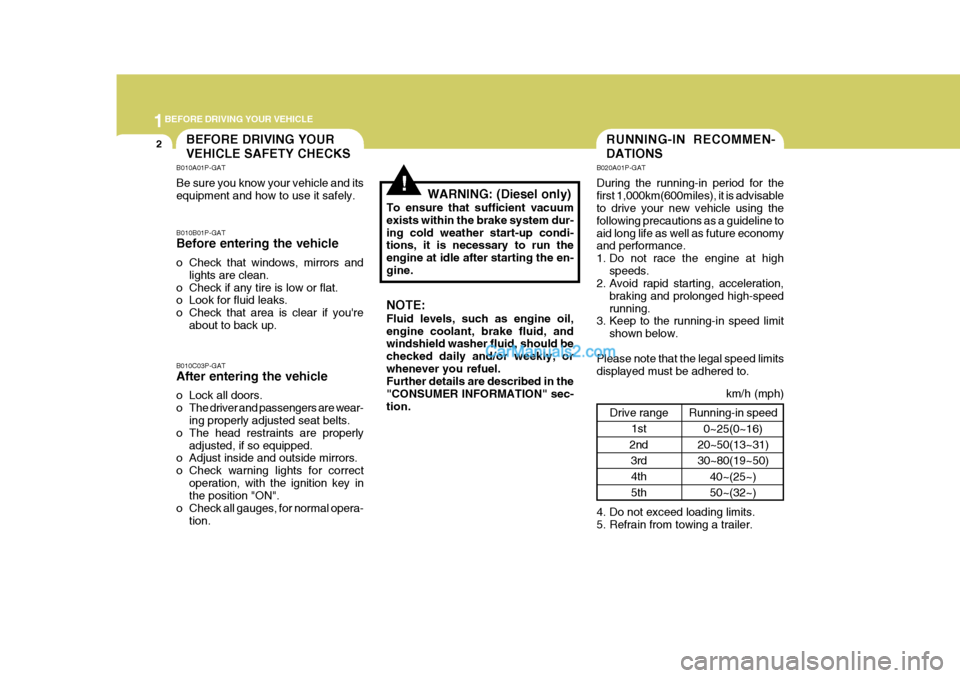
Drive range1st
2nd 3rd
4th 5th
!
B010A01P-GAT Be sure you know your vehicle and its equipment and how to use it safely. B010B01P-GAT Before entering the vehicle
o Check that windows, mirrors and lights are clean.
o Check if any tire is low or flat.
o Look for fluid leaks.
o Check that area is clear if you're about to back up.
B010C03P-GAT After entering the vehicle
o Lock all doors.
o The driver and passengers are wear- ing properly adjusted seat belts.
o The head restraints are properly adjusted, if so equipped.
o Adjust inside and outside mirrors.
o Check warning lights for correct
operation, with the ignition key in the position "ON".
o Check all gauges, for normal opera- tion. WARNING: (Diesel only)
To ensure that sufficient vacuum exists within the brake system dur-ing cold weather start-up condi- tions, it is necessary to run the engine at idle after starting the en-gine. NOTE: Fluid levels, such as engine oil, engine coolant, brake fluid, and windshield washer fluid, should be checked daily and/or weekly, orwhenever you refuel. Further details are described in the "CONSUMER INFORMATION" sec-tion. B020A01P-GAT During the running-in period for the first 1,000km(600miles), it is advisable to drive your new vehicle using the following precautions as a guideline toaid long life as well as future economy and performance.
1. Do not race the engine at high
speeds.
2. Avoid rapid starting, acceleration,
braking and prolonged high-speedrunning.
3. Keep to the running-in speed limit
shown below.
Please note that the legal speed limitsdisplayed must be adhered to.
4. Do not exceed loading limits.
5. Refrain from towing a trailer.
km/h (mph)
Running-in speed 0~25(0~16)
20~50(13~31) 30~80(19~50)
40~(25~) 50~(32~)
Page 73 of 273
2 INSTRUMENTS AND CONTROLS
8WARNING AND INDICATOR LIGHTS
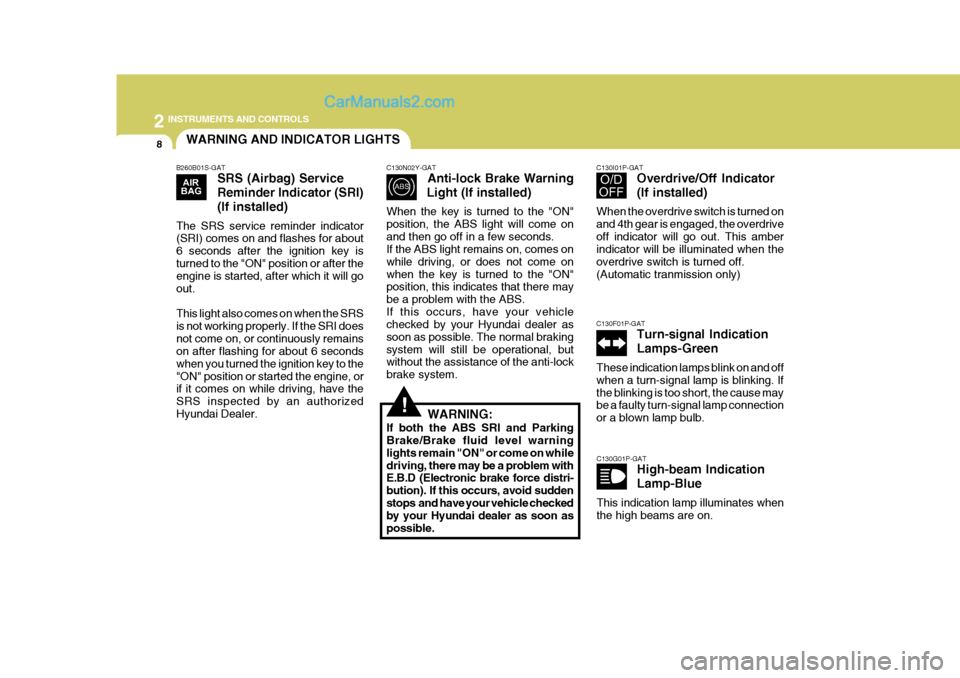
B260B01S-GAT SRS (Airbag) Service Reminder Indicator (SRI)(If installed)
The SRS service reminder indicator (SRI) comes on and flashes for about 6 seconds after the ignition key isturned to the "ON" position or after the engine is started, after which it will go out. This light also comes on when the SRS is not working properly. If the SRI doesnot come on, or continuously remains on after flashing for about 6 seconds when you turned the ignition key to the"ON" position or started the engine, or if it comes on while driving, have the SRS inspected by an authorizedHyundai Dealer.
C130N02Y-GAT Anti-lock Brake Warning
Light (If installed)
When the key is turned to the "ON" position, the ABS light will come onand then go off in a few seconds. If the ABS light remains on, comes on while driving, or does not come onwhen the key is turned to the "ON" position, this indicates that there may be a problem with the ABS.If this occurs, have your vehicle checked by your Hyundai dealer as soon as possible. The normal brakingsystem will still be operational, but without the assistance of the anti-lock brake system.C130I01P-GAT Overdrive/Off Indicator (If installed)
When the overdrive switch is turned on and 4th gear is engaged, the overdriveoff indicator will go out. This amber indicator will be illuminated when the overdrive switch is turned off.(Automatic tranmission only)
C130F01P-GAT Turn-signal Indication Lamps-Green
These indication lamps blink on and off when a turn-signal lamp is blinking. Ifthe blinking is too short, the cause may be a faulty turn-signal lamp connection or a blown lamp bulb.
C130G01P-GAT High-beam Indication Lamp-Blue
This indication lamp illuminates when the high beams are on.
!WARNING:
If both the ABS SRI and Parking Brake/Brake fluid level warning lights remain "ON" or come on whiledriv ing, there may be a problem with
E.B.D (Electronic brake force distri-
bution). If this occurs, avoid suddenstops and have your vehicle checked by your Hyundai dealer as soon as possible.
Page 74 of 273
2
INSTRUMENTS AND CONTROLS
9
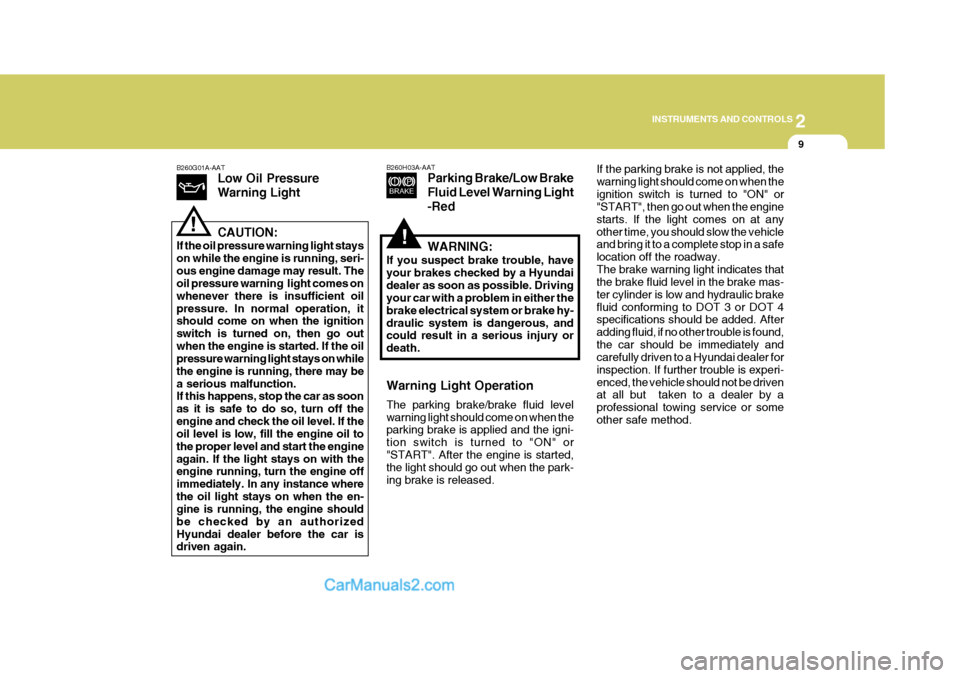
B260G01A-AAT
Low Oil Pressure Warning Light CAUTION:
If the oil pressure warning light stays on while the engine is running, seri-ous engine damage may result. The oil pressure warning light comes on whenever there is insufficient oilpressure. In normal operation, it should come on when the ignition switch is turned on, then go outwhen the engine is started. If the oil pressure warning light stays on while the engine is running, there may bea serious malfunction. If this happens, stop the car as soon as it is safe to do so, turn off theengine and check the oil level. If the oil level is low, fill the engine oil to the proper level and start the engineagain. If the light stays on with the engine running, turn the engine off immediately. In any instance wherethe oil light stays on when the en- gine is running, the engine should be checked by an authorizedHyundai dealer before the car is driven again.
!
!
B260H03A-AAT Parking Brake/Low Brake Fluid Level Warning Light-Red If the parking brake is not applied, the warning light should come on when theignition switch is turned to "ON" or "START", then go out when the engine starts. If the light comes on at anyother time, you should slow the vehicle and bring it to a complete stop in a safe location off the roadway.The brake warning light indicates that the brake fluid level in the brake mas- ter cylinder is low and hydraulic brakefluid conforming to DOT 3 or DOT 4 specifications should be added. After adding fluid, if no other trouble is found,the car should be immediately and carefully driven to a Hyundai dealer for inspection. If further trouble is experi-enced, the vehicle should not be driven at all but taken to a dealer by a professional towing service or someother safe method.
WARNING:
If you suspect brake trouble, have your brakes checked by a Hyundaidealer as soon as possible. Driving your car with a problem in either the brake electrical system or brake hy-draulic system is dangerous, and could result in a serious injury or death. Warning Light Operation The parking brake/brake fluid level warning light should come on when the parking brake is applied and the igni- tion switch is turned to "ON" or"START". After the engine is started, the light should go out when the park- ing brake is released.
Page 152 of 273
3 STARTING AND OPERATING
12
If you need to accelerate rapidly, press the accelerator pedal all the way to thefloor. The transmission will automati- cally shift to a lower gear, depending on the speed. NOTE: Turn the overdrive switch on for good fuel economy and smooth driving. If engine braking is neededin the "D" range or if repeated up- shifting and downshifting between the 3rd and 4th gear is needed whenclimbing a gentle slope, it is recom- mended that the overdrive switch be turned off. Turn the overdriveswitch back on immediately after- ward.
CAUTION:
o Shift into "R" and "P" only when the vehicle has completelystopped.
o Do not accelerate the engine in
the reverse or any of the forwardpositions with the brakes applied.
o Always apply the footbrake when
shifting from "P" or "N" to "R","D", "2" or "L" position.
o Do not use the "P" position in
place of the parking brake. Al-ways set the parking brake, shift the transmission into "P" and turn off the ignition when you leave the vehicle, even momen-tarily. Never leave the vehicle unat- tended while the engine is run-ning.
o Check the automatic transmis-
sion fluid level regularly, and addfluid as necessary. See the maintenance schedule for the proper fluid recommen-dation.
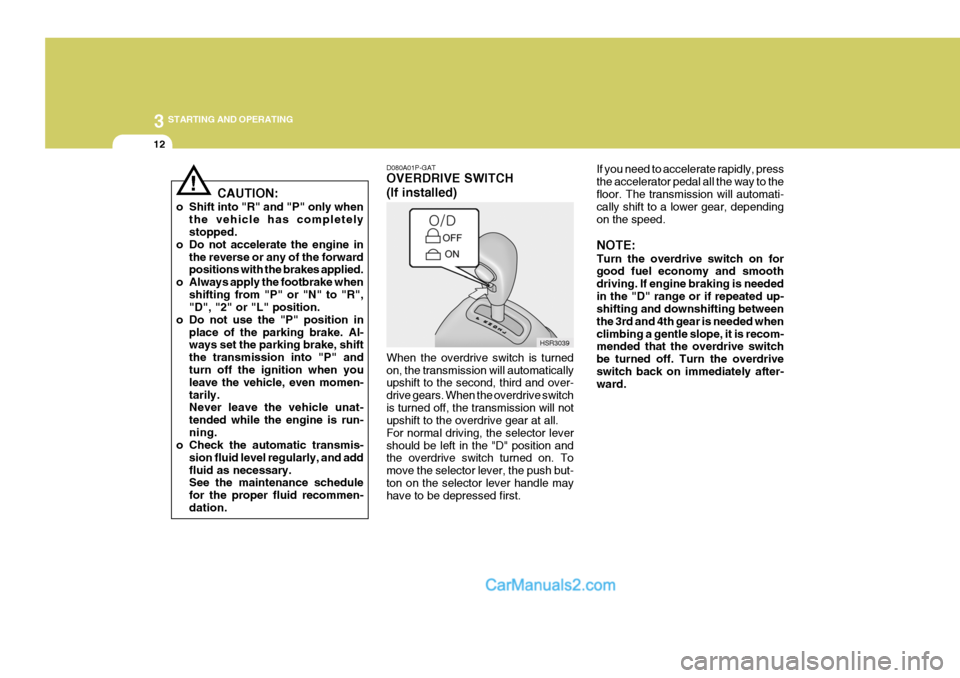
! D080A01P-GAT OVERDRIVE SWITCH (If installed) When the overdrive switch is turned on, the transmission will automatically upshift to the second, third and over- drive gears. When the overdrive switchis turned off, the transmission will not upshift to the overdrive gear at all. For normal driving, the selector levershould be left in the "D" position and the overdrive switch turned on. To move the selector lever, the push but-ton on the selector lever handle may have to be depressed first.HSR3039
Page 159 of 273
3
STARTING AND OPERATING
19BRAKE SYSTEM
D150A01P-GAT All the parts of the brake system are critical to safety. Have the vehicle ser- viced by an authorized HYUNDAI dealer at regular intervals according tothe service standards.
(1) The service brake is divided into two brake circuits so that when one brake circuit fails, the other is avail- able to stop the vehicle. If this oc-curs, however, the brake pedal must be depressed further than usual; stop driving as soon as possibleand have the brake system ser- viced at the nearest authorized HYUNDAI dealer.
(2) Do not place a thick floor mat around the brake pedal; doing so couldprevent the full pedal stroke thatwould be necessary in an emer- gency. Make sure that the pedal can be operated freely at all times.
(3) If the vehicle is equipped with a brake warning lamp, the lamp willlight up if the brake fluid level isabnormally low.
o Do not grip the inside or spokes of
the steering wheel when driving off-road. The steering wheel could jerk and injure your hands. Always firmly hold the outer steering wheel whenyou are driving off-road.
o Drive at lower speeds in strong
crosswinds. Because of yourvehicle’s high center of gravity, its stability will be affected in cross- winds. Slower speeds ensure bettervehicle control.
o Whenever you drive off-road through
sand, mud or water as deep as thewheel hub, more frequent mainte- nance may be required.
o Do not drive in water if the level is higher than the bottom of the wheelhubs.
o Check your brake condition once you are out of mud or water. Pressthe brake several times as you move slowly until your feel normal brakingforces return.
o Four-wheel driving on flat and nor-
mal roads can result in a severebinding condition when turning the steering wheel. Driving on dry paved road and highway Select 2H(2WD) to drive on dry paved roads. Especially on dry highway, neverselect the 4H or 4L(4WD). Driving on snowy or icy roads Select the 4H or 4L in accordance with the road conditions, and then gradu- ally depress the accelerator pedal for a smooth start. Driving on sandy or muddy roads Select the 4H or 4L and then gradually depress the accelerator pedal for a smooth start. Keep the pressure on the accelerator pedal constant as pos-sible, and drive at low speed. Climbing sharp grades Select the 4L to maximize use the engine torque. Descending sharp grades Select 4L, use the engine brake and descend slowly.
Page 190 of 273
44IN CASE OF EMERGENCY
18BLEEDING THE FUEL SYSTEM
CAUTION:
If overheating should occur when towing, (temperature gauge reads near red zone), taking the followingaction may reduce or eliminate the problem.
1. Turn off the air conditioner.
2. Reduce highway speed.
3. Select a lower gear when going uphill.
4. While in stop and go traffic, place
the gear selection in park or neu-tral and idle the engine at a higher speed.
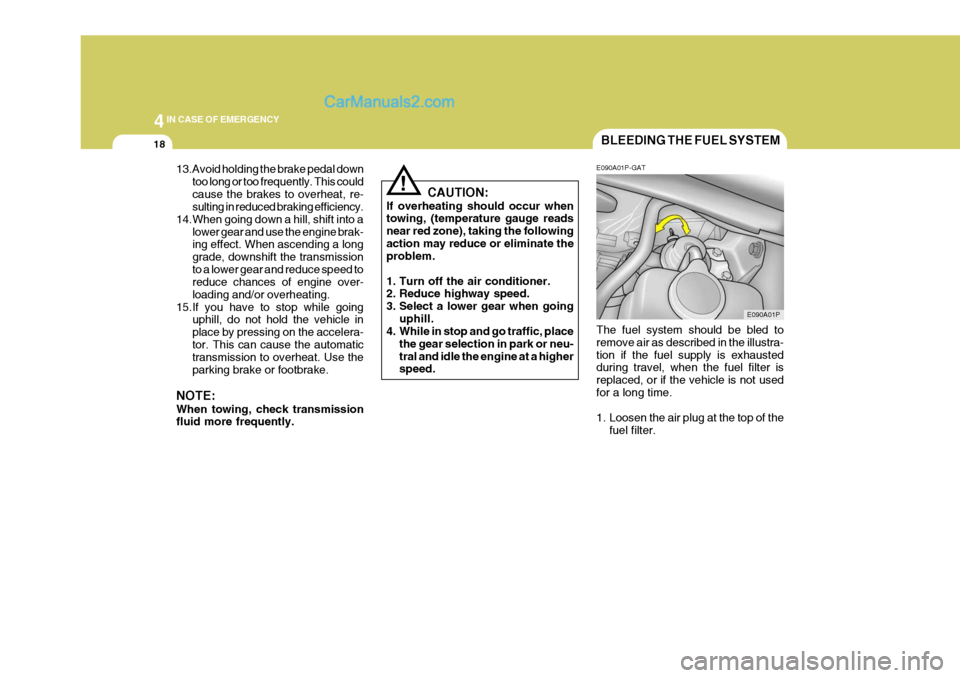
! E090A01P-GAT The fuel system should be bled to remove air as described in the illustra-tion if the fuel supply is exhausted during travel, when the fuel filter is replaced, or if the vehicle is not usedfor a long time.
1. Loosen the air plug at the top of the
fuel filter. E090A01P
13.Avoid holding the brake pedal down
too long or too frequently. This could cause the brakes to overheat, re- sulting in reduced braking efficiency.
14.When going down a hill, shift into a
lower gear and use the engine brak-ing effect. When ascending a long grade, downshift the transmissionto a lower gear and reduce speed to reduce chances of engine over- loading and/or overheating.
15.If you have to stop while going uphill, do not hold the vehicle inplace by pressing on the accelera-tor. This can cause the automatic transmission to overheat. Use the parking brake or footbrake.
NOTE: When towing, check transmission fluid more frequently.
Page 218 of 273
5APPEARANCE CARE
4
F010L01P-GAT Damaged paint Small cracks and scratches in the paint coat should be touched up assoon as possible with HYUNDAI paint pencil or spray paint to prevent corro- sion. Check body areas facing theroad or the tires especially carefully for damage to the paint coat caused by flying stones, etc. The paint code num-ber for your vehicle can be found on the vehicle information code plate. F010M01P-GAT
Tar
If tar becomes adhered to the vehicle, use special tar remover to remove it as soon as possible. If the tar leaves a stain, polish the affected area. F010N01P-GAT
Plastic and rubber parts
Use a soft cloth and wash with water.
If necessary, a cleaning agent spe- cially designed for plastics can beused. If engine oil, brake fluid, battery fluid, etc., comes in contact with these parts, wash promptly with water andthen use alcohol to remove the stain completely. F010O01P-GAT
Load weight and driving speed
Remove any luggage, etc., which is not necessary from the vehicle. The load weight placed on the roof or towed in a trailer also should not be exces-sive.Correctly adjusting the air pressure ofthe tires before driving under maxi- mum load weight conditions and be- fore driving long distances is espe-cially important. F010Q01P-GAT
Kerb parking
If the tires strike a kerb or concrete parking barrier, they could be dam-aged, and this damage could become a source of extreme danger when the vehicle is subsequently driven at highspeed. If the vehicle is to be driven or onto a kerb or any other such barrier, it should be driven slowly and at anappropriate angle to the kerb or barrier.
F010J01P-GAT Engine compartment Clean the engine compartment at the beginning and end of winter. Pay particualr attention to flanges, crev- ices, and peripheral parts where dustcontaining road chemicals and other corrosive materials might collect. If salt and other chemicals are used on the roads in your area, clean the en- gine compartment at least every threemonths.
Page 221 of 273
6VEHICLE MAINTENANCE REQUIREMENTS
2MAINTENANCE INTERVALS
F010C01A-GAT
Specified Scheduled Procedures
These are the procedures such as
inspections, adjustments and replace- ments that are listed in the mainte-nance charts starting on page 6-4. These procedures must be performed at the intervals shown in the mainte-nance schedule to assure that your warranty remains in effect. Although it is strongly recommended that they beperformed by the factory-trained or distributor-trained technicians at your Hyundai dealer, these procedures maybe performed at any qualified service facility. F010D01A-AAT
General Checks
These are the regular checks you should perform when you drive your Hyundai or you fill the fuel tank. A list of these items will be found on page8-6.
F010A01A-GAT Service Requirements To assure that you receive the great- est number of kilometers of satisfying operation from your Hyundai, certain maintenance procedures must be per-formed. Although careful design and engineering have reduced these to a minimum, those that are required areof the utmost importance.It is your responsibility to have thesemaintenance procedures performed to comply with the terms of the warran- ties covering your new Hyundai. TheService Passport supplied with your new vehicle provides further informa- tion about these warranties.
F010B01A-AAT
Maintenance Requirements
The maintenance required for your
Hyundai can be divided into three main areas: o Specified scheduled procedures o General checks o Do-it-yourself maintenance It is suggested that genuine Hyundai
service parts be used for any requiredrepairs or replacements. Other parts of equivalent quality such as engine oil, engine coolant, manual or autotransaxle oil, brake fluid and so on which are not supplied by Hyundai Motor Company or its distributor maybe used without affecting your war- ranty coverage but you should always be sure these are equivalent to thequality of the original Hyundai parts. Your Service Passport provides fur- ther information about your warrantycoverage.
Page 225 of 273
6VEHICLE MAINTENANCE REQUIREMENTS
6
50 40I I I I I I I I I I I I
KILOMETERS X 1000MONTHS
NO.
1 2 3 4 5 6 7 8 9
1011 12 13 14 15 16 17 18 19 20 21 22 DESCRIPTION
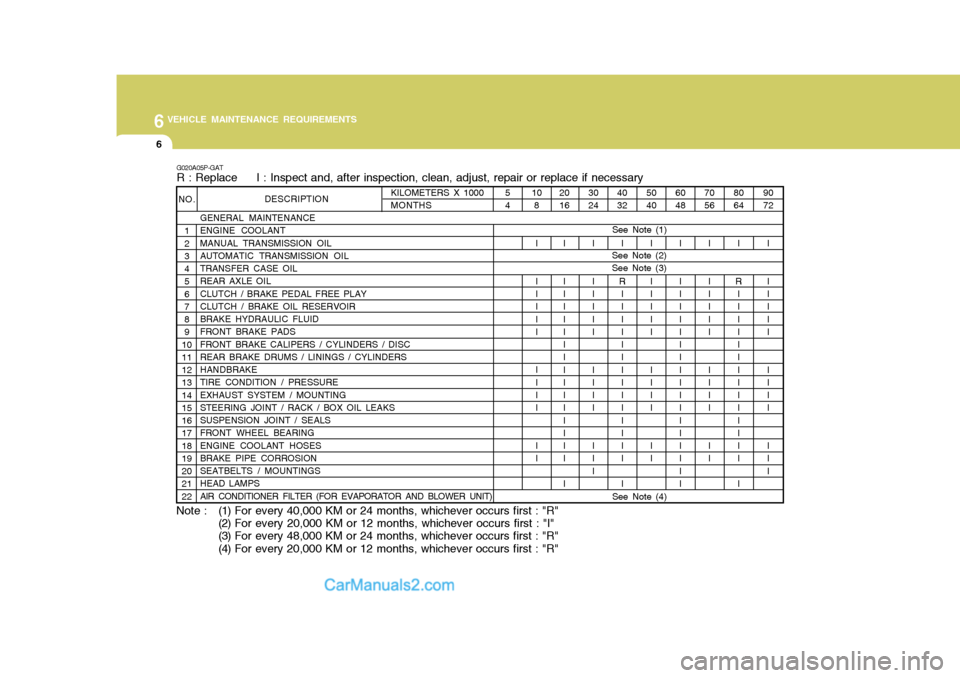
GENERAL MAINTENANCE ENGINE COOLANT MANUAL TRANSMISSION OIL AUTOMATIC TRANSMISSION OIL TRANSFER CASE OIL REAR AXLE OIL CLUTCH / BRAKE PEDAL FREE PLAY CLUTCH / BRAKE OIL RESERVOIR BRAKE HYDRAULIC FLUID FRONT BRAKE PADS FRONT BRAKE CALIPERS / CYLINDERS / DISC REAR BRAKE DRUMS / LININGS / CYLINDERS HANDBRAKE TIRE CONDITION / PRESSURE EXHAUST SYSTEM / MOUNTING STEERING JOINT / RACK / BOX OIL LEAKS SUSPENSION JOINT / SEALS FRONT WHEEL BEARING ENGINE COOLANT HOSES BRAKE PIPE CORROSION SEATBELTS / MOUNTINGS HEAD LAMPS AIR CONDITIONER FILTER (FOR EVAPORATOR AND BLOWER UNIT)
G020A05P-GAT R : Replace I : Inspect and, after inspection, clean, adjust, repair or replace if necessary
80 64
I
R II I I I I I I I I I I I I I 90 72
I I I I I I I I I I I I I
70 56
I I I I I I I I I I I I
6048
I I I I I I I I I I I I I I I I I I
4032
I
R II I I I I I I I I I I I I I
30 24
I I I I I I I I I I I I I
20 16
I I I I I I I I I I I I I I I I I108
I I I I I I I I I I I I
5 4
See Note (1)
Note : (1) For every 40,000 KM or 24 months, whichever occurs first : "R" (2) For every 20,000 KM or 12 months, whichever occurs first : "I"
(3) For every 48,000 KM or 24 months, whichever occurs first : "R"
(4) For every 20,000 KM or 12 months, whichever occurs first : "R"
See Note (4)
See Note (2) See Note (3)