child Hyundai H-1 (Grand Starex) 2007 User Guide
[x] Cancel search | Manufacturer: HYUNDAI, Model Year: 2007, Model line: H-1 (Grand Starex), Model: Hyundai H-1 (Grand Starex) 2007Pages: 284, PDF Size: 11.33 MB
Page 66 of 284
1BEFORE DRIVING YOUR VEHICLE
54
o For cleaning the airbag pad cov-
ers, use only a soft, dry cloth or one which has been moistened with plain water. Solvents orcleaners could adversely affect the airbag covers and proper deployment of the system.
o No objects should be placed over or near the airbag modules onthe steering wheel, instrumentpanel, and the front passenger's panel above the glove box, be- cause any such object couldcause harm if the vehicle is in a crash severe enough to cause the airbags to inflate.
o If the airbags inflate, they must be replaced by an authorizedHyundai dealer.
o Do not tamper with or discon- nect SRS wiring, or other com-ponents of the SRS system. Do-ing so could result in injury, due to accidental inflation of the airbags or by rendering the SRSinoperative.
!WARNING:
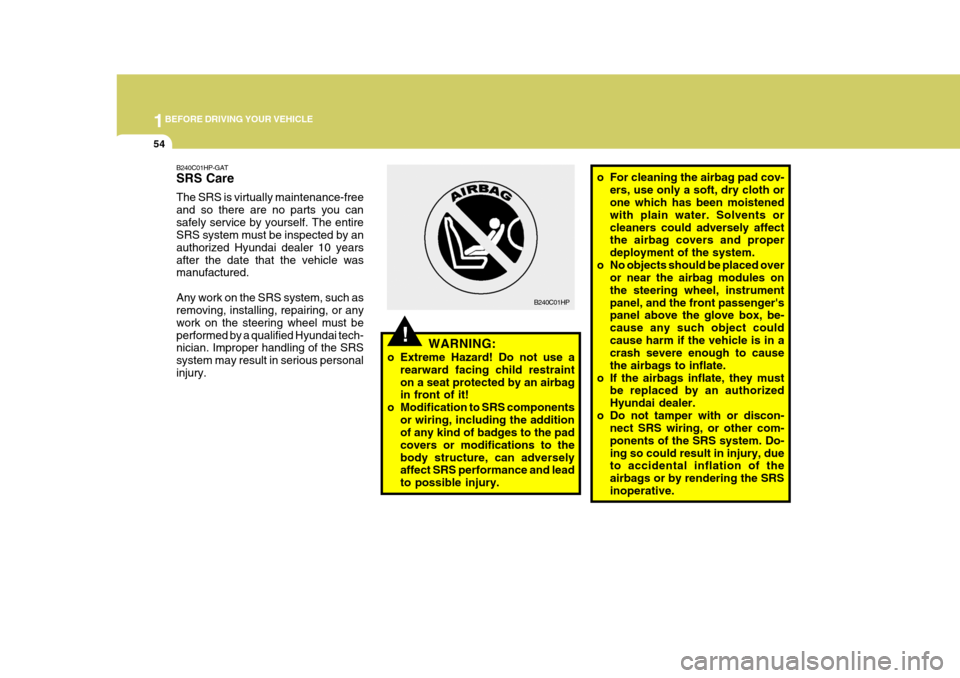
o Extreme Hazard! Do not use a rearward facing child restraint on a seat protected by an airbag in front of it!
o Modification to SRS components
or wiring, including the additionof any kind of badges to the pad covers or modifications to thebody structure, can adversely affect SRS performance and lead to possible injury. B240C01HP
B240C01HP-GAT SRS Care The SRS is virtually maintenance-free and so there are no parts you cansafely service by yourself. The entire SRS system must be inspected by an authorized Hyundai dealer 10 yearsafter the date that the vehicle was manufactured. Any work on the SRS system, such as removing, installing, repairing, or any work on the steering wheel must beperformed by a qualified Hyundai tech- nician. Improper handling of the SRS system may result in serious personalinjury.
Page 67 of 284

1
BEFORE DRIVING YOUR VEHICLE
55
o Do not install a child restraint sys-
tem in the front passenger seat position. A child restraint system mustnever be placed in the front seat. The infant or child could be se- verely injured by an airbag de-ployment in case of an accident.
o If components of the airbag sys-
tem must be discarded, or if thevehicle must be scrapped, cer- tain safety precautions must be observed. Your Hyundai dealerknows these precautions and can give you the necessary informa- tion. Failure to follow these pre-cautions and procedures could increase the risk of personal in- jury.
o If you sell your vehicle, be sure to inform the new owner of theseimportant points and make cer-tain that this manual is trans- ferred to the new owner.o If your car was flooded and has
soaked carpeting or water on flooring, you shouldn't try to startengine; have the car towed to authorized Hyundai dealer.
o Do not replace the bumper or the
bumper guard with other thanHyundai genuine parts. Other- wise, it can adversely affect SRSperformance and lead to unex- pected injury.
Page 208 of 284

44IN CASE OF EMERGENCY
32
8. Remove the protective cap from the
replacement bulb and install the new bulb by matching the plastic base with the headlight hole. Retighten the bulb spring and reconnect thepower cord.
9. Use the protective cap and carton to
promptly dispose of the old bulb.
10.Check for proper headlight aim.
(1) Headlight(2) Front position light (3) Front turn signal light HSRFL275
(1)
(2)
(3)
!
G270A03O
WARNING:
This halogen bulb contains gas under pressure and if impacted could shatter, resulting in flying fragments. Always wear eye pro-tection when servicing the bulb. Protect the bulb against abrasions or scratches and against liquidswhen lighted. Turn the bulb on only when installing in a headlight. Re- place the headlight if damaged orcracked. Keep the bulb out of the reach of children and dispose of the used bulb with care.
HSRFL276
G270B01P-GAT REAR COMBINATION LIGHT Luggage compartment 1. Open the tail gate.
HSRFL294
Rear Turn signal light
Back up light
Stop/Tail light
Page 257 of 284

8
DO-IT YOURSELF MAINTENANCE
13
D010B02P
CHECKING THE BATTERY
!
G210A01A-AAT
WARNING:
Batteries can be dangerous! When working with batteries, carefully observe the following precautionsto avoid serious injuries. The fluid in the battery contains a
strong solution of sulfuric acid, which is poisonous and highly corrosive. Becareful not to spill it on yourself or the car. If you do spill battery fluid on yourself, immediately do the follow-ing: o If battery fluid is on your skin, flush
the affected areas with water for atleast 15 minutes and then seek medical assistance.
o If battery fluid is in your eyes, rinse out your eyes with water and getmedical assistance as soon as possible. While you are being drivento get medical assistance, continue to rinse your eyes by using a sponge or soft cloth saturated withwater.
o If you swallow battery fluid, drink a large quantity of water or milk fol- lowed by milk of magnesia, eat a raw egg or drink vegetable oil. Getmedical assistance as soon as possible.
While batteries are being charged(either by a battery charger or by the vehicle’s alternator), they produceexplosive gases. Always observe these warnings to prevent injuries from occurring:
o Charge batteries only in a well ven- tilated area.
o Do not permit flames, sparks or smoking in the area.
o Keep children away from the area. I090C01P-GAT Disconnection and connection Never disconnect the battery while the engine is running; doing so could damage the vehicle’s electrical com- ponents. First disconnect the nega-tive terminal and then the positive terminal. When connecting the bat- tery, first connect the positive termi-nal and then the negative terminal.
CAUTION:
o Keep the terminals clean. After the battery is connected, applyterminal protection grease. Toclean the terminals, use luke- warm water.
o Never short-circuit the battery; doing so could cause it to over- heat and be damaged.
o Do not smoke or bring an open flame near the battery; doing socould ignite the explosive gasgenerated by the battery.
!
Page 258 of 284

8DO-IT YOURSELF MAINTENANCE
14
o The battery electrolyte is extremelycaustic. Do not allow it to come in contact with your eyes, skin,clothing, or the painted surfaces of the vehicle. Spilled electrolyte should be flushed immediately with ample amounts of water. Irritation to eyes or skin from contact withelectrolyte requires immediate medical attention.
o If the battery is to be quick- charged, first disconnect the battery cables.
o In order to prevent a short cir- cuit, be sure to disconnect thenegative (-) terminal before do- ing anything else.
If any electrolyte gets into your eyes, flush your eyeswith clean water for at least 15 minutes and get imme- diate medical attention. Ifpossible, continue to apply water with a sponge or cloth until medical atten-tion is received.If electrolyte gets on yourskin, thoroughly wash the contacted area. If you feel a pain or a burn- ing sensation, get medical attention immediately. Wear eye protection when charging or working near a battery. Always provide ventilation when working in an en- closed space.
o When lifting a plastic-cased bat-
tery, excessive pressure on thecase may cause battery acid to leak, resulting in personal injury. Lift with a battery carrier or withyour hands on opposite corners.
o Never attempt to charge the bat-
tery when the battery cables areconnected.G210B01Y-GAT
Checking the Battery
Keep the battery clean. Any evidence
of corrosion around the battery posts or terminals should be removed using a solution of household baking sodaand warm water. After the battery ter- minals are dry, cover them with a light coating of grease.
!WARNING:
Always read the following instructions carefully when handling a battery. Keep lighted cigarettes and all other flames or sparks away from the battery. Hydrogen, which is a highly combustible gas, is always present in battery cells andmay explode if ignited.Keep batteries out of thereach of children because batteries contain highly cor- rosive SULFURIC ACID. Donot allow battery acid to contact your skin, eyes, clothing or paint finish.
Page 278 of 284

10INDEX
2
A ADJUSTABLE FRONT SEATS .................................. 1-32
AIR CONDITIONING CARE .......................................8-15
AIR CONDITI ONING SYSTEM .................................. 2-44
ALTIMETER ............................................................... 2-18
ANTENNA .................................................................. 2-73
ANTI-LOCK BRAKE SYSTEM ................................... 3-24
APPEARANCE CARE ................................................. 5-2
ASHTRAY .................................................................. 2-36
AUDIO FAULT CODE ................................................. 2-70
AUDIO SYSTEM Cassette Tape Player Operation (H240, H280)...................................................................... 2-54, 2-65
Compact Disc Player Operation (H260, H280) ...................................................................... 2-59, 2-67
Stereo Radio Operation (H240, H260, H280)
............................................................ 2-51, 2-56, 2-62
AUTOMATIC TRANSMISSION ..................................3-10
AUTOMATIC TRANSMISSION FLUID .......................8-18
AUXILIARY SEAT ...................................................... 1-38BBATTERY
................................................................... 8-13
BEFORE STARTING THE ENGINE ............................ 3-3
BI-LEVEL HEATING ................................................... 2-42
BLEEDING THE FUEL SYSTEM ............................. 4-21
BRAKE FLUID ............................................................ 8-17
BRAKE PEDAL .......................................................... 3-22
BRAKE SYSTEM ....................................................... 3-20
BULB WATTAGE ....................................................... 4-38
CCARE OF CASSETTE TAPES .................................. 2-72
CARE OF DI SC .......................................................... 2-71
CARRYING CHILDREN .............................................. 1-16
CATALYTIC CONVERTER ....... ................................... 7-3
CENTRAL DOOR LOCKS ..... .....................................1-15
CHANGING A FLAT TIRE ........................................... 4-7
CHANGING AND REPLACING FUSES .....................4-27
CHANGING THE CLIMATE CONTROL AIR FILTER . 8-16
CHECKING THE DRIVE BELTS ................................ 8-24
CHECKING THE FREEPLAY .....................................8-23
CHILD PROTECTION SLIDE DOOR ..........................1-16
CHILD RESTRAINT SYSTEM .................................... 1-46
CIGARETTE LIGHTER ............................................... 2-27
CLIMATE CONTROL AIR FILTER ............................. 2-47
CLUTCH FLUID .......................................................... 8-18