cooling Hyundai H-1 (Grand Starex) 2007 User Guide
[x] Cancel search | Manufacturer: HYUNDAI, Model Year: 2007, Model line: H-1 (Grand Starex), Model: Hyundai H-1 (Grand Starex) 2007Pages: 284, PDF Size: 11.33 MB
Page 254 of 284
8DO-IT YOURSELF MAINTENANCE
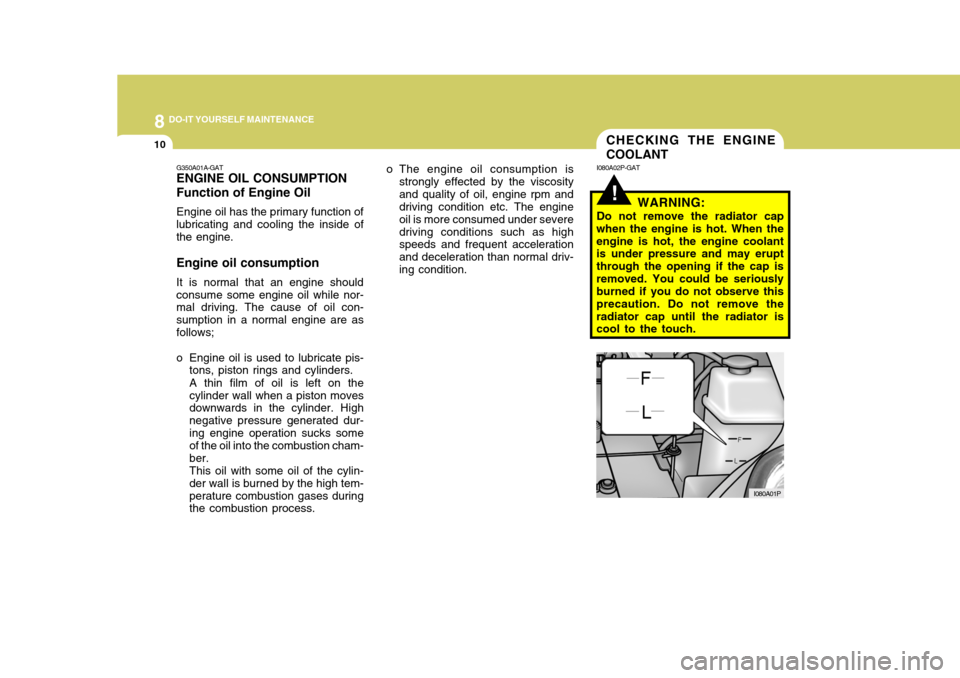
10CHECKING THE ENGINE COOLANT
G350A01A-GAT ENGINE OIL CONSUMPTION Function of Engine Oil Engine oil has the primary function of lubricating and cooling the inside of the engine. Engine oil consumption It is normal that an engine should consume some engine oil while nor- mal driving. The cause of oil con- sumption in a normal engine are asfollows;
o Engine oil is used to lubricate pis-
tons, piston rings and cylinders. A thin film of oil is left on the cylinder wall when a piston moves downwards in the cylinder. High negative pressure generated dur-ing engine operation sucks some of the oil into the combustion cham- ber.This oil with some oil of the cylin-der wall is burned by the high tem-perature combustion gases during the combustion process. o The engine oil consumption is
strongly effected by the viscosity and quality of oil, engine rpm and driving condition etc. The engine oil is more consumed under severedriving conditions such as high speeds and frequent acceleration and deceleration than normal driv-ing condition. I080A02P-GAT
!WARNING:
Do not remove the radiator cap
when the engine is hot. When the engine is hot, the engine coolant is under pressure and may erupt through the opening if the cap isremoved. You could be seriously burned if you do not observe this precaution. Do not remove theradiator cap until the radiator is cool to the touch.
I080A01P
Page 255 of 284
8
DO-IT YOURSELF MAINTENANCE
11
A translucent coolant reservoir tank is
in the engine compartment.
The coolant level in this tank should
be kept between the "L" and "F" marks when measured while the engine iswarm and idling.
The cooling system is a closed sys-
tem and normally the loss of coolant should be very slight. A noticeable drop in the coolant level could indi-cate leakage. If this occurs, have the system
checked at an authorized HYUNDAIdealer as soon as possible. If the level should drop below the "L"
level on the reservoir tank, add cool- ant.
Also, if the reservoir tank is com-
pletely empty, remove the radiatorcap and add coolant until the level reaches the filler neck.
!WARNING:
Do not open the reservoir tank lid
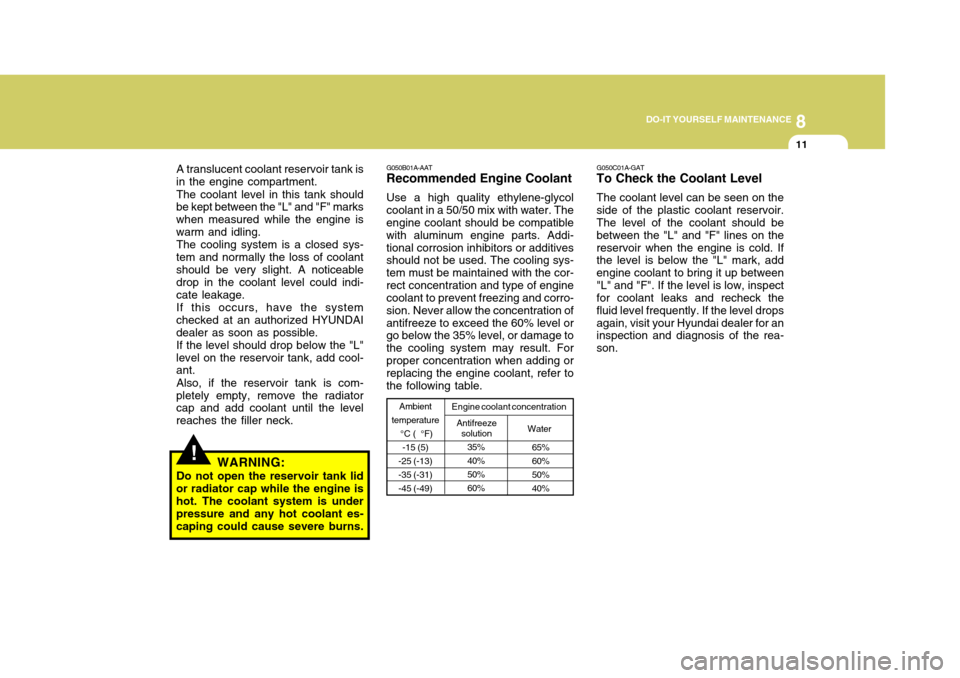
or radiator cap while the engine is hot. The coolant system is under pressure and any hot coolant es-caping could cause severe burns. G050B01A-AAT Recommended Engine Coolant Use a high quality ethylene-glycol coolant in a 50/50 mix with water. The engine coolant should be compatible with aluminum engine parts. Addi-tional corrosion inhibitors or additives should not be used. The cooling sys- tem must be maintained with the cor-rect concentration and type of engine coolant to prevent freezing and corro- sion. Never allow the concentration ofantifreeze to exceed the 60% level or go below the 35% level, or damage to the cooling system may result. Forproper concentration when adding or replacing the engine coolant, refer to the following table.
Water
65% 60%50%40%
35%40%50%60%
Ambient
temperature °C ( °F)-15 (5)
-25 (-13) -35 (-31)-45 (-49) Engine coolant concentration
Antifreezesolution G050C01A-GAT To Check the Coolant Level The coolant level can be seen on the side of the plastic coolant reservoir. The level of the coolant should be between the "L" and "F" lines on thereservoir when the engine is cold. If the level is below the "L" mark, add engine coolant to bring it up between"L" and "F". If the level is low, inspect for coolant leaks and recheck the fluid level frequently. If the level dropsagain, visit your Hyundai dealer for an inspection and diagnosis of the rea- son.
Page 256 of 284
8DO-IT YOURSELF MAINTENANCE
12
!
4. Turn the radiator cap counterclock-
wise without pressing down on it, until it stops. This relieves any pres- sure remaining in the cooling sys- tem. And remove the radiator capby pushing down and turning coun- terclockwise. Now fill the radiator with clean dem- ineralized or distilled water. Con- tinue to add clean demineralized or distilled water in small quantitiesuntil the fluid level stays up in the radiator neck.
5. Start the engine, top off the radia- tor with water and then add engine coolant to the reservoir until thelevel is between "L" and "F".
6. Replace the radiator and reservoir caps and check to be sure thedrain cocks are fully closed and not leaking. WARNING:
The cooling fan is controlled by
engine coolant temperature andmay sometimes operate even when the engine is not running. Useextreme caution when working near the blades of the cooling fan so that you are not injured by a rotat-ing fan blade. As the engine cool- ant temperature decreases, the fan will automatically shut off. This isa normal condition.
G050D02P-AAT To Change the Coolant The coolant should be changed at those intervals specified in the ve- hicle maintenance schedule in Sec- tion 6.
!
CAUTION:
Engine coolant can damage the finish of your car. If you spill en-gine coolant on the car, wash it off thoroughly with clean water.
1. Park the car on level ground, set the parking brake and remove the radia- tor cap when cool.
2. Be sure your drain receptacle is in
place. Open the drain cock on theradiator. Allow all the engine cool- ant to drain from the cooling sys- tem, then securely close the draincock.
3. Check Section 9 for the capacity of the cooling system in your car.Then, following the manufacturer's directions on the engine coolant container, add the appropriatequantity of coolant to the radiator.
Page 259 of 284
8
DO-IT YOURSELF MAINTENANCE
15AIR CONDITIONING CARE
G140A01A-AAT Keeping the Condenser Clean The air conditioning condenser (and engine radiator) should be checked periodically for accumulation of dirt, dead insects, leaves, etc. These caninterfere with maximum cooling effi- ciency. When removing such accu- mulations, brush or hose them awaycarefully to avoid bending the cooling fans.
G140B01A-AAT Checking the Air Conditioning Operation
1. Start the engine and let it run at a fast idle for several minutes with the air conditioning set at the maxi-mum cold setting.
2. If the air coming out of the in-dash
vents is not cold, have the air con-ditioning system inspected by your Hyundai dealer. G140C01A-AAT Lubrication To lubricate the compressor and the seals in the system, the air condition- ing should be run for at least 10 minutes each week. This is particu-larly important during cool weather when the air conditioning system is not otherwise in use.CAUTION:
Running the air conditioning sys- tem for extended periods of time with a low refrigerant level maydamage the compressor.
!
o The electrical ignition system
works with high voltage. Never touch these componentswith the engine running or the ignition switched on.
Page 264 of 284
8DO-IT YOURSELF MAINTENANCE
20
!WARNING:
The cooling fan is controlled by engine coolant temperature and may sometimes operate even when theengine is not running. Use extreme caution when working near the blades of the cooling fan, so thatyou are not injured by a rotating fan blade. As the engine coolant tem- perature decreases, the fan will au-tomatically shut off. This is a nor- mal condition.
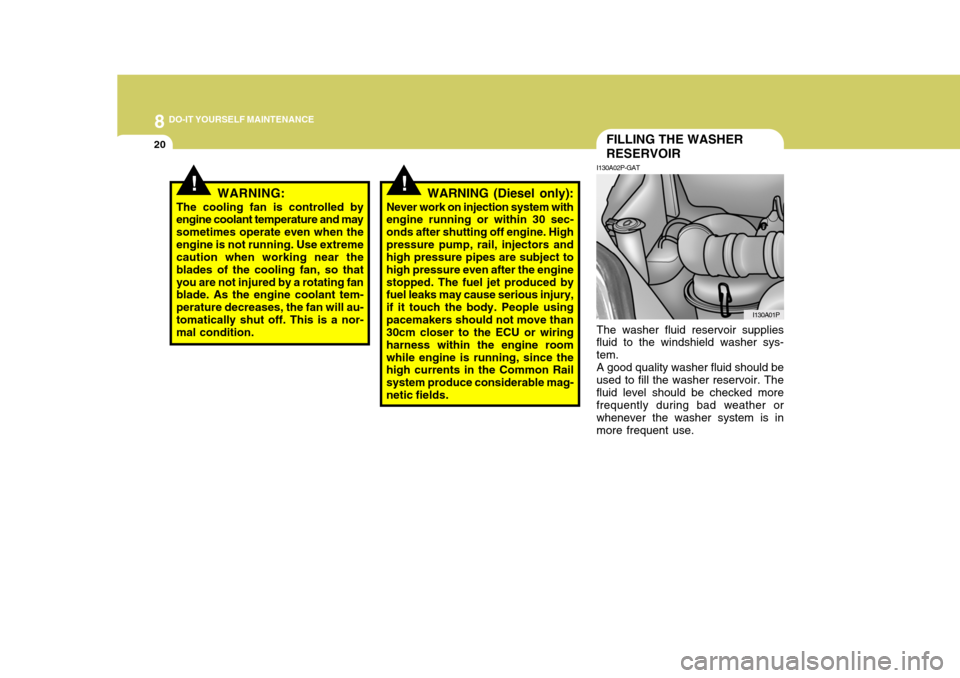
FILLING THE WASHER RESERVOIR
I130A02P-GAT The washer fluid reservoir supplies
fluid to the windshield washer sys- tem.
A good quality washer fluid should be
used to fill the washer reservoir. Thefluid level should be checked more frequently during bad weather or whenever the washer system is inmore frequent use.
!WARNING (Diesel only):
Never work on injection system with engine running or within 30 sec- onds after shutting off engine. Highpressure pump, rail, injectors and high pressure pipes are subject to high pressure even after the enginestopped. The fuel jet produced by fuel leaks may cause serious injury, if it touch the body. People usingpacemakers should not move than 30cm closer to the ECU or wiring harness within the engine roomwhile engine is running, since the high currents in the Common Rail system produce considerable mag-netic fields. I130A01P
Page 279 of 284

10
INDEX
3
D DAY/NIGHT INSIDE REARVIEW MIRROR ................2-34
DEFROSTING/DEFOGGING ......................................2-43
DIGITAL CLOCK ........................................................ 2-37
DOOR LOCKS ............................................................ 1-13
DRINK HOLDER ......................................................... 2-35
DRIVING FOR ECONOMY .........................................3-26
DRIVING WITH ELECTRONIC DUAL-RANGE AUTOMATIC TRANSMISSION ...............................3-14
EEMISSION CONTROL SYSTEM ................................. 7-2
ENGINE ....................................................................... 9-3
ENGINE COMPARTMENT . ......................................... 8-2
ENGINE COOLANT .................................................... 8-10
ENGINE COOLANT TEMPERATURE GAUGE ..........2-12
ENGINE EXHAUST CAN BE DANGEROUS! ............. 3-2
ENGINE NUMBER ...................................................... 1-6
ENGINE OIL ................................................................ 8-7ENGINE RPM ADJUSTMENT KNOB ........................2-24
EXPLANATION OF SCHEDULED
MAINTENANCE ITEMS .............. ...........................6-12
FFOUR-WHEEL DRIVE (4WD) .....................................3-16
FRONT DOOR EDGE WARNING LIGHT ................... 2-25
FRONT DOOR WINDOW GLASS ..............................1-28FRONT FOG LI
GHT SWITCH .................................... 2-25
FRONT/REAR WINDOW DEFROSTER SWITCH ......2-26
FUEL GAUGE ............................................................ 2-12
FUEL RECOMMENDATIONS ...................................... 1-2
FUEL TANK CAPACITY .............................................. 9-2
FUSE PANEL DESC RIPTION .................................... 4-40
GGENERAL CHECKS .................................................... 8-6
GOOD BRAKING PRAC TICE .................................... 3-23
HHAZARD WARNING SYSTEM ................................... 2-26
HEADLIGHT AIMING ADJUSTMENT ........................ 4-29
HEADLIGHT LEVELING DEVICE SYSTEM ..............2-23
HEADREST ................................................................ 1-39
HEATING AND COOLING CONTROL ........................2-38
HEATING CONTROLS ............................................... 2-42
HEIGHT ADJUSTABLE FRONT SEAT SHOULDER BELT ....................................................................... 1-43
HIGH-MOUNTED REAR STOP LIGHT .......................2-25
HOLD OPEN LOCK SYSTEM .................................... 1-14
HOOD RELEASE ....................................................... 1-25
HORN ......................................................................... 2-37