transmission oil Hyundai H-1 (Grand Starex) 2009 Owner's Manual - RHD (UK, Australia)
[x] Cancel search | Manufacturer: HYUNDAI, Model Year: 2009, Model line: H-1 (Grand Starex), Model: Hyundai H-1 (Grand Starex) 2009Pages: 303, PDF Size: 31.48 MB
Page 10 of 303
Your vehicle at a glance
4
2
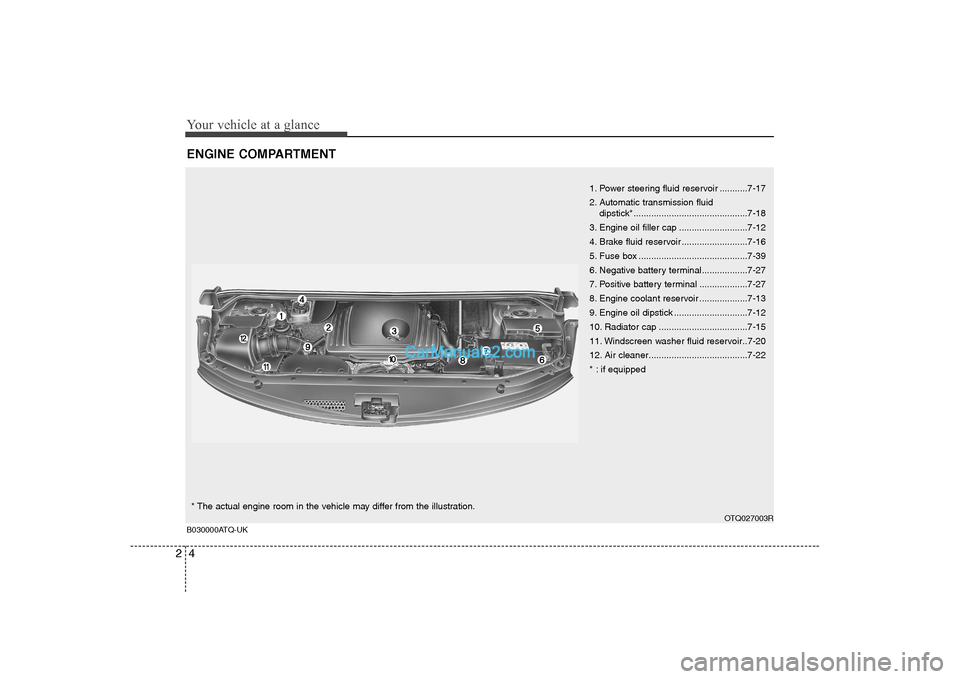
ENGINE COMPARTMENT
1. Power steering fluid reservoir ...........7-17
2. Automatic transmission fluid
dipstick*.............................................7-18
3. Engine oil filler cap ...........................7-12
4. Brake fluid reservoir ..........................7-16
5. Fuse box ...........................................7-39
6. Negative battery terminal..................7-27
7. Positive battery terminal ...................7-27
8. Engine coolant reservoir ...................7-13
9. Engine oil dipstick .............................7-12
10. Radiator cap ...................................7-15
11. Windscreen washer fluid reservoir..7-20
12. Air cleaner.......................................7-22
* : if equipped
OTQ027003R
B030000ATQ-UK* The actual engine room in the vehicle may differ from the illustration.
Page 198 of 303
Driving your vehicle
44
5
5. Start the vehicle, hold the brakes, shift
to neutral, release the parking brake
and slowly release the brakes until the
trailer chocks absorb the load.
6. Reapply the brakes, reapply the park- ing brake and shift the vehicle to R
(Reverse) for manual transmission or
P (Park) automatic transmission.
7. Shut off the vehicle and release the vehicle brakes but leave the parking
brake set.
When you are ready to leave after park-ing on a hill
1. With the manual transmission in Neutral or automatic transmission in P
(Park), apply your brakes and hold the
brake pedal down whilst you:
and
2. Slowly remove your foot from the
brake pedal.
3. Drive slowly until the trailer is clear of the chocks.
4. Stop and have someone pick up and store the chocks.
E140500AUN-UK
Maintenance when trailer towing
Your vehicle will need service more often
when you regularly pull a trailer.
Important items to pay particular atten-tion to include engine oil, automatic
transmission fluid, axle lubricant and
cooling system fluid. Brake condition is
another important item to frequently
check. Each item is covered in this man-
ual, and the Index will help you find them
quickly. If you’re trailering, it’s a good idea
to review these sections before you start
your trip.
Don’t forget to also maintain your trailer
and towbar. Follow the maintenance
schedule that accompanied your trailer
and check it periodically. Preferably, con-
duct the check at the start of each day’s
driving. Most importantly, all towbar nutsand bolts should be tight.
WARNING - Parking brake
It can be dangerous to get out of
your vehicle if the parking brake is
not firmly set.
If you have left the engine running,
the vehicle can move suddenly. You
or others could be seriously or
fatally injured.
CAUTION
Due to higher load during trailer usage, overheating might occurin hot days or during uphill driv- ing. If the coolant gauge indicates
over-heating, switch off the A/C and stop the vehicle in a safe areato cool down the engine.
When towing check transmission fluid more frequently.
If your vehicle is not equipped with the air conditioner, youshould install a condenser fan to improve engine performance
when towing a trailer.
Page 204 of 303
63
What to do in an emergency
3. Passengers must not be allowed toremain inside the vehicle during wheel
changing. If a puncture occurs whilst
the vehicle is on a motorway, the pas-
sengers should take refuge on the
motorway embankment to avoid the
possibility of injury occurring should
the vehicle be struck by other motor-
way traffic.
4. Wheel changing should be performed according to the following instructions.
F020300AEN-UK If engine stalls whilst driving
1. Reduce your speed gradually, keeping a straight line. Move cautiously off the
road to a safe place.
2. Turn on your emergency flashers.
3. Try to start the engine again. If your vehicle will not start, contact a
HYUNDAI authorised repairer or seek
other qualified assistance. F030100AUN-UK If engine cannot be cranked
1. If your car has an automatic transmis-
sion, be sure the gear selector lever is
in N (Neutral) or P (Park) and the
emergency brake is set.
2. Check the battery terminals and con- nections to ensure that these are cleanand also tight.
3. If the ignition warning lights dim when the engine is cranked and the battery
terminals have been checked, a dis-
charged battery is indicated.
4. Do not attempt to push or tow start the vehicle, refer to "Jump Starting" for
information regarding engine starting
when the battery is discharged.
F030200AEN-UK
If engine turns over normally but
does not start
1. Check fuel level.
2. With the ignition switch in the LOCKposition, check all connectors at the
ignition coils and spark plugs.
Reconnect any that may be discon-
nected or loose.
3. Check the fuel line in the engine com- partment.
4. If the engine still does not start, call a HYUNDAI authorised repairer or seek
other qualified assistance.
IF THE ENGINE WILL NOT START
WARNING
If the engine refuses to start, no attempt should be made to push or
tow start the vehicle. Vehicles withautomatic transmission or fuel
injection will not be able to be start-ed in this manner since no drive is
transmitted through the automatictransmission whilst the engine is
not running, and in the case of fuel
injected derivatives, the fuel pump
will not operate under tow start
conditions. In addition, if the vehi-
cle is equipped with an exhaust cat-
alyst, damage to the catalyst may
result if the vehicle is tow started.
Page 207 of 303
What to do in an emergency
6
6
IF THE ENGINE OVERHEATS
F050000AFD-UK
If your temperature gauge indicates over-
heating, you experience a loss of power,
or hear loud pinging or knocking, the
engine is probably too hot. If this hap-
pens, you should:
1. Pull off the road and stop as soon as it is safe to do so.
2. Place the gear selector lever in P (automatic transmission) or neutral
(manual transmission) and set the
parking brake. If the air conditioning is
on, turn it off.
3. If engine coolant is running out under the car or steam is coming out from
the bonnet, stop the engine. Do notopen the bonnet until the coolant has
stopped running or the steaming has
stopped. If there is no visible loss of
engine coolant and no steam, leave
the engine running and check to be
sure the engine cooling fan is operat-
ing. If the fan is not running, turn the
engine off.
4. Check to see if the water pump drive belt is missing. If it is not missing,
check to see that it is tight. If the drive
belt seems to be satisfactory, check
for coolant leaking from the radiator,
hoses or under the car. (If the air con-
ditioning had been in use, it is normal
for cold water to be draining from it
when you stop). 5. If the water pump drive belt is broken
or engine coolant is leaking out, stop the engine immediately and call the
nearest HYUNDAI authorised repairer
for assistance. 6. If the cause of the overheating cannot
be found, wait until the engine temper-
ature has returned to normal. Then, ifcoolant has been lost, carefully add
coolant to the reservoir to bring the
fluid level in the reservoir up to the
base of the radiator fill opening. Fill the
coolant expansion tank to the halfway
mark. To ensure the correct water to
coolant mix is obtained after top up,
testing by an authorised repairer isrequired.
7. Proceed with caution until it is estab- lished that the engine is operating nor-
mally. If the engine overheats repeat-
edly, the advice of a HYUNDAI autho-
rised repairer should be sought.
CAUTION
Serious loss of coolant indicates
there is a leak in the cooling systemand this should be checked as soonas possible by a HYUNDAI autho- rised repairer.
WARNING
Whilst the engine is running, keep
hair, hands and clothing away from
moving parts such as the fan and
drive belts to prevent injury.
WARNING
Do not remove the radiator cap when the engine is hot since steam
and boiling water may be ejected
from the radiator resulting in burnsor scalding.
Page 220 of 303
7
Engine compartment / 7-2 Maintenance services / 7-4
Owner maintenance / 7-6Scheduled maintenance service / 7-8Explanation of scheduled maintenance items / 7-9Engine oil / 7-12Engine coolant / 7-13Brake and clutch fluid / 7-16
Power steering fluid / 7-17Automatic transmission fluid / 7-18
Washer fluid / 7-20Parking brake / 7-20
Fuel filter / 7-21
Air cleaner / 7-22
Climate control air filter / 7-23
Wiper blades / 7-25Battery / 7-27
Tyres and wheels / 7-30 Fuses / 7-39Light bulbs / 7-49
Appearance care / 7-56
Emission control system / 7-62
Maintenance
Page 221 of 303
Maintenance
2
7
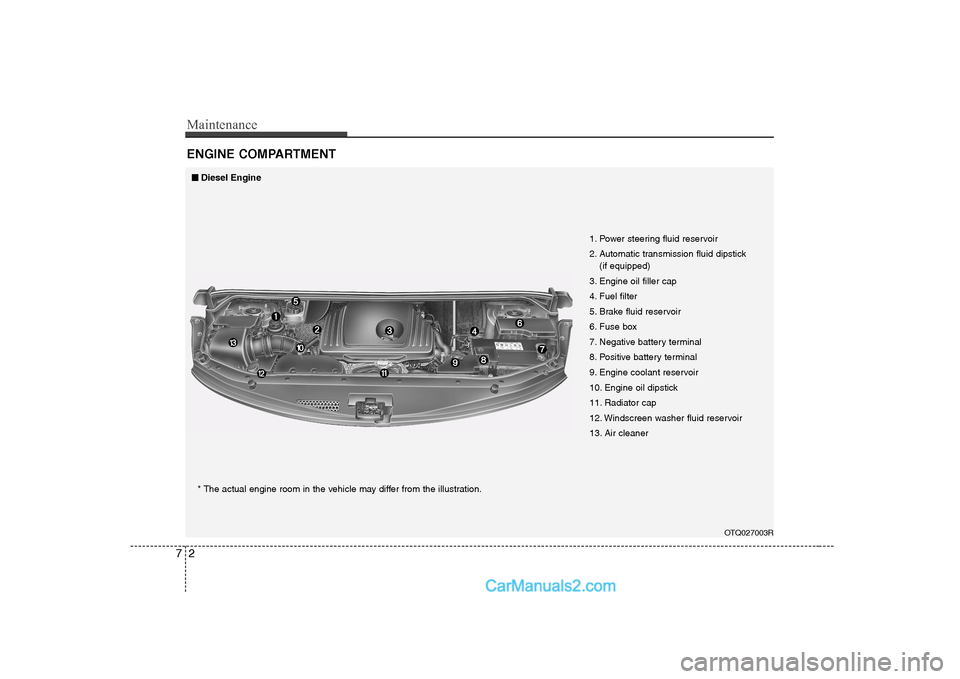
ENGINE COMPARTMENT
OTQ027003R
1. Power steering fluid reservoir
2. Automatic transmission fluid dipstick
(if equipped)
3. Engine oil filler cap
4. Fuel filter
5. Brake fluid reservoir
6. Fuse box
7. Negative battery terminal
8. Positive battery terminal
9. Engine coolant reservoir
10. Engine oil dipstick
11. Radiator cap
12. Windscreen washer fluid reservoir
13. Air cleaner
* The actual engine room in the vehicle may differ from the illustration.
■
■
Diesel Engine
Page 222 of 303
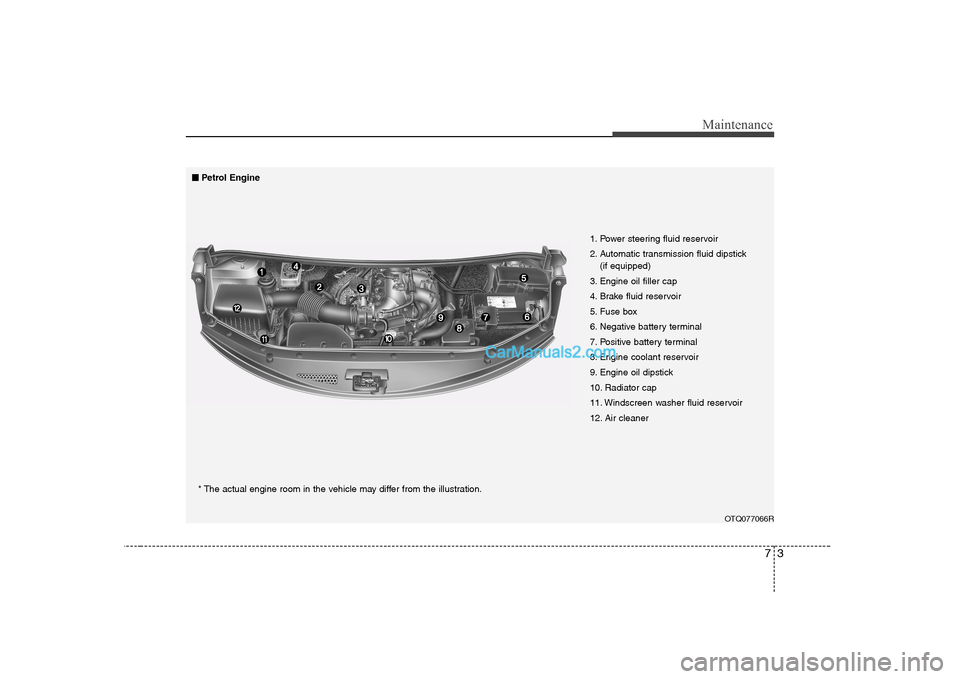
73
Maintenance
OTQ077066R
1. Power steering fluid reservoir
2. Automatic transmission fluid dipstick
(if equipped)
3. Engine oil filler cap
4. Brake fluid reservoir
5. Fuse box
6. Negative battery terminal
7. Positive battery terminal
8. Engine coolant reservoir
9. Engine oil dipstick
10. Radiator cap
11. Windscreen washer fluid reservoir
12. Air cleaner
■
■
Petrol Engine
* The actual engine room in the vehicle may differ from the illustration.
Page 225 of 303
Maintenance
6
7
OWNER MAINTENANCE
G030000AEN-UK
The following lists are vehicle checks and
inspections that should be performed by
the owner or a HYUNDAI authorisedrepairer at the frequencies indicated to
help ensure safe, dependable operation
of your vehicle.
Any adverse conditions should be
brought to the attention of your dealer as
soon as possible.
These Owner Maintenance Checks are
generally not covered by warranties and
you may be charged for labour, parts and
lubricants used. Owner maintenance schedule
G030101AUN-UK
When you stop for fuel:
Check the engine oil level.
Check coolant level in coolant reser-
voir.
Check the windscreen washer fluid level.
Look for low or under-inflated tyres. G030102AUN-UK
Whilst operating your vehicle:
Note any changes in the sound of the
exhaust or any smell of exhaust fumes
in the vehicle.
Check for vibrations in the steering wheel. Notice any increased steering
effort or looseness in the steering
wheel, or change in its straight-aheadposition.
Notice if your vehicle constantly turns slightly or “pulls” to one side when trav-
elling on smooth, level road.
When stopping, listen and check for unusual sounds, pulling to one side,
increased brake pedal travel or “hard-
to-push” brake pedal.
If any slipping or changes in the oper- ation of your transmission occurs,
check the transmission fluid level.
Check automatic transmission P (Park) function.
Check parking brake.
Check for fluid leaks under your vehicle (water dripping from the air condition-
ing system during or after use is nor-mal).
WARNING
Be careful when checking your
engine coolant level when the
engine is hot. Scalding hot coolant
and steam may blow out under
pressure. This could cause burns
or other serious injury.
Page 238 of 303
719
Maintenance
✽✽NOTICE
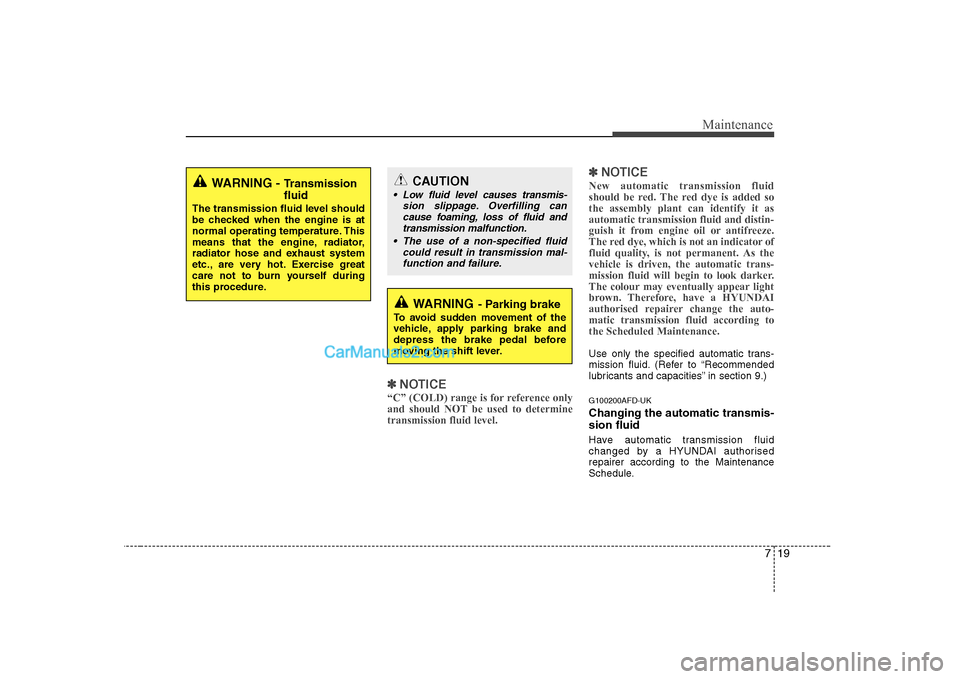
“C” (COLD) range is for reference only
and should NOT be used to determinetransmission fluid level. ✽
✽
NOTICE
New automatic transmission fluid
should be red. The red dye is added sothe assembly plant can identify it asautomatic transmission fluid and distin-
guish it from engine oil or antifreeze.
The red dye, which is not an indicator of
fluid quality, is not permanent. As thevehicle is driven, the automatic trans-
mission fluid will begin to look darker.
The colour may eventually appear light
brown. Therefore, have a HYUNDAI
authorised repairer change the auto-matic transmission fluid according tothe Scheduled Maintenance.
Use only the specified automatic trans-
mission fluid. (Refer to “Recommended
lubricants and capacities” in section 9.) G100200AFD-UK Changing the automatic transmis- sion fluid
Have automatic transmission fluid
changed by a HYUNDAI authorisedrepairer according to the Maintenance
Schedule.
WARNING - Transmission fluid
The transmission fluid level should
be checked when the engine is at
normal operating temperature. This
means that the engine, radiator,
radiator hose and exhaust system
etc., are very hot. Exercise great
care not to burn yourself during
this procedure.
WARNING - Parking brake
To avoid sudden movement of the
vehicle, apply parking brake and
depress the brake pedal before
moving the shift lever.
CAUTION
Low fluid level causes transmis- sion slippage. Overfilling cancause foaming, loss of fluid and transmission malfunction.
The use of a non-specified fluid could result in transmission mal-function and failure.
Page 290 of 303
Specifications
4
9
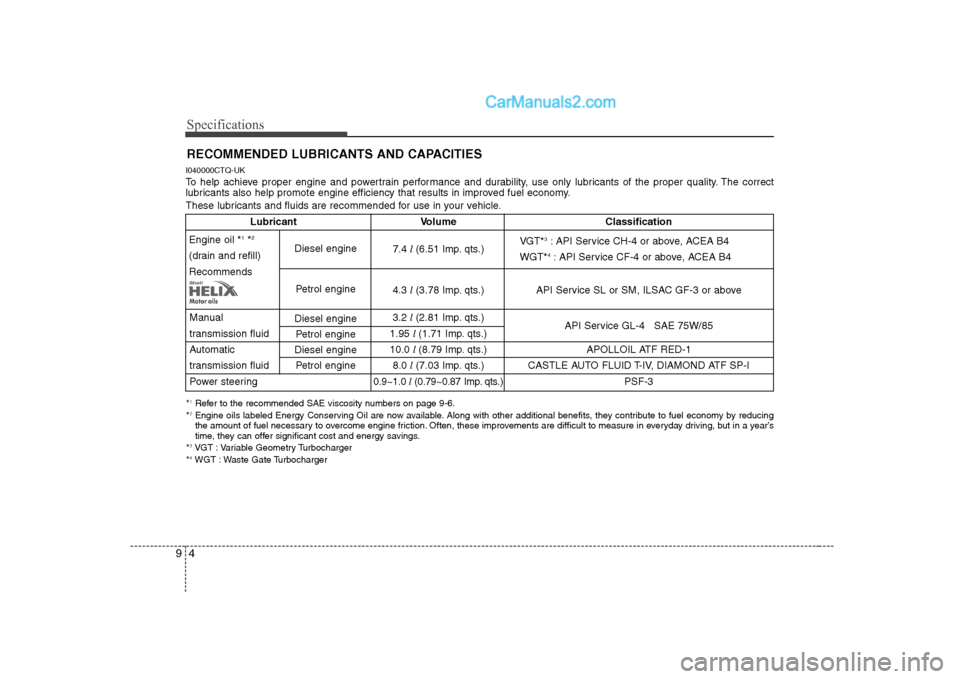
RECOMMENDED LUBRICANTS AND CAPACITIES
I040000CTQ-UK
To help achieve proper engine and powertrain performance and durability, use only lubricants of the proper quality. The correct
lubricants also help promote engine efficiency that results in improved fuel economy.
These lubricants and fluids are recommended for use in your vehicle.
* 1
Refer to the recommended SAE viscosity numbers on page 9-6.
* 2
Engine oils labeled Energy Conserving Oil are now available. Along with other additional benefits, they contribute to fuel econo my by reducing
the amount of fuel necessary to overcome engine friction. Often, these improvements are difficult to measure in everyday driving, but in a year’s
time, they can offer significant cost and energy savings.
* 3
VGT : Variable Geometry Turbocharger
* 4
WGT : Waste Gate Turbocharger
Lubricant Volume Classification
7.4 l (6.51 Imp. qts.)
4.3 l (3.78 Imp. qts.) API Service SL or SM, ILSAC GF-3 or above
Manual 3.2 l (2.81 Imp. qts.)
API Service GL-4 SAE 75W/85
transmission fluid 1.95 l (1.71 Imp. qts.)
Automatic 10.0 l (8.79 Imp. qts.) APOLLOIL ATF RED-1
transmission fluid 8.0 l (7.03 Imp. qts.) CASTLE AUTO FLUID T-IV, DIAMOND ATF SP-I
Power steering
0.9~1.0 l (0.79~0.87 Imp. qts.)PSF-3
Engine oil * 1
*2
(drain and refill) Recommends
Diesel enginePetrol engine
Diesel engine
Petrol engine
Diesel engine
Petrol engineVGT* 3
: API Service CH-4 or above, ACEA B4
WGT* 4
: API Service CF-4 or above, ACEA B4