boot Hyundai H-100 Truck 2012 Owner's Manual
[x] Cancel search | Manufacturer: HYUNDAI, Model Year: 2012, Model line: H-100 Truck, Model: Hyundai H-100 Truck 2012Pages: 217, PDF Size: 9.37 MB
Page 99 of 217
2
DRIVING YOUR HYUNDAI
3
!
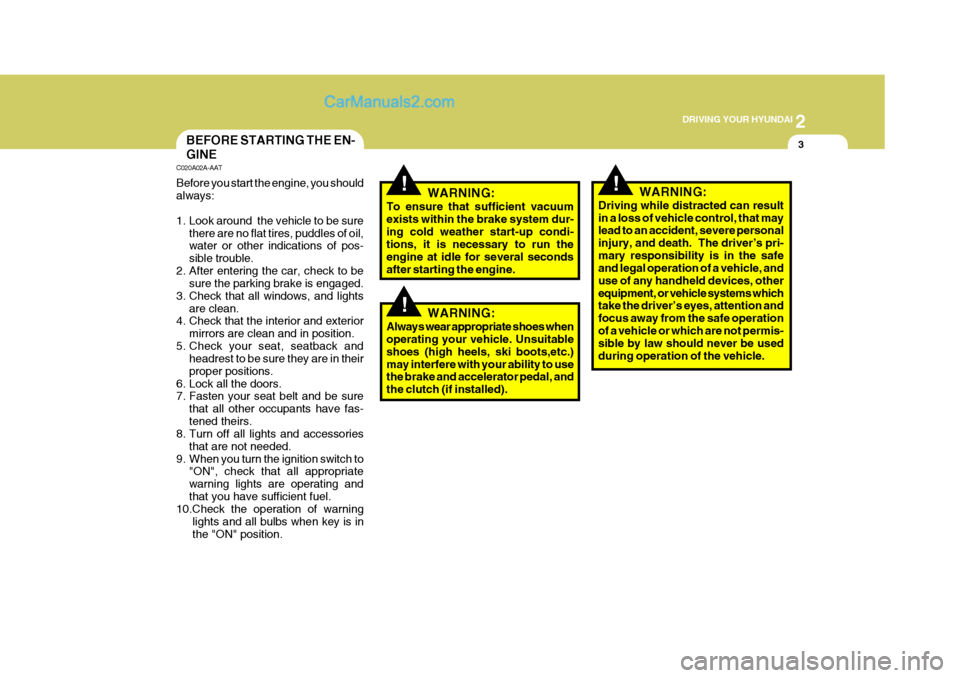
BEFORE STARTING THE EN- GINE
C020A02A-AAT Before you start the engine, you should always:
1. Look around the vehicle to be sure
there are no flat tires, puddles of oil, water or other indications of pos- sible trouble.
2. After entering the car, check to be sure the parking brake is engaged.
3. Check that all windows, and lights are clean.
4. Check that the interior and exterior
mirrors are clean and in position.
5. Check your seat, seatback and headrest to be sure they are in theirproper positions.
6. Lock all the doors.
7. Fasten your seat belt and be sure
that all other occupants have fas- tened theirs.
8. Turn off all lights and accessories
that are not needed.
9. When you turn the ignition switch to "ON", check that all appropriatewarning lights are operating andthat you have sufficient fuel.
10.Check the operation of warning
lights and all bulbs when key is inthe "ON" position.
!WARNING:
To ensure that sufficient vacuum exists within the brake system dur-ing cold weather start-up condi- tions, it is necessary to run the engine at idle for several secondsafter starting the engine.
WARNING:
Always wear appropriate shoes when operating your vehicle. Unsuitable shoes (high heels, ski boots,etc.)may interfere with your ability to use the brake and accelerator pedal, and the clutch (if installed).!WARNING:
Driving while distracted can result in a loss of vehicle control, that may lead to an accident, severe personal
injury, and death. The driver’s pri-mary responsibility is in the safe and legal operation of a vehicle, and use of any handheld devices, otherequipment, or vehicle systems which take the driver’s eyes, attention and focus away from the safe operationof a vehicle or which are not permis- sible by law should never be used during operation of the vehicle.
Page 138 of 217
4
CORROSION PREVENTION AND APPEARANCE CARE
5
4
CORROSION PREVENTION AND APPEARANCE CARE
5
E030D01A-AAT When to Wax Again You should polish and wax the car again when water no longer beads ona clean surface but spreads out over a larger area. E030E01A-AAT Maintaining Bumpers Special precautions must be observed to preserve the appearance of the bumpers on your Hyundai. They are:
o Be careful not to spill battery elec- trolyte or hydraulic brake fluid on the bumpers. If you do, wash it off im- mediately with clear water.
o Be gentle when cleaning the bumper surfaces. They are made of softplastic and the surface can be dam- aged if mistreated. Do not use abra-sive cleaners. Use warm water and mild soap or car-washing solution.
o Do not expose the bumpers to high temperatures. For example, if youhave your car repainted, do not leave the bumpers on the car if thecar is going to be placed in a high- temperature paint booth.
E030B01A-AAT Spot Cleaning Don't use gasoline, strong solvents or corrosive cleaning agents. These candamage the finish of the car. To re- move road tar, use turpentine on a clean, soft cloth or commercially avail-able bug and tar remover. Be gentle. To remove dead insects or tree sap, use warm water and mild soap or car- washing solution. Soak the spot and rub gently. If the paint has lost itsluster, use a commercial car-cleaning polish.
E030C01A-AAT Polishing and Waxing Always wash and dry the car before polishing or waxing or using a combi-nation cleaner and wax. Use a good quality commercial product and follow the manufacturer's directions on thecontainer. Polish and wax the bright trim pieces as well as the paint.CLEANING THE INTERIOR
E040A01A-AAT To Clean the Vinyl Upholstery To clean the vinyl upholstery, first re- move loose dirt and dust with a vacuumcleaner. Then apply a solution of mild soap or detergent and water using a clean sponge or soft cloth. Allow this tostay on the surface to loosen the dirt, then wipe with a clean damp sponge or cloth. If all the dirt stains are not re-moved, repeat this procedure until the upholstery is clean. Do not use gaso- line, solvent, paint thinner or otherstrong cleaners. E040B01HR-AAT To Clean the Leather Upholstery
CAUTION:
When cleaning leather products (steering wheel, seats etc.), use neu- tral detergents or low alcohol con- tent solutions. If you use high alco-hol content solutions or acid/alka- line detergents, the color of the leather may fade or the surface may getstripped off.
!
o To prevent damage to the plastic
parts and lamps, do not clean with chemical solvents or strong deter- gents.
Page 147 of 217
5VEHICLE MAINTENANCE REQUIREMENTS
8
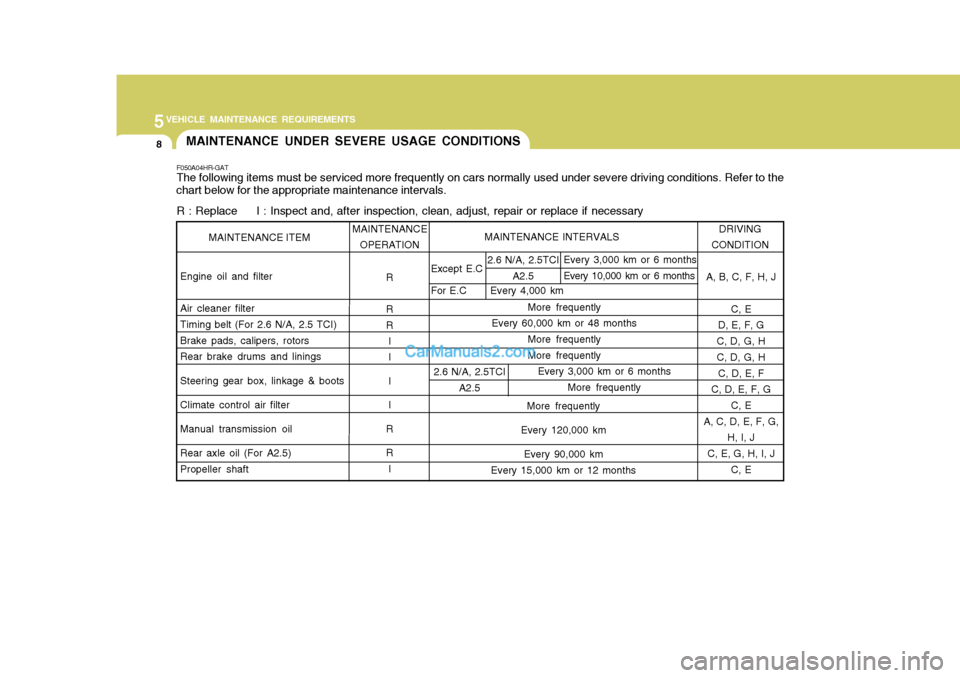
F050A04HR-GAT The following items must be serviced more frequently on cars normally used under severe driving conditions. Refer to the
chart below for the appropriate maintenance intervals.
R : Replace I : Inspect and, after inspection, clean, adjust, repair or replace if necessary MAINTENANCE UNDER SEVERE USAGE CONDITIONS
A, B, C, F, H, JC, E
D, E, F, G
C, D, G, H C, D, G, H C, D, E, F
C, D, E, F, G
C, E
A, C, D, E, F, G, H, I, J
C, E, G, H, I, J
C, E
Except E.C
Engine oil and filter Air cleaner filter Timing belt (For 2.6 N/A, 2.5 TCI) Brake pads, calipers, rotors Rear brake drums and linings Steering gear box, linkage & boots Climate control air filterManual transmission oilRear axle oil (For A2.5) Propeller shaft
MAINTENANCE ITEMMAINTENANCE INTERVALS DRIVING
CONDITION
MAINTENANCE
OPERATION
For E.C Every 3,000 km or 6 months Every 10,000 km or 6 months
2.6 N/A, 2.5TCI
A2.5Every 4,000 km
R R R
II I I
RR I 2.6 N/A, 2.5TCI
A2.5
Every 3,000 km or 6 months More frequently
More frequently
Every 60,000 km or 48 months
More frequently More frequently
More frequently
Every 120,000 km Every 90,000 km
Every 15,000 km or 12 months
Page 151 of 217
5VEHICLE MAINTENANCE REQUIREMENTS
12
F070F01A-AAT
o Brake Hoses and Lines Visually check for proper installation, chafing, cracks, deterioration and any leakage. Replace any deteriorated or damaged parts immediately. F070G02A-GAT
o Brake Fluid Check brake fluid level in the brake fluid reservoir. The level should be between "MIN" and "MAX" marks on the side of the reservoir. Use only hydraulic brake fluid conforming to DOT3 or DOT 4.
F070L01A-AAT
o Suspension Mounting Bolts
Check the suspension connections for
looseness or damage. Retighten to thespecified torque. F070M01A-AAT
o Steering Gear Box, Linkage &
Boots/Lower arm Ball Joint
With the vehicle stopped and engine
off, check for excessive free-play in the steering wheel. Check the linkage for bends or damage. Check the dustboots and ball joints for deterioration, cracks, or damage. Replace any dam- aged parts.
F070N01A-AAT
o Power Steering Pump, Belt
and Hoses
Check the power steering pump and
hoses for leakage and damage. Re-place any damaged or leaking parts immediately. Inspect the power steer- ing belt for evidence of cuts, cracks,excessive wear, oiliness and proper tension. Replace or adjust it if neces- sary.
F070J01A-AAT
o Brake Pads, Calipers and
Rotors
Check the pads for excessive wear,
discs for run out and wear, and cali- pers for fluid leakage.
F070K01A-AAT
o Exhaust Pipe and Muffler
Visually inspect the exhaust pipes,
muffler and hangers for cracks, dete-rioration, or damage. Start the engine and listen carefully for any exhaustgas leakage. Tighten connections or replace parts as necessary.
F070H01A-AAT
o Rear Brake Drums/Linings
Parking Brake
Check the rear brake drums and lin-
ings for scoring, burning, leaking fluid, broken parts, and excessive wear. Inspect the parking brake system in- cluding the parking brake lever andcables. For detailed service proce- dures, refer to the Shop Manual.