ECU Hyundai H350 2015 User Guide
[x] Cancel search | Manufacturer: HYUNDAI, Model Year: 2015, Model line: H350, Model: Hyundai H350 2015Pages: 473, PDF Size: 26.4 MB
Page 94 of 473
3-32
Convenient features of your vehicle
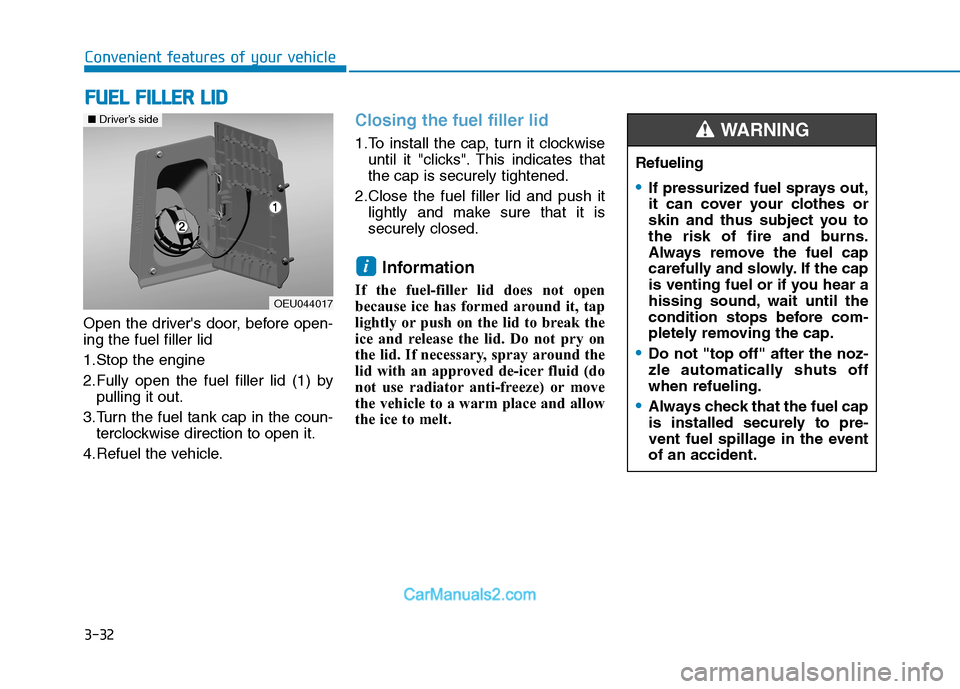
Open the driver's door, before open- ing the fuel filler lid
1.Stop the engine
2.Fully open the fuel filler lid (1) bypulling it out.
3.Turn the fuel tank cap in the coun- terclockwise direction to open it.
4.Refuel the vehicle.
Closing the fuel filler lid
1.To install the cap, turn it clockwise until it "clicks". This indicates that the cap is securely tightened.
2.Close the fuel filler lid and push it lightly and make sure that it issecurely closed.
Information
If the fuel-filler lid does not open
because ice has formed around it, tap
lightly or push on the lid to break the
ice and release the lid. Do not pry on
the lid. If necessary, spray around the
lid with an approved de-icer fluid (do
not use radiator anti-freeze) or move
the vehicle to a warm place and allow
the ice to melt.
i
FF UU EELL FF IILL LLEE RR LL IIDD
OEU044017
■Driver’s side
Refueling
If pressurized fuel sprays out,
it can cover your clothes or
skin and thus subject you to
the risk of fire and burns.
Always remove the fuel cap
carefully and slowly. If the cap
is venting fuel or if you hear a
hissing sound, wait until the
condition stops before com-
pletely removing the cap.
Do not "top off" after the noz-
zle automatically shuts offwhen refueling.
Always check that the fuel cap
is installed securely to pre-
vent fuel spillage in the eventof an accident.
WARNING
Page 95 of 473
3-33
Convenient features of your vehicle
3
Refueling dangers
Automotive fuels are flammable
materials. When refueling,
please note the following guide-
lines carefully. Failure to follow
these guidelines may result in
severe personal injury, severe
burns or death by fire or explo-sion.
Read and follow all warning posted at the gas station facil-
ity.
Before touching the fuel noz-
zle, you should eliminate
potentially dangerous static
electricity discharge by touch-
ing another metal part of the
vehicle, a safe distance away
from the fuel filler neck, noz-
zle, or other gas source.(Continued)
WARNING (Continued)
Do not get back into a vehicle
once you have begun refuel-
ing since you can generate
static electricity by touching,
rubbing or sliding against any
item or fabric (polyester, satin,
nylon, etc.) capable of produc-
ing static electricity. Static
electricity discharge can
ignite fuel vapors resulting in
rapid burning. If you must re-
enter the vehicle, you should
once again eliminate poten-
tially dangerous static elec-
tricity discharge by touching a
metal part of the vehicle, away
from the fuel filler neck, noz-
zle or other diesel source.
When using an approved
portable fuel container, besure to place the container on
the ground prior to refueling.(Continued)
(Continued)
Static electricity discharge
from the container can ignite
fuel vapors causing a fire.Once refueling has begun,
contact with the vehicleshould be maintained until the
filling is complete.
Use only portable plastic fuel
containers designed to carryand store diesel.
Do not use cellular phones
while refueling. Electric cur-
rent and/or electronic interfer-
ence from cellular phones can
potentially ignite fuel vapors
causing a fire.
When refueling, always shut
the engine off. Sparks pro-
duced by electrical compo-nents related to the engine
can ignite fuel vapors causing
a fire. Once refueling is com-
plete, check to make sure thefiller cap and filler door are
securely closed, before start-
ing the engine. (Continued)
Page 96 of 473
3-34
Convenient features of your vehicle
Make sure to refuel your vehicleaccording to the "Fuel require-
ments" suggested in section 1.
If the fuel filler cap requires replacement, we recommend
that you use parts for replace-
ment from an authorized
HYUNDAI dealer. An incorrectfuel filler cap can result in a seri-ous malfunction of the fuel sys-
tem or emission control system.
Do not spill fuel on the exterior surfaces of the vehicle. Any typeof fuel spilled on painted sur-
faces may damage the paint.
After refueling, make sure the fuel cap is installed securely to
prevent fuel spillage in the eventof an accident. The urea level warning lamp illumi-
nates, when the urea solution vol-
ume falls below 12% or less of the
tank. Without adding the urea solu-
tion, when the urea solution volume
drops to 6%, urea level warning lamp
will start blinking. When the urea
solution volume drops 4% or under,
both urea level warning lamp and
urea system warning lamp will simul-
taneously blink with limited torque.
When the urea volume falls below
1%, both lamps will stay blinking sta-
tus with limited vehicle speed.
When the urea level warning lamp
illuminates, the urea solution mustbe added.
NOTICE(Continued)
DO NOT use matches or a
lighter and DO NOT SMOKE or
leave a lit cigarette in your
vehicle while at a gas station
especially during refueling.
Automotive fuel is highly
flammable and can, when
ignited, result in fire.
If a fire breaks out during refu-
eling, leave the vicinity of the
vehicle, and immediately con-
tact the manager of the gasstation and then contact the
local fire department.
UU
RREEAA SS OO LLUU TTIIOO NN FF IILL LLEE RR LL IIDD
OEU044018
■ Passenger’s side
Page 112 of 473
3-50
Convenient features of your vehicle
Main display
MMUULLTT II-- DD IISS PP LLAA YY (( IIFF EE QQ UUIIPP PPEEDD ))
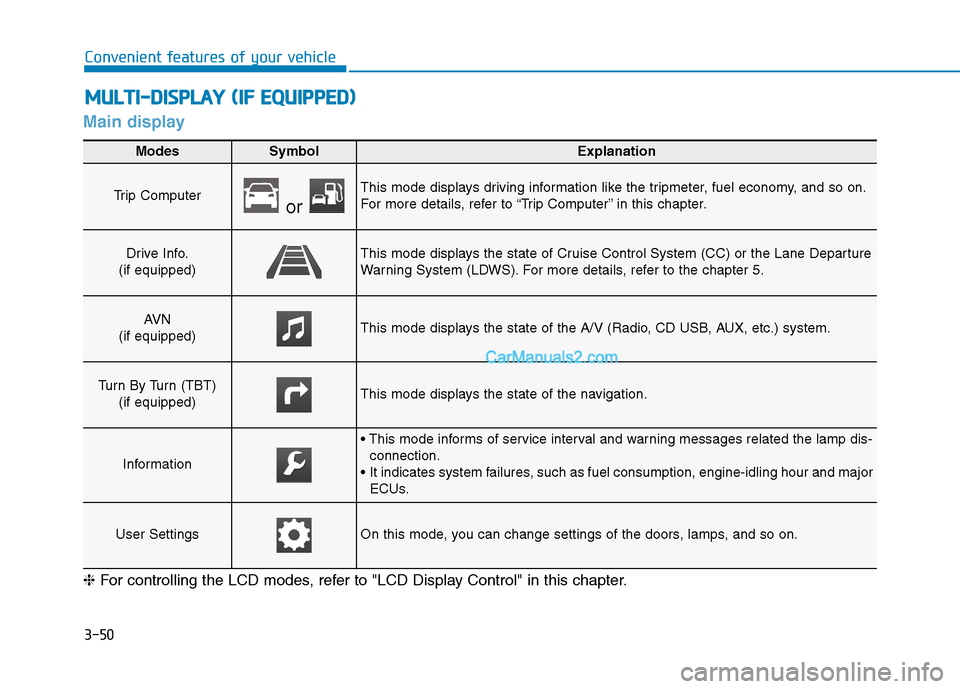
ModesSymbolExplanation
Trip Computer or
This mode displays driving information like the tripmeter, fuel economy, and so on.
For more details, refer to “Trip Computer” in this chapter.
Drive Info.
(if equipped)This mode displays the state of Cruise Control System (CC) or the Lane Departure
Warning System (LDWS). For more details, refer to the chapter 5.
AV N
(if equipped)This mode displays the state of the A/V (Radio, CD USB, AUX, etc.) system.
Turn By Turn (TBT) (if equipped)This mode displays the state of the navigation.
Information
connection.
It indicates system failures, such as fuel consumption, engine-idling hour and major ECUs.
User SettingsOn this mode, you can change settings of the doors, lamps, and so on.
❈ For controlling the LCD modes, refer to "LCD Display Control" in this chapter.
Page 138 of 473
3-76
Convenient features of your vehicle
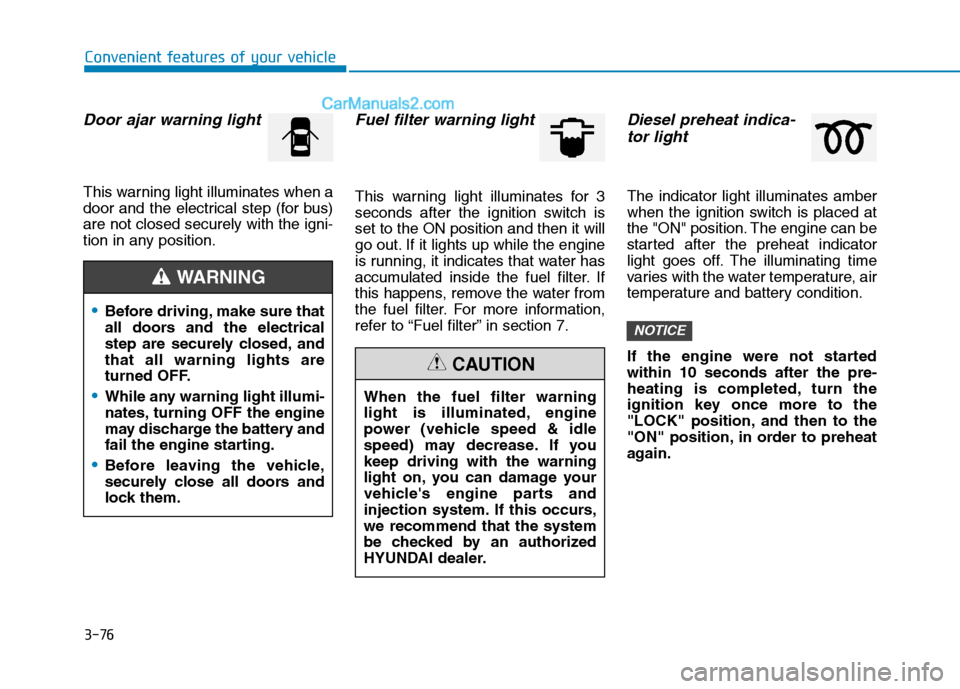
Door ajar warning light
This warning light illuminates when a
door and the electrical step (for bus)are not closed securely with the igni-
tion in any position.
Fuel filter warning light
This warning light illuminates for 3
seconds after the ignition switch isset to the ON position and then it will
go out. If it lights up while the engine
is running, it indicates that water has
accumulated inside the fuel filter. If
this happens, remove the water from
the fuel filter. For more information,
refer to “Fuel filter” in section 7.
Diesel preheat indica-tor light
The indicator light illuminates amber
when the ignition switch is placed at
the "ON" position. The engine can be
started after the preheat indicator
light goes off. The illuminating time
varies with the water temperature, air
temperature and battery condition.
If the engine were not started within 10 seconds after the pre-
heating is completed, turn the
ignition key once more to the
"LOCK" position, and then to the
"ON" position, in order to preheat
again.
NOTICE
When the fuel filter warning
light is illuminated, engine
power (vehicle speed & idle
speed) may decrease. If youkeep driving with the warning
light on, you can damage your
vehicle's engine parts and
injection system. If this occurs,we recommend that the system
be checked by an authorized
HYUNDAI dealer.
CAUTION
Before driving, make sure that
all doors and the electrical
step are securely closed, andthat all warning lights are
turned OFF.
While any warning light illumi-
nates, turning OFF the engine
may discharge the battery and
fail the engine starting.
Before leaving the vehicle,
securely close all doors and
lock them.
WARNING
Page 185 of 473

3-123
Convenient features of your vehicle
3
SSTT OO RRAA GG EE CC OO MM PPAA RRTTMM EENN TT
1. : Indoor air exhaustion
(Air shutter: Open)
2. : Fan non-operation (Air shutter: Close)
3. : Outdoor fresh air inflow to indoor
(Air shutter: Open) These compartments can be used to
store small items required by the
driver or passengers.
To avoid possible theft, do not
leave valuables in the storage
compartment.
Always keep the storage com- partment covers closed while
driving. Do not attempt to place
so many items in the storage
compartment that the storage
compartment cover can not
close securely.
Overhead storage (if equipped)
The storage compartment above the windshield.
The right and left storage space may
be loaded with a maximum of5.5lbs(2.5kg) each.
NOTICE
Flammable materials
Do not store cigarette lighters,
propane cylinders, or other
flammable/explosive materials
in the vehicle. These items may
catch fire and/or explode if the
vehicle is exposed to hot tem-
peratures for extended periods.
WARNING
OEU044063
OEU044057
Page 189 of 473
3-127
Convenient features of your vehicle
3
Ashtray (if equipped)
To use the ashtray, open the cover.
To clean or empty the ashtray, pull it out.
Cup holder
Do not place uncovered cups in
the cup holder while the vehicle is
in motion. If the liquid spills, elec-
tric systems may malfunction.
NOTICEAshtray use
Do not use the vehicle’s ash-
trays as waste receptacles.
Putting lit cigarettes or match-
es in an ashtray with other
combustible materials may
cause a fire.
WARNING
Hot liquids
Do not place uncovered cups of hot liquid in the cup holder
while the vehicle is in motion.
If the hot liquid spills, you
burn yourself. Such a burn tothe driver could lead to loss of
control of the vehicle.
To reduce the risk of personal
injury in the event of sudden
stop or collision, do not place
uncovered or unsecured bot-
tles, glasses, cans, etc., in the
cup holder while the vehicle isin motion.
WARNING Keep cans or bottles out of direct sun light and do not put
them in a vehicle that is heated
up. It may explode.
WARNING
Page 191 of 473
3-129
Convenient features of your vehicle
3
❇There is a cable hole which
enables the use of the power outlet
with the crash-pad console storage
cover being closed. To allow a
cable to pass through the hole,
open the crash-pad console stor-
age, connect to the power outlet,
and fit the cable into the hole
before closing the crash-pad con-
sole storage cover.
Some thick connectors may not
pass from the crash-pad to the
crash-pad console storage cover.
Do not store any volatile or inflam-
mable substance or liquid inside
the crash-pad console storage
while using the power outlet with
the cover closed. The heat gener-
ated by the power outlet may
cause a fire.
Use power outlet only when the engine is running and
remove the accessory plug
after use. Using the accessory
plug for prolonged periods oftime with the engine off could
cause the battery to dis-
charge.
(Continued)
CAUTION
(Continued)
Only use 12V electric acces-
sories which are less than
10A in electric capacity.
Adjust the air-conditioner or
heater to the lowest operating
level when using the poweroutlet.
Close the cover when not in
use.
Some electronic devices can
cause electronic interference
when plugged into a vehicle’s
power outlet. These devices
may cause excessive audiostatic and malfunctions in
other electronic systems or
devices used in your vehicle.
Do not put a finger or a foreign
element (pin, etc.) into a power
outlet and do not touch with a
wet hand. You may get an elec-
tric shock.
WARNING
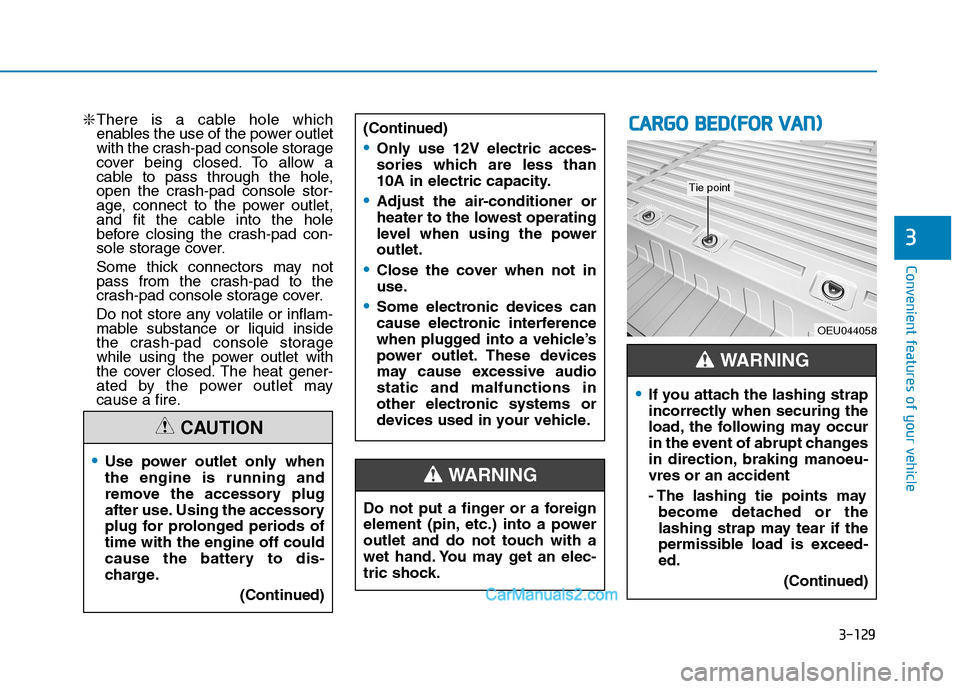
CCAA RRGG OO BB EEDD ((FF OO RR VV AA NN ))
OEU044058
If you attach the lashing strap
incorrectly when securing the
load, the following may occur
in the event of abrupt changes
in direction, braking manoeu-vres or an accident
- The lashing tie points may
become detached or the
lashing strap may tear if the
permissible load is exceed-ed.
(Continued)
WARNING
Tie point
Page 192 of 473
3-130
Convenient features of your vehicle
❈If your vehicle is equipped with
loading rails in the load compart-
ment floor, you can place lashingrods directly in front of and behindthe load.
As the driver, you are respon-
sible for ensuring that:
The applicable requirements and
guidelines relating to load-securing
practices must be met.
If this is not the case, this may con-
stitute a punishable offence,depending on local legislation and
any ensuing consequences.
You should therefore observe the
respective legal requirements for
the relevant country.
- Make sure that the load is securebefore every journey and at regu-
lar intervals during a long journey.
Adjust the load as necessary
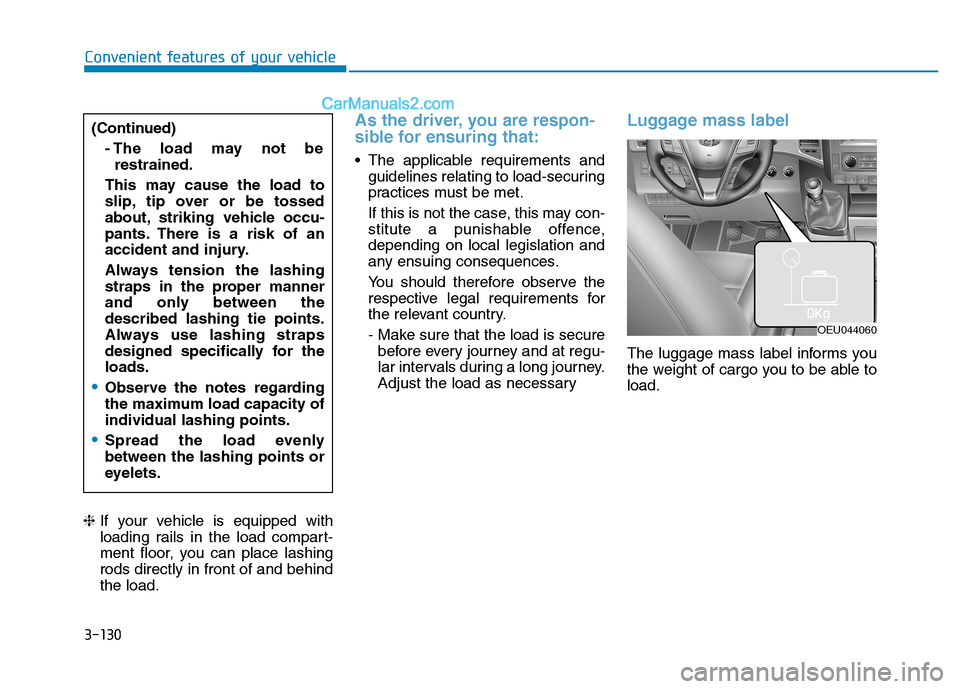
Luggage mass label
The luggage mass label informs you
the weight of cargo you to be able toload.
(Continued)
- The load may not berestrained.
This may cause the load to
slip, tip over or be tossed
about, striking vehicle occu-
pants. There is a risk of an
accident and injury.
Always tension the lashing
straps in the proper manner
and only between thedescribed lashing tie points.
Always use lashing straps
designed specifically for theloads.
Observe the notes regarding
the maximum load capacity ofindividual lashing points.
Spread the load evenly between the lashing points or
eyelets.
OEU044060
Page 291 of 473
5-20
Driving your vehicle
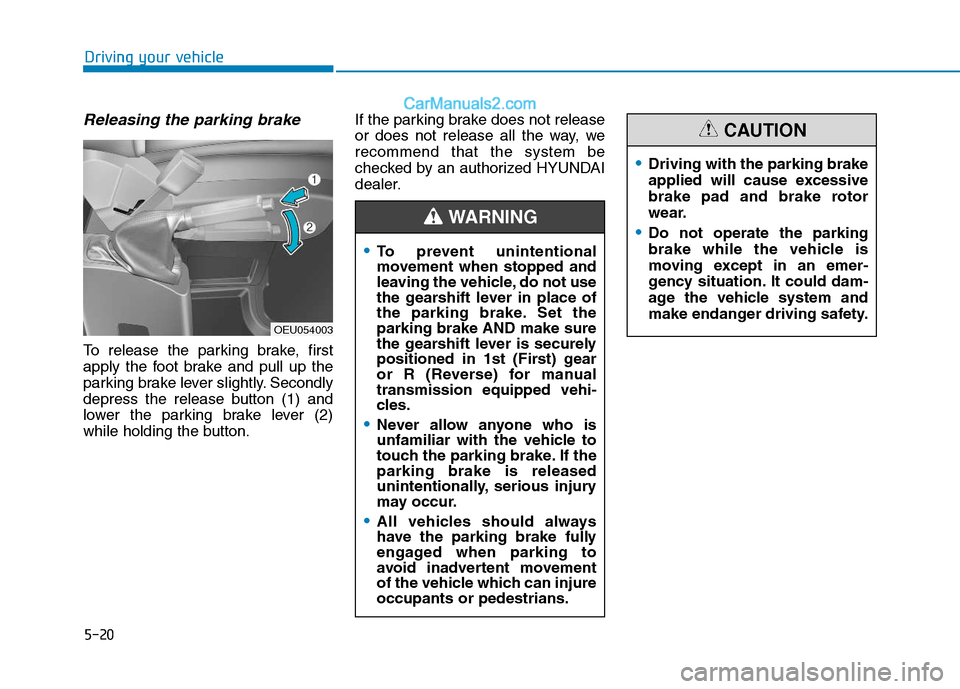
Releasing the parking brake
To release the parking brake, first
apply the foot brake and pull up the
parking brake lever slightly. Secondly
depress the release button (1) and
lower the parking brake lever (2)
while holding the button.If the parking brake does not release
or does not release all the way, werecommend that the system be
checked by an authorized HYUNDAI
dealer.
OEU054003
To prevent unintentional
movement when stopped and
leaving the vehicle, do not use
the gearshift lever in place of
the parking brake. Set theparking brake AND make sure
the gearshift lever is securely
positioned in 1st (First) gear
or R (Reverse) for manualtransmission equipped vehi-
cles.
Never allow anyone who is
unfamiliar with the vehicle to
touch the parking brake. If theparking brake is released
unintentionally, serious injury
may occur.
All vehicles should always
have the parking brake fully
engaged when parking to
avoid inadvertent movement
of the vehicle which can injureoccupants or pedestrians.
WARNING
Driving with the parking brake
applied will cause excessive
brake pad and brake rotor
wear.
Do not operate the parking
brake while the vehicle is
moving except in an emer-
gency situation. It could dam-
age the vehicle system and
make endanger driving safety.
CAUTION