belt Hyundai H350 2015 User Guide
[x] Cancel search | Manufacturer: HYUNDAI, Model Year: 2015, Model line: H350, Model: Hyundai H350 2015Pages: 473, PDF Size: 26.4 MB
Page 38 of 473
2-18
Safety system of your vehicle
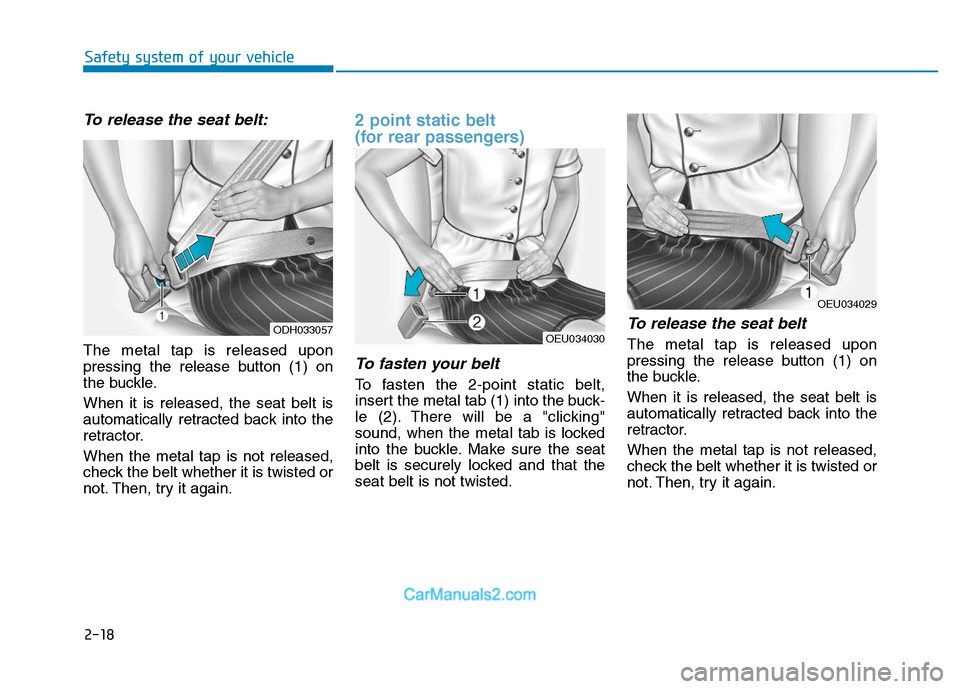
To release the seat belt:
The metal tap is released upon
pressing the release button (1) on
the buckle. When it is released, the seat belt is
automatically retracted back into the
retractor. When the metal tap is not released,
check the belt whether it is twisted or
not. Then, try it again.
2 point static belt
(for rear passengers)
To fasten your belt
To fasten the 2-point static belt,
insert the metal tab (1) into the buck-
le (2). There will be a "clicking"
sound, when the metal tab is locked
into the buckle. Make sure the seat
belt is securely locked and that theseat belt is not twisted.
To release the seat belt
The metal tap is released upon
pressing the release button (1) on
the buckle. When it is released, the seat belt is
automatically retracted back into the
retractor. When the metal tap is not released,
check the belt whether it is twisted or
not. Then, try it again.
ODH033057OEU034030
OEU034029
Page 39 of 473
2-19
Safety system of your vehicle
2
Pregnant women/child
The use of a seat belt is recom-
mended for pregnant women/child to
reduce the risk of injury in an acci-
dent. The lap belt should be fastened
as low and snugly as possible across
the hips, not across the abdomen.
For specific recommendations, con-
sult a physician.
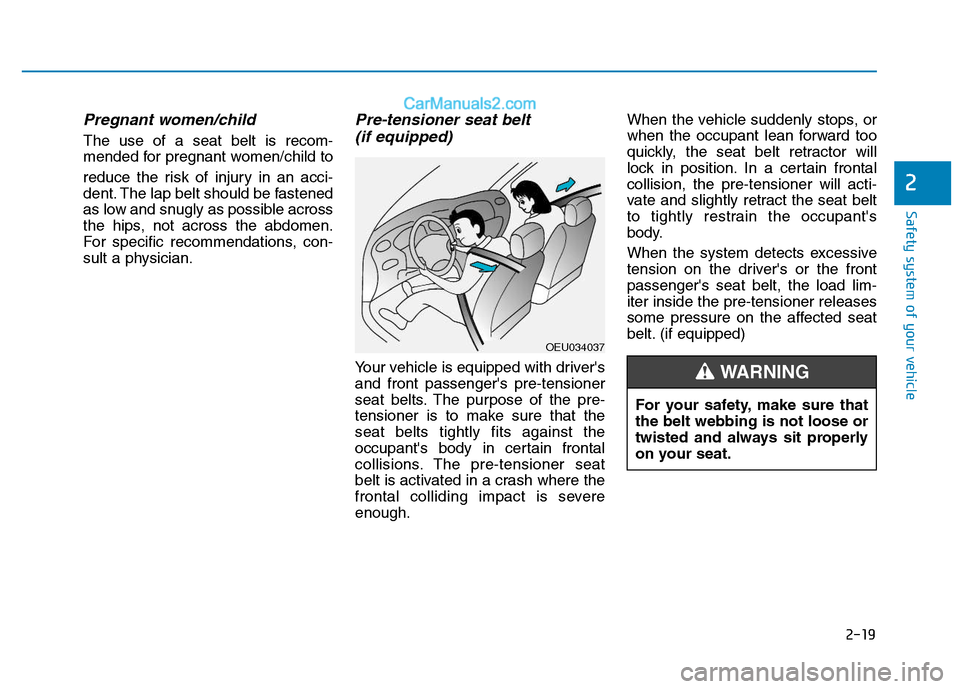
Pre-tensioner seat belt (if equipped)
Your vehicle is equipped with driver'sand front passenger's pre-tensioner
seat belts. The purpose of the pre-
tensioner is to make sure that theseat belts tightly fits against the
occupant's body in certain frontal
collisions. The pre-tensioner seat
belt is activated in a crash where the
frontal colliding impact is severeenough. When the vehicle suddenly stops, or
when the occupant lean forward too
quickly, the seat belt retractor will
lock in position. In a certain frontalcollision, the pre-tensioner will acti-
vate and slightly retract the seat belt
to tightly restrain the occupant's
body.
When the system detects excessive
tension on the driver's or the frontpassenger's seat belt, the load lim-iter inside the pre-tensioner releases
some pressure on the affected seat
belt. (if equipped)
OEU034037
For your safety, make sure that the belt webbing is not loose or
twisted and always sit properly
on your seat.
WARNING
Page 40 of 473
2-20
Safety system of your vehicle
When the pre-tensioner seat beltis activated, there will be a loud
noise and fine dusts. These may
appear to be smoke, and be vis-
ible in the passenger compart-
ment. These are normal operat-
ing conditions, and does not
indicate a problem.
Although they are harmless sub- stances, the fine dusts may
cause skin irritation. These
should not be inhaled for a pro-
longed period of time.
Thoroughly wash all the
exposed skin areas after an
accident, when the pre-tension-
er seat belt was activated.
Because the sensor that acti- vates the SRS air bag is con-nected with the pre-tensioner
seat belt, the SRS air bag warn-
ing light on the instrument clus-
ter will illuminate for approxi-
mately 6 seconds after turning
ON the ignition switch, and then
it goes OFF.
NOTICE
To obtain maximum benefit
from a pre-tensioner seat belt:
1.The seat belt must be proper-ly fastened and adjusted.
Please read and follow all of
the important safety informa-tion and precautions about
your vehicle's occupant safe-
ty features - including seat
belts and air bags - that are
provided in this manual.
2.Make sure you and your pas- sengers always and properlyfasten the seat belts.
WARNING
When the pre-tensioner seat
belt does not properly operate,
the SRS air bag warning light
illuminates even without a mal-
function of the SRS air bag.
When the SRS air bag warninglight does not illuminate after
turning ON the ignition switch,
when it remains ON longer than
6 seconds, or when it remains
ON while driving the vehicle, werecommend that the system be
inspected by an authorized
HYUNDAI dealer.
CAUTION
Page 41 of 473
2-21
Safety system of your vehicle
2
Pre-tensioners are designed
to operate only one time. After
an activation, pre-tensioner
seat belts must be replaced.
All seat belts of any type must
be replaced, when they werefastened during a collision.
The pre-tensioner seat belt
assembly mechanisms beco
-
me hot while being activated.
Do not touch the pre-tension-
er seat belt assembly for sev-
eral minutes, after it is activat-ed.
Do not attempt to inspect or replace the pre-tensioner seat
belts by yourself. We recom-
mend that the system be serv-
iced by an authorized
HYUNDAI dealer.
Do not strike the pre-tension-
er seat belt assemblies with a
strong impact.(Continued)
WARNING (Continued)
Do not attempt to maintain or repair the pre-tensioner seat
belt by yourself in any man-
ner.
Improper handling of the pre- tensioner seat belt assem-
blies, and failure to heed the
warnings not to strike, modify,
inspect, replace, maintain orrepair the pre-tensioner seat
belt assemblies may lead to
improper operation or inad-
vertent activation, or even
serious injury.
Always fasten the seat belts while driving or riding in vehi-
cle.
Before scrapping your vehicle or the pre-tensioner seat belt,
we recommend that you con-
tact an authorized HYUNDAI
dealer.
Repair works on the front area
of the vehicle may damage thepre-tensioner seat belt system.
Therefore, we recommend that the system be maintained and
repaired by an authorized
HYUNDAI dealer.
CAUTION
Page 42 of 473
2-22
Safety system of your vehicle
Seat belt precautionsLarger children
Children who are too large for child
restraint systems should always sit in
a rear seat and use the available
lap/shoulder belts. The lap belt
should be fastened as low and snug-
gly as possible across the hips.
Frequently check the belt tightness.
A child's squirming may move the
belt out of position. Children are
afforded the most safety in the event
of an accident when they are
restrained by a proper restraint sys-
tem in a rear seat. When a large child
(at the age of 13 and over) must beseated in the front seat, the child
should be securely restrained by the
available lap/shoulder belt, and theseat should be placed in the rear-
most position. Children at the age of
12 and under should be restrained
securely in a rear seat. NEVER placea child at the age of 12 and under ina front seat.
NEVER place a rear facing child seat
in the front seat of a vehicle.When the shoulder belt is fastened
slightly across the child's neck or
face, move the child closer to the
center of the vehicle. When the
shoulder belt is still fastened slightly
across their face or neck, they need
to be returned to a child restraint sys-tem.
All occupants of the vehicle
must and always fasten their
seat belts. Seat belts and childrestraints reduce the risk of
serious or fatal injury in the
event of a collision or sudden
stop. Without a seat belt, occu-
pants may slide too close to a
deploying air bag, strike the
interior structure or be thrown
out of the vehicle. Properly
worn seat belts greatly reduce
these hazards.
Always follow the precautions
of this manual, about seat belts,
air bags and occupant seats.
WARNING
Shoulder belts on small chil- dren
Never fasten a shoulder even
slightly across a child's neck
or face, when the vehicle is inmotion.
When seat belts are improper-
ly fastened over children,there is a risk of death or seri-
ous injury.
WARNING
Page 43 of 473
2-23
Safety system of your vehicle
2
Pregnant women
The use of a seat belt is recom-
mended for pregnant women to
lessen the chance of injury in an
accident. When a seat belt is used,
the lap belt portion should be placed
as low and snugly as possible on the
hips, not across the abdomen. For
specific recommendations, consult a
physician.
Injured person
A seat belt should be fastened when
an injured person is transported.
When this is necessary, you should
consult a physician for recommenda-
tions.
One person per belt
Two people (including children)
should never be fastened by a single
seat belt. This may increase the
severity of injury in case of an acci-dent.
Do not lie down
To reduce the risk of injury in the
event of an accident and to guaran-
tee the maximum restraining effects,all passengers should sit in an
upright position when the vehicle is
in motion. A seat belt cannot provideproper protection, when the person
lies down in a rear seat or sit in areclined position in a front seat.
Pregnant women
Pregnant women must never
fasten the lap belt across the
abdomen area where they have
a baby. The belt may imply a
strong impact on their abdomenin an accident.
WARNING
Riding in a reclined seat
increases your risk of serious
or fatal injury in the event of a
collision or a sudden stop.
The protection of your restraint
system (seat belts and air bags)
is greatly compromised, when
your seat is reclined. Seat belts
must be snugly fastened across
your hips and chest to properly
operate. The more the seatback
is reclined, the more likely anoccupant will slide under the
lap belt, getting serious internal
injury. Or, the shoulder belt may
apply a strong impact on an
occupant's neck. Drivers and
passengers should always sit
well back in their seats, proper-
ly belted, and in an upright posi-tion.
WARNING
Page 44 of 473
2-24
Safety system of your vehicle
Care of seat belts
Seat belt systems should never be
disassembled or modified. In addi-
tion, care should be taken not todamage the seat belts and the hard-
ware with the seat hinges, doors or
others.
Periodic inspection
It is recommended that all seat belts
be periodically inspected for a wear-
out or a damage of any kind. Any
damaged parts should be immedi-ately replaced.
Keep belts clean and dry
Seat belts should be kept clean and
dry. When the seat belts are contam-inated, clean them with a mild soap
and warm water. Bleach, dye, strong
detergents or abrasives should not
be used, because they may damage
or weaken the fabric.
When to replace seat belts
An entire seat belt assembly should
be replaced, when the vehicle was
involved in an accident. This should
be done, even when a damage is
invisible. We recommend that you
ask additional questions concerning
seat belt operation to an authorized
HYUNDAI dealer.
When you fold up a rear seat-
back to its upright position,
after folding it down, be careful
not to damage the seat belt
webbing or the buckle. Make
sure that the webbing or buckle
does not get caught or pinched
inside the rear seat mechanism.
A damaged webbing or buckle
will not be strong and may fail
to protect an occupant during a
collision or sudden stop, result-
ing in serious injury. If the web-
bing or buckles are damaged,
immediately replace them.
WARNING
Page 45 of 473
2-25
Safety system of your vehicle
2
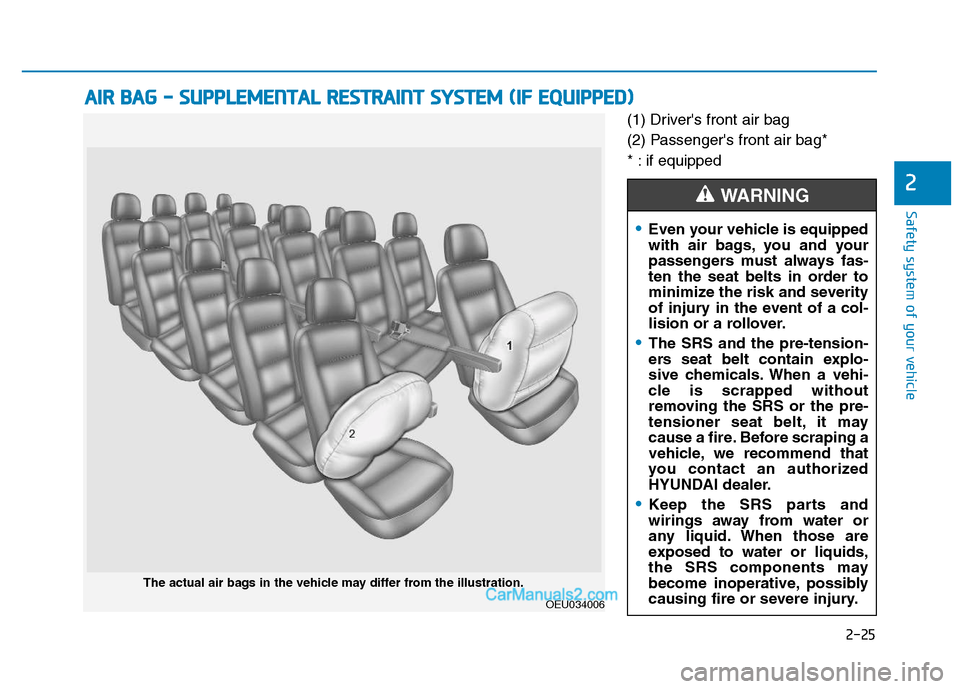
(1) Driver's front air bag
(2) Passenger's front air bag*
* : if equipped
AAIIRR BB AA GG -- SS UU PPPPLLEE MM EENN TTAA LL RR EESSTT RR AA IINN TT SS YY SSTT EEMM (( IIFF EE QQ UUIIPP PPEEDD ))
OEU034006
The actual air bags in the vehicle may differ from the illustration.
Even your vehicle is equipped
with air bags, you and your
passengers must always fas-
ten the seat belts in order to
minimize the risk and severity
of injury in the event of a col-
lision or a rollover.
The SRS and the pre-tension-
ers seat belt contain explo-
sive chemicals. When a vehi-
cle is scrapped without
removing the SRS or the pre-
tensioner seat belt, it may
cause a fire. Before scraping a
vehicle, we recommend that
you contact an authorized
HYUNDAI dealer.
Keep the SRS parts and
wirings away from water or
any liquid. When those are
exposed to water or liquids,
the SRS components may
become inoperative, possibly
causing fire or severe injury.
WARNING
Page 47 of 473
2-27
Safety system of your vehicle
2
Noise and smoke
When the air bags inflate, they make
a loud noise, leaving smoke and
powder inside the vehicle. This is
normal and is a result of the ignition
of the air bag inflator.
After the air bag inflates, you may
feel substantial discomfort in breath-
ing due to the contact of your chestwith both the seat belt and the air
bag, as well as due to the inhaled
smoke and powder.Immediately
open the doors/windows after the
inflation of the air bag in order to
reduce discomfort and prevent a
prolonged exposure to the smoke
and powder.
Though the smoke and powder are
non-toxic, they may cause skin irrita-
tion (for eyes, nose and throat, etc).
In this case, immediately wash the
irritated area with cold water. Consult
a doctor, if the symptom persists.
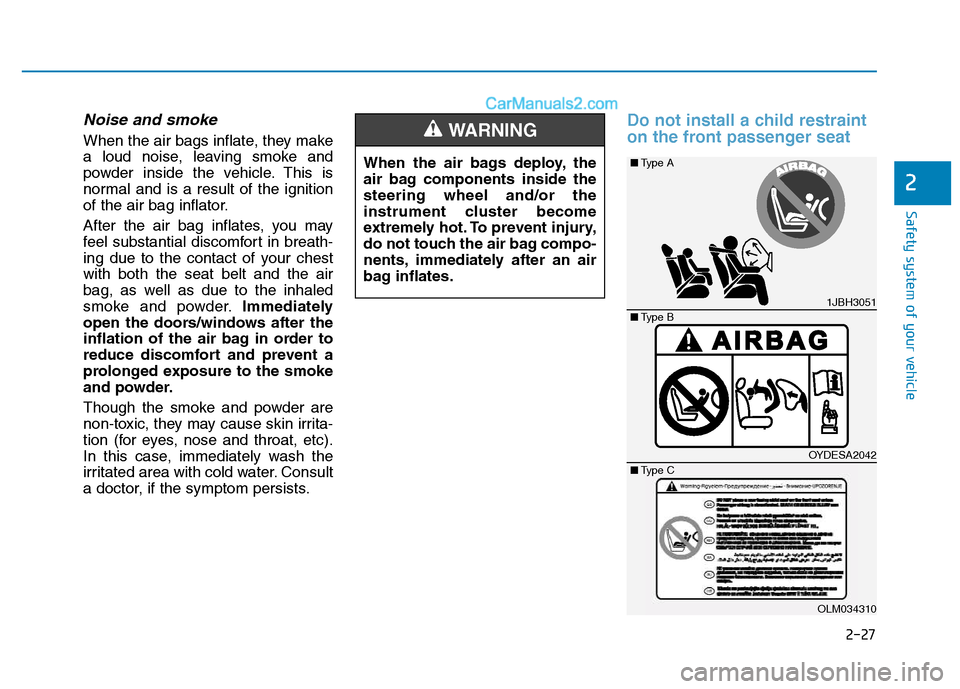
Do not install a child restraint
on the front passenger seat
When the air bags deploy, the
air bag components inside thesteering wheel and/or the
instrument cluster become
extremely hot. To prevent injury,
do not touch the air bag compo-
nents, immediately after an air
bag inflates.
WARNING
1JBH3051
OYDESA2042
OLM034310
■ Type B
■
Type A
■ Type C
Page 49 of 473
2-29
Safety system of your vehicle
2
SRS components and func- tions
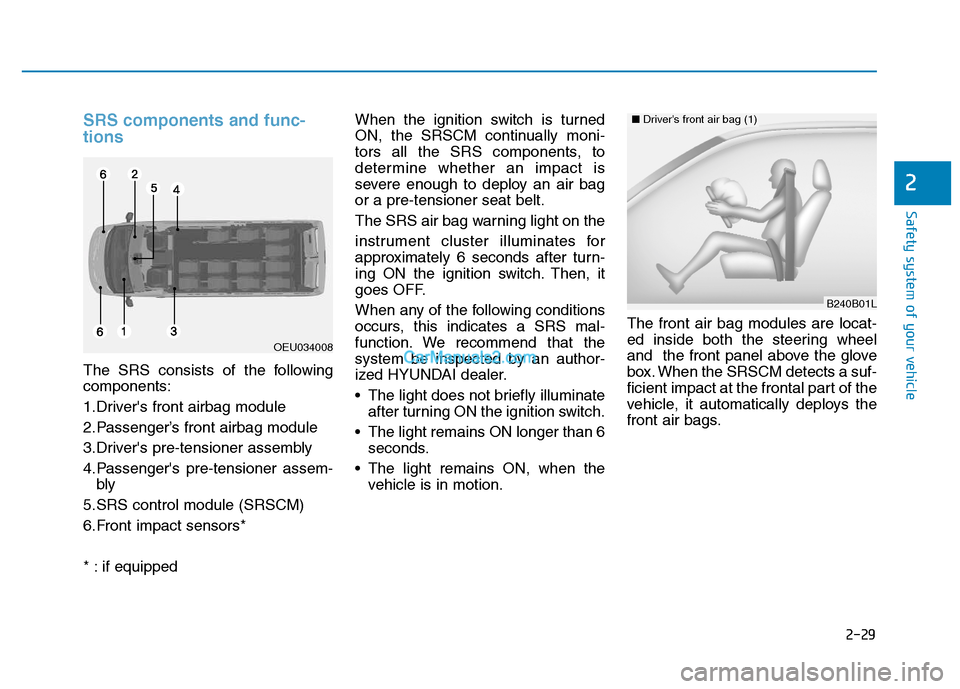
The SRS consists of the following components:
1.Driver's front airbag module
2.Passenger’s front airbag module
3.Driver's pre-tensioner assembly
4.Passenger's pre-tensioner assem-bly
5.SRS control module (SRSCM)
6.Front impact sensors*
* : if equipped When the ignition switch is turned
ON, the SRSCM continually moni-
tors all the SRS components, to
determine whether an impact is
severe enough to deploy an air bagor a pre-tensioner seat belt.
The SRS air bag warning light on the
instrument cluster illuminates for
approximately 6 seconds after turn-
ing ON the ignition switch. Then, it
goes OFF.
When any of the following conditions
occurs, this indicates a SRS mal-
function. We recommend that the
system be inspected by an author-
ized HYUNDAI dealer.
The light does not briefly illuminate
after turning ON the ignition switch.
The light remains ON longer than 6 seconds.
The light remains ON, when the vehicle is in motion. The front air bag modules are locat-
ed inside both the steering wheel
and the front panel above the glove
box. When the SRSCM detects a suf-
ficient impact at the frontal part of the
vehicle, it automatically deploys the
front air bags.
OEU034008
B240B01L
■
Driver's front air bag (1)