belt Hyundai H350 2015 Owner's Guide
[x] Cancel search | Manufacturer: HYUNDAI, Model Year: 2015, Model line: H350, Model: Hyundai H350 2015Pages: 473, PDF Size: 26.4 MB
Page 50 of 473
2-30
Safety system of your vehicle
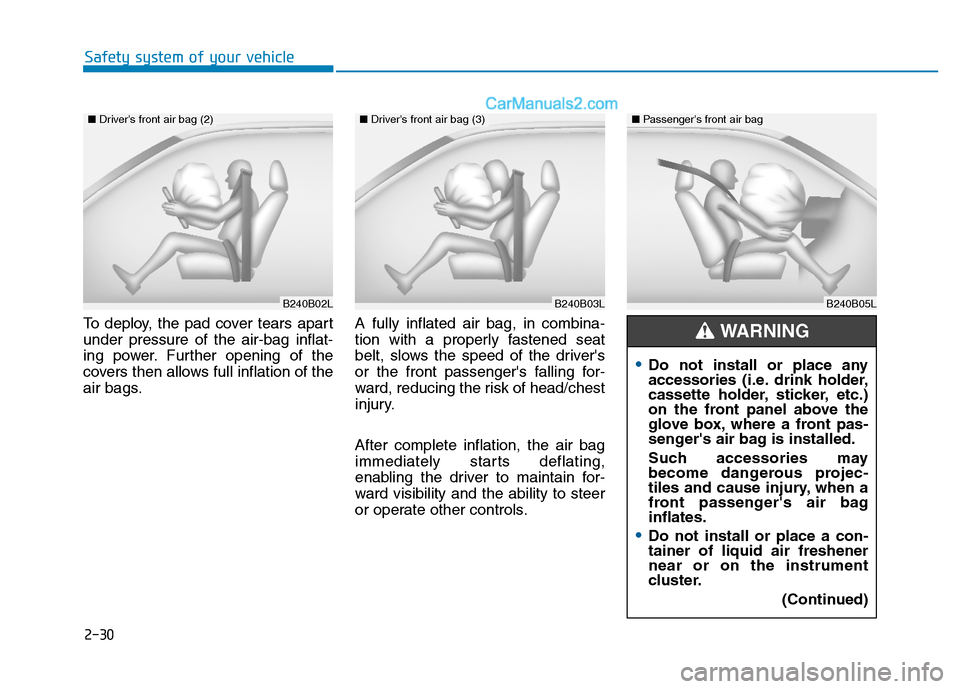
To deploy, the pad cover tears apart under pressure of the air-bag inflat-
ing power. Further opening of the
covers then allows full inflation of the
air bags.A fully inflated air bag, in combina-
tion with a properly fastened seat
belt, slows the speed of the driver's
or the front passenger's falling for-
ward, reducing the risk of head/chest
injury. After complete inflation, the air bag
immediately starts deflating,
enabling the driver to maintain for-
ward visibility and the ability to steer
or operate other controls.
B240B02LB240B03L
■
Driver's front air bag (2)■Driver's front air bag (3)
B240B05L
■ Passenger's front air bag
Do not install or place any
accessories (i.e. drink holder,
cassette holder, sticker, etc.)
on the front panel above the
glove box, where a front pas-
senger's air bag is installed.
Such accessories may
become dangerous projec-
tiles and cause injury, when a
front passenger's air baginflates.
Do not install or place a con- tainer of liquid air freshenernear or on the instrument
cluster.
(Continued)
WARNING
Page 51 of 473
2-31
Safety system of your vehicle
2
Driver's and front passenger's
air bag (if equipped)
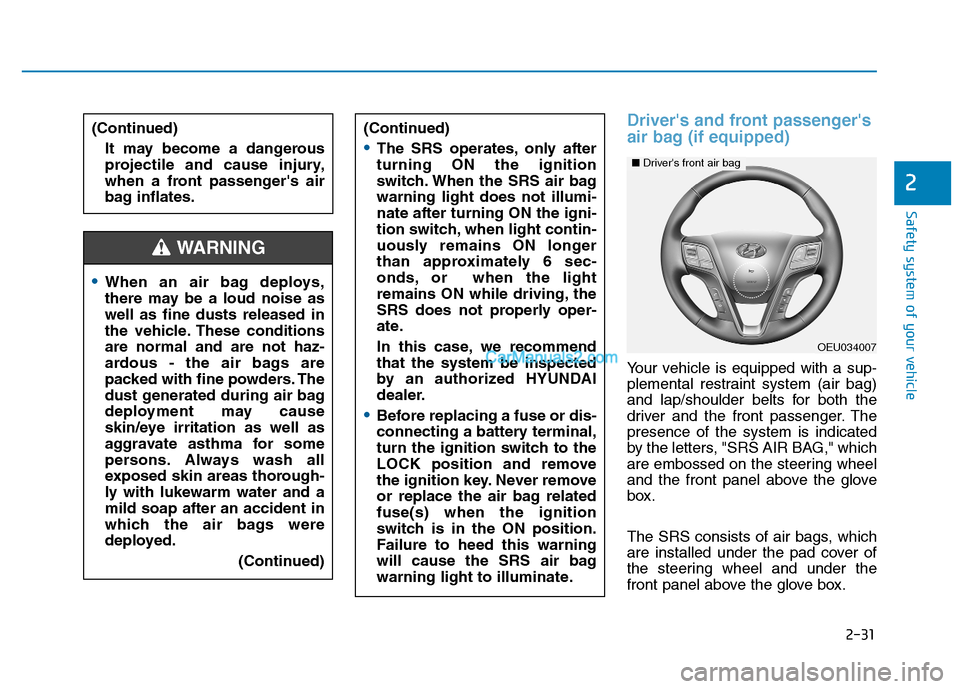
Your vehicle is equipped with a sup-
plemental restraint system (air bag)
and lap/shoulder belts for both the
driver and the front passenger. Thepresence of the system is indicated
by the letters, "SRS AIR BAG," which
are embossed on the steering wheel
and the front panel above the glove
box.
The SRS consists of air bags, which
are installed under the pad cover of
the steering wheel and under the
front panel above the glove box.
(Continued)
It may become a dangerous
projectile and cause injury,
when a front passenger's air
bag inflates.
When an air bag deploys,
there may be a loud noise aswell as fine dusts released in
the vehicle. These conditionsare normal and are not haz-
ardous - the air bags are
packed with fine powders. The
dust generated during air bag
deployment may cause
skin/eye irritation as well as
aggravate asthma for some
persons. Always wash all
exposed skin areas thorough-
ly with lukewarm water and amild soap after an accident in
which the air bags were
deployed. (Continued)
WARNING
(Continued)
The SRS operates, only after turning ON the ignition
switch. When the SRS air bagwarning light does not illumi-nate after turning ON the igni-
tion switch, when light contin-
uously remains ON longer
than approximately 6 sec-
onds, or when the light
remains ON while driving, the
SRS does not properly oper-
ate.
In this case, we recommend that the system be inspected
by an authorized HYUNDAI
dealer.
Before replacing a fuse or dis-
connecting a battery terminal,
turn the ignition switch to the
LOCK position and remove
the ignition key. Never remove
or replace the air bag relatedfuse(s) when the ignition
switch is in the ON position.
Failure to heed this warning
will cause the SRS air bag
warning light to illuminate.
OEU034007
■Driver's front air bag
Page 52 of 473
2-32
Safety system of your vehicle
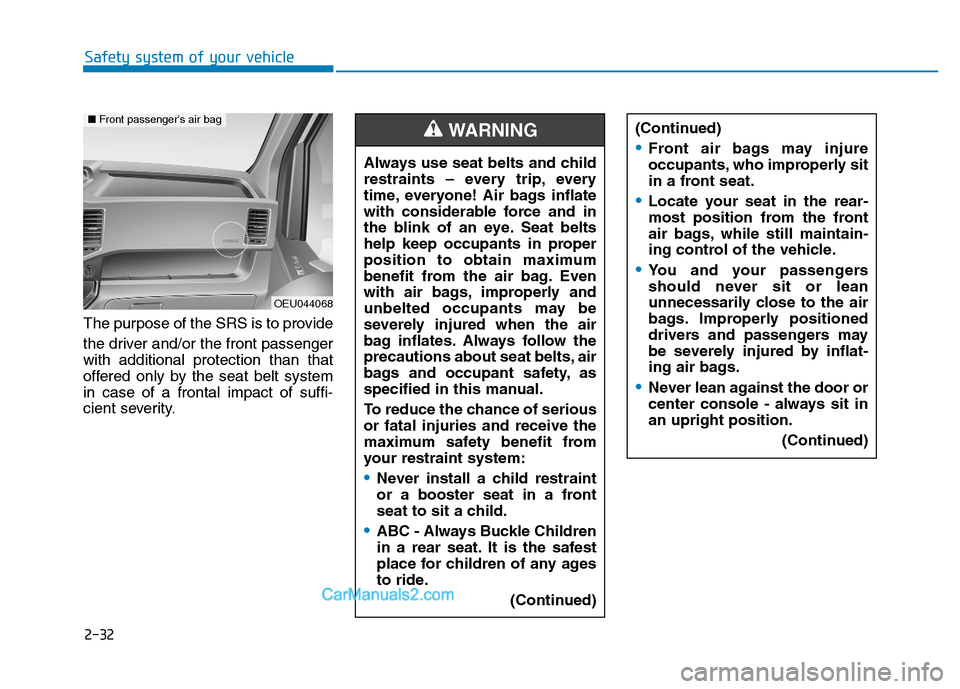
The purpose of the SRS is to provide
the driver and/or the front passenger with additional protection than that
offered only by the seat belt systemin case of a frontal impact of suffi-
cient severity.Always use seat belts and child
restraints – every trip, every
time, everyone! Air bags inflate
with considerable force and in
the blink of an eye. Seat belts
help keep occupants in proper
position to obtain maximum
benefit from the air bag. Even
with air bags, improperly and
unbelted occupants may be
severely injured when the air
bag inflates. Always follow the
precautions about seat belts, air
bags and occupant safety, as
specified in this manual.
To reduce the chance of serious or fatal injuries and receive the
maximum safety benefit from
your restraint system:
Never install a child restraint
or a booster seat in a front
seat to sit a child.
ABC - Always Buckle Children
in a rear seat. It is the safest
place for children of any ages
to ride.
(Continued)
WARNING
OEU044068
■Front passenger's air bag
(Continued)
Front air bags may injure
occupants, who improperly sit
in a front seat.
Locate your seat in the rear-
most position from the front
air bags, while still maintain-
ing control of the vehicle.
You and your passengers
should never sit or lean
unnecessarily close to the air
bags. Improperly positioned
drivers and passengers may
be severely injured by inflat-
ing air bags.
Never lean against the door or
center console - always sit inan upright position.
(Continued)
Page 53 of 473
2-33
Safety system of your vehicle
2
(Continued)
No objects should be placed
over or near the air bag mod-ules on the steering wheel,
the instrument cluster, and
the front panel above the
glove box. Such an object maycause harm in a crash of
which impact is severe
enough to deploy an air bag.
Do not modify or disconnect the SRS wires or the SRS
components. Doing so may
result in injury by accidentally
deploying the air bags or by
deactivating the SRS.
When the SRS air bag warning
light remains ON, while driv-
ing, we recommend that the
system be inspected by an
authorized HYUNDAI dealer.(Continued)
(Continued)
Air bags should be used only once - we recommend that the
system be replaced by an
authorized HYUNDAI dealerafter an accident.
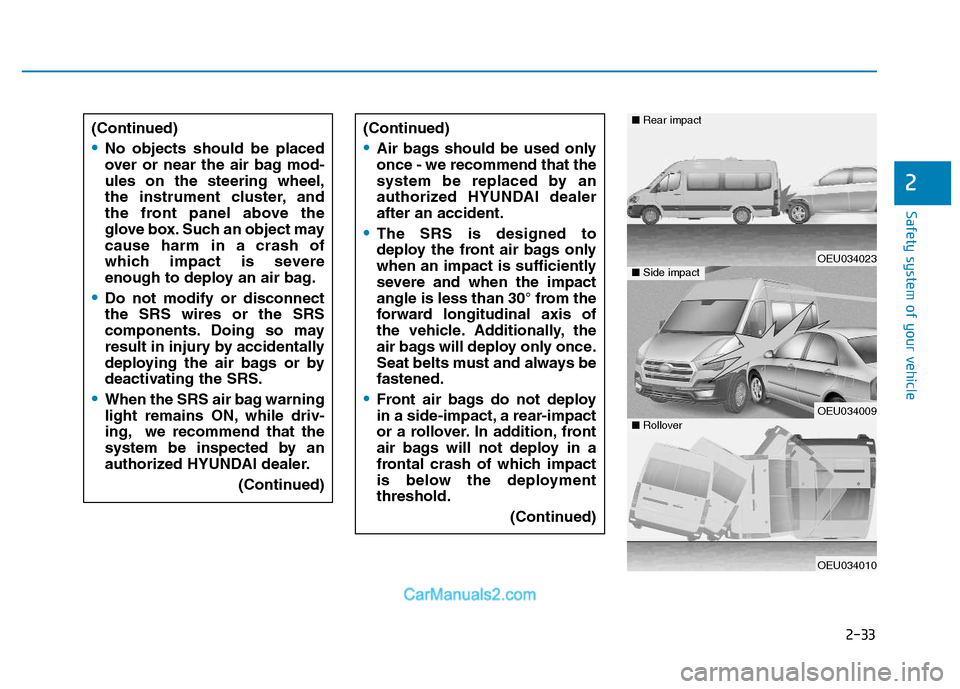
The SRS is designed to
deploy the front air bags only
when an impact is sufficiently
severe and when the impact
angle is less than 30° from the
forward longitudinal axis of
the vehicle. Additionally, the
air bags will deploy only once.
Seat belts must and always befastened.
Front air bags do not deploy
in a side-impact, a rear-impact
or a rollover. In addition, front
air bags will not deploy in a
frontal crash of which impact
is below the deploymentthreshold.(Continued)
OEU034023
OEU034009
OEU034010
■Rear impact
■Side impact
■Rollover
Page 54 of 473
2-34
Safety system of your vehicle
Why did not my air bag go off in a collision? (Inflation andnon-inflation conditions of the
air bag)
There are many types of acci-
dents in which the air bag
would not inflate to provide
additional protection.
These include rear impacts,
second or third collisions in
multiple impact accidents, as
well as low speed impacts.
(Continued)
A child restraint system must
never be installed in a front
seat. The infant or child may
be severely injured or killed
by a deploying air bag in anaccident.
Children at the age of 12 and
under must always be proper-
ly restrained in a rear seat.
Never allow children to ride in
a front passenger's seat.
When a child at the age of 13
and over sits in a front seat,
he or she must be properlyfastened and the seat shouldbe located in the rearmostposition.
❇
❇ The age requirements
about the child detrainment
differ in each country.
For the maximum protection
in all types of crashes, all
occupants including the driv-
er should always wear their
seat belts, regardless of the
air bag installment in theirseats.
(Continued)
(Continued)This is to minimizethe risk of severe injury or
death in the event of a crash. Do not sit or lean unnecessar-
ily close to the air bag, when
the vehicle is in motion.
Sitting improperly or out of
position may result in serious
or fatal injury in a crash. Alloccupants should sit in anupright position with the seat-
back in an upright position,centered on the seat cushion
with their seat belt on, legs
comfortably extended and
their feet rested on the floor
until the vehicle is parked and
the ignition switch is turned
OFF.
The SRS air bag rapidly
inflates to provide Protection
to occupants in a crash. Whenan occupant is out of positionwithout fastening a seat belt,
the air bag may forcefully
strike the occupant, causing
serious or fatal injury.
Page 57 of 473
2-37
Safety system of your vehicle
2
Air bag non-inflation conditions
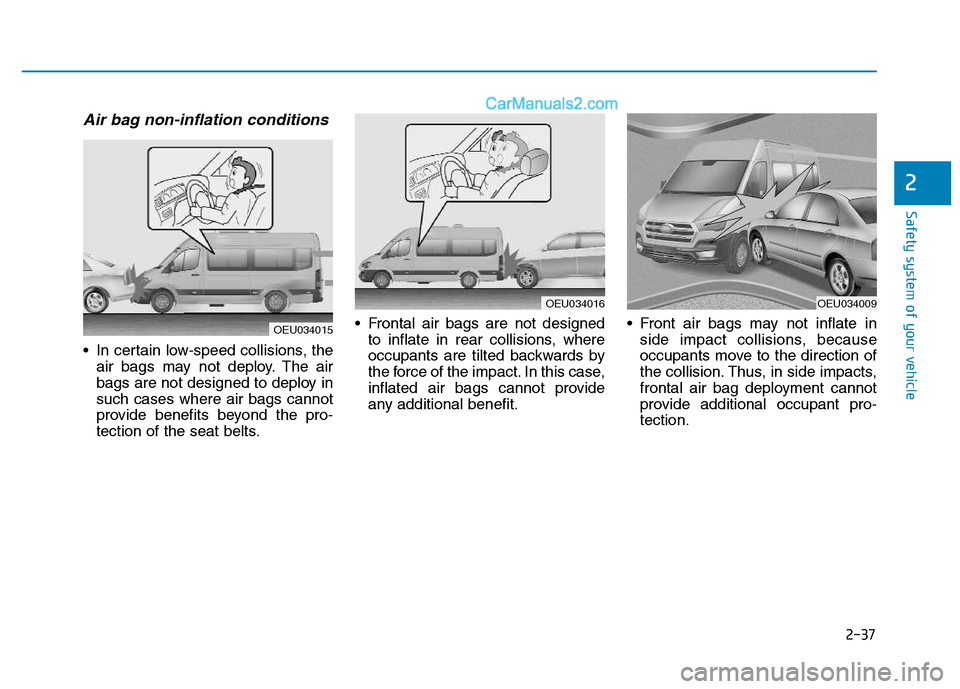
In certain low-speed collisions, theair bags may not deploy. The air
bags are not designed to deploy insuch cases where air bags cannot
provide benefits beyond the pro-
tection of the seat belts. Frontal air bags are not designed
to inflate in rear collisions, where
occupants are tilted backwards by
the force of the impact. In this case,
inflated air bags cannot provide
any additional benefit. Front air bags may not inflate in
side impact collisions, because
occupants move to the direction of
the collision. Thus, in side impacts,
frontal air bag deployment cannot
provide additional occupant pro-tection.
OEU034015
OEU034016OEU034009
Page 60 of 473
2-40
Safety system of your vehicle
Additional safety precautions
Never let passengers ride in the
trunk or on top of a foldeddown
seatback. All occupants should sit
upright, fully back in their seats
with their seat belts fastened and
their feet rested on the floor.
Passengers should not move
out of their seats or change their
seat positions, when the vehicleis in motion. A passenger, who
does not fasten a seat belt during a
crash or emergency stop, may be
thrown against the vehicle interior,
against other occupants, or out of
the vehicle.
Each seat belt is designed torestrain one occupant. When
more than one person uses the
same seat belt, they may be seri-ously injured or killed in a collision.
Do not use any accessories onseat belts. Devices, which the
manufacturers claim to improve
occupants’ comfort, may reduce
the protection provided by the seat
belt and increase the risk of seri-
ous injury in a crash.
(Continued)When the air bags inflate, we recommend that the system
be replaced by an authorized
HYUNDAI dealer.
Do not modify or disconnect SRS wirings or other SRS
components. Such attempts
may result in injury, because
an air bag may accidentally
inflate or deactivate the SRSsystem.
Observe any safety precau-
tions to discard the air bagsystem or to scrape the vehi-
cle. An authorized HYUNDAI
dealer knows these precau-
tions and can give you the
necessary information.
Failure to follow these precau-
tions and procedures may
increase the risk of personal
injury.
(Continued)
(Continued)
When your vehicle is flooded or when the floor mats are
soaked with water, do not
attempt to start the engine. We
recommend that you contact
an authorized HYUNDAI deal-
er.
Page 61 of 473
2-41
Safety system of your vehicle
2
Passengers should not place
hard or sharp objects between
themselves and the air bags.
Carrying hard or sharp objects on
your laps or in your mouth may
result in injury, when an air bag
inflates.
Keep occupants away from the
air bag covers. All occupants
should sit upright, fully back in their
seats with their seat belts fastened
and their feet rested on the floor.When occupants are too close to
the air bag, they may be injured byan inflating air bag.
Do not attach or place objects
on or near the air bag covers.
Any object attached to or placed
on the front air bag covers may
interfere with the proper operation
of the air bags.
Do not modify the front seats.
Modification of the front seats may
interfere with the sensing operation
of the supplemental restraint sys-tem.
Do not place items under the
front seats. Placing items under
the front seats may interfere with
the sensing operation of the sup-
plemental restraint system and
wiring harnesses.
Never hold an infant or child on
your laps. The infant or child may
be seriously injured or killed in the
event of a crash. All infants and
children should be properly
restrained in appropriate child
safety seats or seat belts in a rearseat.
Sitting improperly or out of
position may cause occu-
pants to be shifted too close
to a deploying air bag, strikethe interior structure or be
thrown out of the vehicle,
resulting in serious injury ordeath.
Always sit upright with the
seatback in an upright posi-
tion, centered on the seat
cushion with your seat belt
on, legs comfortably extended
and feet rested on the floor.
WARNING
Page 99 of 473
3-37
Convenient features of your vehicle
3
Power steering
Power steering uses energy from the
engine to assist you in steering the
vehicle. If the engine is off or if the
power steering system becomes
inoperative, the vehicle may still be
steered, but it will require increased
steering effort.
Should you notice any change in the
effort required to steer during normal
vehicle operation, have the power
steering checked by an authorized
HYUNDAI dealer.If the power steering drive belt
breaks or if the power steering
pump malfunctions, the steering
effort will greatly increase.
If the vehicle is parked for extend- ed periods outside in cold weath-
er (below -10°C/14°F), the power
steering may require increased
effort when the engine is first
started. This is caused byincreased fluid viscosity due tothe cold weather and does notindicate a malfunction.
When this happens, increase the
engine RPM by depressing accel-
erator until the RPM reaches 1,500rpm then release or let the engine
idle for two or three minutes towarm up the fluid.
Tilt & telescopic steering
A tilt steering column allows you to
adjust the steering wheel before you
drive. You can also raise it to give
your legs more room when you exit
and enter the vehicle (if equipped).
The steering wheel should be posi-
tioned so that it is comfortable for
you to drive, while permitting you to
see the instrument panel warning
lights and gauges.
NOTICE
NOTICE
SS
TT EEEERR IINN GG WW HHEEEELL
Never hold the steering wheel
against a stop (extreme right or
left turn) for more than 5 sec-onds with the engine running.
Holding the steering wheel formore than 5 seconds in either
position may cause damage to
the power steering pump.
CAUTION
Never adjust the angle and height of steering wheel while
driving. You may lose your
steering control and cause
severe personal injury or acci-dents.
After adjusting, push the steering wheel both up and
down to be certain it is lockedin position.
WARNING
Page 128 of 473
3-66
Convenient features of your vehicle
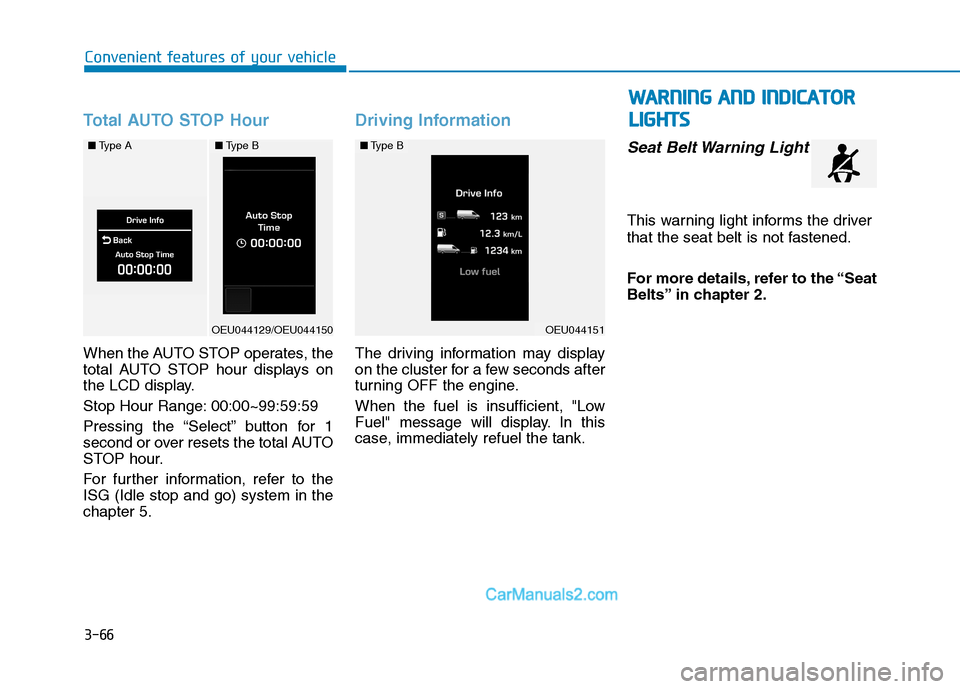
Total AUTO STOP Hour
When the AUTO STOP operates, the
total AUTO STOP hour displays on
the LCD display.
Stop Hour Range: 00:00~99:59:59
Pressing the “Select” button for 1
second or over resets the total AUTO
STOP hour.
For further information, refer to the ISG (Idle stop and go) system in thechapter 5.
Driving Information
The driving information may display
on the cluster for a few seconds after
turning OFF the engine.
When the fuel is insufficient, "Low
Fuel" message will display. In this
case, immediately refuel the tank.
Seat Belt Warning Light
This warning light informs the driver
that the seat belt is not fastened.
For more details, refer to the “Seat
Belts” in chapter 2.
OEU044151
■Type B■ Type A
OEU044129/OEU044150
■Type B
WW AARRNN IINN GG AA NN DD IINN DDIICC AA TTOO RR
L
L IIGG HH TTSS