warning Hyundai H350 2015 Owner's Manual
[x] Cancel search | Manufacturer: HYUNDAI, Model Year: 2015, Model line: H350, Model: Hyundai H350 2015Pages: 473, PDF Size: 26.4 MB
Page 407 of 473
7-44
Maintenance
Remove the valve cap from the tire
valve stem. Press the tire gage firm-
ly onto the valve to get a pressure
measurement. If the cold tire inflationpressure matches the recommendedpressure on the tire and loading
information label, no further adjust-
ment is necessary. If the pressure is
low, add air until you reach the rec-ommended amount.
If you overfill the tire, release air by pushing on the metal stem in the
center of the tire valve. Recheck the
tire pressure with the tire gage. Be
sure to put the valve caps back on
the valve stems. They help prevent
leaks by keeping out dirt and mois-
ture.Tire rotation
To equalize tread wear, it is recom- mended that the tires be rotated
every 12,000 km (7,500 miles) or
sooner if irregular wear develops.
During rotation, check the tires for
correct balance.
When rotating tires, check for uneven
wear and damage. Abnormal wear is
usually caused by incorrect tire pres-
sure, improper wheel alignment, out-
of-balance wheels, severe braking or
severe cornering. Look for bumps or
bulges in the tread or side of tire.
Replace the tire if you find either of
these conditions. Replace the tire if
fabric or cord is visible. After rotation,
be sure to bring the front and rear tire
pressures to specification and check
lug nut tightness.
Refer to “Tire and wheels” in section 8.
Inspect your tires frequently
for proper inflation as well as
wear and damage. Always use
a tire pressure gauge.
Tires with too much or too lit-
tle pressure wear unevenly
causing poor handling, loss of
vehicle control, and suddentire failure leading to acci-
dents, injuries, and even
death. The recommended cold
tire pressure for your vehicle
can be found in this manualand on the tire label locatedon the driver's side center pil-
lar.
Worn tires can cause acci-
dents. Replace tires that are
worn, show uneven wear, or
are damaged.
Remember to check the pres-
sure of your spare tire.
HYUNDAI recommends that
you check the spare every
time you check the pressure
of the other tires on your vehi-
cle.
WARNING
Page 408 of 473
7-45
7
Maintenance
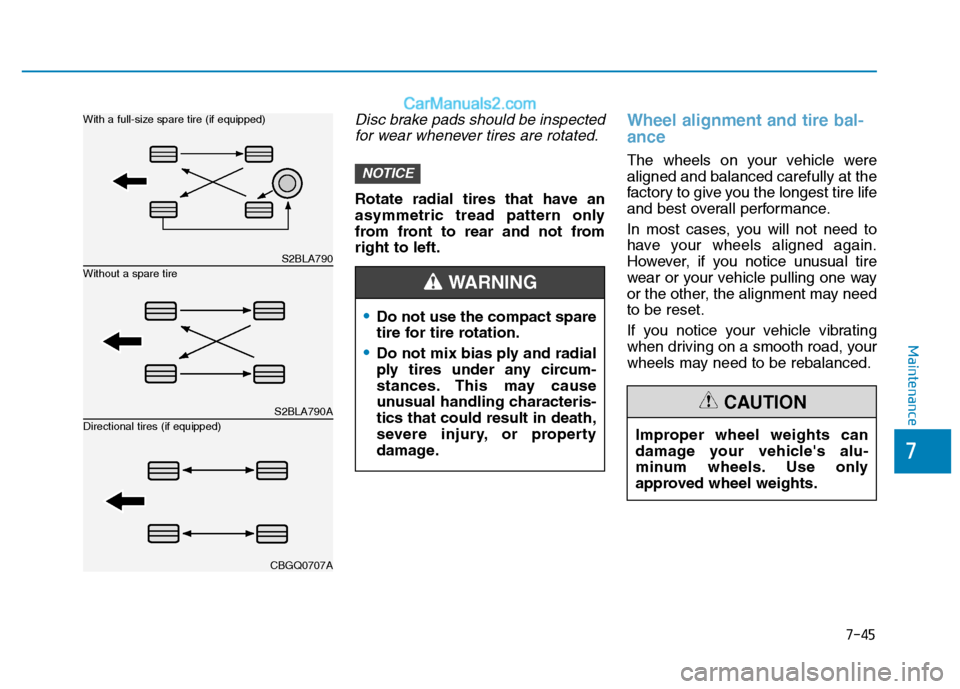
Disc brake pads should be inspectedfor wear whenever tires are rotated.
Rotate radial tires that have an
asymmetric tread pattern only
from front to rear and not fromright to left.
Wheel alignment and tire bal- ance
The wheels on your vehicle were aligned and balanced carefully at the
factory to give you the longest tire life
and best overall performance.
In most cases, you will not need to
have your wheels aligned again.
However, if you notice unusual tire
wear or your vehicle pulling one way
or the other, the alignment may needto be reset.
If you notice your vehicle vibrating
when driving on a smooth road, your
wheels may need to be rebalanced.NOTICE
Do not use the compact spare
tire for tire rotation.
Do not mix bias ply and radial
ply tires under any circum-
stances. This may cause
unusual handling characteris-tics that could result in death,
severe injury, or property
damage.
WARNING
Improper wheel weights can
damage your vehicle's alu-
minum wheels. Use only
approved wheel weights.
CAUTION
S2BLA790
S2BLA790A
CBGQ0707A
Without a spare tire
With a full-size spare tire (if equipped) Directional tires (if equipped)
Page 409 of 473
7-46
Maintenance
Tire replacement
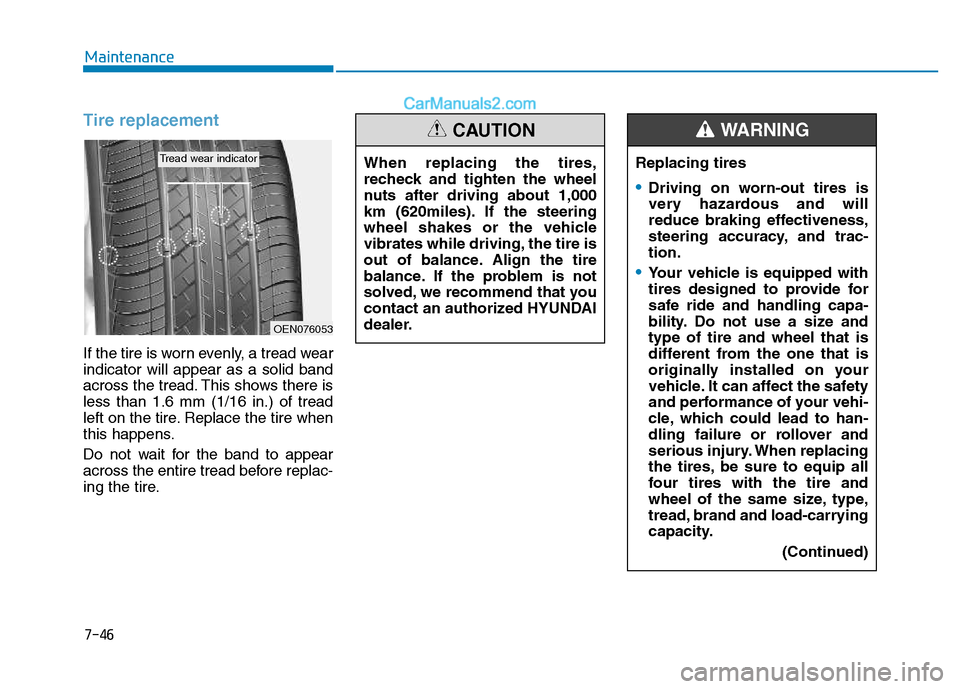
If the tire is worn evenly, a tread wear indicator will appear as a solid band
across the tread. This shows there isless than 1.6 mm (1/16 in.) of tread
left on the tire. Replace the tire when
this happens.
Do not wait for the band to appear
across the entire tread before replac-
ing the tire.When replacing the tires,
recheck and tighten the wheel
nuts after driving about 1,000
km (620miles). If the steering
wheel shakes or the vehicle
vibrates while driving, the tire is
out of balance. Align the tire
balance. If the problem is not
solved, we recommend that you
contact an authorized HYUNDAI
dealer.
CAUTION
Replacing tires
Driving on worn-out tires is
very hazardous and will
reduce braking effectiveness,
steering accuracy, and trac-tion.
Your vehicle is equipped with
tires designed to provide for
safe ride and handling capa-
bility. Do not use a size andtype of tire and wheel that is
different from the one that is
originally installed on your
vehicle. It can affect the safety
and performance of your vehi-
cle, which could lead to han-
dling failure or rollover and
serious injury. When replacing
the tires, be sure to equip all
four tires with the tire and
wheel of the same size, type,
tread, brand and load-carrying
capacity.
(Continued)
WARNING
OEN076053
Tread wear indicator
Page 410 of 473
7-47
7
Maintenance
Wheel replacement
When replacing the metal wheels for
any reason, make sure the new
wheels are equivalent to the original
factory units in diameter, rim widthand offset.
Tire traction
Tire traction can be reduced if you
drive on worn tires, tires that are
improperly inflated or on slippery
road surfaces. Tires should be
replaced when tread wear indicators
appear. To reduce the possibility of
losing control, slow down whenever
there is rain, snow or ice on the road.
Tire maintenance
In addition to proper inflation, correct wheel alignment helps to decrease
tire wear. If you find a tire is worn
unevenly, have your dealer or otherrepair shops that use qualified tech-
nicians check the wheel alignment.
When you have new tires installed,
make sure they are balanced. This
will increase vehicle ride comfort and
tire life. Additionally, a tire should
always be rebalanced if it is removedfrom the wheel.
A wheel that is not the correct
size may adversely affect wheel
and bearing life, braking and
stopping abilities, handling
characteristics, ground clear-
ance, body-to-tire clearance,
snow chain clearance,speedometer and odometer cal-
ibration, headlight aim and
bumper height.
WARNING
(Continued)
The use of any other tire size
or type may seriously affect
ride, handling, ground clear-
ance, stopping distance, body
to tire clearance, snow tire
clearance, and speedometer
reliability.
It is best to replace all four
tires at the same time. If that
is not possible, or necessary,
then replace the two front or
two rear tires as a pair.Replacing just one tire can
seriously affect your vehicle’shandling.
The ABS works by comparing
the speed of the wheels. Tire
size can affect wheel speed.
When replacing tires, all 4
tires must use the same size
originally supplied with the
vehicle. Using tires of a differ-
ent size can cause the ABS
(Anti-lock Brake System) and
ESP (Electronic Stability
Program) (if equipped) to
work irregularly.
Page 412 of 473
7-49
7
Maintenance
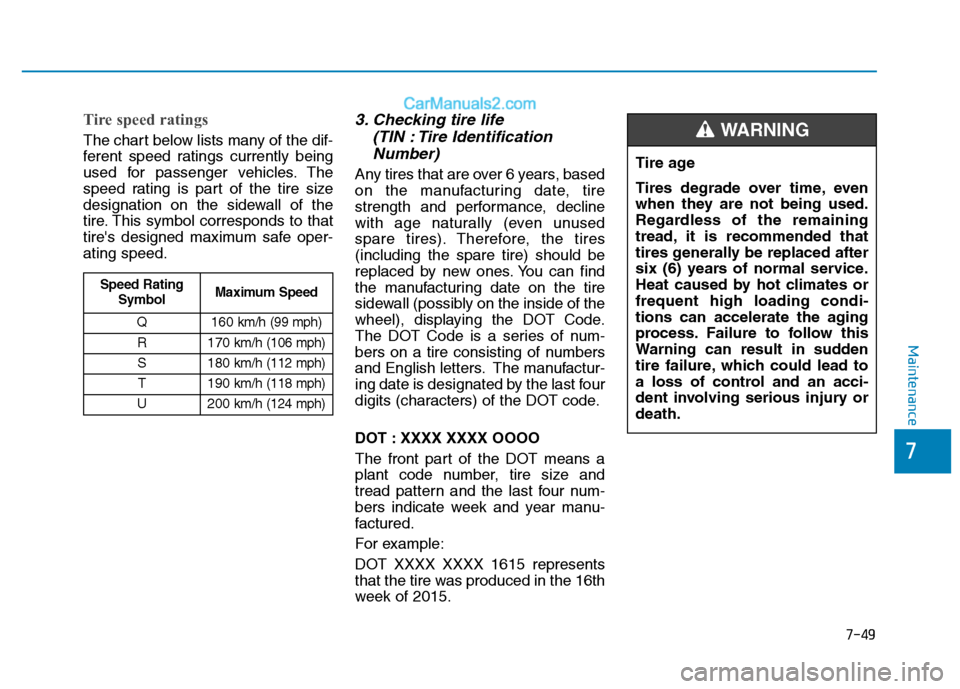
Tire speed ratings
The chart below lists many of the dif-
ferent speed ratings currently being
used for passenger vehicles. The
speed rating is part of the tire size
designation on the sidewall of the
tire. This symbol corresponds to that
tire's designed maximum safe oper-ating speed.
3. Checking tire life (TIN : Tire Identification
Number)
Any tires that are over 6 years, based
on the manufacturing date, tire
strength and performance, decline
with age naturally (even unused
spare tires). Therefore, the tires(including the spare tire) should be
replaced by new ones. You can find
the manufacturing date on the tire
sidewall (possibly on the inside of the
wheel), displaying the DOT Code.
The DOT Code is a series of num-
bers on a tire consisting of numbers
and English letters. The manufactur-
ing date is designated by the last four
digits (characters) of the DOT code.
DOT : XXXX XXXX OOOO
The front part of the DOT means a
plant code number, tire size and
tread pattern and the last four num-
bers indicate week and year manu-
factured.
For example:
DOT XXXX XXXX 1615 represents
that the tire was produced in the 16th
week of 2015. Tire age
Tires degrade over time, even
when they are not being used.
Regardless of the remaining
tread, it is recommended that
tires generally be replaced after
six (6) years of normal service.
Heat caused by hot climates orfrequent high loading condi-
tions can accelerate the aging
process. Failure to follow this
Warning can result in sudden
tire failure, which could lead to
a loss of control and an acci-
dent involving serious injury ordeath.
WARNING
Speed Rating
SymbolMaximum Speed
Q160km/h (99 mph)
R170km/h (106 mph)
S180km/h (112 mph)
T190km/h (118 mph)
U200km/h (124 mph)
Page 414 of 473
7-51
7
Maintenance
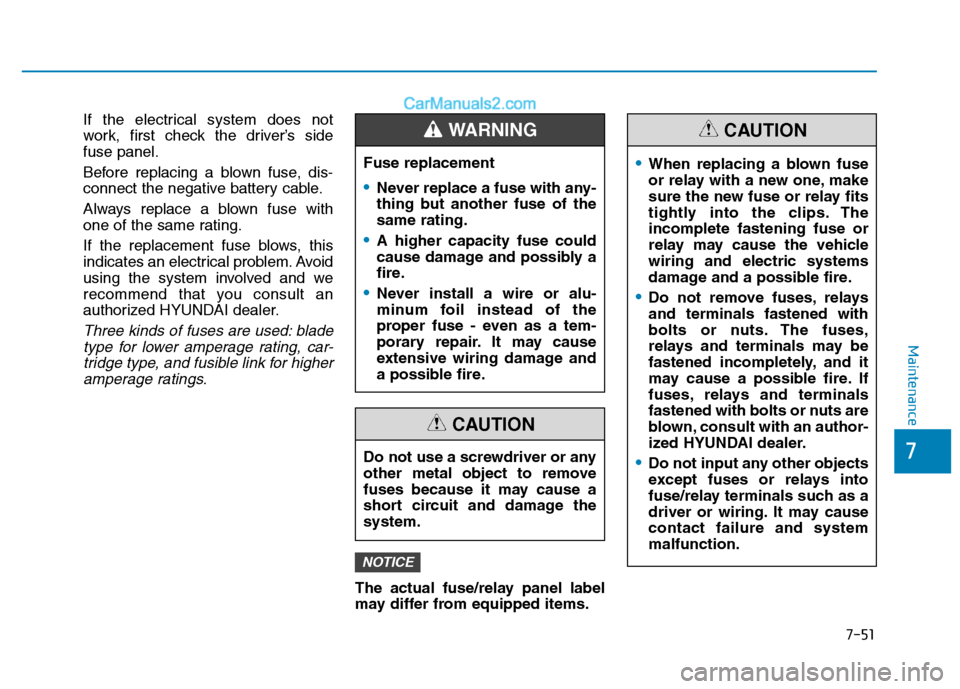
If the electrical system does not
work, first check the driver’s sidefuse panel.
Before replacing a blown fuse, dis-
connect the negative battery cable.
Always replace a blown fuse with
one of the same rating.
If the replacement fuse blows, this
indicates an electrical problem. Avoid
using the system involved and we
recommend that you consult an
authorized HYUNDAI dealer.
Three kinds of fuses are used: bladetype for lower amperage rating, car-tridge type, and fusible link for higher amperage ratings.
The actual fuse/relay panel label
may differ from equipped items.
NOTICE
Fuse replacement
Never replace a fuse with any-
thing but another fuse of thesame rating.
A higher capacity fuse could
cause damage and possibly a
fire.
Never install a wire or alu-
minum foil instead of the
proper fuse - even as a tem-
porary repair. It may cause
extensive wiring damage and
a possible fire.
WARNING
Do not use a screwdriver or any
other metal object to remove
fuses because it may cause a
short circuit and damage thesystem.
CAUTION
When replacing a blown fuse
or relay with a new one, make
sure the new fuse or relay fits
tightly into the clips. Theincomplete fastening fuse or
relay may cause the vehiclewiring and electric systems
damage and a possible fire.
Do not remove fuses, relays and terminals fastened with
bolts or nuts. The fuses,
relays and terminals may be
fastened incompletely, and it
may cause a possible fire. If
fuses, relays and terminals
fastened with bolts or nuts are
blown, consult with an author-
ized HYUNDAI dealer.
Do not input any other objects
except fuses or relays into
fuse/relay terminals such as a
driver or wiring. It may causecontact failure and systemmalfunction.
CAUTION
Page 420 of 473
7-57
7
Maintenance
No.Fuse ratingFuse NameCircuit Protected
1210AMEMORYCluster (B+), A/C Control Module(B+), Drive Door Module(B+ECU), Assist Door Module(B+ECU), DTG(B+), OBDII (B+)
137.5ABRAKE SWBrake Switch, Stop Lamp
1410AMODULE E-3Cluster, Drive Door Module, Assist Door Module, A/C Control Module, Seat HTD Switch
Left/Right, VDC off Switch, AVN, Seat HTD Module Left/Right, DTG, LDWS Module, RPAS
Sensor, Yaw Rate Sensor, Fuel Water Sensor
1510AMIDDLE
DR LOCKMiddle Door Lock Actuator
1610ATAILGATE DR LOCKTailgate Door Lock Actuator
1710AMODULE E-4AUDIO E300/E800(ACC), AVN(ACC), LDC Module(ACC), CM(ACC)
1820AENG BOX (IG1)UH BOX (ABS3 7.5A, SNSR5 7.5A, INHIBITOR 7.5A, BACK UP LAMP 7.5A)
1910ADCUSEAT BOX (DCU SNSR Relay 'S')
207.5A2
CMCM (IG1)
217.5AMODULE-1Rain Sensor
2210AINTERIOR LAMPSEAT BOX(PASS ROOM LAMP Relay 'S'), Key Warning Switch, Step Lamp(MID/ASS),
OH_CONSOLE Lamp, Map Lamp, Passenger Reading Lamp, Cargo_Lamp(Middle / TGAT)
Page 421 of 473
7-58
Maintenance
No.Fuse ratingFuse NameCircuit Protected
2310AMODULE-2HLLD Actuator Left/Right, Glow Relay Module(IG1), Brake Switch, FPAS Sensor, C/PAD Switch, BEZEL Switch, LDC Module(IG1)
247.5AMODULE-5I_S_MIRR(IG2), CM(IG2), Passenger Heater Module(IG2), Seat HTD Module Left/Right(IG2),
F/FILTER Relay 'S'
2510A2
IMMOImmobilizer Module(B+), Key Warning Switch
267.5A1
IMMOImmobilizer Module(IG1)
2720ASEAT BOX (IG2)SEAT BOX (ELECTRIC VENTILATOR2 10A, A/CON RR(IG2) 10A, IG2 10A(AUX POWER(IG2)
Relay 'S'))
287.5A1
A/CONA/C Control Module(IG2)
2915AA/BAGA/BAG Control Module(IG1)
307.52
EMERGENCY CALLEmergency-Call(IG1)
Page 425 of 473
7-62
Maintenance
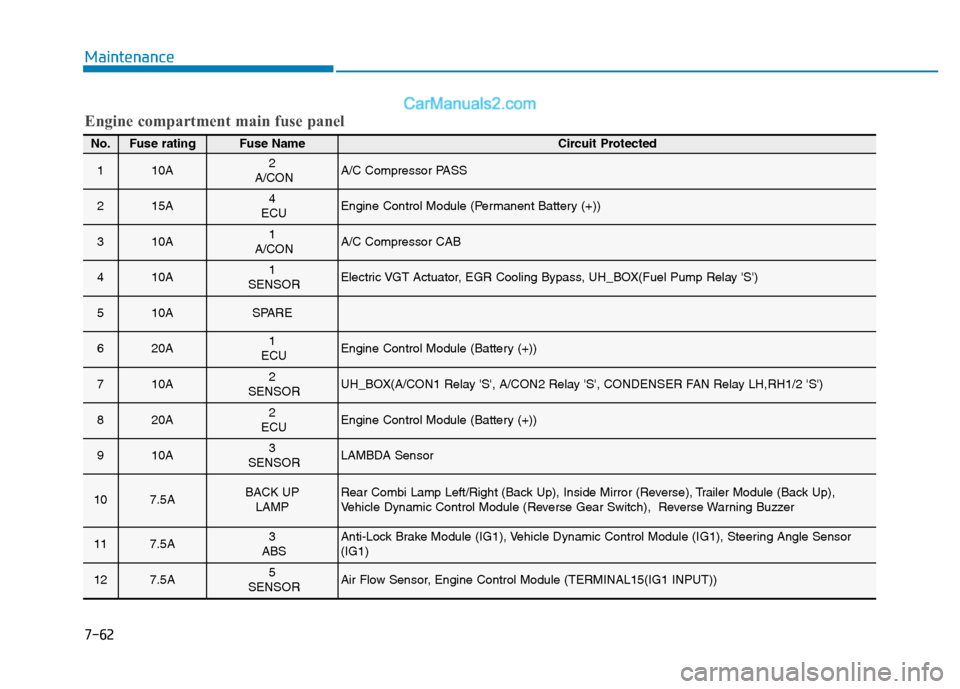
Engine compartment main fuse panel
No.Fuse ratingFuse Name Circuit Protected
110A2
A/CONA/C Compressor PASS
215A4
ECUEngine Control Module (Permanent Battery (+))
310A1
A/CONA/C Compressor CAB
410A1
SENSORElectric VGT Actuator, EGR Cooling Bypass, UH_BOX(Fuel Pump Relay 'S')
510ASPARE
620A1
ECUEngine Control Module (Battery (+))
710A2
SENSORUH_BOX(A/CON1 Relay 'S', A/CON2 Relay 'S', CONDENSER FAN Relay LH,RH1/2 'S')
820A2
ECUEngine Control Module (Battery (+))
910A3
SENSORLAMBDA Sensor
107.5ABACK UP LAMPRear Combi Lamp Left/Right (Back Up), Inside Mirror (Reverse), Trailer Module (Back Up),
Vehicle Dynamic Control Module (Reverse Gear Switch), Reverse Warning Buzzer
117.5A3
ABSAnti-Lock Brake Module (IG1), Vehicle Dynamic Control Module (IG1), Steering Angle Sensor (IG1)
127.5A5
SENSORAir Flow Sensor, Engine Control Module (TERMINAL15(IG1 INPUT))
Page 430 of 473
7-67
7
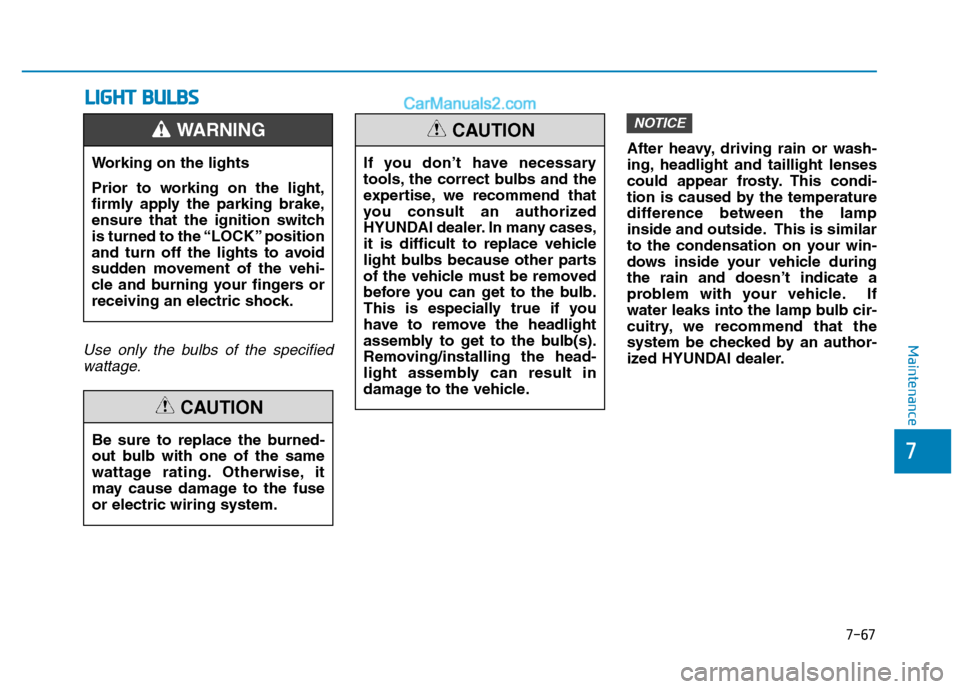
MaintenanceUse only the bulbs of the specifiedwattage.
After heavy, driving rain or wash-
ing, headlight and taillight lenses
could appear frosty. This condi-
tion is caused by the temperature
difference between the lamp
inside and outside. This is similar
to the condensation on your win-
dows inside your vehicle duringthe rain and doesn’t indicate a
problem with your vehicle. If
water leaks into the lamp bulb cir-
cuitry, we recommend that the
system be checked by an author-
ized HYUNDAI dealer.
NOTICE
LL IIGG HH TT BB UU LLBB SS
Working on the lights
Prior to working on the light,
firmly apply the parking brake,
ensure that the ignition switch
is turned to the “LOCK” position
and turn off the lights to avoid
sudden movement of the vehi-
cle and burning your fingers or
receiving an electric shock.
WARNING
Be sure to replace the burned-
out bulb with one of the same
wattage rating. Otherwise, it
may cause damage to the fuseor electric wiring system.
CAUTION
If you don’t have necessary
tools, the correct bulbs and the
expertise, we recommend that
you consult an authorized
HYUNDAI dealer. In many cases,
it is difficult to replace vehicle
light bulbs because other parts
of the vehicle must be removed
before you can get to the bulb.
This is especially true if you
have to remove the headlight
assembly to get to the bulb(s).
Removing/installing the head-
light assembly can result in
damage to the vehicle.
CAUTION