warning Hyundai H350 2015 Owner's Manual
[x] Cancel search | Manufacturer: HYUNDAI, Model Year: 2015, Model line: H350, Model: Hyundai H350 2015Pages: 473, PDF Size: 26.4 MB
Page 370 of 473
7-7
7
Maintenance
Continued)
When you remove the interior
trim cover with a flat head (-)
driver, be careful not to dam-
age the cover.
Be careful when you replace
and clean bulbs to avoid
burns or electrical shock.
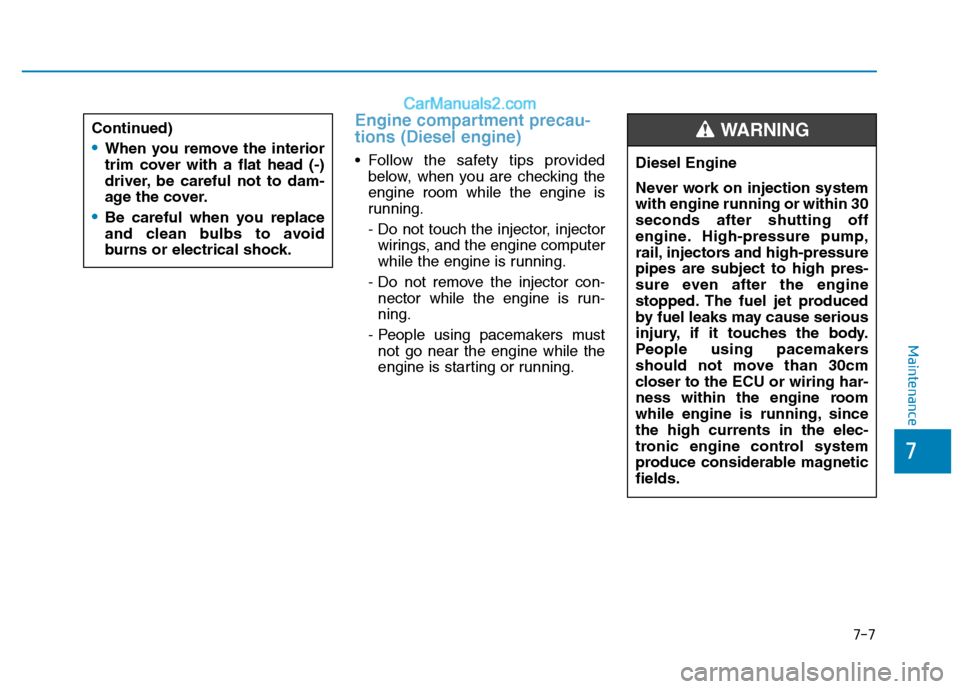
Engine compartment precau- tions (Diesel engine)
• Follow the safety tips providedbelow, when you are checking the engine room while the engine is
running.
- Do not touch the injector, injectorwirings, and the engine computer
while the engine is running.
- Do not remove the injector con- nector while the engine is run-ning.
- People using pacemakers must not go near the engine while the
engine is starting or running. Diesel Engine
Never work on injection system with engine running or within 30seconds after shutting off
engine. High-pressure pump,
rail, injectors and high-pressurepipes are subject to high pres-
sure even after the engine
stopped. The fuel jet produced
by fuel leaks may cause serious
injury, if it touches the body.
People using pacemakers
should not move than 30cm
closer to the ECU or wiring har-
ness within the engine room
while engine is running, sincethe high currents in the elec-
tronic engine control system
produce considerable magneticfields.
WARNING
Page 371 of 473
7-8
Maintenance
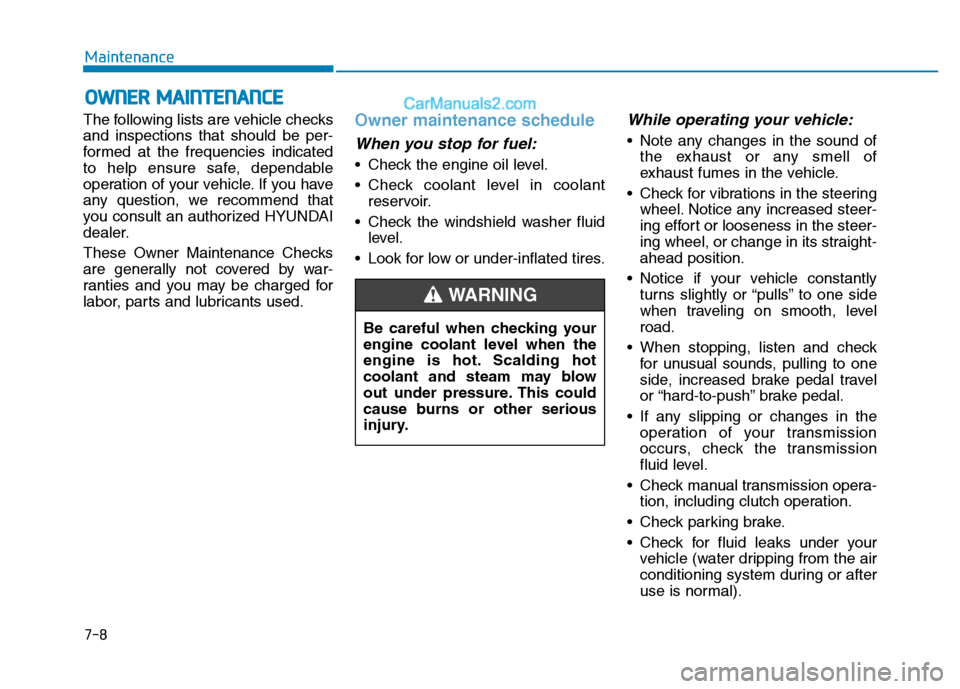
The following lists are vehicle checks and inspections that should be per-
formed at the frequencies indicated
to help ensure safe, dependable
operation of your vehicle. If you have
any question, we recommend that
you consult an authorized HYUNDAI
dealer.
These Owner Maintenance Checks
are generally not covered by war-
ranties and you may be charged for
labor, parts and lubricants used.Owner maintenance schedule
When you stop for fuel:
Check the engine oil level.
Check coolant level in coolantreservoir.
Check the windshield washer fluid level.
Look for low or under-inflated tires.
While operating your vehicle:
Note any changes in the sound of the exhaust or any smell of
exhaust fumes in the vehicle.
Check for vibrations in the steering wheel. Notice any increased steer-
ing effort or looseness in the steer-
ing wheel, or change in its straight-ahead position.
Notice if your vehicle constantly turns slightly or “pulls” to one side
when traveling on smooth, levelroad.
When stopping, listen and check for unusual sounds, pulling to one
side, increased brake pedal travel
or “hard-to-push” brake pedal.
If any slipping or changes in the operation of your transmission
occurs, check the transmission
fluid level.
Check manual transmission opera- tion, including clutch operation.
Check parking brake.
Check for fluid leaks under your vehicle (water dripping from the air
conditioning system during or after
use is normal).
OOWW NNEERR MM AAIINN TTEENN AANN CCEE
Be careful when checking your
engine coolant level when the
engine is hot. Scalding hot
coolant and steam may blow
out under pressure. This could
cause burns or other serious
injury.
WARNING
Page 372 of 473
7-9
7
Maintenance
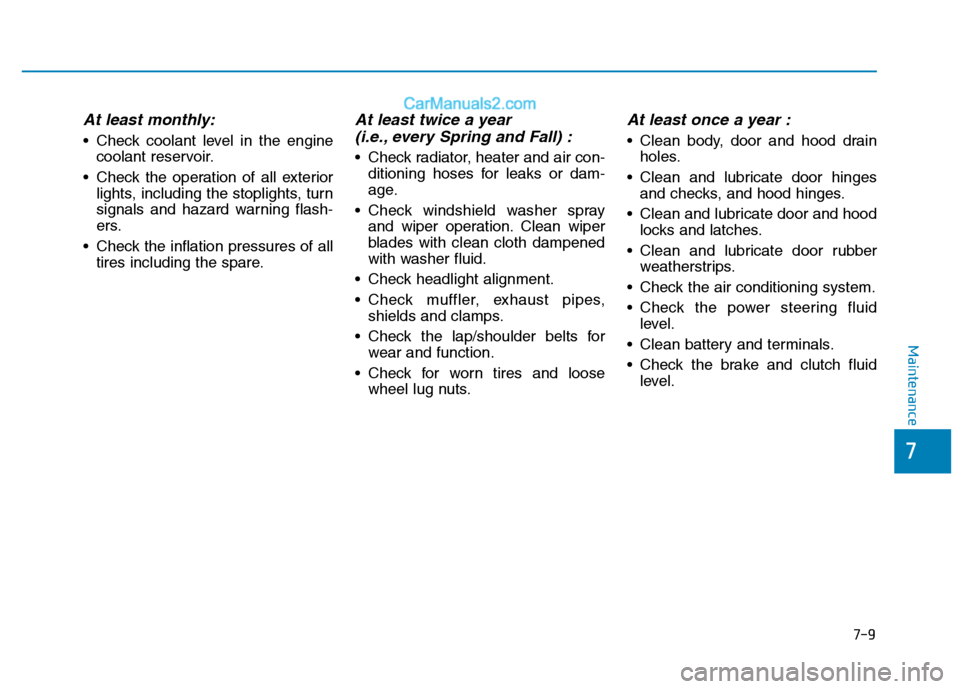
At least monthly:
Check coolant level in the enginecoolant reservoir.
Check the operation of all exterior lights, including the stoplights, turn
signals and hazard warning flash-
ers.
Check the inflation pressures of all tires including the spare.
At least twice a year
(i.e., every Spring and Fall) :
Check radiator, heater and air con- ditioning hoses for leaks or dam-
age.
Check windshield washer spray and wiper operation. Clean wiper
blades with clean cloth dampened
with washer fluid.
Check headlight alignment.
Check muffler, exhaust pipes, shields and clamps.
Check the lap/shoulder belts for wear and function.
Check for worn tires and loose wheel lug nuts.
At least once a year :
Clean body, door and hood drainholes.
Clean and lubricate door hinges and checks, and hood hinges.
Clean and lubricate door and hood locks and latches.
Clean and lubricate door rubber weatherstrips.
Check the air conditioning system.
Check the power steering fluid level.
Clean battery and terminals.
Check the brake and clutch fluid level.
Page 374 of 473
7-11
7
Maintenance
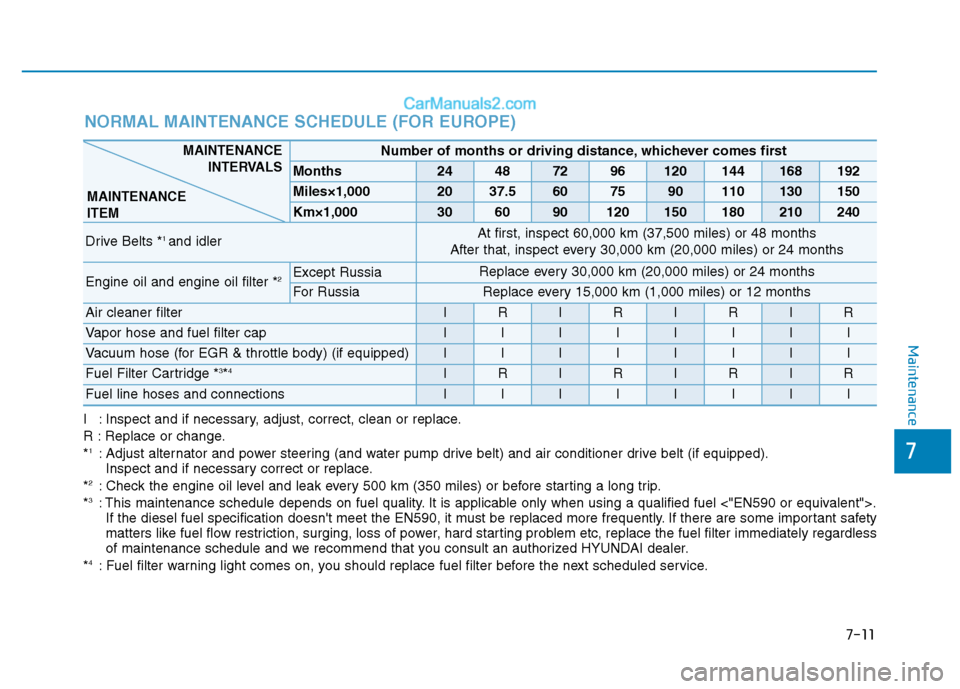
NORMAL MAINTENANCE SCHEDULE (FOR EUROPE)
I : Inspect and if necessary, adjust, correct, clean or replace.
R : Replace or change.*1
: Adjust alternator and power steering (and water pump drive belt) and air conditioner drive belt (if equipped).
Inspect and if necessary correct or replace.
* 2
: Check the engine oil level and leak every 500 km (350 miles) or before starting a long trip.
* 3
: This maintenance schedule depends on fuel quality. It is applicable only when using a qualified fuel <"EN590 or equivalent">.
If the diesel fuel specification doesn't meet the EN590, it must be replaced more frequently. If there are some important safety
matters like fuel flow restriction, surging, loss of power, hard starting problem etc, replace the fuel filter immediately rega rdless
of maintenance schedule and we recommend that you consult an authorized HYUNDAI dealer.
* 4
: Fuel filter warning light comes on, you should replace fuel filter before the next scheduled service.
Number of months or driving distance, whichever comes first
Months24487296120144168192
Miles×1,0002037.5607590110130150
Km×1,000306090120150180210240
Drive Belts * 1
and idlerAt first, inspect 60,000 km (37,500 miles) or 48 months
After that, inspect every 30,000 km (20,000 miles) or 24 months
Engine oil and engine oil filter * 2Except RussiaReplace every 30,000 km (20,000 miles) or 24 months
For RussiaReplace every 15,000 km (1,000 miles) or 12 months
Air cleaner filterIRIRIRIR
Vapor hose and fuel filter capIIIIIIII
Vacuum hose (for EGR & throttle body) (if equipped)IIIIIIII
Fuel Filter Cartridge *3
* 4IRIRIRIR
Fuel line hoses and connectionsIIIIIIII
MAINTENANCE
INTERVALS
MAINTENANCE ITEM
Page 377 of 473
7-14
Maintenance
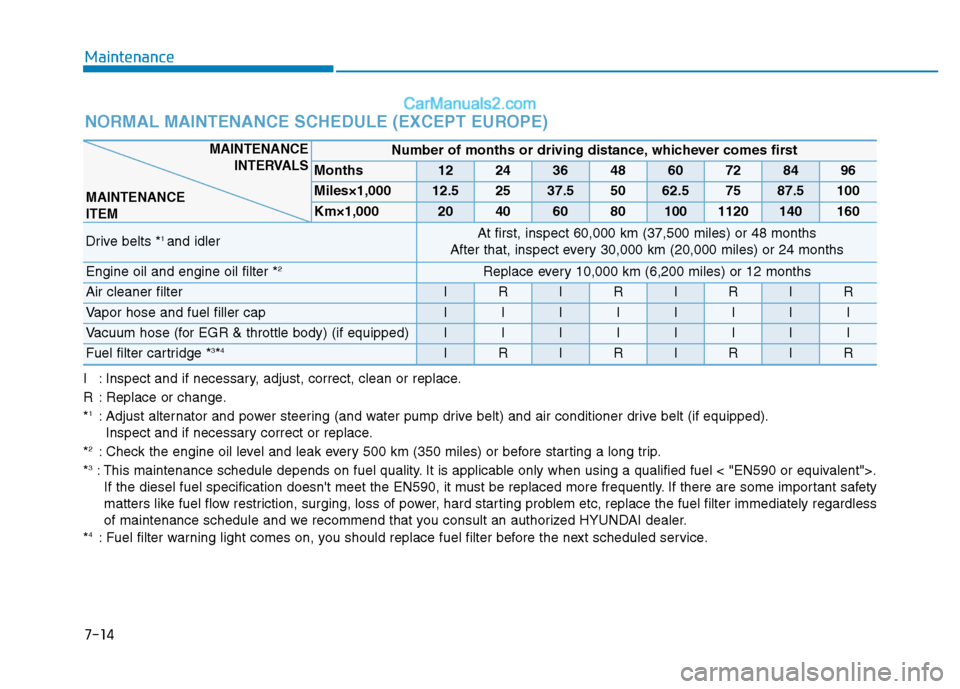
NORMAL MAINTENANCE SCHEDULE (EXCEPT EUROPE)
Number of months or driving distance, whichever comes first
Months1224364860728496
Miles×1,00012.52537.55062.57587.5100
Km×1,000204060801001120140160
Drive belts *1
and idlerAt first, inspect 60,000 km (37,500 miles) or 48 months
After that, inspect every 30,000 km (20,000 miles) or 24 months
Engine oil and engine oil filter * 2Replace every 10,000 km (6,200 miles) or 12 months
Air cleaner filterIRIRIRIR
Vapor hose and fuel filler capIIIIIIII
Vacuum hose (for EGR & throttle body) (if equipped)IIIIIIII
Fuel filter cartridge *3
* 4IRIRIRIR
MAINTENANCE
INTERVALS
MAINTENANCE ITEM
I : Inspect and if necessary, adjust, correct, clean or replace.
R : Replace or change.* 1
: Adjust alternator and power steering (and water pump drive belt) and air conditioner drive belt (if equipped).
Inspect and if necessary correct or replace.
* 2
: Check the engine oil level and leak every 500 km (350 miles) or before starting a long trip.
* 3
: This maintenance schedule depends on fuel quality. It is applicable only when using a qualified fuel < "EN590 or equivalent">.
If the diesel fuel specification doesn't meet the EN590, it must be replaced more frequently. If there are some important safety
matters like fuel flow restriction, surging, loss of power, hard starting problem etc, replace the fuel filter immediately rega rdless
of maintenance schedule and we recommend that you consult an authorized HYUNDAI dealer.
* 4
: Fuel filter warning light comes on, you should replace fuel filter before the next scheduled service.
Page 382 of 473
7-19
7
Maintenance
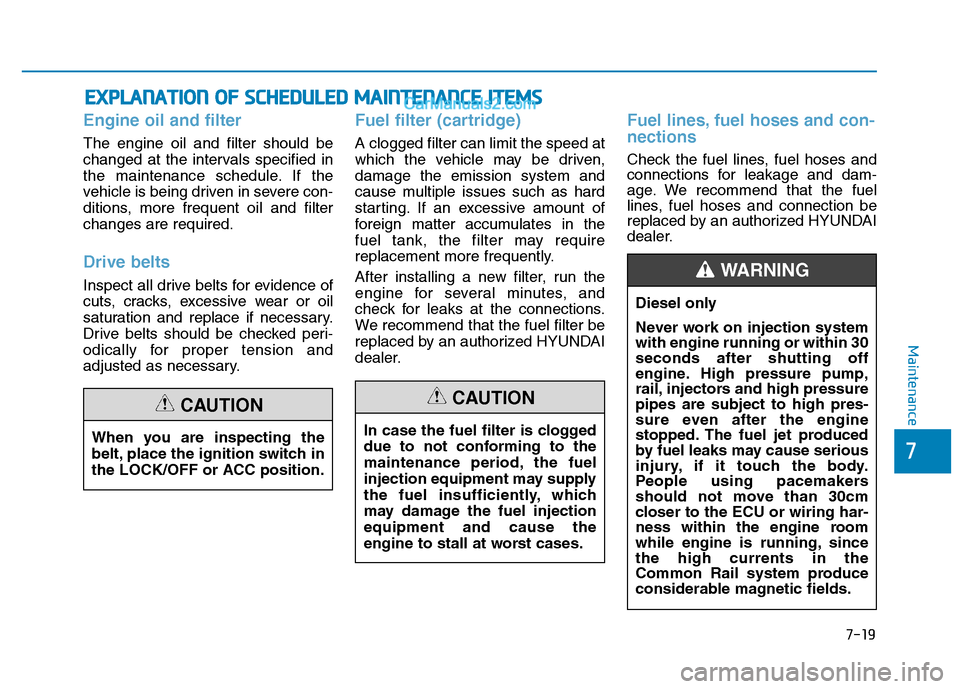
EEXX PPLLAA NN AATTIIOO NN OO FF SS CC HH EEDD UU LLEE DD MM AAIINN TTEENN AANN CCEE IITT EEMM SS
Engine oil and filter
The engine oil and filter should be
changed at the intervals specified in
the maintenance schedule. If the
vehicle is being driven in severe con-
ditions, more frequent oil and filterchanges are required.
Drive belts
Inspect all drive belts for evidence of
cuts, cracks, excessive wear or oil
saturation and replace if necessary.
Drive belts should be checked peri-
odically for proper tension and
adjusted as necessary.
Fuel filter (cartridge)
A clogged filter can limit the speed at
which the vehicle may be driven,damage the emission system and
cause multiple issues such as hard
starting. If an excessive amount of
foreign matter accumulates in the
fuel tank, the filter may require
replacement more frequently.
After installing a new filter, run the
engine for several minutes, and
check for leaks at the connections.
We recommend that the fuel filter be
replaced by an authorized HYUNDAI
dealer.
Fuel lines, fuel hoses and con- nections
Check the fuel lines, fuel hoses and
connections for leakage and dam-
age. We recommend that the fuel
lines, fuel hoses and connection be
replaced by an authorized HYUNDAI
dealer.
When you are inspecting the
belt, place the ignition switch in
the LOCK/OFF or ACC position.
CAUTION
In case the fuel filter is clogged
due to not conforming to the
maintenance period, the fuel
injection equipment may supply
the fuel insufficiently, which
may damage the fuel injectionequipment and cause the
engine to stall at worst cases.
CAUTION
Diesel only
Never work on injection system with engine running or within 30seconds after shutting off
engine. High pressure pump,
rail, injectors and high pressurepipes are subject to high pres-
sure even after the engine
stopped. The fuel jet produced
by fuel leaks may cause serious
injury, if it touch the body.
People using pacemakers
should not move than 30cm
closer to the ECU or wiring har-
ness within the engine room
while engine is running, sincethe high currents in the
Common Rail system produce
considerable magnetic fields.
WARNING
Page 385 of 473
7-22
Maintenance
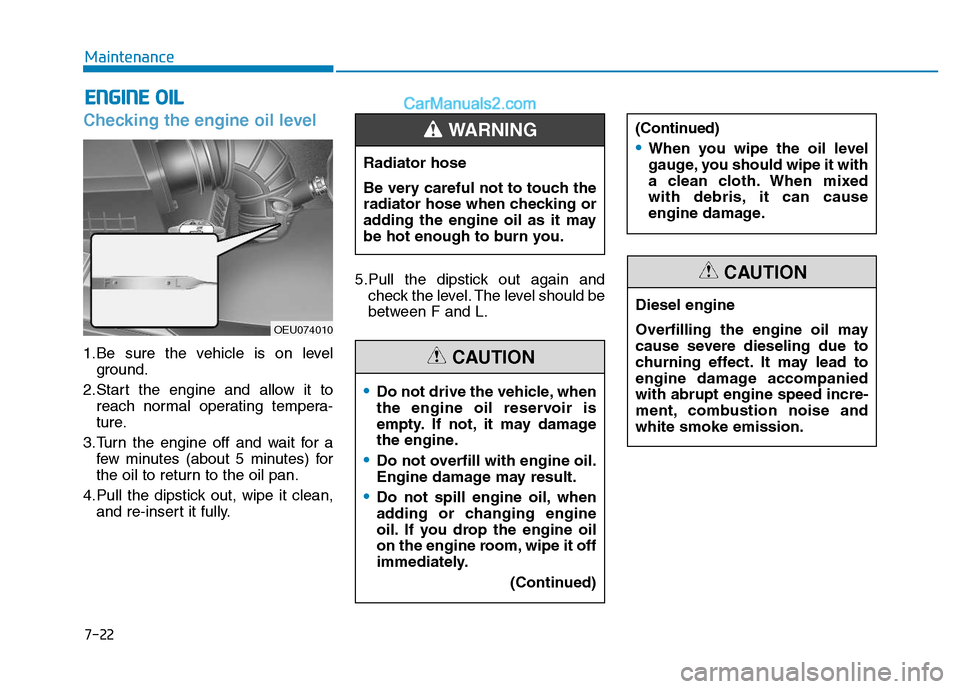
Checking the engine oil level
1.Be sure the vehicle is on levelground.
2.Start the engine and allow it to reach normal operating tempera-
ture.
3.Turn the engine off and wait for a few minutes (about 5 minutes) for
the oil to return to the oil pan.
4.Pull the dipstick out, wipe it clean, and re-insert it fully. 5.Pull the dipstick out again and
check the level. The level should be
between F and L.
EENN GGIINN EE OO IILL
OEU074010 Radiator hose
Be very careful not to touch the
radiator hose when checking or
adding the engine oil as it may
be hot enough to burn you.
WARNING
Do not drive the vehicle, when
the engine oil reservoir is
empty. If not, it may damage
the engine.
Do not overfill with engine oil.
Engine damage may result.
Do not spill engine oil, when
adding or changing engine
oil. If you drop the engine oil
on the engine room, wipe it off
immediately.
(Continued)
(Continued)
When you wipe the oil level
gauge, you should wipe it with
a clean cloth. When mixed
with debris, it can cause
engine damage.
CAUTION
Diesel engine
Overfilling the engine oil may
cause severe dieseling due to
churning effect. It may lead to
engine damage accompaniedwith abrupt engine speed incre-
ment, combustion noise andwhite smoke emission.
CAUTION
Page 386 of 473
7-23
7
Maintenance
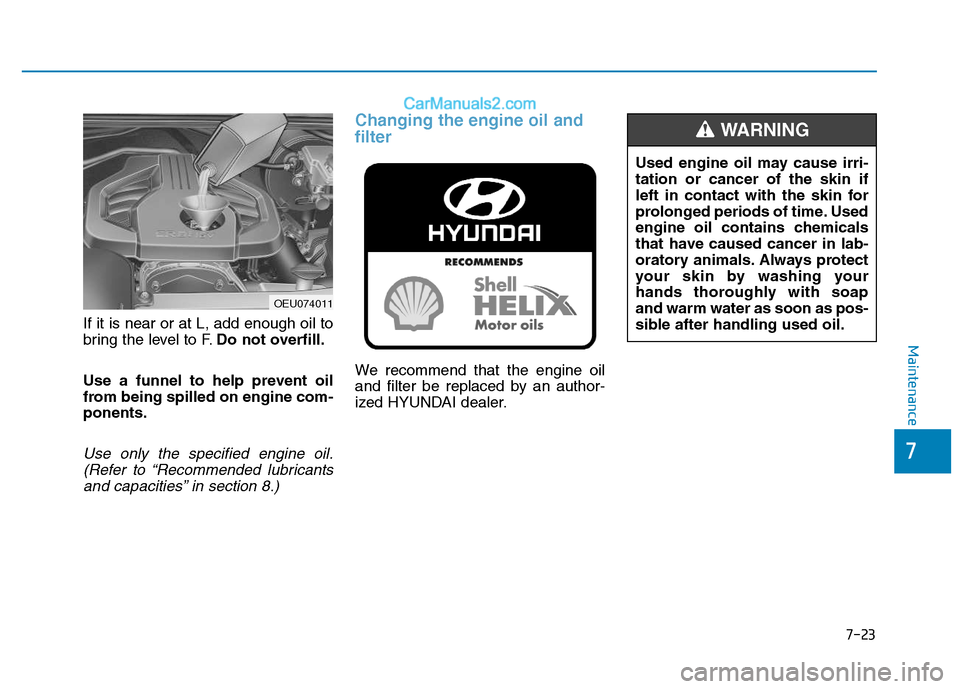
If it is near or at L, add enough oil to
bring the level to F.Do not overfill.
Use a funnel to help prevent oil
from being spilled on engine com-ponents.
Use only the specified engine oil. (Refer to “Recommended lubricantsand capacities” in section 8.)
Changing the engine oil and filter
We recommend that the engine oil
and filter be replaced by an author-
ized HYUNDAI dealer.
OEU074011
Used engine oil may cause irri- tation or cancer of the skin if
left in contact with the skin for
prolonged periods of time. Used
engine oil contains chemicals
that have caused cancer in lab-
oratory animals. Always protect
your skin by washing your
hands thoroughly with soapand warm water as soon as pos-
sible after handling used oil.
WARNING
Page 387 of 473
7-24
Maintenance
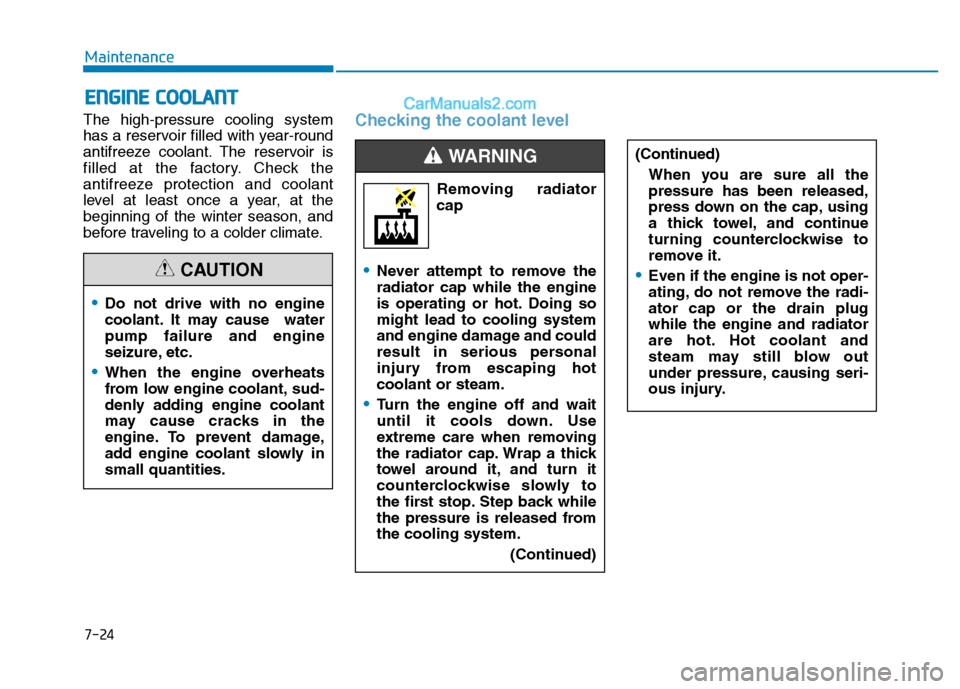
The high-pressure cooling system
has a reservoir filled with year-round
antifreeze coolant. The reservoir is
filled at the factory. Check the
antifreeze protection and coolant
level at least once a year, at thebeginning of the winter season, and
before traveling to a colder climate.Checking the coolant level
EENN GGIINN EE CC OO OOLLAA NN TT
Do not drive with no engine
coolant. It may cause waterpump failure and engine
seizure, etc.
When the engine overheats
from low engine coolant, sud-
denly adding engine coolant
may cause cracks in the
engine. To prevent damage,
add engine coolant slowly insmall quantities.
CAUTION
Removing radiator
cap
Never attempt to remove the radiator cap while the engine
is operating or hot. Doing somight lead to cooling system
and engine damage and could
result in serious personal
injury from escaping hotcoolant or steam.
Turn the engine off and wait
until it cools down. Use
extreme care when removing
the radiator cap. Wrap a thick
towel around it, and turn it
counterclockwise slowly to
the first stop. Step back while
the pressure is released fromthe cooling system.
(Continued)
WARNING (Continued)When you are sure all the pressure has been released,
press down on the cap, using
a thick towel, and continue
turning counterclockwise to
remove it.
Even if the engine is not oper-
ating, do not remove the radi-ator cap or the drain plugwhile the engine and radiator
are hot. Hot coolant and
steam may still blow out
under pressure, causing seri-
ous injury.
Page 388 of 473
7-25
7
Maintenance
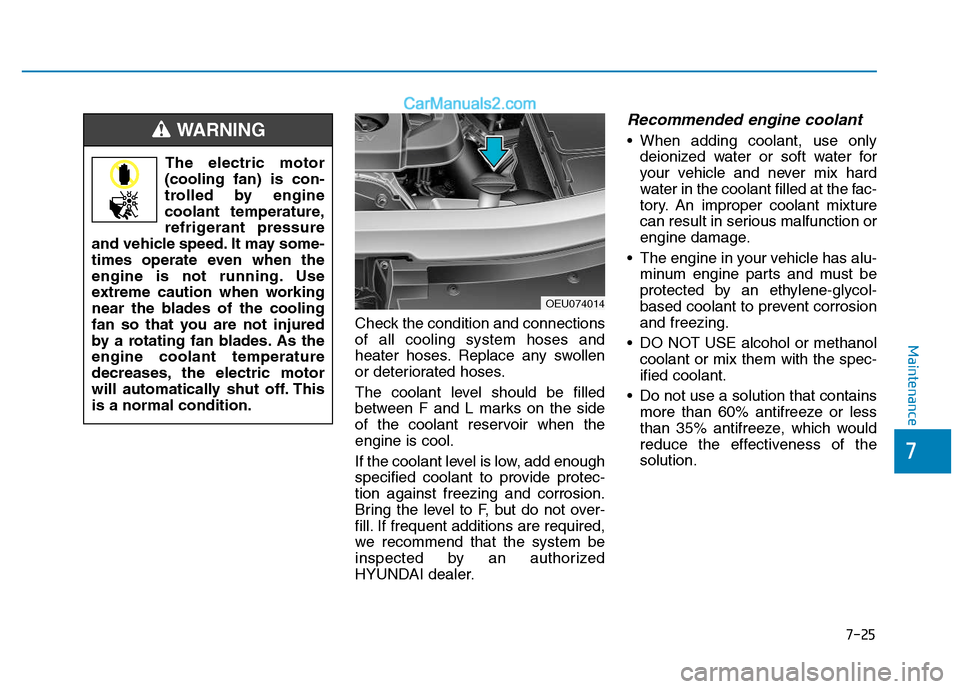
Check the condition and connections of all cooling system hoses and
heater hoses. Replace any swollen
or deteriorated hoses.
The coolant level should be filled
between F and L marks on the side
of the coolant reservoir when theengine is cool.
If the coolant level is low, add enough
specified coolant to provide protec-tion against freezing and corrosion.
Bring the level to F, but do not over-
fill. If frequent additions are required,
we recommend that the system be
inspected by an authorized
HYUNDAI dealer.
Recommended engine coolant
When adding coolant, use onlydeionized water or soft water for
your vehicle and never mix hard
water in the coolant filled at the fac-
tory. An improper coolant mixture
can result in serious malfunction or
engine damage.
The engine in your vehicle has alu- minum engine parts and must be
protected by an ethylene-glycol-
based coolant to prevent corrosionand freezing.
DO NOT USE alcohol or methanol coolant or mix them with the spec-ified coolant.
Do not use a solution that contains more than 60% antifreeze or less
than 35% antifreeze, which would
reduce the effectiveness of thesolution.
The electric motor
(cooling fan) is con-
trolled by engine
coolant temperature,
refrigerant pressure
and vehicle speed. It may some-
times operate even when the
engine is not running. Use
extreme caution when working
near the blades of the cooling
fan so that you are not injured
by a rotating fan blades. As theengine coolant temperature
decreases, the electric motor
will automatically shut off. Thisis a normal condition.WARNING
OEU074014