climate control Hyundai H350 2016 User Guide
[x] Cancel search | Manufacturer: HYUNDAI, Model Year: 2016, Model line: H350, Model: Hyundai H350 2016Pages: 473, PDF Size: 26.4 MB
Page 379 of 473
7-16
Maintenance
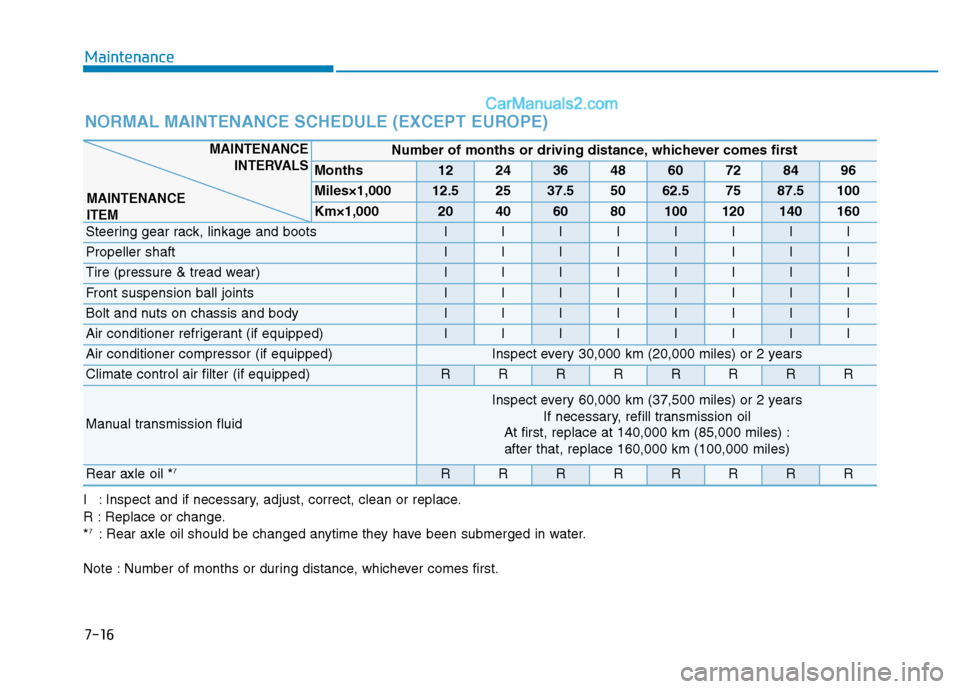
NORMAL MAINTENANCE SCHEDULE (EXCEPT EUROPE)
Number of months or driving distance, whichever comes first
Months1224364860728496
Miles×1,00012.52537.55062.57587.5100
Km×1,00020406080100120140160
Steering gear rack, linkage and bootsIIIIIIII
Propeller shaftIIIIIIII
Tire (pressure & tread wear)IIIIIIII
Front suspension ball jointsIIIIIIII
Bolt and nuts on chassis and bodyIIIIIIII
Air conditioner refrigerant (if equipped)IIIIIIII
Air conditioner compressor (if equipped)Inspect every 30,000 km (20,000 miles) or 2 years
Climate control air filter (if equipped)RRRRRRRR
Manual transmission fluid
Inspect every 60,000 km (37,500 miles) or 2 yearsIf necessary, refill transmission oil
At first, replace at 140,000 km (85,000 miles) :
after that, replace 160,000 km (100,000 miles)
Rear axle oil * 7RRRRRRRR
MAINTENANCE
INTERVALS
I : Inspect and if necessary, adjust, correct, clean or replace.
R : Replace or change.*7
: Rear axle oil should be changed anytime they have been submerged in water.
Note : Number of months or during distance, whichever comes first.
MAINTENANCE ITEM
Page 381 of 473
7-18
Maintenance
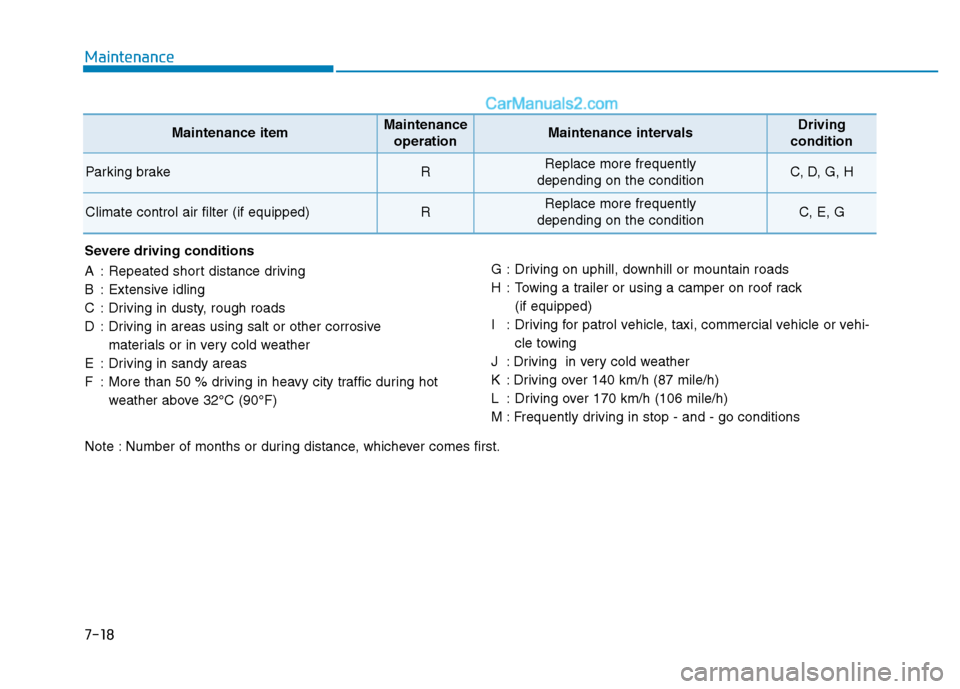
Severe driving conditions
A : Repeated short distance driving
B : Extensive idling
C : Driving in dusty, rough roads
D : Driving in areas using salt or other corrosive materials or in very cold weather
E : Driving in sandy areas
F : More than 50 % driving in heavy city traffic during hot weather above 32°C (90°F) G : Driving on uphill, downhill or mountain roads
H : Towing a trailer or using a camper on roof rack
(if equipped)
I : Driving for patrol vehicle, taxi, commercial vehicle or vehi- cle towing
J : Driving in very cold weather
K : Driving over 140 km/h (87 mile/h)
L : Driving over 170 km/h (106 mile/h)
M : Frequently driving in stop - and - go conditions
Maintenance itemMaintenance operationMaintenance intervalsDriving
condition
Parking brakeRReplace more frequently
depending on the conditionC, D, G, H
Climate control air filter (if equipped)RReplace more frequently
depending on the conditionC, E, G
Note : Number of months or during distance, whichever comes first.
Page 392 of 473
7-29
7
MaintenanceUse only the specified power steer-ing fluid. (Refer to "Recommendedlubricants or capacities" in section 9.)
Checking the power steering hose
Check the connections for oil leaks,
damage and twists in the power
steering hose before driving.
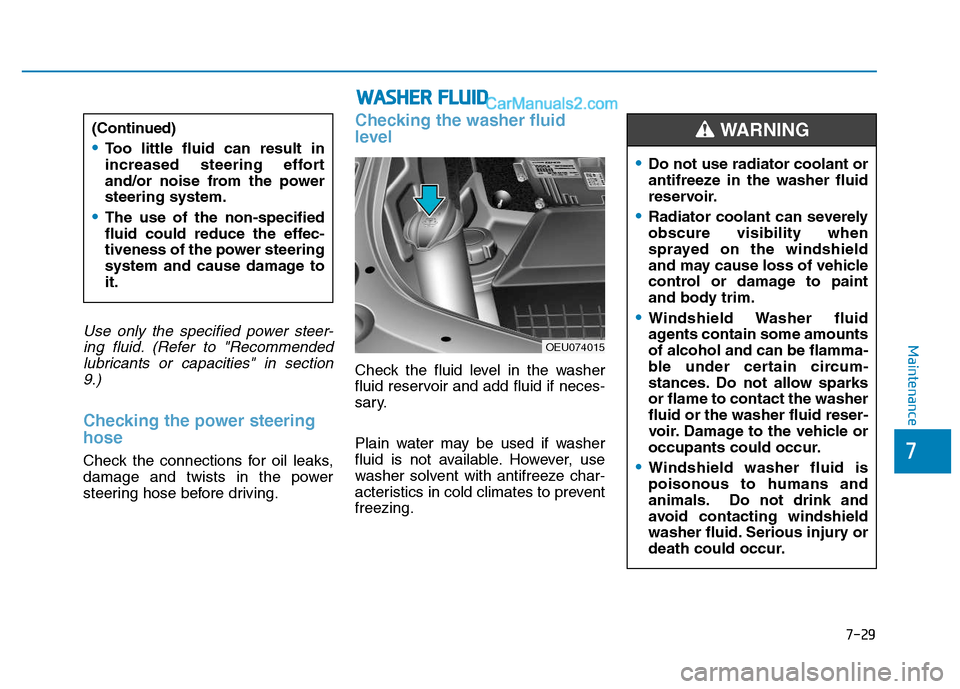
Checking the washer fluid
level
Check the fluid level in the washer
fluid reservoir and add fluid if neces-
sary.
Plain water may be used if washer
fluid is not available. However, use
washer solvent with antifreeze char-
acteristics in cold climates to preventfreezing.
(Continued)
Too little fluid can result in
increased steering effort
and/or noise from the powersteering system.
The use of the non-specified
fluid could reduce the effec-
tiveness of the power steering
system and cause damage toit.
WW
AASSHH EERR FF LLUU IIDD
OEU074015
Do not use radiator coolant or
antifreeze in the washer fluid
reservoir.
Radiator coolant can severely obscure visibility when
sprayed on the windshield
and may cause loss of vehicle
control or damage to paint
and body trim.
Windshield Washer fluid
agents contain some amountsof alcohol and can be flamma-
ble under certain circum-
stances. Do not allow sparksor flame to contact the washerfluid or the washer fluid reser-
voir. Damage to the vehicle or
occupants could occur.
Windshield washer fluid is poisonous to humans and
animals. Do not drink and
avoid contacting windshield
washer fluid. Serious injury or
death could occur.
WARNING
Page 396 of 473
7-33
7
Maintenance
Filter inspection
The climate control air filter should be replaced according to the mainte-
nance schedule. If the vehicle is
operated in severely air-polluted
cities or on dusty rough roads for a
long period, it should be inspected
more frequently and replaced earlier.
When you replace the climate control
air filter, replace it performing the fol-
lowing procedure, and be careful to
avoid damaging other components.
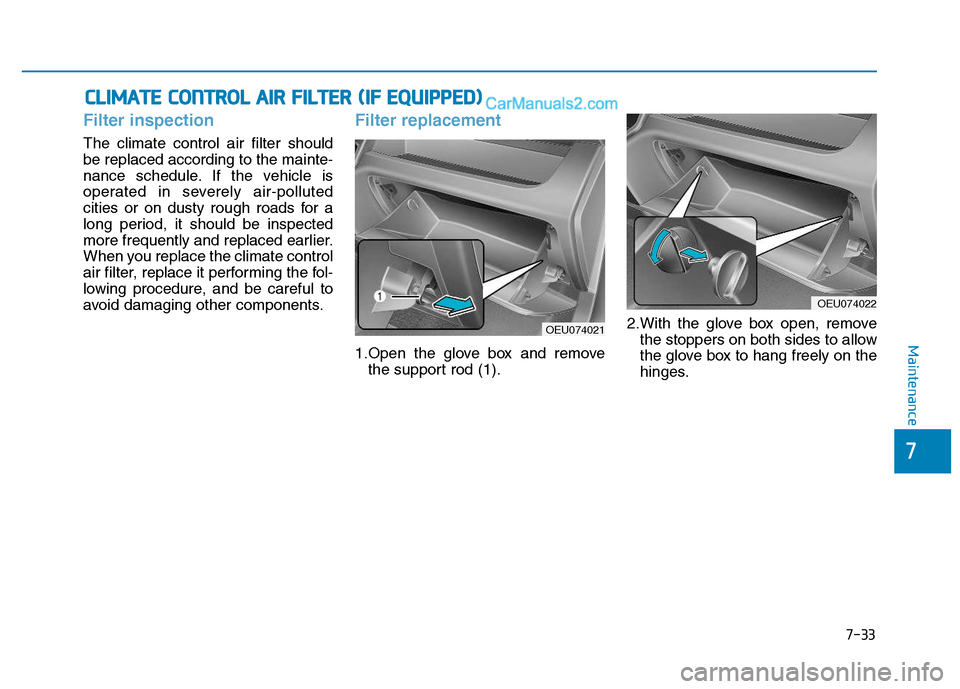
Filter replacement
1.Open the glove box and removethe support rod (1). 2.With the glove box open, remove
the stoppers on both sides to allow
the glove box to hang freely on the
hinges.
CCLLIIMM AATTEE CC OO NNTTRR OO LL AA IIRR FF IILL TT EERR (( IIFF EE QQ UUIIPP PP EEDD ))
OEU074021
OEU074022
Page 397 of 473
7-34
Maintenance
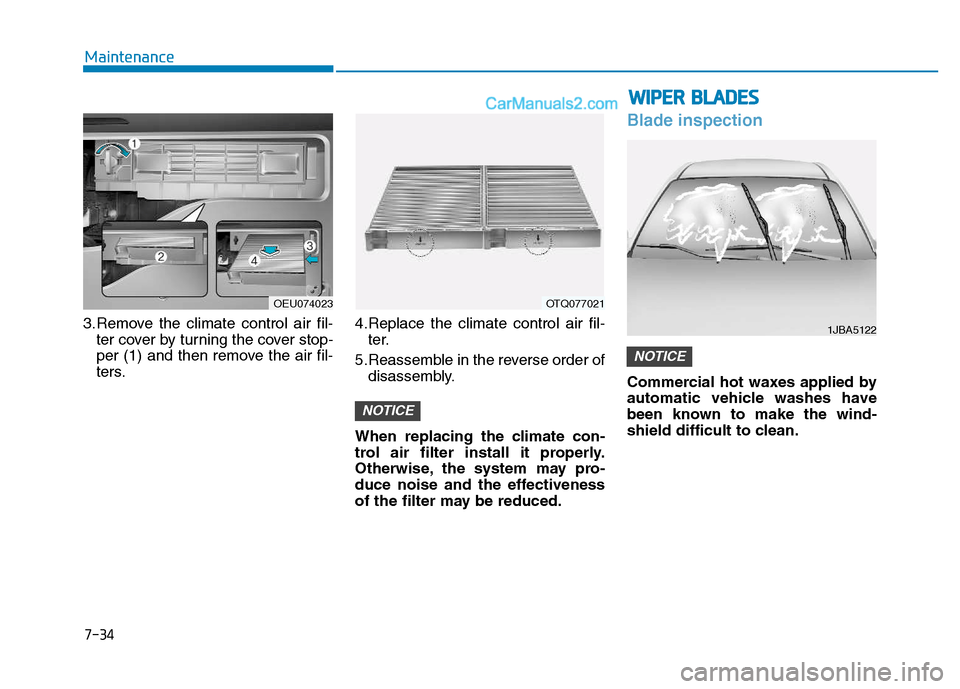
3.Remove the climate control air fil-ter cover by turning the cover stop-
per (1) and then remove the air fil-
ters. 4.Replace the climate control air fil-
ter.
5.Reassemble in the reverse order of disassembly.
When replacing the climate con-
trol air filter install it properly.
Otherwise, the system may pro-
duce noise and the effectiveness
of the filter may be reduced.
Blade inspection
Commercial hot waxes applied by
automatic vehicle washes have
been known to make the wind-
shield difficult to clean.
NOTICE
NOTICE
OEU074023OTQ077021
WW IIPP EERR BB LLAA DDEESS
1JBA5122
Page 404 of 473
7-41
7
MaintenanceReset items
Items should be reset after the bat-
tery has been discharged or the bat-
tery has been disconnected.
Auto up/down window(See section 3)
Trip computer (See section 3)
Climate control system (See section 3)
Clock (See section 3)
Audio (See section 4)
(Continued)
Disconnect the battery charg-
er in the following order.
1. Turn off the battery charger main switch.
2. Unhook the negative clamp from the negative battery ter-minal.
3. Unhook the positive clamp from the positive battery ter-minal.
4. After recharging, park the vehicle for about 5 hours with
the hood and all doors
closed. During this period,
the dark current must be
under 100mA.(AGM battery
only)
Before performing mainte-
nance or recharging the bat-
tery, turn off all accessories
and stop the engine.
The negative battery cable
must be removed first and
installed last when the batteryis disconnected.
Do not open the AGM battery.
WARNING
Recharging battery
When recharging the battery,
observe the following precau-tions:
The battery must be removed
from the vehicle and placed inan area with good ventilation.
Do not allow cigarettes,
sparks, or flame near the bat-
tery.
Watch the battery during
charging, and stop or reduce
the charging rate if the batterycells begin gassing (boiling)
violently or if the temperature
of the electrolyte of any cell
exceeds 49°C (120°F).
Do not charge the AGM bat-
tery with over 14.5V. No quick-
charging routines
Wear eye protection when
checking the battery during
charging.
(Continued)
WARNING
Page 412 of 473
7-49
7
Maintenance
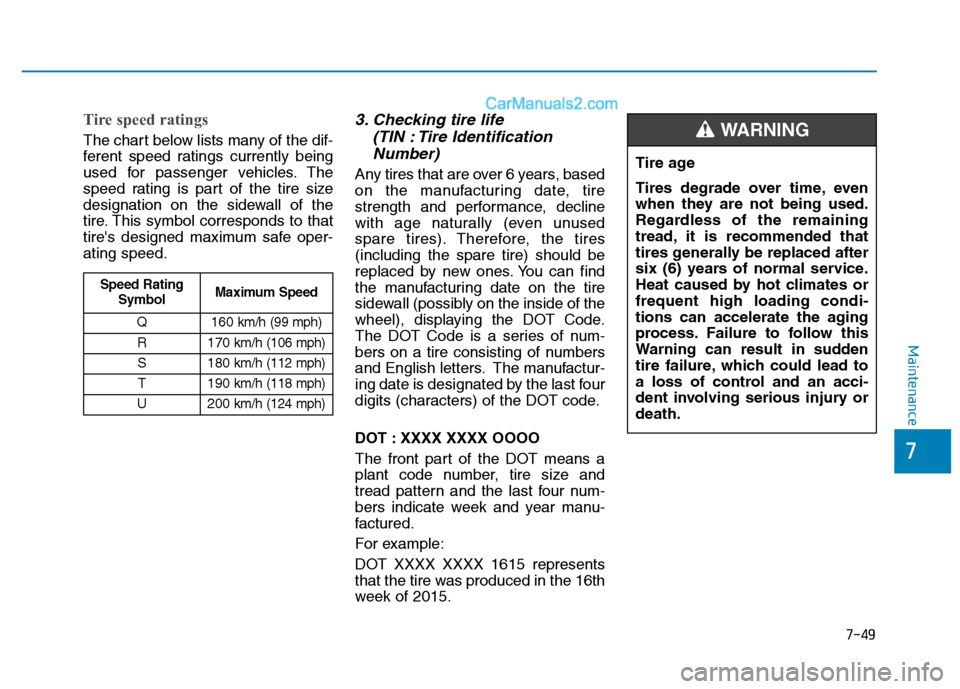
Tire speed ratings
The chart below lists many of the dif-
ferent speed ratings currently being
used for passenger vehicles. The
speed rating is part of the tire size
designation on the sidewall of the
tire. This symbol corresponds to that
tire's designed maximum safe oper-ating speed.
3. Checking tire life (TIN : Tire Identification
Number)
Any tires that are over 6 years, based
on the manufacturing date, tire
strength and performance, decline
with age naturally (even unused
spare tires). Therefore, the tires(including the spare tire) should be
replaced by new ones. You can find
the manufacturing date on the tire
sidewall (possibly on the inside of the
wheel), displaying the DOT Code.
The DOT Code is a series of num-
bers on a tire consisting of numbers
and English letters. The manufactur-
ing date is designated by the last four
digits (characters) of the DOT code.
DOT : XXXX XXXX OOOO
The front part of the DOT means a
plant code number, tire size and
tread pattern and the last four num-
bers indicate week and year manu-
factured.
For example:
DOT XXXX XXXX 1615 represents
that the tire was produced in the 16th
week of 2015. Tire age
Tires degrade over time, even
when they are not being used.
Regardless of the remaining
tread, it is recommended that
tires generally be replaced after
six (6) years of normal service.
Heat caused by hot climates orfrequent high loading condi-
tions can accelerate the aging
process. Failure to follow this
Warning can result in sudden
tire failure, which could lead to
a loss of control and an acci-
dent involving serious injury ordeath.
WARNING
Speed Rating
SymbolMaximum Speed
Q160km/h (99 mph)
R170km/h (106 mph)
S180km/h (112 mph)
T190km/h (118 mph)
U200km/h (124 mph)
Page 467 of 473
I-2Active eco system .........................................................5-40
Active eco operation ..................................................5-40
Limitation of active eco operation:............................5-41
When active eco is activated: ....................................5-41
Adjustable speed limit device (ASLD) ........................3-34
Air bag - supplemental restraint system .......................2-25 Air bag warning light.................................................2-28
Do not install a child restraint on the front passenger seat ..........................................................2-27
Driver's and front passenger's air bag........................2-31
How does the air bag operate? ..................................2-26
SRS care.....................................................................2-39
SRS components and functions .................................2-29
Additional safety precautions .......................................2-40
Air bag warning labels .................................................2-42
Air cleaner ....................................................................7-31
Air conditioner compressor label .................................8-11
Air conditioning system .................................................8-3
Appearance care ...........................................................7-79
Battery...........................................................................7-37 Battery capacity label ................................................7-40
Battery recharging......................................................7-40
For best battery service ..............................................7-37
Reset items .................................................................7-41 Before driving .................................................................5-3
Before entering the vehicle ..........................................5-3
Before starting .............................................................5-3
Necessary inspections ..................................................5-3
Brake system.................................................................5-18
Anti-lock brake system (ABS) ..................................5-21
Emergency stop signal (ESS) ....................................5-28
Good braking practices ..............................................5-29
Hill-start assist control (HAC)...................................5-27
Parking brake .............................................................5-19
Power brakes..............................................................5-18
Vehicle dynamic control (VDC) ................................5-24
Brake/Clutch fluid ........................................................7-27
Bulb wattage ...................................................................8-4
Cargo bed (for van) ....................................................3-129
Caring for disc ................................................................4-5
CD Player (For RDS Model)........................................4-13
CD Player .....................................................................4-16
Ceiling ventilator ........................................................3-122
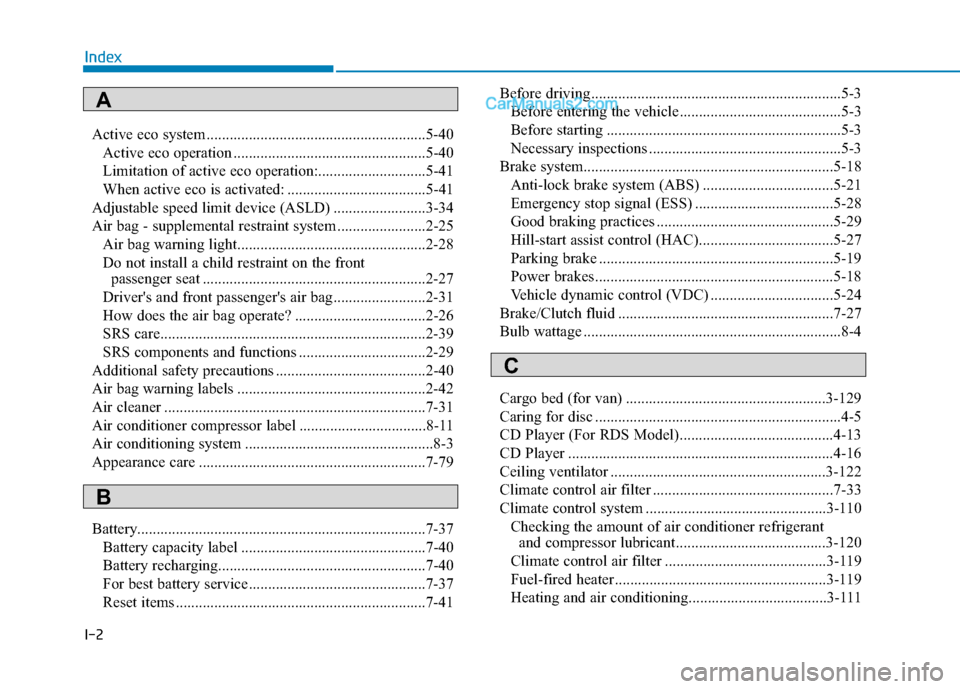
Climate control air filter ...............................................7-33
Climate control system ...............................................3-110
Checking the amount of air conditioner refrigerant and compressor lubricant.......................................3-120
Climate control air filter ..........................................3-119
Fuel-fired heater .......................................................3-119
Heating and air conditioning....................................3-111
Index
A
C
B